Urine casts: what hyaline, granular and red cell casts mean
Urine casts are protein plugs molded in the kidney's tubules. A few hyaline casts are usually harmless. Here's what the other types point to.
Urine casts are tiny tube-shaped plugs that form inside your kidney's tubules and wash out into your urine. They're made of uromodulin (also called Tamm-Horsfall protein), which comes almost only from the kidney. A few clear hyaline casts are normal, especially after a hard workout or when you're low on fluids. Casts packed with red cells, white cells, kidney cells, fat or debris point to different kidney problems, and what's trapped inside tells you where to look.123
The short version
- Normal: no casts, or a few hyaline casts. Labcorp's report prints "none seen" as its reference for casts. The Libby app's lab range for hyaline casts is 0–2 per low-power field (lpf).41
- A few hyaline casts usually mean concentrated urine: low fluids, hard exercise, fever or a "water pill" (diuretic). In healthy volunteers, the diuretics furosemide and ethacrynic acid regularly produced hyaline casts with no protein in the urine.561
- Every other type points inside the kidney: red cell casts to bleeding from the kidney's filters (glomerulonephritis), white cell casts to kidney infection or interstitial nephritis, "muddy brown" granular casts to acute tubular injury, fatty casts to a heavy protein leak, and waxy or broad casts to advanced kidney disease.421
- Get prompt care if you're making little or no urine, or if casts come with brown or rust-colored urine, new swelling, fever with back or side pain, or confusion.789
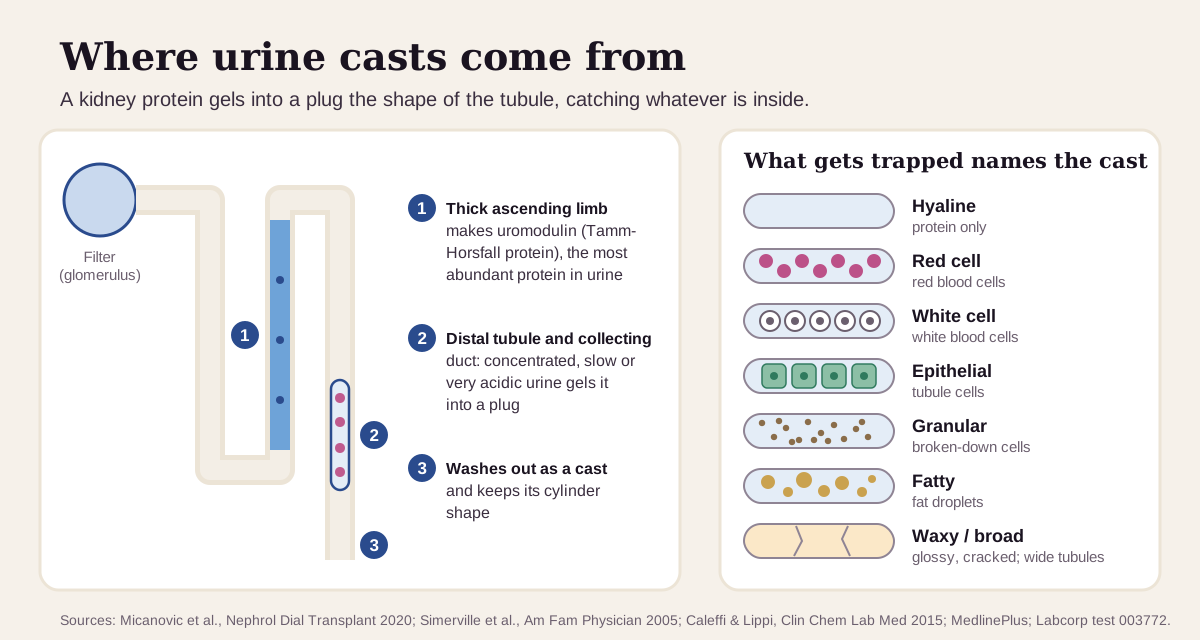
What urine casts are
Casts start with uromodulin, a protein made almost only in the kidney, by the cells lining one stretch of the tubule (the thick ascending limb of the loop of Henle). It's the most abundant protein in healthy urine, and it links up into long strands.3
When urine in the tubule gets concentrated, slows down or turns very acidic, those strands gel into a plug the shape of the tube and catch whatever is floating by. Casts form in the last stretches of the tubule (the distal tubule and collecting duct) and keep their cylinder shape when they wash out.26
What's trapped names the cast. Protein alone makes a hyaline cast. Red cells make a red cell cast, white cells a white cell cast, and kidney tubule cells an epithelial cast. Broken-down cells look granular, and fat droplets make a fatty cast. Waxy casts look glossy and brittle, and broad casts come from widened, damaged tubules.24
Casts turn up in the microscopic part of a urinalysis: the lab spins the urine down and looks at the sediment.21 Labcorp's report has a "Casts" line counted per lpf and a "Cast Type" line that names them, for example "Granular casts".4
What's a normal cast result?
No casts, or a few hyaline casts, is normal. MedlinePlus puts it simply: urine normally has no cellular casts, and a few hyaline casts are normal.1
- Labcorp prints "none seen" per lpf as the reference interval for casts.4
- The Libby app uses a lab range of 0–2 per lpf for hyaline casts and 0 for each of the other named types.
- Researchers in a 2025 study of 503 urine samples counted 4 or more hyaline casts per lpf as "multiple", part of a kidney-disease pattern. Fewer than 4 was "occasional".10
Healthy people shed casts. In 1926, Thomas Addis counted casts in overnight urine from 74 healthy medical students. He found them in 45, an average of 1,040 casts per 12 hours and as many as 4,270. Nearly all were hyaline: only three samples held a single granular or epithelial cast.11
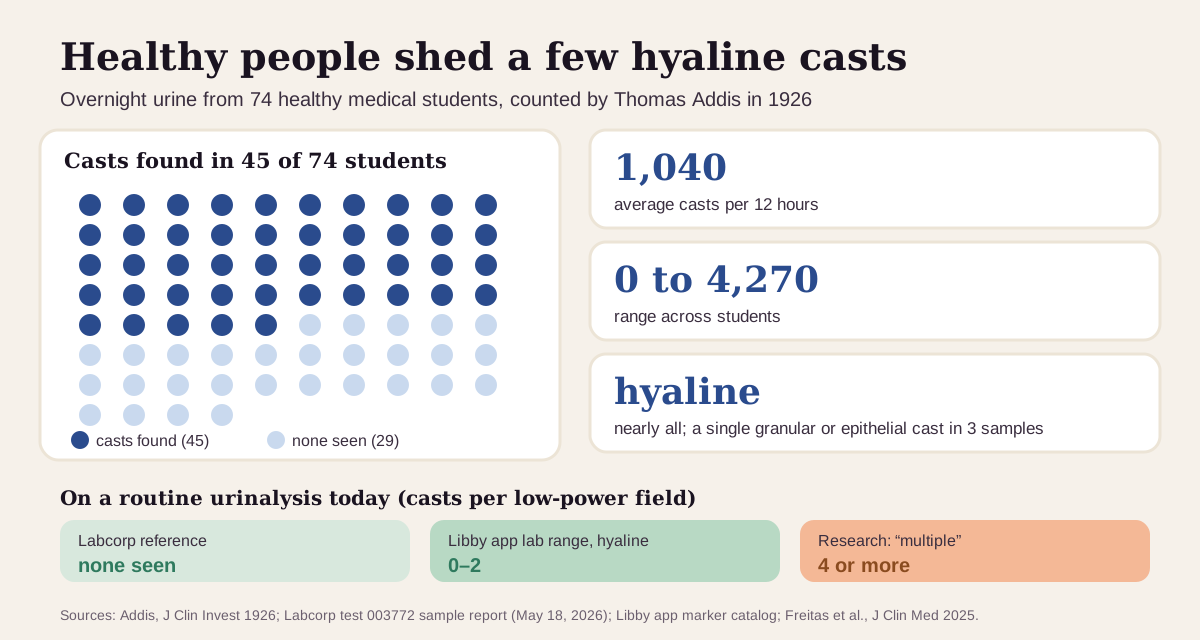
"Optimal" hyaline casts: fewer is the target
For hyaline casts, the Libby app shows 1 or fewer per lpf as optimal. Here's the full ladder, from strictest to loosest:
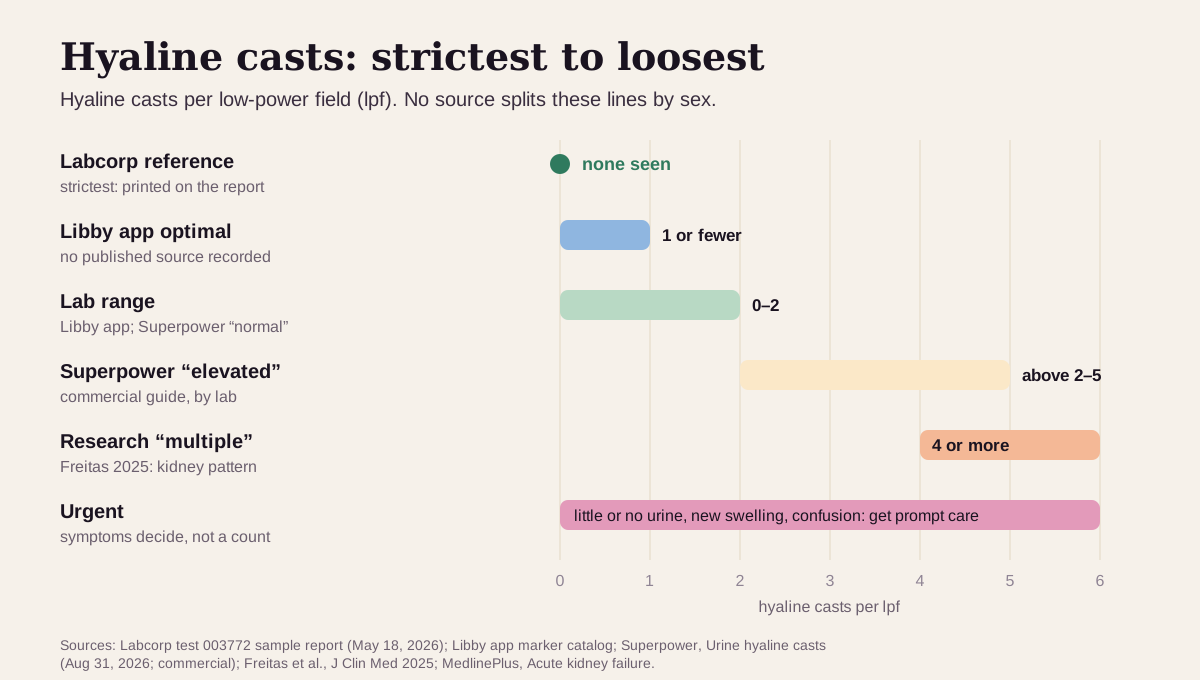
| Line | Hyaline casts per lpf | Who uses it |
|---|---|---|
| Strictest (lab report) | none seen | Labcorp's printed reference interval for casts4 |
| Libby app optimal | 1 or fewer | The optimal range shown in the Libby app. The app's catalog records no published source for this band |
| Lab range | 0–2 | The Libby app's lab range, and what Superpower calls normal12 |
| Commercial "elevated" line | more than 2–5, depending on the lab | Superpower's guide to hyaline casts12 |
| Research "multiple" line | 4 or more | Part of the kidney-disease pattern in a 2025 study10 |
| Urgent | no count | Symptoms decide: little or no urine, new swelling, confusion7 |
The same lines apply to men and women: none of these sources splits them by sex.
Why fewer matters:
- A count above a few is where the kidney question starts. In the 2025 study, 4 or more hyaline casts per lpf counted toward the kidney-disease pattern, alongside odd-shaped red cells and other cast types.10
- Hyaline casts mostly measure the sample. Addis saw casts fall sharply just from giving patients water, because hyaline casts dissolve when urine becomes dilute.11
Keep "optimal" in perspective: a hyaline count is a snapshot of how concentrated your urine was. The diuretic study's authors called casts from diuretics and hard exercise "of no pathological significance", and said a hyaline cast's diagnostic value is very limited on its own.5 The type of cast tells you far more than the number of hyaline ones.2
What each type of cast usually means
Start with the type. Hyaline casts are usually about the sample. Every other type points to a specific part of the kidney.24
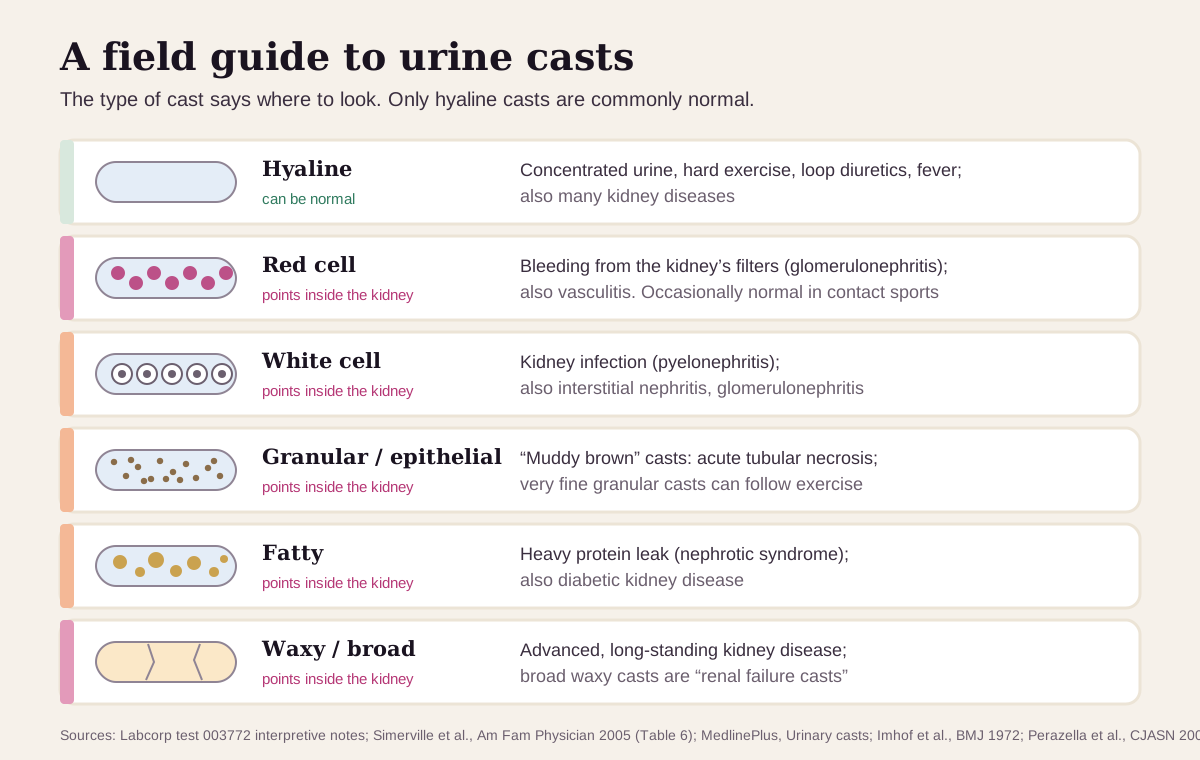
Hyaline casts: usually concentrated urine
The usual suspects:
- Low fluids and concentrated urine. Highly concentrated, acidic urine is what makes uromodulin gel, so dehydration is the classic setting.651
- Hard exercise. Labcorp and MedlinePlus both list strenuous exercise, and the casts after exertion are made of the same protein as diuretic casts.415
- Loop diuretics. Furosemide and ethacrynic acid regularly produced hyaline casts in healthy volunteers, with no protein in the urine.5 Don't stop a prescribed medicine on your own; bring your list to your clinician.
- Fever and acute heart failure can raise the count too, from outside the kidney.6
- Kidney disease. Hyaline casts also appear in many kidney diseases, including chronic kidney failure, which is why the rest of the urinalysis matters.41
Red cell casts: bleeding from the kidney's filters
Red cell casts show that red cells in the urine came from inside the kidney. They suggest glomerulonephritis, inflammation of the kidney's filters, lupus nephritis included. They can also come with vasculitis, a kidney infarct, heart-valve infection (endocarditis), sickle cell disease or malignant hypertension.41 Bleeding from the filters usually travels with a significant protein leak and odd-shaped (dysmorphic) red cells.2 Red cell casts can occasionally be a normal finding in people who play contact sports.2
White cell casts: infection or inflammation in the kidney
White cell casts show the white cells come from the kidney. They're most often found in acute pyelonephritis, a kidney infection, and also in glomerulonephritis and interstitial nephritis, inflammation of the tissue around the tubules.41
Granular and epithelial casts: tubule injury
Coarse granular casts are abnormal. "Dirty brown" or "muddy brown" granular casts are typical of acute tubular necrosis (ATN), injury to the kidney's tubule cells.413 Very finely granular casts can appear after exercise.4 Epithelial casts, built from tubule cells, point the same way.41
ATN and a milder, fluid-related dip are the most common causes of kidney injury in the hospital. In 267 hospital patients with kidney injury, when doctors already suspected ATN, finding any granular casts or tubule cells confirmed it every time (positive predictive value 100%). When they suspected the milder dip, finding none made ATN unlikely (negative predictive value 91%).13
Fatty casts: a heavy protein leak
Fatty casts form when tubule cells take up more filtered protein than they can handle and fill with fat. They're a hallmark of nephrotic syndrome, a heavy protein leak through the kidney's filters, and also show up in diabetic kidney disease.41
Waxy and broad casts: advanced kidney disease
Waxy casts look glossy, brittle and often cracked. They're found mostly in chronic kidney disease and long-standing kidney failure. Broad casts form in widened, damaged tubules, and broad waxy casts are called "renal failure casts".41
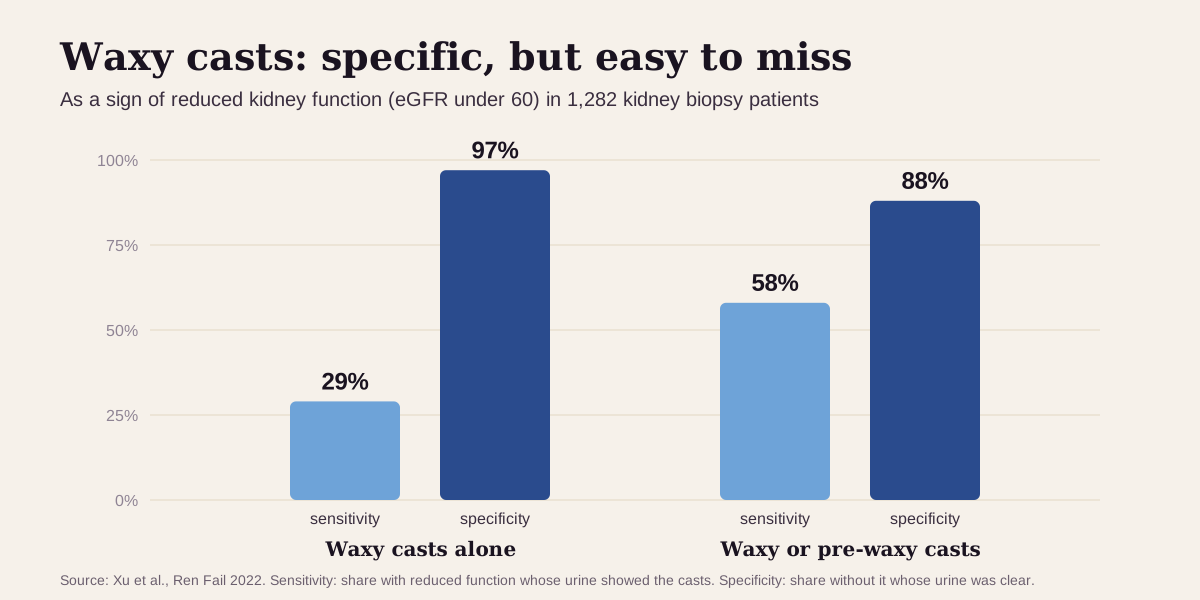
Waxy casts are specific but easy to miss. In 1,282 people who had a kidney biopsy, waxy casts alone flagged reduced kidney function (eGFR under 60) with 97% specificity but only 29% sensitivity. Counting "pre-waxy" casts too raised sensitivity to 58% and lowered specificity to 88%.14
Get prompt care if you're making little or no urine, or if a cast finding comes with new swelling in your face, legs, ankles or feet, dark, rust-colored or brown urine, foamy urine, fever with pain in your back, side or groin, confusion, nausea and vomiting, or shortness of breath.789
Casts read best next to their neighbors
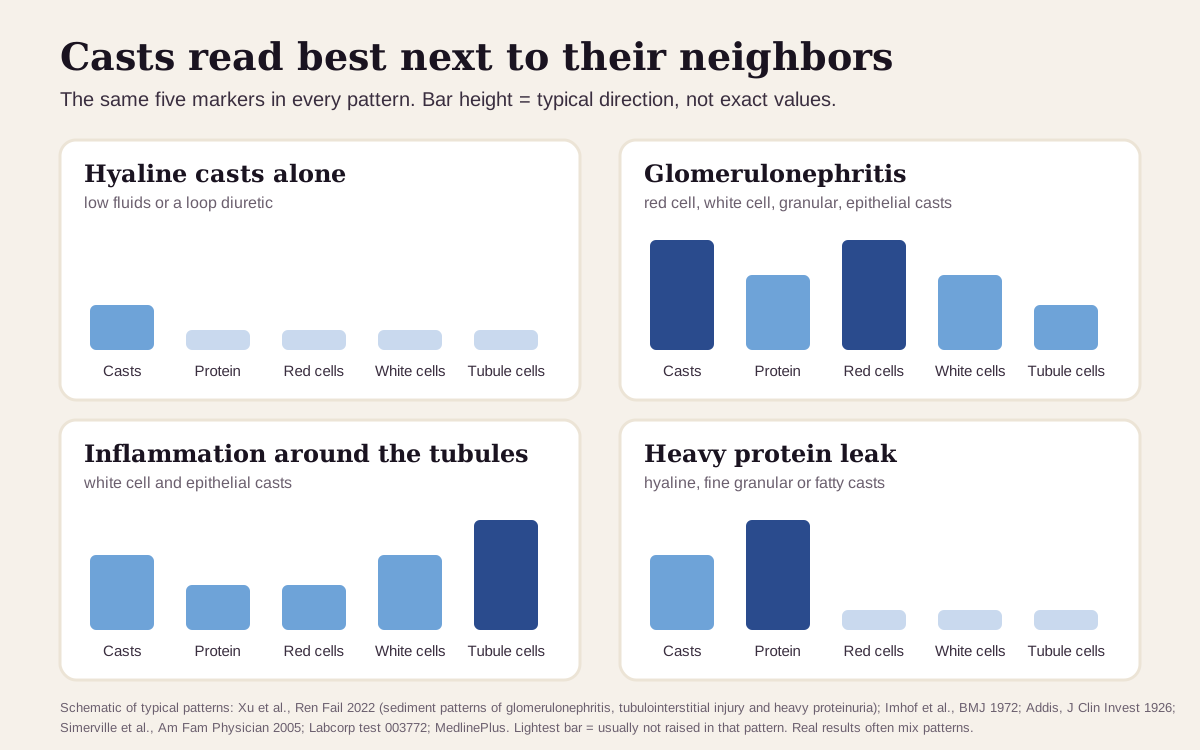
The cast type says where to look. The markers around it say what's going on:
| If you see… | It often points to… |
|---|---|
| A few hyaline casts, the rest of the urinalysis normal | a harmless, temporary cause: low fluids, a hard workout or a diuretic51 |
| Red cell casts with odd-shaped red cells and protein | bleeding from the kidney's filters (glomerulonephritis)24 |
| White cell casts with white cells, plus fever and back or side pain | a kidney infection (pyelonephritis)49 |
| White cell or epithelial casts with tubule cells and little protein | inflammation around the tubules (interstitial injury)144 |
| Muddy brown granular casts with tubule cells, often in the hospital | acute tubular necrosis413 |
| Fatty casts with heavy protein | nephrotic syndrome4114 |
| Waxy or broad casts | advanced, long-standing kidney disease414 |
When casts come with blood in the urine, the usual next steps are a kidney-function test and a measure of the protein leak.2 Our guides to eGFR and creatinine and the urine albumin-creatinine ratio cover those two.
How fast casts change
Casts come and go with your urine. Hyaline casts dissolve in dilute or alkaline urine and need some acidity to survive. Addis saw casts fall sharply in people with kidney disease (then called Bright's disease) just from drinking more water.11 So a count from a concentrated sample says less than the same count on a well-hydrated repeat.
Casts also fade in the cup:
- MedlinePlus asks for the sample to reach the lab within 1 hour.1
- European urinalysis guidelines call for looking at the particles within 1 hour at room temperature, or 4 hours refrigerated.15
- Delays of more than 2 hours often give unreliable results, so a sample that can't be examined promptly goes in the fridge.2 Labcorp accepts an unrefrigerated urine cup for up to 2 hours, or 48 hours refrigerated.4
- Even the tube matters: vacuum transfer tubes cut hyaline cast counts by at least 58% and cellular cast counts by at least 51%, compared with ordinary tubes.15
Trends beat snapshots. A single hyaline count swings with hydration, so a cast type that keeps turning up on repeat samples says more than any one count.11
Going deeper: how reliably labs identify each cast
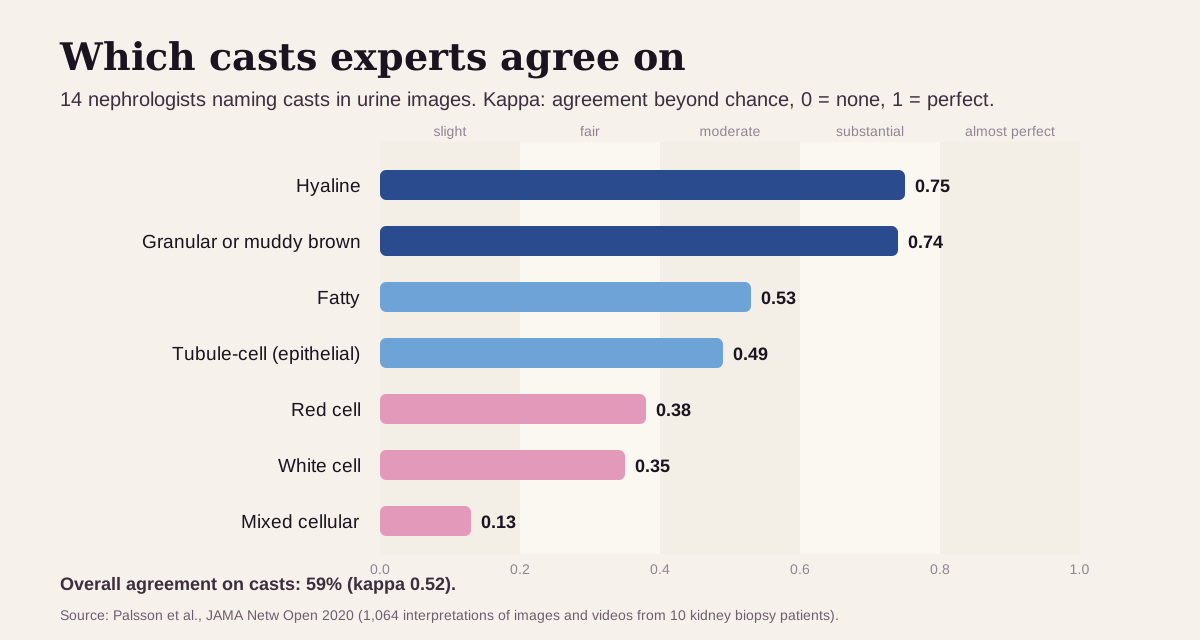
Some casts are easy to name; others are hard. When 14 nephrologists named casts in urine images, they agreed on only 59% of casts overall (kappa 0.52). Agreement was highest for hyaline casts (0.75) and granular or muddy brown casts (0.74), and lowest for red cell (0.38), white cell (0.35) and mixed cellular casts (0.13).16
Machines count cells better than casts. Most urine samples now go through analyzers in central labs.16 These machines count red and white cells accurately but are less useful for casts, which are best judged by a person at the microscope.17 In the Palsson study, the automated urinalysis named no cast other than hyaline casts for any of the 9 patients with a lab report, while the nephrologists named granular, fatty, red cell and white cell casts in images from the same group of patients.16 In one reported case, the automated report showed white cells and two hyaline casts per lpf, and a manual look found white cell casts.17
In a 2025 study from a hospital lab in Brazil, only about 10% of each day's urine samples got a manual microscope review.10 So a named cast type on your report is worth taking seriously, and a report that lists only hyaline casts can still have missed others.
Questions worth asking
- What type of casts were seen, and how many per lpf?
- Was my sample concentrated, and should we repeat it when I'm well hydrated?
- Could a diuretic, a hard workout or a fever explain hyaline casts?
- What do my urine protein and red cells, and my creatinine or eGFR, show next to it?
- Did a person look at the sediment, or only an automated analyzer?
- If red cell, white cell, granular, fatty or waxy casts were seen, what's the next step?
FAQ
Are hyaline casts in urine normal? A few are. MedlinePlus says a few hyaline casts are normal and lists dehydration and strenuous exercise among the causes. The Libby app's lab range is 0–2 per lpf.1
What causes casts in urine? Casts form when uromodulin, a protein the kidney makes, gels inside the tubules in concentrated, slow-moving or acidic urine. Whatever gets trapped inside names the type.23
What do granular casts in urine mean? Coarse granular casts point to kidney disease, and muddy brown ones are typical of acute tubular necrosis. Very finely granular casts can follow exercise.4
Can drinking water get rid of casts? It can lower the count: hyaline casts dissolve in dilute urine, even in people with kidney disease.11 That's why the type of cast matters more than the number.
This guide is for education. It can't diagnose you or replace care from a clinician who knows your history.
Footnotes
-
National Library of Medicine. Urinary casts. MedlinePlus Medical Encyclopedia. Review date July 13, 2025. Normal results (no cellular casts, a few hyaline casts), hyaline casts made of uromodulin after dehydration or strenuous exercise, what each abnormal type means, and the 1-hour delivery rule. MedlinePlus ↩ ↩2 ↩3 ↩4 ↩5 ↩6 ↩7 ↩8 ↩9 ↩10 ↩11 ↩12 ↩13 ↩14 ↩15 ↩16 ↩17 ↩18 ↩19 ↩20 ↩21
-
Simerville JA, Maxted WC, Pahira JJ. Urinalysis: a comprehensive review. Am Fam Physician. 2005;71(6):1153–1162. How casts form from Tamm-Horsfall mucoprotein, the table of cast types and associated conditions, glomerular hematuria, and the two-hour rule. AAFP ↩ ↩2 ↩3 ↩4 ↩5 ↩6 ↩7 ↩8 ↩9 ↩10 ↩11 ↩12 ↩13 ↩14 ↩15 ↩16
-
Micanovic R, LaFavers K, Garimella PS, Wu XR, El-Achkar TM. Uromodulin (Tamm-Horsfall protein): guardian of urinary and systemic homeostasis. Nephrol Dial Transplant. 2020;35(1):33–43. Made almost exclusively by the thick ascending limb; the most abundant protein in healthy urine; forms polymer filaments. PMC ↩ ↩2 ↩3 ↩4
-
Labcorp. Urinalysis, Complete With Microscopic Examination (test 003772), test page and sample report (date reported May 18, 2026). Reference interval for Casts: "None seen" per lpf; interpretive notes on each cast type; specimen storage limits. A national commercial lab's published range. Labcorp ↩ ↩2 ↩3 ↩4 ↩5 ↩6 ↩7 ↩8 ↩9 ↩10 ↩11 ↩12 ↩13 ↩14 ↩15 ↩16 ↩17 ↩18 ↩19 ↩20 ↩21 ↩22 ↩23 ↩24 ↩25 ↩26 ↩27 ↩28 ↩29
-
Imhof PR, Hushak J, Schumann G, Dukor P, Wagner J, Keller HM. Excretion of urinary casts after the administration of diuretics. Br Med J. 1972;2(5807):199–202. Furosemide and ethacrynic acid produced hyaline casts in healthy volunteers without proteinuria; exertion casts have the same composition. PMC ↩ ↩2 ↩3 ↩4 ↩5 ↩6 ↩7 ↩8
-
Caleffi A, Lippi G. Cylindruria. Clin Chem Lab Med. 2015;53 Suppl 2:s1471–s1477. Cast formation favored by high urine osmolality and low pH; casts in normal subjects, fever, dehydration and acute heart failure. PubMed ↩ ↩2 ↩3 ↩4 ↩5
-
National Library of Medicine. Acute kidney failure. MedlinePlus Medical Encyclopedia. Review date May 6, 2024. Symptoms, and when to contact a provider. MedlinePlus ↩ ↩2 ↩3 ↩4
-
National Library of Medicine. Glomerulonephritis. MedlinePlus Medical Encyclopedia. Review date September 2, 2025. Symptoms: dark, rust-colored or brown urine, foamy urine and swelling. MedlinePlus ↩ ↩2
-
National Institute of Diabetes and Digestive and Kidney Diseases. Kidney Infection (Pyelonephritis). NIH. Last reviewed October 2024. Symptoms: fever; pain in the back, side or groin; painful urination. NIDDK ↩ ↩2 ↩3
-
Freitas PAC, da Silva YDS, Poloni JAT, Veronese FJV, Gonçalves LFS. Dipstick Proteinuria and Hematuria as Triggers for Manual Microscopic Review in Nephrology Patients. J Clin Med. 2025;14(13):4522. 503 samples; 4 or more hyaline casts per lpf counted as "multiple". PMC ↩ ↩2 ↩3 ↩4 ↩5 ↩6
-
Addis T. The number of formed elements in the urinary sediment of normal individuals. J Clin Invest. 1926;2(5):409–415. 74 healthy medical students; casts in 45, averaging 1,040 per 12 hours (range 0–4,270); hyaline casts dissolve in dilute and alkaline urine. PMC ↩ ↩2 ↩3 ↩4 ↩5 ↩6 ↩7
-
Superpower. Urine hyaline casts (guide). Published April 3, 2026; last updated August 31, 2026. States that "0–2 per low-power field is normal" and that elevated numbers are "more than 2 to 5 per low-power field, depending on the laboratory reference." A commercial source, listed as what an optimizer platform says. superpower.com ↩ ↩2 ↩3
-
Perazella MA, Coca SG, Kanbay M, Brewster UC, Parikh CR. Diagnostic value of urine microscopy for differential diagnosis of acute kidney injury in hospitalized patients. Clin J Am Soc Nephrol. 2008;3(6):1615–1619. 267 patients; positive predictive value 100% and negative predictive value 91%. PMC ↩ ↩2 ↩3 ↩4
-
Xu D, Li J, Wang S, Tan Y, Liu Y, Zhao M. The clinical and pathological relevance of waxy casts in urine sediment. Ren Fail. 2022;44(1):1038–1044. 1,282 kidney biopsy patients; waxy cast sensitivity and specificity; the urine sediment patterns of glomerulonephritis, heavy proteinuria and tubulointerstitial injury. PMC ↩ ↩2 ↩3 ↩4 ↩5 ↩6
-
Delanghe J, Speeckaert M. Preanalytical requirements of urinalysis. Biochem Med (Zagreb). 2014;24(1):89–104. The European guideline's 1-hour and 4-hour limits, and cast losses in vacuum tubes. PMC ↩ ↩2
-
Palsson R, Colona MR, Hoenig MP, et al. Assessment of Interobserver Reliability of Nephrologist Examination of Urine Sediment. JAMA Netw Open. 2020;3(8):e2013959. 14 nephrologists, 1,064 interpretations; kappa for each cast type. PMC ↩ ↩2 ↩3 ↩4
-
Hoenig MP, Mena JD, Lecker SH. More than meets the I(ris): Use of manual urine microscopy to complement automated findings in acute kidney injury. Pract Lab Med. 2022;29:e00267. What automated analyzers count well and what needs a microscope. PMC ↩ ↩2
Educational content, not medical advice. Libby is a personal record tool, not a medical service — it doesn't diagnose, treat, or prescribe. Reference ranges vary by lab and by person. Talk to a qualified healthcare professional about your results.
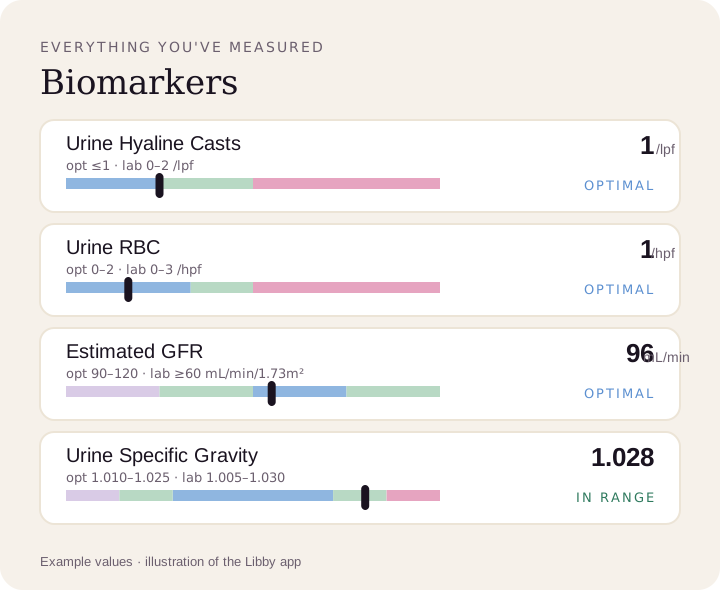
See your urinalysis on your lab's range.
Upload a lab PDF or a photo of your report. Libby puts every marker on your lab's range, adds the optimal range where the app has one, and tracks each urinalysis over time.
View your urine casts ›