Urine sodium test: normal range, FENa, low and high causes
Urine sodium shows how much salt your kidneys let go. Here's the 24-hour range, spot vs 24-hour tests, FENa, salt targets, and what low or high means.
Urine sodium measures how much sodium your kidneys are letting go. Healthy kidneys filter a huge amount of sodium every day and usually pull more than 99% of it back. What slips through mostly matches the salt you ate, so a 24-hour urine sodium is the best everyday gauge of your salt intake. In someone who is ill, a single spot urine sodium shows whether the kidneys are holding on to salt or letting it go, which helps sort out a low blood sodium or a sudden drop in kidney function.1234
The short version
- Normal (24-hour): about 40–220 mmol a day (MedlinePlus). Labcorp prints 58–337 for men and 39–258 for women. The range is wide because it follows your diet: U.S. adults average about 183 (men) and 132 (women).567
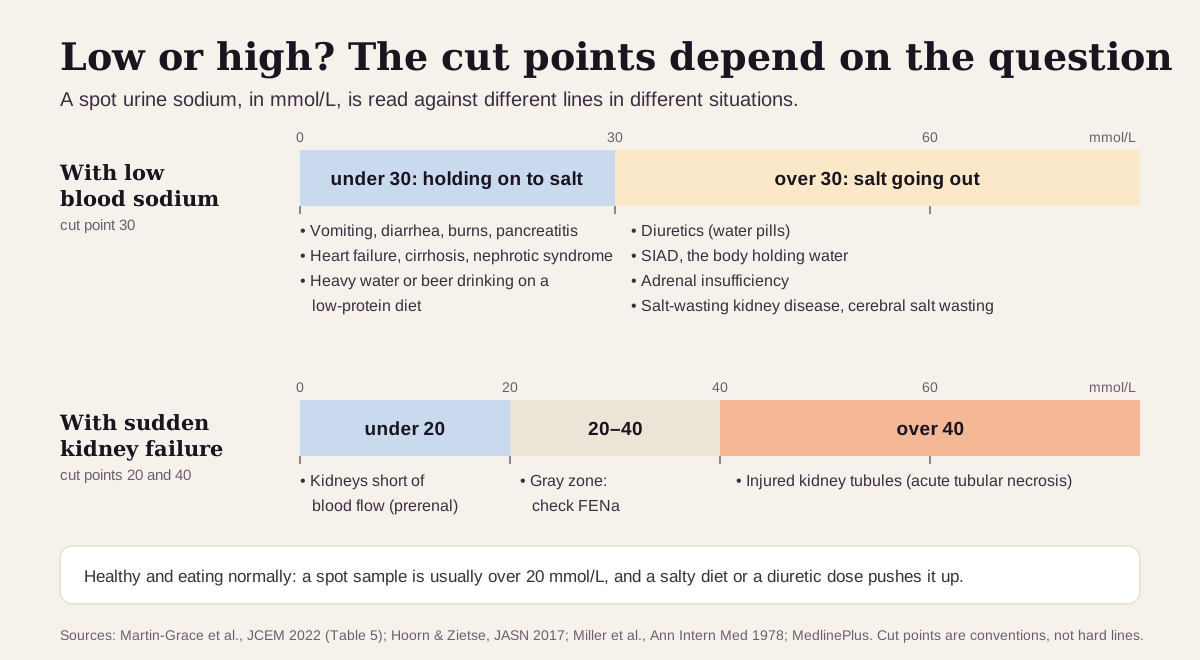
- Low: a salt-light diet, or kidneys holding on to salt because the body senses too little fluid: dehydration, vomiting or diarrhea, heart failure, cirrhosis. With low blood sodium, a spot result under 30 mmol/L points this way.548
- High: the everyday cause is a salty diet. Diuretics ("water pills") raise it too. With low blood sodium, a spot result over 30 points to diuretics, SIAD (the body holding water) or an adrenal problem. In sudden kidney failure, over 40 points to injured kidney tubules.589
- Urgent: set by what comes with it. A blood sodium under 125 mmol/L, or low sodium with confusion, vomiting, severe drowsiness or a seizure, needs care right away.48
What urine sodium is
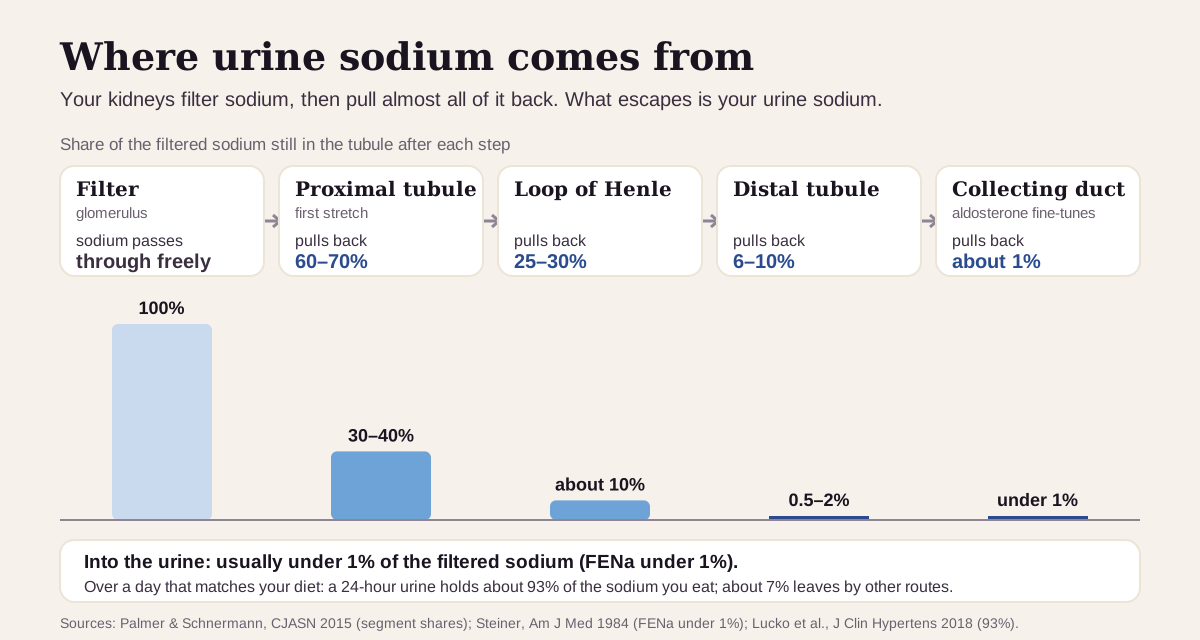
Your kidneys filter your blood all day, and sodium passes through the filter freely. The tubules downstream then pull it back in stages: 60–70% in the first stretch (the proximal tubule), 25–30% in the loop of Henle, 6–10% in the distal tubule and about 1% in the collecting duct, where the hormone aldosterone fine-tunes the last step.18 Across a tenfold change in salt intake, the kidneys still reclaim between 97% and 99.7% of what they filter.1
What escapes is your urine sodium. Over a day it closely matches what you ate: a review of 35 studies found that a 24-hour urine holds about 93% of the sodium eaten, and about 7% leaves by other routes.3 That's why health agencies measure salt intake with 24-hour urine collections.7
The test comes in two forms:
- Spot (random) urine sodium, in mmol/L, from one sample. It's used mostly in illness: to work out an abnormal blood sodium or a sudden drop in kidney function.564
- 24-hour urine sodium, in mmol per day, from every drop you pass for a full day. It's the standard check on salt intake, and Labcorp's test notes cite a recommendation to measure it in people with kidney stones and high urine calcium.76
What's a normal urine sodium?
For a 24-hour collection, normal is wide because diet is wide. MedlinePlus gives 40–220 mmol a day for adults.5 Labcorp, a large commercial lab, prints 58–337 for men and 39–258 for women aged 18 to 80, and 23–207 over age 80.6 Across the world's populations, daily urine sodium runs from under 1 mmol (the Yanomamo of the Amazon, who eat almost no salt) to about 250.1
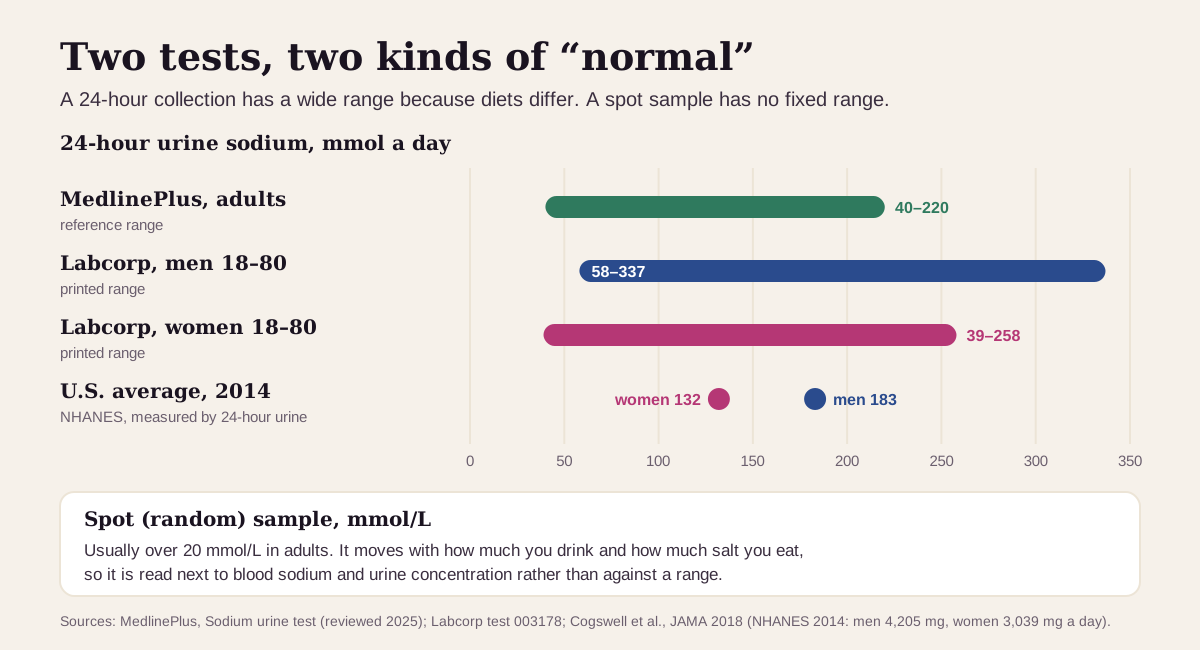
- In the CDC's NHANES 2014 survey, 827 U.S. adults collected 24-hour urine. The average was 3,608 mg (157 mmol) a day: 4,205 mg (183 mmol) for men and 3,039 mg (132 mmol) for women.7
- That's well above every guideline target in the next section. The FDA puts the average American intake at about 3,400 mg a day.11
For a spot sample, there's no fixed range. MedlinePlus says a random sample is generally over 20 mmol/L, and that the result depends on how much fluid and salt you take in.5 A big glass of water dilutes it; a dry day concentrates it. So clinicians read a spot result next to your blood sodium, your urine concentration and the reason it was ordered.4
"Optimal" urine sodium: the salt-intake targets
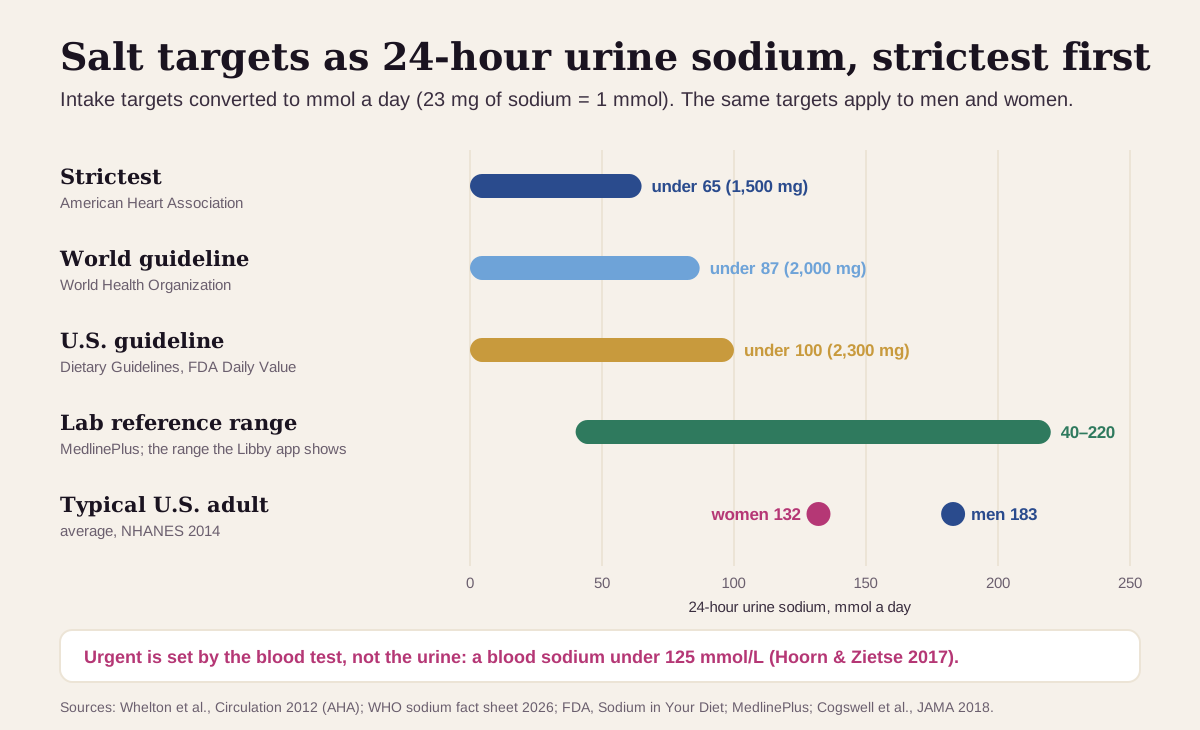
The Libby app shows your 24-hour urine sodium on your lab's range; its marker catalog has no separate optimal band for it. The tighter targets come from salt-intake guidelines, because a 24-hour urine sodium is a measure of intake. Here's the ladder, from strictest to loosest. The same targets apply to men and women.
| Target | 24-hour sodium, men and women | Who uses it |
|---|---|---|
| Strictest | under 65 mmol (1,500 mg) | The American Heart Association's goal for most adults12 |
| World guideline | under 87 mmol (2,000 mg, or 5 g of salt) | World Health Organization10 |
| U.S. guideline | under 100 mmol (2,300 mg) | Dietary Guidelines for Americans, as the FDA's Daily Value11 |
| Lab reference range | 40–220 mmol | MedlinePlus, and the range the Libby app shows.5 Labcorp prints 58–337 (men) and 39–258 (women)6 |
| Typical U.S. adult | 183 (men), 132 (women) average | NHANES 2014, measured by 24-hour urine7 |
| Urgent | set by the blood test, not the urine: blood sodium under 125 mmol/L | "Severe" or "profound" low sodium in the U.S. and European guidelines4 |
Why the low targets exist:
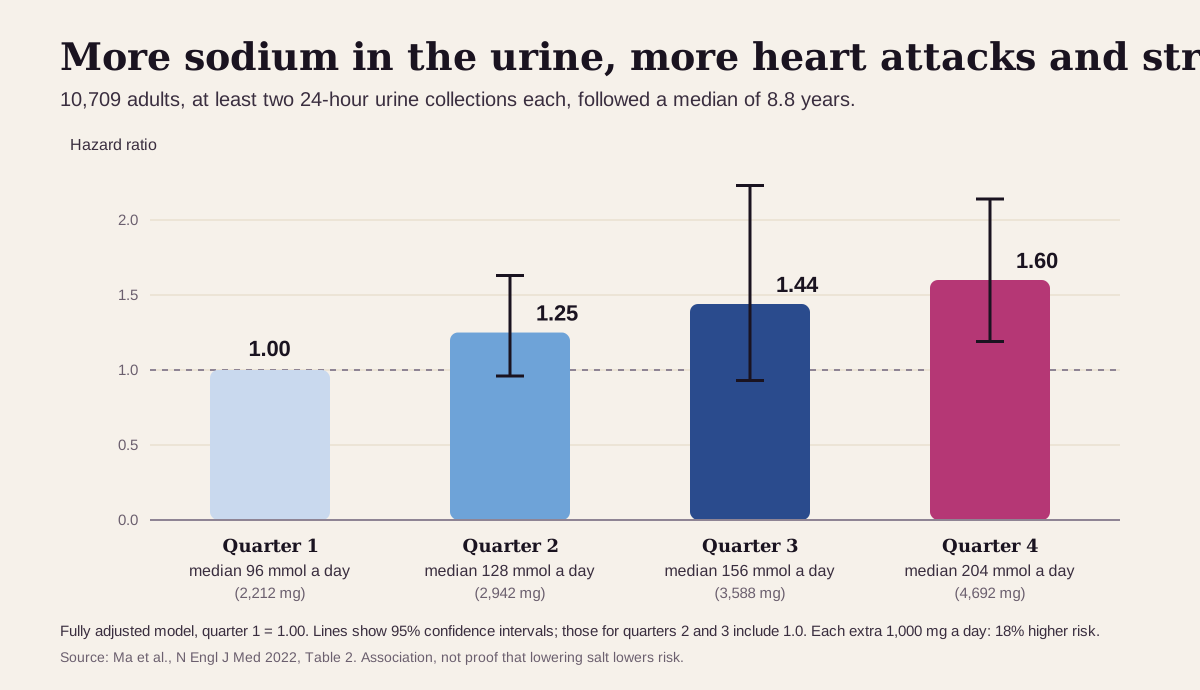
- In six cohorts of 10,709 healthy adults, each with at least two 24-hour urine collections and followed for a median of 8.8 years, heart attacks, strokes and heart procedures rose step by step with urine sodium. The top quarter (median 204 mmol a day) had 1.60 times the risk of the bottom quarter (median 96).13
- Each extra 1,000 mg (about 43 mmol) a day went with an 18% higher risk.13
- In the DASH-Sodium feeding trial, 412 adults ate each of three sodium levels for 30 days. On a typical American diet, cutting from the high to the middle level lowered systolic blood pressure by 2.1 mm Hg, and cutting to the low level, below 100 mmol a day, lowered it another 4.6 mm Hg.14
Keep "optimal" in perspective. These are intake targets for healthy people, and a low urine sodium in someone who is sick means something else: kidneys hoarding salt because the body is short of fluid.4 The low end is also debated. Some observational studies prompted calls to drop low-salt advice, and the American Heart Association answered that those studies had serious methods problems.12 Measurement is one of them: when researchers re-analyzed one long trial, measured 24-hour sodium showed a straight-line link with death, while three spot-urine formulas applied to the same people bent it into a J or U shape.15 A single 24-hour result of 150 is a reason to look at processed and packaged food, where much of our sodium hides, and a reason to repeat the test, not a diagnosis.1016
What a low or high urine sodium usually means
The cut points depend on why the test was ordered. A spot urine sodium gets read against different lines when your blood sodium is low than when your kidney function has suddenly dropped.49
Low urine sodium: the kidneys are holding on to salt
The usual suspects:
- Dehydration, vomiting or diarrhea. When the body senses too little fluid, the kidneys keep nearly every bit of sodium.58
- Heart failure, cirrhosis and nephrotic syndrome. The body is holding extra fluid, but the circulation still "feels" underfilled, so the kidneys hoard salt.84
- A low-salt diet. With little salt coming in, little goes out. Hoorn and Zietse note this is rare in Western diets.4
- Less common: too much aldosterone (hyperaldosteronism), and, with low blood sodium, drinking large amounts of water or beer on a low-protein diet.58
High urine sodium: salt going out
- A salty diet. This is the everyday cause of a high 24-hour result: the average American eats about 3,400 mg of sodium a day, well over the guidelines.511 Labcorp notes that, depending on intake, a spot result over 40 mmol/L also shows up in healthy people.6
- Diuretics. Water pills work by making the kidneys dump sodium, so a recent dose raises urine sodium.1745 Don't stop a prescribed medicine on your own. Tell your clinician what you took and when.
- SIAD, the syndrome of inappropriate antidiuresis. The body holds on to water it should let go, so blood sodium falls while urine sodium stays over 30. Lung disease, brain injury, some cancers and some medicines can set it off.818
- Adrenal insufficiency and salt-wasting kidney disease. The kidneys lose salt they should keep.85
- Injured kidney tubules. In sudden kidney failure, a urine sodium over 40 points to acute tubular necrosis (ATN), damage to the cells that reclaim sodium.96
Get care now if a low blood sodium comes with headache and nausea, confusion, vomiting, unusual sleepiness or a seizure. Those symptoms can mean the brain is swelling and need immediate treatment.8
Urine sodium reads best next to its neighbors
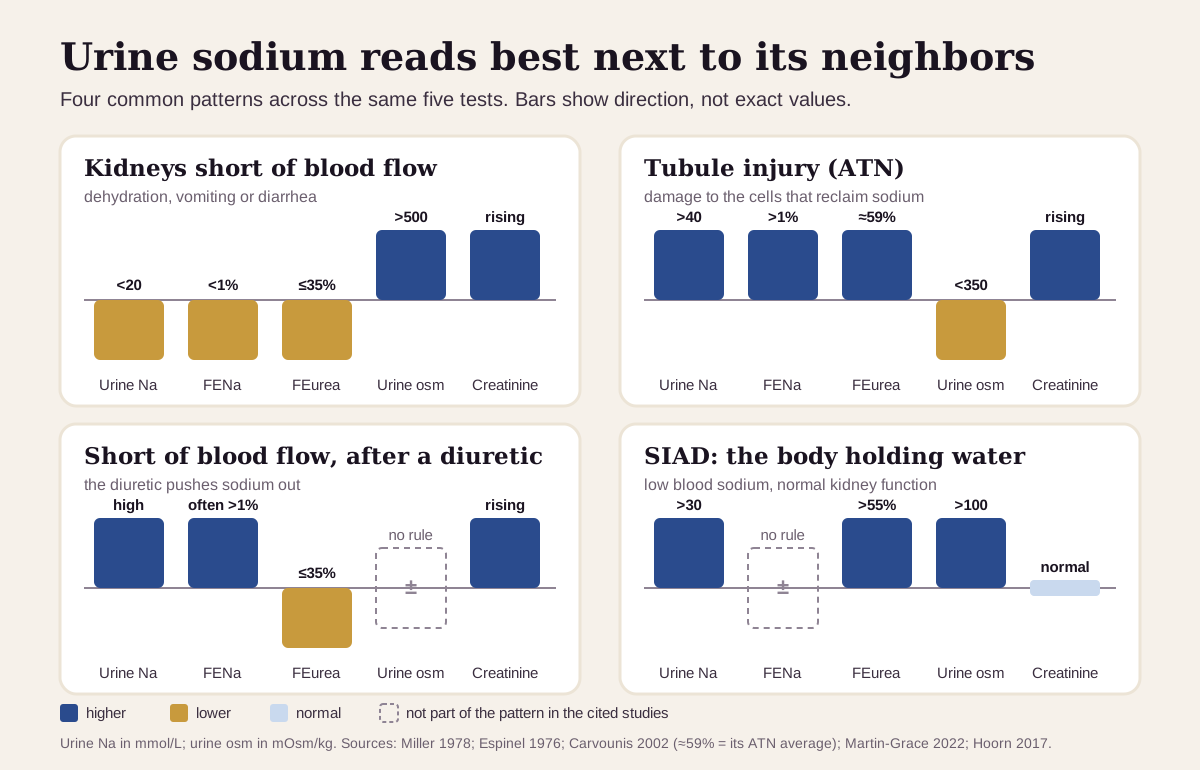
A urine sodium alone can mislead: diuretics raise it, and a salt-light diet lowers it.4 Clinicians read it with the fractional excretion of sodium (FENa), the fractional excretion of urea (FEurea), urine osmolality (how concentrated the urine is) and your blood creatinine:917
| If you see… | It often points to… |
|---|---|
| Urine sodium under 20, FENa under 1%, concentrated urine (over 500 mOsm/kg), creatinine rising | kidneys short of blood flow ("prerenal"), as with dehydration or vomiting and diarrhea. It's potentially reversible |
| Urine sodium over 40, FENa over 1% (over 3% in Espinel's study), urine under 350 mOsm/kg, creatinine rising | injured kidney tubules (acute tubular necrosis) |
| FENa over 1% after a diuretic, but FEurea 35% or less | still a shortage of blood flow: the diuretic pushed the sodium out |
| Low blood sodium, urine sodium over 30, urine over 100 mOsm/kg, normal fluid status and kidney function, no diuretic, thyroid and adrenal problems ruled out | SIAD, the body holding on to water; an FEurea over 55% supports it |
| Low blood sodium, urine sodium under 30 | the body holding on to salt: vomiting or diarrhea, heart failure, cirrhosis, nephrotic syndrome. With normal fluid status: very low food intake, or heavy water or beer drinking |
| Low FENa with heart or liver failure, contrast dye, muscle or red-cell breakdown, or glomerulonephritis | FENa can read low even when extra fluid won't help |
The rows come from Miller's prospective study of urinary indices,9 Espinel's 1976 FENa paper,19 Carvounis's diuretic study,17 the SIAD criteria and urine-sodium table in Martin-Grace's review,8 Hoorn and Zietse's guideline summary,4 Steiner's list of exceptions,2 and MedlinePlus.5 Miller and Espinel studied people passing little urine, and Miller notes that many results fall between the cut points.9
How fast urine sodium changes
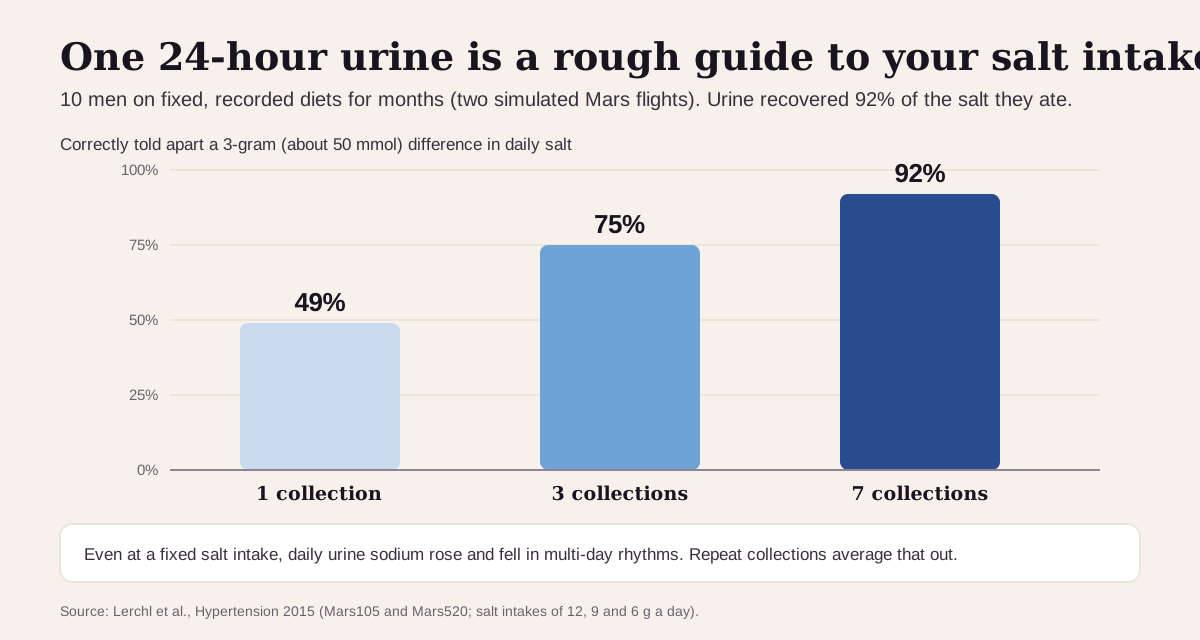
Urine sodium follows your recent meals, and it bounces from day to day. In two simulated flights to Mars, 10 men ate fixed, recorded diets for months. Their urine recovered 92% of the salt they ate, yet daily urine sodium still rose and fell in multi-day rhythms at the same intake.16
What that means in practice:
- One 24-hour collection is a rough estimate. It told a 3-gram difference in salt intake apart only 49% of the time. Three collections got it right 75% of the time, and seven, 92%.16 The big outcome study above used at least two per person.13
- Missed urine lowers the number. In studies that checked with a marker pill, 6–47% of 24-hour collections were incomplete, and complete ones read about 20 mmol higher.20 Labcorp's instructions: pass urine at 8 AM and flush it, then collect every drop until and including 8 AM the next morning.6
- Spot results move with the moment. A spot urine sodium changes with what you just drank and with a recent diuretic dose, which is why it's read together with the other tests from the same time.54
- Trends beat snapshots. For salt intake, repeat 24-hour collections at the same lab and compare them.165
Going deeper: FENa, FEurea and spot-urine formulas
FENa corrects urine sodium for how concentrated the urine is, by comparing sodium with creatinine in blood and urine:199
FENa (%) = (urine sodium × blood creatinine) ÷ (blood sodium × urine creatinine) × 100
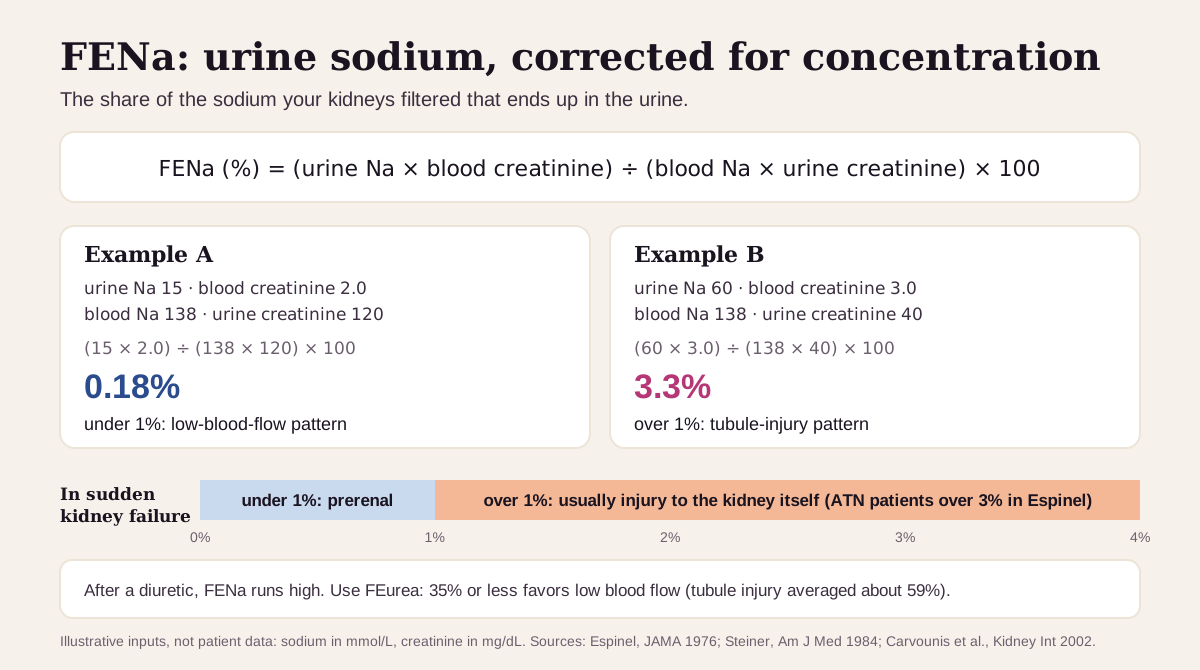
In healthy people FENa is usually under 1%, and a salty diet can push it higher.2 In sudden kidney failure, Espinel found prerenal patients under 1% and tubule-injury patients over 3%.19 The weak spot is diuretics: in Carvounis's study, 92% of people short of blood flow had a FENa under 1%, but only 48% of those who'd had a diuretic. The fractional excretion of urea held up better: 89% of the diuretic group had an FEurea of 35% or less, against an average of 59% in tubule injury.17 For low blood sodium in someone on a diuretic, the fractional excretion of uric acid does a similar job: over 12% pointed to SIAD in Fenske's study.18
Spot-urine formulas (Kawasaki, Tanaka, INTERSALT) try to turn one spot sample into a daily intake. In the Trials of Hypertension Prevention, where 2,974 adults had repeated 24-hour collections, every formula overestimated low intakes and underestimated high ones.15 Use a 24-hour collection, ideally several, when the question is how much salt you eat.16
Questions worth asking
- Was this a spot sample or a 24-hour collection, and was the collection complete?
- Had I taken a diuretic (water pill) before the sample?
- What were my blood sodium, creatinine and urine osmolality at the same time?
- Would a FENa, or an FEurea if I'm on a diuretic, help here?
- How much salt am I eating, and would repeat 24-hour collections give a clearer picture?
- Could my heart, liver, adrenal glands or medicines be affecting my salt balance?
FAQ
What is a normal urine sodium level? For a 24-hour collection, about 40–220 mmol a day, and Labcorp prints 58–337 for men and 39–258 for women. A random spot sample is generally over 20 mmol/L.56
What does a low urine sodium mean? Usually that the kidneys are holding on to salt because the body senses too little fluid: dehydration, vomiting or diarrhea, heart failure or cirrhosis. A low-salt diet lowers it too.548
What does a high urine sodium mean? Most often a salty diet. Diuretics raise it, and with low blood sodium a spot value over 30 mmol/L points to SIAD, diuretics or an adrenal problem.58
Is a spot urine sodium or a 24-hour urine better? They answer different questions. A spot sample helps sort out low blood sodium or sudden kidney failure; a 24-hour collection, repeated a few times, measures salt intake.416
This guide is for education. It can't diagnose you or replace care from a clinician who knows your history.
Footnotes
-
Palmer LG, Schnermann J. Integrated control of Na transport along the nephron. Clin J Am Soc Nephrol. 2015;10(4):676–687. Where along the nephron filtered sodium is reclaimed, and how little the reclaimed share moves with intake. PMC ↩ ↩2 ↩3 ↩4 ↩5 ↩6
-
Steiner RW. Interpreting the fractional excretion of sodium. Am J Med. 1984;77(4):699–702. FENa is usually under 1% in healthy people and rises with salt intake; the settings where it misleads. PubMed ↩ ↩2 ↩3 ↩4 ↩5
-
Lucko AM, Doktorchik C, Woodward M, et al. Percentage of ingested sodium excreted in 24-hour urine collections: A systematic review and meta-analysis. J Clin Hypertens (Greenwich). 2018;20(9):1220–1229. 35 studies: a 24-hour urine holds about 93% of the sodium eaten. PMC ↩ ↩2 ↩3
-
Hoorn EJ, Zietse R. Diagnosis and Treatment of Hyponatremia: Compilation of the Guidelines. J Am Soc Nephrol. 2017;28(5):1340–1349. Compares the U.S. and European hyponatremia guidelines: the urine sodium 30 mmol/L cut point and its caveats (diet, diuretics, kidney disease), FEurea over 55% in SIAD, and the under-125 threshold. PMC ↩ ↩2 ↩3 ↩4 ↩5 ↩6 ↩7 ↩8 ↩9 ↩10 ↩11 ↩12 ↩13 ↩14 ↩15 ↩16 ↩17 ↩18
-
National Library of Medicine. Sodium urine test. MedlinePlus Medical Encyclopedia. Reviewed July 13, 2025. Normal values (over 20 mEq/L in a random sample; 40–220 mEq a day) and the common causes of high and low results. MedlinePlus ↩ ↩2 ↩3 ↩4 ↩5 ↩6 ↩7 ↩8 ↩9 ↩10 ↩11 ↩12 ↩13 ↩14 ↩15 ↩16 ↩17 ↩18 ↩19 ↩20 ↩21
-
Labcorp. Sodium, 24-Hour Urine (test 003178). Reference range 58–337 mmol/24 h for men and 39–258 for women aged 18–80; collection instructions and interpretive notes. A commercial laboratory's published test page, cited for its printed range and notes. labcorp.com ↩ ↩2 ↩3 ↩4 ↩5 ↩6 ↩7 ↩8 ↩9 ↩10 ↩11
-
Cogswell ME, Loria CM, Terry AL, et al. Estimated 24-Hour Urinary Sodium and Potassium Excretion in US Adults. JAMA. 2018;319(12):1209–1220. CDC and NIH analysis of 827 NHANES 2014 participants with 24-hour urine collections. PMC ↩ ↩2 ↩3 ↩4 ↩5 ↩6 ↩7
-
Martin-Grace J, Tomkins M, O'Reilly MW, Thompson CJ, Sherlock M. Approach to the Patient: Hyponatremia and the Syndrome of Inappropriate Antidiuresis (SIAD). J Clin Endocrinol Metab. 2022;107(8):2362–2376. The SIAD criteria (Table 4), the causes of low blood sodium sorted by urine sodium (Table 5), and symptoms that need immediate treatment. PMC ↩ ↩2 ↩3 ↩4 ↩5 ↩6 ↩7 ↩8 ↩9 ↩10 ↩11 ↩12 ↩13 ↩14 ↩15
-
Miller TR, Anderson RJ, Linas SL, et al. Urinary diagnostic indices in acute renal failure: a prospective study. Ann Intern Med. 1978;89(1):47–50. The classic urine sodium (under 20 vs over 40) and urine osmolality (over 500 vs under 350) cut points. PubMed ↩ ↩2 ↩3 ↩4 ↩5 ↩6 ↩7 ↩8 ↩9
-
World Health Organization. Sodium reduction (fact sheet). May 11, 2026. Recommends under 2,000 mg of sodium (5 g of salt) a day for adults; 1 g of salt holds 400 mg of sodium. who.int ↩ ↩2 ↩3 ↩4
-
U.S. Food and Drug Administration. Sodium in Your Diet. The Dietary Guidelines for Americans limit of under 2,300 mg a day (the Daily Value), and the U.S. average of about 3,400 mg. fda.gov ↩ ↩2 ↩3 ↩4
-
Whelton PK, Appel LJ, Sacco RL, et al. Sodium, blood pressure, and cardiovascular disease: further evidence supporting the American Heart Association sodium reduction recommendations. Circulation. 2012;126(24):2880–2889. The American Heart Association's recommendation of under 1,500 mg a day. PubMed ↩ ↩2 ↩3
-
Ma Y, He FJ, Sun Q, et al. 24-Hour Urinary Sodium and Potassium Excretion and Cardiovascular Risk. N Engl J Med. 2022;386(3):252–263. Six cohorts, 10,709 adults, at least two 24-hour urine samples each; quartile medians and hazard ratios from Table 2. PMC ↩ ↩2 ↩3 ↩4
-
Sacks FM, Svetkey LP, Vollmer WM, et al. Effects on blood pressure of reduced dietary sodium and the Dietary Approaches to Stop Hypertension (DASH) diet. N Engl J Med. 2001;344(1):3–10. The DASH-Sodium feeding trial in 412 adults. PubMed ↩
-
He FJ, Ma Y, Campbell NRC, MacGregor GA, Cogswell ME, Cook NR. Formulas to Estimate Dietary Sodium Intake From Spot Urine Alter Sodium-Mortality Relationship. Hypertension. 2019;74(3):572–580. 2,974 adults followed for a median of 24 years: measured 24-hour sodium versus three spot-urine formulas. PubMed ↩ ↩2
-
Lerchl K, Rakova N, Dahlmann A, et al. Agreement between 24-hour salt ingestion and sodium excretion in a controlled environment. Hypertension. 2015;66(4):850–857. Ten men on fixed, recorded diets for 105 and 205 days in two simulated flights to Mars (Mars105 and Mars520); how many 24-hour collections it takes to classify salt intake. PMC ↩ ↩2 ↩3 ↩4 ↩5 ↩6 ↩7
-
Carvounis CP, Nisar S, Guro-Razuman S. Significance of the fractional excretion of urea in the differential diagnosis of acute renal failure. Kidney Int. 2002;62(6):2223–2229. 102 episodes of acute kidney failure; FENa versus FEurea with and without diuretics. PubMed ↩ ↩2 ↩3 ↩4 ↩5 ↩6
-
Fenske W, Störk S, Koschker AC, et al. Value of fractional uric acid excretion in differential diagnosis of hyponatremic patients on diuretics. J Clin Endocrinol Metab. 2008;93(8):2991–2997. 86 patients with low sodium: urine sodium works for SIAD without diuretics; fractional uric acid excretion over 12% works with them. DOI ↩ ↩2
-
Espinel CH. The FENa test. Use in the differential diagnosis of acute renal failure. JAMA. 1976;236(6):579–581. The original FENa paper: prerenal under 1, tubular necrosis over 3. PubMed ↩ ↩2 ↩3 ↩4 ↩5
-
John KA, Cogswell ME, Campbell NR, et al. Accuracy and Usefulness of Select Methods for Assessing Complete Collection of 24-Hour Urine: A Systematic Review. J Clin Hypertens (Greenwich). 2016;18(5):456–467. How often 24-hour collections are incomplete and how much that lowers sodium. PMC ↩
Educational content, not medical advice. Libby is a personal record tool, not a medical service — it doesn't diagnose, treat, or prescribe. Reference ranges vary by lab and by person. Talk to a qualified healthcare professional about your results.
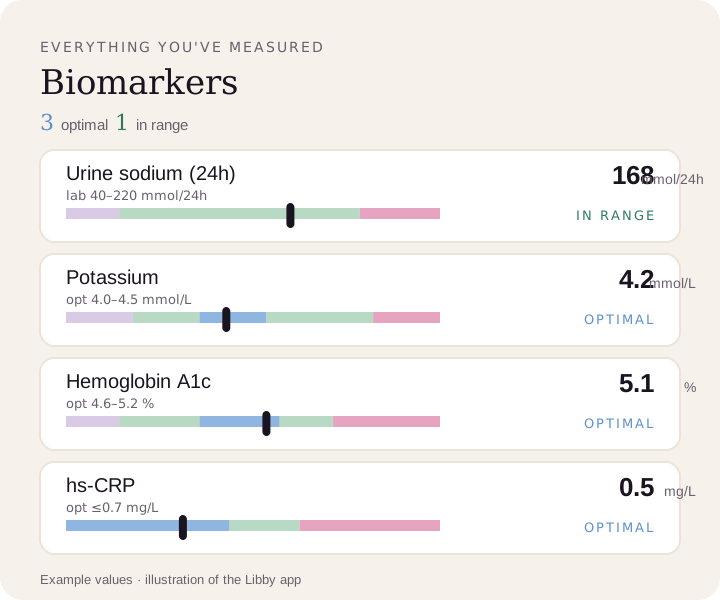
See every result against your lab's range.
Upload a lab PDF or a photo of your report. Libby puts every marker on your lab's range, adds the optimal range where one exists, and tracks your trends over time.
View your urine sodium ›