Aldosterone test: normal levels, renin ratio and causes
Aldosterone controls salt and potassium. See normal levels, how to read it with renin, what a high ratio means, and who should be screened.
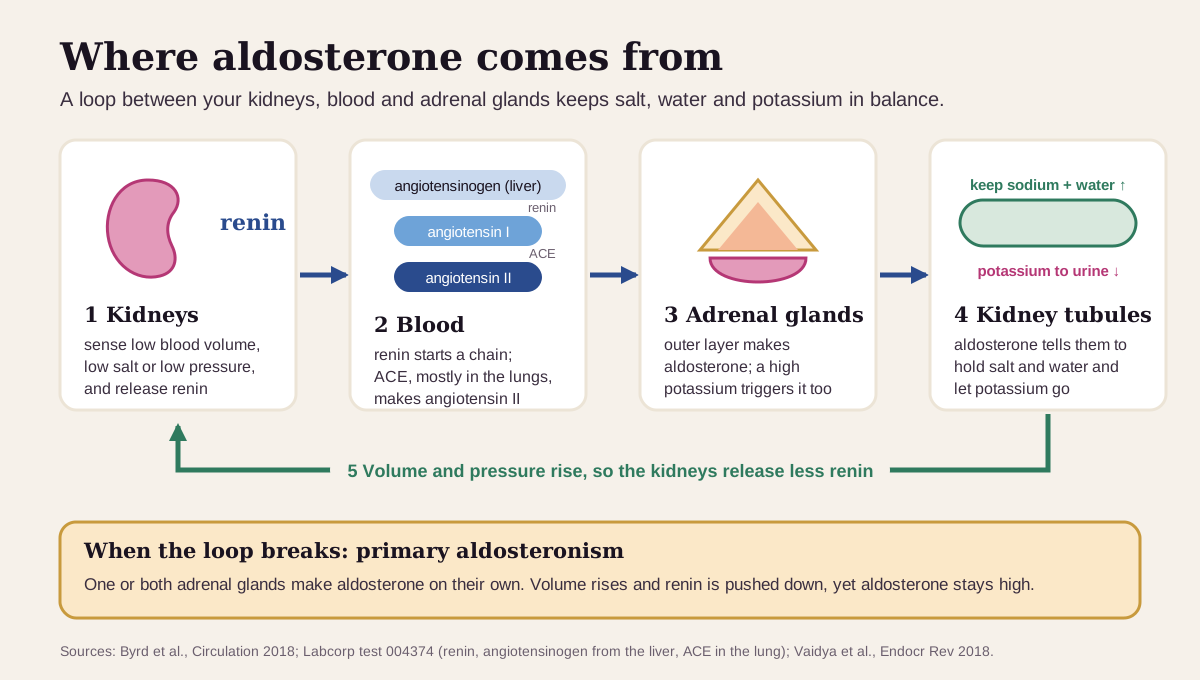
Aldosterone is the hormone your adrenal glands make to hold on to salt and water and get rid of potassium. Your kidneys steer it with renin, an enzyme they release when blood volume or salt runs low; renin rises and pulls aldosterone up with it. That's why aldosterone makes sense only next to renin. A high aldosterone with a suppressed renin is the classic sign of primary aldosteronism, the most common hormonal cause of high blood pressure.12
The short version
- Normal: check your report. Labcorp's adult range is 0.0–30.0 ng/dL after 30 minutes up and about. Posture, salt intake and the lab's method all shift it.3
- The pair is the test. The Endocrine Society's 2025 guideline counts a screen as positive when renin is suppressed (activity 1 ng/mL/h or less) and aldosterone is 10 ng/dL or more (7.5 by mass spectrometry), with an aldosterone-to-renin ratio over 20.2
- Who should check: the 2025 guideline suggests screening everyone with high blood pressure. Primary aldosteronism affects 5–14% of people with hypertension and up to 29% of those with hard-to-control (resistant) hypertension.42
- Get care now for severe muscle weakness with a low potassium, a potassium above 6.0 mmol/L, or fainting, vomiting and confusion that can signal an adrenal crisis.356
What aldosterone is
Aldosterone is a steroid hormone made in the outer layer of your adrenal glands, which sit on top of your kidneys. It works on the last stretch of the kidney's tubules. There it tells the cells to pull sodium, and water with it, back into the blood and to send potassium out in the urine. That stretch handles only 1–5% of the sodium your kidneys filter. Your kidneys filter about 180 liters of plasma a day, though, so small shifts add up to big changes in blood volume.1
Two signals run it. When your kidneys sense low blood volume, low salt or low pressure, they release renin. Renin starts a chain that ends in angiotensin II, which tells the adrenal glands to make aldosterone. A high potassium triggers aldosterone directly, and ACTH, a pituitary hormone, gives it a brief push.13 In health, renin and aldosterone rise and fall together.1
Aldosterone is a specific test, usually ordered with renin and potassium. Common reasons are blood pressure that's high or hard to control, a low potassium, dizziness on standing, or an adrenal nodule found on a scan done for something else.7
What's a normal aldosterone?
Start with the range on your own report. Labs use different methods, and the number depends on your position before the draw.7
- Labcorp, a large U.S. commercial lab, prints 0.0–30.0 ng/dL for anyone over 14 who has been up and about for at least 30 minutes on a normal-salt diet.3
- Lying down lowers it. Renin, which drives aldosterone, runs 0.2–1.6 ng/mL/h lying down and 0.5–4.0 standing on a normal-salt diet, according to MedlinePlus.8
- Salt moves it the other way. A very low-salt diet raises aldosterone, and a very high-salt diet lowers it.7
- The Libby app uses a lab range of 3.0–16.0 ng/dL and an optimal band of 5–12 ng/dL, from its marker catalog.
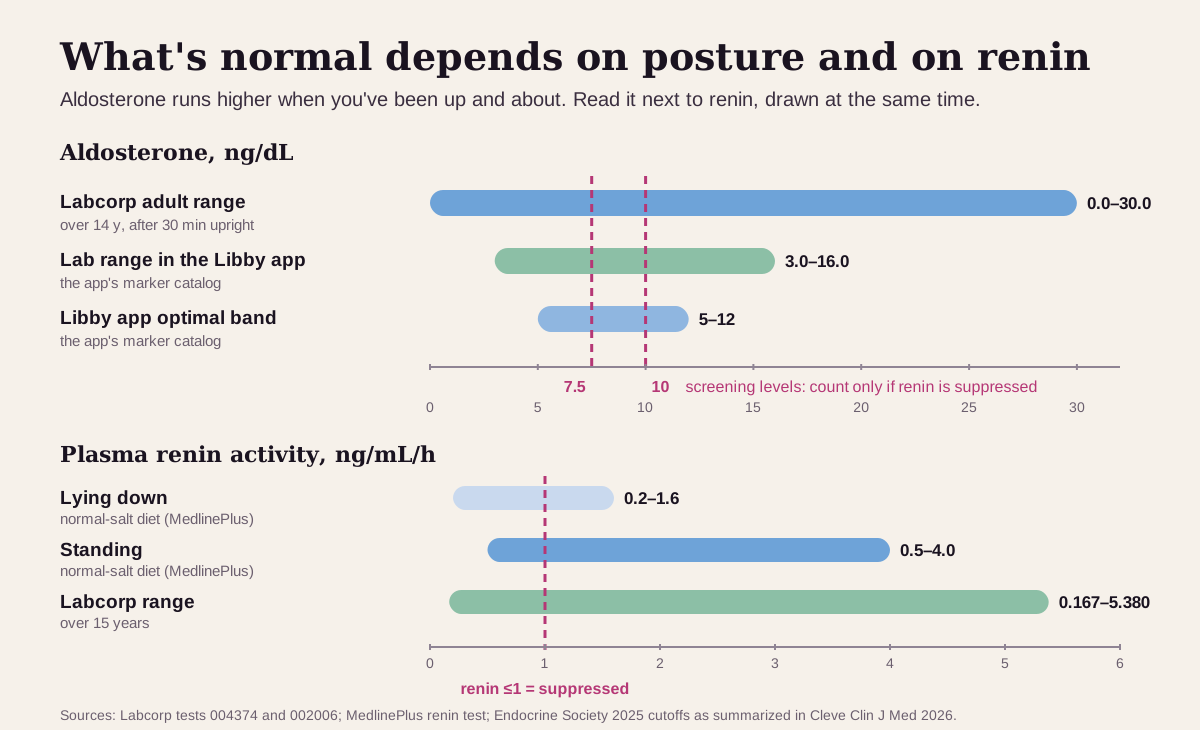
A normal aldosterone can still be too much. In primary aldosteronism, aldosterone is often only mildly high or even inside the lab range. What gives it away is a renin that's suppressed at the same time.1 Pregnancy raises both renin and aldosterone.16
"Optimal" aldosterone: why the pair beats the number
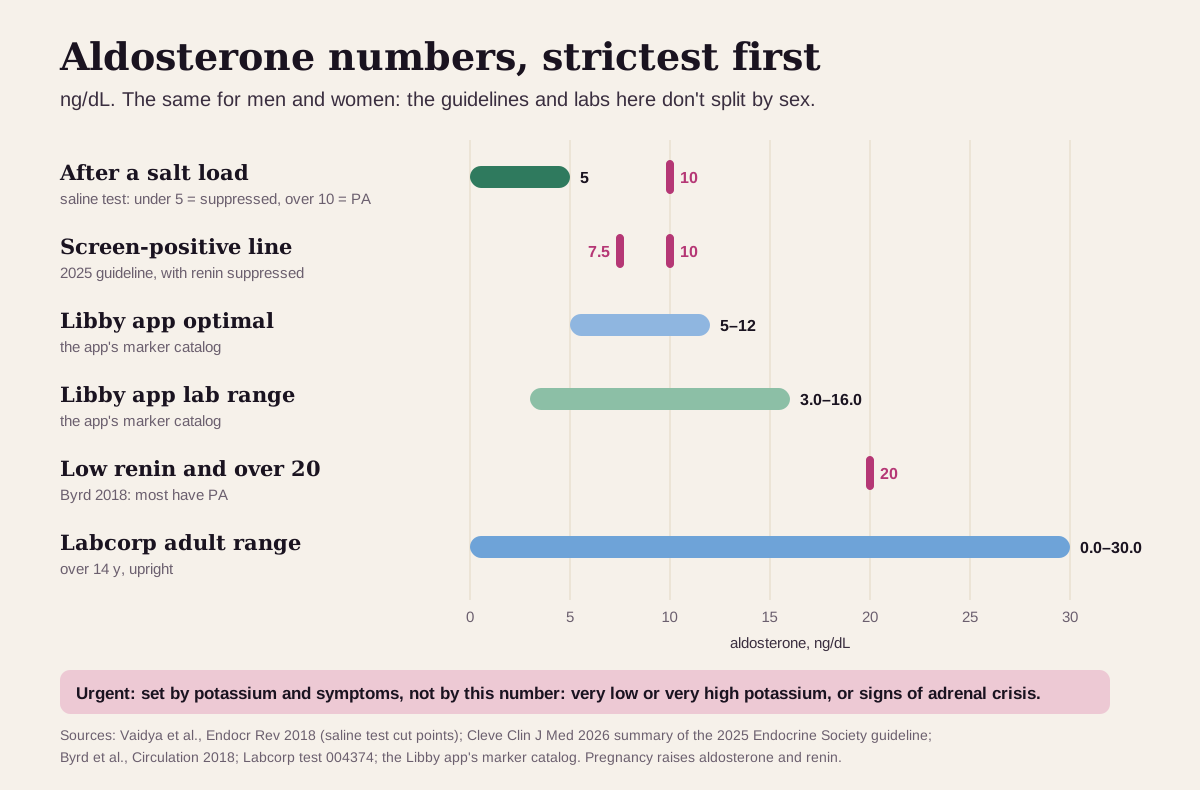
For aldosterone, the useful numbers are the ones endocrinologists use to decide when aldosterone is too high for the renin next to it. Here's the full ladder, from strictest to loosest:
| Target | Aldosterone | Who uses it |
|---|---|---|
| After a salt load | under 5 ng/dL is normal suppression; over 10 confirms primary aldosteronism | The saline suppression test: 2 liters of saline over 4 hours9 |
| Screen-positive line | 10 ng/dL or more (7.5 by LC-MS/MS), with renin suppressed and a ratio over 20 | Endocrine Society 2025 guideline2 |
| Libby app optimal | 5–12 ng/dL | The optimal range shown in the Libby app. The app's catalog credits it to the Endocrine Society, whose 2025 guideline sets the screening cutoffs above rather than an optimal band2 |
| Libby app lab range | 3.0–16.0 ng/dL | The app's marker catalog |
| Low renin, aldosterone over 20 | over 20 ng/dL | Most people with this pair have primary aldosteronism1 |
| Lab standard | 0.0–30.0 ng/dL | Labcorp, over age 14, upright3 |
| Urgent | set by potassium and symptoms | Potassium above 6.0 mmol/L,5 severe muscle weakness with a very low potassium,3 or signs of adrenal crisis6 |
These numbers are the same for men and women; none of the sources above split them by sex.
Why the extra aldosterone matters:
- In the Framingham Offspring Study, 1,688 adults without high blood pressure were followed for 4 years. Those in the top quarter of aldosterone, still within the normal range, had 1.60 times the risk of their blood pressure moving up a category and 1.61 times the risk of developing hypertension, compared with the bottom quarter.10
- A review of 31 studies compared people with primary aldosteronism with people whose high blood pressure had no hormonal cause. Those with primary aldosteronism had 3.52 times the odds of atrial fibrillation, 2.58 of stroke, 2.05 of heart failure and 1.77 of coronary artery disease.11
- Among 602 people with primary aldosteronism treated with spironolactone-type drugs, the extra risk of heart attack, stroke and heart-failure admission (2.83 times) was confined to those whose renin stayed suppressed. Those whose renin rose to 1 ng/mL/h or more had no significant excess risk.12 The 2025 guideline now suggests adjusting treatment to raise renin.4
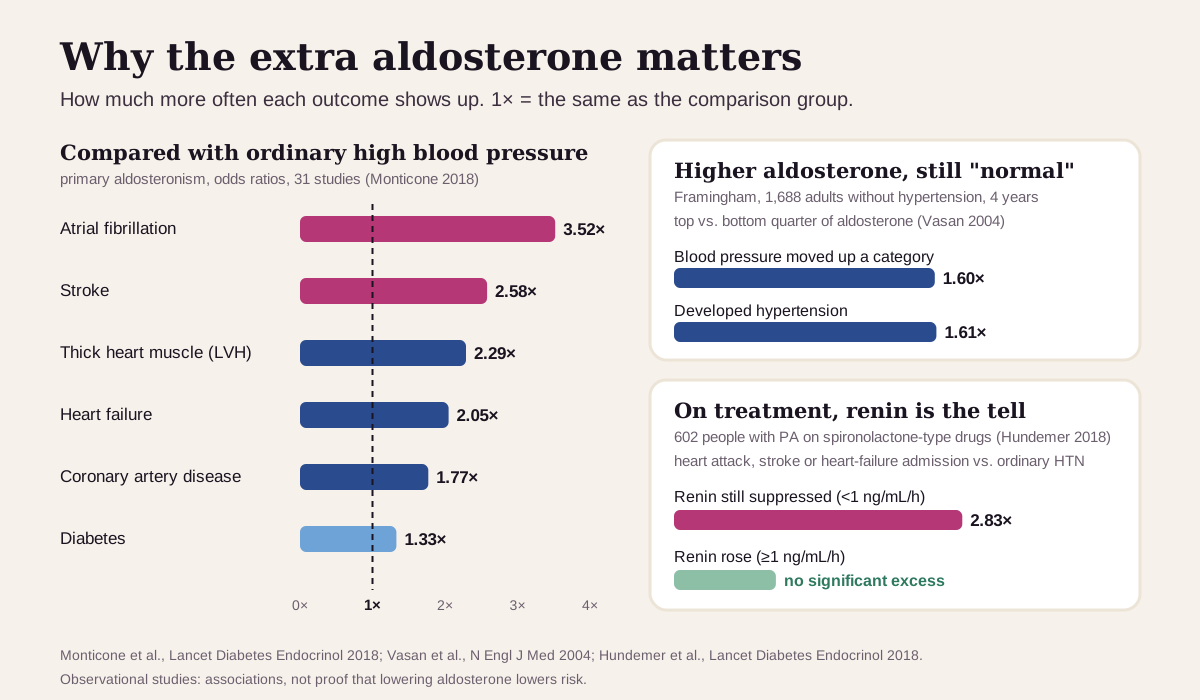
Keep "optimal" in perspective. Aldosterone is supposed to swing: a low-salt day or a standing draw pushes it up for good reasons.73 An aldosterone of 11 sits inside the app's optimal band and still counts toward a positive screen when renin is suppressed.2 A high aldosterone with a high renin on a water pill is the expected response to the pill.79 Read the number with its renin, your salt intake and your medicine list.
What a high aldosterone usually means
Start with renin. The renin drawn at the same time sorts a high aldosterone into one of two groups: renin-driven, or made by an adrenal gland on its own.19
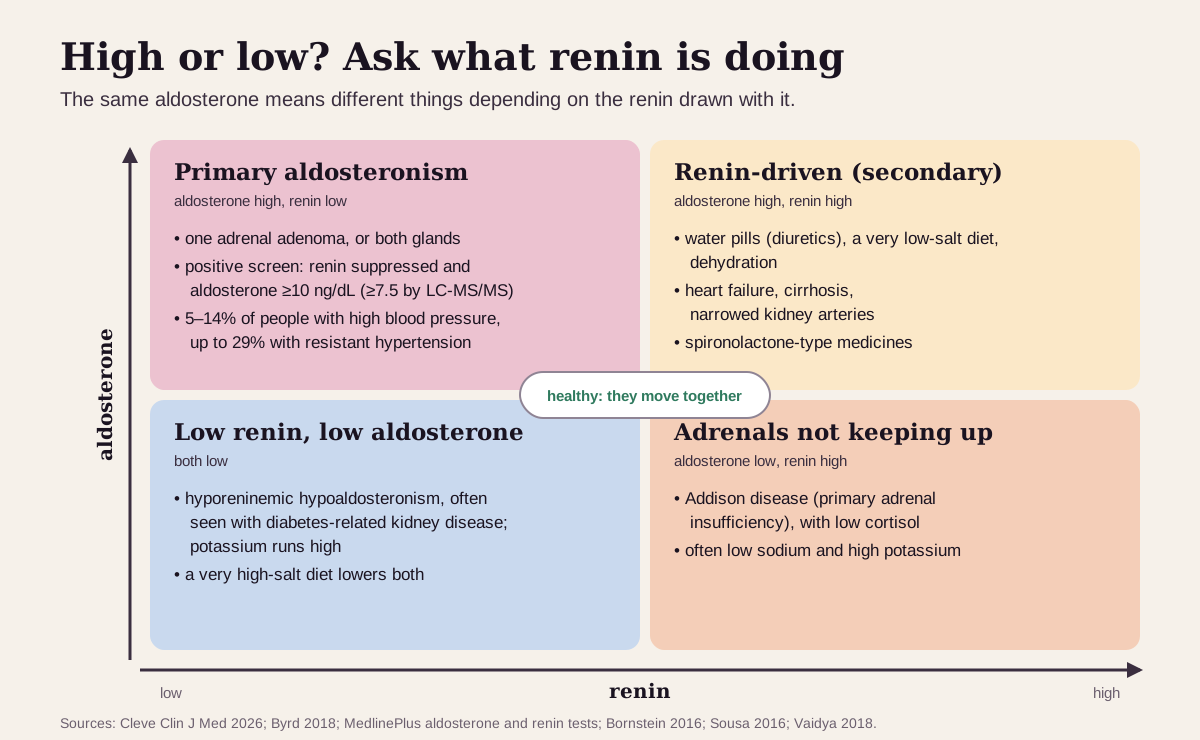
Renin high too: renin-driven (secondary) aldosteronism
Something makes your kidneys sense low volume or low salt, and aldosterone follows renin up.9 The usual suspects:
- Water pills (diuretics) and a very low-salt diet.7
- Dehydration or blood loss.8
- Heart failure and cirrhosis.7 In heart failure, the kidneys sense low flow even though the body holds extra fluid.9
- Narrowed kidney arteries (renovascular hypertension).83
- Spironolactone-type medicines (mineralocorticoid-receptor blockers), which raise aldosterone.7
- Also: Bartter syndrome, a group of rare kidney conditions, and kidney tumors that make renin.78
Renin low: primary aldosteronism
Here one or both adrenal glands make aldosterone on their own. Salt and water build up, renin is pushed down, and aldosterone stays high anyway.9
- It's common. It affects 5–14% of people with high blood pressure and up to 29% with resistant hypertension.2 In a U.S. study that salt-loaded every participant, it turned up in 11.3% of people with normal blood pressure and 22.0% of those with resistant hypertension.13
- It's rarely tested for. Among 269,010 U.S. veterans with hard-to-control blood pressure, only 1.6% were ever tested.14
- Low potassium is the minority. Only 9–37% of people with primary aldosteronism have a low potassium, so most have a normal one.15
- Two main forms. A benign nodule on one adrenal gland (an aldosterone-producing adenoma, usually under 2 cm), which surgery can often cure, or overactivity of both glands, treated with medicine.1
- Rare: inherited forms, including one that responds to steroid treatment (glucocorticoid-remediable aldosteronism).1
The 2025 Endocrine Society guideline suggests screening everyone with high blood pressure.4 The 2016 version limited screening to higher-risk groups: resistant hypertension, a low potassium, an adrenal nodule, sleep apnea, or a family history of early hypertension, stroke or primary aldosteronism.2
Get prompt care if a high aldosterone or a low potassium comes with severe muscle weakness, or if your potassium is above 6.0 mmol/L. With a low aldosterone, fainting, severe weakness, vomiting, belly pain or confusion can mean an adrenal crisis, which is an emergency.356
What a low aldosterone usually means
A low aldosterone usually shows up as a high potassium, sometimes with a low sodium and an acid buildup (metabolic acidosis).3 Renin sorts it again:
- Renin low too: hyporeninemic hypoaldosteronism. It's the most common form of isolated low aldosterone.3 It mostly affects people aged 50–70 with diabetes-related or other chronic kidney disease, and it's the leading cause of a long-running high potassium in people with diabetes.5
- Renin high: the adrenal glands fall short. Addison disease (primary adrenal insufficiency) lowers aldosterone and cortisol together. A high renin with a normal-to-low aldosterone can be an early clue.6
- Medicines: heparin can lower aldosterone production.3 ACE inhibitors, ARBs, NSAIDs, beta-blockers and calcineurin inhibitors can push potassium up in people with this condition.5
- A very high-salt diet lowers aldosterone, which is the system working as designed.7
Aldosterone reads best next to its neighbors
Aldosterone and renin show which way the system is being pushed. Potassium and bicarbonate (the CO2 on a metabolic panel) show the effect on your blood.916
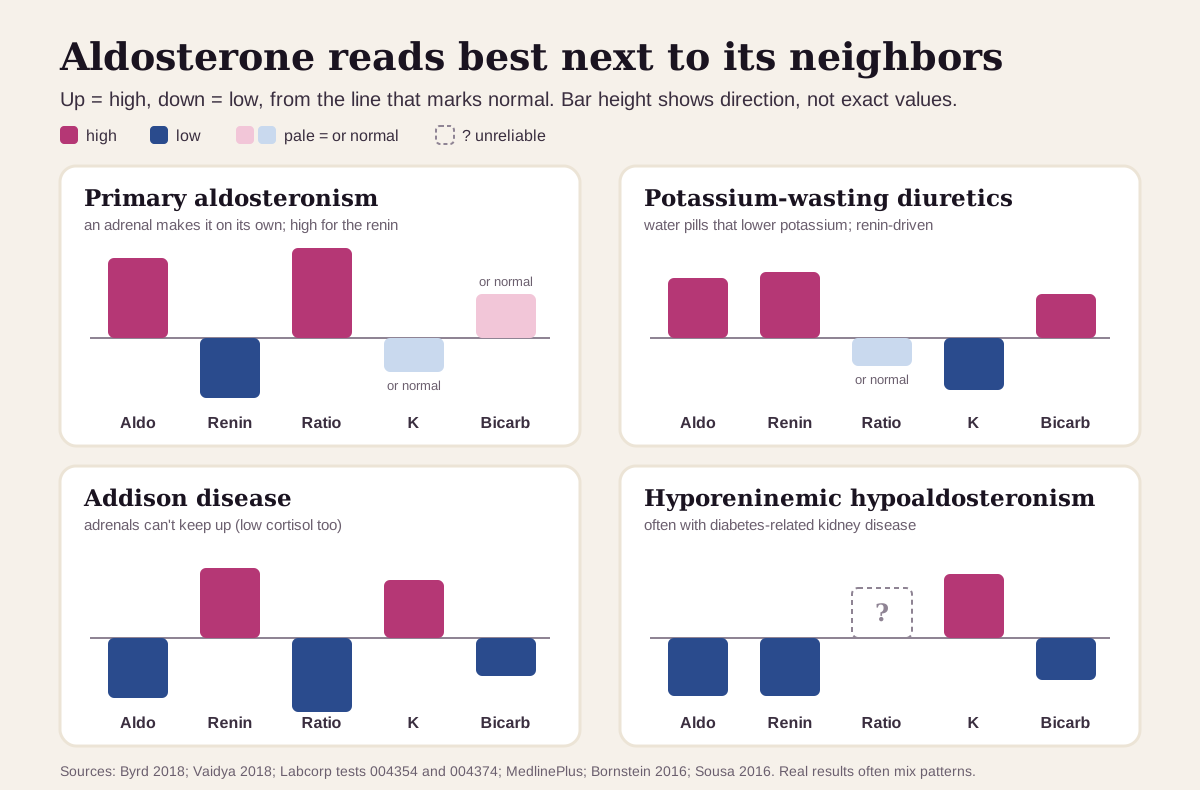
| If you see… | It often points to… |
|---|---|
| Aldosterone high for its renin, renin suppressed, ratio over 20, potassium low or normal, bicarbonate high or normal | primary aldosteronism: an adrenal gland making aldosterone on its own |
| Aldosterone and renin both high, potassium low, bicarbonate high | a potassium-wasting water pill (diuretic); heart failure, cirrhosis, a low-salt diet and narrowed kidney arteries also raise both aldosterone and renin |
| Aldosterone low, renin high, potassium high, sodium low | Addison disease, with a low cortisol too |
| Aldosterone and renin both low, potassium high, bicarbonate low | hyporeninemic hypoaldosteronism, often with diabetes-related kidney disease |
| Ratio over 20 but aldosterone under 10 (7.5 by LC-MS/MS) | a very low renin can inflate the ratio; on its own, this pair falls short of a positive screen |
Medicines shift the pair. Water pills, ACE inhibitors, ARBs and spironolactone-type drugs raise renin and can make a real case look normal. Beta-blockers and clonidine-type drugs lower renin; they and NSAIDs can make the ratio look falsely high.215 Estrogen-containing pills lower direct renin readings.1 Don't stop a prescribed medicine on your own. Bring your list to your clinician: the 2025 guideline allows a first screen on most medicines.2
How fast aldosterone changes
Aldosterone moves within hours. It follows a daily rhythm like cortisol's, highest in the morning, and standing up raises it.63 That's why labs ask for a specific setup. For the ratio, Labcorp wants a mid-morning draw after at least 2 hours up, then 5–15 minutes seated.15
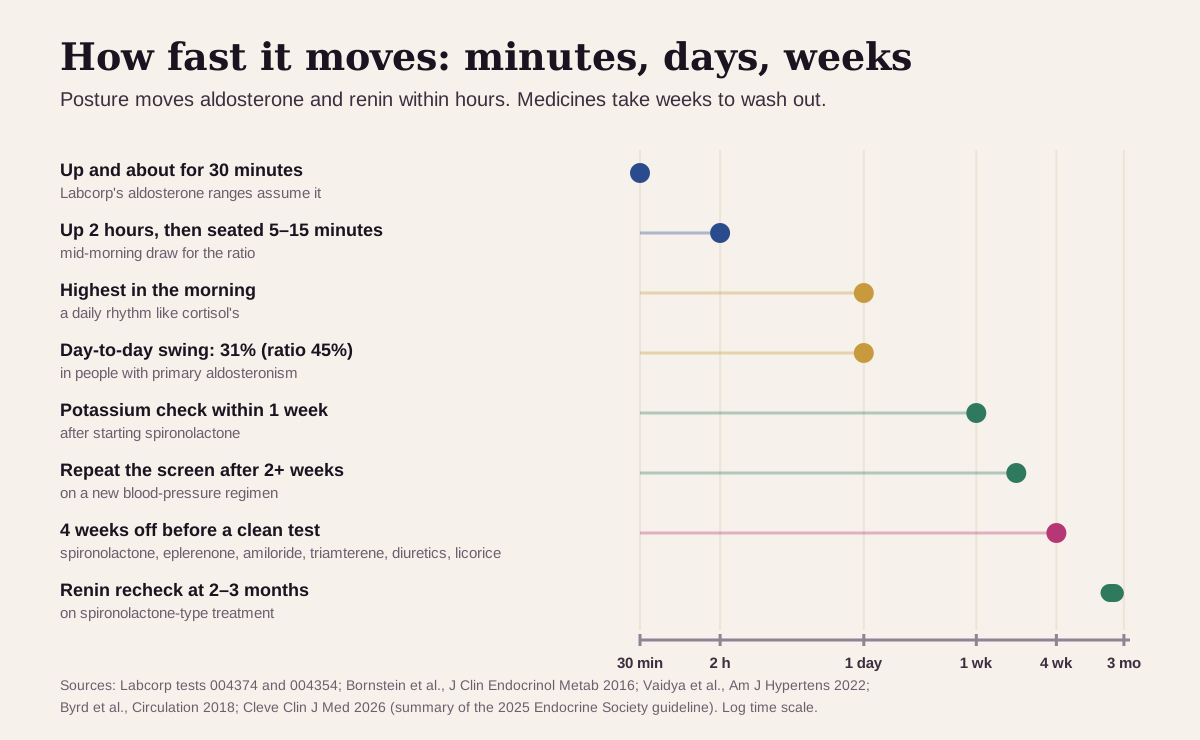
What that means in practice:
- One normal screen may not be the last word. In people with confirmed primary aldosteronism, aldosterone varied 31% from day to day and the ratio 45%; a third had at least one aldosterone under 10.17 The 2025 guideline suggests screening again if blood pressure worsens, potassium drops, or atrial fibrillation appears without another cause.2
- Correct potassium first. A low potassium holds aldosterone down, so clinicians bring potassium up, to about 4.0 mmol/L, before testing.12
- Medicine changes take weeks. Labcorp asks for 4 weeks off spironolactone, eplerenone, amiloride, triamterene, potassium-wasting diuretics and licorice when a clean result is needed. After other blood-pressure medicine changes, a repeat screen waits 2 weeks or more.151
- On treatment, renin is the gauge. After starting spironolactone, potassium and creatinine are checked within a week and renin at 2–3 months.2 Here the trend is the point: a renin that climbs out of the suppressed zone is the goal.124
Going deeper: the ratio and its units
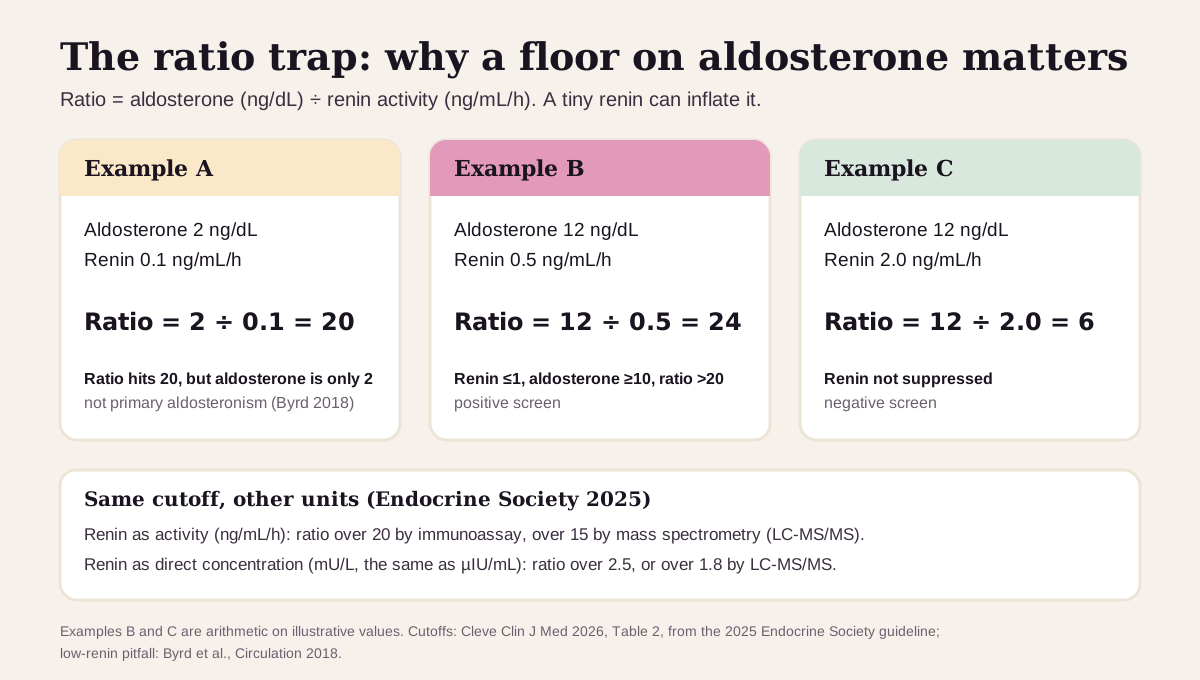
The aldosterone-to-renin ratio divides aldosterone by renin, so a tiny renin inflates it. With a renin activity of 0.1 ng/mL/h, an aldosterone of just 2 ng/dL gives a ratio of 20.1 That's why the guideline also asks for an aldosterone of at least 10 ng/dL (7.5 by LC-MS/MS).2 In the general population the ratio's median is about 5. A cutoff of 20 caught 78% of cases, with 83% specificity, in people with resistant hypertension.1
Your ratio's unit matters. A ratio built on a direct renin in µIU/mL runs on a much smaller scale than one built on renin activity: a direct-renin ratio of 3 is already over the cutoff.2 Check which renin your lab measured before you compare your ratio with any range.
After a positive screen, a specialist often confirms it with a suppression test. After 2 liters of saline over 4 hours, an aldosterone above 10 ng/dL confirms primary aldosteronism.92 If surgery is an option, adrenal vein sampling shows which side makes the excess. A CT scan alone can point to the wrong side, because harmless adrenal nodules are common.118 At specialized centers, removing a one-sided adenoma brings complete biochemical success in 94% of patients.1 The 2025 guideline also suggests an overnight dexamethasone test for anyone with an adenoma, because some make cortisol too.42
Questions worth asking
- Was my renin measured at the same time, and was it suppressed?
- Was it renin activity or direct renin, and which ratio cutoff applies?
- Could any of my medicines have shifted the result, and should we repeat it?
- Was my potassium normal when the blood was drawn?
- Given my blood pressure, should I be screened for primary aldosteronism?
- If the screen is positive, do I need a suppression test, or can we go straight to treatment?
FAQ
What is a normal aldosterone level? It depends on the lab and your posture. Labcorp's adult range is 0.0–30.0 ng/dL after 30 minutes up and about. Read it next to renin.3
What does high aldosterone with low renin mean? It's the pattern of primary aldosteronism. The 2025 Endocrine Society guideline counts a screen as positive when renin is suppressed and aldosterone is 10 ng/dL or more (7.5 by LC-MS/MS).2
Should everyone with high blood pressure be tested? The 2025 Endocrine Society guideline suggests it. Primary aldosteronism affects 5–14% of people with hypertension, and it's treatable.42
Can medicines change aldosterone results? Yes. Water pills, ACE inhibitors and ARBs raise renin; beta-blockers and NSAIDs lower it. Ask your clinician before stopping anything.15
This guide is for education. It can't diagnose you or replace care from a clinician who knows your history.
Footnotes
-
Byrd JB, Turcu AF, Auchus RJ. Primary Aldosteronism: Practical Approach to Diagnosis and Management. Circulation. 2018;138(8):823–835. Physiology, the ratio's pitfalls (median about 5; 78% sensitivity and 83% specificity at 20), sampling, medicine effects and subtyping. PMC ↩ ↩2 ↩3 ↩4 ↩5 ↩6 ↩7 ↩8 ↩9 ↩10 ↩11 ↩12 ↩13 ↩14 ↩15 ↩16 ↩17 ↩18 ↩19 ↩20 ↩21 ↩22
-
Bindukumari Sureshkumar N, Linz MO, Rao PP, Correa R. Primary aldosteronism: Interpreting the 2025 Endocrine Society clinical practice guideline update. Cleve Clin J Med. 2026;93(9):515–522. Open summary of the 2025 guideline, with its assay-specific screening cutoffs (Table 2), prevalence (5–14%, up to 29% in resistant hypertension) and follow-up timing. DOI ↩ ↩2 ↩3 ↩4 ↩5 ↩6 ↩7 ↩8 ↩9 ↩10 ↩11 ↩12 ↩13 ↩14 ↩15 ↩16 ↩17 ↩18 ↩19 ↩20 ↩21 ↩22 ↩23 ↩24 ↩25 ↩26
-
Labcorp. Aldosterone, LC/MS (test 004374). Reference range, posture and salt requirements, and background on aldosterone excess and deficiency. Labcorp is a commercial laboratory; its published range is cited as a lab standard. labcorp.com ↩ ↩2 ↩3 ↩4 ↩5 ↩6 ↩7 ↩8 ↩9 ↩10 ↩11 ↩12 ↩13 ↩14 ↩15 ↩16 ↩17 ↩18
-
Adler GK, Stowasser M, Correa RR, et al. Primary Aldosteronism: An Endocrine Society Clinical Practice Guideline. J Clin Endocrinol Metab. 2025;110(9):2453–2495. The current guideline: screen everyone with hypertension, favor spironolactone, titrate treatment to raise renin, and test adenomas for cortisol. PubMed ↩ ↩2 ↩3 ↩4 ↩5 ↩6
-
Sousa AG, Cabral JV, El-Feghaly WB, de Sousa LS, Nunes AB. Hyporeninemic hypoaldosteronism and diabetes mellitus: Pathophysiology assumptions, clinical aspects and implications for management. World J Diabetes. 2016;7(5):101–111. Who gets it, its lab pattern, and the hyperkalemia threshold (above 5.5–6.0 mmol/L). PMC ↩ ↩2 ↩3 ↩4 ↩5 ↩6 ↩7
-
Bornstein SR, Allolio B, Arlt W, et al. Diagnosis and Treatment of Primary Adrenal Insufficiency: An Endocrine Society Clinical Practice Guideline. J Clin Endocrinol Metab. 2016;101(2):364–389. Signs of adrenal insufficiency and crisis, the renin–aldosterone pattern, the morning peak and pregnancy. PMC ↩ ↩2 ↩3 ↩4 ↩5 ↩6 ↩7 ↩8 ↩9
-
National Library of Medicine. Aldosterone blood test. MedlinePlus Medical Encyclopedia. Why it's ordered, what affects it, and causes of high and low results. MedlinePlus ↩ ↩2 ↩3 ↩4 ↩5 ↩6 ↩7 ↩8 ↩9 ↩10 ↩11 ↩12
-
National Library of Medicine. Renin blood test. MedlinePlus Medical Encyclopedia. Lying and standing ranges, and causes of high and low renin. MedlinePlus ↩ ↩2 ↩3 ↩4 ↩5 ↩6
-
Vaidya A, Mulatero P, Baudrand R, Adler GK. The Expanding Spectrum of Primary Aldosteronism: Implications for Diagnosis, Pathogenesis, and Treatment. Endocr Rev. 2018;39(6):1057–1088. Primary vs secondary aldosteronism, metabolic alkalosis, and the suppression-test cut points. PMC ↩ ↩2 ↩3 ↩4 ↩5 ↩6 ↩7 ↩8 ↩9 ↩10 ↩11
-
Vasan RS, Evans JC, Larson MG, et al. Serum aldosterone and the incidence of hypertension in nonhypertensive persons. N Engl J Med. 2004;351(1):33–41. 1,688 Framingham Offspring participants followed for 4 years. PubMed ↩ ↩2
-
Monticone S, D'Ascenzo F, Moretti C, et al. Cardiovascular events and target organ damage in primary aldosteronism compared with essential hypertension: a systematic review and meta-analysis. Lancet Diabetes Endocrinol. 2018;6(1):41–50. 31 studies, 3,838 people with primary aldosteronism. PubMed ↩ ↩2
-
Hundemer GL, Curhan GC, Yozamp N, Wang M, Vaidya A. Cardiometabolic outcomes and mortality in medically treated primary aldosteronism: a retrospective cohort study. Lancet Diabetes Endocrinol. 2018;6(1):51–59. 602 treated patients vs 41,853 with essential hypertension; excess risk only when renin stayed suppressed. PMC ↩ ↩2 ↩3
-
Brown JM, Siddiqui M, Calhoun DA, et al. The Unrecognized Prevalence of Primary Aldosteronism: A Cross-sectional Study. Ann Intern Med. 2020;173(1):10–20. 1,015 U.S. participants salt-loaded regardless of screening results. PMC ↩
-
Cohen JB, Cohen DL, Herman DS, et al. Testing for Primary Aldosteronism and Mineralocorticoid Receptor Antagonist Use Among U.S. Veterans: A Retrospective Cohort Study. Ann Intern Med. 2021;174(3):289–297. 1.6% of 269,010 veterans with resistant hypertension were tested. PMC ↩
-
Labcorp. Aldosterone:Renin Ratio (test 004354). Ratio range (0.0–30.0 ng/dL per ng/mL/hour), sampling instructions, medicine washout and the factors that push the ratio up or down. Labcorp is a commercial laboratory. labcorp.com ↩ ↩2 ↩3 ↩4 ↩5 ↩6 ↩7
-
National Library of Medicine. Alkalosis. MedlinePlus Medical Encyclopedia. Diuretics as a cause of low-potassium (hypokalemic) alkalosis. MedlinePlus ↩ ↩2
-
Vaidya A, Hundemer GL, Nanba K, Parksook WW, Brown JM. Primary Aldosteronism: State-of-the-Art Review. Am J Hypertens. 2022;35(12):967–988. Day-to-day variability of aldosterone (31%) and the ratio (45%). PMC ↩ ↩2
-
National Library of Medicine. Primary and secondary hyperaldosteronism. MedlinePlus Medical Encyclopedia. Symptoms, and why a CT scan alone can pick the wrong adrenal gland. MedlinePlus ↩
Educational content, not medical advice. Libby is a personal record tool, not a medical service — it doesn't diagnose, treat, or prescribe. Reference ranges vary by lab and by person. Talk to a qualified healthcare professional about your results.
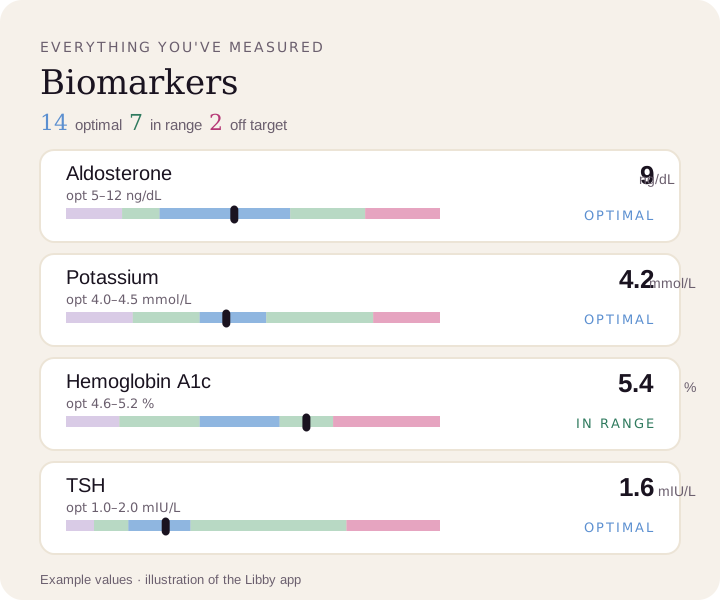
Compare your results to optimal ranges.
Upload a lab PDF or a photo of your report. Libby puts each marker on your lab's range and, where one exists, the optimal range, and tracks your trends over time.
View your aldosterone ›