Renin blood test: normal ranges, high and low causes
Renin is the kidney hormone that starts the blood-pressure chain. What's normal, how posture, salt and pills move it, and what high or low renin means.
Renin is a hormone your kidneys release when your blood pressure, blood volume or salt runs low. It starts a chain that ends with aldosterone and a higher blood pressure. So a renin result tells you how hard your body is working to hold on to salt and pressure, and it moves within minutes when you stand up, eat less salt or take a blood-pressure pill.12
The short version
- Normal depends on the test and your posture. For renin activity, ARUP lists 0.5–4.0 ng/mL/h upright and 0.2–1.6 lying down for adults; Labcorp prints 0.167–5.380. Direct renin uses different units.34
- High renin usually means your body is defending salt and pressure: standing before the draw, low-salt eating, water pills, ACE inhibitors or ARBs, or dehydration. Less often it's a narrowed kidney artery or adrenal failure.42
- Low renin usually comes from high salt intake, beta-blockers or NSAIDs, older age or lower kidney function. With high blood pressure, it can point to primary aldosteronism. The Endocrine Society calls renin "suppressed" at 1 ng/mL/h or less (activity) or 8.2 mU/L or less (direct).45
- Urgent: a renin number by itself never is. High renin with low sodium, high potassium, fainting or vomiting can mean adrenal crisis, an emergency.6
What renin is
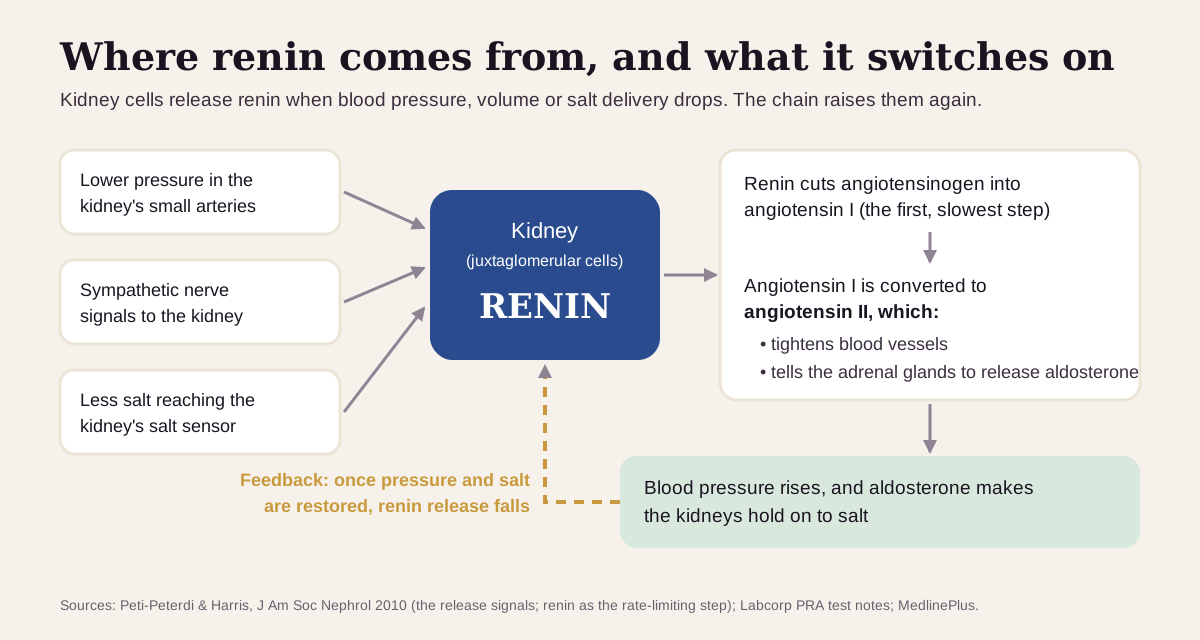
Renin comes from special cells in the walls of the kidney's small arteries (the juxtaglomerular cells). Four signals make them release more: lower pressure in those arteries, sympathetic nerve signals to the kidney, less salt reaching the kidney's salt-sensing cells (the macula densa), and lower levels of local hormones such as angiotensin II.1
Renin is an enzyme. It cuts a blood protein, angiotensinogen, into angiotensin I, which is then converted to angiotensin II. Angiotensin II tightens blood vessels and tells the adrenal glands to release aldosterone, which helps the kidneys balance sodium and potassium and keeps blood pressure steady.42 Renin's cut is the first and rate-limiting step of the whole system, so renin sets the pace for everything after it.1
Usually renin and aldosterone move together.2 When they split apart, one high and one low, that split is often the most telling part of the result (see neighbors below).
Most people get a renin test because of high blood pressure that is hard to control, low potassium, or a question about the adrenal glands.2 The Endocrine Society's 2025 guideline now suggests that everyone with high blood pressure be screened with renin and aldosterone.5
What's a normal renin?
Start with the range printed on your report, and check two things beside it: which test (activity or direct renin) and your posture when the blood was drawn.
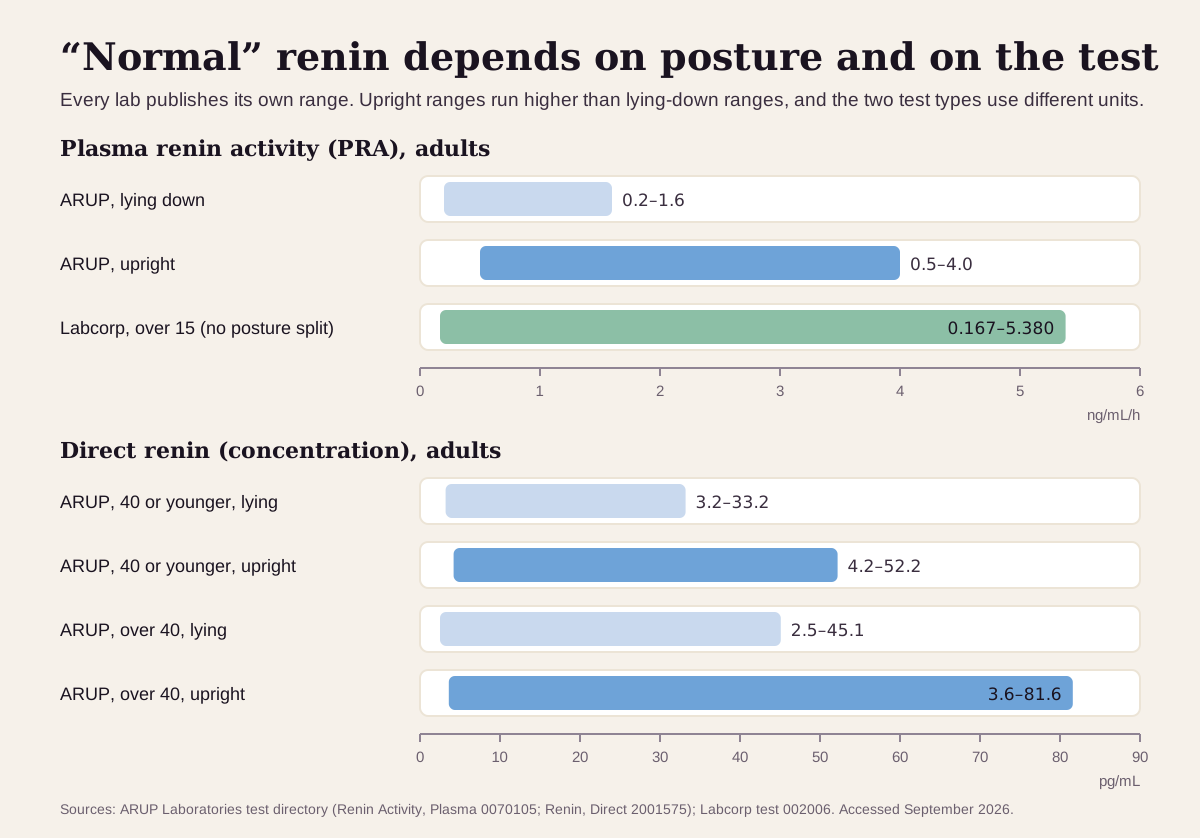
- Posture. Standing lowers the pressure inside the kidney's arteries, so renin rises. ARUP's adult range for renin activity is 0.2–1.6 ng/mL/h lying down and 0.5–4.0 upright.34
- Time of day. Renin is highest early in the morning on waking and falls through the day.4
- Salt. Eating less salt raises renin; eating more lowers it.4 In a Cochrane review of salt-reduction trials, cutting salt raised renin activity by an average of 1.56 ng/mL/h (82 trials, 2,904 people).7 That's a big shift next to ARUP's upright adult range of 0.5–4.0.3
- Age and kidneys. Renin drifts down with age and as kidney function falls.4 ARUP's direct-renin upper limits are higher over 40, so check which age band your lab used.3
Labcorp's adult range for renin activity (0.167–5.380 ng/mL/h) has no posture split, and it spans both of ARUP's.43
"Optimal" renin: what health optimizers aim for
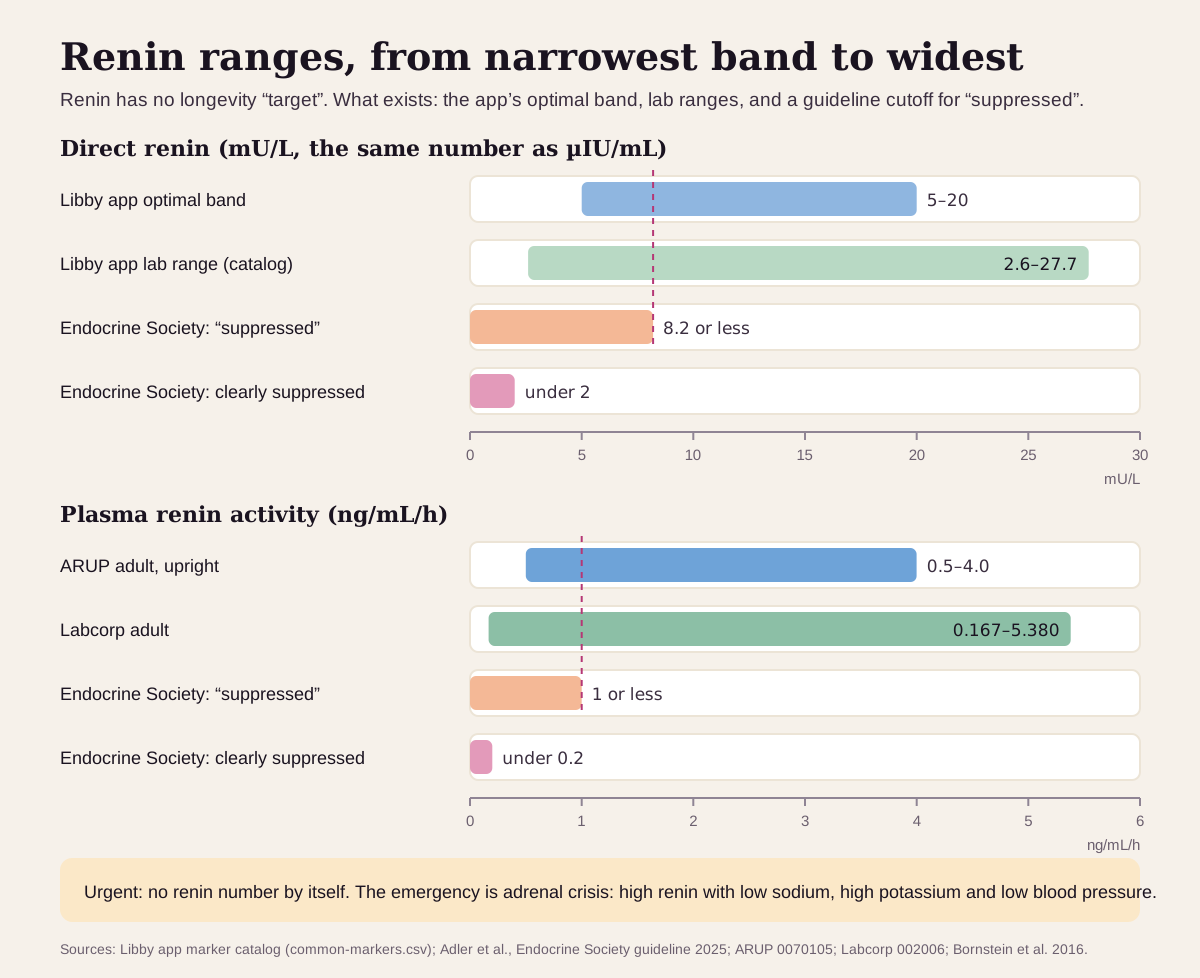
Renin is a two-sided marker: both high and low values mean something, and "lower is better" doesn't apply. What exists is a ladder of bands, from the Libby app's optimal band out to the lab ranges, plus a guideline cutoff for when renin counts as suppressed:
| Band | Direct renin (mU/L = µIU/mL) | Renin activity (ng/mL/h) | Who uses it |
|---|---|---|---|
| Libby app optimal | 5–20 | not set | The optimal band shown in the Libby app, for all adults. The app's catalog credits it to the Endocrine Society, whose 2025 guideline publishes cutoffs for suppressed renin rather than an optimal band5 |
| Libby app lab range | 2.6–27.7 | not set | The reference range the app's catalog uses for direct renin |
| Lab reference range | ARUP: 4.2–52.2 pg/mL upright (40 or younger), a different unit | ARUP 0.5–4.0 upright; Labcorp 0.167–5.380 | National lab ranges for adults34 |
| "Suppressed" (guideline cutoff) | 8.2 or less; clearly suppressed under 2 | 1 or less; clearly suppressed under 0.2 | Endocrine Society 2025, as part of screening for primary aldosteronism when aldosterone is also high5 |
| Urgent | no renin number | no renin number | Adrenal crisis: high renin with low sodium, high potassium and low blood pressure6 |
Notice the overlap at the bottom: a direct renin of 5–8.2 mU/L sits inside the app's optimal band but counts as suppressed on the Endocrine Society's screen if aldosterone is high at the same time.5 That's why a low-normal renin is read next to aldosterone.
Why renin matters beyond a single workup:
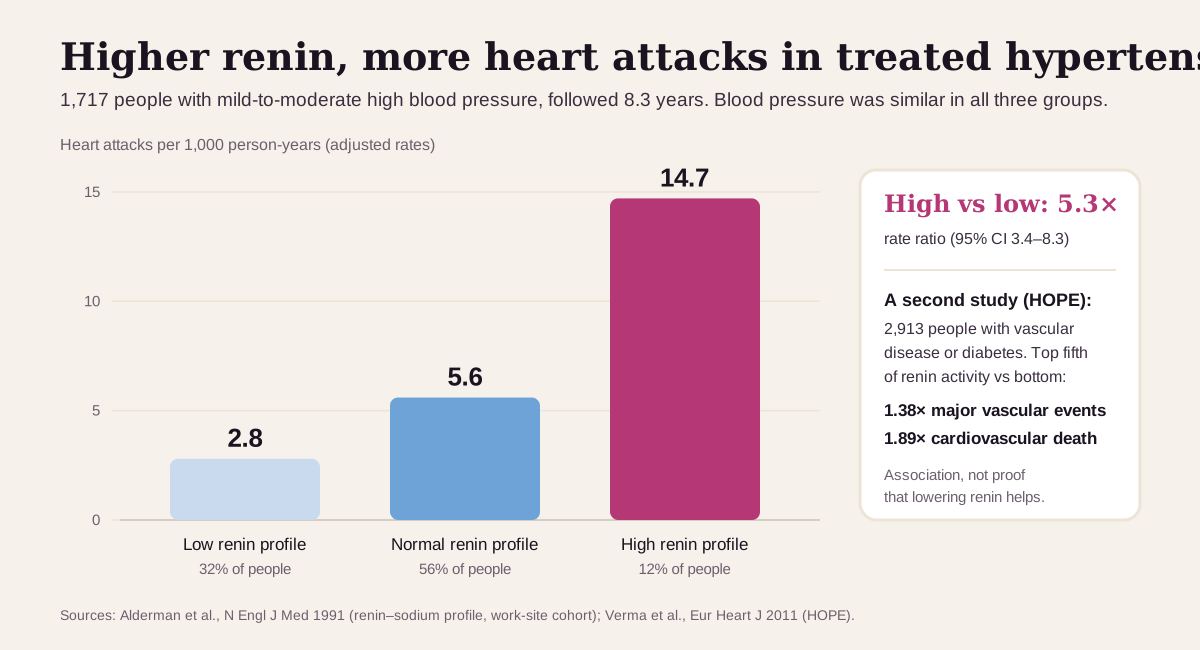
- In 1,717 people with mild-to-moderate high blood pressure followed for 8.3 years, those with a high renin profile (renin activity judged against their salt intake) had 14.7 heart attacks per 1,000 person-years, versus 5.6 with a normal profile and 2.8 with a low one. That's a 5.3-fold difference between high and low, at similar blood pressures.8
- In the HOPE study of 2,913 people with vascular disease or diabetes, the top fifth of renin activity had 1.38 times the risk of major vascular events and 1.89 times the risk of cardiovascular death compared with the bottom fifth, after adjusting for medicines and other markers.9
Keep "optimal" in perspective. A renin value is a snapshot of how your body is balancing salt and pressure at that moment, and posture, salt and medicines can triple it.107 Low renin is common (up to 30% of people with high blood pressure have it), and it's also the setting where primary aldosteronism hides.115 High renin on a diuretic is expected; high renin with no explanation deserves a look.4
What high or low renin usually means
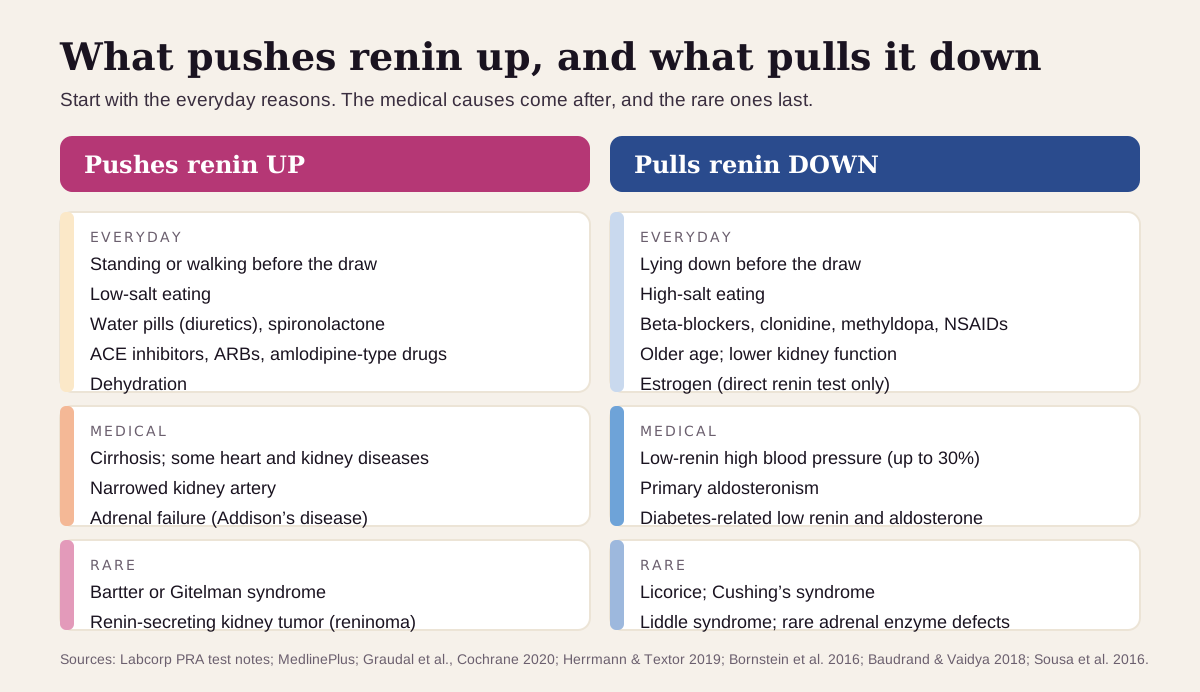
Start with the everyday reasons. Posture, salt and medicines all move renin, so check those before anything else.4
High renin
The usual suspects:
- Medicines. Diuretics (including spironolactone), ACE inhibitors, ARBs and dihydropyridine calcium-channel blockers such as amlodipine all tend to raise renin.4 On these drugs a high renin is the expected response. Don't stop a prescribed medicine on your own; bring your full list to your clinician.2
- Low salt or low fluid. A low-salt diet and dehydration both raise renin.72
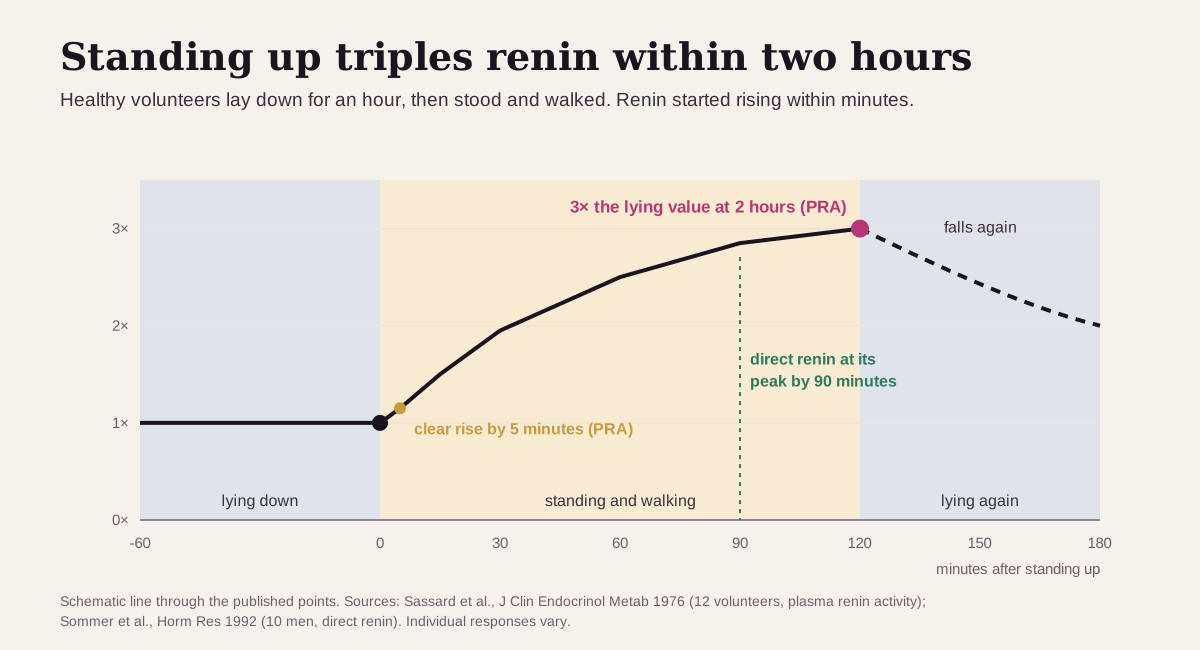
- Standing before the draw. Renin roughly triples over two hours upright (see how fast it changes).10
- Liver, heart or kidney disease. Cirrhosis and other conditions of the heart, liver and kidneys can drive renin and aldosterone up together, which doctors call secondary aldosteronism.2
Less common, and worth finding:
- A narrowed kidney artery (renovascular hypertension). About 90% of cases come from hardened, plaque-narrowed arteries and 9% from fibromuscular dysplasia. Renin release starts once the pressure beyond the narrowing falls 10–20%. Renin alone is a weak screen for it, because renin also swings with salt and fluid status; imaging such as a kidney-artery ultrasound looks for the narrowing.12
- Adrenal failure (Addison's disease). The adrenals stop making cortisol and aldosterone, so renin climbs while aldosterone stays low or "normal".6 It's rare, about 100–140 people per million.6
- Rare: salt-losing kidney conditions (Bartter and Gitelman syndromes), salt-wasting forms of congenital adrenal hyperplasia, and a renin-secreting kidney tumor (reninoma), an uncommon but curable cause of high blood pressure with low potassium in young adults.414
Low renin
The usual suspects:
- High salt intake, lying down before the draw, and beta-blockers, clonidine, methyldopa or NSAIDs.4
- Older age and lower kidney function, which gradually reduce how much renin the kidneys can make.4
- Estrogen, on the direct-renin test only. Estrogen raises angiotensinogen, so direct renin reads lower while renin activity stays normal.43
- Low-renin high blood pressure. Up to 30% of people with high blood pressure have a low or suppressed renin, depending on age. High salt intake, obesity and diabetes all push toward it.11
Less common, and worth finding:
- Primary aldosteronism. The adrenals make aldosterone on their own, which holds salt and shuts renin off. It's a common, treatable cause of high blood pressure, and the Endocrine Society screens for it with renin and aldosterone together.5 Most people with it have a normal potassium.4
- Diabetes- or kidney-related low renin and aldosterone (hyporeninemic hypoaldosteronism). It's the most important cause of chronic high potassium in diabetes; about half of people with it have diabetes. NSAIDs and calcineurin inhibitors can do the same.13
- Another salt-retaining signal. Cushing's syndrome, eating natural black licorice, rare adrenal enzyme defects, and Liddle syndrome all mimic aldosterone, so renin and aldosterone both fall.4112
Get emergency care if high renin or a known adrenal problem comes with severe weakness, fainting, very low blood pressure, belly pain with vomiting, or confusion. Those are signs of adrenal crisis, a medical emergency.6 Muscle cramps, weakness and a racing heartbeat can mean low potassium: get checked promptly.2
Renin reads best next to its neighbors
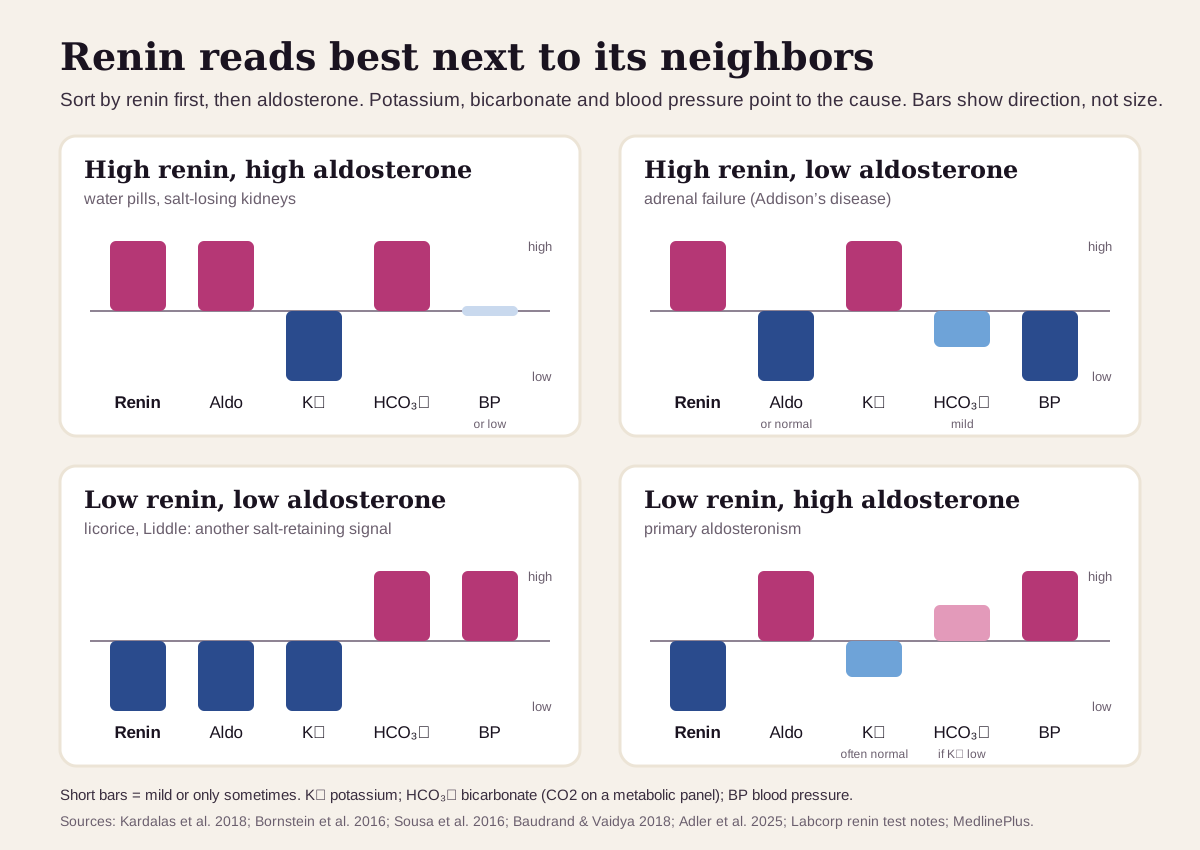
Renin is usually ordered with aldosterone.2 Sort the pair first (which is high, which is low), then let potassium, bicarbonate (the CO2 on a metabolic panel) and blood pressure point to the cause:
| If you see… | It often points to… |
|---|---|
| Renin and aldosterone both high, potassium low, bicarbonate high, normal blood pressure | water pills, or a salt-losing kidney condition such as Bartter or Gitelman syndrome144 |
| Renin and aldosterone both high with high blood pressure | a narrowed kidney artery; potassium runs low in some cases12 |
| Renin high, aldosterone low or "normal", sodium low, potassium high, low blood pressure | adrenal failure (Addison's disease)6 |
| Renin and aldosterone both low, potassium low, high blood pressure | another salt-retaining signal: licorice, Liddle syndrome, Cushing's syndrome112 |
| Renin and aldosterone both low, potassium high, bicarbonate low | diabetes- or kidney-related low renin and aldosterone, or NSAIDs13 |
| Renin low, aldosterone high, high blood pressure | primary aldosteronism, the reason renin and aldosterone are screened as a ratio425 |
How fast renin changes
Renin moves in minutes. In healthy volunteers who stood up after an hour lying down, renin activity rose clearly by 5 minutes and was 3 times the lying value after 2 hours.10 Direct renin rose within 15 minutes and peaked by 90 minutes.15 Both fell again once people lay back down.
What that means in practice:
- How you're drawn matters. Labs ask for blood in the morning while seated, after you've been up and about. Labcorp notes that a mid-morning seated draw after 2–4 hours upright makes the test more sensitive, and asks for at least 30 minutes walking around first.4 If you must be drawn lying down, ARUP asks for 30 minutes lying first.3
- Keep your usual salt. Labcorp asks for unrestricted salt intake before testing, because a low-salt stretch raises renin.4
- Medicines take weeks to wash out. When a clinician does pause medicines for testing, spironolactone, eplerenone, amiloride, triamterene and potassium-wasting diuretics need at least 4 weeks, per the Endocrine Society guidance Labcorp cites.4 Skip natural black licorice for 2 weeks before the test.2
- Trends beat snapshots. Posture, salt and medicines all move renin, so compare results drawn the same way, from the same lab and the same test type.43
Going deeper: renin activity vs direct renin
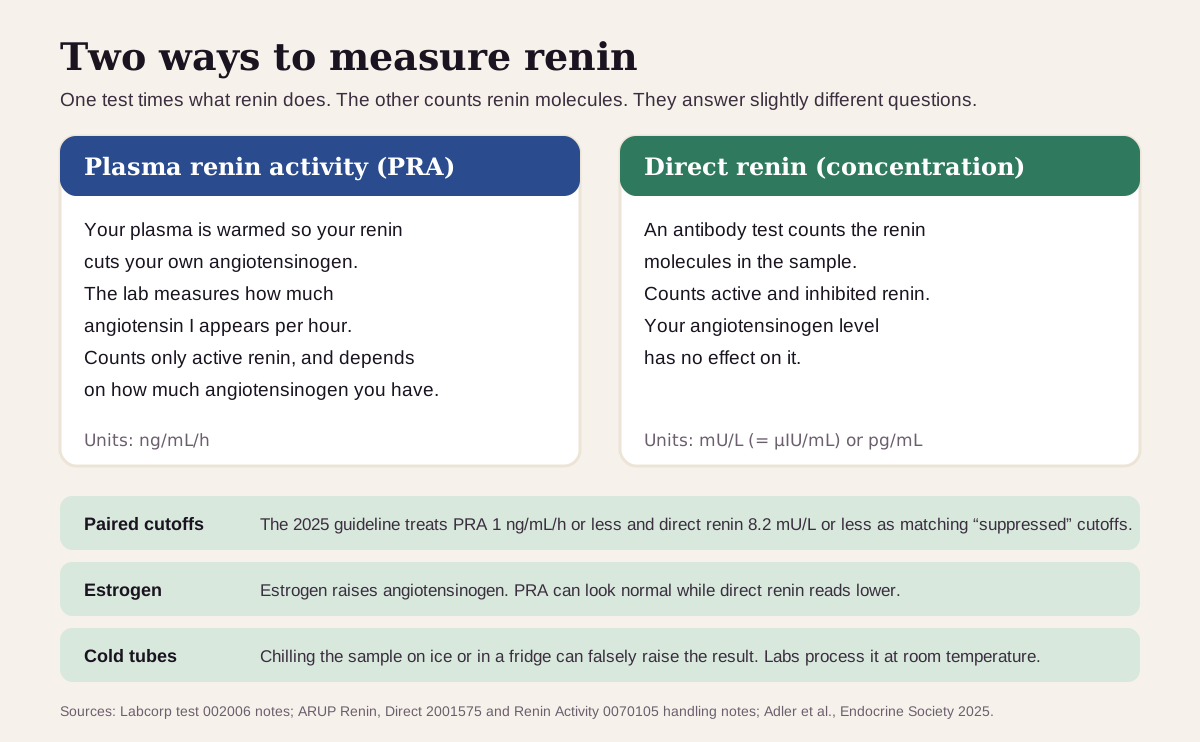
Labs measure renin two ways:
- Plasma renin activity (PRA) warms your plasma so your renin works on your own angiotensinogen, then measures the angiotensin I it makes per hour (ng/mL/h). It counts only active renin, and it depends on how much angiotensinogen you have.4
- Direct renin uses antibodies to count renin molecules (mU/L, µIU/mL or pg/mL). It counts both active and inhibited renin, and your angiotensinogen level has no effect on it.4
The two track each other closely,15 and the Endocrine Society's 2025 guideline treats 1 ng/mL/h (activity) and 8.2 mU/L (direct) as matching cutoffs for suppressed renin.5 They split apart when angiotensinogen is high: women in the second half of the menstrual cycle or taking estrogen can have a normal renin activity but a low direct renin, which can make an aldosterone-to-renin ratio look falsely high.43
Handling matters too. Chilling the tube on ice or in a fridge can falsely raise renin, so labs collect and spin it at room temperature and then freeze the plasma.3
Questions worth asking
- Was my renin measured as activity (PRA) or direct renin, and which range did the lab use?
- Was I sitting, standing or lying down, and what time was I drawn?
- Which of my medicines could be moving my renin, and should anything change before a retest?
- What did my aldosterone, potassium and sodium show on the same draw?
- Does my blood pressure pattern fit a narrowed kidney artery, low-renin hypertension or primary aldosteronism?
- When should we repeat it, and under what conditions?
FAQ
What is a normal renin level? It depends on the test and your posture. For adult renin activity, ARUP lists 0.5–4.0 ng/mL/h upright and 0.2–1.6 lying down; Labcorp lists 0.167–5.380.34 Direct renin uses different units, so compare with the range on your own report.
What causes high renin? Most often standing before the draw, low salt intake, dehydration, or medicines such as diuretics, ACE inhibitors and ARBs. Less often a narrowed kidney artery, adrenal failure, or liver, heart or kidney disease.4212
What does a low renin mean? Often high salt intake, beta-blockers or NSAIDs, or older age. With high blood pressure it can be low-renin hypertension, which affects up to 30% of people with hypertension, or primary aldosteronism, which is screened with aldosterone alongside renin.4115
Should I stop my medicines before a renin test? Only if your clinician tells you to. Some pauses take at least 4 weeks to work, and stopping blood-pressure medicine can be unsafe.42 Avoid natural black licorice for 2 weeks beforehand.2
This guide is for education. It can't diagnose you or replace care from a clinician who knows your history.
Footnotes
-
Peti-Peterdi J, Harris RC. Macula densa sensing and signaling mechanisms of renin release. J Am Soc Nephrol. 2010;21(7):1093–1096. The source for the four release signals and for renin as the rate-limiting step of the renin-angiotensin system. PMC ↩ ↩2 ↩3
-
National Library of Medicine. Renin Test. MedlinePlus. Last updated September 24, 2024. Plain-language causes of high and low renin, the four renin–aldosterone pairings, medicine and licorice advice. MedlinePlus ↩ ↩2 ↩3 ↩4 ↩5 ↩6 ↩7 ↩8 ↩9 ↩10 ↩11 ↩12 ↩13 ↩14 ↩15 ↩16 ↩17 ↩18 ↩19
-
ARUP Laboratories. Renin, Direct (2001575) and Renin Activity, Plasma (0070105). Laboratory Test Directory, accessed September 23, 2026. A commercial reference-lab catalog with posture- and age-specific adult ranges, the estrogen note, and the room-temperature handling rule. ARUP direct renin · ARUP renin activity ↩ ↩2 ↩3 ↩4 ↩5 ↩6 ↩7 ↩8 ↩9 ↩10 ↩11 ↩12 ↩13 ↩14 ↩15
-
Labcorp. Renin Activity, Plasma (test 002006) and Aldosterone:Renin Ratio (test 004354). Test catalog, accessed September 23, 2026. A commercial laboratory's published adult range (0.167–5.380 ng/mL/h, over age 15) and test notes on posture, time of day, salt, age, medicines, activity vs direct renin, and conditions with low or high renin. Labcorp 002006 · Labcorp 004354 ↩ ↩2 ↩3 ↩4 ↩5 ↩6 ↩7 ↩8 ↩9 ↩10 ↩11 ↩12 ↩13 ↩14 ↩15 ↩16 ↩17 ↩18 ↩19 ↩20 ↩21 ↩22 ↩23 ↩24 ↩25 ↩26 ↩27 ↩28 ↩29 ↩30 ↩31 ↩32 ↩33 ↩34 ↩35 ↩36 ↩37
-
Adler GK, Stowasser M, Correa RR, et al. Primary Aldosteronism: An Endocrine Society Clinical Practice Guideline. J Clin Endocrinol Metab. 2025;110(9):2453–2495. Suggests screening everyone with hypertension; defines suppressed renin as activity ≤1 ng/mL/h or direct renin ≤8.2 mU/L (clearly suppressed below 0.2 and 2). PubMed · DOI ↩ ↩2 ↩3 ↩4 ↩5 ↩6 ↩7 ↩8 ↩9 ↩10 ↩11 ↩12 ↩13
-
Bornstein SR, Allolio B, Arlt W, et al. Diagnosis and Treatment of Primary Adrenal Insufficiency: An Endocrine Society Clinical Practice Guideline. J Clin Endocrinol Metab. 2016;101(2):364–389. High renin with low or inappropriately normal aldosterone, the electrolyte and blood-pressure signs, adrenal crisis, and prevalence. PMC ↩ ↩2 ↩3 ↩4 ↩5 ↩6 ↩7 ↩8 ↩9
-
Graudal NA, Hubeck-Graudal T, Jurgens G. Effects of low sodium diet versus high sodium diet on blood pressure, renin, aldosterone, catecholamines, cholesterol, and triglyceride. Cochrane Database Syst Rev. 2020;12(12):CD004022. Sodium reduction raised renin activity by 1.56 ng/mL/h (95% CI 1.39–1.73; 82 trials, 2,904 participants). PMC ↩ ↩2 ↩3 ↩4
-
Alderman MH, Madhavan S, Ooi WL, Cohen H, Sealey JE, Laragh JH. Association of the renin-sodium profile with the risk of myocardial infarction in patients with hypertension. N Engl J Med. 1991;324(16):1098–1104. 1,717 treated patients followed 8.3 years; heart attacks per 1,000 person-years 14.7, 5.6 and 2.8 for high, normal and low renin profiles. PubMed ↩ ↩2
-
Verma S, Gupta M, Holmes DT, et al. Plasma renin activity predicts cardiovascular mortality in the Heart Outcomes Prevention Evaluation (HOPE) study. Eur Heart J. 2011;32(17):2135–2142. 2,913 patients, median 4.5 years; top vs bottom fifth HR 1.38 for major vascular events and 1.89 for cardiovascular death. PubMed ↩ ↩2
-
Sassard J, Vincent M, Annat G, Bizollon CA. A kinetic study of plasma renin and aldosterone during changes of posture in man. J Clin Endocrinol Metab. 1976;42(1):20–27. 12 healthy volunteers: renin activity up by 5 minutes of standing and 3 times the lying value at 120 minutes. PubMed ↩ ↩2 ↩3 ↩4
-
Baudrand R, Vaidya A. The Low-Renin Hypertension Phenotype: Genetics and the Role of the Mineralocorticoid Receptor. Int J Mol Sci. 2018;19(2):546. Low-renin hypertension in up to 30% of people with hypertension; licorice, Liddle syndrome and other causes of low renin with low aldosterone. PMC ↩ ↩2 ↩3 ↩4 ↩5 ↩6 ↩7
-
Herrmann SM, Textor SC. Renovascular Hypertension. Endocrinol Metab Clin North Am. 2019;48(4):765–778. Causes (90% atherosclerotic, 9% fibromuscular dysplasia), the 10–20% pressure drop that triggers renin release, and the limited value of renin alone. PMC ↩ ↩2 ↩3 ↩4
-
Sousa AG, Cabral JV, El-Feghaly WB, de Sousa LS, Nunes AB. Hyporeninemic hypoaldosteronism and diabetes mellitus: Pathophysiology assumptions, clinical aspects and implications for management. World J Diabetes. 2016;7(5):101–111. Low renin and aldosterone with high potassium and mild acidosis; diabetes, NSAIDs and calcineurin inhibitors. PMC ↩ ↩2 ↩3 ↩4
-
Kardalas E, Paschou SA, Anagnostis P, et al. Hypokalemia: a clinical update. Endocr Connect. 2018;7(4):R135–R146. Diuretics, Bartter and Gitelman syndromes: low potassium and metabolic alkalosis with high renin and aldosterone; the causes to consider with high blood pressure. PMC ↩ ↩2 ↩3
-
Sommer L, Quade A, Hartmann K, Bidlingmaier F, Klingmüller D. Direct measurement of immunoreactive renin during changes of posture in man. Horm Res. 1992;37(4-5):171–175. 10 healthy men: direct renin up by 15 minutes, peak by 90 minutes. PubMed ↩ ↩2 ↩3
Educational content, not medical advice. Libby is a personal record tool, not a medical service — it doesn't diagnose, treat, or prescribe. Reference ranges vary by lab and by person. Talk to a qualified healthcare professional about your results.
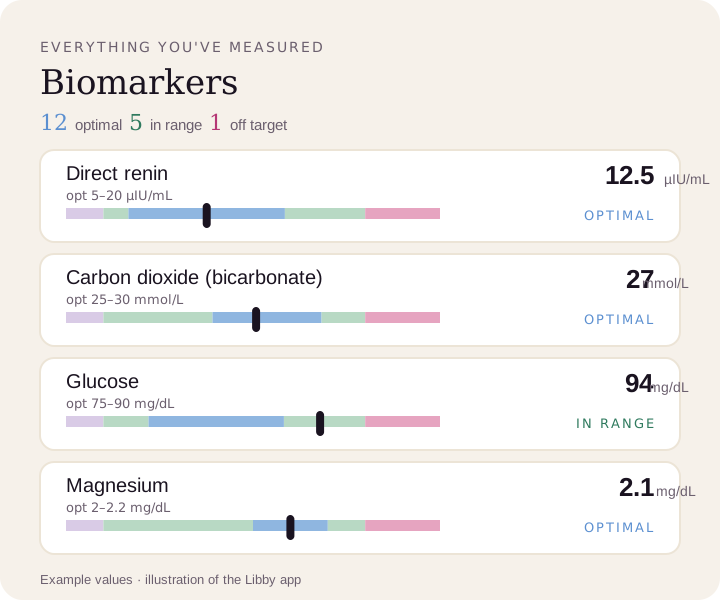
Compare your results to optimal ranges.
Upload a lab PDF or a photo of your report. Libby puts every marker on your lab's range and, where one exists, the optimal range, and tracks your trends over time.
View your renin ›