Sodium blood test: normal range, low and high causes
Blood sodium mostly tracks water. Here's the normal range, what optimizers aim for, the common causes of low and high sodium, and when it's urgent.
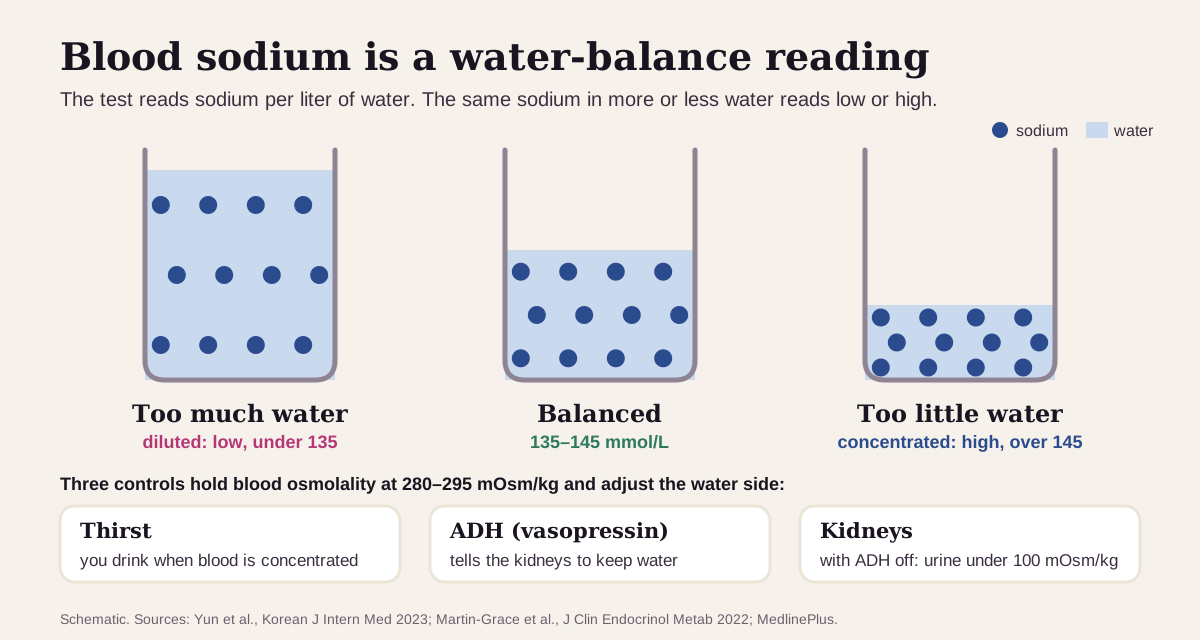
Sodium is the main salt dissolved in the fluid outside your cells, and a blood sodium result is mostly a reading of your water balance. Hold on to too much water and sodium gets diluted, so the number falls. Lose more water than you take in and it rises. Thirst, a water-keeping hormone and your kidneys hold it in a tight band, so a result outside the range usually means something is changing how your body handles water.12
The short version
- Normal: about 135–145 mmol/L, though labs differ by a point or two (Labcorp prints 134–144). Half of U.S. adults sit between about 137 and 140.345
- Low sodium (hyponatremia, under 135) is the most common fluid and electrolyte problem in medicine. The usual reasons are medicines (especially diuretics and some antidepressants), illnesses that make the body hold water, vomiting or diarrhea, heart or liver failure, and drinking far more water than the kidneys can clear.617
- High sodium (hypernatremia, over 145) almost always means water lost and not replaced: too little to drink, fever or sweating, vomiting or diarrhea, or kidneys that let water slip through.2
- Urgent: under 125 or over 155, or any abnormal sodium with confusion, severe drowsiness, vomiting or a seizure. That needs care right away.827
What sodium is
Sodium is the most plentiful electrolyte, an electrically charged mineral, in your blood and in the fluid around your cells. It steers how water moves around your body, and your nerves and muscles need it to fire.3
The blood test measures a concentration: how much sodium there is for each liter of water. That's why it reads water balance. Your body holds the concentration of everything dissolved in blood (its osmolality) at about 280–295 mOsm/kg with three controls: thirst, the water-keeping hormone ADH (antidiuretic hormone, also called vasopressin), and the kidneys.2 When blood gets too dilute, ADH switches off and the kidneys pour out very watery urine, under 100 mOsm/kg.7 When blood gets too concentrated, you get thirsty and ADH tells the kidneys to keep water.
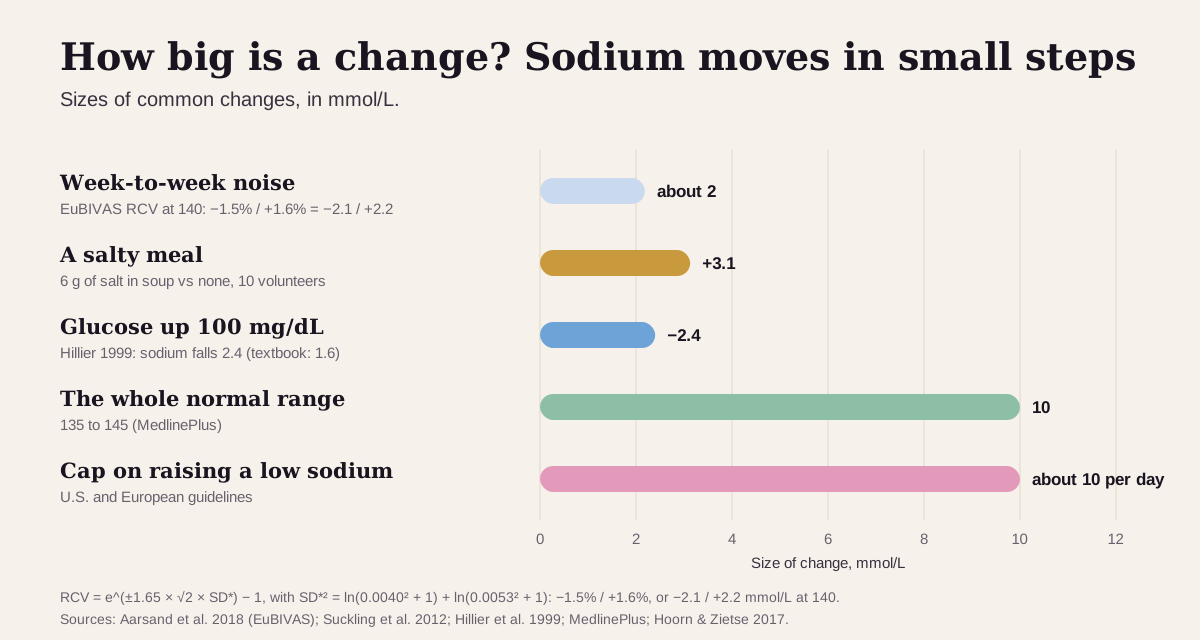
The salt you eat matters much less than most people expect. The kidneys adjust how much sodium they let go, which is why CDC researchers note that blood levels aren't used as a sign of eating too little sodium.5 A salty meal nudges it only a little: in 10 volunteers, soup with 6 g of salt raised plasma sodium by about 3 mmol/L more than the same soup without salt.9
Sodium is on every basic and comprehensive metabolic panel (BMP and CMP) and every electrolyte panel, so most people see it on routine blood work.3
What's a normal sodium?
Start with the range printed on your own report. Most labs land close to 135–145 mmol/L, the range MedlinePlus gives, but each lab sets its own.3 Labcorp, a large commercial lab, prints 134–144, for example.4
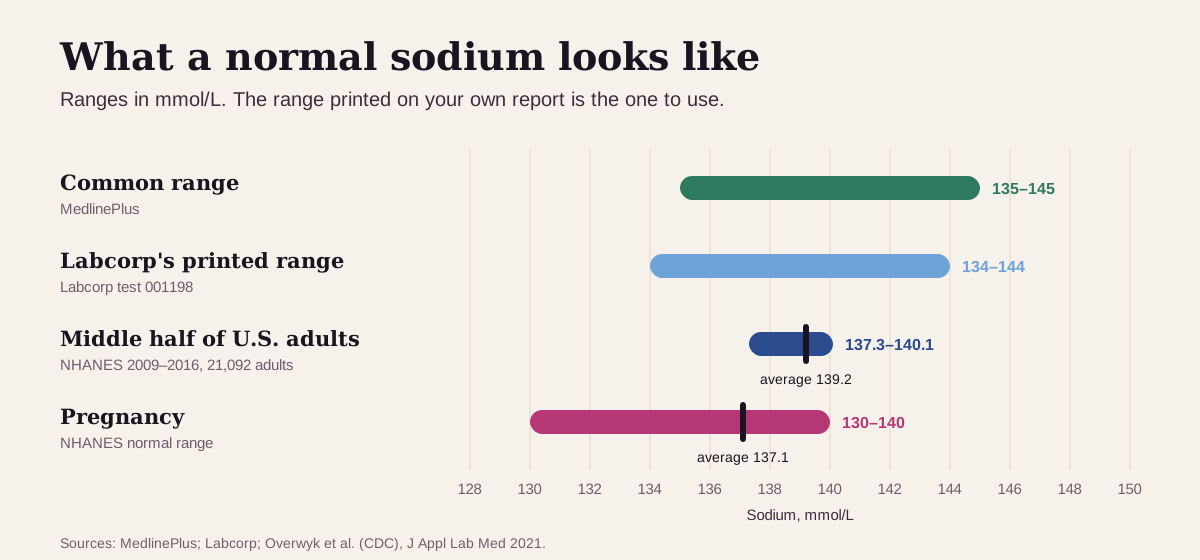
- In the CDC's NHANES survey of 21,092 U.S. adults, the average sodium was 139.2 mmol/L, and the middle half of adults fell between 137.3 and 140.1.5
- About 2% of adults had a sodium under 135. That rose to 4.7% at age 71 and older and 5.0% with diabetes.5
- Pregnancy runs lower. The 235 pregnant women in NHANES averaged 137.1, and the survey counted 130–140 as normal in pregnancy.5
Labs use one range for men and women. In one European study that sampled 89 healthy adults every week for 10 weeks, men averaged 143.8 and women 141.9, a gap the authors called unexpected.10
"Optimal" sodium: what health optimizers aim for
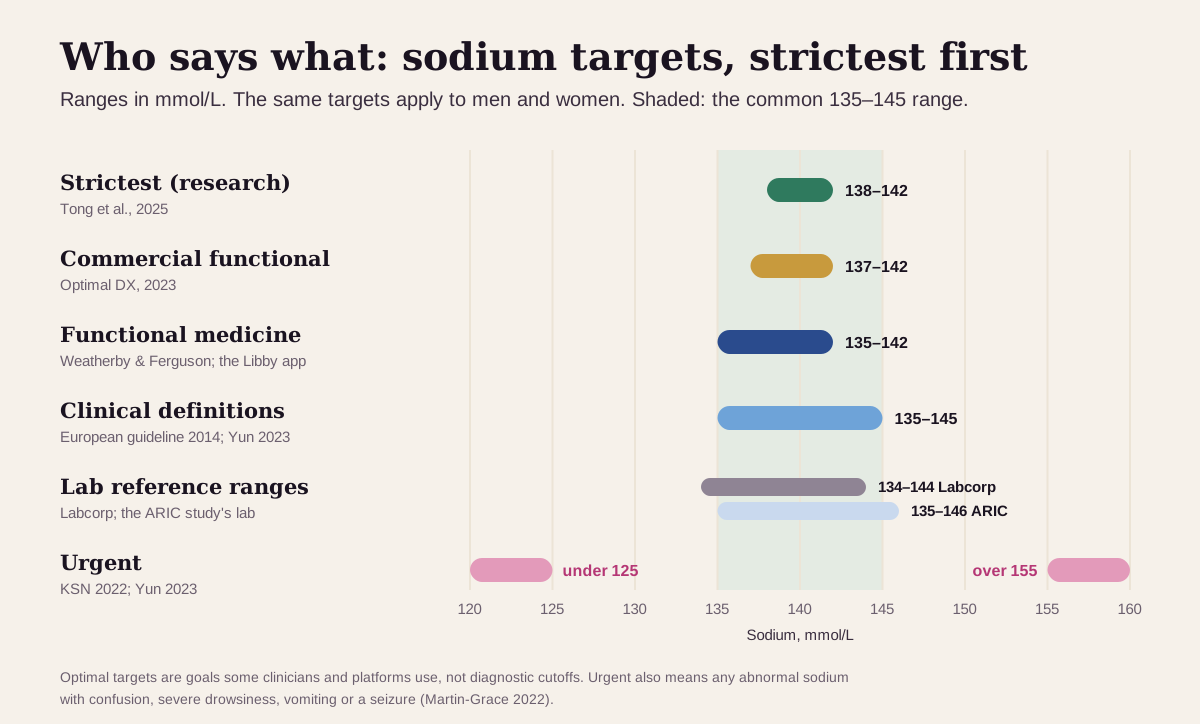
Optimizers and a few research groups aim for the middle of the normal range, trimming a few points off both ends. Here's the ladder, from strictest to loosest. The same targets apply to men and women.
| Target | Range (mmol/L), men and women | Who uses it |
|---|---|---|
| Strictest (research, healthy aging) | 138–142 | Tong et al., 18,301 U.S. adults: biological age was lowest at a sodium of 139.311 |
| Commercial functional range | 137–142 | Optimal DX's published range.12 It matches the group with the lowest death rate in an NIH analysis13 |
| Functional medicine | 135–142 | The optimal range shown in the Libby app, from the Weatherby & Ferguson functional-medicine textbook14 |
| Clinical definitions | 135–145 | Under 135 is hyponatremia;6 over 145 is hypernatremia2 |
| Lab reference ranges | 134–144 to 135–146 | Labcorp prints 134–144;4 the NIH study's lab range was 135–14613 |
| Urgent | under 125 or over 155 | Severe low and severe high sodium: get care now82 |
Why the targets sit in the middle:
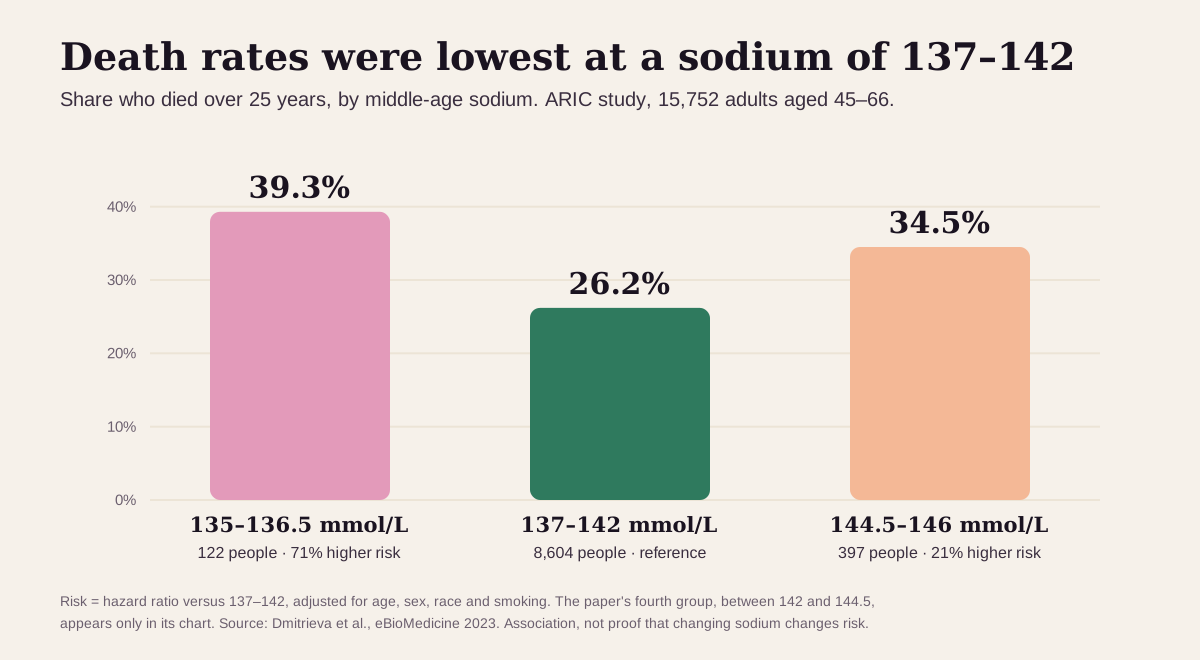
- An NIH analysis of the ARIC study followed 15,752 middle-aged adults for 25 years. Death rates were lowest with a sodium of 137–142 (26.2% died). They were higher at 135–136.5 (39.3%) and at 144.5–146 (34.5%), all inside the normal range.13
- After adjusting for age, sex, race and smoking, a sodium of 135–136.5 carried a 71% higher risk of death, and 144.5–146 a 21% higher risk.13
- A sodium above 142 went with 39% more chronic disease (heart failure, stroke, dementia and others) and 50% higher odds of being biologically older than your age.13
- A 2025 analysis of NHANES found the same U shape: biological age bottomed out at 139.3.11
Keep "optimal" in perspective. These are observational studies, and the ARIC team left out people with high blood sugar or a BMI over 35, so other health differences may explain part of the link. The researchers suspect that a high-normal sodium marks people who habitually drink too little, and they call for trials to test it.13 Lower isn't always better, either: the 135–136.5 group did worst, and below the range even mild low sodium goes with three times the risk of falls in older adults, plus fractures and memory problems.7 A sodium of 143 is a reason to look at how much you drink and which medicines you take, not a diagnosis.
What a low sodium usually means
How low it is matters, and so does how fast it fell. Clinicians grade low sodium as mild (130–134), moderate (125–129) or severe (under 125), and call it acute when it develops within 48 hours.81 High sodium has its own grades: mild 146–150, moderate 151–155 and severe over 155.2
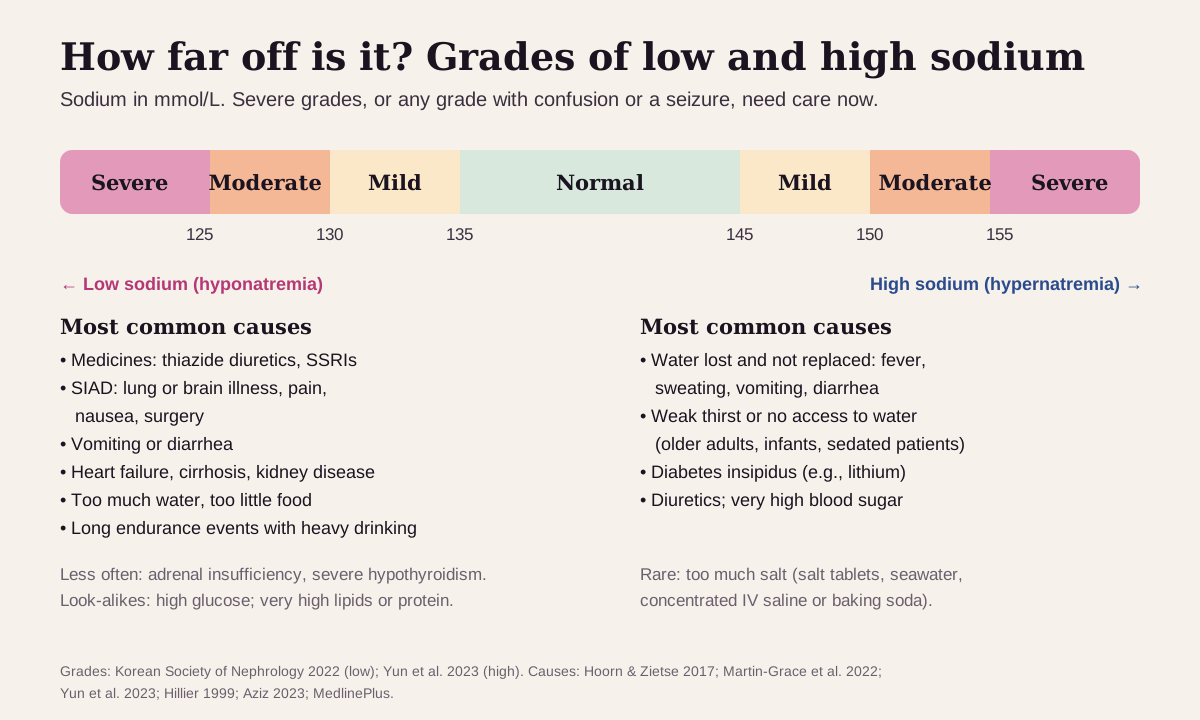
Low sodium is common in hospitals: it shows up in 15–30% of hospitalized patients, though severe drops under 125 affect only 0.5–3%.7
The usual suspects, from nephrologists Hoorn and Zietse's list of the most common causes:1
- Medicines. Thiazide diuretics ("water pills") are a common cause, especially in older women.8 Antidepressants (SSRIs and tricyclics), carbamazepine, some cancer drugs and over-the-counter pain relievers can also make the body hold water.73 Don't stop a prescribed medicine on your own. Bring your full list to your clinician.
- SIAD: the body holding water it should let go. In the syndrome of inappropriate antidiuresis, ADH keeps working even though the blood is already dilute. Pneumonia and other lung disease, stroke or brain injury, some cancers (lung cancer among them), pain, nausea and surgery can all set it off.7
- Vomiting or diarrhea. You lose salt and water. Low blood volume then switches ADH on, so the water you drink to replace it gets held on to.17
- Heart failure, cirrhosis and kidney disease. These make the body hold extra fluid, which dilutes sodium.13
- Too much water, too little food. Drinking far more water than the kidneys can clear, or drinking lots of beer or other fluids on a low-protein diet, dilutes sodium.7 Long endurance events are a classic setting: exercise switches ADH on, and heavy drinking during the event can drop sodium below 135 during or up to 24 hours after it.715
- Less common: adrenal insufficiency (Addison disease) and, rarely, very severe hypothyroidism.17
Two look-alikes. High blood sugar pulls water out of cells and dilutes sodium, as Labcorp's test notes explain.4 In one experiment, sodium fell 2.4 mmol/L for every 100 mg/dL rise in glucose.16 And very high triglycerides or proteins (as in multiple myeloma) can make some lab machines read sodium falsely low, an artifact called pseudohyponatremia.17
Get care now if a low sodium comes with a worsening headache and nausea, confusion, severe drowsiness, vomiting or a seizure, especially after an endurance event or when the drop may have been fast.78
What a high sodium usually means
High sodium is much rarer: it shows up in 0.5–5% of hospital patients and about 10% of people in intensive care.2 Thirst is a strong signal, so sodium stays high mainly when thirst is weak or water is out of reach. That's why it mostly affects older adults, infants, and people who are confused, sedated or on a breathing tube.2
The usual suspects:
- Water lost and not replaced. Fever, heavy sweating, vomiting and diarrhea all drain water. If drinking falls behind, sodium climbs.23
- Kidneys that let water through. In diabetes insipidus the kidneys make large amounts of watery urine, because the brain makes too little ADH or the kidneys ignore it (drugs such as lithium can do this). Very high blood sugar also drags water out through the urine.2
- Diuretics, which make the kidneys flush out water.23
- Rare: too much salt. Salt tablets, seawater, or concentrated saline or baking-soda infusions in hospital.2
Get care now if a high sodium comes with confusion, severe drowsiness, muscle twitching or a seizure. In hospital studies of adults, a sodium over 160 carried a death rate of about 75%, which is why severe high sodium is treated as an emergency.23
Sodium reads best next to its neighbors
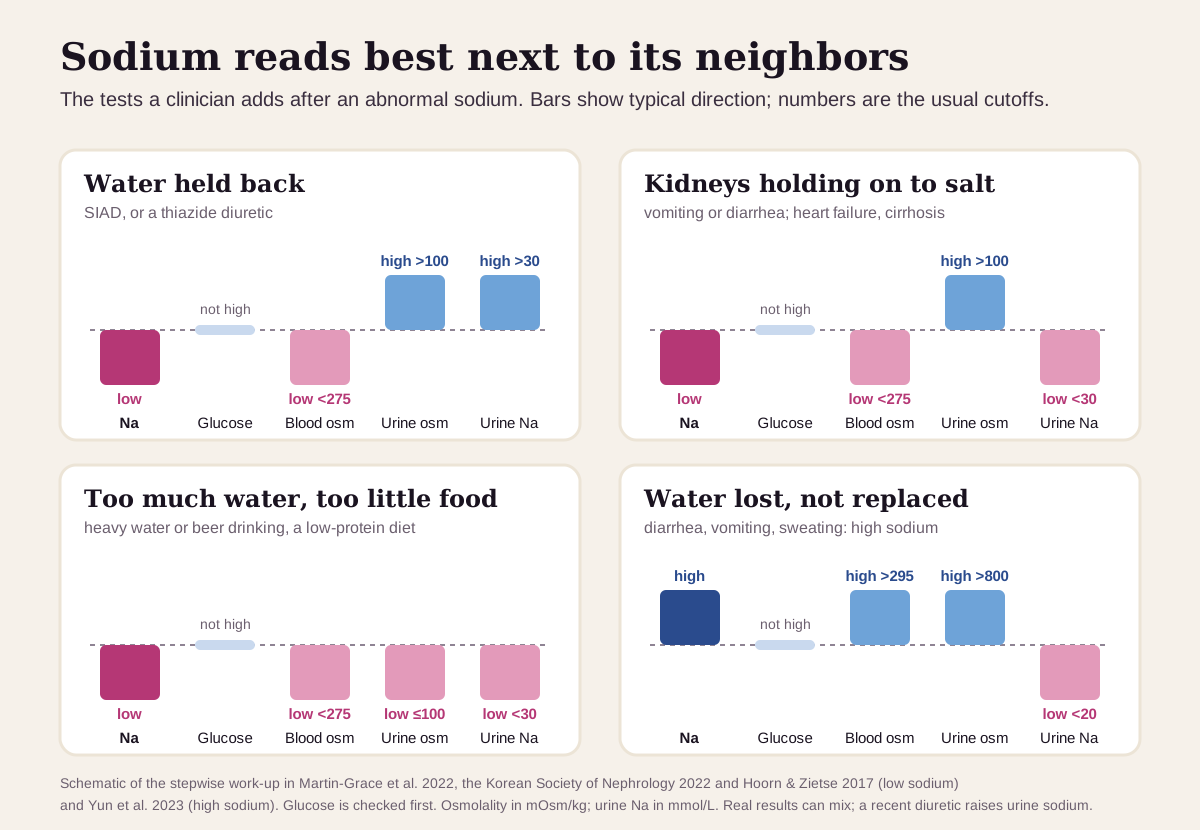
A sodium result says water and salt are out of balance. The next tests say why: your glucose and blood osmolality, then a urine osmolality and urine sodium from a sample taken at the same time. Guidelines read them in that order.187
| If you see… | It often points to… |
|---|---|
| Low sodium, low blood osmolality, concentrated urine (over 100 mOsm/kg), urine sodium over 30 | SIAD (the body holding water), a diuretic, or less often an adrenal or thyroid problem |
| Low sodium, concentrated urine, urine sodium under 30 | the body holding salt: vomiting or diarrhea, or heart failure or cirrhosis |
| Low sodium, very watery urine (100 mOsm/kg or less) | more water than the kidneys can clear: heavy water drinking, or beer on a low-protein diet |
| High sodium, very concentrated urine (over 800), urine sodium under 20 | water lost through the gut or skin and not replaced |
| Low sodium with high glucose, blood osmolality normal or high | sugar pulling water out of cells, rather than extra water; sodium is corrected for glucose first |
| High sodium, watery urine (under 300) and a lot of it | diabetes insipidus: kidneys letting water through |
| Low sodium, normal blood osmolality, very high triglycerides or protein | a measurement artifact (pseudohyponatremia) |
How fast sodium changes
Sodium is one of the steadiest numbers on your panel. In the EuBIVAS study, 89 healthy adults gave blood every week for 10 weeks, and each person's sodium varied only about 0.5% from week to week. A change had to pass −1.5% or +1.6% (about 2 mmol/L at a sodium of 140) before it was likely to be real.10
What that means in practice:
- A 1- or 2-point change is usually noise. Bigger moves are worth a look, especially when they keep going the same way.10
- Fast changes matter more than slow ones. A drop within 48 hours can swell the brain, because brain cells have had no time to adapt. A slow, long-standing low is better tolerated but needs a slow fix: both the U.S. and European guidelines cap the rise at about 10 mmol/L per day to avoid a brain injury called osmotic demyelination.1
- Trends beat snapshots. Compare results from the same lab when you can. Analyzers that dilute the sample first (indirect ion-selective electrodes) and ones that measure it undiluted (direct) can disagree, especially when protein or fat levels are unusual.17 When you get tested, mention a recent endurance event, vomiting or diarrhea, and any new medicine.
Going deeper: tonicity and the lab method
Tonicity comes first. A clinician's first question about a low sodium is whether blood osmolality is low (under 275 mOsm/kg), normal (275–295) or high (over 295).8 Only the low-osmolality kind means the body has too much water for its sodium. High glucose, or IV mannitol or contrast dye, causes the high kind, and lab artifacts cause the normal kind.17
ADH is behind almost every true low sodium. In one study, ADH was being released for reasons other than blood concentration in 97% of people with low sodium. That release is "appropriate" when blood volume is low (vomiting, heart failure) and "inappropriate" in SIAD.1
The glucose correction. Clinicians adjust sodium for high glucose. The textbook factor is 1.6 mmol/L per 100 mg/dL of glucose. In Hillier's experiment in six healthy volunteers it averaged 2.4, and was closer to 4.0 once glucose passed 400 mg/dL.16
Corrected sodium = sodium + 0.024 × (glucose − 100)
Why some machines read too low. Serum is normally about 93% water and 7% solids (proteins and fats), and sodium lives only in the water. Analyzers that dilute the sample (indirect ion-selective electrodes) assume that split. When protein or fat is very high, the water share shrinks and the reading comes out falsely low. Direct electrodes measure the undiluted sample and avoid the problem. Very low protein does the reverse, hiding a real low or faking a high.17
Questions worth asking
- How far outside the range is my sodium, and did it change quickly?
- Could any of my medicines, including diuretics or antidepressants, be lowering it?
- Should we check my blood osmolality, and a urine osmolality and urine sodium?
- Were my glucose, triglycerides or protein high enough to affect the reading?
- How much should I be drinking, given my heart, kidneys and activity?
- When should we repeat it, and at the same lab?
FAQ
What is a normal sodium level? About 135–145 mmol/L, depending on your lab. Labcorp uses 134–144.34
What is the most common cause of low sodium? The most common causes are medicines (especially thiazide diuretics and some antidepressants), SIAD from an illness, vomiting or diarrhea, heart or liver failure, and drinking far more water than the kidneys can clear.17
Does drinking too little water raise sodium? Yes. High sodium almost always means water lost and not replaced.2 In a 25-year NIH study, even a high-normal sodium over 142 went with more chronic disease. The researchers used sodium as a sign of how much people habitually drink.13
When is a sodium result an emergency? Under 125 or over 155, or any abnormal sodium with confusion, severe drowsiness, vomiting or a seizure.827
This guide is for education. It can't diagnose you or replace care from a clinician who knows your history.
Footnotes
-
Hoorn EJ, Zietse R. Diagnosis and Treatment of Hyponatremia: Compilation of the Guidelines. J Am Soc Nephrol. 2017;28(5):1340–1349. Compares the U.S. and European guidelines: the most common causes, the under-125 and 48-hour cutoffs, urine sodium under 30, and the correction limit of about 10 mmol/L per day. PMC ↩ ↩2 ↩3 ↩4 ↩5 ↩6 ↩7 ↩8 ↩9 ↩10 ↩11 ↩12 ↩13 ↩14 ↩15
-
Yun G, Baek SH, Kim S. Evaluation and management of hypernatremia in adults: clinical perspectives. Korean J Intern Med. 2023;38(3):290–302. Definition (over 145), grades, how common it is, causes, who is at risk, urine tests, and the glucose-correction formulas. PMC ↩ ↩2 ↩3 ↩4 ↩5 ↩6 ↩7 ↩8 ↩9 ↩10 ↩11 ↩12 ↩13 ↩14 ↩15 ↩16 ↩17 ↩18 ↩19 ↩20
-
National Library of Medicine. Sodium blood test. MedlinePlus (lab test page and Medical Encyclopedia). The 135–145 mEq/L range, symptoms of high and low sodium, and common causes. Lab test page · Encyclopedia ↩ ↩2 ↩3 ↩4 ↩5 ↩6 ↩7 ↩8 ↩9 ↩10 ↩11 ↩12
-
Labcorp. Sodium (test 001198). Reference range 134–144 mmol/L; its notes explain that glucose or mannitol can move water out of cells and dilute sodium. A commercial laboratory's published test page, cited for its printed range and notes. labcorp.com ↩ ↩2 ↩3 ↩4 ↩5 ↩6 ↩7
-
Overwyk KJ, Pfeiffer CM, Storandt RJ, et al. Serum Sodium and Potassium Distribution and Characteristics in the US Population, National Health and Nutrition Examination Survey 2009–2016. J Appl Lab Med. 2021;6(1):63–78. CDC analysis of 25,520 participants: adult mean 139.2 mmol/L, how common low sodium is, and pregnancy values. PMC ↩ ↩2 ↩3 ↩4 ↩5 ↩6
-
Spasovski G, Vanholder R, Allolio B, et al. Clinical practice guideline on diagnosis and treatment of hyponatraemia. Eur J Endocrinol. 2014;170(3):G1–G47. The joint European guideline. It defines hyponatremia as a sodium under 135 mmol/L and calls it the most common fluid and electrolyte disorder in clinical practice. PubMed ↩ ↩2 ↩3
-
Martin-Grace J, Tomkins M, O'Reilly MW, Thompson CJ, Sherlock M. Approach to the Patient: Hyponatremia and the Syndrome of Inappropriate Antidiuresis (SIAD). J Clin Endocrinol Metab. 2022;107(8):2362–2376. Hospital prevalence, the causes and criteria of SIAD, the urine-sodium table, and symptoms. PMC ↩ ↩2 ↩3 ↩4 ↩5 ↩6 ↩7 ↩8 ↩9 ↩10 ↩11 ↩12 ↩13 ↩14 ↩15 ↩16 ↩17 ↩18
-
Lee Y, Yoo KD, Baek SH, et al. Korean Society of Nephrology 2022 recommendations on controversial issues in diagnosis and management of hyponatremia. Korean J Intern Med. 2022;37(6):1120–1137. Severity grades (130–134, 125–129, under 125), osmolality cutoffs, the stepwise urine tests, and thiazides in older women. PMC ↩ ↩2 ↩3 ↩4 ↩5 ↩6 ↩7 ↩8 ↩9 ↩10 ↩11 ↩12
-
Suckling RJ, He FJ, Markandu ND, MacGregor GA. Dietary salt influences postprandial plasma sodium concentration and systolic blood pressure. Kidney Int. 2012;81(4):407–411. Randomized crossover in 10 volunteers: soup with 6 g of salt raised plasma sodium 3.13 mmol/L more than unsalted soup. PubMed ↩ ↩2
-
Aarsand AK, Díaz-Garzón J, Fernandez-Calle P, et al. The EuBIVAS: Within- and Between-Subject Biological Variation Data for Electrolytes, Lipids, Urea, Uric Acid, Total Protein, Total Bilirubin, Direct Bilirubin, and Glucose. Clin Chem. 2018;64(9):1380–1393. Healthy adults sampled weekly for 10 weeks on one analyzer; for sodium, analytical variation 0.40%, within-person variation 0.53%, and a reference change value of −1.5%/+1.6%. DOI ↩ ↩2 ↩3 ↩4 ↩5
-
Tong X, Wang F, Liu M. Serum sodium within the normal range and its U-shaped relationship with biological aging in U.S. adults. Front Nutr. 2025;12:1589962. 18,301 NHANES adults with normal sodium; lowest biological age at 139.3 mmol/L; proposes 138–142. PMC ↩ ↩2 ↩3
-
Optimal DX. Electrolyte Biomarkers: Sodium. July 10, 2023 (updated November 2, 2023). States an optimal ("ODX") range of 137–142 mmol/L against a standard range of 135–146. A commercial source, listed as what the functional-medicine community uses. optimaldx.com ↩ ↩2
-
Dmitrieva NI, Gagarin A, Liu D, Wu CO, Boehm M. Middle-age high normal serum sodium as a risk factor for accelerated biological aging, chronic diseases, and premature mortality. EBioMedicine. 2023;87:104404. NIH (NHLBI) analysis of 15,752 ARIC participants aged 45–66, followed for 25 years. PMC ↩ ↩2 ↩3 ↩4 ↩5 ↩6 ↩7 ↩8 ↩9
-
Weatherby D, Ferguson S. Blood Chemistry and CBC Analysis: Clinical Laboratory Testing from a Functional Perspective. 2nd ed. Bear Mountain Publishing; 2004. ISBN 978-0976136712. Widely used functional-medicine reference. The 135–142 mmol/L optimal range is as recorded in the Libby app's marker catalog; the book was not opened for this article. ↩ ↩2
-
Bennett BL, Hew-Butler T, Rosner MH, Myers T, Lipman GS. Wilderness Medical Society Clinical Practice Guidelines for the Management of Exercise-Associated Hyponatremia: 2019 Update. Wilderness Environ Med. 2020;31(1):50–62. Defines exercise-associated hyponatremia as a sodium under 135 mmol/L during or up to 24 hours after prolonged activity. PubMed ↩
-
Hillier TA, Abbott RD, Barrett EJ. Hyponatremia: evaluating the correction factor for hyperglycemia. Am J Med. 1999;106(4):399–403. Six healthy volunteers: sodium fell 2.4 mEq/L for each 100 mg/dL rise in glucose, versus the usual 1.6, and a factor of 4.0 fit better above 400 mg/dL. PubMed ↩ ↩2 ↩3 ↩4
-
Aziz F, Sam R, Lew SQ, et al. Pseudohyponatremia: Mechanism, Diagnosis, Clinical Associations and Management. J Clin Med. 2023;12(12):4076. Why analyzers that dilute the sample read falsely low with high protein or lipids. PMC ↩ ↩2 ↩3
Educational content, not medical advice. Libby is a personal record tool, not a medical service — it doesn't diagnose, treat, or prescribe. Reference ranges vary by lab and by person. Talk to a qualified healthcare professional about your results.
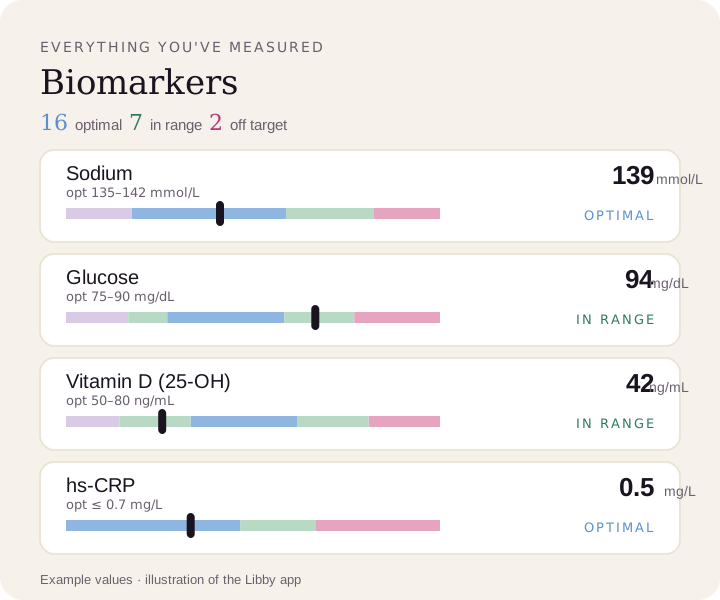
Compare your results to optimal ranges.
Upload a lab PDF or a photo of your report. Libby puts every marker on a lab reference range and the optimal range, and tracks your trends over time.
View your sodium ›