Serum osmolality test: normal range, high and low causes
Serum osmolality shows how concentrated your blood is. Here's the normal range, what makes it high or low, how to read it with sodium, and when it's urgent.
Serum osmolality measures how concentrated your blood is: the number of particles dissolved in each kilogram of blood water, most of them sodium. Your brain tracks this number closely. When it creeps up, you get thirsty and your kidneys hold on to water. So a high result usually means you're short of water, or carrying extra sugar, urea or alcohol, and a low result usually means too much water for the sodium you have.12
The short version
- Normal: about 275–295 mOsm/kg at many labs. Labcorp uses 275–295 up to age 60 and 280–301 from age 61. Check the range on your report.23
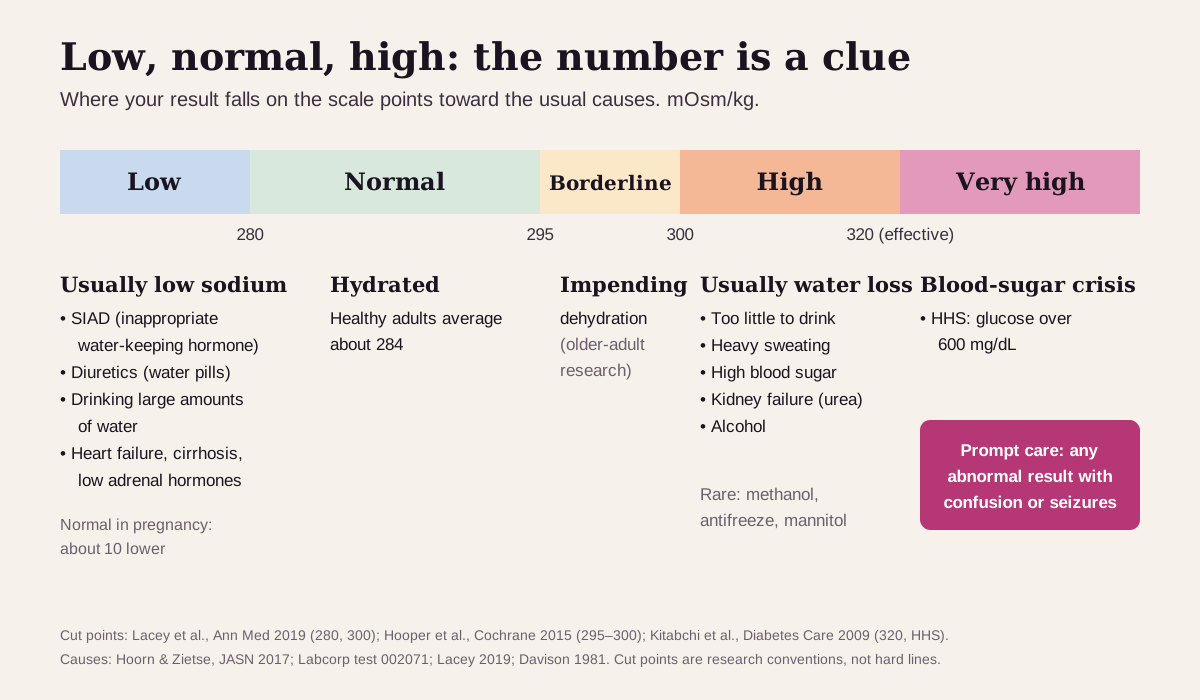
- High (over about 295–300) most often means water loss: too little to drink or heavy sweating. High blood sugar, kidney failure and alcohol are the next suspects. Hydration researchers call anything over 300 dehydration.42
- Low (280 or less) usually comes with low sodium: extra water held by a hormone signal (SIAD), water pills, or very heavy water drinking.45
- Urgent: an abnormal result with confusion, seizures or severe sleepiness, or very high blood sugar with an effective osmolality over 320. If someone may have swallowed antifreeze or methanol, call Poison Control at 1-800-222-1222 now.67
What serum osmolality is
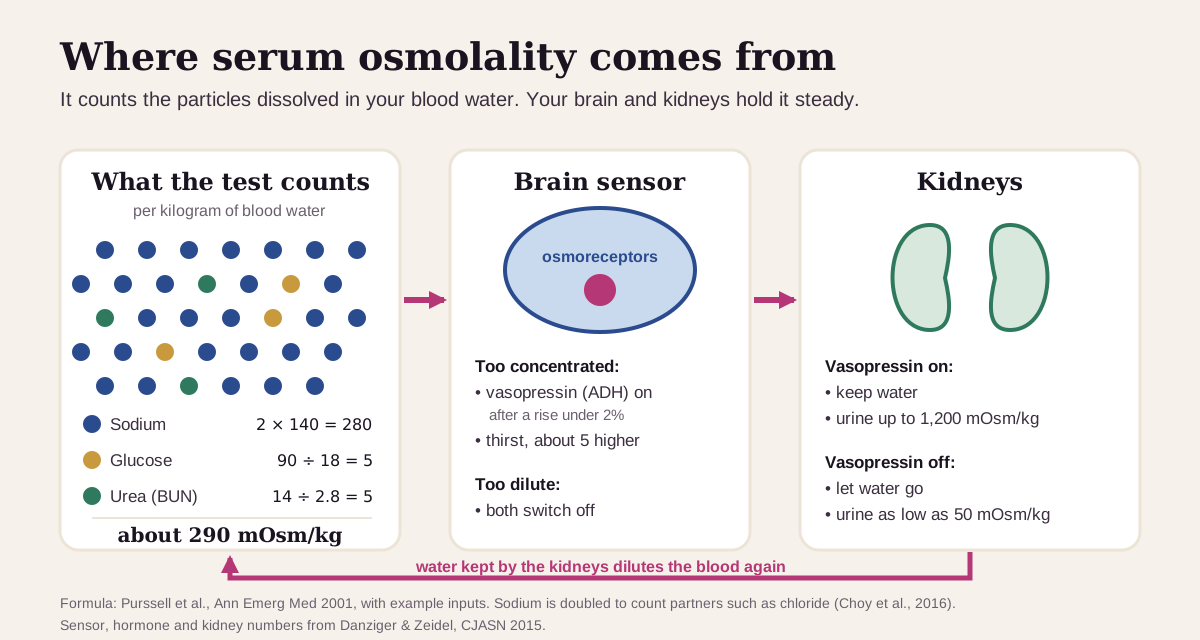
Think of it as a particle count. The lab freezes a little of your serum and measures how far its freezing point drops: the more particles dissolved in it, the further it drops.29 Sodium and the salts that travel with it make up almost all of the count. Glucose and urea (measured as BUN, blood urea nitrogen) add a few more. With a sodium of 140, glucose of 90 and BUN of 14, the common formula gives 280 + 5 + 5, about 290 mOsm/kg.8
Your body defends this number hard. Sensors in the brain called osmoreceptors notice a rise of under 2% and release vasopressin (also called antidiuretic hormone, or ADH). Vasopressin tells your kidneys to keep water, and it can concentrate urine up to about 1,200 mOsm/kg. Thirst kicks in about 5 mOsm/kg higher. When blood gets too dilute, both switch off, and urine can be as dilute as 50 mOsm/kg.1
Clinicians usually order it to work up a low or high sodium, check for dehydration or a blood-sugar crisis, or look for a poisoning such as methanol or antifreeze.210
What's a normal serum osmolality?
Start with the range printed on your report. Labs set their own:
- Labcorp: 275–295 mOsm/kg from birth to age 60, 280–301 from 61, and as low as 266 in newborns.2
- ARUP Laboratories: 271–296 for ages 0–16 and 280–303 from 17.3
- Oxford University Hospitals (NHS): 275–295 for women and men of all ages.11
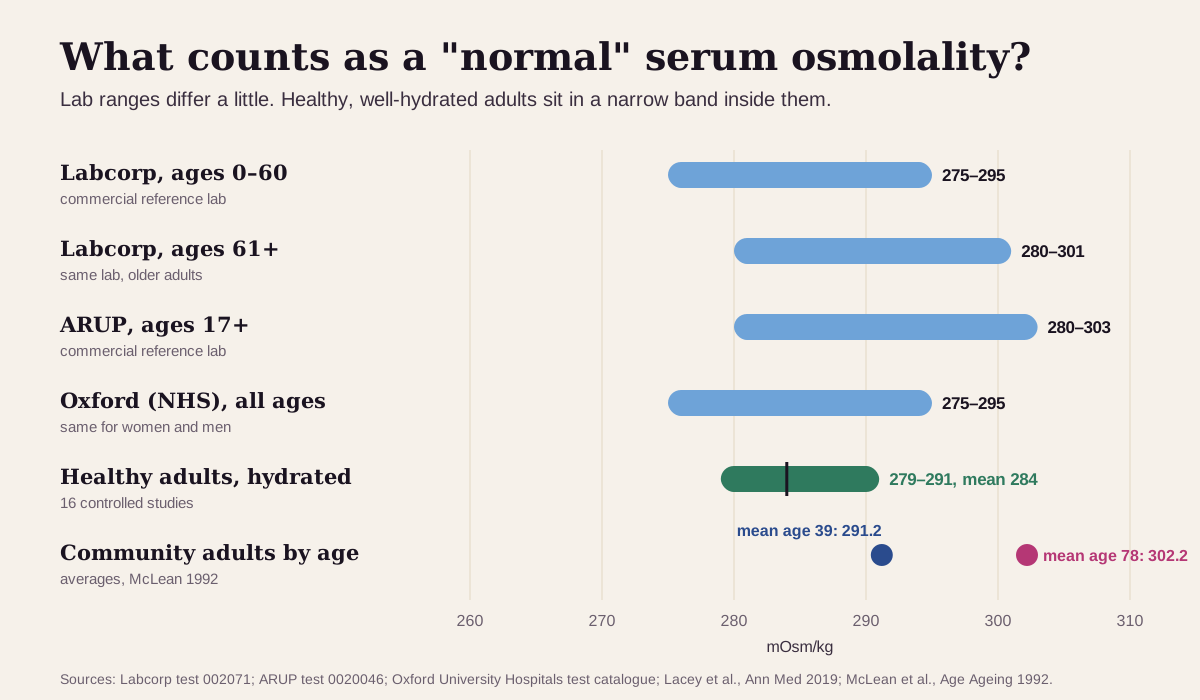
Healthy people sit in a narrow band. Across 16 controlled fluid-balance studies, well-hydrated adults averaged 284 mOsm/kg, with study averages from 279 to 291.4 Each person's own level is tightly held: in adults over 70, it varied by only about 0.8% from test to test.4
Age nudges it up. In a community study, adults with an average age of 78 averaged 302.2, versus 291.2 for adults averaging 39. Screened healthy older adults came in between, at 298.1.12 Labcorp's range for ages 61 and up is higher too.2
Pregnancy lowers it. Osmolality starts falling with the first missed period and sits about 10 mOsm/kg lower by week 10, then stays there.13 Men and women share the same range.11
"Optimal" serum osmolality: what hydration research aims for
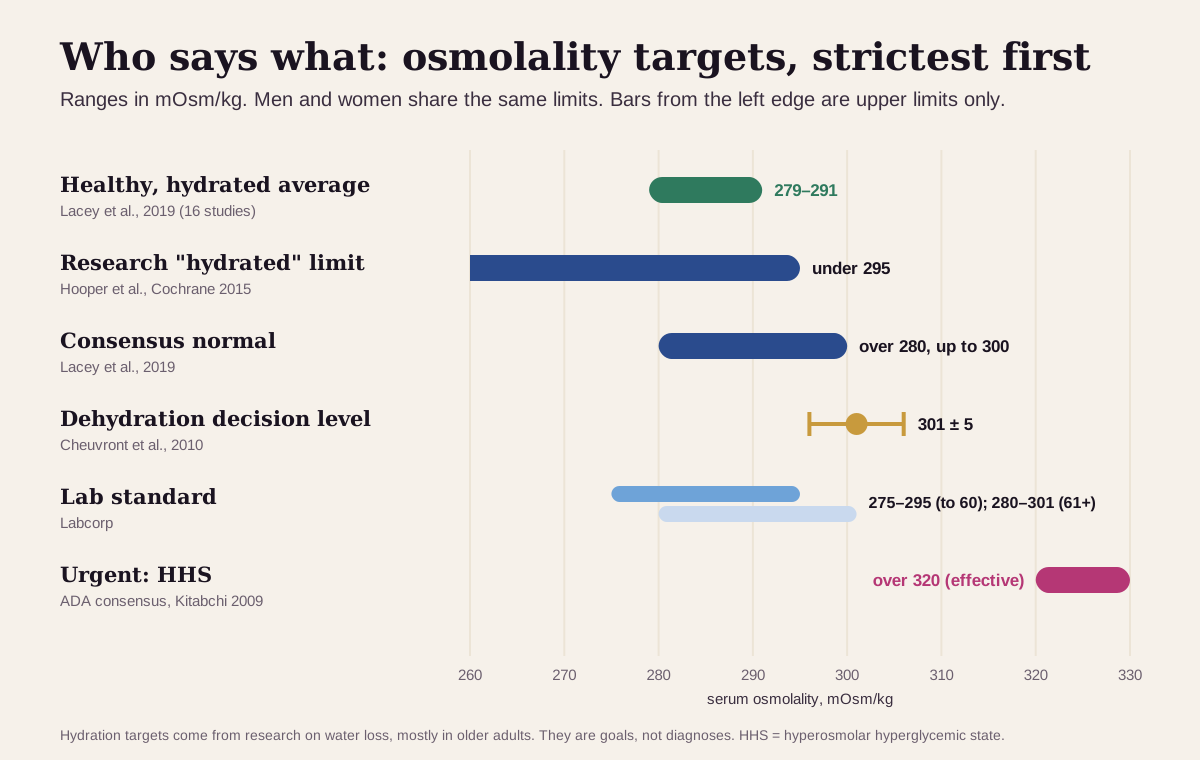
No longevity platform we checked publishes an osmolality target, and the Libby app shows your osmolality against your lab's range; its marker catalog has no separate optimal band for it. The "tighter" targets come from hydration research, mostly in older adults. Here's the ladder, from strictest to loosest:
| Target | Men and women | Who uses it |
|---|---|---|
| Healthy, hydrated average | 279–291 mOsm/kg (mean 284) | 16 controlled fluid-balance studies4 |
| Research "hydrated" limit | under 295 | A Cochrane review treats 295–300 as impending dehydration and over 300 as current dehydration14 |
| Consensus "normal" | over 280, up to 300 | A multidisciplinary consensus: 280 or less is hypo-osmolar, over 300 is hyperosmolar4 |
| Dehydration decision level | 301 ± 5 | A U.S. Army lab study of controlled dehydration15 |
| Lab standard | 275–295 (to age 60); 280–301 (61+) | Labcorp;2 ARUP uses 280–303 from age 173 |
| Urgent | effective osmolality over 320, with glucose over 600 mg/dL | The hyperosmolar hyperglycemic state (HHS), a diabetes emergency6 |
Why the tighter lines matter:
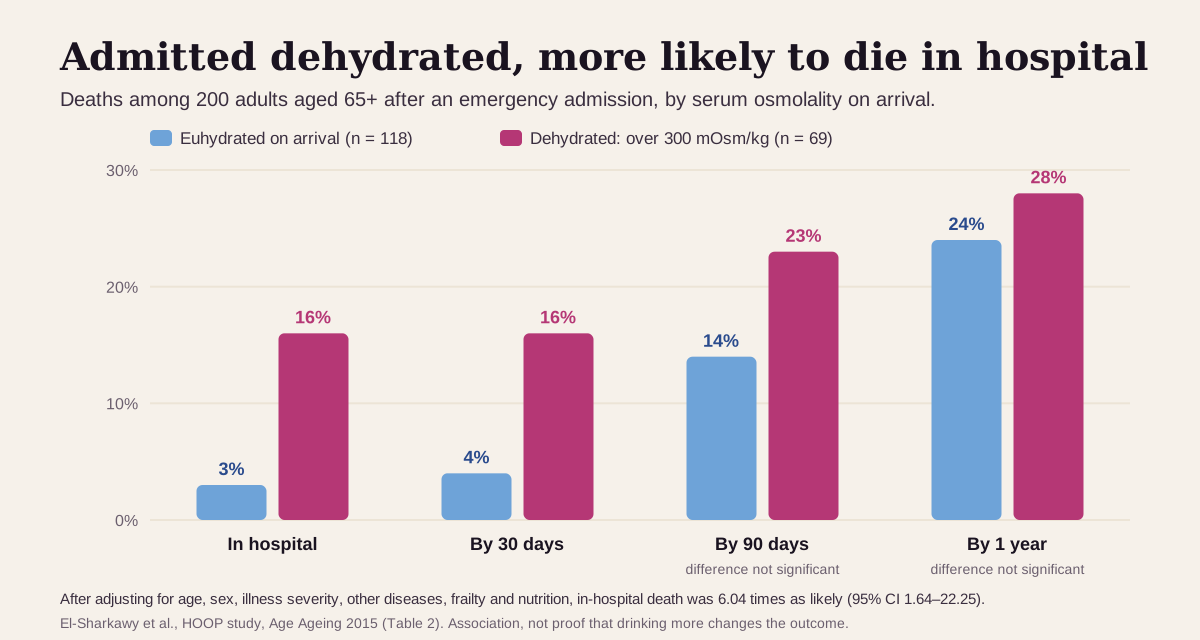
- In the HOOP study of 200 adults aged 65+ admitted to hospital as emergencies, 37% arrived with an osmolality over 300. Of those, 16% died in hospital, versus 3% of those who arrived hydrated. After adjusting for age, illness severity, other diseases, frailty and nutrition, the risk was 6 times higher.16
- Dehydration often lingers: 62% of the dehydrated patients were still over 300 two days later. By one year, the death rates had drawn close (28% vs 24%).16
- In UK care homes, 20% of 188 residents were over 300 and 48% were at 295 or higher.4
Keep "optimal" in perspective. A 297 is a reason to look at how much you drink, your blood sugar and your kidney numbers, and these research lines stay targets, never diagnoses. One reading can mislead: in one analysis, 13% of well-hydrated people still read 295 or higher.4 Lower is also no better. At 280 or less, the question becomes low sodium.4
What a high or low serum osmolality usually means
Which side of the range you're on is the first clue. High usually means water loss; low usually means low sodium.42
High: usually water loss
The usual suspects:
- Too little water in, or too much sweated out. Raised osmolality usually means dehydration, most often from drinking too little or heavy sweating, and every ~2% of body weight lost as sweat adds about 5 mOsm/kg.4 Older adults are especially prone, because thirst fades with age.16 Diarrhea and water pills lose salt along with the water, so osmolality can stay normal even when you're dry.4
- High blood sugar. Glucose adds particles. In the hyperosmolar hyperglycemic state, glucose runs over 600 mg/dL and effective osmolality over 320, and confusion rises in step with the number.6
- Kidney failure. Urea builds up (azotemia) and raises the count.2
- Alcohol. Ethanol raises measured osmolality: roughly 1 mOsm/kg for every 3.7 mg/dL of alcohol in the blood.8
- Less common: diabetes insipidus, where the kidneys lose too much water,10 and mannitol, a drug given in hospital.2
- Rare but dangerous: methanol, ethylene glycol (antifreeze) and isopropanol. They show up as a gap between measured and calculated osmolality (see neighbors).17
Low: usually low sodium with extra water
A low osmolality usually travels with hyponatremia (sodium under 136 mmol/L), the most common electrolyte disorder.51 The most common causes are:
- SIAD (syndrome of inappropriate antidiuresis): the body keeps making vasopressin when it should stop. An underlying illness, a medicine, lung cancer, or even pain or nausea can set it off.52
- Diuretics (water pills), especially thiazides.5
- Drinking very large amounts of water (polydipsia).5
- Heart failure, liver cirrhosis, low adrenal hormones and fluid loss.5
Two look-alikes are worth knowing. A low sodium with a normal osmolality can be a lab artifact from very high blood fats or proteins (pseudohyponatremia).18 A low sodium with a high osmolality usually means high blood sugar pulling water out of cells.6 That's the main reason clinicians order osmolality alongside a low sodium: it sorts these apart.5
Get care now if an abnormal osmolality comes with confusion, seizures, severe sleepiness, weakness, or repeated vomiting.101 If someone may have swallowed antifreeze, methanol or another chemical, call Poison Control at 1-800-222-1222 right away. Antifreeze poisoning builds up slowly, so waiting for symptoms is risky.7
Serum osmolality reads best next to its neighbors
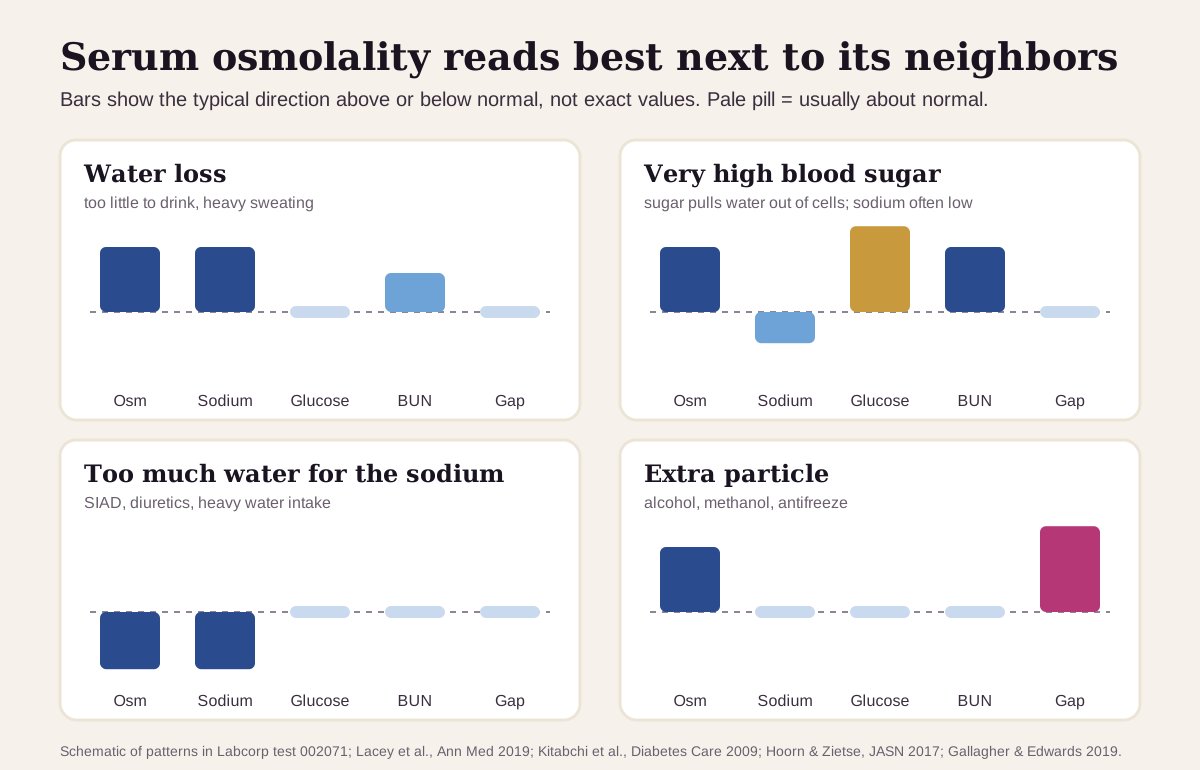
Osmolality is ordered to answer one question: which particles are doing it? Your sodium, glucose, BUN and the osmolal gap answer it.217
| If you see… | It often points to… |
|---|---|
| Osmolality and sodium both high, glucose normal, BUN a little up | water loss: too little to drink or heavy sweating24 |
| Osmolality high, glucose very high, sodium often low (can be normal or high) | high blood sugar pulling water out of cells; a normal or high sodium here means a lot of water has been lost too6 |
| Osmolality and sodium both low | too much water for the sodium: SIAD, water pills or very heavy water drinking52 |
| Osmolality high, sodium normal, osmolal gap high | an extra particle the formula misses: alcohol, methanol or antifreeze217 |
| Osmolality high, BUN very high, sodium normal | kidney failure, with urea building up2 |
| Sodium low, osmolality normal | often a lab artifact from very high blood fats or proteins18 |
How fast serum osmolality changes
It moves as fast as water does. Osmolality has no half-life of its own: it's a count of many particles, so it shifts within hours when you sweat, drink, or get IV fluids.
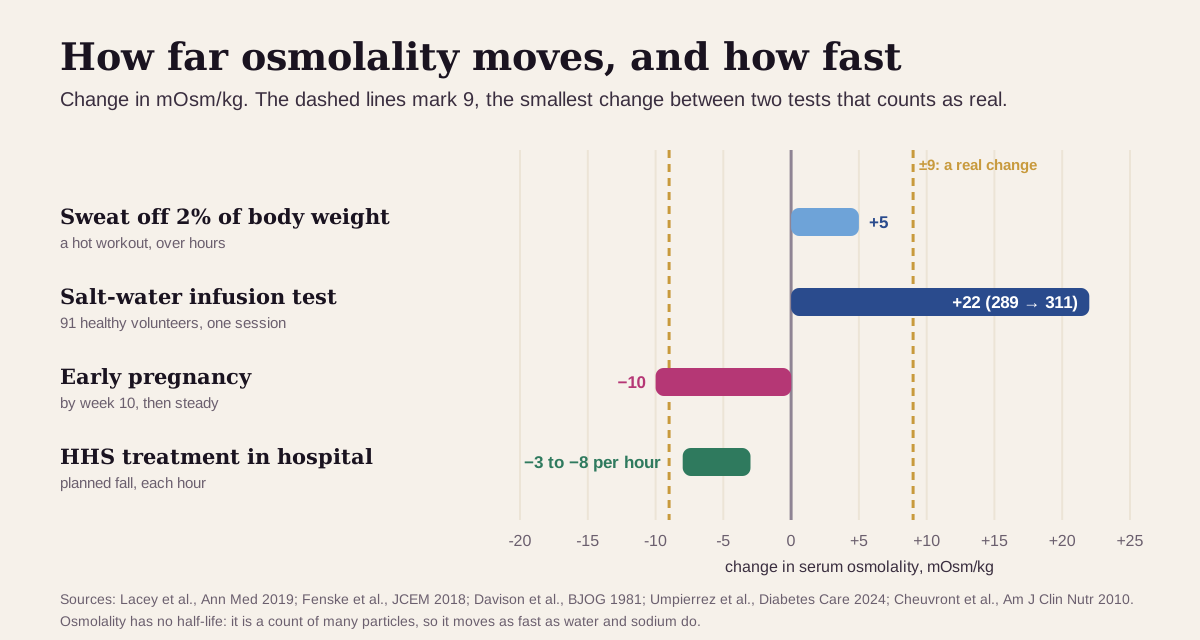
- Hours: sweating off about 2% of your body weight raises it about 5 mOsm/kg.4 In a supervised salt-water infusion test, 91 healthy volunteers went from 289 to 311; a water load then brought them back to 298.19
- In hospital: when treating a blood-sugar crisis, clinicians lower osmolality slowly, by 3–8 mOsm/kg per hour, to protect the brain from swelling.20
- Weeks: pregnancy lowers it about 10 by week 10.13
What that means in practice:
- A change needs to be about 9 mOsm/kg between two tests before it reliably reflects a real shift rather than day-to-day noise.15
- Mention the context when you're tested: a hot workout, a stomach bug, alcohol in the past day, new medicines, or IV fluids.24
- Trends beat snapshots, ideally from the same lab, because ranges and methods differ.23
Going deeper: measured vs calculated, and the osmolal gap
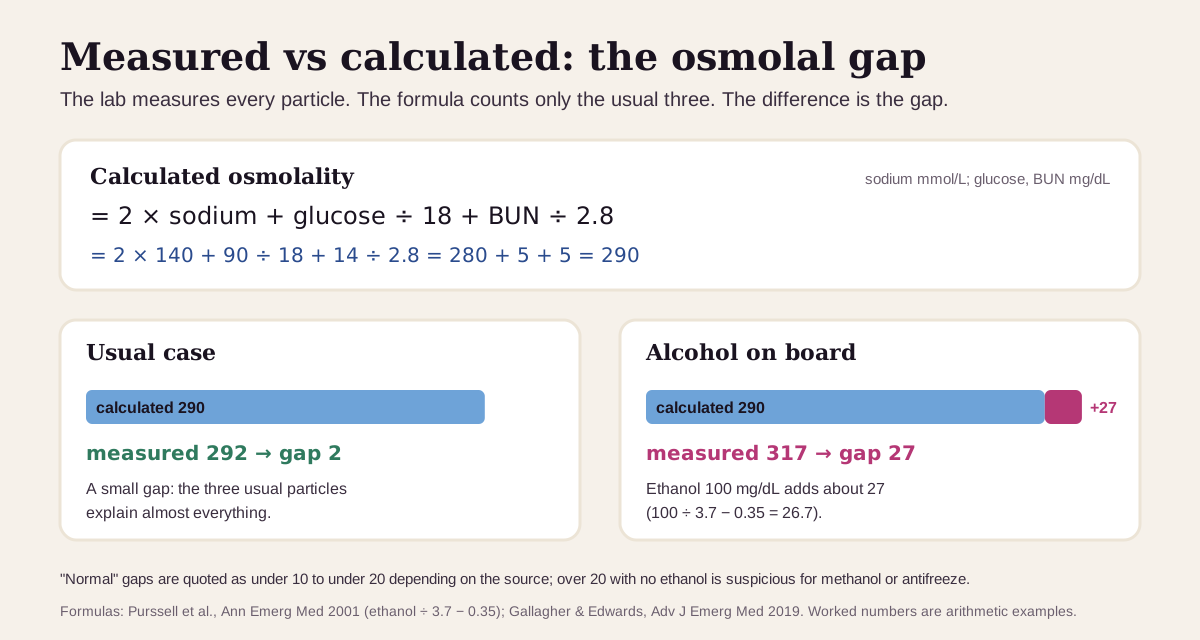
The lab measures osmolality directly. Clinicians can also calculate it from three routine results:817
Calculated osmolality = 2 × sodium + glucose ÷ 18 + BUN ÷ 2.8
The osmolal gap is measured minus calculated. A small gap means sodium, glucose and urea explain the count. A big gap means something else is dissolved in your blood. Ethanol widens the gap too, so clinicians check a blood alcohol level at the same time.17 Published "normal" gaps run from under 10 to under 20, depending on the source, and a gap over 20 with no alcohol is suspicious for methanol or antifreeze.17 The timing matters: as the body breaks a toxic alcohol down into acids, the osmolal gap shrinks and the anion gap grows, so a small gap later on can still hide a poisoning.17
The method matters. Most labs measure by freezing point, Labcorp included; a few use vapor pressure.92 Vapor-pressure osmometers miss volatile substances such as alcohols, so an alcohol can hide on that type of machine.21
Osmolality vs tonicity. Urea, and glucose when insulin is working, slip across cell walls, so they add to the count without pulling much water out of cells.1 That's why the diabetes-crisis cutoff uses effective osmolality, 2 × sodium + glucose ÷ 18, which leaves urea out.6 Urea makes up only about 1% of blood osmolality, but up to 40% of urine osmolality.4
Questions worth asking
- Was this osmolality measured, or calculated from my sodium, glucose and BUN?
- What do my sodium, glucose and BUN show next to it?
- If it's high, could I be dehydrated, and what would you like me to drink before a repeat test?
- If it's low, could any of my medicines, such as a water pill, be involved?
- Is there an osmolal gap, and does it need a follow-up?
- When should we repeat it, and at the same lab?
FAQ
What is a normal serum osmolality? Most labs use about 275–295 mOsm/kg. Labcorp uses 280–301 from age 61.2 Healthy, well-hydrated adults usually sit near 284.4
Does a high serum osmolality mean I'm dehydrated? Usually. Water loss is the most common cause, and research uses over 300 as the dehydration line.4 High blood sugar, kidney failure and alcohol can raise it too, so your sodium, glucose and BUN tell them apart.2
What causes a low serum osmolality? Almost always low sodium with extra water: SIAD, water pills or very heavy water drinking are common causes.5 Pregnancy lowers it about 10 mOsm/kg, which is normal.13
When is serum osmolality an emergency? When an abnormal result comes with confusion, seizures or severe sleepiness, when blood sugar is very high with an effective osmolality over 320,6 or when poisoning is possible. For suspected antifreeze or methanol, call Poison Control at 1-800-222-1222.7
This guide is for education. It can't diagnose you or replace care from a clinician who knows your history.
Footnotes
-
Danziger J, Zeidel ML. Osmotic homeostasis. Clin J Am Soc Nephrol. 2015;10(5):852–862. A physiology review of osmoreceptors, vasopressin, thirst and kidney water handling: the under-2% vasopressin trigger, the ~5 mOsm/kg thirst offset, urine from under 50 to 1,200 mOsm/kg, and why urea is an ineffective osmole. PMC ↩ ↩2 ↩3 ↩4 ↩5 ↩6
-
Labcorp. Osmolality (test 002071). Test catalog, accessed September 23, 2026. A commercial reference laboratory's own test page: freezing-point method, reference ranges (neonates as low as 266; 275–295 mOsm/kg to age 60; 280–301 from 61) and its lists of causes of high and low results. labcorp.com ↩ ↩2 ↩3 ↩4 ↩5 ↩6 ↩7 ↩8 ↩9 ↩10 ↩11 ↩12 ↩13 ↩14 ↩15 ↩16 ↩17 ↩18 ↩19 ↩20 ↩21 ↩22 ↩23 ↩24 ↩25 ↩26
-
ARUP Laboratories. Osmolality, Serum or Plasma (test 0020046). Laboratory test directory, accessed September 23, 2026. A commercial reference laboratory's published reference intervals: 271–296 mOsm/kg for ages 0–16 and 280–303 from 17. aruplab.com ↩ ↩2 ↩3 ↩4 ↩5 ↩6
-
Lacey J, Corbett J, Forni L, et al. A multidisciplinary consensus on dehydration: definitions, diagnostic methods and clinical implications. Ann Med. 2019;51(3–4):232–251. Over 300 hyperosmolar and 280 or less hypo-osmolar; healthy mean 284 (279–291) across 16 studies; ~5 mOsm/kg per ~2% body mass sweated off; 0.8% within-person variation; care-home prevalence. PMC ↩ ↩2 ↩3 ↩4 ↩5 ↩6 ↩7 ↩8 ↩9 ↩10 ↩11 ↩12 ↩13 ↩14 ↩15 ↩16 ↩17 ↩18 ↩19 ↩20 ↩21 ↩22 ↩23
-
Hoorn EJ, Zietse R. Diagnosis and treatment of hyponatremia: compilation of the guidelines. J Am Soc Nephrol. 2017;28(5):1340–1349. Compares the U.S. and European guidelines; lists the most common causes of hyponatremia and the first step of sorting hypotonic from nonhypotonic cases. PMC ↩ ↩2 ↩3 ↩4 ↩5 ↩6 ↩7 ↩8 ↩9 ↩10 ↩11
-
Kitabchi AE, Umpierrez GE, Miles JM, Fisher JN. Hyperglycemic crises in adult patients with diabetes. Diabetes Care. 2009;32(7):1335–1343. The American Diabetes Association consensus: HHS criteria (glucose over 600 mg/dL, effective osmolality over 320), the effective-osmolality formula, and why sodium is often low in hyperglycemia. PMC ↩ ↩2 ↩3 ↩4 ↩5 ↩6 ↩7 ↩8 ↩9 ↩10
-
National Capital Poison Center. Antifreeze: bad for your kids and pets. Poison Control. Antifreeze toxicity develops slowly; call 1-800-222-1222 or use webPOISONCONTROL. poison.org ↩ ↩2 ↩3
-
Purssell RA, Pudek M, Brubacher J, Abu-Laban RB. Derivation and validation of a formula to calculate the contribution of ethanol to the osmolal gap. Ann Emerg Med. 2001;38(6):653–659. The formula 2 Na + BUN/2.8 + glucose/18 and ethanol's contribution (ethanol/3.7 − 0.35). PubMed ↩ ↩2 ↩3 ↩4
-
Choy KW, Wijeratne N, Lu ZX, Doery JC. Harmonisation of osmolal gap: can we use a common formula? Clin Biochem Rev. 2016;37(3):113–119. Osmolality as a count of dissolved particles, usually measured by freezing-point depression (less commonly vapour pressure), and why formulas multiply sodium by about 2. PMC ↩ ↩2 ↩3 ↩4
-
National Library of Medicine. Osmolality Tests. MedlinePlus. Why the test is ordered (fluid imbalance, diabetes insipidus, poisoning), symptoms, and what abnormal results can mean. MedlinePlus ↩ ↩2 ↩3
-
Oxford University Hospitals NHS Foundation Trust. Osmolality. Biochemistry test catalogue, last reviewed April 23, 2025. Reference interval 275–295 mosmol/kg for women and men of all ages. ouh.nhs.uk ↩ ↩2 ↩3
-
McLean KA, O'Neill PA, Davies I, Morris J. Influence of age on plasma osmolality: a community study. Age Ageing. 1992;21(1):56–60. 152 community adults: 302.2 at mean age 78 vs 291.2 at mean age 39. PubMed ↩ ↩2
-
Davison JM, Vallotton MB, Lindheimer MD. Plasma osmolality and urinary concentration and dilution during and after pregnancy. Br J Obstet Gynaecol. 1981;88(5):472–479. Osmolality fell about 10 mOsm/kg by week 10 of pregnancy. PubMed ↩ ↩2 ↩3 ↩4
-
Hooper L, Abdelhamid A, Attreed NJ, et al. Clinical symptoms, signs and tests for identification of impending and current water-loss dehydration in older people. Cochrane Database Syst Rev. 2015;(4):CD009647. Defines impending (295–300 mOsm/kg) and current (over 300) water-loss dehydration. PMC ↩ ↩2 ↩3
-
Cheuvront SN, Ely BR, Kenefick RW, Sawka MN. Biological variation and diagnostic accuracy of dehydration assessment markers. Am J Clin Nutr. 2010;92(3):565–573. Proposed a dehydration decision level of 301 ± 5 and a reference change value of 9 mOsm/kg. PubMed ↩ ↩2 ↩3 ↩4
-
El-Sharkawy AM, Watson P, Neal KR, et al. Hydration and outcome in older patients admitted to hospital (The HOOP prospective cohort study). Age Ageing. 2015;44(6):943–947. 200 adults aged 65+; dehydration defined as over 300 mOsm/kg; in-hospital deaths 16% vs 3%, adjusted hazard ratio 6.04. PMC ↩ ↩2 ↩3 ↩4
-
Gallagher N, Edwards FJ. The diagnosis and management of toxic alcohol poisoning in the emergency department: a review article. Adv J Emerg Med. 2019;3(3):e28. The osmolal gap, its quoted normal limits (under 10 to under 20), the over-20 warning sign, and why the gap shrinks as toxic alcohols are metabolized. PMC ↩ ↩2 ↩3 ↩4 ↩5 ↩6 ↩7 ↩8
-
Aziz F, Sam R, Lew SQ, et al. Pseudohyponatremia: mechanism, diagnosis, clinical associations and management. J Clin Med. 2023;12(12):4076. How high lipids or proteins falsely lower a measured sodium while osmolality stays normal. PMC ↩ ↩2
-
Fenske WK, Schnyder I, Koch G, et al. Release and decay kinetics of copeptin vs AVP in response to osmotic alterations in healthy volunteers. J Clin Endocrinol Metab. 2018;103(2):505–513. 91 healthy volunteers: osmolality rose from 289 to 311 with hypertonic saline, then fell to 298 after a water load and glucose infusion. PubMed ↩ ↩2
-
Umpierrez GE, Davis GM, ElSayed NA, et al. Hyperglycemic crises in adults with diabetes: a consensus report. Diabetes Care. 2024;47(8):1257–1275. Recommends lowering serum osmolality by 3.0–8.0 mOsm/kg per hour during HHS treatment. PMC ↩ ↩2
-
Draviam EJ, Custer EM, Schoen I. Vapor pressure and freezing point osmolality measurements applied to a volatile screen. Am J Clin Pathol. 1984;82(6):706–709. Volatile substances are missed by vapor-pressure osmometry. PubMed ↩
Educational content, not medical advice. Libby is a personal record tool, not a medical service — it doesn't diagnose, treat, or prescribe. Reference ranges vary by lab and by person. Talk to a qualified healthcare professional about your results.
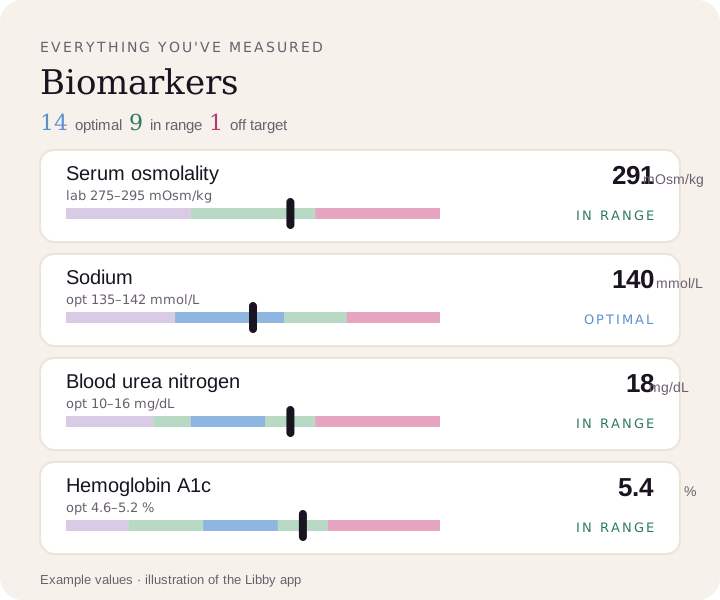
See every result against your lab's range.
Upload a lab PDF or a photo of your report. Libby puts every marker on your lab's range, adds the optimal range where one exists, and tracks your trends over time.
View your serum osmolality ›