SHBG blood test: normal range, low and high causes
SHBG holds testosterone and estrogen in your blood. Here's what's normal, what low or high SHBG usually means, and how to read it with free testosterone.
SHBG (sex hormone-binding globulin) is a protein your liver makes that holds testosterone and estrogen in your blood. Hormone gripped by SHBG is held in reserve, and only a small free slice reaches your tissues.12 That makes SHBG the number that tells you how much of a total testosterone result your body can use. Low SHBG most often travels with extra weight and insulin resistance. High SHBG most often comes from getting older (in men), estrogen from the pill or pregnancy, or an overactive thyroid.12
The short version
- Normal: check the range on your report. Labcorp, a large U.S. lab, uses 16.5–55.9 nmol/L for men aged 20–49 and 24.6–122.0 for women aged 20–49. Women run higher: healthy U.S. women averaged 62 nmol/L, men 34.34
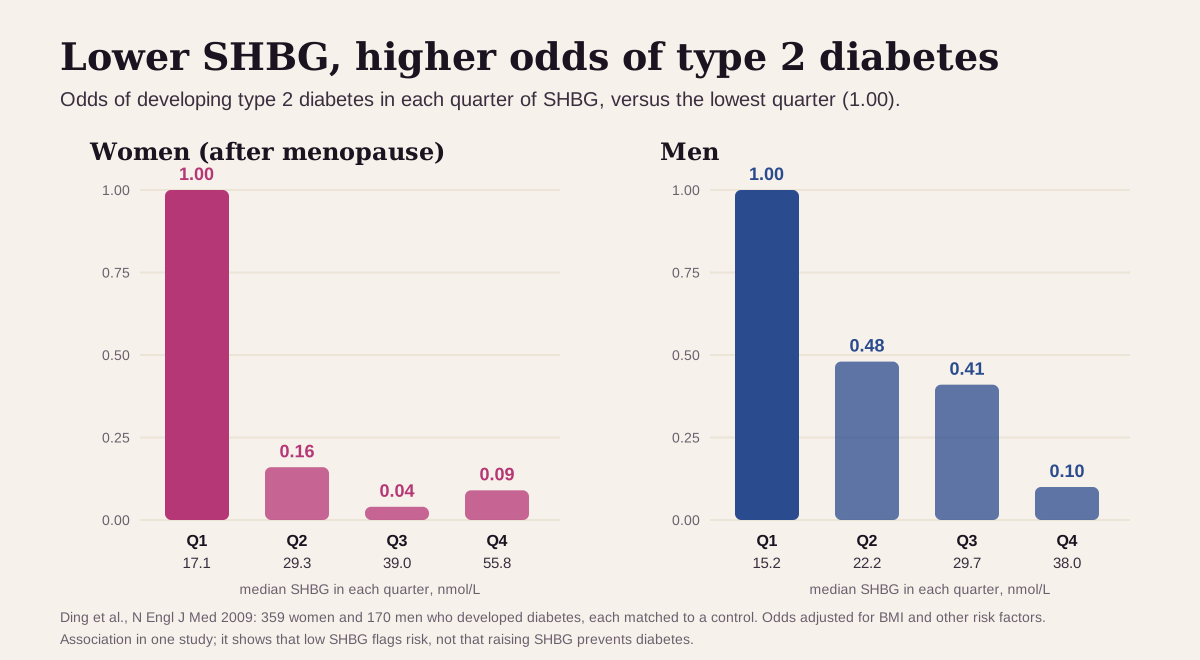
- Low SHBG usually points to extra weight, insulin resistance or type 2 diabetes, fatty liver, or PCOS in women. In one study, people in the lowest quarter of SHBG had about 10 times the odds of developing type 2 diabetes of people in the highest quarter.45
- High SHBG usually comes from getting older (men), estrogen (the pill, oral hormone therapy, pregnancy) or an overactive thyroid. It leaves less testosterone free, so total testosterone can look fine while free testosterone runs low.16
- The key move: when SHBG is off, ask for free testosterone. The Endocrine Society recommends it for men in exactly that situation, and the international PCOS guideline uses it for women.78 No guideline we found sets an urgent SHBG level; urgency comes from the cause.
What SHBG is
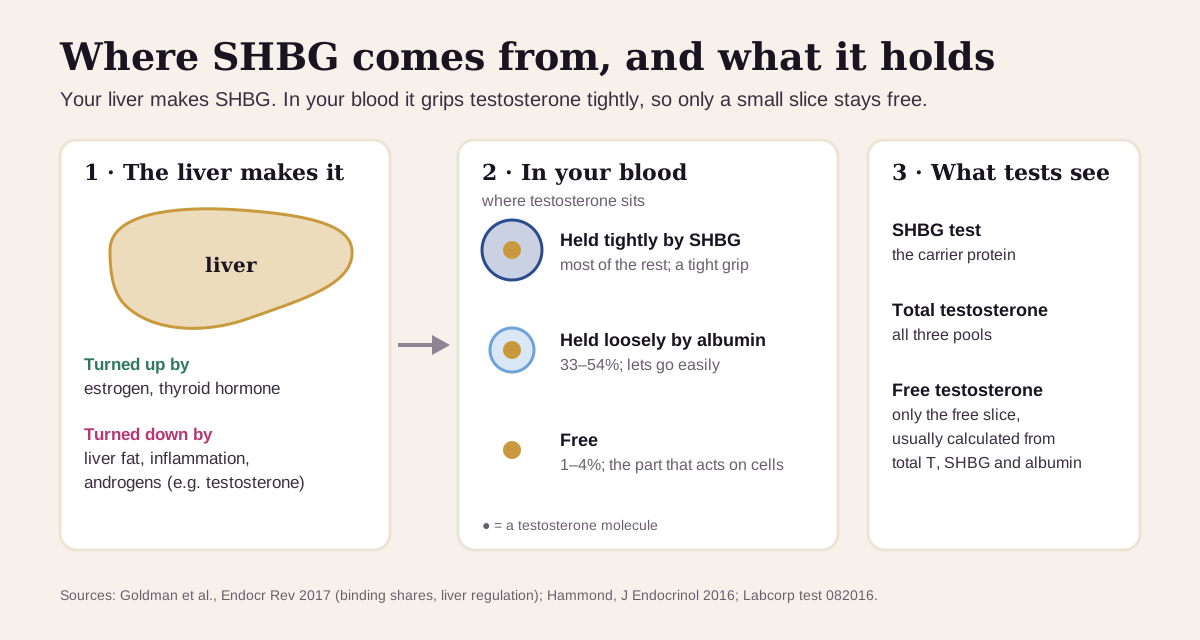
SHBG is a carrier protein. Your liver makes most of it and releases it into your blood, where it binds sex hormones: dihydrotestosterone (DHT) most tightly, then testosterone and estradiol.31
In a man's blood, testosterone sits in three places. Only 1–4% is free. Another 33–54% rides loosely on albumin, the most common blood protein, and lets go easily. Most of the rest is gripped tightly by SHBG.1 Free plus albumin-bound testosterone is often called "bioavailable" testosterone.
Your liver turns SHBG production up in response to estrogen and thyroid hormone, and down in response to liver fat, inflammation and androgens such as testosterone.93 That's why SHBG tracks your metabolism, your thyroid and your hormone exposures, as well as your sex hormones.
SHBG is usually ordered alongside total testosterone: for men with symptoms of low testosterone, for women with signs of too much (extra facial or body hair, acne, irregular periods), and to help work up PCOS.2
What's a normal SHBG?
Start with the range printed on your report. Labs use different assays: in a comparison of four common platforms, Roche's read highest and Abbott's lowest.4
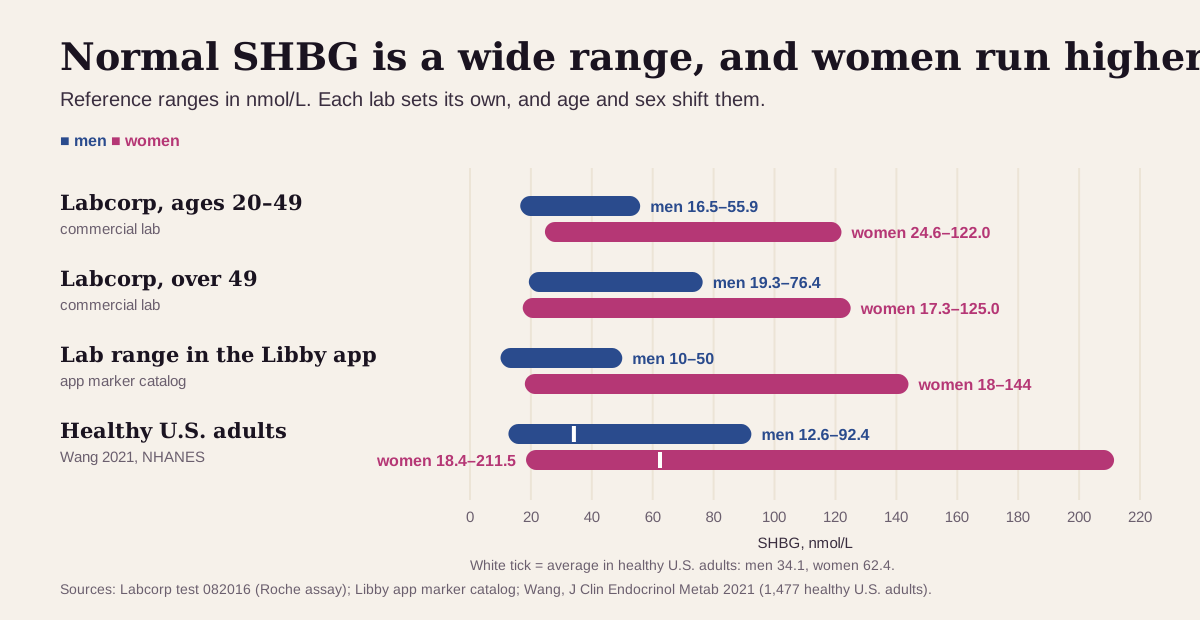
- Labcorp uses 16.5–55.9 nmol/L for men aged 20–49 and 19.3–76.4 over 49. For women it uses 24.6–122.0 at ages 20–49 and 17.3–125.0 over 49.3
- A 2021 study of 1,477 healthy U.S. adults from the national NHANES survey put 95% of healthy men between 12.6 and 92.4 nmol/L and 95% of healthy women between 18.4 and 211.5. Men averaged 34.1 and women 62.4.4
Women run higher than men, and men's SHBG climbs with age. In the same U.S. data, healthy men aged 20–49 averaged 31.3 nmol/L and men aged 50–80 averaged 52.0.4 Children have high SHBG that falls as puberty advances, and pregnancy raises it 5 to 10 times.9
"Optimal" SHBG: what health optimizers aim for
SHBG is different from most markers on an optimizer's list: it has a sweet spot, with risks at both ends. Too low signals metabolic trouble. Too high holds back more of your testosterone. Here's the ladder, from strictest to loosest:
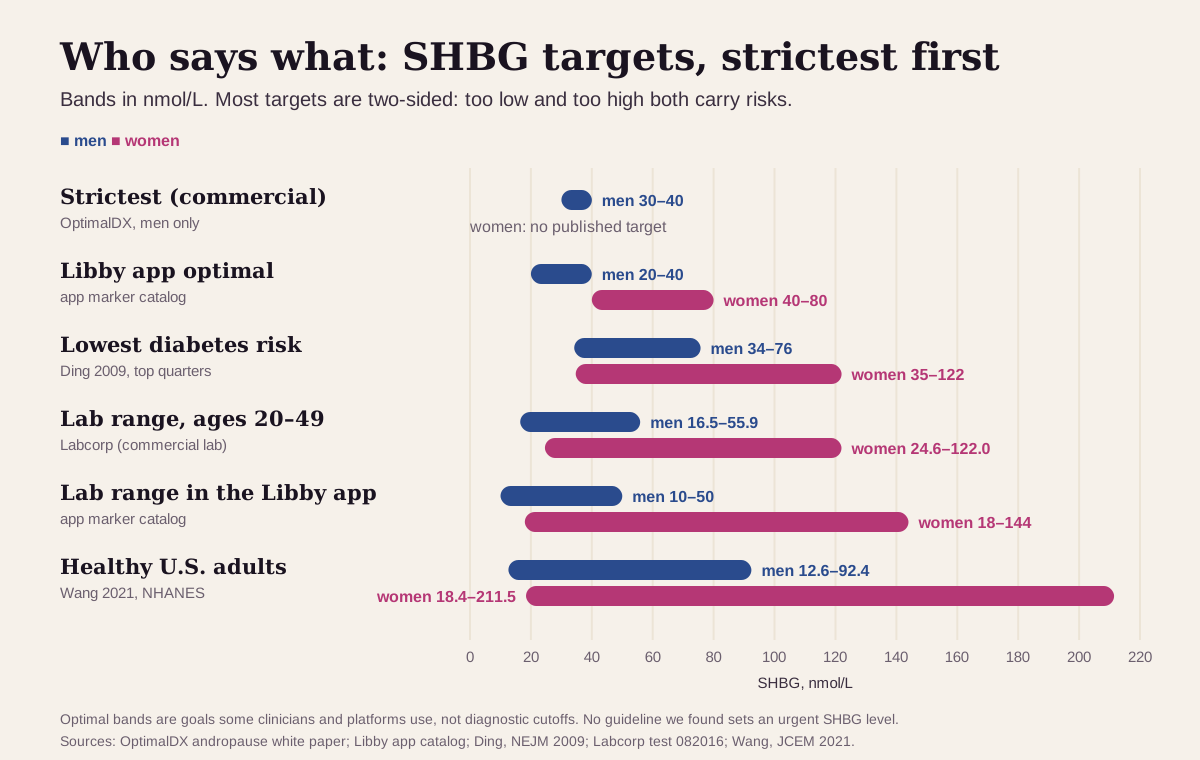
| Target | Men | Women | Who uses it |
|---|---|---|---|
| Strictest (commercial) | 30–40 nmol/L | none published | OptimalDX, which sells functional-medicine lab tools, in its andropause white paper11 |
| Libby app optimal | 20–40 nmol/L | 40–80 nmol/L | The optimal range shown in the Libby app; its catalog attributes it to Endocrine Society guidance10 |
| Lowest diabetes risk (research) | about 34 and up | about 35 and up | The top quarter of SHBG in men and the top half in women, in a study of type 2 diabetes5 |
| Lab range (Labcorp, ages 20–49) | 16.5–55.9 | 24.6–122.0 | Labcorp's reference range3 |
| Lab range in the Libby app | 10–50 | 18–144 | The range the app uses to flag a result low or high10 |
| Research "healthy" limits | 12.6–92.4 | 18.4–211.5 | Healthy U.S. adults in NHANES4 |
| Urgent | none set | none set | Urgency comes from the cause, such as an overactive thyroid |
The NHANES study also proposed research cutoffs for low SHBG: under 12.3 nmol/L in men under 50 and under 23.5 at 50 and older; under 14.5 in women under 30 and under 21.9 at 30 and older.4
Why a floor makes sense:
- In a study nested in two large U.S. cohorts, women past menopause whose SHBG sat in the lowest quarter (median 17.1 nmol/L) had about 11 times the odds of developing type 2 diabetes of women in the top quarter (median 55.8), after adjusting for BMI and other risk factors. In men, the lowest quarter (median 15.2) had about 10 times the odds of the top quarter (median 38.0).5
- In the same study, people who inherited gene variants that raise SHBG had a lower diabetes risk, a hint that SHBG itself may play a causal role.5
- In U.S. adults, extra weight was the biggest risk factor for low SHBG, and low SHBG was three times as common in people with diabetes (7.1%) as in people without it (2.3%).4
Why a ceiling makes sense, at least for men:
- Pooling data on men from nine cohort studies, researchers found that men in the lowest fifth of SHBG (median 20.6 nmol/L) had 15% lower all-cause mortality than men in the highest fifth (median 68.3), after adjusting for age, weight and health conditions.12
- In 205,973 UK Biobank men, lower SHBG went with fewer fractures: 45% lower hip-fracture risk in the lowest fifth than in the highest.13
- More SHBG means more testosterone held back. On the combined pill, for example, free testosterone fell about twice as much as total testosterone.6
Keep "optimal" in perspective: these are targets, and none of them is a diagnosis. A low SHBG in a man is a reason to look at weight, blood sugar and liver fat. A high SHBG is a reason to check free testosterone and thyroid function. The evidence is strongest for the floor; the ceiling data come from studies of men.
What low or high SHBG usually means
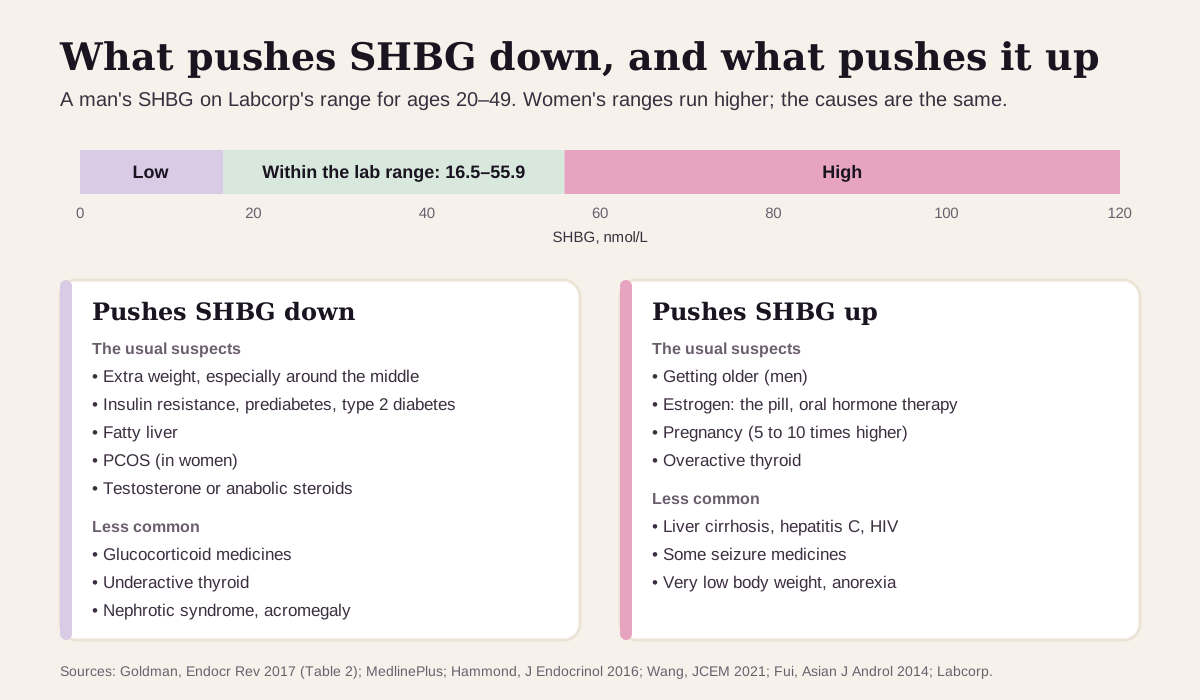
Direction is the first clue. SHBG mostly reflects what your liver is responding to: weight and blood sugar push it down, while age, estrogen and thyroid hormone push it up.19
Low SHBG: usually metabolic
The usual suspects:
- Extra weight and insulin resistance. This is the big one. In U.S. adults, a higher BMI was the biggest risk factor for low SHBG, and diabetes raised the odds of low SHBG 2.65-fold in men and 3.52-fold in women.4 Liver fat and low-grade inflammation turn down the liver's SHBG production.1 In overweight men, low SHBG pulls total testosterone down while free testosterone often stays in range.14
- Fatty liver. Fat inside the liver suppresses SHBG production directly.19
- PCOS (polycystic ovary syndrome). Low SHBG is common in PCOS and leaves more testosterone free.12 The international PCOS guideline uses total and free testosterone to confirm high androgens.8
- Testosterone or anabolic steroids. Androgens suppress SHBG.31
- Less common causes: glucocorticoid medicines, an underactive thyroid, nephrotic syndrome (a kidney condition that leaks protein), acromegaly, Cushing's syndrome, and inherited SHBG gene variants.12
High SHBG: usually age, estrogen or thyroid
The usual suspects:
- Getting older (men). In the Massachusetts Male Aging Study, SHBG rose about 1.6% per year of age while free testosterone fell about 2% per year.15
- Estrogen. In a meta-analysis of 42 studies, the combined pill raised SHBG by an average of 99 nmol/L.6 In a randomized trial in women past menopause, estradiol taken by mouth raised SHBG by 67–171%, while estradiol through the skin left it about where it was.16
- Pregnancy. SHBG rises 5 to 10 times.9
- Overactive thyroid. Thyroid hormone drives the liver's SHBG production, and LH tends to run high too.91
- Less common causes: liver cirrhosis, hepatitis C, HIV, some anticonvulsant (seizure) medicines, and very low body weight, as in anorexia.1
Don't stop a prescribed pill, hormone therapy or thyroid medicine to move your SHBG. Bring the question to the clinician who prescribed it.2
Get prompt care if a high SHBG comes with signs of an overactive thyroid: a rapid or irregular heartbeat, a hand tremor, trouble tolerating heat, nervousness, or unexplained weight loss.17
SHBG reads best next to its neighbors
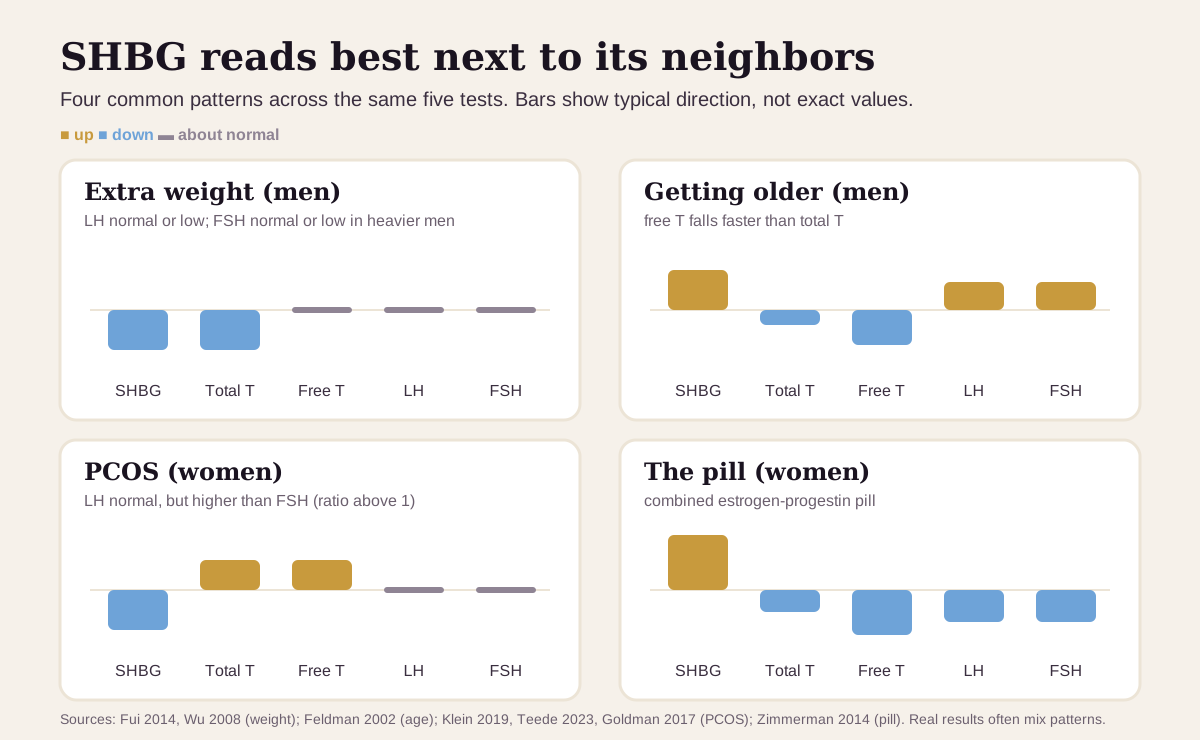
The SHBG test is mostly there to explain testosterone. Read it with total testosterone, free testosterone and the two pituitary hormones that drive the testes and ovaries, LH and FSH. The pattern says far more than SHBG alone:
| If you see… | It often points to… |
|---|---|
| Low SHBG and low total testosterone, free testosterone in range, LH normal or low (men) | extra weight and insulin resistance: the low total number is mostly an SHBG effect1418 |
| High SHBG, falling free testosterone, rising LH and FSH (older men) | age-related decline in the testes1518 |
| Low SHBG, high or high-normal testosterone, LH higher than FSH (women) | a PCOS pattern1981 |
| High SHBG, low free testosterone, low LH and FSH (women) | the combined pill: free testosterone drops about twice as much as total6 |
| Low SHBG, high testosterone, suppressed LH and FSH (men) | testosterone use; other anabolic steroids lower testosterone along with LH and FSH201 |
| High SHBG with a racing heart or weight loss | an overactive thyroid: ask about a TSH test917 |
The Endocrine Society's rule for men: when total testosterone is near the lower limit, or a condition has changed SHBG, get free testosterone measured by equilibrium dialysis or estimated with an accurate formula. A diagnosis of low testosterone also needs symptoms plus repeatedly low morning, fasting levels.7
How fast SHBG changes
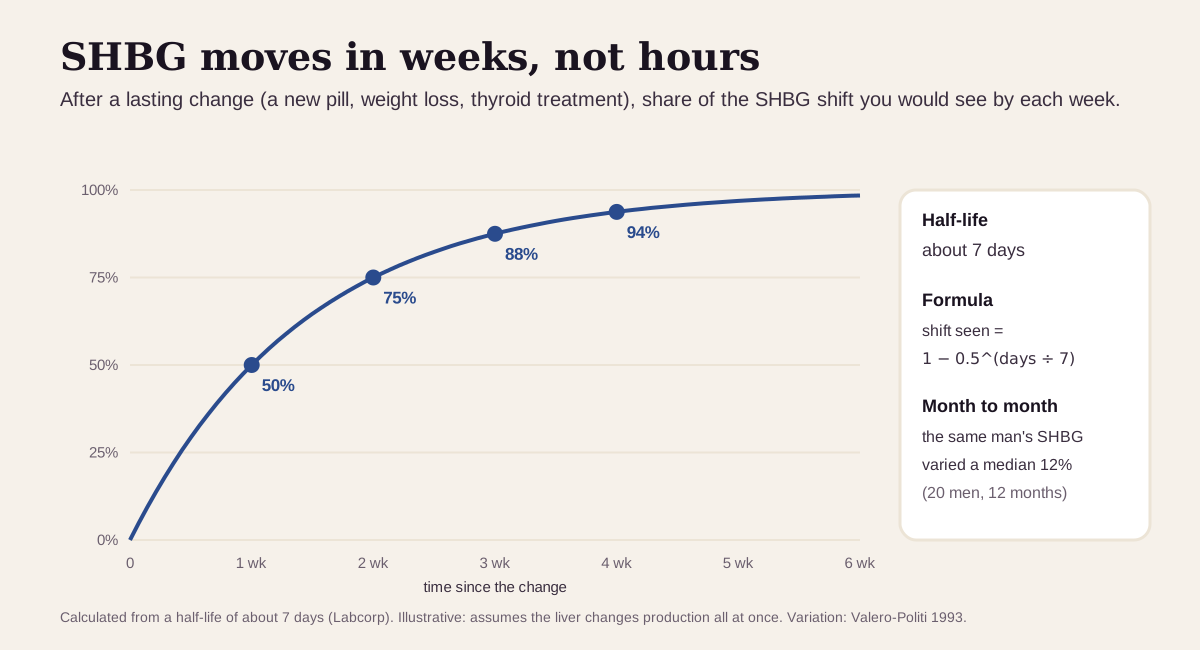
SHBG is slow. Its half-life in the blood is about 7 days.3 After a lasting change, such as a new pill, weight loss or thyroid treatment, about half the shift shows up in a week and most of it (about 94%) in four weeks, calculated from that half-life. A test a few days after the change catches only part of it.
What that means in practice:
- Expect some wobble. In 20 men tested monthly for a year, each man's SHBG varied by a median 12% from test to test. The spread between men was 43%.21 A small move between two tests is often just this wobble; a steady trend across several tests tells you more.
- Weight change moves it. In men followed for about four years, modest weight loss raised total testosterone by about 2 nmol/L, most likely through a rise in SHBG.14
- Mention supplements. High-dose biotin can interfere with the test. Labcorp asks for biotin to be stopped at least 72 hours before the blood draw.3 Check with your clinician first if it was prescribed.
- Trends beat snapshots. Compare results from the same lab when you can, because assays differ.4
Going deeper: turning SHBG into free testosterone
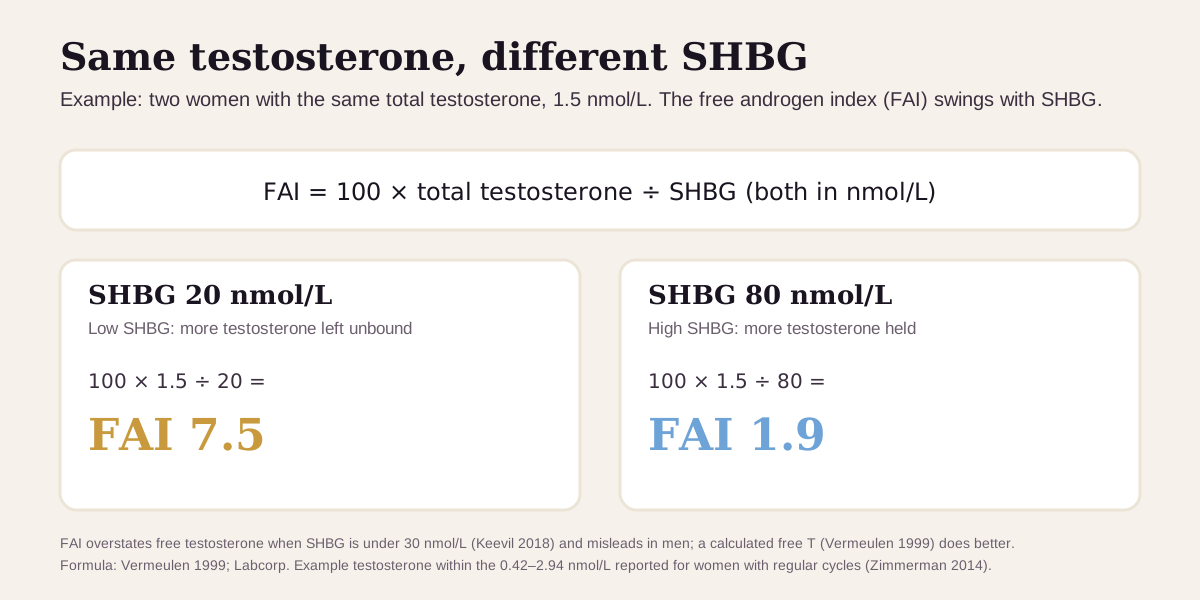
Free testosterone is hard to measure directly, so labs usually calculate it from total testosterone, SHBG and albumin with the law of mass action. A 1999 study found this calculated value almost identical to the reference method (equilibrium dialysis) across SHBG levels from very low to very high. Pregnancy was the exception: estradiol fills many of SHBG's binding sites, so the calculation came out too low.22
Two shortcuts are weaker:
- Direct ("analog") free testosterone immunoassays gave only a fraction of the true value, and the fraction shifted with SHBG.22
- The free androgen index (FAI), 100 × total testosterone ÷ SHBG, is widely used for women. It overstates free testosterone once SHBG falls below about 30 nmol/L, and it is known to give wrong results in men.23
Men and women use SHBG differently. In men about 80% of SHBG's binding sites are occupied, mostly by testosterone; in women only about 20% are.9 That's one reason the same SHBG number means something different for each.
Questions worth asking
- Is my SHBG low, high or in range, and what does that do to my free testosterone?
- Should my free testosterone be calculated or measured, rather than judged from total testosterone alone?
- Could weight, blood sugar or liver fat explain a low SHBG? Would a fasting glucose, HbA1c or liver panel help?
- Could the pill, hormone therapy, testosterone or another medicine be moving my SHBG?
- Should I have a TSH test to check my thyroid?
- When should we repeat it, and should it be at the same lab?
FAQ
What is a normal SHBG level? It depends on your lab, age and sex. Labcorp uses 16.5–55.9 nmol/L for men aged 20–49 and 24.6–122.0 for women aged 20–49.3
What causes low SHBG? Extra weight and insulin resistance are the most common causes. Type 2 diabetes, fatty liver, PCOS, and testosterone or anabolic steroids also lower it.41
Does high SHBG mean low testosterone? It can mean low free testosterone. High SHBG holds more testosterone back, so total testosterone can look normal while the free share runs low. A free testosterone result answers the question.72
Can SHBG change? Yes, over weeks. Its half-life is about 7 days.3 Weight loss tends to raise it, estrogen raises it, and androgens lower it.1463
This guide is for education. It can't diagnose you or replace care from a clinician who knows your history.
Footnotes
-
Goldman AL, Bhasin S, Wu FCW, Krishna M, Matsumoto AM, Jasuja R. A Reappraisal of Testosterone's Binding in Circulation: Physiological and Clinical Implications. Endocr Rev. 2017;38(4):302–324. The source for the free (1–4%) and albumin-bound (33–54%) shares, liver regulation of SHBG, and Table 2 of conditions that raise or lower SHBG. PMC ↩ ↩2 ↩3 ↩4 ↩5 ↩6 ↩7 ↩8 ↩9 ↩10 ↩11 ↩12 ↩13 ↩14 ↩15 ↩16 ↩17 ↩18 ↩19
-
National Library of Medicine. SHBG Blood Test. MedlinePlus. Updated January 12, 2026. Why the test is ordered, and conditions linked with low and high SHBG. MedlinePlus ↩ ↩2 ↩3 ↩4 ↩5 ↩6 ↩7 ↩8
-
Labcorp. Sex Hormone-binding Globulin (SHBG), test 082016. Roche electrochemiluminescence assay. Reference ranges: male 20–49 years 16.5–55.9 nmol/L, over 49 19.3–76.4; female 20–49 years 24.6–122.0, over 49 17.3–125.0. States a half-life of about seven days, liver production raised by estrogens and thyroid hormones and suppressed by androgens, binding strongest for DHT, and a 72-hour biotin stop before collection. Labcorp is a commercial laboratory. Retrieved September 23, 2026. labcorp.com ↩ ↩2 ↩3 ↩4 ↩5 ↩6 ↩7 ↩8 ↩9 ↩10 ↩11 ↩12 ↩13 ↩14 ↩15
-
Wang Y. Definition, Prevalence, and Risk Factors of Low Sex Hormone-Binding Globulin in US Adults. J Clin Endocrinol Metab. 2021;106(10):e3946–e3956. NHANES 2013–2016, 4,093 adults with a healthy reference group of 1,477; reference intervals, low-SHBG cutoffs, assay differences, and BMI and diabetes as risk factors. PMC ↩ ↩2 ↩3 ↩4 ↩5 ↩6 ↩7 ↩8 ↩9 ↩10 ↩11 ↩12 ↩13 ↩14
-
Ding EL, Song Y, Manson JE, et al. Sex hormone-binding globulin and risk of type 2 diabetes in women and men. N Engl J Med. 2009;361(12):1152–1163. Nested case-control studies in the Women's Health Study (359 cases) and Physicians' Health Study II (170 cases), with Mendelian randomization. Table 3 gives the quartile medians and odds ratios. PMC ↩ ↩2 ↩3 ↩4 ↩5 ↩6
-
Zimmerman Y, Eijkemans MJ, Coelingh Bennink HJ, Blankenstein MA, Fauser BC. The effect of combined oral contraception on testosterone levels in healthy women: a systematic review and meta-analysis. Hum Reprod Update. 2014;20(1):76–105. 42 studies, 1,495 women: SHBG up 99 nmol/L, total testosterone down 31%, free testosterone down 61%; the pill suppresses the gonadotrophins; testosterone of 0.42–2.94 nmol/L in women with regular cycles. PMC ↩ ↩2 ↩3 ↩4 ↩5 ↩6 ↩7
-
Bhasin S, Brito JP, Cunningham GR, et al. Testosterone Therapy in Men With Hypogonadism: An Endocrine Society Clinical Practice Guideline. J Clin Endocrinol Metab. 2018;103(5):1715–1744. Free testosterone by equilibrium dialysis or an accurate formula when total testosterone is near the lower limit or SHBG is altered; diagnosis needs symptoms plus consistently low morning fasting testosterone. PubMed ↩ ↩2 ↩3
-
Teede HJ, Tay CT, Laven JJE, et al. Recommendations From the 2023 International Evidence-based Guideline for the Assessment and Management of Polycystic Ovary Syndrome. J Clin Endocrinol Metab. 2023;108(10):2447–2469. Total and free testosterone to assess high androgens; the pill raises SHBG and lowers gonadotrophin-driven androgen production. PMC ↩ ↩2 ↩3 ↩4
-
Hammond GL. Plasma steroid-binding proteins: primary gatekeepers of steroid hormone action. J Endocrinol. 2016;230(1):R13–R25. Hormones and factors that turn liver SHBG production up or down; high SHBG in childhood; 5- to 10-fold rises in pregnancy; about 80% of binding sites occupied in men versus 20% in women; high LH in hyperthyroidism. PMC ↩ ↩2 ↩3 ↩4 ↩5 ↩6 ↩7 ↩8 ↩9 ↩10
-
Libby Health app marker catalog: SHBG optimal range 20–40 nmol/L for men and 40–80 nmol/L for women, with lab ranges of 10–50 and 18–144. The catalog attributes the optimal bands to Endocrine Society clinical practice guidelines (various publications); no single guideline stating these numbers was identified for this article. The catalog credits its lab ranges to Labcorp, whose current published ranges differ. Endocrine Society ↩ ↩2 ↩3 ↩4
-
Weatherby D, DiLuglio BE. Andropause (white paper). Optimal DX, LLC; PDF created 2021, revised January 2025. Lists an "OptimalDX Male" SHBG range of 3.37–4.5 µg/mL (30–40 nmol/L), next to lab ranges of 16.5–55.9 (Labcorp, ages 20–49) and 10–50 (Quest, ages 18–55). A commercial source, listed as what the optimizer community uses. optimaldx.com ↩ ↩2
-
Yeap BB, Marriott RJ, Dwivedi G, et al. Associations of Testosterone and Related Hormones With All-Cause and Cardiovascular Mortality and Incident Cardiovascular Disease in Men: Individual Participant Data Meta-analyses. Ann Intern Med. 2024;177(6):768–781. Nine cohorts with individual data; SHBG quintile 1 versus 5 (medians 20.6 vs 68.3 nmol/L), adjusted hazard ratio 0.85 for all-cause mortality; also gives 213 ng/dL as 7.4 nmol/L. PubMed ↩
-
Grahnemo L, Marriott RJ, Murray K, et al. Associations of Serum Testosterone and SHBG With Incident Fractures in Middle-aged to Older Men. J Clin Endocrinol Metab. 2025;110(7):1964–1973. UK Biobank, 205,973 men; lowest versus highest SHBG quintile, hip fracture hazard ratio 0.55. PMC ↩
-
Fui MN, Dupuis P, Grossmann M. Lowered testosterone in male obesity: mechanisms, morbidity and management. Asian J Androl. 2014;16(2):223–231. Moderate obesity lowers total testosterone mainly through lower SHBG, with free testosterone in range; LH and FSH normal or low; weight loss of under 15% raised total testosterone by about 2 nmol/L. PMC ↩ ↩2 ↩3 ↩4 ↩5 ↩6
-
Feldman HA, Longcope C, Derby CA, et al. Age trends in the level of serum testosterone and other hormones in middle-aged men: longitudinal results from the Massachusetts male aging study. J Clin Endocrinol Metab. 2002;87(2):589–598. 1,156 men followed 7–10 years: SHBG up 1.6% per year of age, free testosterone down about 2% per year, and pituitary gonadotropins (LH, FSH) rising. PubMed ↩ ↩2 ↩3
-
Ropponen A, Aittomäki K, Vihma V, Tikkanen MJ, Ylikorkala O. Effects of oral and transdermal estradiol administration on levels of sex hormone-binding globulin in postmenopausal women with and without a history of intrahepatic cholestasis of pregnancy. J Clin Endocrinol Metab. 2005;90(6):3431–3434. Randomized, double-blind crossover trial in 40 women. PubMed ↩
-
National Library of Medicine. Hyperthyroidism. MedlinePlus. Updated March 22, 2024. Symptoms of an overactive thyroid. MedlinePlus ↩ ↩2
-
Wu FC, Tajar A, Pye SR, et al. Hypothalamic-pituitary-testicular axis disruptions in older men are differentially linked to age and modifiable risk factors: the European Male Aging Study. J Clin Endocrinol Metab. 2008;93(7):2737–2745. 3,200 men aged 40–79: age brought lower free testosterone with raised LH (impaired testicular function); overweight and obesity brought lower total and free testosterone with unchanged or decreased LH. PubMed ↩ ↩2 ↩3
-
Klein DA, Paradise SL, Reeder RM. Amenorrhea: A Systematic Approach to Diagnosis and Management. Am Fam Physician. 2019;100(1):39–48. Table 4 gives the PCOS pattern: LH under 15 with an LH/FSH ratio above 1, FSH under 10, testosterone high or high-normal, TSH normal. AAFP ↩ ↩2
-
Pope HG Jr, Wood RI, Rogol A, Nyberg F, Bowers L, Bhasin S. Adverse health consequences of performance-enhancing drugs: an Endocrine Society scientific statement. Endocr Rev. 2014;35(3):341–375. High testosterone with suppressed LH and FSH should raise suspicion of testosterone misuse. PMC ↩
-
Valero-Politi J, Fuentes-Arderiu X. Within- and between-subject biological variations of follitropin, lutropin, testosterone, and sex-hormone-binding globulin in men. Clin Chem. 1993;39(8):1723–1725. 20 men tested for 12 months; SHBG within-subject variation 12.1%, between-subject 42.7%. PubMed ↩ ↩2
-
Vermeulen A, Verdonck L, Kaufman JM. A critical evaluation of simple methods for the estimation of free testosterone in serum. J Clin Endocrinol Metab. 1999;84(10):3666–3672. Calculated free testosterone matched equilibrium dialysis except in pregnancy; analog assays and the FAI varied with SHBG. PubMed ↩ ↩2 ↩3
-
Keevil BG, Adaway J, Fiers T, Moghetti P, Kaufman JM. The free androgen index is inaccurate in women when the SHBG concentration is low. Clin Endocrinol (Oxf). 2018;88(5):706–710. 130 women with PCOS, 53 female controls and 120 men; FAI drifted from measured free testosterone below SHBG 30 nmol/L. PubMed ↩ ↩2
Educational content, not medical advice. Libby is a personal record tool, not a medical service — it doesn't diagnose, treat, or prescribe. Reference ranges vary by lab and by person. Talk to a qualified healthcare professional about your results.
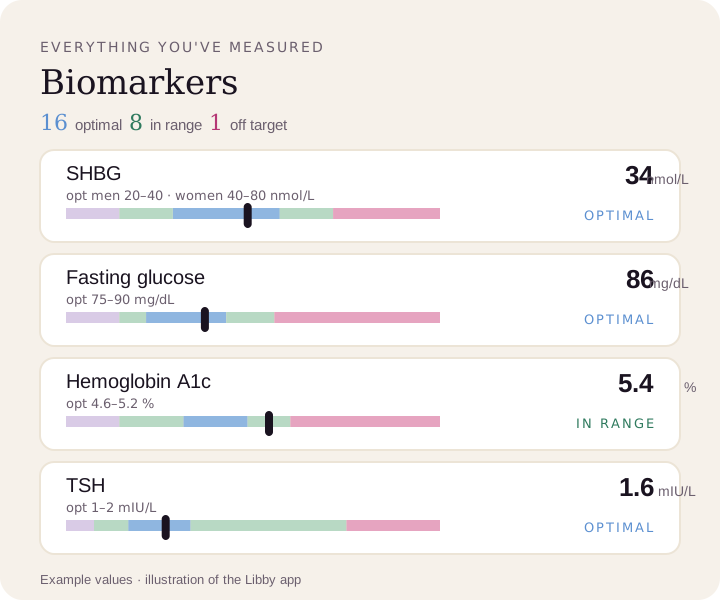
Compare your results to optimal ranges.
Upload a lab PDF or a photo of your report. Libby puts every marker on your lab's range and the optimal range, and tracks your trends over time.
View your SHBG ›