Sickle cell screen: what a positive or negative means
A sickle cell screen checks blood for hemoglobin S. What a positive or negative result means, when it can be wrong, and which test sorts trait from disease.
A sickle cell screen is a quick blood test for hemoglobin S (HbS), the form of hemoglobin behind sickle cell trait and sickle cell disease. A negative result means no HbS was found. A positive result means HbS is there, but the screen answers only that yes-or-no question: it reads positive for a carrier with sickle cell trait and for a person with sickle cell disease alike. A second test, hemoglobin electrophoresis or HPLC, tells them apart.123
The short version
- Normal: negative, meaning no hemoglobin S.1 That's the expected result on the report.4
- Positive: hemoglobin S is present. In an adult it's most often sickle cell trait, a carrier state that usually causes no symptoms.5 About 1 in 13 Black or African American babies and about 15 in 1,000 U.S. newborns overall are born with it.67 Electrophoresis or HPLC confirms which it is.2
- A negative can miss HbS in babies under 6 months, after a blood transfusion in the past 3 months, with very low hemoglobin (under 8 g/dL), or when HbS is under about 15% of the total.4128
- Urgent: in someone with sickle cell disease, a fever above 101.3°F (38.5°C) needs medical care right away.9
What the sickle cell screen is
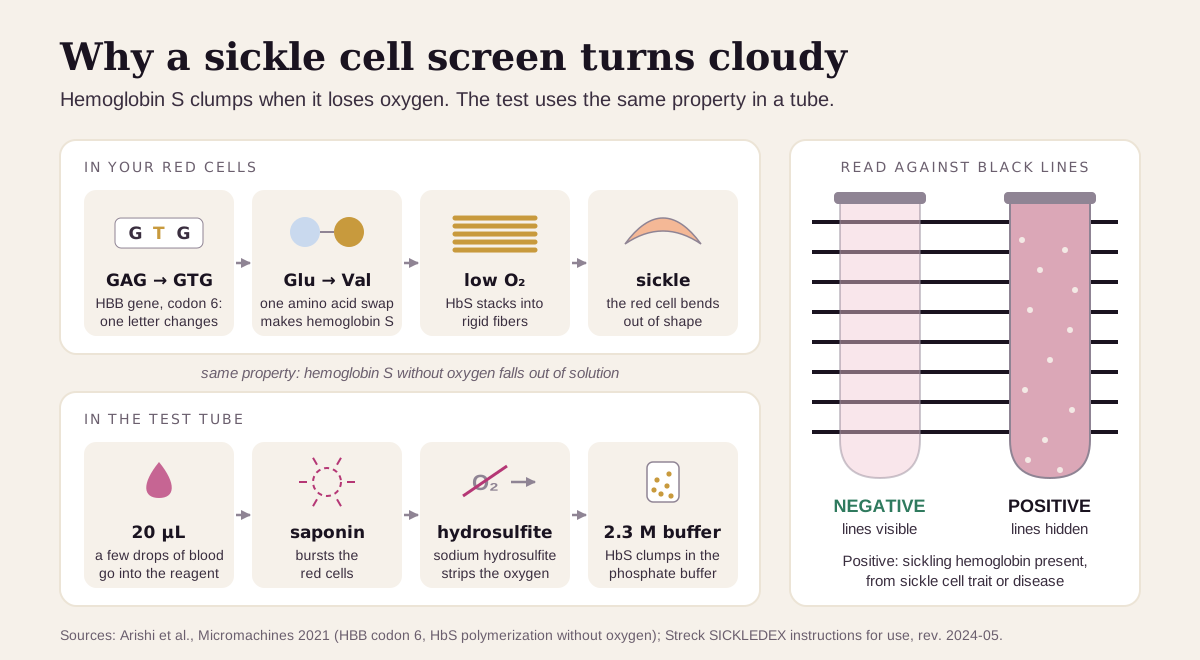
Hemoglobin is the oxygen-carrying protein that fills your red blood cells. You inherit one hemoglobin gene for its beta chain (HBB) from each parent. A single-letter change in that gene, at codon 6, swaps one amino acid (glutamic acid) for another (valine) and makes hemoglobin S.1011 When HbS loses its oxygen, it stacks into long, rigid fibers that bend red cells into a sickle shape.10
The screen uses that same property in a test tube. A few drops of blood go into a reagent that bursts the red cells and strips oxygen from the hemoglobin. HbS falls out of solution and turns the liquid cloudy; normal hemoglobin A stays dissolved.23 The lab reads it by eye against black lines behind the tube: lines hidden means positive, lines clearly visible means negative.2
You may see it on a report as a sickle solubility test or Sickledex, a common kit.1 It's used when a quick answer about HbS matters: before surgery or anesthesia in some hospitals, before blood donation, and for sickle cell trait screening in college athletes, where the NCAA uses it as the first-line test.83
What's a normal sickle cell screen result?
Negative. A negative result means no hemoglobin S was found, and "Negative" is the reference result Labcorp prints for its solubility test.14
Whether HbS is there at all comes down to inheritance. Each parent passes on one HBB gene. When both parents have sickle cell trait, each child has a 1 in 4 chance of sickle cell disease, a 1 in 2 chance of trait, and a 1 in 4 chance of neither.5
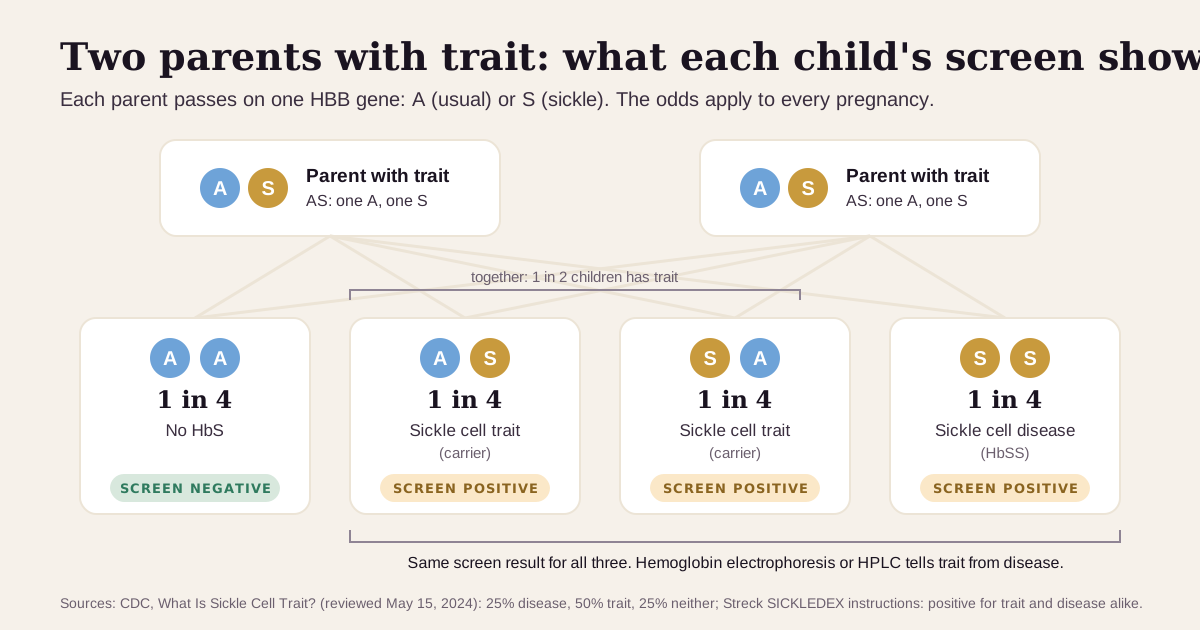
Sickle cell disease takes two altered genes, and HbS has to be one of them. Sickle cell anemia (HbSS) has two HbS genes. HbSC disease pairs HbS with hemoglobin C, and HbS/beta-thalassemia pairs it with a gene that makes little or no normal beta chain.119 The screen reads all of them as positive. So does trait, with one HbS gene and one normal gene.2
"Optimal" sickle cell screen: negative, and where each line is drawn
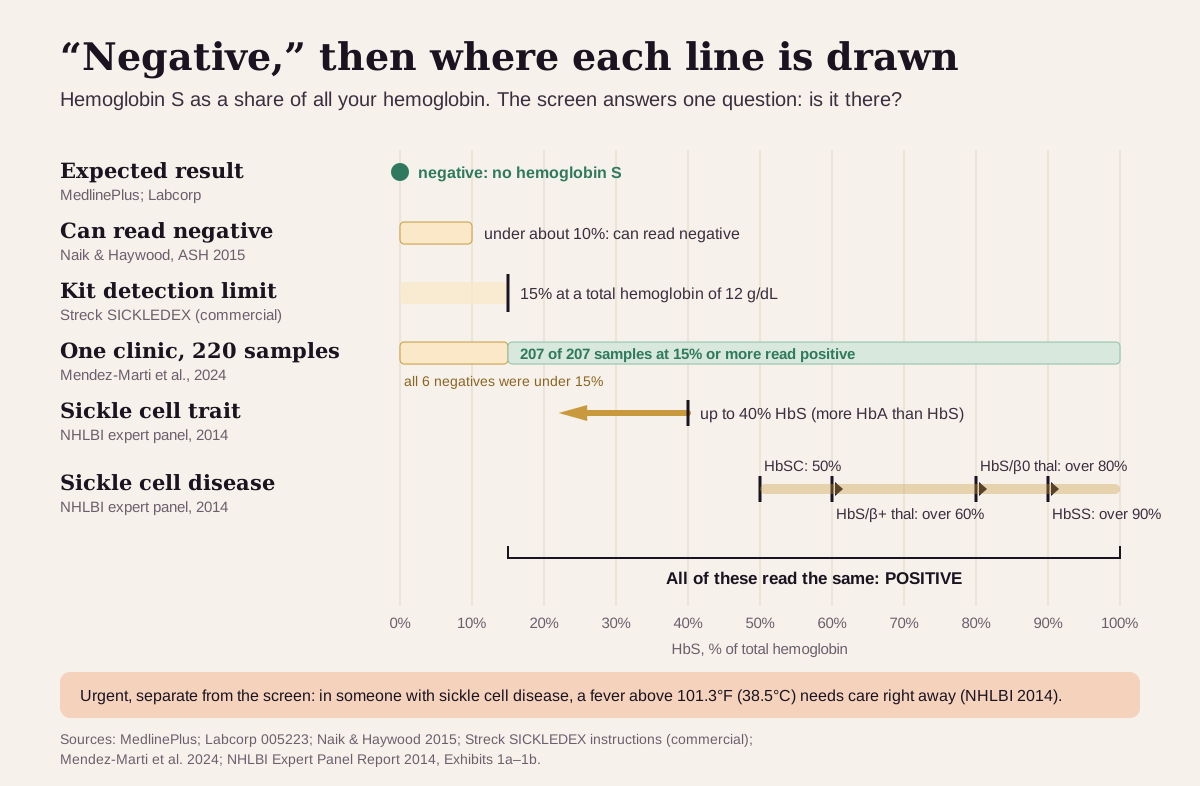
For this screen every source agrees on the goal: negative. We found no functional-medicine or longevity target for it, and the Libby app has no optimal range for it. What sources do draw is where the screen stops being reliable, and how much HbS sits behind a positive. From lowest to highest share of HbS:
| Line | Where it's drawn | Who draws it |
|---|---|---|
| Expected result | negative: no hemoglobin S | MedlinePlus; Labcorp's reference result14 |
| Can read negative | HbS under about 10% of total hemoglobin | An American Society of Hematology education review3 |
| Kit detection limit | 15% HbS at a total hemoglobin of 12 g/dL | Streck, the maker of the SICKLEDEX kit2 |
| Seen in a clinic | every sample with HbS of 15% or more read positive (207 of 207) | Mendez-Marti et al., 220 adult samples8 |
| Sickle cell trait | HbS up to 40%, with more hemoglobin A than S | NHLBI expert panel9 |
| Sickle cell disease | HbS about 50% (HbSC) to over 90% (HbSS) | NHLBI expert panel9 |
| Urgent | fever above 101.3°F (38.5°C) in someone with sickle cell disease | NHLBI: seek care right away9 |
Why the low lines matter:
- In one U.S. clinic, all 6 negative screens out of 220 came from samples with HbS under 15%. Four were from people with sickle cell disease after a red-cell exchange, and one after heavy transfusion.8
- The detection limit also depends on how much hemoglobin is in the tube, which is why the kit's 15% figure is stated at a total hemoglobin of 12 g/dL.2 The clinic study put the floor at about 1.2 g/L of HbS.8
Keep "optimal" in perspective. A positive screen in an adult most often means sickle cell trait, and the NHLBI expert panel classes trait as a carrier state, separate from sickle cell disease.9 The percentages that sort trait from disease come from the follow-up test; our hemoglobin S guide and hemoglobin A guide cover those numbers.
What a positive screen usually means
A positive screen means sickling hemoglobin is present. It's usually one of these, with trait by far the most common:246
- Sickle cell trait (HbAS). One HbS gene and one normal gene. Most people with trait have no symptoms.5 It's common: about 1 in 13 Black or African American babies is born with it, and in 2010 the rate across 44 states was 15.5 per 1,000 newborns.67 HbS is most common in people whose ancestors come from Africa, the Mediterranean, the Arabian Peninsula, India and Spanish-speaking parts of the Americas, and about 300 million people carry trait worldwide.113
- Sickle cell disease. About 100,000 people in the U.S. have it. Among Black or African American births, disease (about 1 in 365) is far rarer than trait (about 1 in 13), and every U.S. newborn has been screened for it since 2006 (see below).612
- Rare sickling variants. A few uncommon hemoglobins, such as hemoglobin C-Harlem and C-Georgetown, also turn the tube cloudy.24
- A false positive. A very high red-cell count (erythrocytosis or polycythemia), high blood proteins, a very high white-cell count, or high blood fats can cloud the tube without HbS.24
That's why every positive screen should go on to hemoglobin electrophoresis or HPLC, which measures each type of hemoglobin as a percentage.24
What sickle cell trait means for your health
Trait is a carrier state. The CDC notes that most people with it have no symptoms of sickle cell disease, and a U.S. Army study found no higher risk of death.513 Large studies have found a few specific, measurable risks:
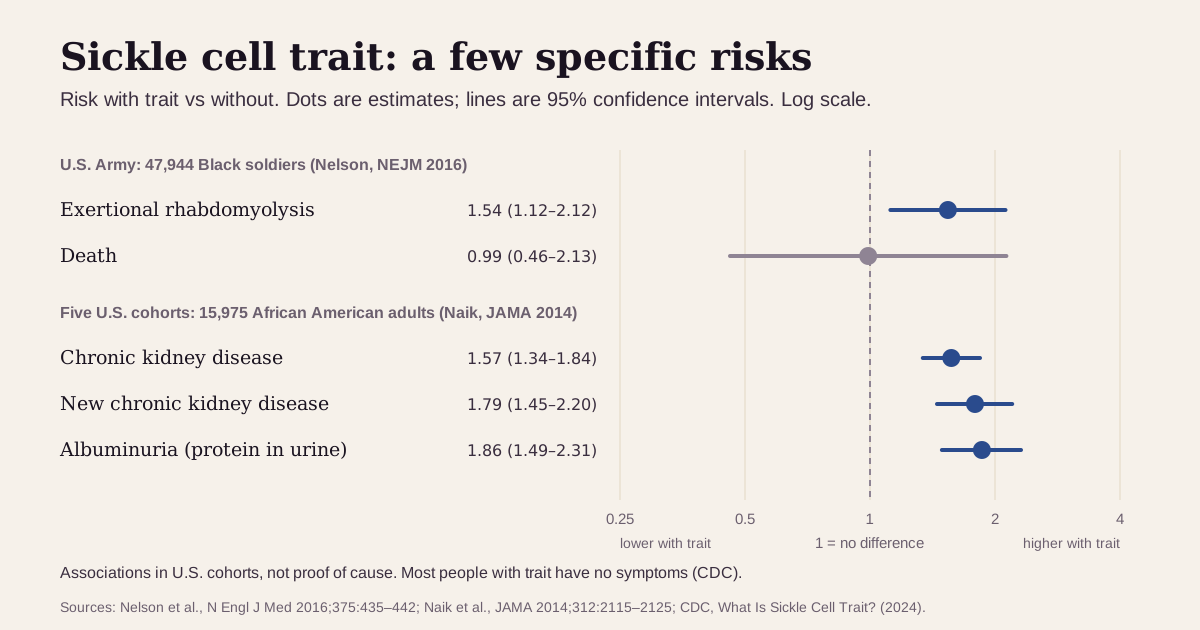
- Hard exercise. Among 47,944 Black U.S. Army soldiers, trait raised the risk of exertional rhabdomyolysis (muscle breakdown during hard exercise) by about half, similar to smoking or obesity.13 Heat illness and collapse during intense exercise are the other exercise risks.3 The CDC advises athletes with trait to stay hydrated, build up intensity gradually and get care when ill.5
- Kidneys. In 15,975 African American adults, people with trait had higher odds of chronic kidney disease (19.2% vs 13.5%) and of protein in the urine.14 Blood in the urine is more common with trait, and a rare kidney cancer, renal medullary carcinoma, occurs almost only in people with trait.53
- Other. Trait has been linked to blood clots in the veins, and to spleen damage at high altitude, with severe dehydration or with intense activity.35
- HbA1c. Trait can shift some HbA1c results: in 4,620 African American adults, HbA1c ran about 0.3 points lower with trait at the same fasting glucose, and some HbA1c methods are thrown off by HbS or HbC.1516 Our HbA1c guide covers what to ask your lab.
Get care right away if someone with sickle cell disease has a fever above 101.3°F (38.5°C).9 For someone with sickle cell trait, get urgent care for collapse during hard exercise, or for dark, cola-colored urine with muscle aching or weakness after it.317
What a negative screen usually means
Usually just that: no hemoglobin S. In an adult with a normal hemoglobin and no recent transfusion, a negative is usually reliable.28 The exceptions are specific, and worth checking against your own situation:
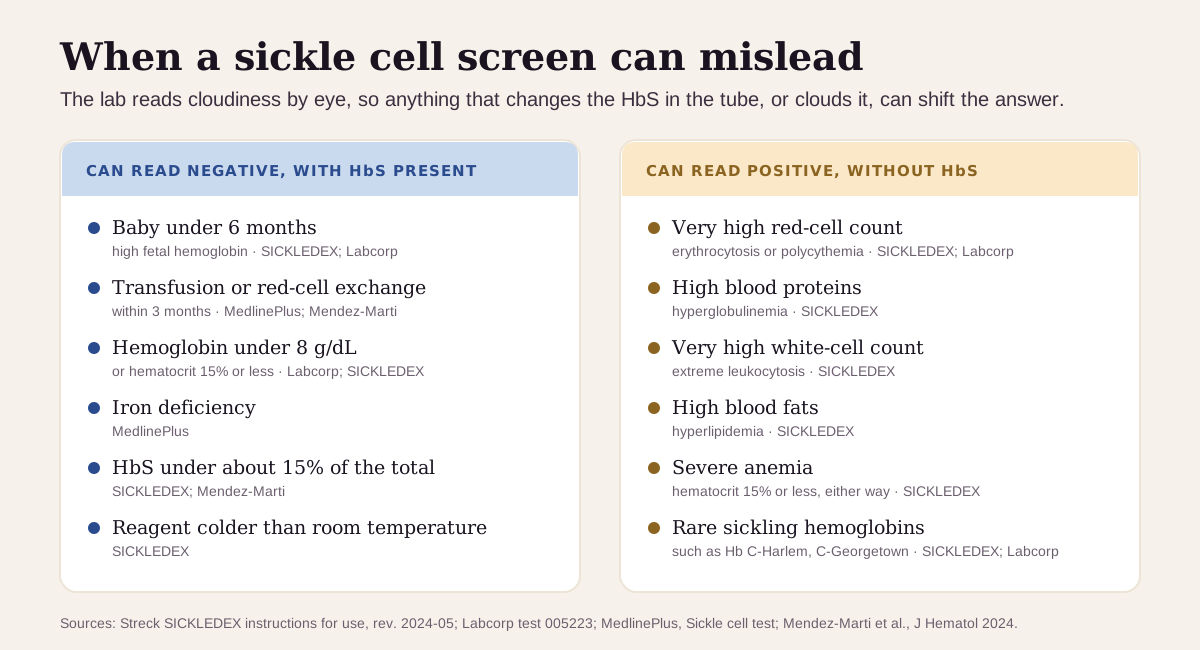
- Babies under 6 months. Newborns carry mostly fetal hemoglobin, which holds back the sickling reaction in the tube.184 Labcorp says the screen is unlikely to be reliably positive before 6 months and shouldn't be used in newborns.42
- A recent transfusion. Donor blood dilutes your own HbS. MedlinePlus flags transfusions within the past 3 months; in the clinic study, 5 of the 6 negatives came after a transfusion or red-cell exchange.18
- Very low hemoglobin. Labcorp flags hemoglobin under 8 g/dL; the kit maker flags a hematocrit of 15% or less, which can cause false results either way.42 MedlinePlus adds iron deficiency.1
- A small share of HbS. Under about 15%, the screen can miss it.28
The sickle cell screen reads best next to its neighbors
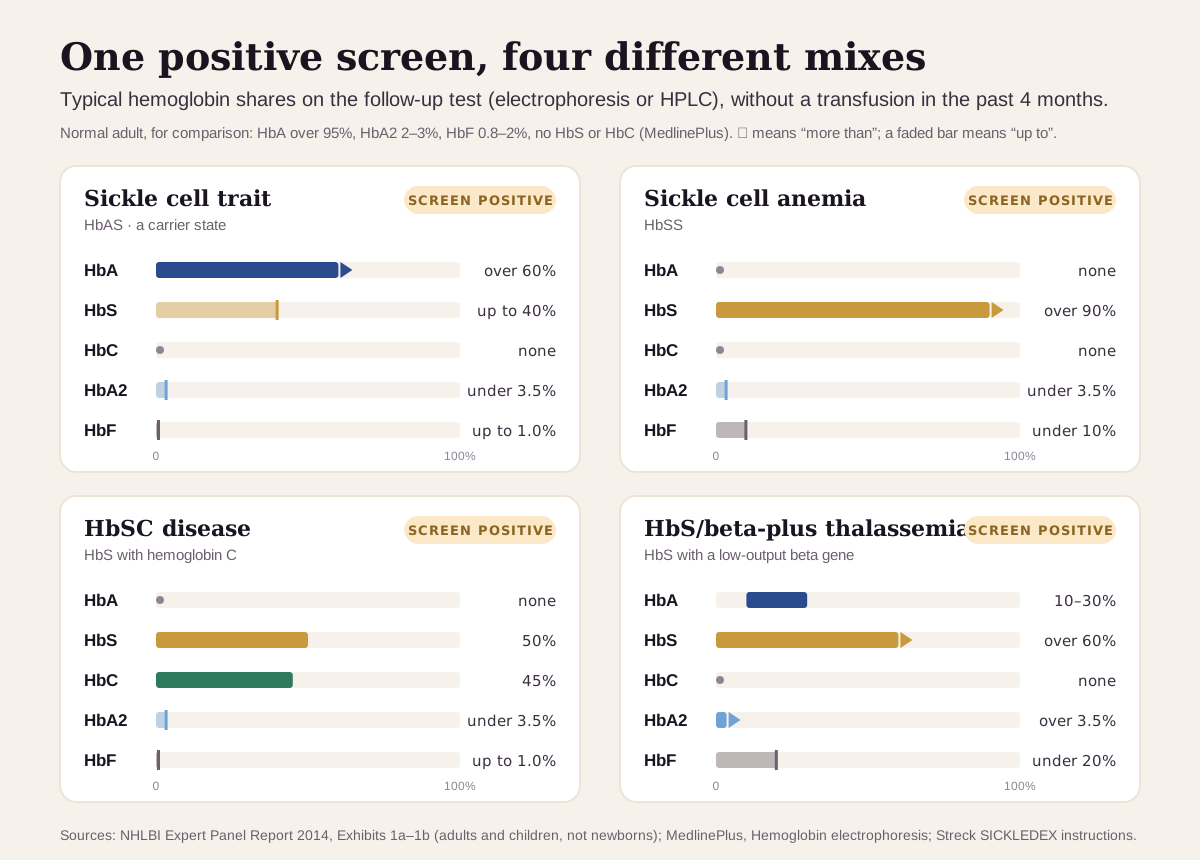
A positive screen looks the same whether it's trait or disease. The follow-up test lays out the full mix of hemoglobins, and four common patterns cover most positives:9
| If you see… | It often points to… |
|---|---|
| Screen positive, more HbA than HbS (HbS up to 40%) | sickle cell trait, a carrier state |
| Screen positive, no HbA, HbS over 90% | sickle cell anemia (HbSS); HbS/beta-zero thalassemia looks similar, with HbA2 above 3.5% |
| Screen positive, HbS and HbC about equal, no HbA | HbSC disease |
| Screen positive, more HbS than HbA, HbA2 above 3.5% | HbS/beta-plus thalassemia |
| Screen negative soon after a transfusion or red-cell exchange | a possible false negative: in one clinic, every negative after exchange or transfusion had HbS under 15%; the typical patterns assume no transfusion in the past 4 months89 |
The HbA-versus-HbS comparison is the key one. Trait typically has more HbA than HbS, while HbS/beta-plus thalassemia has more HbS than HbA, and newborn programs warn that the two can be mixed up.912 A complete blood count adds context: people with trait usually have a normal hemoglobin, while sickle cell anemia typically runs at 6–9 g/dL.9
How fast a sickle cell screen result changes
Your HbS status is inherited, so after infancy the answer stays the same. Public-health labs note that a person's hemoglobin types stay the same after about a year of age.12 Two things change what the screen shows:
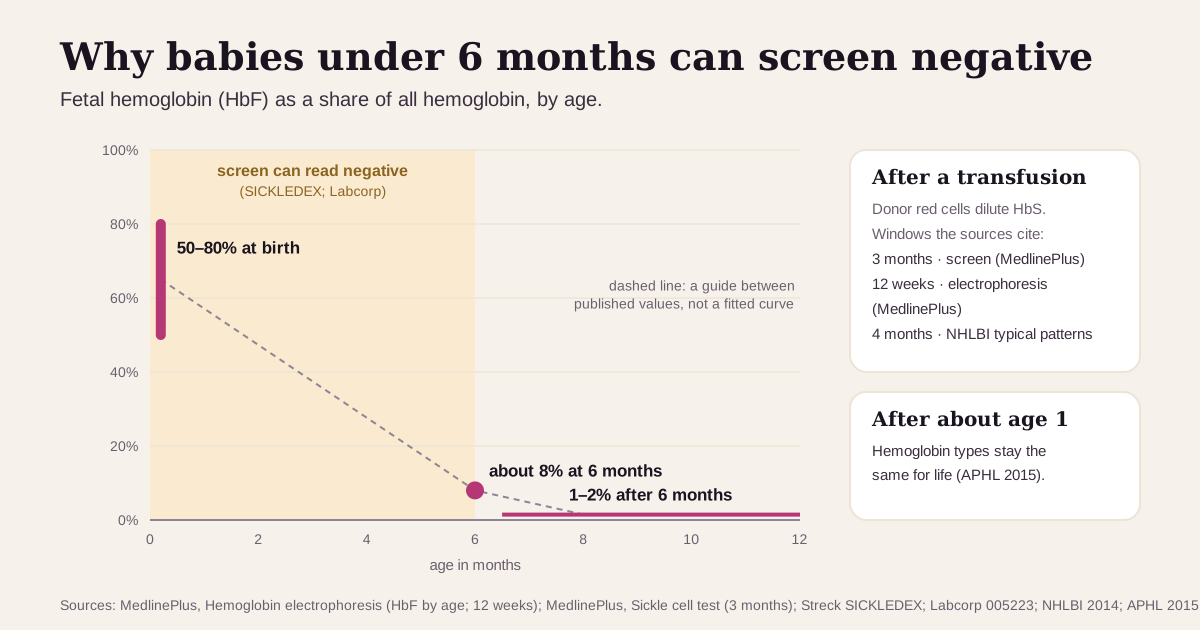
- Age. Fetal hemoglobin makes up 50–80% of a newborn's hemoglobin, about 8% at 6 months, and 1–2% after that.18 Until it falls, a baby with HbS can screen negative.24
- Transfusion. Donor red cells dilute HbS for months. MedlinePlus flags 3 months for the screen and 12 weeks for electrophoresis, and the NHLBI's typical patterns assume no transfusion in the past 4 months.1189
So one clear result after infancy, without a recent transfusion, usually stands for life. Repeat testing makes sense when the first result came from a young baby, followed a transfusion, or was never confirmed.212
Newborns get a different test
Every U.S. baby is screened for sickle cell disease at birth. Since May 1, 2006, all 50 states and the District of Columbia have required universal newborn screening.12 Earlier programs targeted babies by race and missed more than 30% of cases, because race is hard to assign at birth; universal screening fixed that.12
Newborn programs use methods that separate each hemoglobin, such as isoelectric focusing and HPLC. Public-health labs advise against the solubility screen here, because of false results and because it treats carriers and babies with disease alike.12 Results come back as letter patterns: FAS is probable trait, FS probable sickle cell anemia, FSC probable HbSC disease and FSA possible HbS/beta thalassemia.12
Going deeper: what happens in the tube
The kit mixes 20 µL of blood (a few drops) with a 2.3 M potassium phosphate buffer holding two chemicals: saponin, which bursts the red cells, and sodium hydrosulfite, which strips oxygen from the released hemoglobin.2 Deoxygenated HbS is insoluble in the concentrated buffer and forms a cloudy suspension; hemoglobin A and most other hemoglobins stay dissolved.2
The tube stands at room temperature for at least 6 minutes and is read between 6 and 60 minutes, by looking through it at the black lines of the rack. Cold reagent can give false results.2
The same chemistry explains the blind spots. The cloudiness depends on the amount of HbS in the tube, so a small share of HbS, a low total hemoglobin, or HbS diluted by donor blood can leave the tube clear, and a high share of fetal hemoglobin holds the reaction back.84 Anything else that clouds the liquid, such as extra proteins or fats, can mimic a positive.2
Questions worth asking
- Was this a solubility screen, or hemoglobin electrophoresis or HPLC?
- If it was positive, has it been confirmed, and what were my HbA and HbS percentages?
- Could a transfusion in the past few months, or a low hemoglobin, have affected a negative result?
- If I have trait, what should I know about hard exercise, heat and hydration?
- Is my HbA1c measured with a method that HbS affects?
- Should my partner be tested before a pregnancy?
FAQ
Does a positive sickle cell screen mean I have sickle cell disease? A positive screen means hemoglobin S is present. In adults that's most often sickle cell trait, a carrier state. Hemoglobin electrophoresis or HPLC sorts trait from disease.25
Can a sickle cell screen be wrong? Yes. It can read negative in babies under 6 months, after a recent transfusion, or with very low hemoglobin, and read positive with a very high red-cell count, high blood proteins or high blood fats.241
Is sickle cell trait a disease? Trait is a carrier state: one HbS gene and one normal gene. Most people with trait have no symptoms, though hard exercise and kidney health deserve attention.591314
How common is sickle cell trait? About 1 in 13 Black or African American babies and about 15 in 1,000 U.S. newborns overall are born with it.67 Anyone can carry it, which is why every U.S. newborn is screened.12
This guide is for education. It can't diagnose you or replace care from a clinician who knows your history.
Footnotes
-
National Library of Medicine. Sickle cell test. MedlinePlus Medical Encyclopedia. Reviewed January 29, 2026. What negative and positive mean; iron deficiency or a transfusion within 3 months can cause a false negative. MedlinePlus ↩ ↩2 ↩3 ↩4 ↩5 ↩6 ↩7 ↩8 ↩9 ↩10 ↩11 ↩12
-
Streck. SICKLEDEX Sickle Cell Testing Kit: Instructions for Use (12-Test Kit). Document 350512-19, revision 2024-05. A commercial source: the kit maker's own instructions. The source for the chemistry, the 6–60 minute read, the 15% detection limit at a total hemoglobin of 12 g/dL, the 166-sample validation, and the listed false positives and negatives. streck.com ↩ ↩2 ↩3 ↩4 ↩5 ↩6 ↩7 ↩8 ↩9 ↩10 ↩11 ↩12 ↩13 ↩14 ↩15 ↩16 ↩17 ↩18 ↩19 ↩20 ↩21 ↩22 ↩23 ↩24 ↩25 ↩26 ↩27 ↩28 ↩29 ↩30 ↩31
-
Naik RP, Haywood C Jr. Sickle cell trait diagnosis: clinical and social implications. Hematology Am Soc Hematol Educ Program. 2015;2015:160–167. The American Society of Hematology's education review of trait testing and trait-related complications. PMC ↩ ↩2 ↩3 ↩4 ↩5 ↩6 ↩7 ↩8 ↩9 ↩10
-
Labcorp. Hemoglobin (Hb) Solubility, test 005223. A commercial source: a national lab's test page. Reference result "Negative"; false negatives with hemoglobin under 8.0 g/dL, high fetal hemoglobin, and before 6 months of age; false positives with polycythemia and rare variants. labcorp.com ↩ ↩2 ↩3 ↩4 ↩5 ↩6 ↩7 ↩8 ↩9 ↩10 ↩11 ↩12 ↩13 ↩14 ↩15 ↩16 ↩17 ↩18
-
Centers for Disease Control and Prevention. What Is Sickle Cell Trait? Last reviewed May 15, 2024. Inheritance odds, symptoms and rare complications. cdc.gov ↩ ↩2 ↩3 ↩4 ↩5 ↩6 ↩7 ↩8 ↩9 ↩10
-
Centers for Disease Control and Prevention. Data and Statistics on Sickle Cell Disease. Last reviewed August 7, 2026. About 100,000 people in the U.S. with sickle cell disease; about 1 in 13 Black or African American babies born with trait. cdc.gov ↩ ↩2 ↩3 ↩4 ↩5
-
Ojodu J, Hulihan MM, Pope SN, Grant AM. Incidence of sickle cell trait — United States, 2010. MMWR Morb Mortal Wkly Rep. 2014;63(49):1155–1158. Newborn screening data from 44 states: 15.5 per 1,000 newborns overall. PMC ↩ ↩2 ↩3
-
Mendez-Marti SR, Zik C, Alan S, Wang H, Ershler WB. Sickle Cell Screening in Adults: A Current Review of Point-of-Care Testing. J Hematol. 2024;13(3):53–60. 220 adult samples: all 207 with HbS of 15% or more screened positive; the 6 negatives had HbS under 15%, 5 of them after transfusion or red-cell exchange. PMC ↩ ↩2 ↩3 ↩4 ↩5 ↩6 ↩7 ↩8 ↩9 ↩10 ↩11 ↩12
-
National Heart, Lung, and Blood Institute. Evidence-Based Management of Sickle Cell Disease: Expert Panel Report, 2014. NIH. Exhibits 1a and 1b give typical hemoglobin patterns by genotype; the fever threshold is from its health-maintenance chapter. nhlbi.nih.gov ↩ ↩2 ↩3 ↩4 ↩5 ↩6 ↩7 ↩8 ↩9 ↩10 ↩11 ↩12 ↩13 ↩14 ↩15
-
Arishi WA, Alhadrami HA, Zourob M. Techniques for the Detection of Sickle Cell Disease: A Review. Micromachines (Basel). 2021;12(5):519. The HBB codon 6 change (GAG to GTG, glutamic acid to valine) and HbS polymerization without oxygen. PMC ↩ ↩2 ↩3
-
National Library of Medicine. Sickle cell disease. MedlinePlus Genetics. The HBB gene, the forms of sickle cell disease, and where HbS is most common. MedlinePlus ↩ ↩2 ↩3
-
Association of Public Health Laboratories. Hemoglobinopathies: Current Practices for Screening, Confirmation and Follow-up. December 2015. Produced with CDC support. Universal U.S. newborn screening since May 1, 2006; newborn methods and result patterns; why solubility testing isn't recommended for newborns. cdc.gov ↩ ↩2 ↩3 ↩4 ↩5 ↩6 ↩7 ↩8 ↩9
-
Nelson DA, Deuster PA, Carter R 3rd, Hill OT, Wolcott VL, Kurina LM. Sickle Cell Trait, Rhabdomyolysis, and Mortality among U.S. Army Soldiers. N Engl J Med. 2016;375(5):435–442. 47,944 soldiers: exertional rhabdomyolysis hazard ratio 1.54; death 0.99. PMC ↩ ↩2 ↩3 ↩4
-
Naik RP, Derebail VK, Grams ME, et al. Association of sickle cell trait with chronic kidney disease and albuminuria in African Americans. JAMA. 2014;312(20):2115–2125. Five U.S. cohorts, 15,975 adults. PMC ↩ ↩2 ↩3
-
Lacy ME, Wellenius GA, Sumner AE, et al. Association of Sickle Cell Trait With Hemoglobin A1c in African Americans. JAMA. 2017;317(5):507–515. HbA1c 0.29 points lower with trait at the same fasting glucose. PMC ↩
-
NGSP. HbA1c Assay Interferences. Updated June 2026. Which common HbA1c methods are affected by HbS, HbC, HbE and HbD trait or high fetal hemoglobin. ngsp.org ↩
-
National Library of Medicine. Rhabdomyolysis. MedlinePlus Medical Encyclopedia. Reviewed September 2, 2025. Symptoms include dark, red or cola-colored urine, muscle aching and weakness; severe exertion is a cause. MedlinePlus ↩
-
National Library of Medicine. Hemoglobin electrophoresis. MedlinePlus Medical Encyclopedia. Reviewed February 27, 2026. Normal adult hemoglobin percentages, fetal hemoglobin by age, and the 12-week transfusion window. MedlinePlus ↩ ↩2 ↩3 ↩4
Educational content, not medical advice. Libby is a personal record tool, not a medical service — it doesn't diagnose, treat, or prescribe. Reference ranges vary by lab and by person. Talk to a qualified healthcare professional about your results.
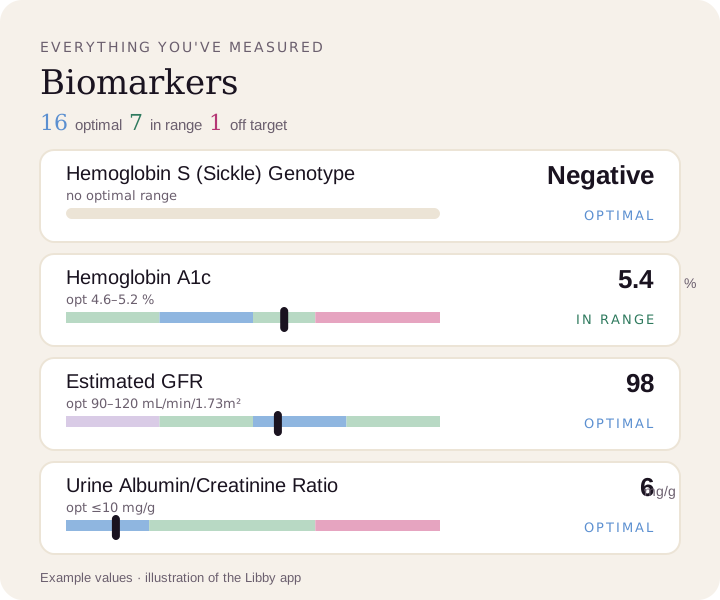
See every result against your lab's range.
Upload a lab PDF or a photo of your report. Libby keeps your sickle cell screen with the rest of your results, shows each one on your lab's range, and tracks your trends over time.
View your sickle cell screen ›