Hemoglobin S percentage: trait, disease and targets
Hemoglobin S (HbS) percentage is the share of your hemoglobin that is the sickle form. What 0%, under 40% and over 50% mean, and the 30% target.
Hemoglobin S percentage is the share of your hemoglobin that is the sickle form, HbS, measured by hemoglobin electrophoresis or HPLC. The expected result is 0%. A share under half, with more normal hemoglobin A than hemoglobin S, is the classic pattern of sickle cell trait, a carrier state. A share over half with little or no hemoglobin A points to sickle cell disease, where the same number also becomes a treatment target: under 30% before the next transfusion, to prevent stroke.1234
The short version
- Normal: 0%. MedlinePlus lists HbS as absent in adults, and ARUP prints a reference of 0.0% at every age.15
- Under half, with more HbA than HbS: sickle cell trait, a carrier state. The NHLBI expert panel gives 40% or less as typical. In one London study, HbS ran 31–43% with the usual four alpha-globin genes and 22–29% when two were missing.32
- Over half, with little or no HbA: sickle cell disease. Typical shares: about 50% (with 45% HbC) in HbSC, over 60% (with 10–30% HbA) in HbS/beta-plus thalassemia, and over 80–90% with no HbA in HbS/beta-zero thalassemia and HbSS.3
- In treatment: guidelines aim to keep HbS under 30% before each transfusion to prevent stroke, and a transfusion in the past 3–4 months changes every pattern above. Stroke signs in someone with sickle cell disease need emergency care.431
What hemoglobin S percentage is
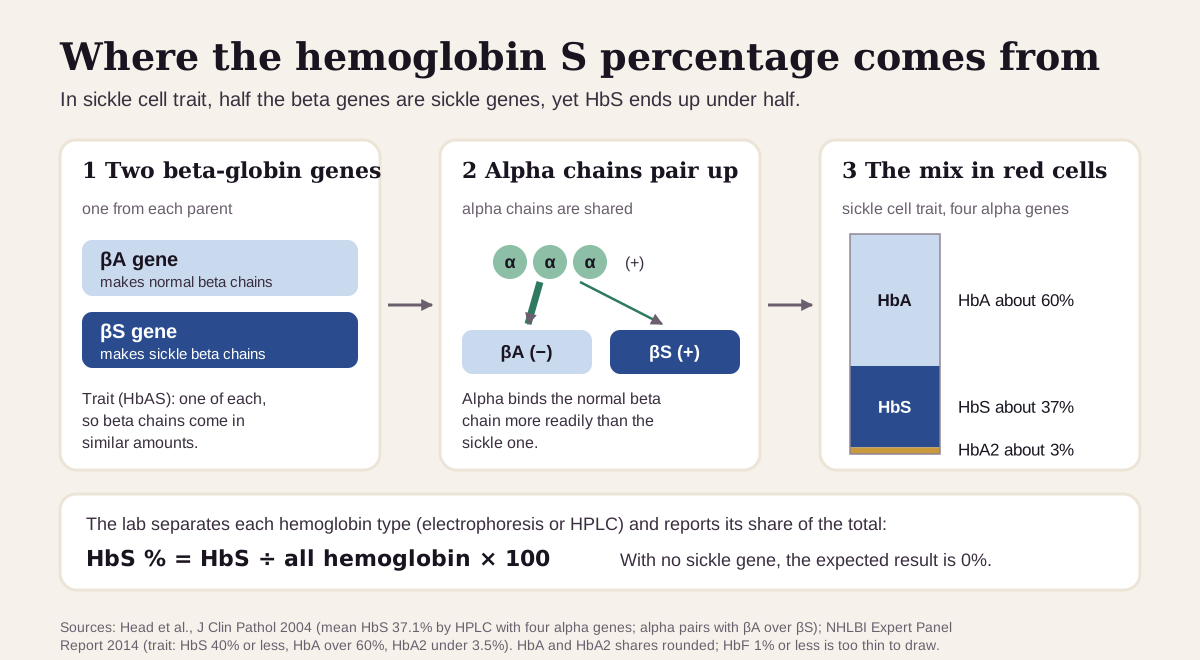
Hemoglobin is the oxygen-carrying protein that fills your red blood cells. Adult hemoglobin is built from two alpha chains and two beta chains. HbS comes from a single change in the beta chain: the amino acid valine replaces glutamic acid at position 6.3
You inherit one beta-globin gene from each parent. One HbS gene plus one usual gene is sickle cell trait (HbAS), the carrier state. Sickle cell disease takes HbS plus a second altered beta gene: another HbS (HbSS), hemoglobin C (HbSC), or a beta-thalassemia gene (HbS/beta-thalassemia).3
The percentage comes from a test that separates each type of hemoglobin and measures its share of the total: hemoglobin electrophoresis, HPLC (high-performance liquid chromatography) or capillary electrophoresis. Reference labs favor HPLC and capillary electrophoresis because they measure each type more precisely.6 The same report lists the other types. Our guides to hemoglobin A (the usual adult pattern), hemoglobin A2 (beta-thalassemia trait) and fetal hemoglobin cover those numbers. The sickle cell screen guide covers the quick yes-or-no test that often comes first.
What's a normal hemoglobin S percentage?
Zero. In adults, MedlinePlus lists HbS as absent, next to HbA over 95%, HbA2 2–3% and HbF 0.8–2%. ARUP's HPLC reference for anyone 2 years and older is HbS 0.0%, with HbA 95.0–97.9%.15
When HbS is present, its share falls into a handful of typical patterns. The NHLBI expert panel's tables are the standard summary:3
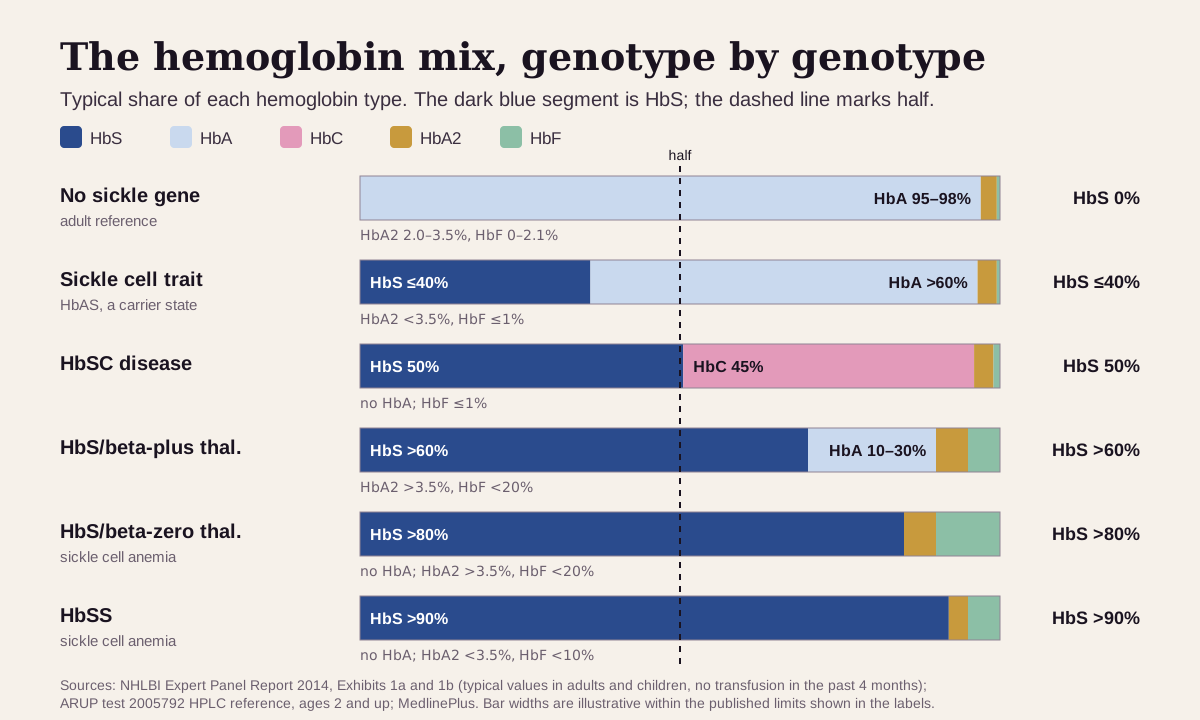
- Sickle cell trait: HbS 40% or less, HbA over 60%.3 Half the beta genes are sickle genes, yet HbS stays under half, because alpha chains pair more readily with normal beta chains than with sickle ones.2
- HbSC disease: HbS about 50% and HbC about 45%, with no HbA.3
- HbS/beta-plus thalassemia: HbS over 60%, with 10–30% HbA and HbA2 above 3.5%.3
- HbS/beta-zero thalassemia and HbSS: HbS over 80% and over 90%, with no HbA. The two behave so alike that together they're called sickle cell anemia.3
Babies are the exception to all of this. ARUP's reference for the first month of life puts fetal hemoglobin at 45.8–91.7%, and ARUP recommends repeating any test done before age 1.5
"Optimal" hemoglobin S: 0% for most people, and the targets in sickle cell disease
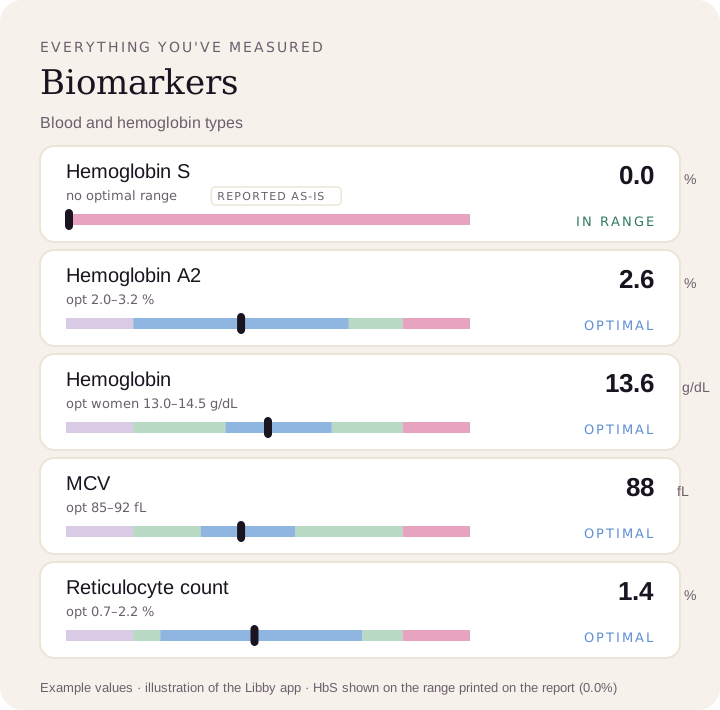
For people without sickle cell disease there's nothing to optimize. HbS is 0%, or, in trait, it sits wherever your genes put it. We found no longevity or functional-medicine target for HbS, and the Libby app has no optimal band for it: it shows your result exactly as your lab reported it, with the range printed on your report.
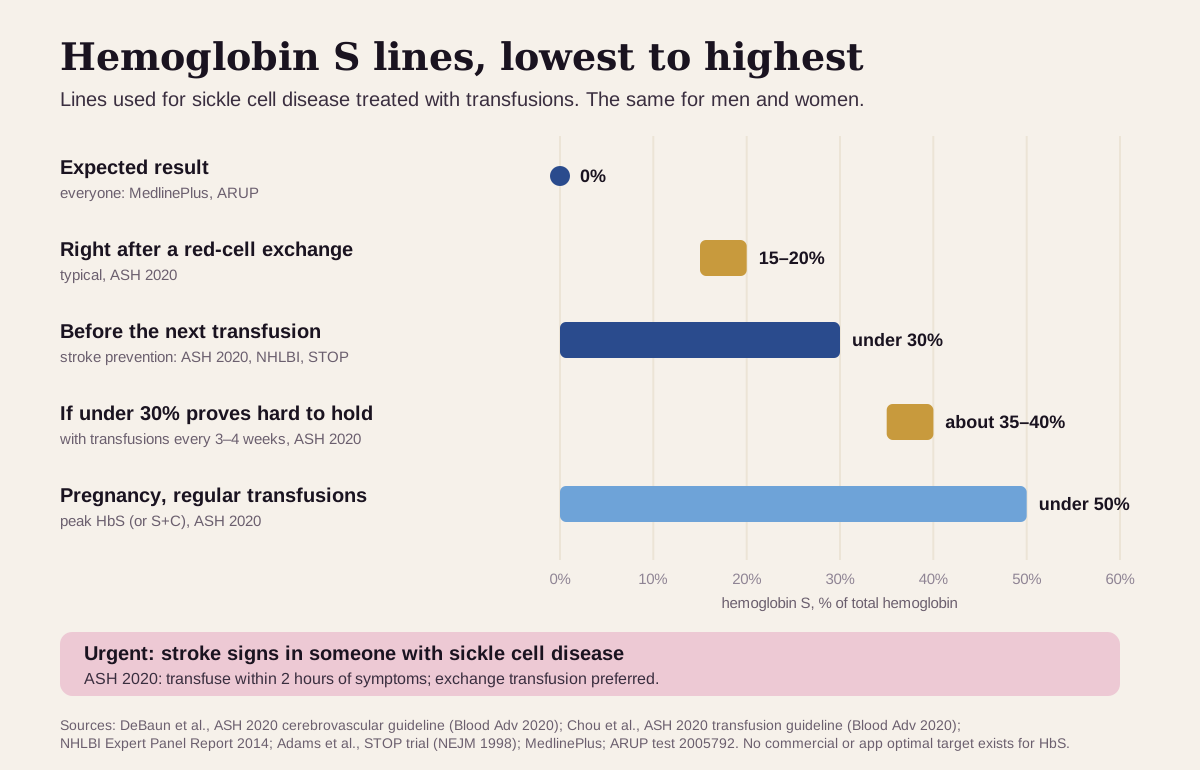
The HbS percentage becomes a target in sickle cell disease treated with regular transfusions. Donor blood carries HbA, so each transfusion or red-cell exchange lowers the HbS share, and guidelines set lines for how low. From lowest to highest:
| Line | HbS | Who draws it |
|---|---|---|
| Expected result | 0% | MedlinePlus; ARUP's printed reference15 |
| Right after a red-cell exchange | typically 15–20% | American Society of Hematology (ASH) 2020; starting there holds HbS under 30% for about 4 weeks4 |
| Before the next transfusion (stroke prevention) | under 30% | ASH 2020 (a strong recommendation) and the NHLBI panel, for sickle cell anemia; the STOP trial's target438 |
| When under 30% proves hard to hold | about 35–40% | ASH 2020, with transfusions every 3–4 weeks4 |
| Pregnancy, if regular transfusions start | peak under 50% (HbS plus HbC) | ASH 2020 transfusion guideline7 |
| Before surgery, very severe disease | under 30% or under 50% | ASH 2020, for people with a past stroke or repeated acute chest syndrome; for low- to moderate-risk surgery, a hemoglobin of 9–11 g/dL matters more7 |
| Urgent | stroke signs in sickle cell disease | ASH 2020: transfusion within 2 hours, exchange preferred4 |
Why the 30% line exists:
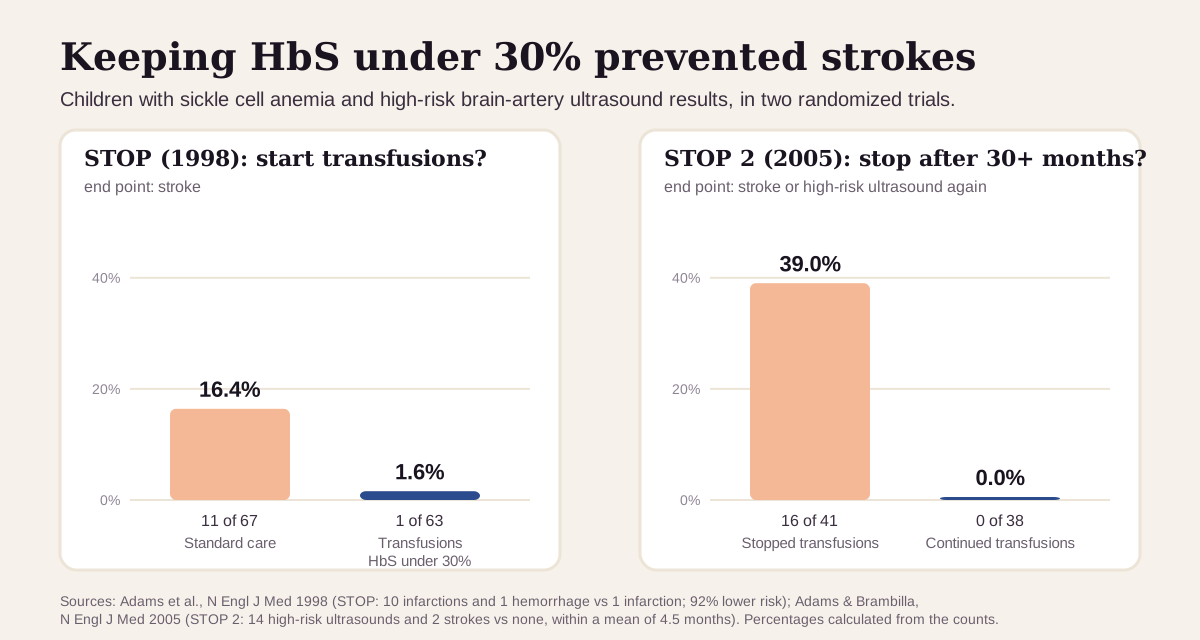
- In the STOP trial, 130 children with sickle cell anemia and high-risk brain-artery ultrasound (transcranial Doppler) results were randomized to standard care or to transfusions that kept HbS under 30%. There were 11 strokes among 67 children on standard care and 1 among 63 on transfusions, a 92% lower risk, and the trial stopped early.8
- STOP 2 tested stopping after 30 months or more of transfusions. Among 41 children who stopped, 14 had their ultrasound turn high-risk again and 2 had a stroke, within a mean of 4.5 months. Among the 38 who continued, neither happened.9
Keep "optimal" in perspective: 30% is a treatment line borrowed from these trials. The NHLBI panel found no study comparing one HbS target with another. The 30% cutoff comes from the two stroke trials, and about three in four observational studies used it too.3 In trait the percentage matters in quieter ways. In 27 adults with trait, the higher the HbS share, the weaker the kidneys' ability to concentrate urine.10
What a lower or higher HbS percentage usually means
The first clue is which is bigger, HbA or HbS. The exact number, the red-cell size (MCV) and any recent transfusion fill in the rest.23
Under half, with more HbA: sickle cell trait
Trait is by far the most common reason to have HbS: more than 2 million people in the U.S. carry at least one HbS gene, while 70,000–100,000 have sickle cell disease.3 Where a trait result lands depends mostly on the alpha-globin genes, which normally come in four copies:2
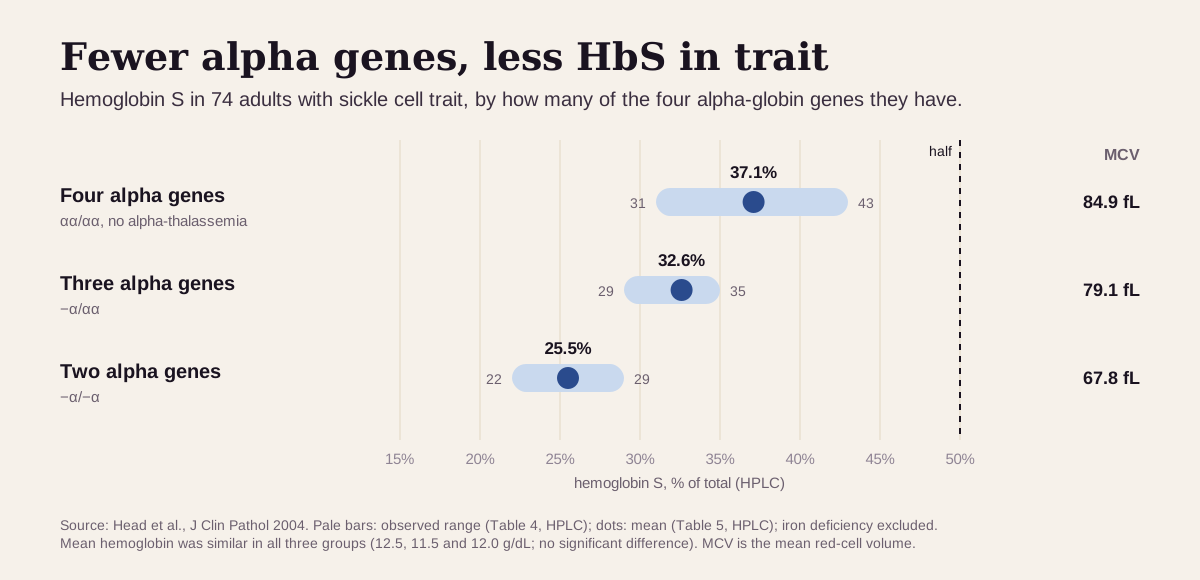
- About 37% (31–43%) with all four alpha genes, and a normal red-cell size (MCV about 85 fL).
- About 33% (29–35%) with one alpha gene missing, one form of alpha-thalassemia trait.
- About 26% (22–29%) with two missing, usually with small red cells (MCV about 68 fL).
So a trait result in the 20s with small red cells points toward coexisting alpha-thalassemia trait. Head's group combined the HbS share with the red-cell indices to flag it, after checking ferritin whenever the indices suggested iron deficiency.2
Over half: sickle cell disease
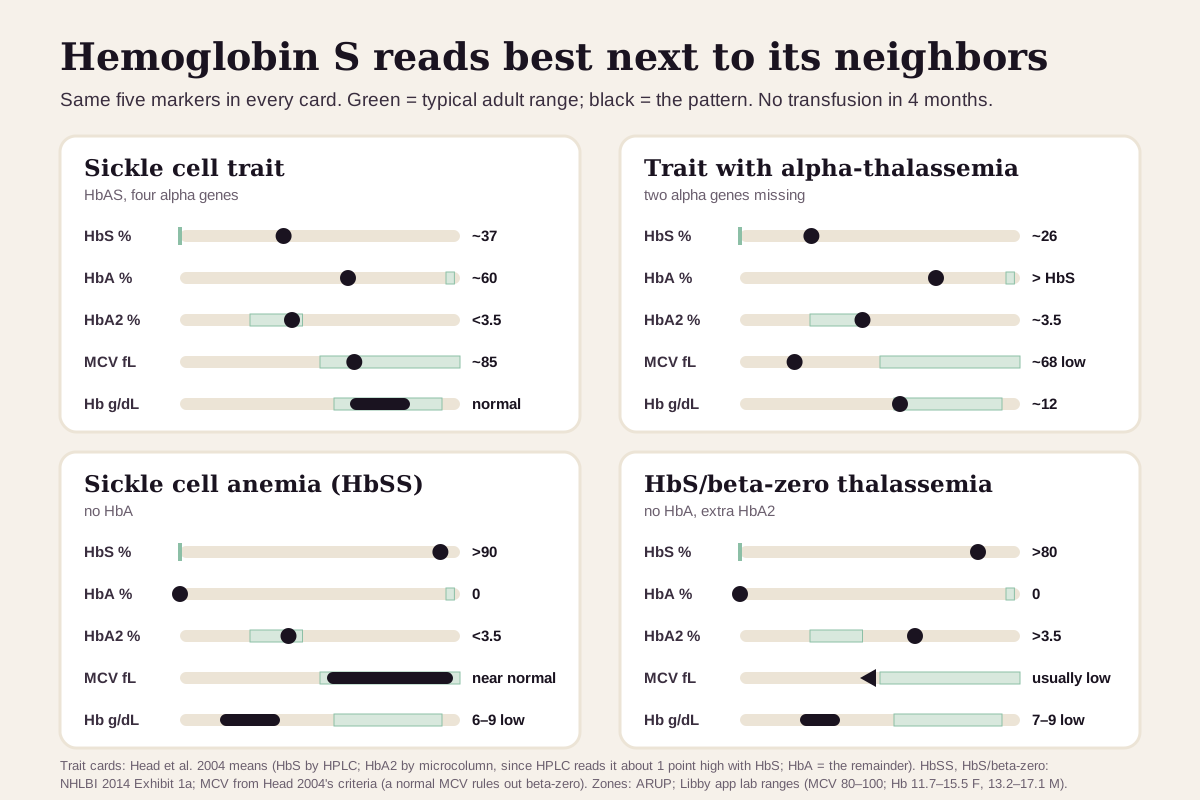
A share over 50% with HbA absent or smaller than HbS points to one of the sickle cell disease genotypes (see the figure above).32 Two distinctions trip people up:
- HbS/beta-plus thalassemia vs trait. Both show HbA and HbS. In trait, HbA is the larger share; in HbS/beta-plus thalassemia, HbS is.23
- HbSS vs HbS/beta-zero thalassemia. Neither has HbA. An HbA2 above 3.5% points to beta-zero.3 So do small red cells: Head's group counted a result as HbSS only when the MCV was normal or near normal.2
Lower than the genotype predicts: a transfusion or hydroxyurea
Donor blood carries HbA. So in someone with sickle cell disease, an HbS under 30% with plenty of HbA usually reflects transfusions, and the genotype patterns only apply with no transfusion in the past 4 months. MedlinePlus warns of misleading results within 12 weeks of one.31 Hydroxyurea works mainly by raising fetal hemoglobin, and because the shares add up to 100%, HbS falls as HbF rises. Our fetal hemoglobin guide covers that side.3
Rising too fast after a transfusion
HbS climbing back quickly while HbA falls, together with a drop in total hemoglobin within 21 days of a transfusion, is one of the signs ASH lists for a delayed hemolytic transfusion reaction, in which the body destroys the donor cells.7
Get emergency care for anyone with sickle cell disease who has a severe headache, confusion, a seizure, trouble speaking, or weakness or paralysis (possible stroke); a fever of 101.3°F (38.5°C) or higher; or new cough or shortness of breath. Call the care team promptly for sudden anemia, pain, or yellow eyes or skin (jaundice) within 3 weeks after a transfusion.34
Hemoglobin S reads best next to its neighbors
The HbS share alone can land in the same range for different reasons. Reading it with HbA, HbA2, red-cell size (MCV) and total hemoglobin sorts the four most common patterns:23
| If you see… | It often points to… |
|---|---|
| HbS 31–43%, HbA the larger share, normal MCV | sickle cell trait with four alpha genes23 |
| HbS 22–29%, HbA larger, MCV about 68 fL | trait plus alpha-thalassemia, with two alpha genes missing2 |
| HbS over 90%, no HbA, HbA2 under 3.5%, hemoglobin 6–9 g/dL | sickle cell anemia (HbSS)3 |
| HbS over 80%, no HbA, HbA2 over 3.5%, usually small red cells | HbS/beta-zero thalassemia, which behaves like HbSS3 (small red cells: Head 20042) |
| HbS over 60% with 10–30% HbA, HbA2 over 3.5% | HbS/beta-plus thalassemia: more HbS than HbA sets it apart from trait32 |
| HbS about 50% with HbC about 45% | HbSC disease3 |
| HbS under 30% with mostly HbA, in someone with sickle cell disease | recent transfusion or exchange43 |
For the hemoglobin number itself, see our hemoglobin and hematocrit guide. For how fast the marrow is replacing red cells, see reticulocyte count. HbS can also skew some HbA1c methods: NGSP flags one of the 20 most-used methods for HbS, so it's worth asking which method your lab uses (our HbA1c guide has more).11
How fast hemoglobin S percentage changes
In trait, your genes set it. The share depends on your beta and alpha genes, so a repeat test after infancy lands in the same range. ARUP recommends repeating any result from before age 1.25
With transfusions, it moves in weeks:
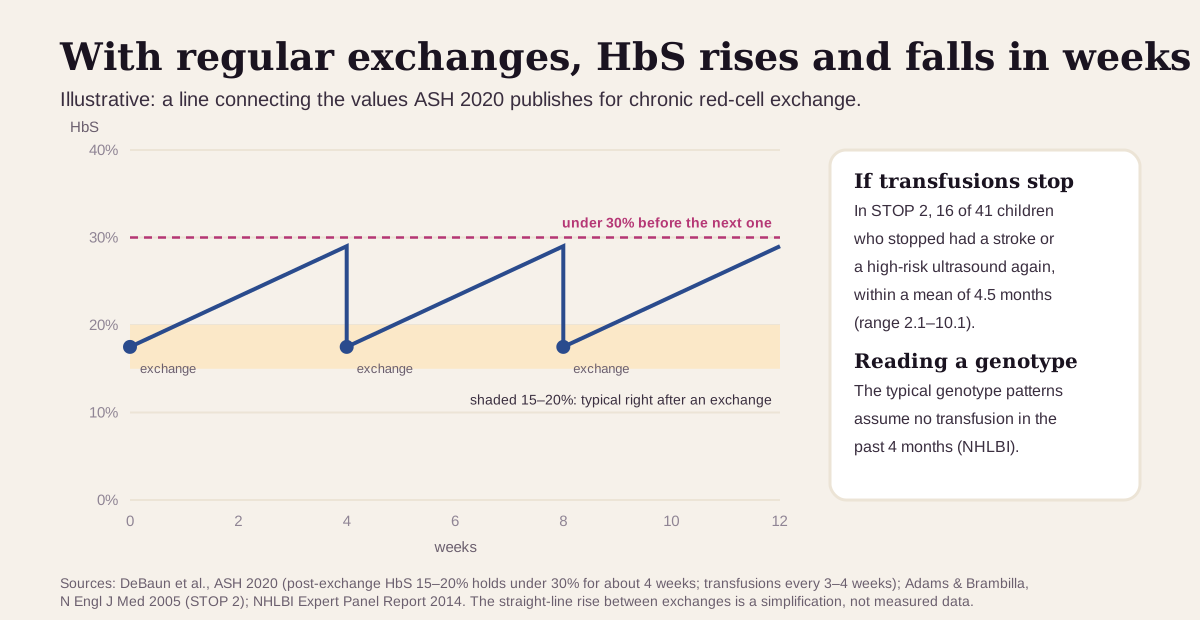
- An exchange lowers HbS at once. Automated red-cell exchange lowers it faster than manual exchange.7
- Then it climbs back. Transfusions quiet your own marrow, but its output of new red cells (the reticulocyte count) can pick up again by the next transfusion, adding new sickle cells.3 Starting at 15–20% keeps HbS under 30% for about 4 weeks, which is why regular transfusions come every 3–4 weeks.4
- After transfusions stop, the protection fades over months. In STOP 2, high-risk results and strokes came within a mean of 4.5 months (range 2.1–10.1).9
- That's why HbS is checked before each transfusion. The NHLBI protocol measures percent HbA and HbS each time to confirm the target was met.3
Going deeper: why trait sits under half, and how HPLC reads HbS
In trait, the two beta genes make normal and sickle beta chains in similar amounts, but both compete for the same pool of alpha chains. The normal beta chain carries a negative charge and the sickle chain a positive one, and the positively charged alpha chain binds the normal chain more readily. When alpha chains run short, as in alpha-thalassemia, that preference bites harder and the HbS share falls further. Head's group put the order of preference as normal beta, then the delta chain of HbA2, then sickle beta.2
HPLC separates the hemoglobin types by how long each takes to pass through a column, and HbS leaves traces in two other windows. Sugar-bound (glycated) HbS comes out with HbA, and a modified form of HbS comes out with HbA2. In trait, HPLC reported HbA2 at 4.4% on average, against 3.3% by microcolumn chromatography, and samples stored for two weeks read higher still (4.5% fresh, 5.1% at two weeks).2 HbS itself reads slightly low as a result, by too little to matter. The practical point: an HPLC HbA2 above 3.5% carries less weight when HbS is present, which matters when separating HbSS from HbS/beta-zero thalassemia. See our HbA2 guide for HbA2 on its own.
Electrophoresis has its own blind spot: a few rare variants travel alongside HbS on a standard gel, so labs confirm with a second method such as citrate agar, cellulose acetate or isoelectric focusing.6
Questions worth asking
- Was this electrophoresis, HPLC or capillary electrophoresis, and which lab ran it?
- Is my HbA larger than my HbS, and what pattern does that point to?
- If my trait result is in the 20s and my red cells are small, should alpha-thalassemia and my iron be checked?
- Had I had a blood transfusion in the 4 months before this test?
- If I'm on regular transfusions, what HbS target are we aiming for before each one, and why that number?
- Is my HbA1c measured with a method that HbS affects?
FAQ
What is a normal hemoglobin S percentage? 0%. HbS is absent in people without a sickle gene, and ARUP prints 0.0% as the reference at every age.15
What HbS percentage means sickle cell trait? Typically 40% or less, with more HbA than HbS. In one study, trait ran 31–43% with four alpha genes and 22–29% with two missing.32
Why is HbS kept under 30% in sickle cell disease? In the STOP trial, transfusions that kept HbS under 30% cut strokes by 92% in high-risk children, and ASH 2020 recommends that target for stroke prevention.84
Does a blood transfusion change my HbS percentage? Yes. Donor blood lowers the HbS share for weeks to months, so the genotype patterns apply only with no transfusion in the past 4 months.31
This guide is for education. It can't diagnose you or replace care from a clinician who knows your history.
Footnotes
-
National Library of Medicine. Hemoglobin electrophoresis. MedlinePlus Medical Encyclopedia. Reviewed February 27, 2026. Normal adult percentages (HbS absent) and the 12-week transfusion caveat. MedlinePlus ↩ ↩2 ↩3 ↩4 ↩5 ↩6 ↩7 ↩8 ↩9 ↩10
-
Head CE, Conroy M, Jarvis M, Phelan L, Bain BJ. Some observations on the measurement of haemoglobin A2 and S percentages by high performance liquid chromatography in the presence and absence of alpha thalassaemia. J Clin Pathol. 2004;57(3):276–280. 78 adults with sickle cell trait in London, alpha genes typed by PCR: HbS and MCV by alpha-gene count, and how HPLC reads HbA2 when HbS is present. PMC ↩ ↩2 ↩3 ↩4 ↩5 ↩6 ↩7 ↩8 ↩9 ↩10 ↩11 ↩12 ↩13 ↩14 ↩15 ↩16 ↩17 ↩18 ↩19 ↩20 ↩21
-
National Heart, Lung, and Blood Institute. Evidence-Based Management of Sickle Cell Disease: Expert Panel Report, 2014. NIH. The U.S. expert-panel guideline. Exhibits 1a and 1b give the typical HbS, HbA, HbA2, HbF and HbC percentages by genotype; the transfusion chapter sets the under-30% goal and notes that no study has compared HbS targets. nhlbi.nih.gov ↩ ↩2 ↩3 ↩4 ↩5 ↩6 ↩7 ↩8 ↩9 ↩10 ↩11 ↩12 ↩13 ↩14 ↩15 ↩16 ↩17 ↩18 ↩19 ↩20 ↩21 ↩22 ↩23 ↩24 ↩25 ↩26 ↩27 ↩28 ↩29 ↩30 ↩31 ↩32 ↩33 ↩34 ↩35 ↩36
-
DeBaun MR, Jordan LC, King AA, et al. American Society of Hematology 2020 guidelines for sickle cell disease: prevention, diagnosis, and treatment of cerebrovascular disease in children and adults. Blood Adv. 2020;4(8):1554–1588. The under-30% HbS target, the 35–40% fallback, post-exchange levels of 15–20%, and transfusion within 2 hours of stroke symptoms. PMC ↩ ↩2 ↩3 ↩4 ↩5 ↩6 ↩7 ↩8 ↩9 ↩10 ↩11 ↩12
-
ARUP Laboratories. Hemoglobin Evaluation Reflexive Cascade, test 2005792. A commercial source: a national reference lab's test page. HPLC reference intervals by age (Hb S 0.0% at every age), the Hb S LOINC code 4625-0, and the advice to repeat tests done before age 1. aruplab.com ↩ ↩2 ↩3 ↩4 ↩5 ↩6 ↩7 ↩8 ↩9
-
Naik RP, Haywood C Jr. Sickle cell trait diagnosis: clinical and social implications. Hematology Am Soc Hematol Educ Program. 2015;2015:160–167. The American Society of Hematology's education review of the methods used to identify trait. PMC ↩ ↩2
-
Chou ST, Alsawas M, Fasano RM, et al. American Society of Hematology 2020 guidelines for sickle cell disease: transfusion support. Blood Adv. 2020;4(2):327–355. The pregnancy and surgery HbS lines, automated exchange, and the signs of a delayed hemolytic transfusion reaction. PMC ↩ ↩2 ↩3 ↩4 ↩5
-
Adams RJ, McKie VC, Hsu L, et al. Prevention of a first stroke by transfusions in children with sickle cell anemia and abnormal results on transcranial Doppler ultrasonography. N Engl J Med. 1998;339(1):5–11. The STOP trial: 130 children; transfusion to HbS under 30% cut the risk of stroke by 92%. PubMed ↩ ↩2 ↩3 ↩4
-
Adams RJ, Brambilla D; STOP 2 Trial Investigators. Discontinuing prophylactic transfusions used to prevent stroke in sickle cell disease. N Engl J Med. 2005;353(26):2769–2778. 79 children randomized to stop or continue after 30 months or more of transfusions. PubMed ↩ ↩2 ↩3 ↩4
-
Gupta AK, Kirchner KA, Nicholson R, et al. Effects of alpha-thalassemia and sickle polymerization tendency on the urine-concentrating defect of individuals with sickle cell trait. J Clin Invest. 1991;88(6):1963–1968. 27 adults with trait: urine concentration fell as the HbS share rose (r = −0.654). PMC ↩
-
NGSP. HbA1c Assay Interferences. Updated June 2026. Which of the 20 most-used HbA1c methods HbS and other variants affect. ngsp.org ↩
Educational content, not medical advice. Libby is a personal record tool, not a medical service — it doesn't diagnose, treat, or prescribe. Reference ranges vary by lab and by person. Talk to a qualified healthcare professional about your results.
See every result against your lab's range.
Upload a lab PDF or a photo of your report. Libby keeps your hemoglobin S percentage with the rest of your results, shows each one on the range your lab printed, and tracks your trends over time.
View your hemoglobin S ›