Hemoglobin A2 (HbA2): normal range and beta-thal trait
HbA2 is a minor adult hemoglobin. Here's the normal range, why above 3.5% points to beta-thalassemia trait, and what else can push it up or down.
Hemoglobin A2 (HbA2) is a minor form of adult hemoglobin, normally about 2 to 3% of the total. Its main job on a lab report is screening: a result above 3.5%, together with small red cells, is the standard sign of beta-thalassemia trait, a common carrier state that usually causes no symptoms.123
The short version
- Normal: most labs put HbA2 between about 2.0 and 3.3%. Labcorp prints 1.8–3.2% for anyone 2 or older.14
- Above 3.5% with small red cells (low MCV and MCH) is the standard marker of beta-thalassemia trait. Carriers typically run 3.4–6.0%, with a normal or high red cell count.15
- Borderline (about 3.1–3.9%) needs a closer look: mild beta mutations, iron deficiency, low B12 or folate, an overactive thyroid and some HIV medicines all land here.16789
- Timing matters most in pregnancy. If both partners carry beta-thal trait, each pregnancy has a 25% chance of a child with a serious thalassemia, so European guidance aims to offer screening by 8–10 weeks of pregnancy.310
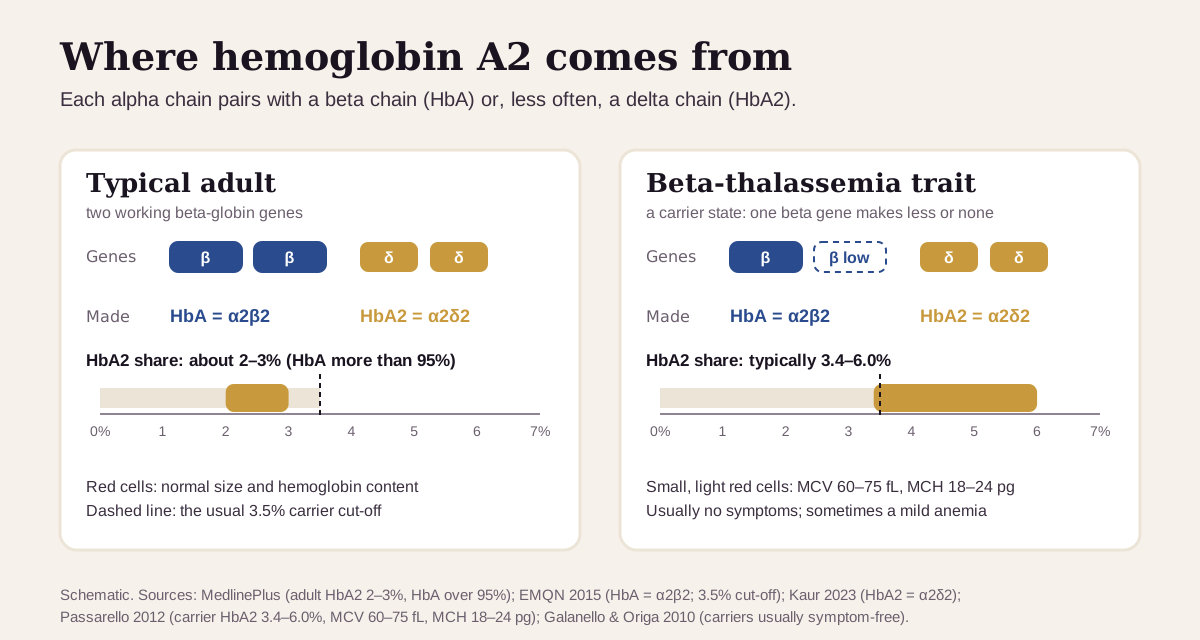
What hemoglobin A2 is
Every hemoglobin molecule is built from four protein chains. Adult hemoglobin A (HbA) pairs two alpha chains with two beta chains. HbA2 pairs two alpha chains with two delta chains instead.111 Your body makes far less delta than beta chain, so HbA2 stays a small slice: about 2–3% in adults, against more than 95% for HbA.2
That small slice is a sensitive gauge of your beta genes. You carry two copies of the beta-globin gene, one from each parent. When one copy makes less beta chain or none, which is what beta-thalassemia trait is, more alpha chains end up paired with delta, and HbA2 rises.311 About 1.5% of people worldwide (80–90 million) carry beta-thalassemia trait. It is most common in families from the Mediterranean, the Middle East, Central Asia, India, southern China and the Far East, and along the north coast of Africa.3
HbA2 comes from a hemoglobin analysis (electrophoresis or HPLC), which sorts your hemoglobin into its types. The hemoglobin A guide covers how that test works and the usual adult pattern. The same report shows HbF, fetal hemoglobin (see the hemoglobin F guide), and flags variants such as HbS, the sickle hemoglobin (see the hemoglobin S guide).
What's a normal HbA2?
Start with the range printed on your report. HbA2 is a small number measured very precisely, and labs, instruments and methods differ by a few tenths of a percent.1213
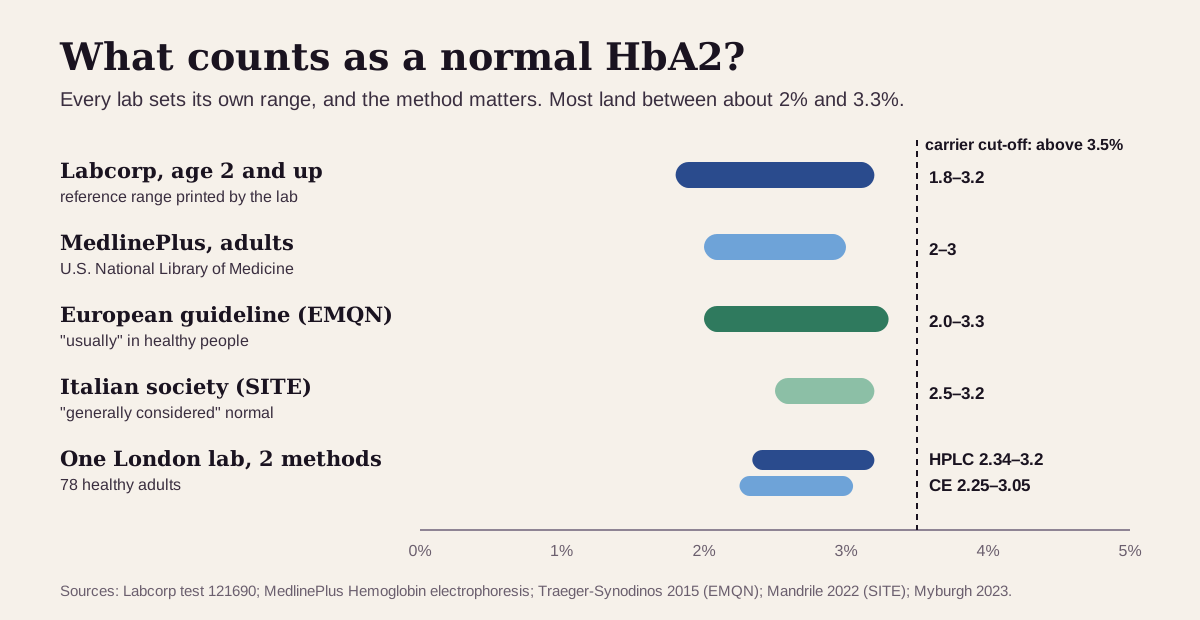
- The European Molecular Genetics Quality Network (EMQN) guideline says healthy people usually run 2.0–3.3%.1
- Labcorp prints 1.8–3.2% for anyone age 2 and up.4
- The Italian Society of Thalassemia and Haemoglobinopathies calls 2.5–3.2% normal, and notes that a small share of healthy people read 2.2–2.5% or 3.2–3.5%.14
- Methods differ. In one London lab, healthy adults ran 2.34–3.2% by HPLC (high-performance liquid chromatography) and 2.25–3.05% by capillary electrophoresis. In a comparison of nine instruments, the average for the same samples ranged from 2.2% to 2.8%.12
Men and women share one range. In 1,356 adults screened before marriage, average HbA2 was the same in men and women, and in smokers and non-smokers.15 Babies are the exception: HbA2 starts near 0.4% at birth and reaches adult levels by about 6 months (see how fast it changes).14
"Optimal" HbA2: a ladder of cut-offs, not a target
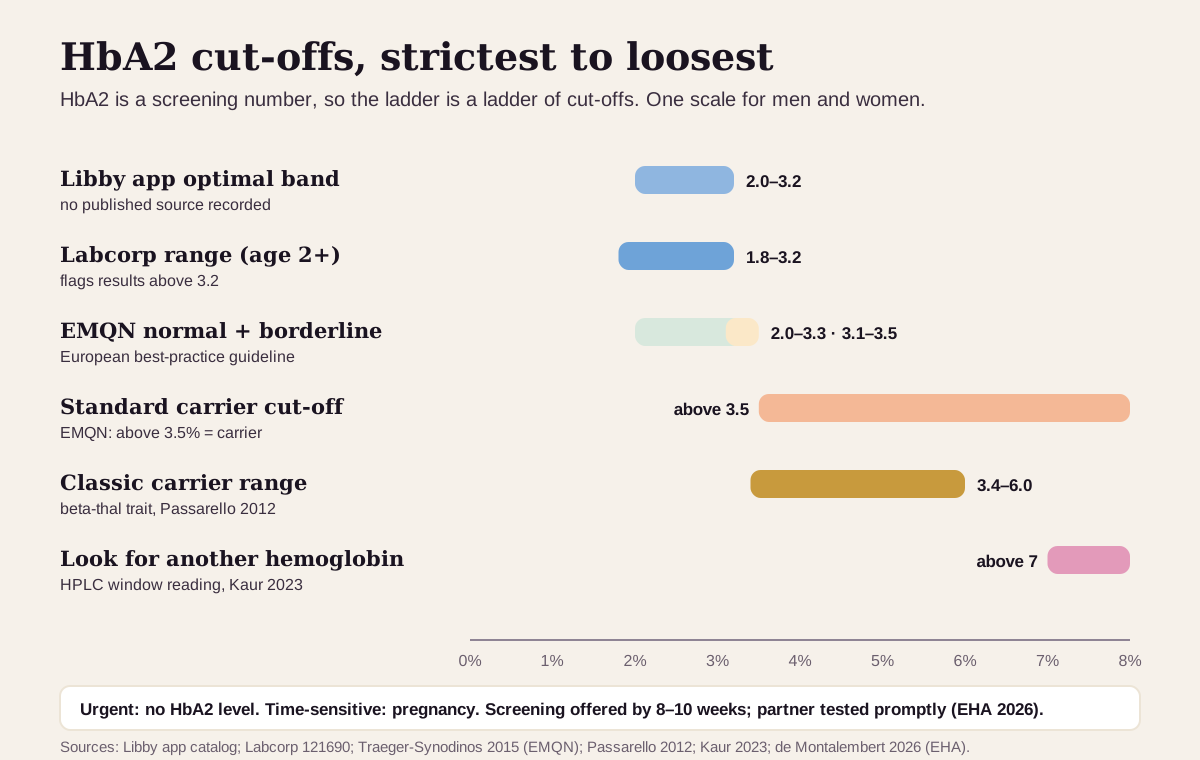
HbA2 is a genetic screening number rather than a health target, so the useful ladder is a ladder of cut-offs: where labs and guidelines draw their lines. Here they are, from the strictest flag to the loosest:
| Cut-off | HbA2 | Who uses it |
|---|---|---|
| Libby app optimal band | 2.0–3.2% | The range shaded as optimal in the Libby app. The app's catalog records no published source for it |
| Lab reference range | 1.8–3.2% | Labcorp, age 2 and up4 |
| Guideline "normal" and borderline | 2.0–3.3% normal; 3.1–3.5% borderline | EMQN: borderline results need more testing, depending on the method and the lab's own range1 |
| Standard carrier cut-off | above 3.5% | EMQN: "the standard cut-off value, above which heterozygosity for β-thalassaemia is indicated"1 |
| Classic carrier range | 3.4–6.0% | The usual beta-thal trait picture, with small red cells5 |
| Look for another hemoglobin | above 7% | Rare for HbA2 itself: a variant is probably sharing the reading11 |
| Time-sensitive | any raised or borderline result in pregnancy | Test the partner promptly. European guidance aims to offer screening by 8–10 weeks of pregnancy10 |
Why the borderline zone gets so much attention: the gap between a carrier and a non-carrier can be a few tenths of a percent.13
- In 205 people with HbA2 of 3.0–3.9% in an Indian screening program, 149 turned out to carry beta-thalassemia trait. Of those carriers, 20 had HbA2 under 3.5% and an MCV over 80 fL, a picture that would pass a simple screen.6
- Acquired shifts are much smaller than the carrier gap. An overactive thyroid raised the average from 2.48% to 3.21%, and iron deficiency lowered it from 2.50% to 2.30%. Carriers averaged 5.26–5.4%.81516
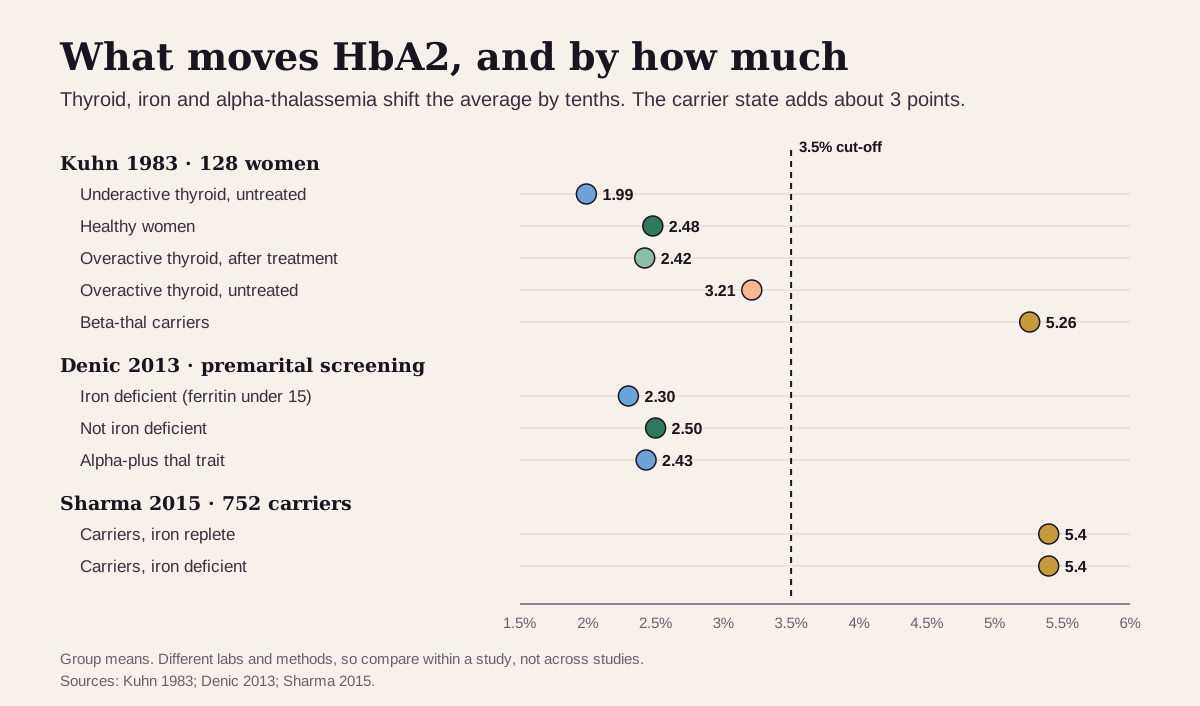
Keep the cut-offs in perspective: HbA2 is one piece of a carrier screen. The European and Italian guidelines read it only together with the red cell indices, the other hemoglobin fractions and iron studies, and send borderline or unusual results for DNA testing.114
What a high HbA2 usually means
The size of the rise is the first clue. Most results sit in the normal band. The borderline band is where the neighbors matter most.116
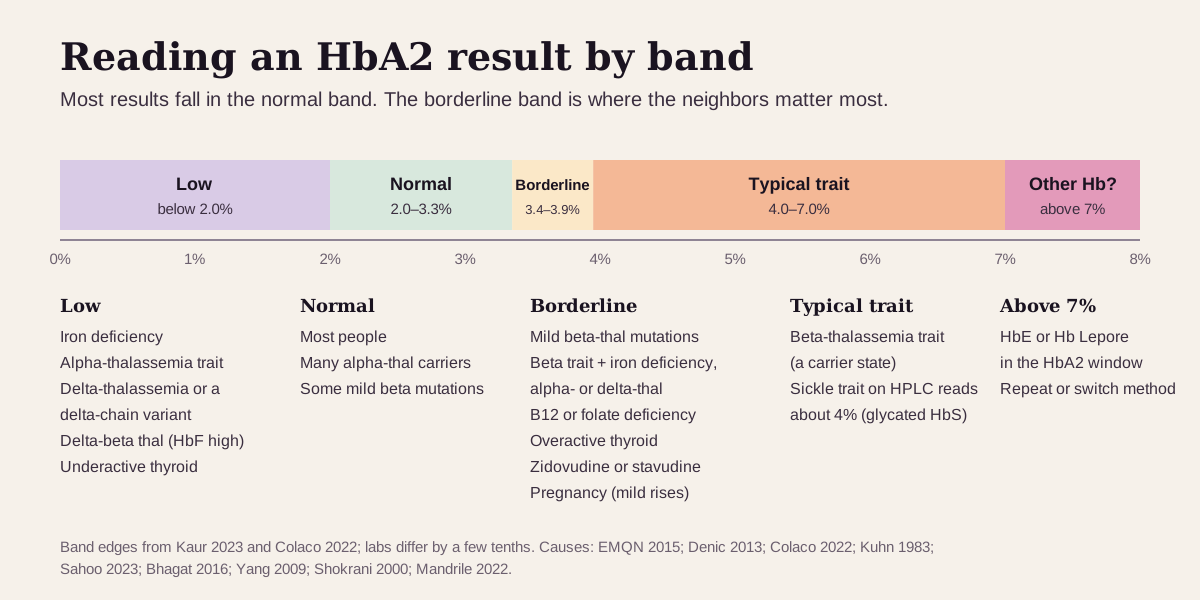
Above 3.5%, with small red cells: beta-thalassemia trait
In one U.S. lab's review, most raised HbA2 results came with a variant, mostly HbS (see going deeper). Without a variant, 5 of 7 non-pregnant patients with a raised HbA2 had beta-thal trait, while mild rises in pregnant women were mostly something else.17 The classic picture is HbA2 3.4–6.0%, MCV 60–75 fL, MCH 18–24 pg and a relatively high red cell count.5 The MCV, red cell count and RDW guides explain those indices.
What it means for you:
- It's a carrier state. Carriers usually have no symptoms, sometimes a mild anemia.3 Your hemoglobin may sit a little low while your red cell count runs high, often 6–7 million per microliter.14
- The small cells come from the trait, not from missing iron. Iron studies tell the two apart, and both can happen at once.116
- It matters for family planning. When both partners are carriers, each pregnancy has a 25% chance of a child with thalassemia major.3 Relatives may carry it too, and the Italian guideline encourages carriers to tell them.14
Borderline (about 3.1–3.9%)
Labs draw this zone slightly differently: 3.1–3.5% in the EMQN guideline and 3.0–3.9% in the Indian study above.16 The common explanations:
- A mild beta-thalassemia mutation. Some beta changes lower beta output only a little and give normal or borderline HbA2.36
- Beta-thal trait plus something that pulls HbA2 down, such as alpha-thalassemia, delta-thalassemia or iron deficiency (more on these below).6
- Low vitamin B12 or folate. In one study of people with megaloblastic anemia and a raised HbA2, the diagnosis changed in 71% after two months of B12 and folate.7
- An overactive thyroid. Untreated hyperthyroid women averaged 3.21%, against 2.48% in healthy women, and the level returned to normal with treatment.8
- Some HIV medicines. In one antenatal program, 25.5% of people on zidovudine- or stavudine-based treatment had borderline HbA2. Everyone on tenofovir read normal.9
- Pregnancy. Mild rises without beta-thal trait were more common in pregnant women, and mostly fell below a 3.5% cut-off.17
Above 7%: usually another hemoglobin
A true HbA2 above 7% is rare. On HPLC, a reading that high usually means a variant is coming out in the same window: Hb Lepore trait reads 10–14% and HbE trait 25–40%.11 The lab then reports the variant and, where it can, measures HbA2 another way.14 More on this in going deeper.
Act quickly if you're pregnant or planning a pregnancy. A raised or borderline HbA2 is a reason to test your partner now. European guidance aims to offer screening by 8–10 weeks of pregnancy and, where these traits are common, to finish the whole process, the partner's test included, within the first 12–13 weeks. That leaves time for prenatal testing if both of you are carriers.10
What a low HbA2 usually means
A low HbA2 (under about 2%) is usually a clue to something else.11
- Iron deficiency. People with a ferritin under 15 averaged HbA2 0.2 points lower than those with enough iron (2.30% vs 2.50%).15 In a U.S. review of isolated low HbA2, about half of the patients with iron studies were iron deficient, and 46% had normal iron.19
- Alpha-thalassemia trait. It lowered the average by about 0.13 points in the same screening study.15 It gives small red cells with a normal HbA2 and HbF, and is confirmed by DNA testing.1
- Delta-thalassemia or a delta-chain variant. A change in a delta gene lowers HbA2 or splits it into two peaks. The lab then adds both peaks for the true total.120
- Delta-beta thalassemia gives a normal or low HbA2 with a raised HbF, typically 5–20%.14
- An underactive thyroid averaged 1.99%, against 2.48% in healthy women.8
Can these hide beta-thal trait? Near the cut-off, yes. The UAE researchers estimated that 2.6% of their cohort, with HbA2 of 3.2–3.5%, were at risk of a missed diagnosis.15 Delta-thalassemia can bring a carrier's HbA2 all the way back to normal.3 Iron deficiency rarely masks a clearly raised level, though: among 752 confirmed carriers, iron-deficient and iron-replete carriers both averaged 5.4%, even with a ferritin under 5.16 Alpha-thalassemia can normalize the red cell indices in a beta carrier, but HbA2 stays in the carrier range.3
HbA2 reads best next to its neighbors
HbA2 is only half the story. The pattern with your red cell indices, HbF and iron usually says more than HbA2 does alone:1
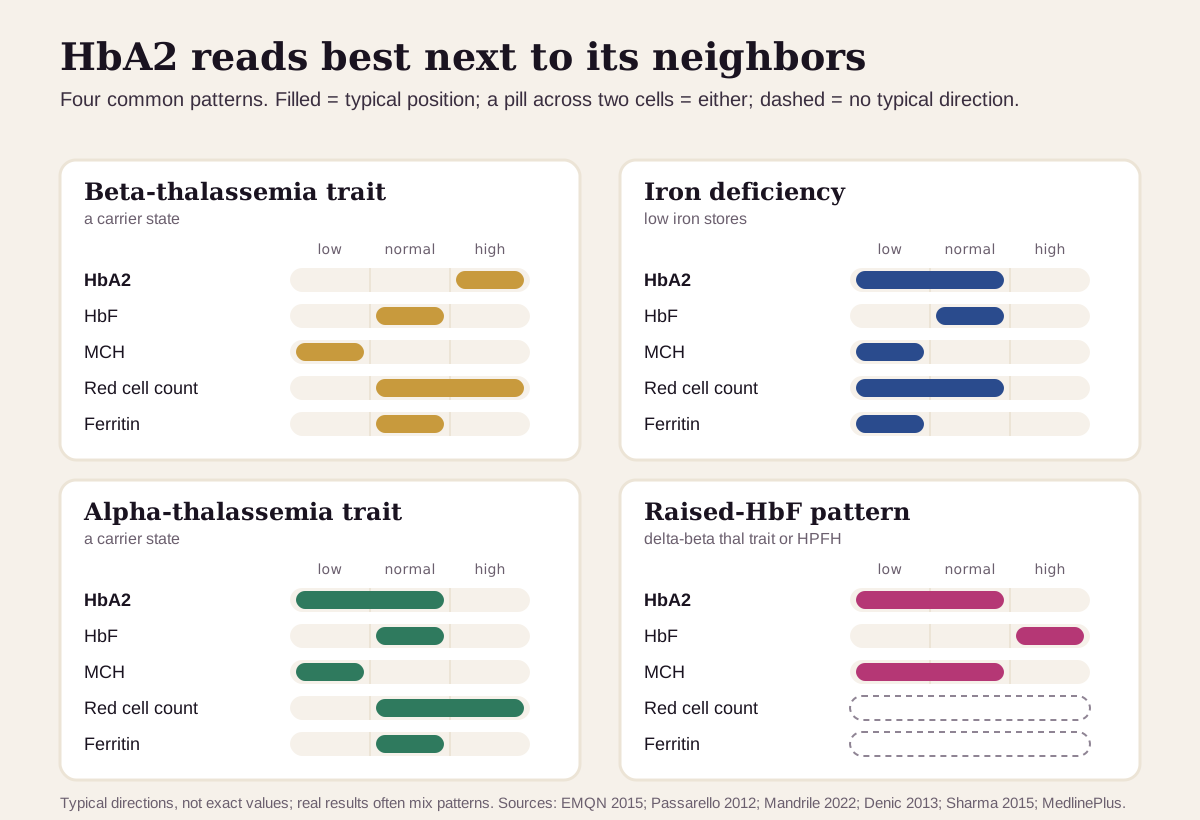
| If you see… | It often points to… |
|---|---|
| HbA2 above 3.5%, low MCH, normal or high red cell count, normal ferritin | beta-thalassemia trait: the classic carrier picture (HbF usually normal)151416 |
| Low MCH, low ferritin, HbA2 normal or slightly low | iron deficiency: iron stores are low, and HbA2 drifts down about 0.2 points115 |
| Low MCH, normal ferritin, normal (or slightly low) HbA2, normal HbF | alpha-thalassemia trait (or a mild beta mutation): DNA testing confirms it1 |
| HbF above 5% with a normal or low HbA2 | delta-beta thalassemia trait (small red cells) or hereditary persistence of fetal hemoglobin (normal red cells)114 |
Iron and the trait can travel together. In the 752-carrier study, about 1 in 5 carriers also had iron deficiency, a third of the women.16 That's why a ferritin result belongs next to any HbA2. The European hematology recommendations treat an MCH under 27 pg as a reason to suspect a hemoglobin disorder.10
How fast HbA2 changes
HbA2 barely moves on its own. Your genes set it, so a carrier's HbA2 stays in the carrier range year after year. What changes it is the red cells in your blood. Red cells live about 115 days, so any change takes months to show fully.22
- After a transfusion, donor cells mix with yours. The Italian guideline waits 3 months before testing, and MedlinePlus warns of misleading results within 12 weeks.142
- During iron deficiency, the Italian guideline treats a first HbA2 as provisional and repeats it once the iron is replaced.14
- After B12 and folate treatment, the study above re-tested at 2 months.7 After thyroid treatment, HbA2 normalized once people were euthyroid.8
- In infancy, HbA2 climbs from about 0.4% at birth to adult levels by 6 months, which is why a newborn result can look normal in a carrier.14
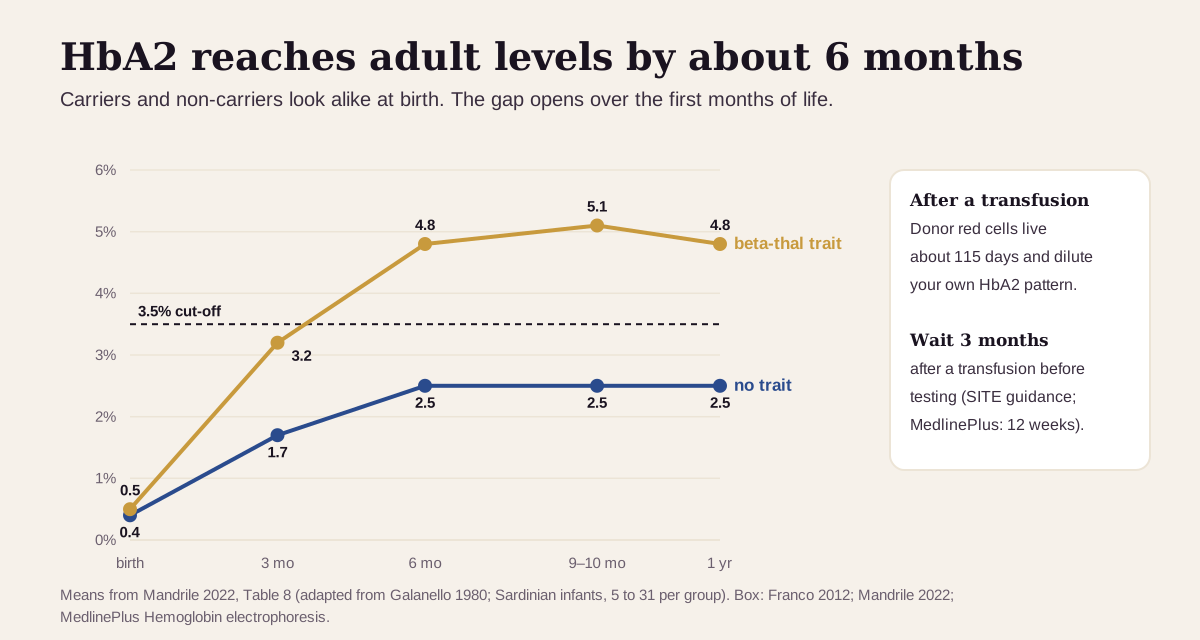
Trends matter less for HbA2 than for most markers. A repeat helps most when the first test fell in a transfusion window, during iron, B12 or folate deficiency, or in pregnancy. A borderline result that persists goes to DNA testing.147171
Going deeper: why HbA2 is hard to measure
HbA2 is a small peak, and carriers differ from non-carriers by only a little, so the test has to be both precise and accurate.13 Three things trip it up:
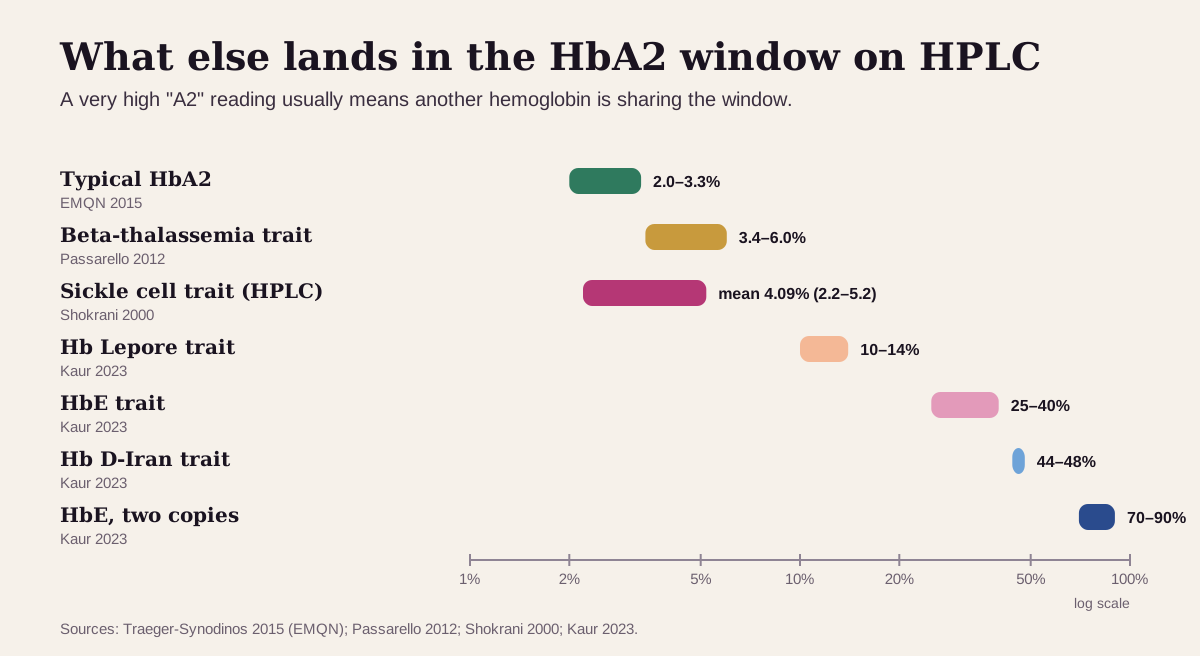
- HbE shares the window. On HPLC, HbE comes out with or next to HbA2, as do Hb Lepore and several rarer variants.1411 So a person with HbE trait shows an "A2" of 25–40%, and the true HbA2 needs a different method.1114
- HbS inflates the reading on HPLC. Sugar-coated (glycated) HbS lands in the HbA2 window.1214 In one U.S. series, people with sickle cell trait averaged an HPLC HbA2 of 4.09%, against 2.57% in people without a variant, overlapping the carrier range.18 Labs note this on the report.14
- Delta variants split the peak. A second "A2" peak is HbA2 made with a variant delta chain, and both peaks count toward the total.201
Why beta-thal trait raises HbA2 at all: with less beta chain around, the cell makes relatively more delta chain, and more alpha chains end up paired with it. Researchers describe both a gene-reading (transcriptional) effect and a chain-pairing (post-translational) effect.11 Iron deficiency works the other way: it cuts alpha-chain supply, beta chains out-compete delta chains for what's left, and HbA2 dips.5
Questions worth asking
- Is my HbA2 clearly above 3.5%, or in the borderline zone for this lab's method?
- What do my MCV, MCH and red cell count show next to it?
- Was my iron checked at the same time, and should HbA2 be repeated once iron is replaced?
- Could a medicine, a thyroid problem, low B12 or folate, or a recent transfusion be affecting it?
- Did the report flag a variant like HbE or HbS that could change the reading?
- If I'm a carrier, should my partner be tested, and would DNA testing help us?
FAQ
What is a normal hemoglobin A2 level? Most labs put it between about 2.0 and 3.3%. Labcorp prints 1.8–3.2% for anyone age 2 and up.14
What does a high HbA2 mean? Above 3.5% with small red cells is the standard sign of beta-thalassemia trait, a carrier state that usually causes no symptoms. Borderline values of about 3.1–3.9% can also come from low B12 or folate, an overactive thyroid or some HIV medicines.1789
Can iron deficiency hide beta-thalassemia trait? It lowers HbA2 by about 0.2 points on average, which matters mainly near the cut-off. In 752 confirmed carriers, those with iron deficiency still averaged 5.4%.1516
Is beta-thalassemia trait a disease? It's a carrier state. Carriers usually feel well, sometimes with a mild anemia. It matters most for family planning, because two carriers have a 25% chance in each pregnancy of a child with thalassemia major.3
This guide is for education. It can't diagnose you or replace care from a clinician who knows your history.
Footnotes
-
Traeger-Synodinos J, Harteveld CL, Old JM, et al. EMQN Best Practice Guidelines for molecular and haematology methods for carrier identification and prenatal diagnosis of the haemoglobinopathies. Eur J Hum Genet. 2015;23(4):426–437. The European best-practice guideline for carrier testing. Source for the 3.5% cut-off, the 3.1–3.5% borderline zone, the usual 2.0–3.3% normal range, the high red cell count in carriers, normal HbF in typical carriers, and the pattern table (iron deficiency, alpha-thalassemia, delta-beta thalassemia, delta variants). PMC ↩ ↩2 ↩3 ↩4 ↩5 ↩6 ↩7 ↩8 ↩9 ↩10 ↩11 ↩12 ↩13 ↩14 ↩15 ↩16 ↩17 ↩18 ↩19 ↩20 ↩21 ↩22 ↩23 ↩24 ↩25 ↩26 ↩27 ↩28
-
National Library of Medicine. Hemoglobin electrophoresis. MedlinePlus Medical Encyclopedia. Adult HbA2 2–3% and HbA over 95%; transfusion within 12 weeks can give misleading results. MedlinePlus ↩ ↩2 ↩3 ↩4 ↩5 ↩6
-
Galanello R, Origa R. Beta-thalassemia. Orphanet J Rare Dis. 2010;5:11. Major review. Carrier prevalence (about 1.5%, 80–90 million people), where it is common, carriers usually symptom-free, the 25% risk per pregnancy when both parents carry it, and the effects of co-inherited alpha- and delta-thalassemia. PMC ↩ ↩2 ↩3 ↩4 ↩5 ↩6 ↩7 ↩8 ↩9 ↩10 ↩11
-
Labcorp. Hemoglobinopathy Fractionation Cascade, test 121690. Reference range for Hb A2, age 2 and up: 1.8–3.2%. Capillary electrophoresis first, HPLC as a reflex. A commercial laboratory's published reference range, opened September 23, 2026. labcorp.com ↩ ↩2 ↩3 ↩4 ↩5 ↩6
-
Passarello C, Giambona A, Cannata M, et al. Iron deficiency does not compromise the diagnosis of high HbA2 β thalassemia trait. Haematologica. 2012;97(3):472–473. The classic carrier phenotype (HbA2 3.4–6.0%, MCV 60–75 fL, MCH 18–24 pg, relatively high red cell count) and why iron deficiency lowers HbA2. PMC ↩ ↩2 ↩3 ↩4 ↩5 ↩6 ↩7 ↩8 ↩9
-
Colaco S, Colah R, Nadkarni A. Significance of borderline HbA2 levels in β thalassemia carrier screening. Sci Rep. 2022;12(1):5414. 205 people with HbA2 3.0–3.9%; 149 were beta-thalassemia carriers, 20 of them with HbA2 under 3.5% and MCV over 80 fL. PMC ↩ ↩2 ↩3 ↩4 ↩5 ↩6
-
Sahoo S, Sahu N, Das P, Senapati U. Effect of megaloblastic anemia on hemoglobin A2 and diagnosis of β-thalassemia trait. Indian J Pathol Microbiol. 2023;66(2):327–331. HbA2 fell after 2 months of B12 and folate; the diagnosis changed in 70.97%. PubMed ↩ ↩2 ↩3 ↩4 ↩5 ↩6
-
Kuhn JM, Rieu M, Rochette J, et al. Influence of thyroid status on hemoglobin A2 expression. J Clin Endocrinol Metab. 1983;57(2):344–348. 128 women: hyperthyroid 3.21%, treated 2.42%, healthy 2.48%, hypothyroid 1.99%, carriers 5.26%. PubMed ↩ ↩2 ↩3 ↩4 ↩5 ↩6 ↩7 ↩8
-
Bhagat P, Kaur Sachdeva R, Sharma P, et al. Effect of antiretroviral therapy on hemoglobin A2 values can have implications in antenatal beta-thalassemia screening programs. Infect Dis (Lond). 2016;48(2):122–126. 25.5% borderline HbA2 on zidovudine or stavudine; normal on tenofovir. PubMed ↩ ↩2 ↩3 ↩4
-
de Montalembert M, Cappellini MD, Iolascon A, et al. EHA Recommendations for preconceptual and antenatal screening and prenatal diagnosis for hemoglobinopathies. HemaSphere. 2026;10(6):e70381. European Hematology Association: an MCH under 27 pg or an HbA2 outside the test's range is a reason to suspect a hemoglobin disorder; aim to finish screening by 8–10 weeks of pregnancy. PMC ↩ ↩2 ↩3 ↩4 ↩5
-
Kaur G, Tyagi S, Seth T, et al. Comparison of HbA2 Using High Performance Liquid Chromatography Versus Haemoglobin Capillary Zone Electrophoresis. Indian J Hematol Blood Transfus. 2023;39(4):572–578. HbA2 as alpha2-delta2, the band groupings (under 2%, 2.0–3.3%, borderline, over 7%), and the HPLC readings for Hb Lepore, HbE and Hb D-Iran. PMC ↩ ↩2 ↩3 ↩4 ↩5 ↩6 ↩7 ↩8 ↩9 ↩10 ↩11 ↩12
-
Myburgh JK, Szydlo RM, Bain BJ. The accuracy of haemoglobin A2 measurements in the presence and absence of haemoglobin S. EJHaem. 2023;4(2):437–441. HPLC vs capillary electrophoresis ranges, instrument-to-instrument spread, and why HbS disturbs the HPLC reading. PMC ↩ ↩2 ↩3 ↩4
-
Stephens AD, Colah R, Fucharoen S, et al. ICSH recommendations for assessing automated high-performance liquid chromatography and capillary electrophoresis equipment for the quantitation of HbA2. Int J Lab Hematol. 2015;37(5):577–582. The international standards body on why HbA2 must be measured precisely. PubMed ↩ ↩2 ↩3
-
Mandrile G, Barella S, Giambona A, et al. First and Second Level Haemoglobinopathies Diagnosis: Best Practices of the Italian Society of Thalassemia and Haemoglobinopathies (SITE). J Clin Med. 2022;11(18):5426. Normal range 2.5–3.2%, what raises and lowers HbA2 (Table 4), variants in the HbA2 window (Table 5), the 3-month wait after transfusion, testing during iron deficiency, delta-beta thalassemia HbF 5–20%, and infant HbA2 values (Table 8, adapted from Galanello 1980). PMC ↩ ↩2 ↩3 ↩4 ↩5 ↩6 ↩7 ↩8 ↩9 ↩10 ↩11 ↩12 ↩13 ↩14 ↩15 ↩16 ↩17 ↩18 ↩19 ↩20 ↩21
-
Denic S, Agarwal MM, Al Dabbagh B, et al. Hemoglobin A2 Lowered by Iron Deficiency and α-Thalassemia: Should Screening Recommendation for β-Thalassemia Change? ISRN Hematol. 2013;2013:858294. 1,356 adults in a UAE premarital program: iron deficiency lowered HbA2 by 0.2 points, alpha-plus trait by 0.13; no difference by sex or smoking. PMC ↩ ↩2 ↩3 ↩4 ↩5 ↩6 ↩7 ↩8 ↩9 ↩10
-
Sharma P, Das R, Trehan A, et al. Impact of iron deficiency on hemoglobin A2% in obligate β-thalassemia heterozygotes. Int J Lab Hematol. 2015;37(1):105–111. 752 confirmed carriers; mean HbA2 5.4% with and without iron deficiency. PubMed ↩ ↩2 ↩3 ↩4 ↩5 ↩6 ↩7 ↩8
-
Yang Z, Chaffin CH, Easley PL, et al. Prevalence of elevated hemoglobin A2 measured by the CAPILLARYS system. Am J Clin Pathol. 2009;131(1):42–48. Mild HbA2 rises without beta-thal trait were more common in pregnancy; at a 3.5% cut-off only 3 remained. PubMed ↩ ↩2 ↩3 ↩4
-
Shokrani M, Terrell F, Turner EA, Aguinaga MD. Chromatographic measurements of hemoglobin A2 in blood samples that contain sickle hemoglobin. Ann Clin Lab Sci. 2000;30(2):191–194. HPLC HbA2 averaged 4.09% (2.2–5.2%) in sickle cell trait vs 2.57% without a variant. PubMed ↩ ↩2 ↩3
-
Moore M, Courville EL. Work-up of Patients with Decreased Hemoglobin A2 Identified by Capillary Zone Electrophoresis: A North American Institutional Experience. Lab Med. 2023;54(3):235–240. Low HbA2 was linked to iron deficiency, but 46% of patients with iron studies were iron-replete. PubMed ↩
-
Panyasai S, Fucharoen G, Fucharoen S. Known and new hemoglobin A2 variants in Thailand and implication for β-thalassemia screening. Clin Chim Acta. 2015;438:226–230. Why a second HbA2 peak is added to the first for the total. PubMed ↩ ↩2
-
National Library of Medicine. RBC count. MedlinePlus Medical Encyclopedia. Iron deficiency is among the causes of a low red cell count. MedlinePlus ↩
-
Franco RS. Measurement of red cell lifespan and aging. Transfus Med Hemother. 2012;39(5):302–307. Red cells survive about 115 days. PMC ↩ ↩2
Educational content, not medical advice. Libby is a personal record tool, not a medical service — it doesn't diagnose, treat, or prescribe. Reference ranges vary by lab and by person. Talk to a qualified healthcare professional about your results.
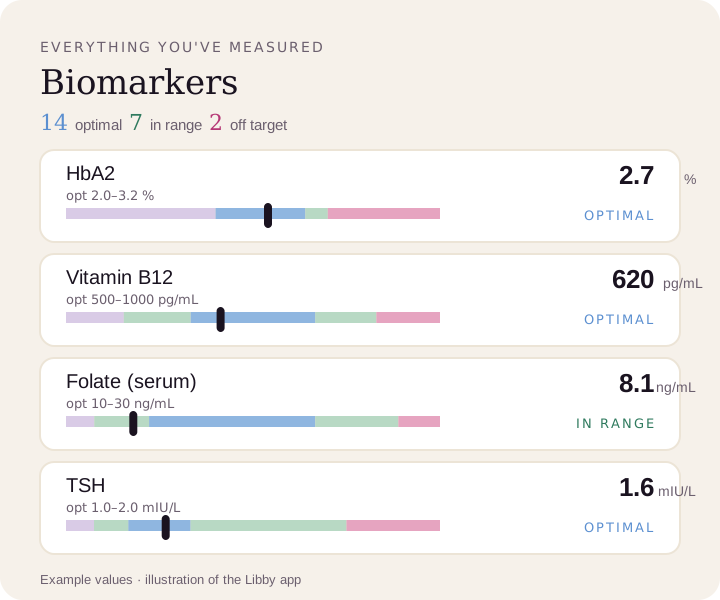
See your HbA2 next to the rest of your blood work.
Upload a lab PDF or a photo of your report. Libby puts HbA2, B12, folate, thyroid and the rest of your markers on range bars and tracks every repeat test.
View your HbA2 ›