ACTH blood test: normal range, high and low causes
ACTH is the pituitary signal that tells your adrenals to make cortisol. Here's a normal morning level, what high and low results mean, and when it's urgent.
ACTH (adrenocorticotropic hormone) is the signal your pituitary gland sends to your adrenal glands to make cortisol. Doctors almost always read it next to a cortisol drawn at the same time, because the pair shows whether a cortisol problem starts in the adrenal glands or in the pituitary.12 ACTH comes out in bursts and peaks in the early morning, so labs want the blood drawn between 7 and 10 a.m.34
The short version
- Normal (7–10 a.m. draw): about 7–63 pg/mL. Labcorp and ARUP print 7.2–63.3; MedlinePlus lists 9–52.451
- Low: most often from steroid medicines such as prednisone, which switch ACTH off.1 With a high cortisol, an ACTH under 10 pg/mL points to an adrenal tumor making cortisol on its own.6
- High: an early-morning draw and physical stress push it up.34 With a low cortisol, an ACTH more than 2 times the upper limit points to the adrenal glands failing (Addison disease).2 With a high cortisol, it points to a tumor making ACTH, most often in the pituitary.7
- Urgent: a high ACTH with a low cortisol plus vomiting, severe weakness, fainting or confusion can be adrenal crisis, a medical emergency.2
What ACTH is
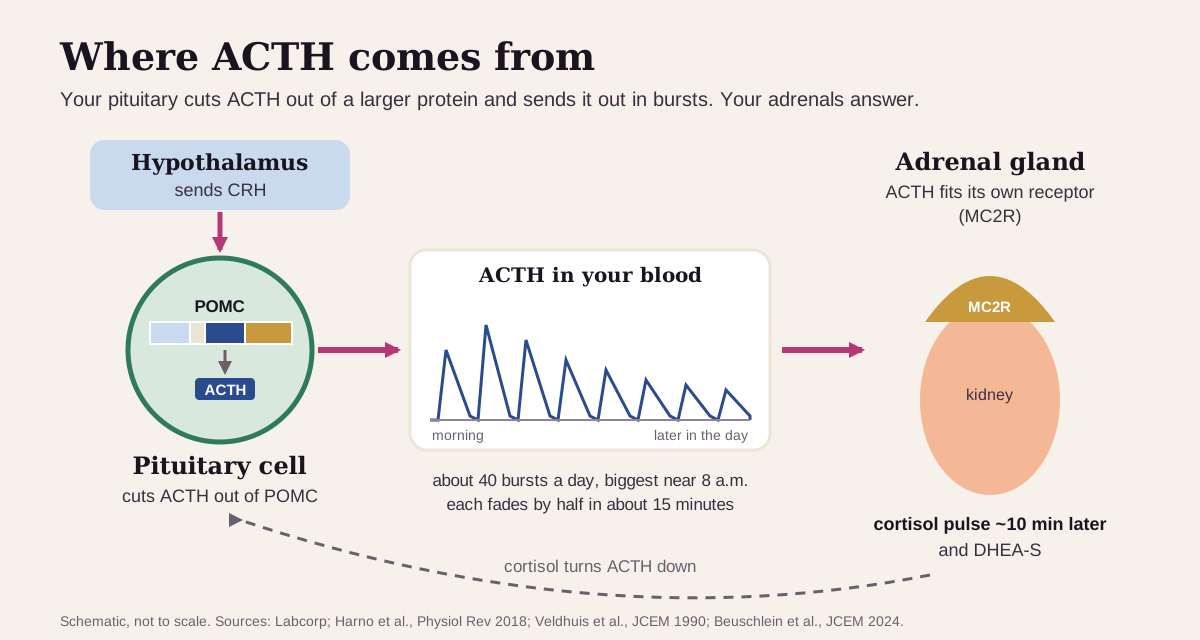
ACTH is a small protein hormone, 39 amino acids long, made in the front part of your pituitary gland at the base of the brain.4 The pituitary builds a larger protein called POMC and cuts ACTH out of it. (More on that at the end.)8
The chain of command starts in the hypothalamus. It sends a hormone called CRH to the pituitary in response to your body clock or physical effort.4 ACTH then travels in the blood to your two adrenal glands, where it fits a receptor built for ACTH alone and switches on cortisol production.8 Cortisol feeds back to turn ACTH down, which is why steroid medicines lower it.9 ACTH also keeps up the adrenals' output of DHEA-S, a hormone that falls when ACTH is switched off.610
ACTH comes in bursts. In a classic study that sampled 8 healthy men every 10 minutes for a full day, ACTH arrived in about 40 bursts a day, one every 39 minutes, and a cortisol pulse followed each burst about 10 minutes later. The bursts were largest around 8 a.m., about 3.8 times bigger than at their daily low.3
What's a normal ACTH?
Start with the time on your report. Labs publish an ACTH range for morning draws only: Labcorp and ARUP, two large commercial labs, list 7.2–63.3 pg/mL for blood drawn between 7 and 10 a.m., and ARUP sets no afternoon range at all.45
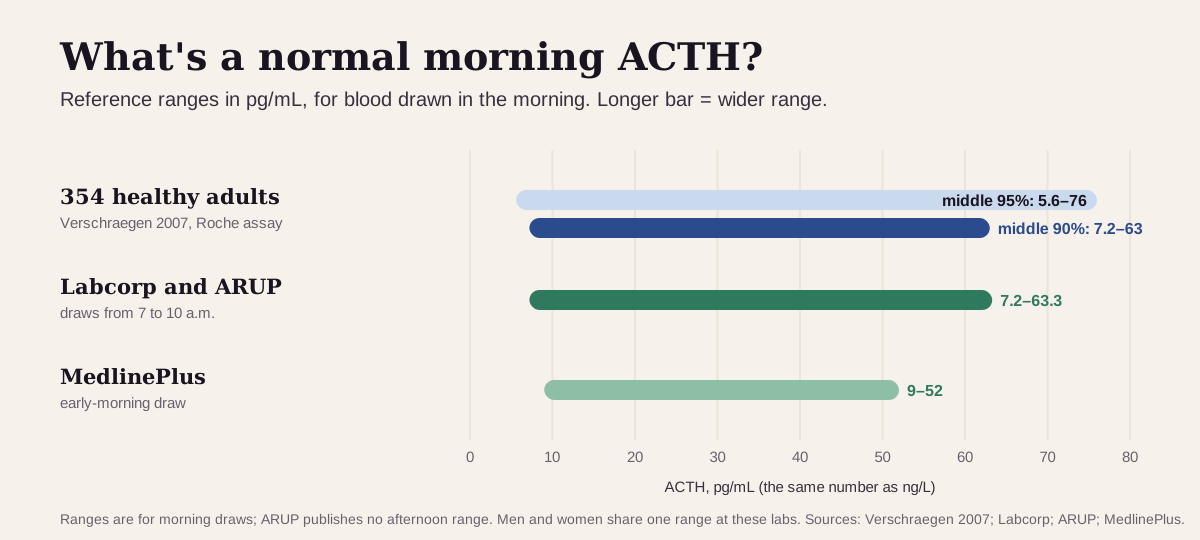
- That range comes from 354 healthy adults tested at six labs on the Roche assay that Labcorp uses. It covers the middle 90% of them; the middle 95% ran from 5.6 to 76 pg/mL.114
- MedlinePlus lists 9–52 pg/mL (2–12 pmol/L) for an early-morning sample.1
- Men and women share one range at these labs. In a study of 529 healthy Danish children and young people, ACTH was the same in both sexes.12
Different tests give different numbers. When 35 labs using seven ACTH tests measured the same 25 samples, results for one sample ran from about 0.13 to 1.9 times its target value, and only 60% of truly low samples were reported as low.13 Compare results from the same lab when you can.
"Optimal" ACTH: what health optimizers aim for
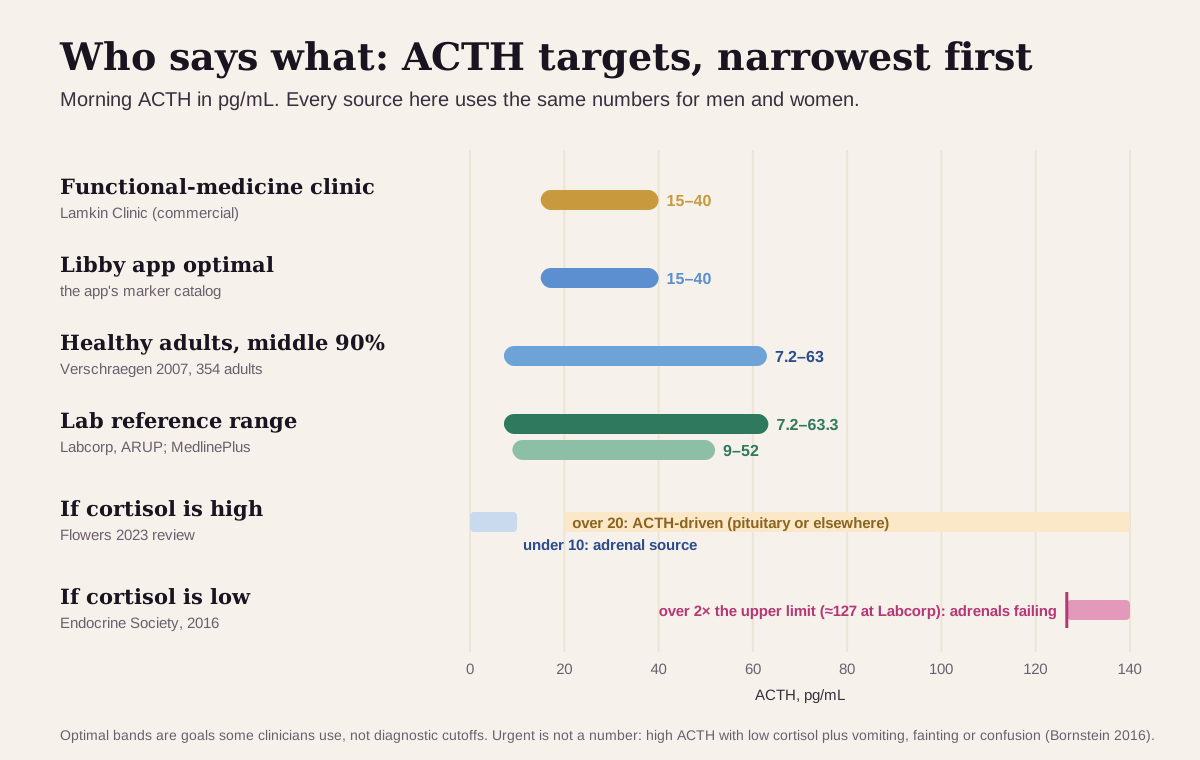
Some functional-medicine clinics aim for the middle of the lab range. ACTH targets have a floor as well as a ceiling, because too little cortisol and too much both cause disease.27 Here's the ladder for a morning draw, from the narrowest target to the decision lines doctors use:
| Target | Morning ACTH (men and women) | Who uses it |
|---|---|---|
| Functional-medicine clinic | 15–40 pg/mL | Lamkin Clinic's published "FM Optimal (AM)" band14 |
| Libby app optimal | 15–40 pg/mL | The optimal range shown in the Libby app. The app's catalog credits Endocrine Society guidelines; the Endocrine Society guidelines opened for this article set decision lines, not an optimal ACTH band15 |
| Healthy adults | 7.2–63 pg/mL | The middle 90% of 354 healthy adults on the Roche assay11 |
| Lab reference range | 7.2–63.3 pg/mL (MedlinePlus: 9–52) | Labcorp and ARUP, for 7–10 a.m. draws451 |
| Decision lines, cortisol high | under 10 / over 20 pg/mL | Under 10 points to an adrenal source; over 20 to an ACTH-driven cause6 |
| Guideline line, cortisol low | over 2× the upper limit (about 127 at Labcorp) | Endocrine Society: fits the adrenal glands failing2 |
| Urgent | no single number | High ACTH with low cortisol plus vomiting, fainting or confusion: get emergency care2 |
None of these sources sets different numbers for men and women.
What the numbers rest on. ACTH cutoffs come from studies that sort adrenal and pituitary disease. The clearest example: in 100 people with Cushing syndrome from their own cortisol, those with a pituitary tumor making ACTH had a median morning ACTH of 58 pg/mL, and those with an adrenal cause had a median of 6. A cutoff of 14.65 pg/mL split the two groups with 100% sensitivity and 98% specificity.10
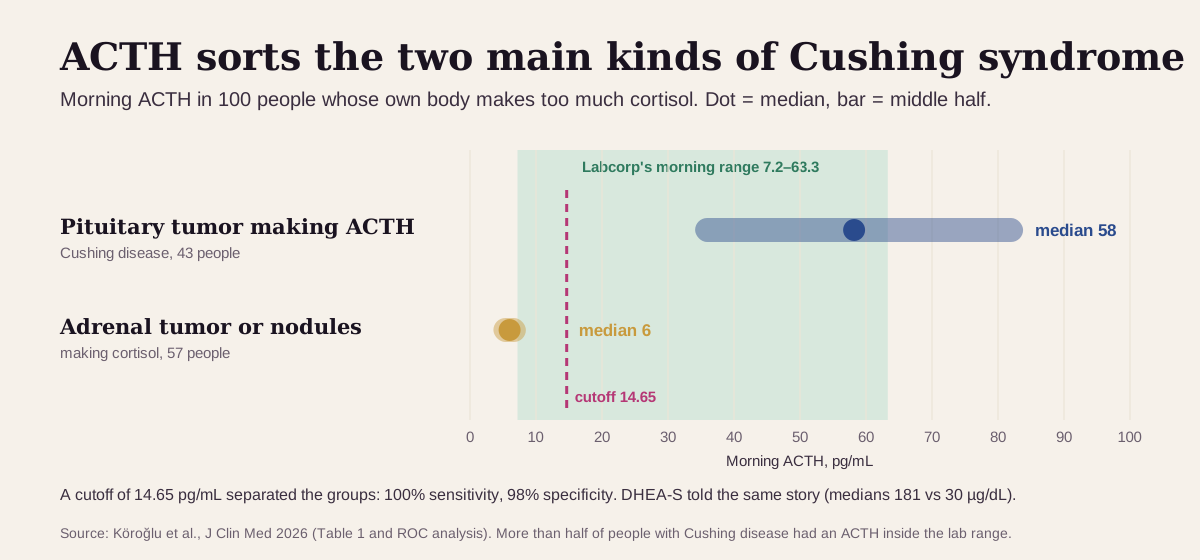
Keep "optimal" in perspective. The 15–40 band sits in the middle of the healthy range, but it's narrower than the spread between ACTH tests,13 and a warm tube can shave 12% off a result in 4 hours.16 ACTH also swings from burst to burst through the day.3 A morning ACTH means the most when you read it with the cortisol drawn beside it.
What a low or high ACTH usually means
The cortisol drawn with it is the first clue. Next to a cortisol, an ACTH points to where the problem starts: the adrenal glands, the pituitary, or a medicine.62
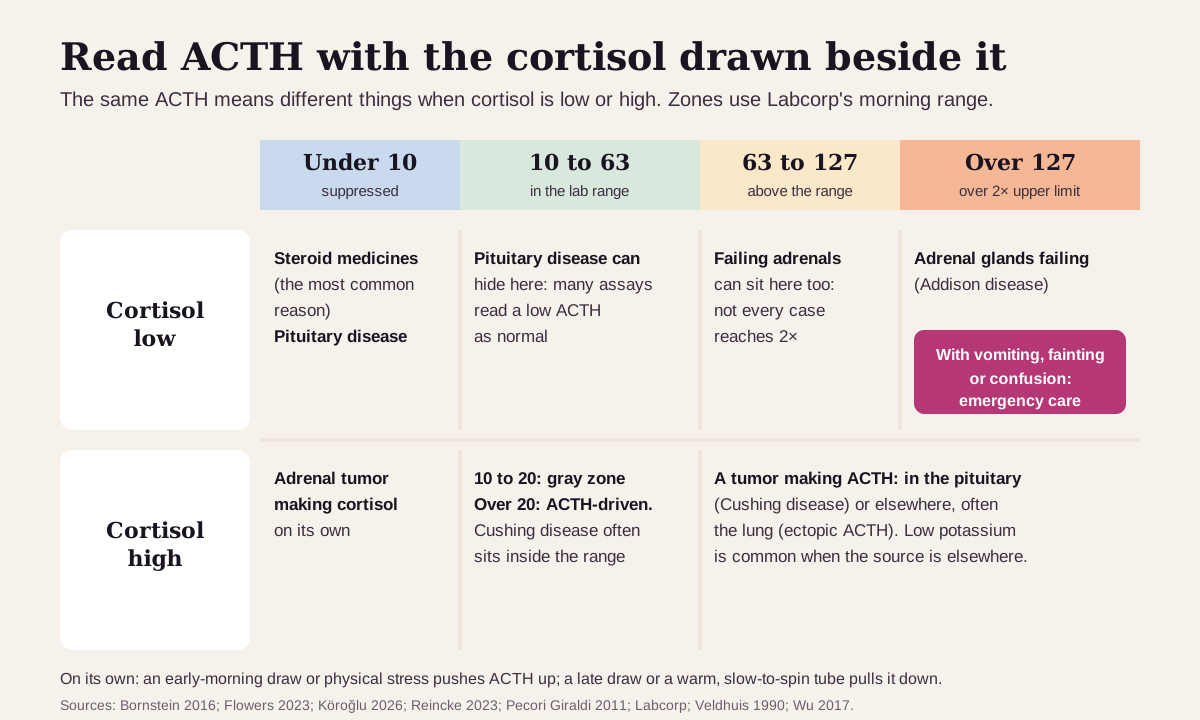
Low ACTH: the usual suspects
- Steroid medicines. They are the most common reason for a low ACTH.1 Prednisone and similar drugs switch off CRH and ACTH, and any route can do it: pills, inhalers, nasal sprays, joint injections, skin creams and IV doses.9 Don't stop these medicines unless your clinician tells you to.1
- An afternoon or evening draw. ACTH bursts are smallest late in the day, and labs publish ranges for morning draws only.35
- A warm or slow-to-spin sample. ACTH breaks down in the tube. In unspun blood left at room temperature, 12% was gone after 4 hours and 20% after 8; kept at 4 °C, under 5% was lost in 8 hours.16 That's why labs ask for an iced tube spun within an hour and frozen, and why a plain glass tube can read falsely low.4
- An adrenal tumor making cortisol. With a high cortisol, an ACTH under 10 pg/mL points to the adrenal gland working on its own.6 In one study the median was 6.10
- Pituitary disease. When the pituitary makes too little ACTH (hypopituitarism), ACTH runs low.1 It may still read "normal": in the multi-lab study, only 6 in 10 truly low samples were reported as low.13 A morning cortisol and an ACTH stimulation test settle the question.9
High ACTH: the usual suspects
- Time of day and stress. ACTH peaks in the morning, and physical effort triggers the CRH signal that releases it.34
- Adrenal glands failing (primary adrenal insufficiency, or Addison disease). When the adrenals fall short on cortisol, the pituitary pushes harder. With a low cortisol, an ACTH more than twice the upper limit fits this diagnosis, though some cases sit just above the range.2 Autoimmune damage causes up to 90% of cases in Western countries, and it's rare: about 100–140 people per million. The extra ACTH often darkens sun-exposed skin, skin creases, scars and the inside of the mouth.2
- A pituitary tumor making ACTH (Cushing disease). It causes 60–70% of Cushing syndrome from the body's own cortisol, which is itself rare: 2–8 new cases per million people a year. ACTH runs mid-normal to high, so it often sits inside the lab range.710
- A tumor elsewhere making ACTH (ectopic ACTH). Lung tumors are the classic source.4 Low potassium is common: 71% of patients in one group. Cushing features that build fast with a very low potassium point this way.6
- Rarer causes include congenital adrenal hyperplasia (adrenal glands born unable to make enough hormones) and multiple endocrine neoplasia type 1.1
Get emergency care if a high ACTH or a low cortisol comes with severe weakness, vomiting, belly pain, fainting, confusion or very low blood pressure, especially if you take steroids or have a known adrenal problem. That can be adrenal crisis, which needs treatment right away.2
ACTH reads best next to its neighbors
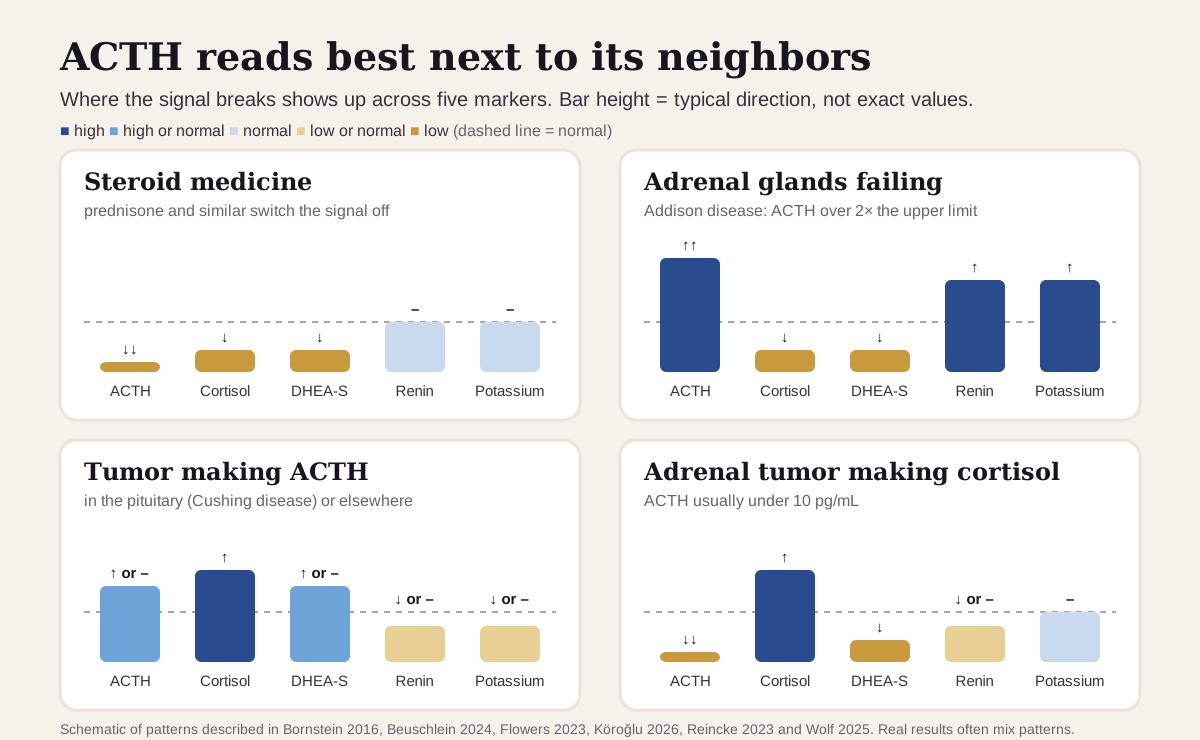
ACTH tells you where the signal breaks. Cortisol, DHEA-S, renin and potassium show which parts of the adrenal gland are still working:29
| If you see… | It often points to… |
|---|---|
| ACTH and cortisol both low while you take a steroid medicine | the medicine switching off your own supply; renin and potassium stay normal because the salt-keeping side runs on its own signal |
| ACTH over 2× the upper limit, cortisol low, renin high, potassium high | the adrenal glands failing: primary adrenal insufficiency (Addison disease) |
| ACTH low, cortisol low, no steroid medicines | a pituitary making too little ACTH (central adrenal insufficiency) |
| ACTH mid-normal to high, cortisol high, DHEA-S normal to high | a tumor making ACTH, in the pituitary (Cushing disease) or elsewhere |
| ACTH under 10, cortisol high, DHEA-S low | an adrenal tumor making cortisol on its own |
| ACTH and cortisol high, potassium low, symptoms building fast | ACTH from a tumor outside the pituitary |
DHEA-S is a handy second opinion. It falls when ACTH is switched off or the adrenal gland itself fails, so it runs low with steroid medicines, failing adrenals and adrenal tumors, and normal to high when a tumor is pumping out ACTH.29610 Renin separates the two kinds of low cortisol. It climbs when the adrenal gland itself fails, and it stays normal when only the ACTH signal is missing, because the salt-keeping hormone runs on its own kidney signal.29 In Cushing syndrome, renin tends to run normal or a little low.17
How fast ACTH changes
ACTH moves in minutes. Its half-life in the blood is about 15 minutes, so half of each burst is gone a quarter of an hour later.3
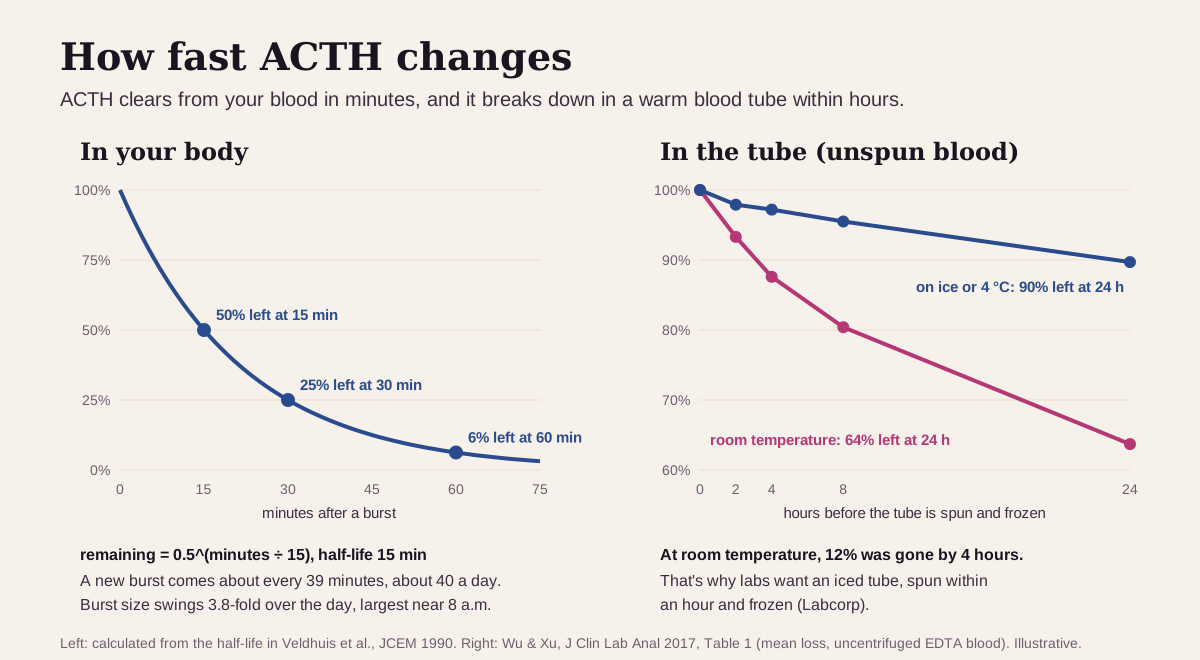
What that means in practice:
- Get tested between 7 and 10 a.m. That's the window labs set their ranges for.45 Compare each result with earlier ones drawn at the same time of day, at the same lab.13
- One draw catches one moment. Because ACTH comes in pulses, Labcorp notes that more than one sample may be needed.4
- Handling matters as much as timing. Blood goes into a chilled lavender-top (EDTA) tube and should be spun within an hour.4 A sample that sat warm reads low.16
- Stop biotin first. High-dose biotin supplements can interfere with the test. Labcorp asks you to stop at least 72 hours before the draw.4
- After steroids, ACTH leads the recovery. As a steroid dose comes down, ACTH rises first and cortisol follows. In studies, recovery took anywhere from days to years.9
Going deeper: one precursor, several hormones
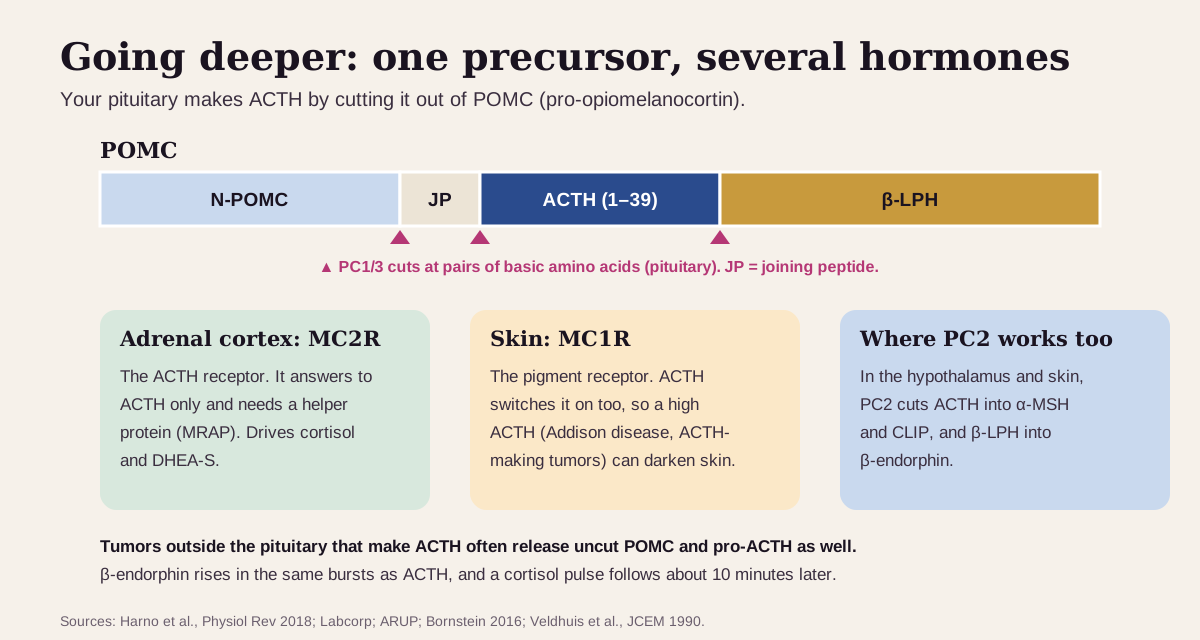
- Your pituitary makes a large protein called POMC (pro-opiomelanocortin). An enzyme, PC1/3, cuts it at pairs of basic amino acids into ACTH, N-POMC, a joining peptide and β-LPH.8
- ACTH works through MC2R, the ACTH receptor in the adrenal cortex. It responds to ACTH alone and needs a helper protein, MRAP, to reach the cell surface.8
- ACTH also fits MC1R, the skin's pigment receptor. At high levels it can darken the skin, which is why Addison disease so often changes skin color.82
- In the hypothalamus and skin, a second enzyme, PC2, cuts ACTH further into α-MSH and CLIP, and β-LPH into β-endorphin.8 In the blood, β-endorphin rises in the same bursts as ACTH.3
- Tumors outside the pituitary that make ACTH often release uncut POMC and pro-ACTH as well.4 ARUP's test measures only intact ACTH, all 39 amino acids.5
Questions worth asking
- What time was my blood drawn, and was the tube kept cold?
- What was my cortisol at the same draw?
- Could any of my medicines, including inhalers, nasal sprays, joint injections or skin creams, be lowering my ACTH?
- Should we check DHEA-S, renin or potassium alongside it?
- If my cortisol is low, do I need an ACTH stimulation test?
- When should we repeat it, and can we use the same lab?
FAQ
What is a normal ACTH level? For a morning draw (7–10 a.m.), Labcorp and ARUP list 7.2–63.3 pg/mL, and MedlinePlus lists 9–52.451
What is the most common cause of a low ACTH? Steroid medicines such as prednisone, which switch off the pituitary's ACTH signal.19
What does a high ACTH with a low cortisol mean? It points to the adrenal glands failing (primary adrenal insufficiency, or Addison disease), especially when ACTH is more than twice the upper limit.2 With vomiting, fainting or confusion, it needs emergency care.
Why does an ACTH test need an early-morning draw and a cold tube? ACTH is highest in the morning and comes in bursts, and it breaks down in a warm tube within hours.316 Labs set their ranges for 7–10 a.m. and ask for a chilled tube spun within an hour.4
This guide is for education. It can't diagnose you or replace care from a clinician who knows your history.
Footnotes
-
National Library of Medicine. ACTH blood test. MedlinePlus Medical Encyclopedia. Reviewed April 24, 2025. The early-morning normal range (9–52 pg/mL, 2–12 pmol/L), the causes of a high or low ACTH, and steroid medicines as the most common cause of a low result. MedlinePlus ↩ ↩2 ↩3 ↩4 ↩5 ↩6 ↩7 ↩8 ↩9 ↩10 ↩11 ↩12 ↩13 ↩14
-
Bornstein SR, Allolio B, Arlt W, et al. Diagnosis and Treatment of Primary Adrenal Insufficiency: An Endocrine Society Clinical Practice Guideline. J Clin Endocrinol Metab. 2016;101(2):364–389. ACTH over 2× the upper limit with low cortisol; prevalence, the autoimmune share, skin darkening, renin, DHEA-S, electrolytes and adrenal crisis. PMC ↩ ↩2 ↩3 ↩4 ↩5 ↩6 ↩7 ↩8 ↩9 ↩10 ↩11 ↩12 ↩13 ↩14 ↩15 ↩16 ↩17 ↩18 ↩19
-
Veldhuis JD, Iranmanesh A, Johnson ML, Lizarralde G. Amplitude, but not frequency, modulation of adrenocorticotropin secretory bursts gives rise to the nyctohemeral rhythm of the corticotropic axis in man. J Clin Endocrinol Metab. 1990;71(2):452–463. Eight healthy men sampled every 10 minutes for 24 hours: 40 bursts a day, a 15-minute half-life, a 3.8-fold daily rhythm peaking near 8:18 a.m., and β-endorphin with each burst followed by cortisol 10 minutes later. DOI · PubMed ↩ ↩2 ↩3 ↩4 ↩5 ↩6 ↩7 ↩8 ↩9 ↩10 ↩11
-
Labcorp. Adrenocorticotropic Hormone (ACTH) (test 004440). Updated August 17, 2026; accessed September 23, 2026. A commercial reference laboratory's page: the 7.2–63.3 pg/mL range for 7–10 a.m. draws on the Roche ECLIA assay, the 39-amino-acid structure and POMC origin, CRH release with physical effort, the iced EDTA tube spun within an hour and frozen, falsely low results in nonsiliconized glass, pulsatile secretion, ectopic sources and precursors, and the 72-hour biotin stop. labcorp.com ↩ ↩2 ↩3 ↩4 ↩5 ↩6 ↩7 ↩8 ↩9 ↩10 ↩11 ↩12 ↩13 ↩14 ↩15 ↩16 ↩17 ↩18 ↩19 ↩20 ↩21 ↩22 ↩23
-
ARUP Laboratories. Adrenocorticotropic Hormone, Plasma (test 0070010). Accessed September 23, 2026. A commercial reference laboratory's page: 7.2–63.3 pg/mL for a.m. draws (effective August 5, 2019), no reference interval for p.m. collections, and an assay for intact ACTH 1–39. aruplab.com ↩ ↩2 ↩3 ↩4 ↩5 ↩6 ↩7 ↩8 ↩9
-
Flowers KC, Shipman KE. Pitfalls in the Diagnosis and Management of Hypercortisolism (Cushing Syndrome) in Humans; A Review of the Laboratory Medicine Perspective. Diagnostics (Basel). 2023;13(8):1415. ACTH under 10 pg/mL (adrenal source) and over 20 (ACTH-dependent), DHEA-S patterns, and low potassium in 71% of ectopic ACTH cases in one cohort. PMC ↩ ↩2 ↩3 ↩4 ↩5 ↩6 ↩7 ↩8 ↩9 ↩10
-
Reincke M, Fleseriu M. Cushing Syndrome: A Review. JAMA. 2023;330(2):170–181. Incidence 2–8 per million a year; Cushing disease in 60–70% of endogenous cases; ACTH suppressed in adrenal causes and midnormal to elevated in ACTH-dependent forms. DOI · PubMed ↩ ↩2 ↩3 ↩4 ↩5
-
Harno E, Gali Ramamoorthy T, Coll AP, White A. POMC: The Physiological Power of Hormone Processing. Physiol Rev. 2018;98(4):2381–2430. POMC processing by PC1/3 and PC2, the ACTH receptor MC2R and its helper MRAP, and ACTH acting on the skin's MC1R. PMC ↩ ↩2 ↩3 ↩4 ↩5 ↩6 ↩7
-
Beuschlein F, Else T, Bancos I, et al. European Society of Endocrinology and Endocrine Society Joint Clinical Guideline: Diagnosis and Therapy of Glucocorticoid-induced Adrenal Insufficiency. J Clin Endocrinol Metab. 2024;109(7):1657–1683. Steroids by any route suppress CRH and ACTH; ACTH recovers before cortisol; recovery in 4 days to 3 years; salt-keeping function is preserved; DHEA-S in secondary adrenal insufficiency. PMC ↩ ↩2 ↩3 ↩4 ↩5 ↩6 ↩7 ↩8 ↩9
-
Köroğlu EY, Tam AA, Faki S, et al. Diagnostic Utility of ACTH, Cortisol, DHEAS, and Their Derived Ratios in Cushing's Syndrome Subtypes. J Clin Med. 2026;15(7):2772. 100 patients: morning ACTH median 58.2 pg/mL in Cushing disease versus 6 with an adrenal cause; a 14.65 pg/mL cutoff had 100% sensitivity and 98.25% specificity; DHEA-S medians 180.7 versus 29.6 µg/dL. PMC ↩ ↩2 ↩3 ↩4 ↩5 ↩6 ↩7 ↩8
-
Verschraegen I, Anckaert E, Schiettecatte J, et al. Multicenter evaluation of a rapid electrochemiluminescent adrenocorticotropic hormone (ACTH) immunoassay. Clin Chim Acta. 2007;380(1–2):75–80. The Roche Elecsys assay at six labs; reference values in 354 adults of 7.2–63 ng/L (5th–95th percentile) and 5.6–76 ng/L (2.5th–97.5th). DOI · PubMed ↩ ↩2 ↩3 ↩4
-
Edström PB, Holmboe SA, Vilmann L, et al. ACTH and renin in 529 healthy youths: associations to sex, puberty and contraceptives. Endocr Connect. 2026;15(3):e250541. Ages 5.8–20.4; ACTH did not differ between the sexes. PMC ↩
-
Pecori Giraldi F, Saccani A, Cavagnini F; Study Group on the Hypothalamo-Pituitary-Adrenal Axis of the Italian Society of Endocrinology. Assessment of ACTH assay variability: a multicenter study. Eur J Endocrinol. 2011;164(4):505–512. 25 samples, seven assays, 35 labs: limits of agreement 0.13–1.91 times the target value; 60% of low-ACTH measurements classified correctly. DOI · PubMed ↩ ↩2 ↩3 ↩4 ↩5
-
Lamkin Clinic. ACTH (Adrenocorticotropic Hormone): Optimal Levels, Reference Ranges & HPA Axis Interpretation. Undated page (© 2026), accessed September 23, 2026. Lists "FM Optimal (AM) 15 to 40 pg/mL"; an interpretation table on the same page calls 10–35 pg/mL optimal. A commercial source (a functional-medicine practice), listed as what the optimizer community uses. lamkinclinic.com ↩ ↩2
-
Endocrine Society. Clinical Practice Guidelines. Credited in the Libby app's marker catalog for its 15–40 pg/mL optimal ACTH range. The Endocrine Society guidelines opened for this article (primary adrenal insufficiency, 2016; glucocorticoid-induced adrenal insufficiency, 2024) give ACTH decision lines, not an optimal band. endocrine.org ↩ ↩2
-
Wu ZQ, Xu HG. Preanalytical stability of adrenocorticotropic hormone depends on both time to centrifugation and temperature. J Clin Lab Anal. 2017;31(5):e22081. Table 1: ACTH loss in EDTA blood at room temperature versus 4 °C over 2–24 hours. PMC ↩ ↩2 ↩3 ↩4 ↩5
-
Wolf P, Travers S, Domenig O, et al. Mineralocorticoid axis activity and cardiac remodeling in patients with ACTH-dependent Cushing's syndrome. Endocr Connect. 2025;14(2):e240617. Renin in Cushing syndrome runs lower than in controls or within the normal range. PMC ↩ ↩2
Educational content, not medical advice. Libby is a personal record tool, not a medical service — it doesn't diagnose, treat, or prescribe. Reference ranges vary by lab and by person. Talk to a qualified healthcare professional about your results.
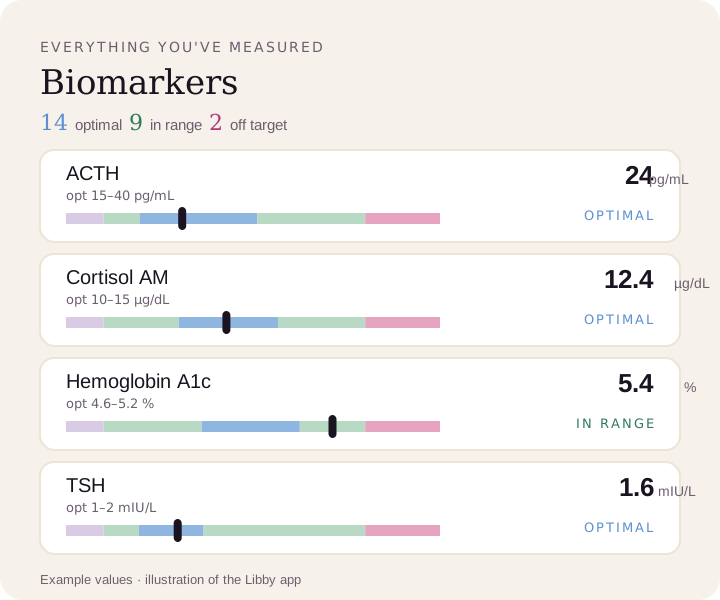
Compare your results to optimal ranges.
Upload a lab PDF or a photo of your report. Libby puts every marker on your lab's range and, where one exists, the optimal range, and tracks your trends over time.
View your ACTH ›