24-hour urine protein: collection, normal range, results
A 24-hour urine protein test adds up the protein you lose in a day. How to collect it, what's normal, the nephrotic range, and what it means in pregnancy.
A 24-hour urine protein test adds up all the protein you lose in your urine over one full day, and healthy kidneys let through less than 150 mg of it.12 It's the most complete way to count protein loss. Doctors use it to confirm and size protein in the urine, to follow kidney disease over time, and sometimes in pregnancy. The number is only as good as the collection, so the creatinine measured in the same jug matters almost as much as the protein.23
The short version
- Normal: under 150 mg per 24 hours. That's the international kidney guideline's normal category, and one large U.S. lab prints a range of 30–150.14
- 150–500 mg is moderately increased and over 500 mg is severely increased.1 Losses over 2,000 mg a day usually come from the kidney's filters (glomerular disease).2 Diabetes and high blood pressure are the most common causes of kidney disease.5
- Over 3,500 mg a day is the nephrotic range. With swelling, foamy urine or a low blood albumin, see a clinician promptly.36 In pregnancy, 300 mg or more after 20 weeks, with high blood pressure, is a sign of preeclampsia.7
- Check the creatinine in the same jug. Men usually pass 16–26 mg per kg of body weight a day and women 12–24 mg per kg. A total far below that means urine was missed, and the protein reads low too.2
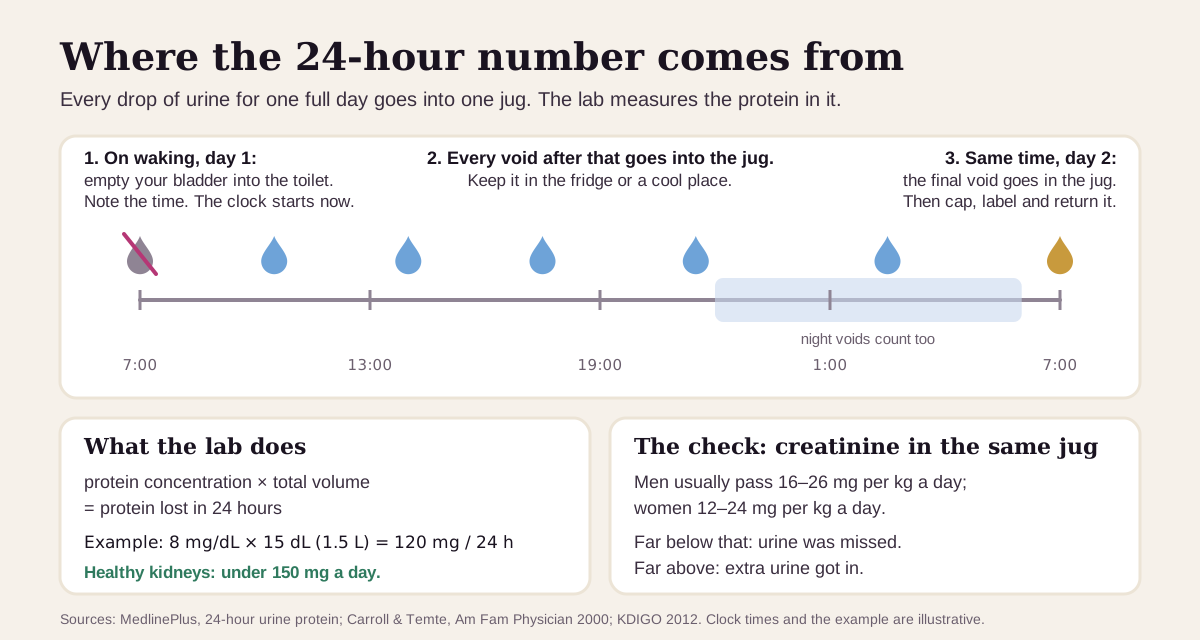
What a 24-hour urine protein test is
Your kidneys filter your blood through about a million tiny units. Each one has a filter, the glomerulus, and a tubule that takes back what your body needs.6 The filter holds back large proteins such as albumin, so healthy urine carries very little protein: under 150 mg a day.2 Of that, albumin is at most about 35 mg, and Tamm-Horsfall protein, which the kidney's own tubules make, is up to 50 mg. The rest is small proteins from the blood.4
Protein loss swings through the day with posture, activity and the time of day. A full-day collection averages those swings out.3 That's why kidney guidelines still treat an accurately timed 24-hour collection as the reference point, even though most people now start with a single-sample ratio.9
You're most likely to be asked for one:
- to measure protein after a urine test found some, and to see how much;2
- if you have a glomerular disease, before starting or stepping up immune-suppressing treatment, or when something changes. The KDIGO glomerular guideline recommends a 24-hour collection at exactly those moments;3
- in pregnancy, to check for preeclampsia, though practice is moving to single-sample ratios (more below).710
How to collect a 24-hour urine sample
The steps are simple. The hard part is catching every drop.82
- Day 1, when you get up: urinate into the toilet and write down the time. The clock starts now.
- For the next 24 hours: collect all of your urine in the container, including at night. Keep it capped, in the fridge or a cool place.
- Day 2, at the same time: urinate one last time into the jug. That final void belongs in the collection.
- Label and return it with your name and the date and time you started and finished.
The two classic mistakes push the result in opposite directions. Missing a void makes the total read low. Keeping day 1's first void, or collecting past 24 hours, adds extra urine and makes it read high.39 If you miss one, say so when you hand the jug in.
A few things can raise the result for a while, so mention them: strenuous exercise, dehydration, a urine infection, vaginal fluid in the sample, severe emotional stress, and an x-ray or scan with contrast dye in the 3 days before.8 Keep taking your medicines unless your clinician says otherwise, and give them your full list, supplements included.8
What's a normal 24-hour urine protein?
Under 150 mg per 24 hours is the standard answer. The exact line depends on who draws it:
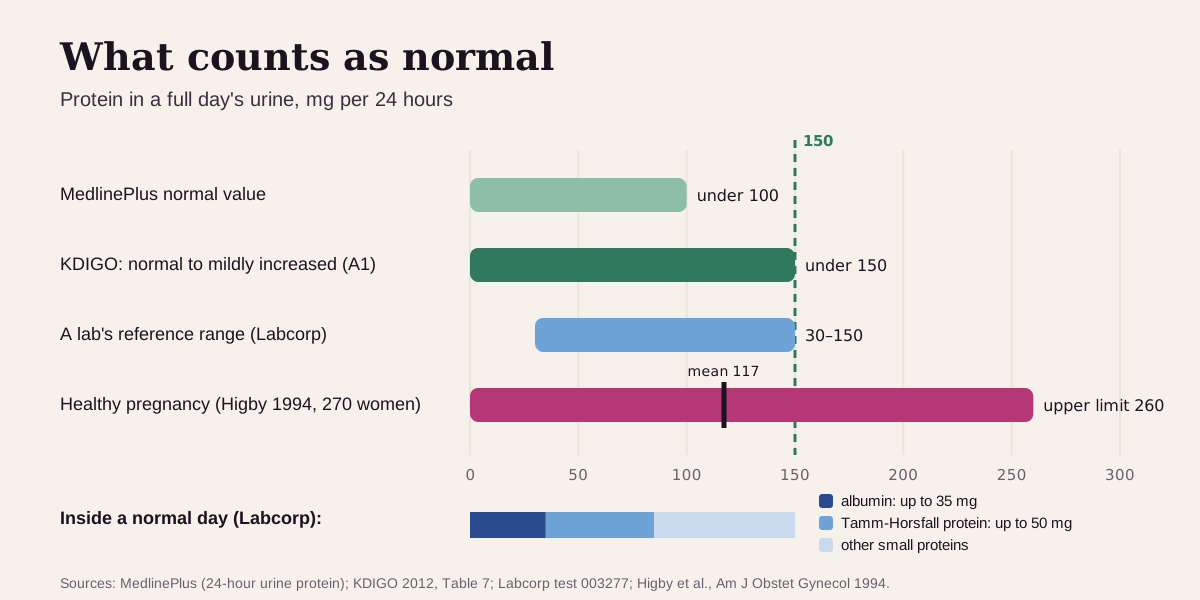
- KDIGO, the international kidney guideline group, calls a protein excretion rate under 150 mg per 24 hours "normal to mildly increased" (category A1).1
- Labcorp, a large U.S. commercial lab, prints a reference range of 30–150 mg/24 h.4
- MedlinePlus gives a stricter normal value: under 100 mg per day.8
- In pregnancy, normal runs higher. In 270 healthy pregnant women, the average was 117 mg a day and the upper limit 260 mg, and protein climbed after 20 weeks.11
Urine protein in healthy people also tends to rise with age, exercise and standing.4 Labs measure total urine protein with different methods, so results vary from lab to lab.9
"Optimal" 24-hour urine protein: the lines doctors use
For this test, lower is better down to the normal range. We found no functional-medicine or longevity target for 24-hour protein, and the Libby app shows your result against the range your lab prints on the report. What doctors do publish is a set of lines: where normal ends, when to act, and what to aim for once kidney disease is found. From strictest to loosest:
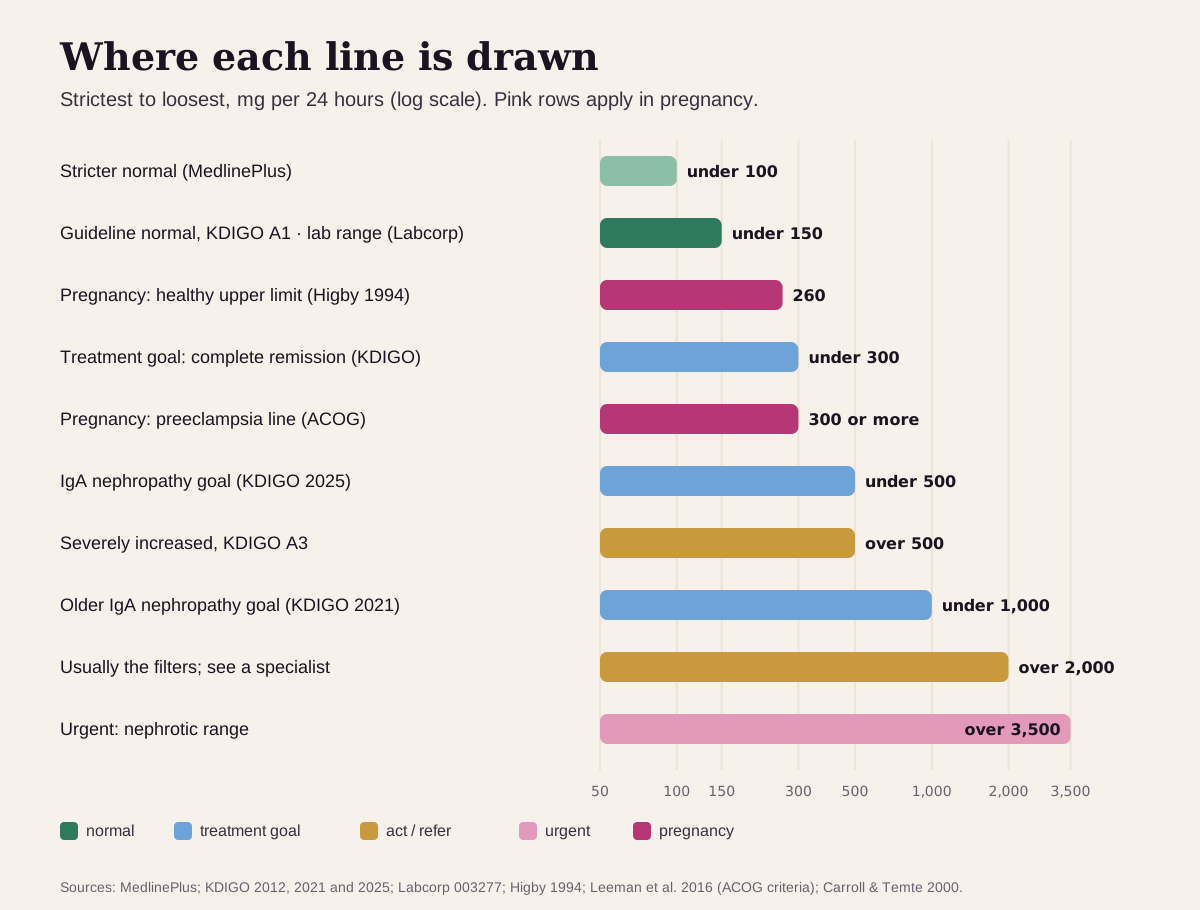
| Line | 24-hour protein | Who draws it |
|---|---|---|
| Stricter normal | under 100 mg | MedlinePlus8 |
| Guideline normal | under 150 mg | KDIGO category A1;1 Labcorp prints 30–1504 |
| Healthy pregnancy | up to 260 mg | The upper limit in 270 healthy pregnant women11 |
| Treatment goal: complete remission | under 300 mg | KDIGO glomerular disease guideline3 |
| Preeclampsia line (after 20 weeks, with new blood pressure of 140 systolic or 90 diastolic or higher) | 300 mg or more | ACOG's criteria, as summarized in American Family Physician7 |
| IgA nephropathy goal | under 500 mg, ideally under 300 | KDIGO 202512 |
| Severely increased | over 500 mg | KDIGO category A3.1 When it's a consistent finding with blood in the urine too, KDIGO suggests a kidney specialist9 |
| Older IgA nephropathy goal | under 1,000 mg | KDIGO 20213 |
| Usually glomerular | over 2,000 mg | Carroll & Temte, who advise seeing a kidney specialist2 |
| Urgent: nephrotic range | over 3,500 mg | With a low blood albumin, this is nephrotic syndrome. Get care promptly36 |
Why the lower targets matter:
- In 1,155 Chinese adults with IgA nephropathy, the average 24-hour protein during follow-up was the strongest predictor of kidney failure. Compared with under 0.5 g a day, the risk was 13.1 times higher at 0.5–1.0 g and 46.5 times higher above 1.0 g. The authors called under 1.0 g the basic goal and under 0.5 g the optimal one.13
- In 542 Toronto patients with the same disease, those who kept protein under 1 g a day lost kidney function 90% more slowly than the group average. Those who stayed above 3 g lost it 25 times faster than those under 1 g. People who started at 3 g or more and got below 1 g did about as well as those under 1 g all along.14
- In 348 people with membranous nephropathy and nephrotic-range protein, a partial remission sharply cut the risk of kidney failure (hazard ratio 0.08).15
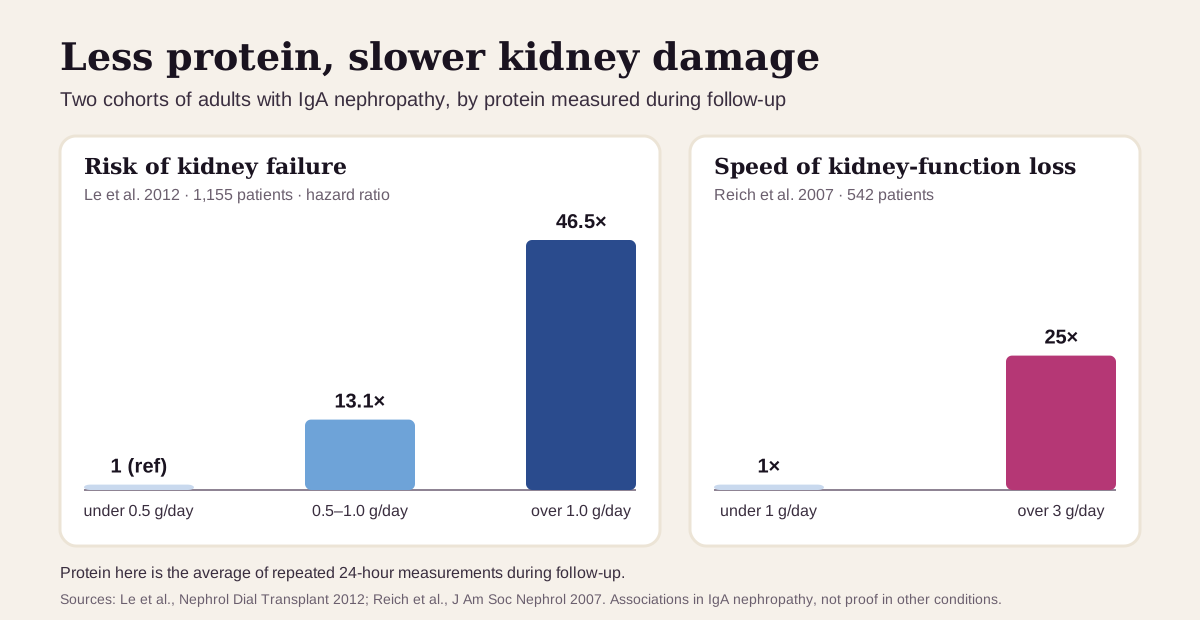
Keep these in perspective. The treatment goals come from people with glomerular disease, where cutting protein is part of the treatment. For everyone else, the goal is simpler: a result under 150 mg that stays there on repeat testing.1
What a high 24-hour urine protein usually means
First, check the collection. Look at the 24-hour creatinine on the same report. If it's far below what your weight predicts, the protein total is probably low too. If it's far above, the protein is probably high (more in Going deeper).216
Then look at the size. KDIGO sorts results into bands, and the size of the loss hints at where it comes from:12
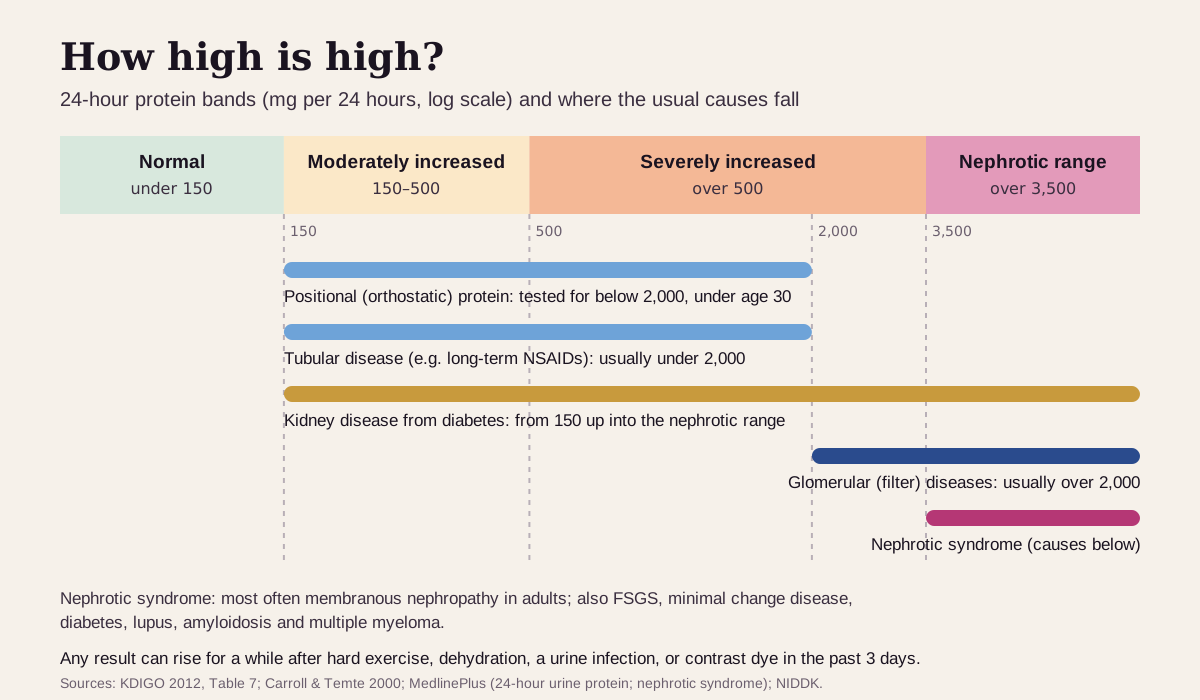
Mildly to moderately high (150–2,000 mg): often temporary, positional or tubular
The usual suspects:
- A temporary rise. Strenuous exercise, dehydration and a urine infection can all push the number up, and so can emotional stress and recent contrast dye.8 KDIGO advises confirming a high result and repeating any large change.9
- Kidney disease from diabetes or high blood pressure, the two most common causes of chronic kidney disease in adults.5
- Positional (orthostatic) protein. About 3–5% of teens and young adults lose extra protein only while upright. It's benign: people followed for 20 to 50 years kept normal kidney function. Clinicians test for it in people under 30 who lose less than 2 g a day, with a split day/night collection.2
- Tubular disease, where the tubules fail to take back small proteins. It usually stays under 2 g a day. Examples include kidney damage from high blood pressure (hypertensive nephrosclerosis) and from long-term NSAID pain relievers.2 Don't stop a prescribed medicine on your own. Bring your full list to your clinician.
Clearly high (over 2,000 mg): usually the kidney filters
Above about 2 g a day, the loss usually comes from the glomeruli, and Carroll and Temte advise seeing a kidney specialist.2 The glomerular diseases include IgA nephropathy, membranous nephropathy, focal segmental glomerulosclerosis (FSGS) and minimal change disease.3 KDIGO also suggests a specialist when 500 mg a day or more shows up consistently, with blood in the urine too.9
A less common route is overflow: the blood carries so much of a small protein that the tubules are swamped. Most often these are the light chains made in multiple myeloma, and a urine protein electrophoresis shows them.24
Nephrotic range (over 3,500 mg)
KDIGO defines nephrotic syndrome as protein over 3.5 g a day plus a low blood albumin (under 30 g/L, or 3.0 g/dL), often with high cholesterol and swelling.3 In adults, membranous nephropathy is the most common cause. Diabetes, lupus, amyloidosis, multiple myeloma, infections and some medicines can cause it too.17 It raises the risk of blood clots and infections, and it can lead to kidney failure.6 Nephrotic-range protein can also show up with a normal blood albumin, for example in IgA nephropathy.3
In pregnancy
After 20 weeks, a 24-hour protein of 300 mg or more with new high blood pressure (a top number of 140 or more, or a bottom number of 90 or more, on two readings at least 4 hours apart) meets ACOG's criteria for preeclampsia. A protein-to-creatinine ratio of 0.3 or more counts too. Preeclampsia can also be diagnosed without protein when a severe feature is present, and the amount of protein tracks poorly with how severe it gets.7
The 24-hour collection is fading in pregnancy care. In 198 pregnant women with high blood pressure, 13% to 54% of collections were inaccurate, depending on the creatinine cutoff used.16 The UK's NICE guideline advises against routine 24-hour collections in pregnancy and uses a protein-to-creatinine ratio instead.10
Get prompt care if high urine protein comes with swelling of your legs, ankles, belly or around your eyes, foamy urine, or fast weight gain from fluid.6 If you're pregnant or recently gave birth, contact your provider right away for a headache that won't go away, vision changes, pain under your right ribs, trouble breathing, or new swelling of your hands and face.18
24-hour urine protein reads best next to its neighbors
A 24-hour protein result is easier to read with four other numbers: the creatinine from the same jug, and three blood tests.
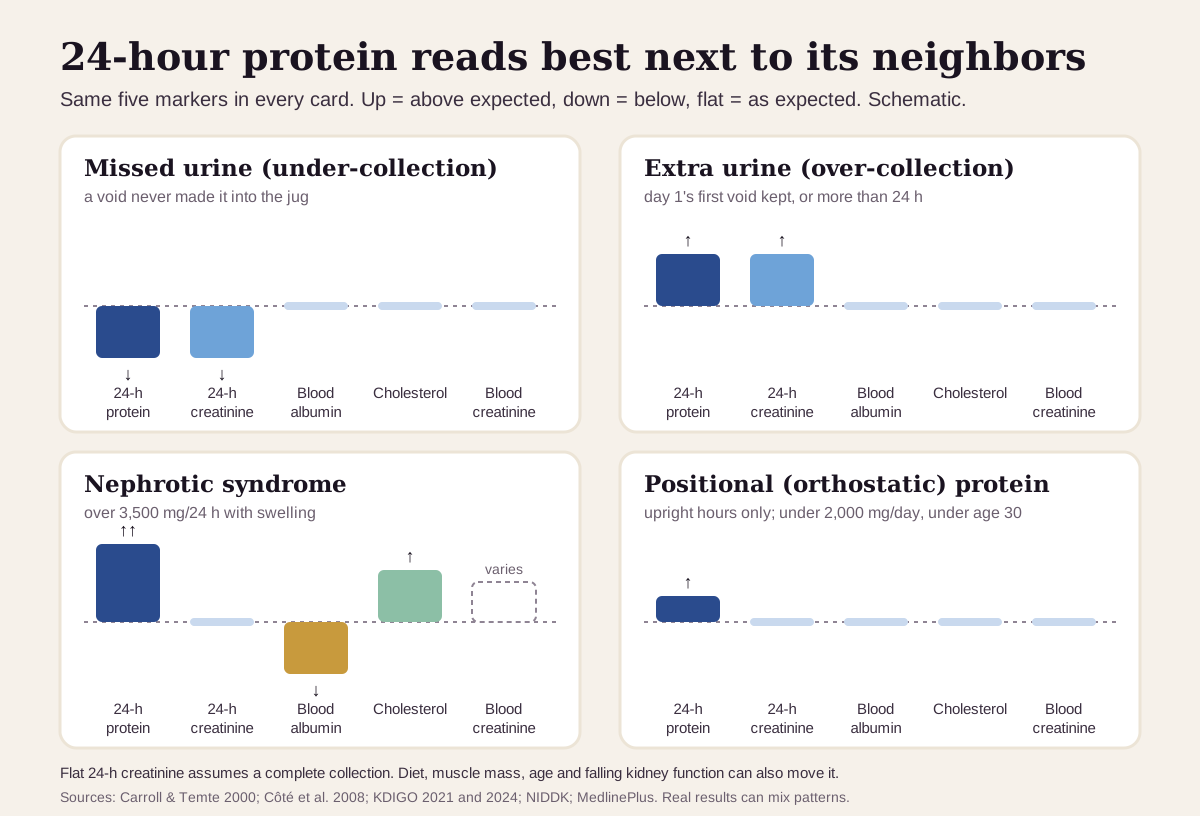
| If you see… | It often points to… |
|---|---|
| 24-hour creatinine far below what your weight predicts | most often missed urine, which leaves protein out of the jug too216 |
| 24-hour creatinine far above what your weight predicts | often extra urine, such as day 1's first void or more than 24 hours, which adds protein too29 |
| Protein over 3,500 mg, low blood albumin, high cholesterol, swelling | nephrotic syndrome36 |
| Protein under 2,000 mg in someone under 30, with normal kidney function | possibly positional protein. A split day/night collection sorts it out2 |
| Protein of 500 mg or more on repeat tests, with blood in the urine | a pattern KDIGO flags for a kidney specialist9 |
| Protein of 300 mg or more after 20 weeks of pregnancy, with new blood pressure of 140 systolic or 90 diastolic or higher on two readings | preeclampsia7 |
| Protein creeping up along with a high 24-hour urine sodium | a salty diet may be adding to it. The same jug can measure sodium3 |
How fast 24-hour urine protein changes
Within a day, a lot. Protein loss swings with posture, activity and the time of day. Urine made overnight, lying down, carries less: a first-morning sample tends to underestimate the 24-hour total by about 20%.3 The full-day collection is there to average that out.
Between collections, more than you'd think. In pregnant women with repeat 24-hour collections a median of 11 days apart, the creatinine totals differed by a median of 14.4%, and 1 in 4 differed by 25% or more. That's more than lab and body variation explain, so it points to collection error.16
With treatment, by percentage. Kidney specialists judge treatment by how far protein falls. KDIGO counts a fall of more than 30% as a sign of protection from kidney failure. A partial remission is a fall of at least 50% to under 3.5 g a day, and a complete remission is under 0.3 g.3
What that means in practice:
- Collect on an ordinary day. Skip a hard workout, stay normally hydrated, and mention a fever, a urine infection or recent contrast dye.8
- Use the same lab when you can. Total urine protein methods differ, so results vary between labs.9
- Trends beat snapshots. In both IgA nephropathy cohorts above, protein measured across follow-up was the strongest predictor of how kidney function fared.1314
Going deeper: checking the jug
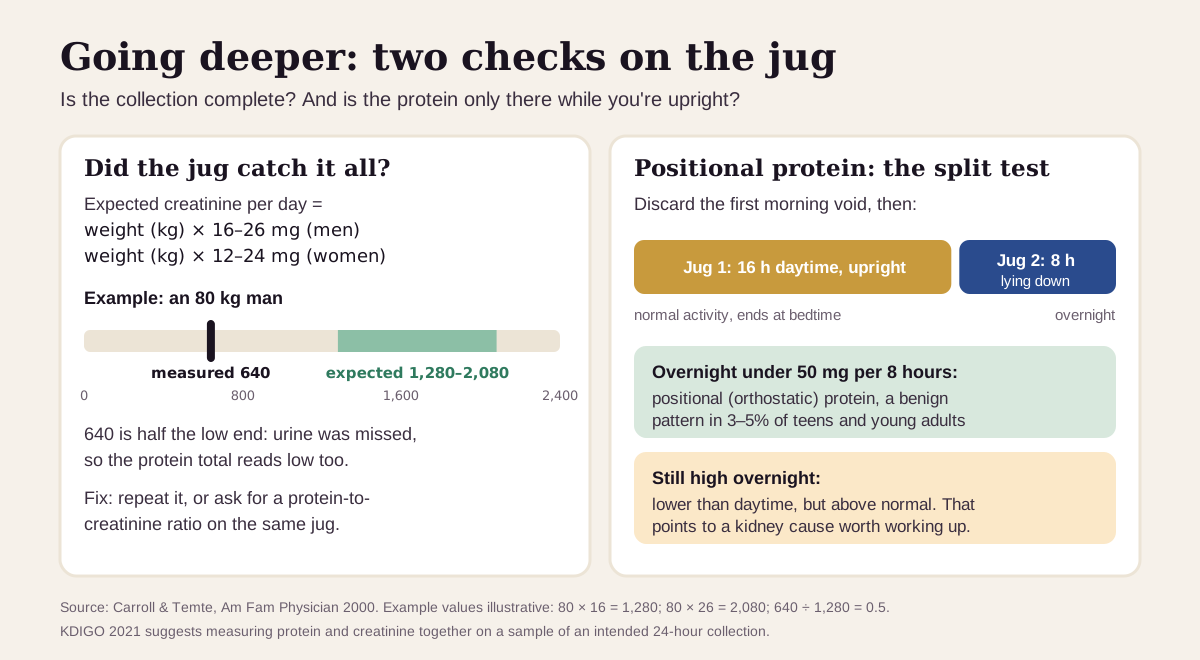
The creatinine check. Creatinine comes from muscle and leaves in the urine at a fairly steady rate, so a full collection should hold a predictable amount. Carroll and Temte give 16–26 mg per kg of body weight a day for young and middle-aged men and 12–24 mg per kg for women, and less in older or malnourished people.2 MedlinePlus gives similar ranges: 14–26 for men and 11–20 for women.19 An 80 kg man should pass roughly 1,280–2,080 mg. If his jug holds 640 mg, about half his urine is likely missing, and the protein with it.
Collection errors are common. In the pilot for the African American Study of Kidney Disease, a quarter of 24-hour creatinine clearances ran at least 18% below measured kidney function, and another quarter at least 23% above it. KDIGO calls timed collections highly prone to error from under- or over-collection.9
The rescue: a ratio from the same jug. Creatinine leaves at a steady rate, so dividing protein by creatinine corrects for how concentrated or dilute the urine is.9 KDIGO's glomerular guideline calls measuring both on a sample of an "intended" 24-hour collection a reasonable compromise.3 In grams per gram, the ratio roughly equals grams of protein per day, because the average person passes about 1 g of creatinine a day.92
The split test for positional protein. Discard the first morning void. Collect a 16-hour daytime jug during normal activity, finishing just before bed, then a separate 8-hour overnight jug. In positional protein the overnight jug is normal: under 50 mg per 8 hours. In true kidney disease the overnight amount drops but stays above that.2
What the protein is made of. In glomerular disease, albumin makes up about 65% of urine protein on average.3 When total protein is high but albumin is a small share, think tubular or overflow protein.2
Creatinine clearance. The same jug plus a blood creatinine gives a measured creatinine clearance, an estimate of how well your kidneys filter.20
Questions worth asking
- Was my 24-hour creatinine in the expected range for my weight, so the collection counts?
- How does this result compare with my last one, from the same lab?
- Is the protein mostly albumin, or should we look for other proteins?
- What are my blood albumin, cholesterol and eGFR?
- Should I see a kidney specialist, and what number are we aiming for?
- If I'm pregnant, would a protein-to-creatinine ratio work instead?
FAQ
What is a normal 24-hour urine protein? Under 150 mg per 24 hours by the KDIGO guideline. One large lab prints 30–150 mg, and MedlinePlus uses a stricter under 100 mg.148
How do I collect a 24-hour urine sample? Flush your first urine on day 1 and note the time. Collect every drop for the next 24 hours in the jug, kept cold, and add your first urine of day 2 at the same time.8
What if I missed a void? Tell the lab or your clinician when you hand it in. A missed void makes the total read low, and the 24-hour creatinine usually shows it.216
What does over 3.5 grams of protein in 24 hours mean? That's the nephrotic range. With a low blood albumin, it defines nephrotic syndrome, which needs prompt care.36
This guide is for education. It can't diagnose you or replace care from a clinician who knows your history.
Footnotes
-
Kidney Disease: Improving Global Outcomes (KDIGO) CKD Work Group. KDIGO 2012 Clinical Practice Guideline for the Evaluation and Management of Chronic Kidney Disease. Kidney Int Suppl. 2013;3(1):1–150. Table 7 sets the protein excretion categories: under 150, 150–500 and over 500 mg per 24 hours. KDIGO ↩ ↩2 ↩3 ↩4 ↩5 ↩6 ↩7 ↩8 ↩9 ↩10 ↩11 ↩12 ↩13
-
Carroll MF, Temte JL. Proteinuria in adults: a diagnostic approach. Am Fam Physician. 2000;62(6):1333–1340. The primary-care review behind the collection steps, the creatinine check (men 16–26, women 12–24 mg/kg a day), the 150 mg and 2 g lines, tubular and overflow protein, orthostatic proteinuria and the split collection. AAFP · PubMed ↩ ↩2 ↩3 ↩4 ↩5 ↩6 ↩7 ↩8 ↩9 ↩10 ↩11 ↩12 ↩13 ↩14 ↩15 ↩16 ↩17 ↩18 ↩19 ↩20 ↩21 ↩22 ↩23 ↩24 ↩25 ↩26 ↩27 ↩28
-
Kidney Disease: Improving Global Outcomes (KDIGO) Glomerular Diseases Work Group. KDIGO 2021 Clinical Practice Guideline for the Management of Glomerular Diseases. Kidney Int. 2021;100(4S):S1–S276. When to collect 24-hour urine, the 20% first-morning underestimate, remission definitions, the nephrotic syndrome definition, urine sodium, and the under-1 g IgA nephropathy goal. PubMed ↩ ↩2 ↩3 ↩4 ↩5 ↩6 ↩7 ↩8 ↩9 ↩10 ↩11 ↩12 ↩13 ↩14 ↩15 ↩16 ↩17 ↩18 ↩19 ↩20
-
Labcorp. Protein, Total, Quantitative, 24-Hour Urine (test 003277). A commercial laboratory's published test page: the reference range of 30–150 mg/24 hours, the normal make-up of urine protein, collection instructions, and urine electrophoresis for myeloma. labcorp.com ↩ ↩2 ↩3 ↩4 ↩5 ↩6 ↩7 ↩8 ↩9
-
National Institute of Diabetes and Digestive and Kidney Diseases. Causes of Chronic Kidney Disease. NIH. Diabetes and high blood pressure are the most common causes in adults. NIDDK ↩ ↩2 ↩3
-
National Institute of Diabetes and Digestive and Kidney Diseases. Nephrotic Syndrome in Adults. NIH. Kidney structure, the features and symptoms of nephrotic syndrome, and its complications. NIDDK ↩ ↩2 ↩3 ↩4 ↩5 ↩6 ↩7 ↩8
-
Leeman L, Dresang LT, Fontaine P. Hypertensive Disorders of Pregnancy. Am Fam Physician. 2016;93(2):121–127. Summarizes ACOG's criteria: 300 mg or more of protein in a 24-hour urine, or a protein/creatinine ratio of 0.3 or more, with new hypertension after 20 weeks. AAFP · PubMed ↩ ↩2 ↩3 ↩4 ↩5 ↩6
-
National Library of Medicine. 24-hour urine protein. MedlinePlus Medical Encyclopedia. Collection steps, what can affect the result, and a normal value under 100 mg per day. MedlinePlus ↩ ↩2 ↩3 ↩4 ↩5 ↩6 ↩7 ↩8 ↩9 ↩10 ↩11 ↩12 ↩13
-
Kidney Disease: Improving Global Outcomes (KDIGO) CKD Work Group. KDIGO 2024 Clinical Practice Guideline for the Evaluation and Management of Chronic Kidney Disease. Kidney Int. 2024;105(4S):S117–S314. The timed 24-hour specimen as the reference point, collection error (the AASK pilot), creatinine excretion of about 1 g a day, between-lab variation, confirming results, and referral criteria. PubMed ↩ ↩2 ↩3 ↩4 ↩5 ↩6 ↩7 ↩8 ↩9 ↩10 ↩11 ↩12 ↩13 ↩14
-
National Institute for Health and Care Excellence. Hypertension in pregnancy: diagnosis and management (NG133). 2019. Recommends against routine 24-hour urine collection to measure protein in pregnancy. NICE ↩ ↩2
-
Higby K, Suiter CR, Phelps JY, Siler-Khodr T, Langer O. Normal values of urinary albumin and total protein excretion during pregnancy. Am J Obstet Gynecol. 1994;171(4):984–989. 270 healthy pregnant women; mean 116.9 mg and upper limit 259.4 mg of protein a day. PubMed ↩ ↩2 ↩3 ↩4
-
Floege J, Barratt J, Cook HT, et al. Executive summary of the KDIGO 2025 Clinical Practice Guideline for the Management of Immunoglobulin A Nephropathy (IgAN) and Immunoglobulin A Vasculitis (IgAV). Kidney Int. 2025;108(4):548–554. The stricter goal of under 0.5 g a day, ideally under 0.3 g. PubMed ↩ ↩2
-
Le W, Liang S, Hu Y, et al. Long-term renal survival and related risk factors in patients with IgA nephropathy: results from a cohort of 1155 cases in a Chinese adult population. Nephrol Dial Transplant. 2012;27(4):1479–1485. Hazard ratios by time-averaged 24-hour protein. PubMed ↩ ↩2 ↩3
-
Reich HN, Troyanov S, Scholey JW, Cattran DC. Remission of proteinuria improves prognosis in IgA nephropathy. J Am Soc Nephrol. 2007;18(12):3177–3183. 542 patients in the Toronto Glomerulonephritis Registry. PubMed ↩ ↩2 ↩3
-
Troyanov S, Wall CA, Miller JA, Scholey JW, Cattran DC. Idiopathic membranous nephropathy: definition and relevance of a partial remission. Kidney Int. 2004;66(3):1199–1205. 348 nephrotic patients from the Toronto registry. PubMed ↩
-
Côté AM, Firoz T, Mattman A, Lam EM, von Dadelszen P, Magee LA. The 24-hour urine collection: gold standard or historical practice? Am J Obstet Gynecol. 2008;199(6):625.e1–625.e6. 198 pregnant women with a hypertensive disorder; 13–54% of collections inaccurate by creatinine, and repeat collections differing by a median of 14.4%. PubMed ↩ ↩2 ↩3 ↩4 ↩5 ↩6
-
National Library of Medicine. Nephrotic syndrome. MedlinePlus Medical Encyclopedia. Membranous glomerulonephritis is the most common cause in adults; other causes. MedlinePlus ↩ ↩2
-
National Library of Medicine. Preeclampsia. MedlinePlus Medical Encyclopedia. Warning symptoms during pregnancy and after delivery. MedlinePlus ↩
-
National Library of Medicine. Creatinine urine test. MedlinePlus Medical Encyclopedia. Normal 24-hour creatinine of 14–26 mg per kg a day for men and 11–20 for women. MedlinePlus ↩ ↩2
-
National Library of Medicine. Creatinine clearance test. MedlinePlus Medical Encyclopedia. How a 24-hour urine and a blood test together estimate kidney filtering. MedlinePlus ↩
Educational content, not medical advice. Libby is a personal record tool, not a medical service — it doesn't diagnose, treat, or prescribe. Reference ranges vary by lab and by person. Talk to a qualified healthcare professional about your results.
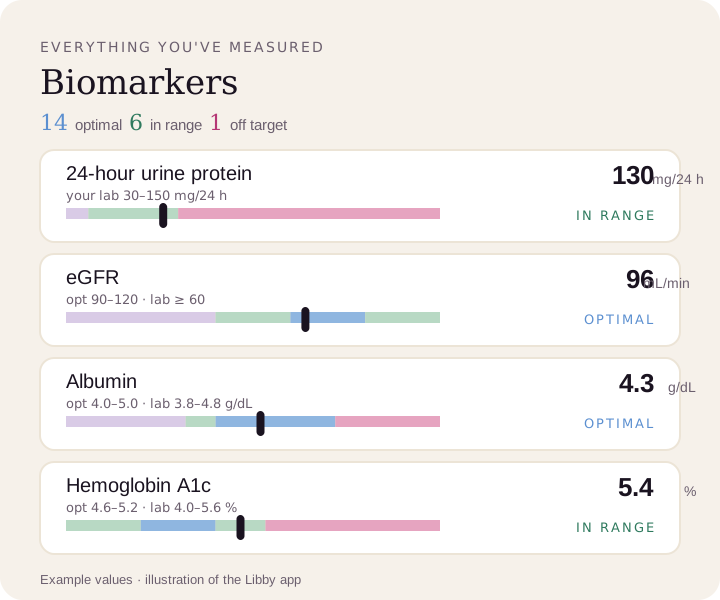
See every result against your lab's range.
Upload a lab PDF or a photo of your report. Libby shows every result next to your lab's range, flags what's off, and tracks each marker over time.
View your 24-hour urine protein ›