VWF activity test: low results, types and the 0.7 ratio
VWF activity shows how well von Willebrand factor grips platelets: the normal range, the activity-to-antigen ratio, the four test types and what low means.
Von Willebrand factor (VWF) activity measures how well your VWF does its job: grabbing platelets and holding them where a blood vessel is injured. It's read next to VWF antigen, which counts how much VWF you have. When activity falls further than the amount, the protein is there but gripping poorly, and the ratio of activity to antigen is what sorts the types of von Willebrand disease (VWD), the most common inherited bleeding disorder.1
The short version
- Normal: Labcorp's activity test reads 50–150%, and 50% is the usual lower limit.21
- Low activity usually means one of three things: too little VWF (type 1 VWD or "low VWF"), VWF that works poorly (type 2), or VWF worn down by a tight heart valve, a heart pump or a very high platelet count (acquired von Willebrand syndrome).34
- The ratio is the key number. Activity divided by antigen under 0.7 points toward type 2 or acquired disease, the cutoff the 2021 international guideline chose over the older 0.5.1
- Urgent: bleeding that won't stop, black or bloody stools, or vomit that looks like coffee grounds needs emergency care, whatever your number.5
What VWF activity is
VWF is a large, sticky protein made mostly by the cells that line your blood vessels.3 It has two jobs. It glues platelets to the wall of an injured vessel, and it carries clotting factor VIII, protecting it in the bloodstream.1
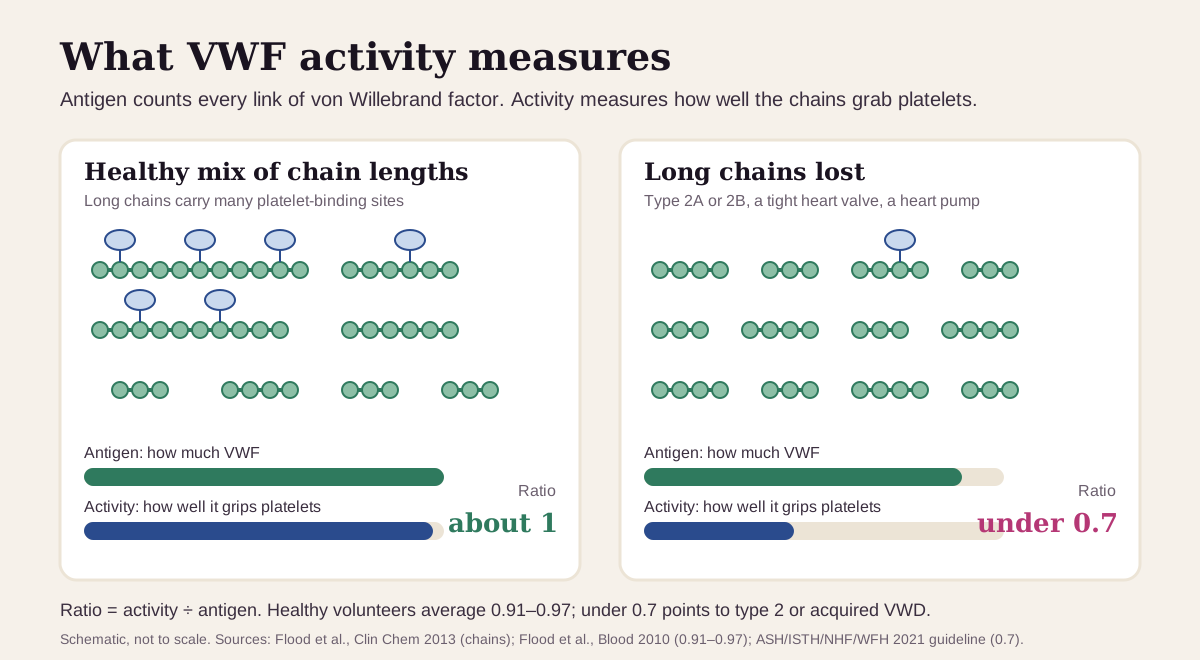
VWF circulates as chains. Each link is a 225-kilodalton unit, and the longest chains weigh more than 20,000 kilodaltons.7 The long chains do most of the gripping: they carry many platelet-binding sites, so losing them cuts activity even when the total amount of VWF looks fine.73
That's why labs run two tests. VWF antigen counts all the VWF, working or not. VWF activity measures how much of it binds the platelet's VWF receptor, called GPIb.6 The 2021 guideline from the American Society of Hematology, the International Society on Thrombosis and Haemostasis, the National Hemophilia Foundation and the World Federation of Hemophilia (ASH/ISTH/NHF/WFH) names three blood tests for VWD: VWF antigen, VWF activity and factor VIII.1
VWD shows up as heavy periods, nosebleeds, easy bruising and bleeding after dental work, childbirth or surgery. Estimates of how many people have it run from 1 in 100 to 1 in 10,000; about 1 in 1,000 need medical care for bleeding.1
What's a normal VWF activity?
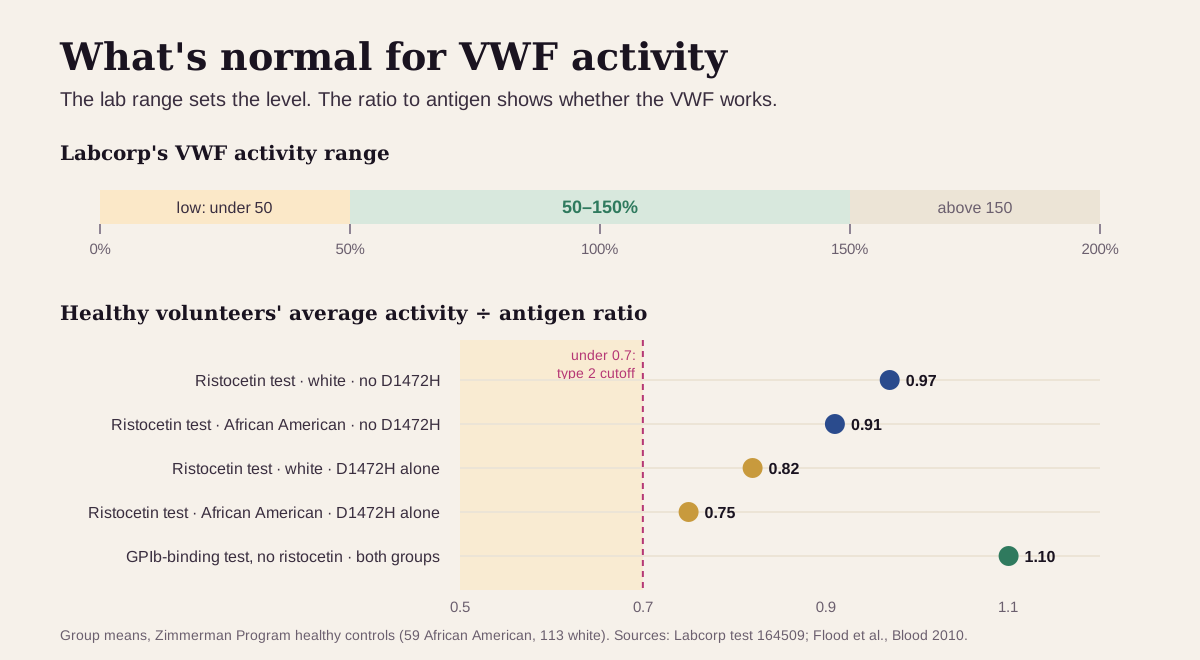
Labcorp, a large commercial lab, prints 50% to 150% for its activity test.2 Ranges vary a little between labs and between the four kinds of activity test (next section), so start with the range printed on your report.
The more telling "normal" is the ratio. In people whose VWF works normally, activity and antigen move together, so activity ÷ antigen sits above 0.7.6 In healthy volunteers in the U.S. Zimmerman Program, the average ratio was 0.97 in white controls and 0.91 in African American controls without a common VWF variant called D1472H.8
Two things push healthy people's VWF around. People with blood type O run lower: Labcorp quotes average VWF levels of about 75% for type O versus 106% for type A.2 And VWF rises with anxiety, exercise, infection and pregnancy.6 Our VWF antigen guide covers those swings and when to repeat a borderline test.
Four tests called "VWF activity"
"VWF activity" on a report can mean any of four different tests. They agree most of the time, and they disagree in ways that matter.91
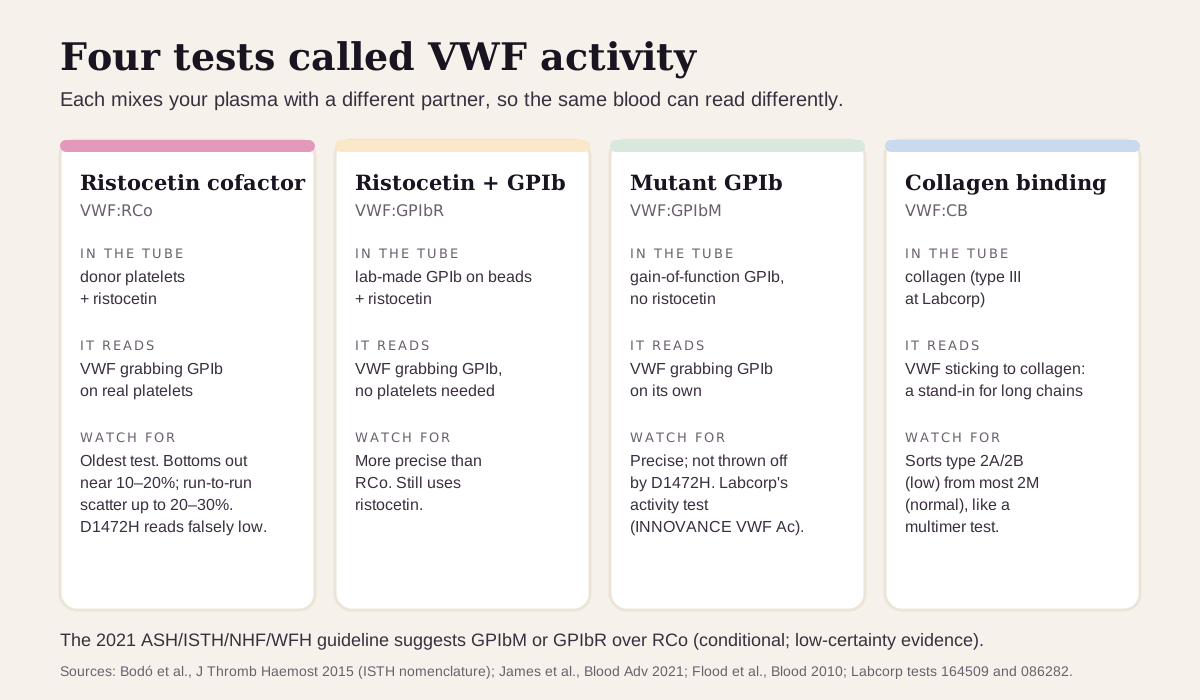
- Ristocetin cofactor (VWF:RCo) is the original test. It mixes your plasma with donor platelets and ristocetin, an old antibiotic that makes VWF grab GPIb. Older semi-automated versions bottom out at about 10–20%, and their run-to-run scatter (coefficient of variation) reaches 20–30%.9
- Ristocetin-triggered GPIb binding (VWF:GPIbR) keeps the ristocetin but swaps the platelets for a lab-made piece of GPIb on beads or plates, which is more precise.9
- Mutant GPIb binding (VWF:GPIbM) uses a GPIb fragment with two gain-of-function mutations, so VWF binds it with no ristocetin at all.9 This is Labcorp's activity test (INNOVANCE VWF Ac).2
- Collagen binding (VWF:CB) measures how well VWF sticks to collagen, the protein exposed in a damaged vessel wall. It's a stand-in for the long chains, and the guideline accepts it, like a multimer test, for sorting type 2.1
The 2021 guideline suggests the newer GPIbM and GPIbR tests over the ristocetin cofactor test. They're more reproducible, and ristocetin can misread VWF in some healthy people. The recommendation is conditional, based on low-certainty evidence.1
The D1472H artifact. The D1472H variant changes one building block in VWF's platelet-binding A1 region, near spots linked to ristocetin. In the Zimmerman Program's healthy volunteers, 37 of 59 African American and 22 of 113 white controls carried it.8 Those with D1472H alone averaged a ristocetin cofactor ratio of 0.75 (African American) and 0.82 (white), against 0.91 and 0.97 without it. Sometimes it fell low enough to suggest type 2M VWD. On a GPIb-binding test that uses no ristocetin, both groups averaged 1.10, and D1472H made no significant difference.8 In people with type 1 VWD, D1472H lowered the ratio without raising bleeding scores.10 The guideline flags this as a risk of overdiagnosis in people of African descent tested with the ristocetin cofactor assay.1
"Optimal" VWF activity: the targets are for surgery and childbirth
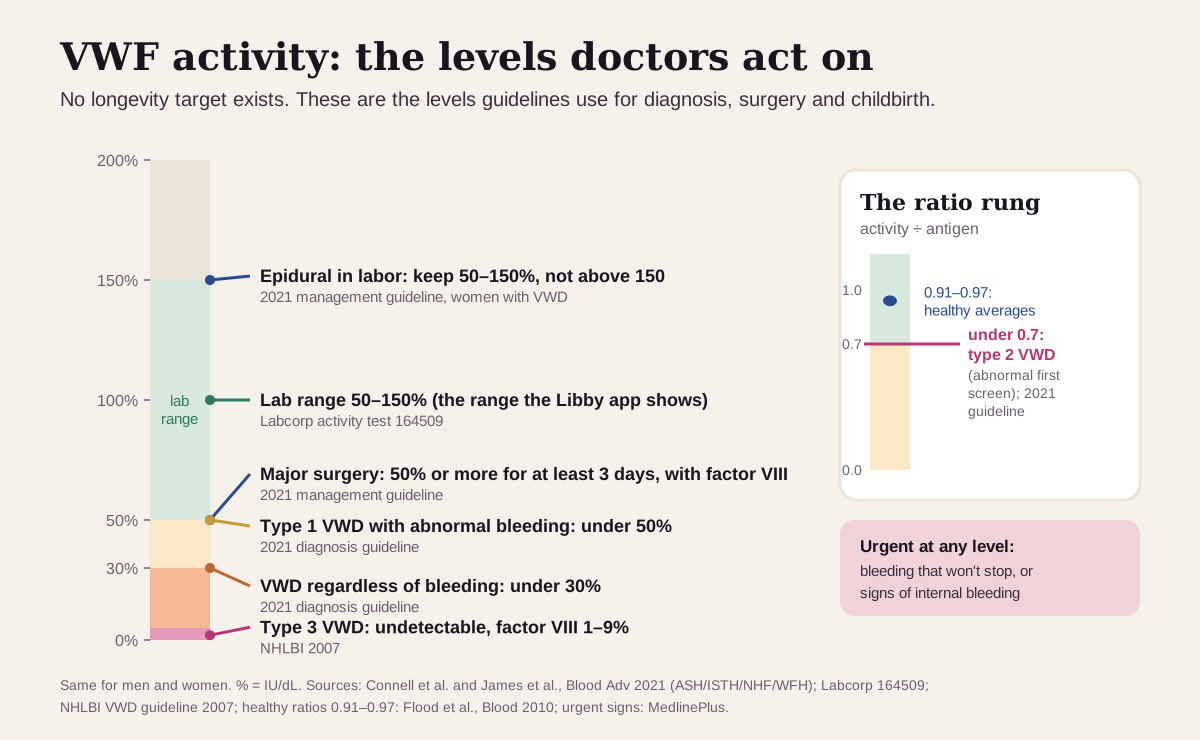
With many markers, longevity clinics publish a stricter "optimal" range. For VWF activity there's none: Superpower's published biomarker list, for one, leaves it out, and the Libby app shows your VWF activity against your lab's range, with no separate optimal band. What exists instead is a ladder of levels that doctors act on. They're the same for men and women.
| Level | VWF activity | Who uses it |
|---|---|---|
| Epidural during labor | keep 50–150% (rather than above 150) | 2021 management guideline, for women with VWD; at least 50% while the epidural is in and for 6 hours after11 |
| Lab range (the range the Libby app shows) | 50–150% | Labcorp's activity test2 |
| Major surgery | 50% or more for at least 3 days, with factor VIII at 50% too | 2021 management guideline11 |
| Type 1 VWD, with abnormal bleeding | under 50% | 2021 diagnosis guideline1 |
| VWD, regardless of bleeding | under 30% | 2021 diagnosis guideline1 |
| Type 2 VWD | activity ÷ antigen under 0.7 | 2021 diagnosis guideline, in people with an abnormal first screen1 |
| Type 3 VWD | undetectable, with factor VIII 1–9% | NHLBI3 |
| Urgent | bleeding that won't stop, or signs of internal bleeding | Get emergency care5 |
The two diagnostic cutoffs apply to antigen and activity alike; the VWF antigen guide explains how they were set.
Why the 0.7 ratio cutoff won:
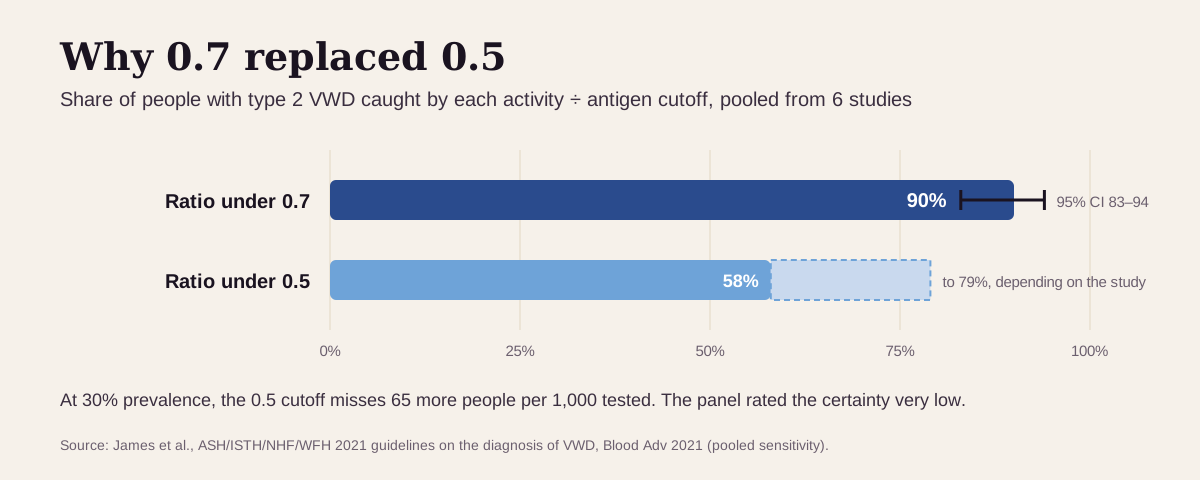
- Across 6 studies, a cutoff of 0.7 caught 90% of people with type 2 VWD (95% CI 83–94%), versus 58–79% for the older 0.5.1
- In a group where 30% have the disease, the 0.5 cutoff would miss 65 more people per 1,000 tested. The panel judged a missed diagnosis worse than a false alarm, because multimer or collagen-binding tests sort out false alarms next.1
Keep these numbers in perspective. The surgery and childbirth targets rest on very low-certainty evidence; the surgery target comes from seven case series.11 And higher is no goal in itself: for people at higher risk of clots, the guideline suggests avoiding VWF and factor VIII above 150% for long stretches combined with long use of tranexamic acid, a clot-protecting medicine.11
What a low VWF activity usually means
Read activity next to antigen first. Where the pair lands tells you which family of causes to think about.16
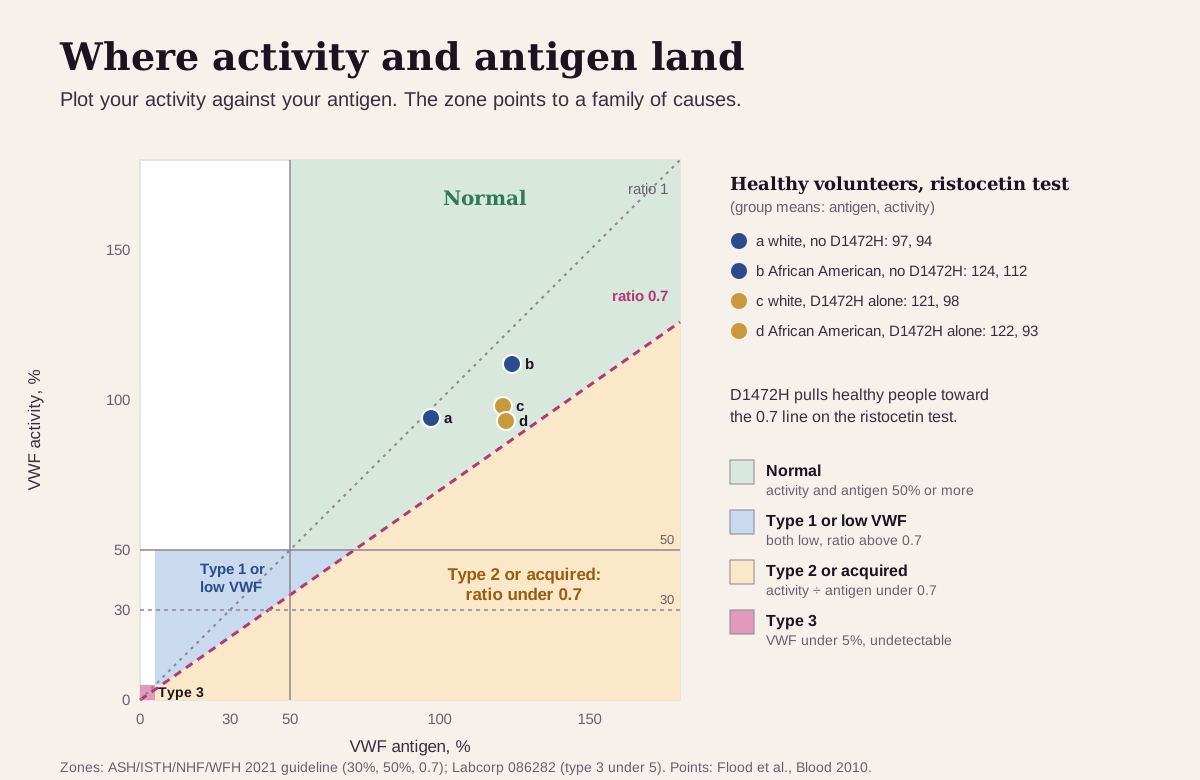
Both low, ratio above 0.7: too little VWF
- Low VWF and type 1 VWD. The VWF you have works normally; there's just less of it. Type 1 is about 75% of people with symptoms of VWD, and factor VIII is usually normal or mildly low.3 About 15–20% of type 1 comes from VWF being cleared too fast (type 1C).1
- Blood type O and a borderline single test belong here too; the antigen guide covers them.
Activity lower than antigen, ratio under 0.7: VWF that works poorly
- Acquired von Willebrand syndrome. Usually a new bleeding tendency in an
adult with no family history.4 Common settings:
- Severe aortic stenosis, a narrowed heart valve. The fast flow through the valve shears the long chains or exposes them to cutting by an enzyme, ADAMTS13.4 In 42 people with severe stenosis, 67–92% had these changes and 21% had skin or mucous-membrane bleeding.12
- A left ventricular assist device (LVAD), a heart pump. All 26 of 26 people on one pump lost their long chains.13
- A very high platelet count. In essential thrombocythemia, a marrow disorder, 55% of 116 patients developed it; their median platelet count was 920 × 10⁹/L.14
- Blood cancers and antibody disorders (MGUS, myeloma, chronic lymphocytic leukemia, lupus). Lymphoproliferative disorders were behind 48% of 211 cases in the ISTH registry.4
- Type 2A, 2B and 2M VWD. Inherited VWF that works poorly. In 2A the long chains are missing; in 2B VWF is over-sticky and drags platelets out of circulation, so the platelet count drops, especially with surgery, pregnancy or stress; in 2M the chains are full length but grip poorly.3
- A ristocetin cofactor test in a D1472H carrier. A ratio a little under normal, a normal bleeding history and a normal GPIbM test point to the artifact, not disease.810
Almost none: type 3
Type 3 VWD is rare (about 1 in 250,000 to 1 in 1,000,000). VWF is undetectable and factor VIII is very low, so bleeding into joints can look like hemophilia.311
Get emergency care for bleeding that won't stop, or signs of internal bleeding: black, maroon or bloody stools, vomit that's red or looks like coffee grounds, dizziness, a racing pulse, or vaginal bleeding much heavier than usual.5 If you have VWD, tell every surgeon, dentist and emergency team, and check with your clinician before taking aspirin or other NSAID pain relievers, which can make bleeding worse.15
VWF activity reads best next to its neighbors
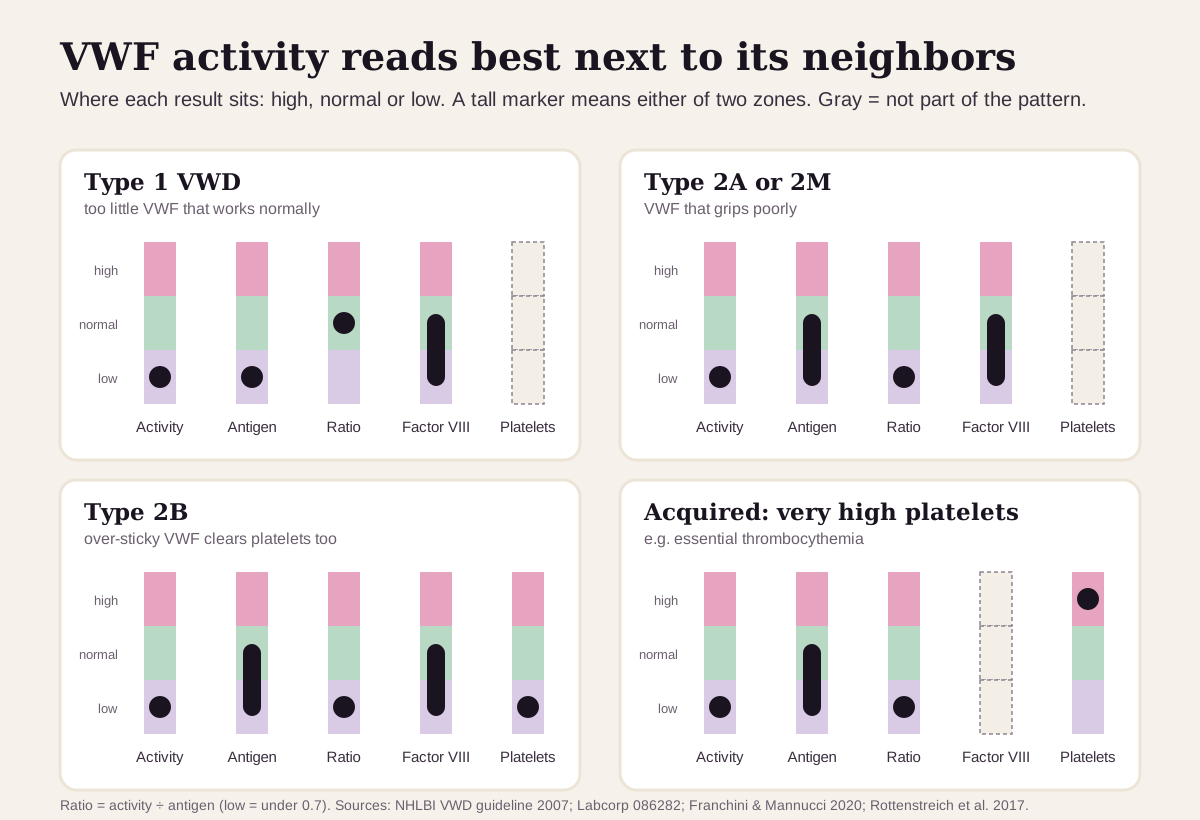
VWF activity is ordered as part of a panel, and the pattern across it says far more than activity alone. The five results worth reading together are activity, antigen, their ratio, factor VIII and the platelet count.61
| If you see… | It often points to… |
|---|---|
| Activity and antigen both low, ratio above 0.7 | type 1 VWD or low VWF; factor VIII normal or mildly low36 |
| Activity low, antigen normal or mildly low, ratio under 0.7 | type 2A or 2M; a multimer or collagen-binding test tells them apart16 |
| The same, plus a low platelet count | type 2B, where over-sticky VWF clears platelets too36 |
| Ratio under 0.7 with a narrowed heart valve, a heart pump or a very high platelet count | acquired von Willebrand syndrome414 |
| Activity and antigen normal, factor VIII very low | type 2N VWD (factor VIII often under 10%) or hemophilia A36 |
| VWF undetectable, factor VIII 1–9% | type 3 VWD3 |
| A mildly low ratio on a ristocetin test, no bleeding history | the D1472H artifact; a GPIbM test reads normally89 |
A low factor VIII lengthens the aPTT clotting test, and a long aPTT is one reason people get sent for VWF testing;41 see our aPTT guide. For the platelet side of the pattern, see the platelet count guide.
How fast VWF activity changes
VWF turns over in about half a day. Its half-life in the blood is about 12 hours (range 9–15).3 So levels can move within a day, which is why the guideline asks for testing when you're at your usual baseline health, not after a bleed or an injury or during pregnancy.1
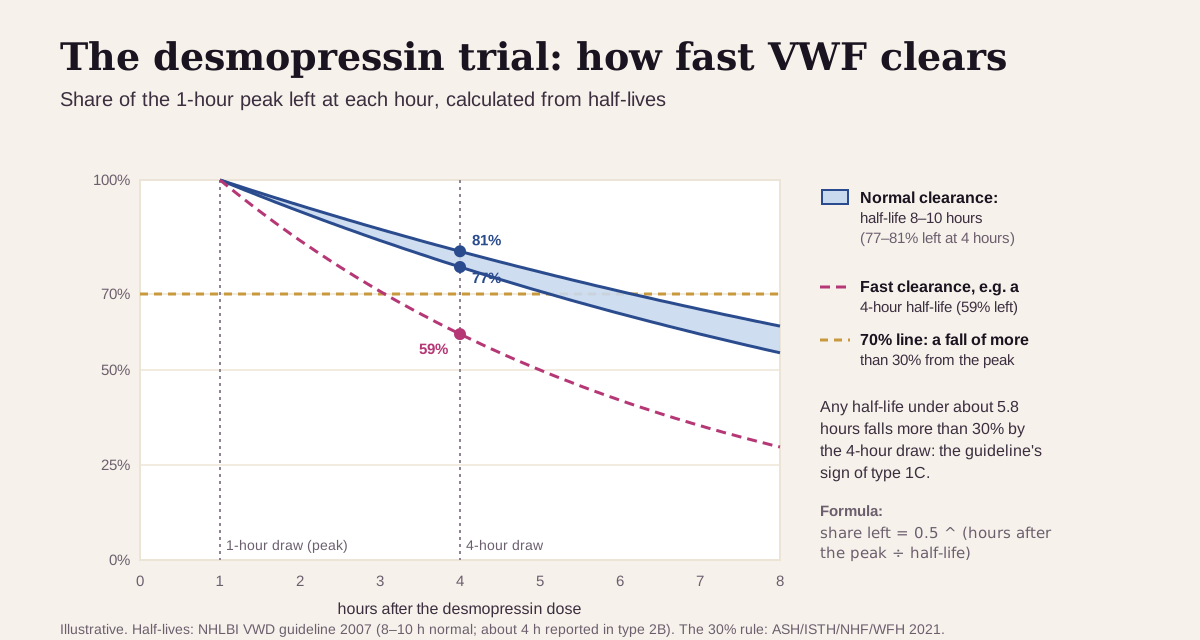
The desmopressin trial uses that speed. Desmopressin is a medicine that raises VWF by releasing the body's stores.3 The 2021 guideline checks VWF 1 hour and 4 hours after a dose; a fall of more than 30% from the peak by 4 hours points to fast clearance (type 1C).1 After desmopressin, VWF normally clears with a half-life of about 8–10 hours.3
Acquired causes can reverse just as fast:
- After aortic valve replacement, the VWF changes were fully corrected the first day after surgery. They tended to come back by 6 months when the new valve was too small for the patient.12
- After an LVAD comes out, the long chains and the collagen-binding ratio return to normal.13
- In pregnancy with essential thrombocythemia, median activity rose from 48% early on to 86% in the third trimester, as the platelet count fell from 701 to 359 × 10⁹/L.16
What that means in practice: one result is a snapshot. A low reading is usually repeated on a fresh sample, and a trend across tests from the same lab and the same kind of activity test tells you far more.6
Going deeper: why the tests disagree
Ristocetin is an artificial trigger. In the body, VWF grips platelets after it changes shape on a damaged vessel wall under fast blood flow. Ristocetin forces that change in a test tube, so the ristocetin cofactor test measures two things at once: ristocetin binding to VWF, and VWF binding to platelets.9 A variant like D1472H, in the platelet-binding A1 region of VWF, can upset the first step without touching the second. That's probably why carriers read low only on ristocetin tests.8
Collagen binding catches a different defect. Most type 2M VWD grips GPIb poorly but binds collagen normally, so its activity-to-antigen ratio is low while its collagen-binding ratio is normal.6 Types 2A and 2B lose the long chains, which drags collagen binding down too. In the Zimmerman Program, the collagen-binding-to-antigen ratio averaged 1.10 with normal chains and 0.51 with abnormal ones, and a cutoff of 0.6 flagged every type 2A and 2B case.7
One more test name to know. Some labs report an antibody-based "VWF activity" (VWF:Ab). It measures an antibody binding to VWF's A1 region rather than true GPIb binding. It misses some type 2M variants and reads reliably only above roughly 12–19%.9
Questions worth asking
- Which activity test did my lab run: ristocetin cofactor, GPIbM, GPIbR or collagen binding?
- What's my activity-to-antigen ratio, and is it above or below 0.7?
- Were antigen and factor VIII measured on the same sample?
- Was I sick, stressed or pregnant when this was drawn, and should we repeat it at my usual baseline?
- Could a heart valve, a heart pump, a high platelet count or another condition be lowering my VWF?
- Do I need a multimer test, a collagen-binding test or a desmopressin trial before surgery or delivery?
FAQ
What is a normal VWF activity level? Labcorp's range is 50–150%, and 50% is the usual lower limit. Your activity should also be close to your antigen: a ratio above 0.7.26
What does a low VWF activity-to-antigen ratio mean? Under 0.7 points toward type 2 VWD or acquired von Willebrand syndrome, where VWF is present but works poorly. A multimer or collagen-binding test usually comes next.14
Can VWF activity be falsely low? Yes. On the ristocetin cofactor test, the common D1472H variant lowers the result without causing bleeding, and a GPIbM test reads normally.810 Factor VIII in the same panel can read falsely low if the sample is handled poorly, so low results are usually repeated on a fresh sample.6
Can a heart problem lower VWF activity? Yes. Severe aortic stenosis and heart pumps (LVADs) shred the long VWF chains. Valve replacement corrected the problem by the next day in one study.1213
This guide is for education. It can't diagnose you or replace care from a clinician who knows your history.
Footnotes
-
James PD, Connell NT, Ameer B, et al. ASH ISTH NHF WFH 2021 guidelines on the diagnosis of von Willebrand disease. Blood Adv. 2021;5(1):280–300. The international diagnosis guideline: the three-test panel, the preference for GPIbM/GPIbR assays over VWF:RCo, the <0.30 and <0.50 IU/mL type 1 cutoffs, the desmopressin trial for type 1C, and the <0.7 ratio for type 2 (pooled sensitivity 0.90 vs 0.58–0.79 for <0.5). PMC ↩ ↩2 ↩3 ↩4 ↩5 ↩6 ↩7 ↩8 ↩9 ↩10 ↩11 ↩12 ↩13 ↩14 ↩15 ↩16 ↩17 ↩18 ↩19 ↩20 ↩21 ↩22 ↩23 ↩24 ↩25 ↩26 ↩27 ↩28 ↩29 ↩30
-
Labcorp. von Willebrand Factor (vWF) Activity, test 164509: GPIbM method (INNOVANCE VWF Ac), reference range 50% to 150%, and mean VWF by blood type. A commercial lab; ranges differ between labs. labcorp.com ↩ ↩2 ↩3 ↩4 ↩5 ↩6 ↩7 ↩8 ↩9
-
Nichols WL, Hultin MB, James AH, et al. The Diagnosis, Evaluation, and Management of von Willebrand Disease. National Heart, Lung, and Blood Institute; NIH Publication No. 08-5832; December 2007. The U.S. expert-panel report: type descriptions, type 1 at about 75% of symptomatic VWD, type 3 prevalence and factor VIII levels, and VWF half-lives. NHLBI ↩ ↩2 ↩3 ↩4 ↩5 ↩6 ↩7 ↩8 ↩9 ↩10 ↩11 ↩12 ↩13 ↩14 ↩15 ↩16 ↩17
-
Franchini M, Mannucci PM. Acquired von Willebrand syndrome: focused for hematologists. Haematologica. 2020;105(8):2032–2037. Causes, the ISTH registry, and lab findings (VWF:RCo/VWF:Ag often below 0.7). PMC ↩ ↩2 ↩3 ↩4 ↩5 ↩6 ↩7 ↩8
-
National Library of Medicine. Bleeding. MedlinePlus Medical Encyclopedia. Reviewed October 14, 2025. Signs of internal bleeding and when to get emergency help. MedlinePlus ↩ ↩2 ↩3
-
Labcorp. von Willebrand Factor (vWF) Disease (VWD) Profile, test 086282: what each test measures, the >0.7 ratio, and result patterns by VWD type. A commercial lab. labcorp.com ↩ ↩2 ↩3 ↩4 ↩5 ↩6 ↩7 ↩8 ↩9 ↩10 ↩11 ↩12 ↩13 ↩14 ↩15 ↩16 ↩17
-
Flood VH, Gill JC, Friedman KD, et al. Collagen binding provides a sensitive screen for variant von Willebrand disease. Clin Chem. 2013;59(4):684–691. 146 controls, 351 type 1 and 77 type 2 VWD; VWF:CB/VWF:Ag 1.10 vs 0.51, and VWF chain sizes. PMC ↩ ↩2 ↩3 ↩4
-
Flood VH, Gill JC, Morateck PA, et al. Common VWF exon 28 polymorphisms in African Americans affecting the VWF activity assay by ristocetin cofactor. Blood. 2010;116(2):280–286. 59 African American and 113 white healthy controls; D1472H lowered the VWF:RCo/VWF:Ag ratio but not GPIb binding. PMC ↩ ↩2 ↩3 ↩4 ↩5 ↩6 ↩7 ↩8 ↩9 ↩10 ↩11
-
Bodó I, Eikenboom J, Montgomery R, et al. Platelet-dependent von Willebrand factor activity. Nomenclature and methodology: communication from the SSC of the ISTH. J Thromb Haemost. 2015;13(7):1345–1350. The official names and how each activity assay works. PMC ↩ ↩2 ↩3 ↩4 ↩5 ↩6 ↩7 ↩8
-
Flood VH, Friedman KD, Gill JC, et al. No increase in bleeding identified in type 1 VWD subjects with D1472H sequence variation. Blood. 2013;121(18):3742–3744. PMC ↩ ↩2 ↩3
-
Connell NT, Flood VH, Brignardello-Petersen R, et al. ASH ISTH NHF WFH 2021 guidelines on the management of von Willebrand disease. Blood Adv. 2021;5(1):301–325. Surgery and neuraxial-anesthesia targets, and the caution on long stretches above 1.50 IU/mL. PMC ↩ ↩2 ↩3 ↩4 ↩5 ↩6
-
Vincentelli A, Susen S, Le Tourneau T, et al. Acquired von Willebrand syndrome in aortic stenosis. N Engl J Med. 2003;349(4):343–349. 50 patients with aortic stenosis, 42 with severe stenosis having valve replacement. PubMed ↩ ↩2 ↩3
-
Meyer AL, Malehsa D, Bara C, et al. Acquired von Willebrand syndrome in patients with an axial flow left ventricular assist device. Circ Heart Fail. 2010;3(6):675–681. PubMed ↩ ↩2 ↩3
-
Rottenstreich A, Kleinstern G, Krichevsky S, et al. Factors related to the development of acquired von Willebrand syndrome in patients with essential thrombocythemia and polycythemia vera. Eur J Intern Med. 2017;41:49–54. PubMed ↩ ↩2 ↩3
-
National Library of Medicine. Von Willebrand disease. MedlinePlus Medical Encyclopedia. Reviewed January 29, 2026. MedlinePlus ↩
-
Rottenstreich A, Kleinstern G, Amsalem H, Kalish Y. The course of acquired von Willebrand syndrome during pregnancy among patients with essential thrombocytosis. J Thromb Thrombolysis. 2018;46(3):304–309. 18 women, 24 pregnancies. PubMed ↩
Educational content, not medical advice. Libby is a personal record tool, not a medical service — it doesn't diagnose, treat, or prescribe. Reference ranges vary by lab and by person. Talk to a qualified healthcare professional about your results.
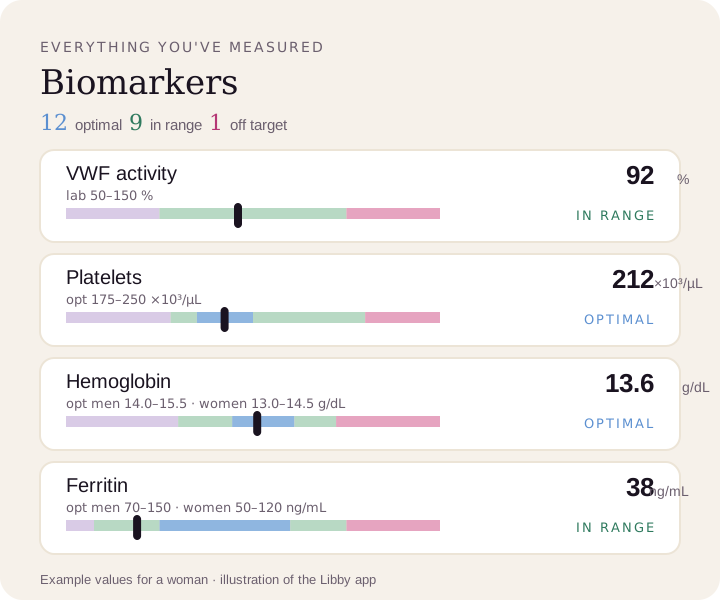
See every result against your lab's range.
Upload a lab PDF or a photo of your report. Libby puts every marker on your lab's range, adds the optimal range where one exists, and tracks your trends over time.
View your VWF activity ›