hCG blood test: levels, pregnancy and what results mean
hCG is the pregnancy hormone. Here's a normal level outside pregnancy, how fast it rises, why it can run high, and when a result is urgent.
hCG (human chorionic gonadotropin) is the hormone a pregnancy makes, and it's what every pregnancy test looks for. It shows up in blood and urine about 10 days after conception, then climbs fast, peaking around week 10.12 Outside pregnancy, hCG stays close to zero. A positive result when you're not pregnant can come from a recent pregnancy, a fertility shot, the pituitary gland around menopause, a quirk of the lab test, or a tumor.34
The short version
- Not pregnant: under 5 mIU/mL is negative for women before menopause, and healthy men run under 2.13 After menopause the pituitary adds a little: Labcorp's range goes up to 8, and the cutoff recommended for women 55 and older is 14.563
- Early pregnancy: hCG typically more than doubles every 2 days (a median rise of 124% in one study). In pregnancies that turned out healthy, the slowest 2-day rise was 33–49%, depending on the starting level.78
- Urgent: a positive test with sudden, severe belly or pelvic pain, shoulder pain, or weakness, dizziness or fainting can mean a ruptured ectopic pregnancy. Go to an emergency room.4
- A single number shows that hCG is there. The change over 2 days, plus an ultrasound, shows whether a pregnancy is growing and where.89
What hCG is
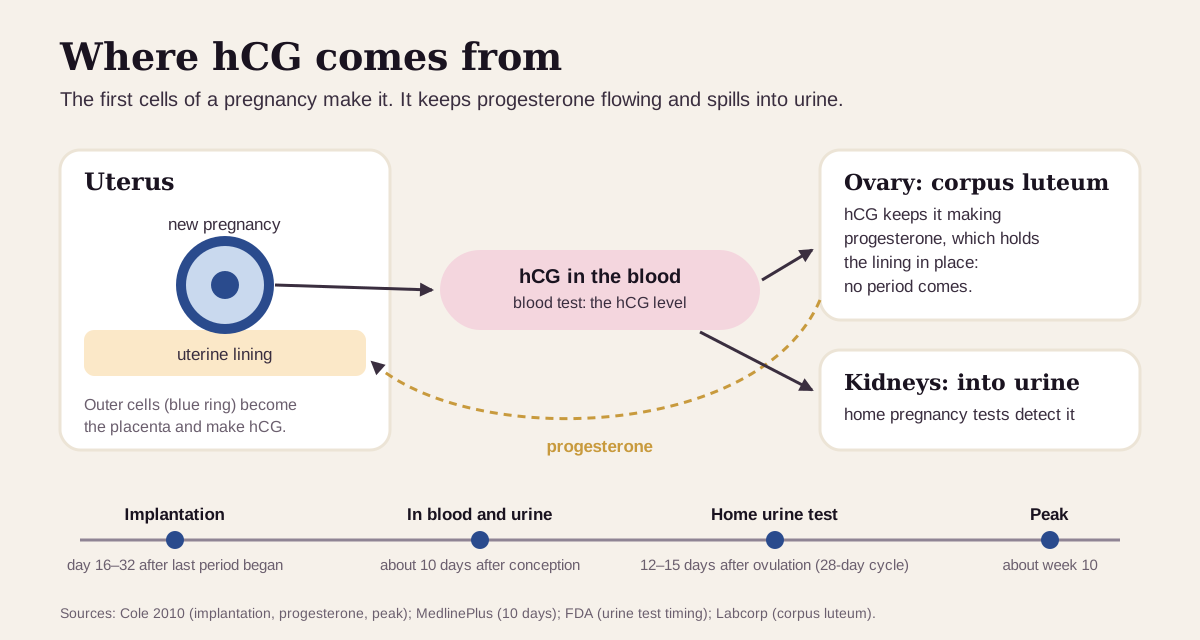
hCG is made by the outer layer of cells of a new pregnancy, the cells that go on to form the placenta. Its first job is to keep the corpus luteum, the leftover egg follicle in the ovary, making progesterone. Progesterone holds the uterine lining in place, so no period comes.25 (More on the chemistry at the end.)
The hormone has two halves. The alpha half is nearly identical to the alpha half of LH, FSH and TSH. The beta half is unique to hCG, which is why blood tests measure "beta-hCG".53
You'll meet hCG in three forms of test:310
- Home urine test: a yes-or-no answer. It turns positive once hCG is high enough, about 25 mIU/mL in blood terms.
- Qualitative blood test: also yes or no, run in a lab.
- Quantitative blood test (the "hCG level"): the actual number. This is the one used to follow an early pregnancy, a pregnancy loss, or a tumor.
Men get hCG tests too. It's one of three tumor markers, with AFP and LDH, used for testicular cancer.1112
What's a normal hCG?
If you're not pregnant, a normal hCG is close to zero. The usual numbers:
- Women before menopause: under 5 mIU/mL. That's the standard cutoff in the American College of Obstetricians and Gynecologists' (ACOG) 2026 guidance, and it's Labcorp's range (0–5).35
- Men: under 2 by MedlinePlus's reference values; Labcorp uses 0–3.15
- After menopause: a little higher, because the pituitary makes small amounts of hCG when estrogen falls. Labcorp uses 0–8. ACOG notes that up to 8% of women 55 and older test above 5, and recommends a cutoff of 14 for that age group.53
In pregnancy, "normal" is a moving target. Labs print a range for each week, counted from the first day of your last period. The ranges are wide and overlap heavily:
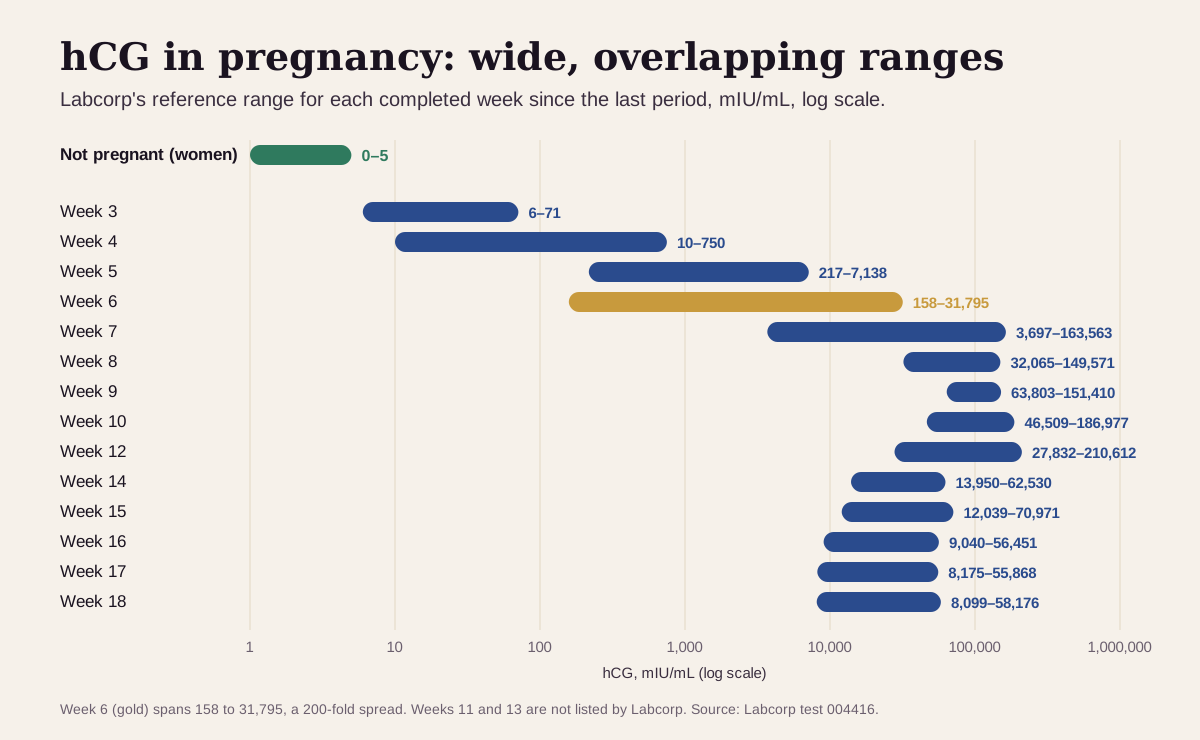
At 6 weeks, Labcorp's range runs from 158 to 31,795 mIU/mL, a 200-fold spread.5 A single value fits several different weeks, so the number tells you little about how far along a pregnancy is. The change between two tests says much more (see how fast hCG changes).
"Optimal" hCG: the ladder of cutoffs
For most markers, longevity clinics and testing companies aim for a tight target inside the lab range. hCG works differently. Outside pregnancy the healthy level is close to zero, and every number above that is a decision point, not a goal. Function Health, a longevity-testing company, sells hCG only as a pregnancy add-on, with no optimal target.13 Here are the cutoffs, from strictest to loosest:
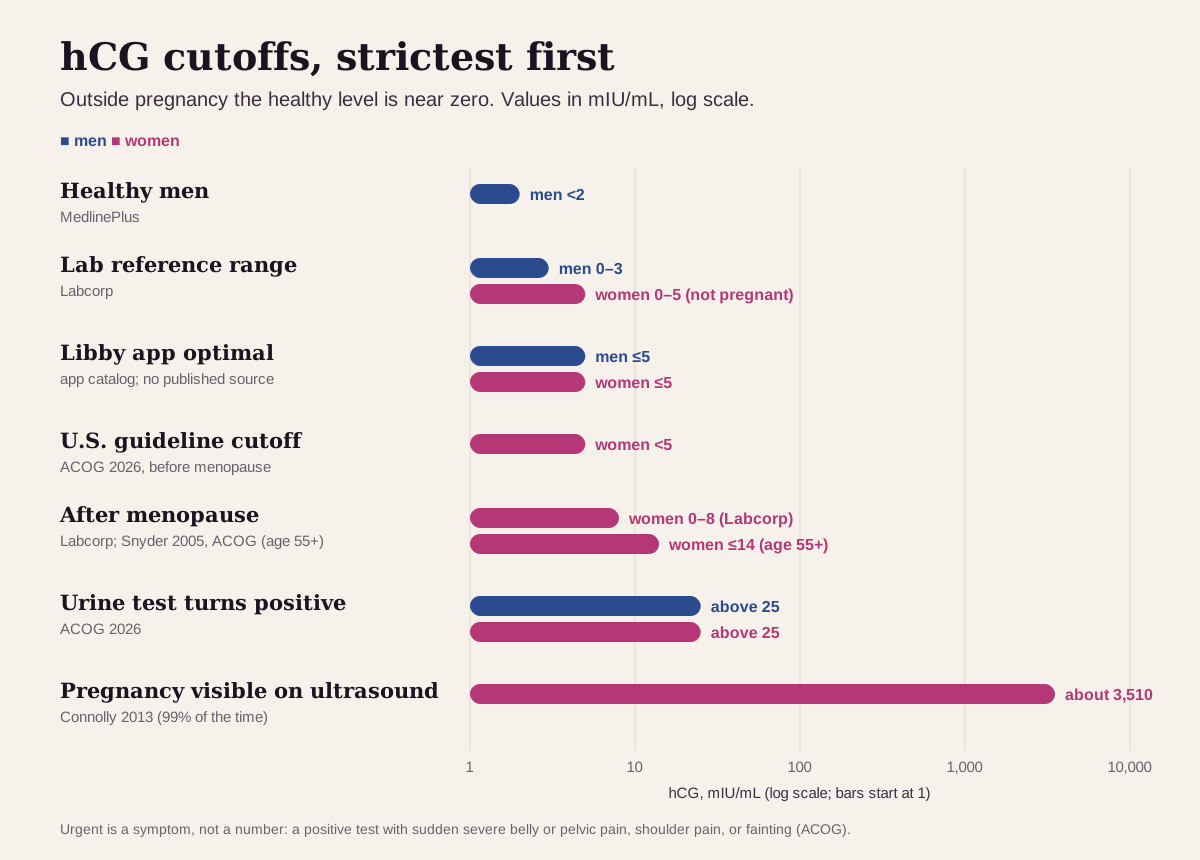
| Target | Men | Women | Who uses it |
|---|---|---|---|
| Strictest: healthy men | under 2 mIU/mL | none set | MedlinePlus reference value1 |
| Lab reference range | 0–3 | 0–5 (not pregnant) | Labcorp5 |
| Libby app optimal | 5 or less | 5 or less | The optimal band shown in the Libby app. The app's catalog records no published source for it, and it matches the app's lab range of 0–5 |
| U.S. guideline cutoff | none set | under 5 before menopause | ACOG3 |
| After menopause | none set | 0–8 (Labcorp); 14 or less at age 55+ | Labcorp; Snyder et al., adopted by ACOG563 |
| Urine test turns positive | over 25 | over 25 | ACOG3 |
| Pregnancy should show on ultrasound | none set | about 3,510 | Connolly et al.: a sac in the uterus was predicted to be visible 99% of the time at this level9 |
| Urgent | symptoms, not a number | symptoms, not a number | A positive test with severe pain, shoulder pain or fainting: see the box below4 |
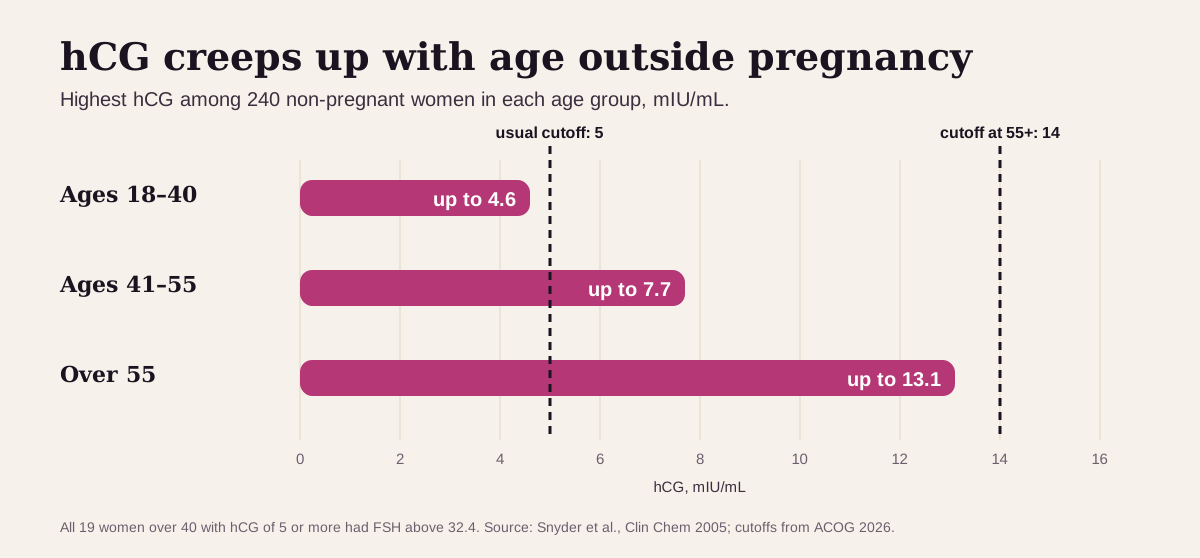
Why the cutoffs rise with age:
- In a study of 240 non-pregnant women in each age group, the highest hCG was 4.6 at ages 18–40, 7.7 at 41–55, and 13.1 over 55. Every woman over 40 with an hCG of 5 or more had an FSH above 32.4. In pregnant women, FSH never went above 7.3.6
- That's why ACOG says to read hCG together with FSH around menopause. After menopause, a stable, low hCG (under 14) with an FSH of 40 or higher most likely comes from the pituitary and needs no further testing.3
Getting these cutoffs right matters. ACOG notes that positive hCG results outside pregnancy have led to needless procedures and even chemotherapy.3
Keep "optimal" in perspective: for hCG, lower is not something you work toward. Under 5 simply means no pregnancy hormone is around. In pregnancy a high number is expected, and the change over days matters far more than any one value.8 The Libby app shows hCG against the non-pregnant band of 5 or less, so a pregnancy result reads as high there; the trend view is where the rise or fall shows.
What a high hCG usually means
The level and the setting are the first clues. A result of 5 to 25 is a low positive that a home urine test can miss.3 Above 25, home tests turn positive, and the usual reason is pregnancy.10 Very high values for the week point to twins or a molar pregnancy.1
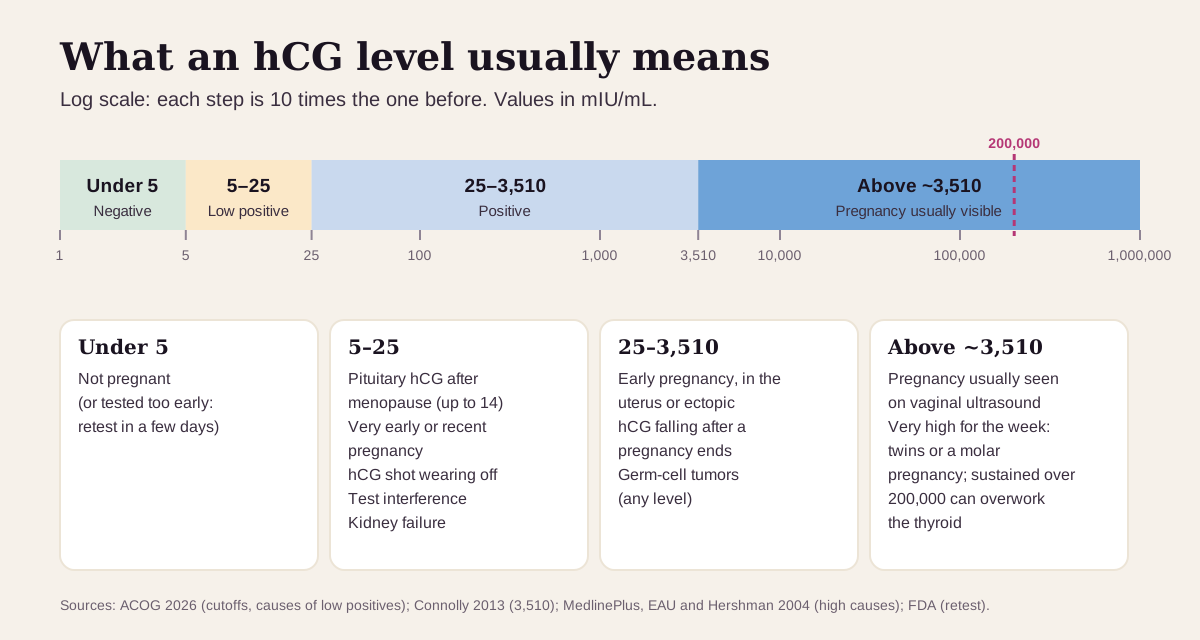
The usual reasons, most common first
- Pregnancy. By far the most common. In a 28-day cycle, a home urine test can pick up hCG 12–15 days after ovulation. Even so, 10 to 20 of every 100 pregnant women get a negative on the first day of a missed period, often because the period was due later than they thought. If you think you're pregnant, test again in a few days.10
- A recent pregnancy. After a miscarriage, an abortion or a birth, hCG takes days to weeks to clear (see how fast hCG changes).1516
- An hCG shot. Fertility clinics use hCG injections to trigger ovulation. In one IVF study it stayed detectable for up to 14 days after the shot.17 hCG has also been used for weight loss and by athletes.3
- Menopause. The pituitary makes small amounts of hCG when estrogen falls: usually under 14, stable over time, with a high FSH.36
Less common causes
- A lab-test glitch ("phantom hCG"). Antibodies in some people's blood (heterophile antibodies) fool the test in an estimated 1 in 1,000 to 1 in 10,000 blood tests. The clue: a blood hCG above 50 with a negative urine test.3
- Kidney failure can keep hCG from being cleared, leaving a low positive.3
- Molar pregnancy, an abnormal growth of placental tissue, happens in about 0.6 to 2 of every 1,000 pregnancies.18 Moles can make very large amounts of hCG, and very high levels (over about 200,000 for weeks) can overwork the thyroid.14
- Germ-cell tumors. In men, hCG is raised in up to 30% of seminomas, and AFP or hCG is raised in up to 90% of other testicular germ-cell tumors.11 Ovarian and some other cancers can also make hCG.13
Lower than expected in pregnancy
A value that is low for the week, or rises slowly, can mean a miscarriage or an ectopic pregnancy.1 It can also mean the pregnancy is simply earlier than the date of your last period suggests, because the day of implantation varies by up to two weeks.2 Repeat testing sorts it out.
Get emergency care if you have a positive pregnancy test and sudden, severe pain in your belly or pelvis, shoulder pain, or weakness, dizziness or fainting. These can be signs of a ruptured ectopic pregnancy, which can cause life-threatening internal bleeding. Call your clinician soon about vaginal bleeding or milder pelvic pain in early pregnancy.4
hCG reads best next to its neighbors
hCG rarely gets read alone. A second hCG two days later, progesterone, FSH and TSH usually say more together than hCG does by itself:
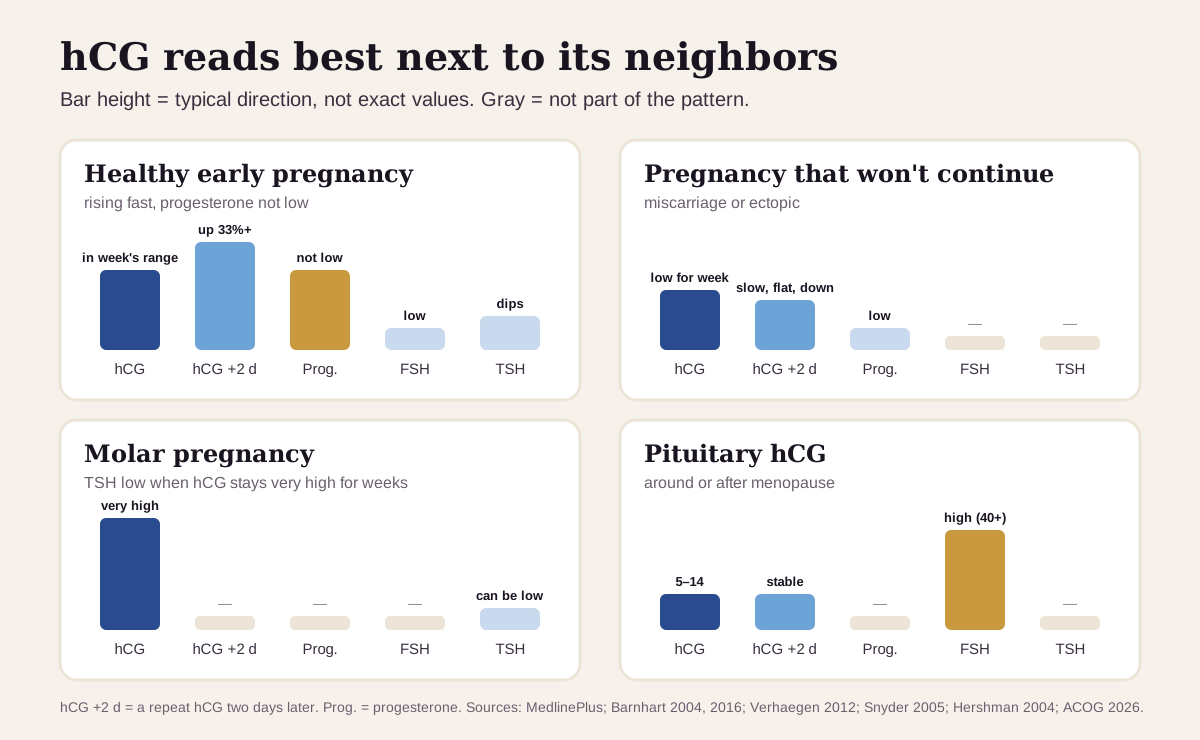
| If you see… | It often points to… |
|---|---|
| hCG up at least 33–49% in 2 days (median about 124%) and progesterone not low | a pregnancy that's developing as expected7819 |
| hCG rising more slowly than that, flat, or falling, with progesterone under about 3.2–6 ng/mL | a pregnancy that won't continue: a miscarriage or an ectopic pregnancy, which always needs treatment. In women with pain or bleeding and an unclear scan, a low progesterone raised the chance of a non-viable pregnancy from 73% to 99%7815194 |
| hCG above about 3,510 and no pregnancy seen in the uterus on a vaginal ultrasound | a level where a sac in the uterus is usually visible,9 so your clinician will want to find where the pregnancy is4 |
| hCG very high for the week | twins or a molar pregnancy.1 A mole making very large amounts of hCG (over about 200,000 for weeks) can push TSH low; TSH also falls at any normal hCG peak14 |
| hCG 5–14 and stable, FSH 40 or higher, around or after menopause | hCG from the pituitary, not a pregnancy36 |
| Blood hCG above 50, urine hCG negative | a lab-test glitch from interfering antibodies3 |
| In a man, hCG and/or AFP up (LDH is checked alongside) | can point to a testicular germ-cell tumor; borderline rises can be false positives, so they're rechecked1112 |
How fast hCG changes
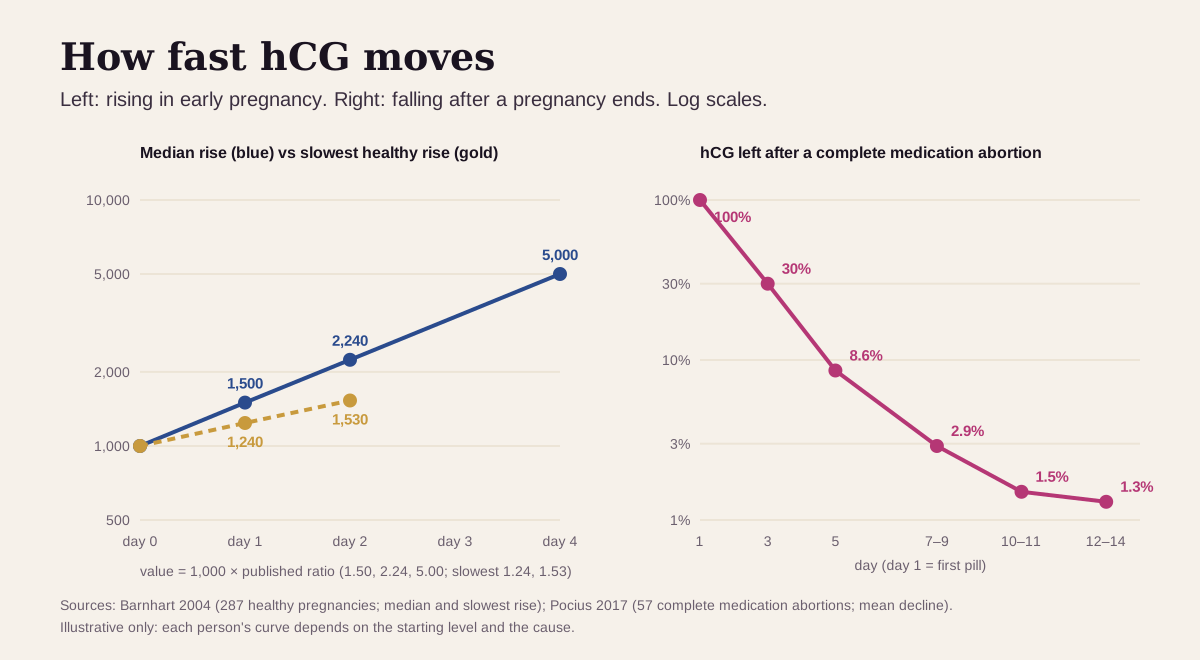
In early pregnancy, hCG rises fast. In 287 women with pain or bleeding whose pregnancies turned out healthy, the median rise was 50% in 1 day, 124% in 2 days and 5-fold in 4 days. The slowest was 53% in 2 days.7 A later study found the slowest healthy rise depends on the starting level: 49% below 1,500, 40% at 1,500–3,000, and 33% above 3,000.8
After a pregnancy ends, hCG falls. After a miscarriage, it typically fell 21–35% in 2 days and 60–84% in 7 days, depending on the starting level. A fall of less than 21% in 2 days or 60% in 7 days suggests tissue left behind or an ectopic pregnancy.15 After a complete medication abortion, the average drop was 70% by day 3, 91% by day 5 and 97% by days 7–9.16
What that means in practice:
- Two tests 48 hours apart are the usual way to follow an early pregnancy with pain or bleeding.8
- Use the same lab each time. Labcorp notes that values from different test methods shouldn't be mixed in serial testing.5
- Mention biotin. High-dose biotin supplements can interfere with this test; Labcorp asks people to stop biotin 72 hours before the draw.5
- Follow it down to under 5 after a miscarriage, an ectopic pregnancy or a molar pregnancy, as your clinician directs.1518 ACOG's advice after methotrexate for an ectopic pregnancy is follow-up "until hCG is no longer found in your blood."4
Going deeper: one hormone, four look-alikes
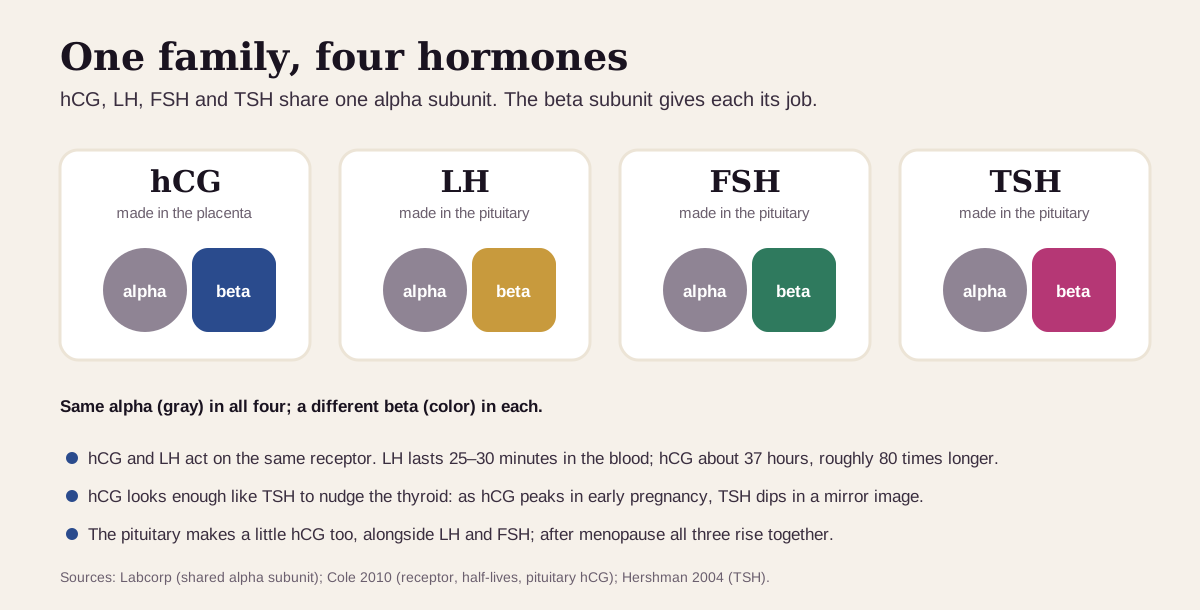
hCG belongs to a family of four hormones: hCG, LH, FSH and TSH. All four share one alpha subunit; the beta subunit gives each its job.5 hCG and LH even use the same receptor. The difference is staying power: LH lasts 25–30 minutes in the blood, hCG about 37 hours, roughly 80 times longer. That staying power suits its job of keeping the corpus luteum switched on.2
The family likeness explains two things you might see on your labs:
- TSH dips in early pregnancy. hCG looks enough like TSH to nudge the thyroid. As hCG peaks, TSH falls in a mirror image.14
- Menopause hCG. The pituitary makes a little hCG alongside LH and FSH. When estrogen falls after menopause, all three rise together.23
hCG comes in several forms. The placenta makes regular hCG; early pregnancy cells make a "hyperglycosylated" form that helps the pregnancy implant; the pituitary makes a slightly different version; and some cancers release only the free beta half.2 Labcorp notes that hCG circulates as several of these isohormones, one more reason to compare results from the same lab.5
Other ultrasound milestones. In the same study behind the 3,510 figure, a yolk sac was predicted to be visible 99% of the time at 17,716 and a fetal pole at 47,685 mIU/mL.9
Questions worth asking
- Is my hCG in the non-pregnant range for my age, or does it need a repeat?
- If I'm pregnant, when should the next hCG be drawn, and what rise would be reassuring?
- Should I have a progesterone test or an ultrasound alongside it?
- Could a fertility shot, a recent pregnancy or a supplement explain this number?
- If I'm near menopause, would an FSH help explain a low positive?
- If blood and urine results disagree, could the test be picking up interfering antibodies?
FAQ
What hCG level means pregnant? Under 5 mIU/mL is negative. Home urine tests usually turn positive above about 25. In between is a low positive, which a repeat test in a few days usually clarifies.310
How fast should hCG rise in early pregnancy? The median rise in one study was 124% in 2 days. In healthy pregnancies the slowest 2-day rise was 33–49%, depending on the starting level.78
Can you have a positive hCG without being pregnant? Yes. Common reasons are a recent pregnancy, an hCG shot, the pituitary around menopause, and interfering antibodies in the blood. Rarely, it's a tumor.3
How long does hCG take to go back to zero? It depends on the starting level. After a complete medication abortion, it fell 97% within about a week on average.16 After an hCG shot, it stayed detectable for up to 14 days.17
This guide is for education. It can't diagnose you or replace care from a clinician who knows your history.
Footnotes
-
National Library of Medicine. HCG blood test - quantitative. MedlinePlus Medical Encyclopedia. Reviewed October 15, 2024. Normal values (non-pregnant women under 5 mIU/mL, healthy men under 2), detection about 10 days after conception, and the causes of higher- and lower-than-expected levels. MedlinePlus ↩ ↩2 ↩3 ↩4 ↩5 ↩6 ↩7 ↩8 ↩9 ↩10 ↩11
-
Cole LA. Biological functions of hCG and hCG-related molecules. Reprod Biol Endocrinol. 2010;8:102. hCG's sources, forms and receptor; peak at 10 weeks; half-life about 37 hours versus 25–30 minutes for LH; implantation 3 to 16 days after the LH peak. PMC ↩ ↩2 ↩3 ↩4 ↩5 ↩6 ↩7 ↩8 ↩9
-
American College of Obstetricians and Gynecologists. Management of Positive Human Chorionic Gonadotropin Test Results in Nonpregnant Patients Without Gynecologic Malignancy. Clinical Consensus No. 11. Obstet Gynecol. 2026. The U.S. guidance on positive hCG outside pregnancy: the under-5 cutoff, 14 at age 55+, the 8% figure, FSH of 40 or higher, urine tests above 25, heterophile antibodies (1 in 1,000 to 1 in 10,000; blood over 50 with negative urine), kidney failure and exogenous hCG. ACOG ↩ ↩2 ↩3 ↩4 ↩5 ↩6 ↩7 ↩8 ↩9 ↩10 ↩11 ↩12 ↩13 ↩14 ↩15 ↩16 ↩17 ↩18 ↩19 ↩20 ↩21 ↩22 ↩23 ↩24 ↩25 ↩26 ↩27
-
American College of Obstetricians and Gynecologists. Ectopic Pregnancy (patient FAQ). Warning signs of a ruptured ectopic pregnancy, and hCG follow-up after methotrexate. ACOG ↩ ↩2 ↩3 ↩4 ↩5 ↩6 ↩7
-
Labcorp. Human Chorionic Gonadotropin (hCG), β-Subunit, Quantitative, test 004416. Roche electrochemiluminescence assay. Reference ranges: male 0–3 mIU/mL; female non-pregnant 0–5, postmenopausal 0–8; weekly pregnancy ranges from 6–71 (3 weeks) to 27,832–210,612 (12 weeks). Also the biotin and same-method cautions. Labcorp is a commercial laboratory. labcorp.com ↩ ↩2 ↩3 ↩4 ↩5 ↩6 ↩7 ↩8 ↩9 ↩10 ↩11 ↩12 ↩13 ↩14 ↩15 ↩16 ↩17
-
Snyder JA, Haymond S, Parvin CA, Gronowski AM, Grenache DG. Diagnostic considerations in the measurement of human chorionic gonadotropin in aging women. Clin Chem. 2005;51(10):1830–1835. 240 women per group; proposed the cutoff of 14 for women over 55. PubMed ↩ ↩2 ↩3 ↩4 ↩5 ↩6 ↩7 ↩8
-
Barnhart KT, Sammel MD, Rinaudo PF, Zhou L, Hummel AC, Guo W. Symptomatic patients with an early viable intrauterine pregnancy: HCG curves redefined. Obstet Gynecol. 2004;104(1):50–55. 287 women, 861 measurements; median and slowest rises. PubMed ↩ ↩2 ↩3 ↩4 ↩5 ↩6 ↩7
-
Barnhart KT, Guo W, Cary MS, et al. Differences in Serum Human Chorionic Gonadotropin Rise in Early Pregnancy by Race and Value at Presentation. Obstet Gynecol. 2016;128(3):504–511. 285 women with confirmed healthy pregnancies; slowest 2-day rise of 49%, 40% and 33% by starting level. PMC ↩ ↩2 ↩3 ↩4 ↩5 ↩6 ↩7 ↩8 ↩9
-
Connolly A, Ryan DH, Stuebe AM, Wolfe HM. Reevaluation of discriminatory and threshold levels for serum β-hCG in early pregnancy. Obstet Gynecol. 2013;121(1):65–70. 651 pregnancies; 99% visibility levels of 3,510 (gestational sac), 17,716 (yolk sac) and 47,685 (fetal pole). PubMed ↩ ↩2 ↩3 ↩4 ↩5 ↩6
-
U.S. Food and Drug Administration. Pregnancy (home-use tests). hCG detectable in urine 12–15 days after ovulation; 10 to 20 of 100 pregnant women miss it on the first day of a missed period. FDA ↩ ↩2 ↩3 ↩4 ↩5
-
European Association of Urology. EAU Guidelines on Testicular Cancer: Diagnostic Evaluation. AFP, hCG and LDH before and after surgery; hCG raised in up to 30% of pure seminomas; AFP or hCG raised in up to 90% of nonseminomas; half-lives of 1–3 days (hCG) and 5–7 days (AFP). uroweb.org ↩ ↩2 ↩3
-
Gilligan TD, Hayes DF, Seidenfeld J, Temin S. ASCO Clinical Practice Guideline on Uses of Serum Tumor Markers in Adult Males With Germ Cell Tumors. J Oncol Pract. 2010;6(4):199–202. AFP, hCG and LDH in testicular cancer; hCG half-life of 24 to 36 hours. PMC ↩ ↩2 ↩3
-
Function Health. What We Test. Lists "Pregnancy HcG" as an add-on test, with no optimal range published. A commercial source, listed to show what the optimizer community offers. functionhealth.com ↩
-
Hershman JM. Physiological and pathological aspects of the effect of human chorionic gonadotropin on the thyroid. Best Pract Res Clin Endocrinol Metab. 2004;18(2):249–265. TSH falls as hCG peaks; molar pregnancies make large amounts of hCG; hyperthyroidism needs hCG above 200 U/mL (200,000 mIU/mL) for several weeks. PubMed ↩ ↩2 ↩3 ↩4 ↩5 ↩6
-
Barnhart K, Sammel MD, Chung K, Zhou L, Hummel AC, Guo W. Decline of serum human chorionic gonadotropin and spontaneous complete abortion: defining the normal curve. Obstet Gynecol. 2004;104(5 Pt 1):975–981. 710 miscarriages; declines of 21–35% at 2 days and 60–84% at 7 days. PubMed ↩ ↩2 ↩3 ↩4 ↩5
-
Pocius KD, Bartz D, Maurer R, Stenquist A, Fortin J, Goldberg AB. Serum human chorionic gonadotropin (hCG) trend within the first few days after medical abortion: a prospective study. Contraception. 2017;95(3):263–268. 57 complete medication abortions up to 63 days' gestation. PubMed ↩ ↩2 ↩3 ↩4
-
Damewood MD, Shen W, Zacur HA, Schlaff WD, Rock JA, Wallach EE. Disappearance of exogenously administered human chorionic gonadotropin. Fertil Steril. 1989;52(3):398–400. 34 IVF patients; detectable up to 14 days; half-life 2.32 days. PubMed ↩ ↩2
-
Ngan HYS, Seckl MJ, Berkowitz RS, et al. Diagnosis and management of gestational trophoblastic disease: 2021 update. Int J Gynaecol Obstet. 2021;155(Suppl 1):86–93. The FIGO cancer report: molar pregnancy in 0.57 to 2 of every 1,000 pregnancies, and hCG follow-up after a mole. PMC ↩ ↩2
-
Verhaegen J, Gallos ID, van Mello NM, et al. Accuracy of single progesterone test to predict early pregnancy outcome in women with pain or bleeding: meta-analysis of cohort studies. BMJ. 2012;345:e6077. 26 cohort studies, 9,436 women; cutoffs of 3.2–6 ng/mL. PMC ↩ ↩2 ↩3
Educational content, not medical advice. Libby is a personal record tool, not a medical service — it doesn't diagnose, treat, or prescribe. Reference ranges vary by lab and by person. Talk to a qualified healthcare professional about your results.
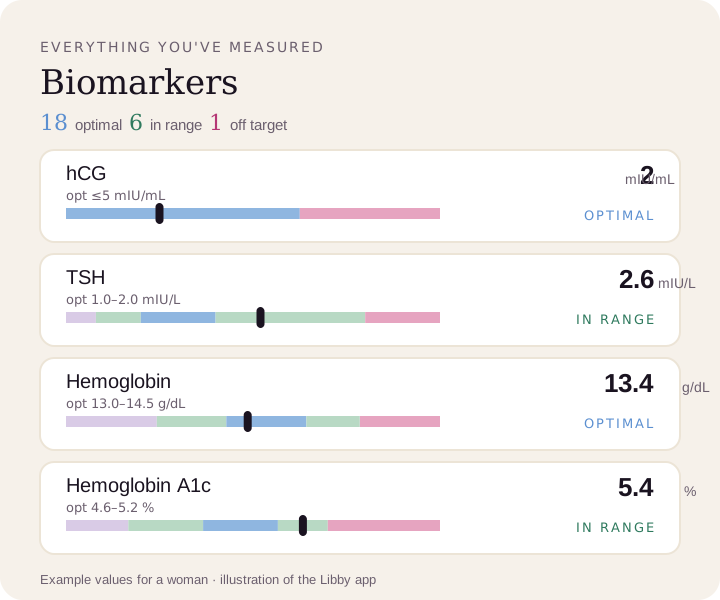
See every result in one place.
Upload a lab PDF or a photo of your report. Libby puts each marker on its reference range and, where one exists, the optimal range, and tracks your trends over time.
View your hCG ›