Carboxyhemoglobin test: normal levels and CO poisoning
Carboxyhemoglobin (COHb) is the share of your hemoglobin carrying carbon monoxide. Normal and smoker levels, CO poisoning signs, and when it's urgent.
Carboxyhemoglobin (COHb) is the share of your hemoglobin that is carrying carbon monoxide instead of oxygen. Everyone has a little, because your body makes a small amount of carbon monoxide (CO) as it recycles old red cells, and everyday air adds a bit more. In a nonsmoker the result is usually under 2%. Smoking pushes it higher, and a level well above the smoker range usually means recent fumes from a furnace, heater, generator, engine or fire.1
The short version
- Normal: under about 2% if you don't smoke. In a US national survey, half of never-smokers were at 0.72% or lower. Labs print upper limits from 1.5% to 2.0%.2345
- Smokers usually run 3–5%, and up to about 9%. A level over 9–10% points to a source other than cigarettes, even in a smoker.1
- Carbon monoxide poisoning: the CDC says a COHb of 2% or more in a nonsmoker, or over 9% in a smoker, strongly supports it when the story fits: headache, dizziness, nausea or confusion, often in several people in one place. Get everyone into fresh air and call 911.6
- A regular fingertip pulse oximeter reads COHb as if it were oxygen, so it can show a normal number during dangerous poisoning. A co-oximeter blood test measures COHb directly.67
What carboxyhemoglobin is
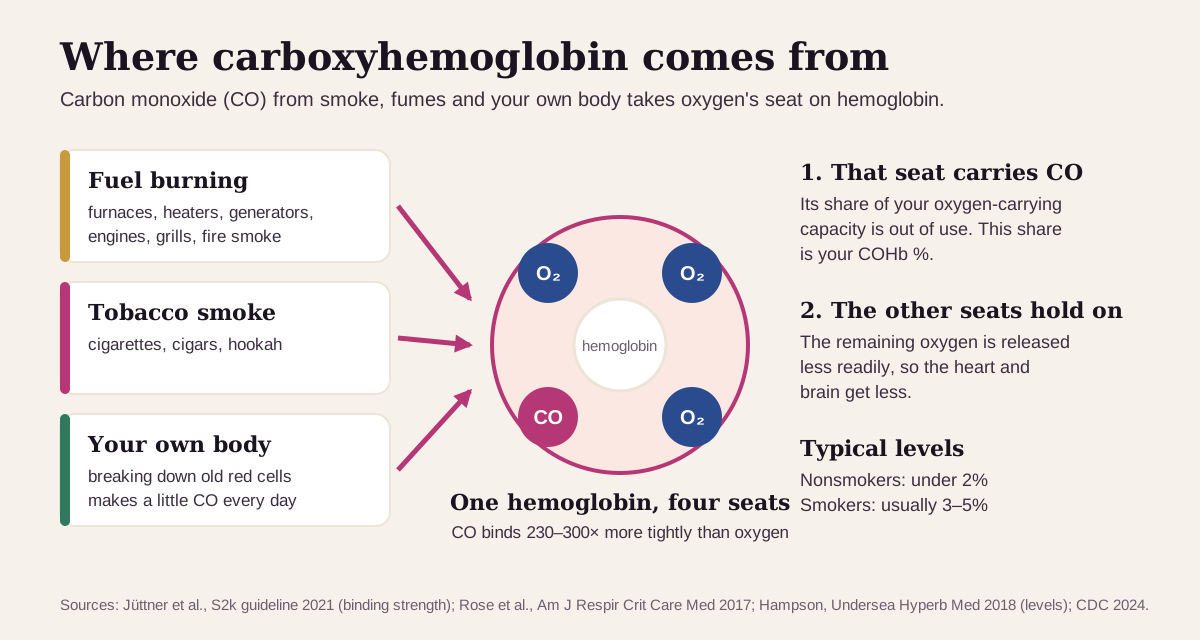
Hemoglobin is the protein in your red blood cells that carries oxygen from your lungs to the rest of your body. Each hemoglobin molecule has four seats for oxygen. Carbon monoxide fits the same seats, and it grips them 230–300 times more tightly than oxygen does. Hemoglobin carrying CO is carboxyhemoglobin.8
That does two things. A seat holding CO carries no oxygen. And the seats that still hold oxygen let go of it less easily, so tissues get less, above all the heart and brain, which use the most.9 CO also latches onto proteins inside cells, including the machinery cells use to burn oxygen.6
COHb is measured on a co-oximetry panel, often run with a blood gas in the emergency room. A co-oximeter shines several wavelengths of light through a blood sample and sorts hemoglobin into its forms: carrying oxygen, carrying CO, empty, or oxidized (methemoglobin). Venous blood works as well as arterial blood for COHb.61
What's a normal carboxyhemoglobin?
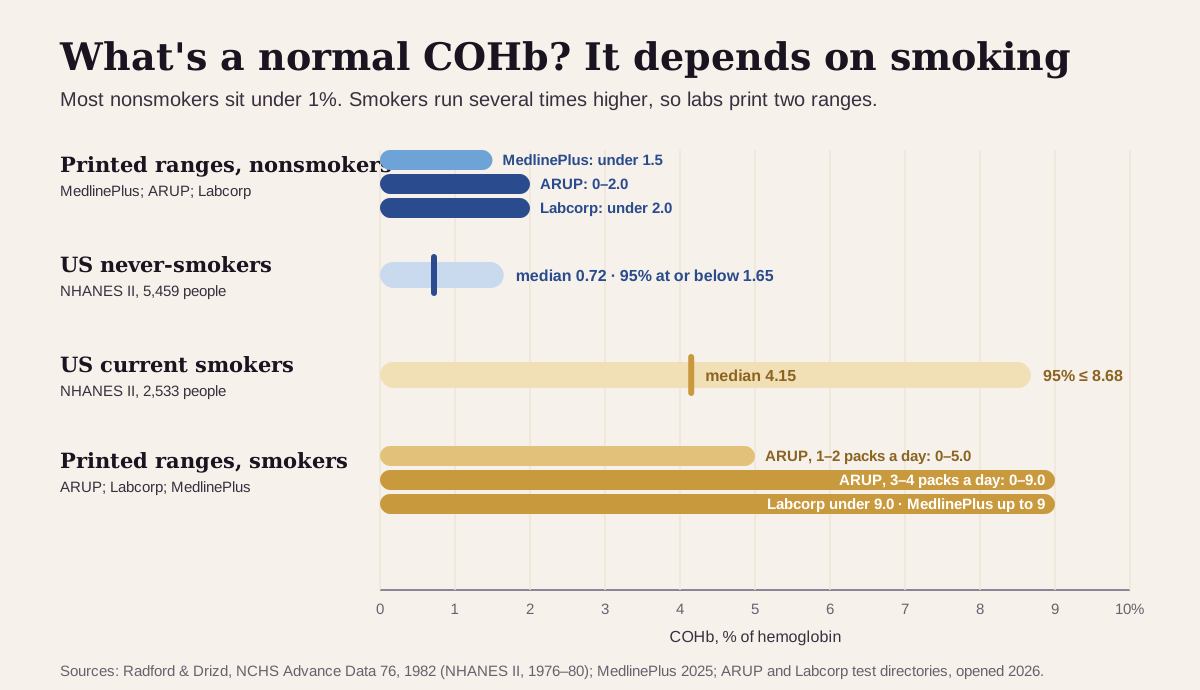
It depends mostly on whether you smoke. The best national numbers come from NHANES II, a US survey that measured COHb in 1976–80:2
- 5,459 never-smokers: median 0.72%, and 95% were at 1.65% or lower.
- 2,533 current smokers: median 4.15%, and 95% were at 8.68% or lower. The smokers' average was more than four times the never-smokers'.
Printed lab ranges follow the same split. MedlinePlus lists under 1.5%, and up to 9% in smokers.3 Two national commercial reference labs split it the same way. ARUP prints 0–2.0% for nonsmokers, 0–5.0% for one to two packs a day and 0–9.0% for three to four packs a day.4 Labcorp prints under 2.0% for nonsmokers and under 9.0% for smokers.5 Start with the range on your own report, since labs set their own.
Your home and your season nudge it too. In NHANES II, 5.4% of adult never-smokers were above 2% in winter, versus 1.6% in summer. People heated by unvented space heaters averaged 1.06%, versus 0.74% with electric heat. City children ran slightly higher than rural children.2
"Optimal" COHb: as close to background as your air allows
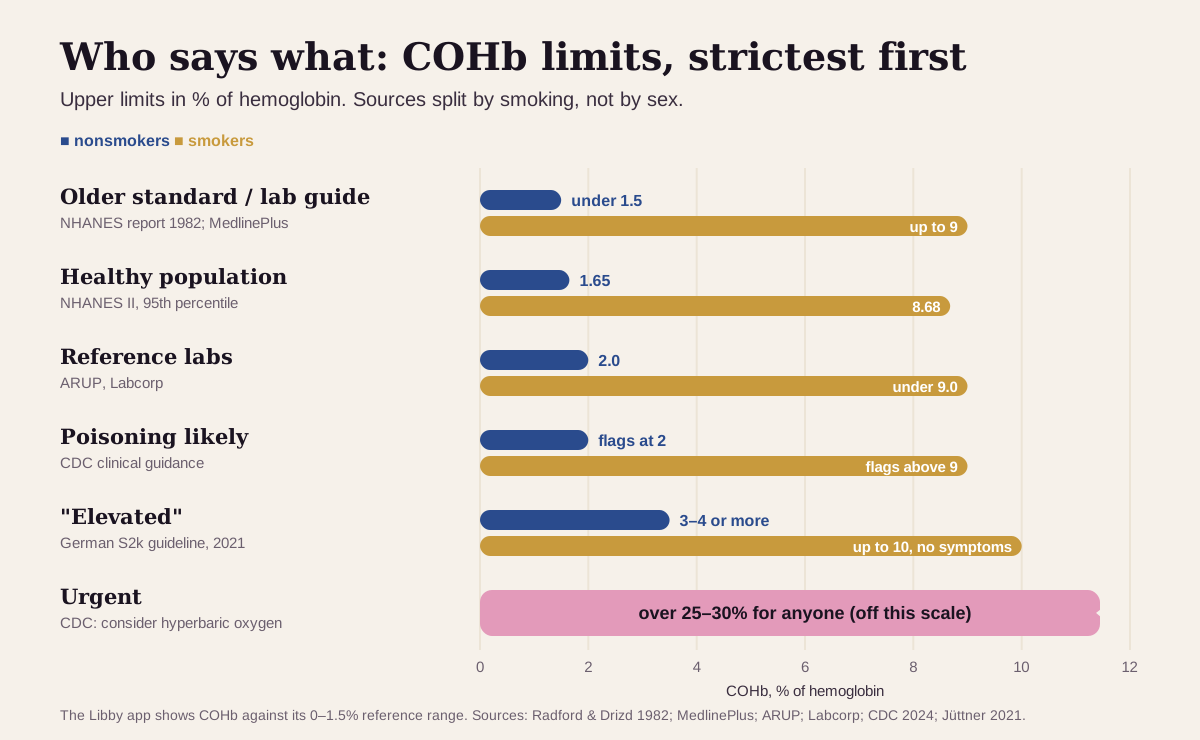
For COHb, the targets come from population data and exposure guidelines, not from longevity platforms or a functional-medicine textbook. The Libby app shows your COHb against its reference range of 0–1.5% and sets no separate optimal band for it. Here is the full ladder, from strictest to loosest. The sources split by smoking status, not by sex:
| Target | Nonsmokers | Smokers | Who uses it |
|---|---|---|---|
| Older standard / lab guide | under 1.5% | up to 9% | The NHANES II report's limit "in the absence of ambient sources" (1982);2 MedlinePlus today3 |
| Healthy population | 1.65% or less | 8.68% or less | 95th percentile of US never-smokers and current smokers, NHANES II2 |
| Reference labs | up to 2.0% | under 9.0% | ARUP4 and Labcorp5 printed ranges |
| Poisoning likely | 2% or more | over 9% | CDC clinical guidance, when the history fits6 |
| "Elevated" (German guideline) | 3–4% or more | up to 10% without symptoms | The 2021 German S2k guideline on CO poisoning8 |
| Urgent | over 25–30% | over 25–30% | CDC: consider hyperbaric oxygen, or at lower levels with heart or brain involvement6 |
Why the low end still matters:
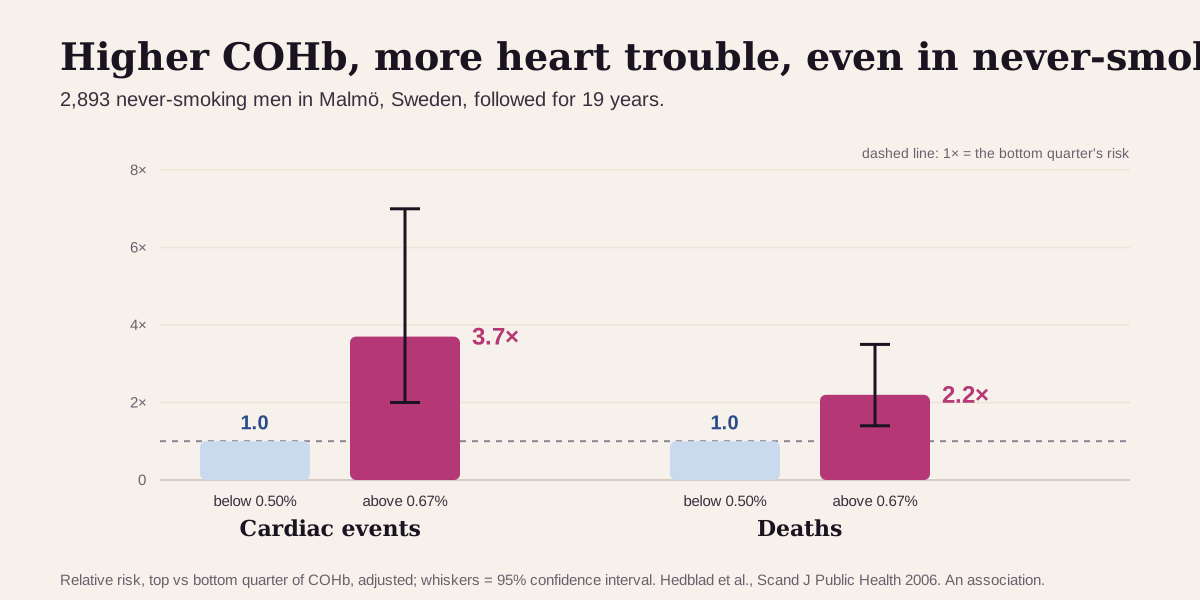
- In 2,893 never-smoking men aged 34–49 in Malmö, Sweden, followed for 19 years, those in the top quarter of COHb (above 0.67%) had 3.7 times the rate of heart events and 2.2 times the death rate of those in the bottom quarter (below 0.50%), after adjustment for other risk factors. Every one of those levels sits inside a normal lab range. The authors pointed to secondhand smoke as one hidden source.10
Keep "optimal" in perspective. For COHb it means cutting avoidable CO: tobacco smoke, a poorly vented heater, a car idling in an attached garage. Zero is neither possible nor the goal. Your body makes some CO as it recycles heme, and a stress-response enzyme ramps that up during illness. In 868 intensive-care patients, those who died had slightly lower minimum COHb than survivors (0.9% vs 1.2%).11
What a high carboxyhemoglobin usually means
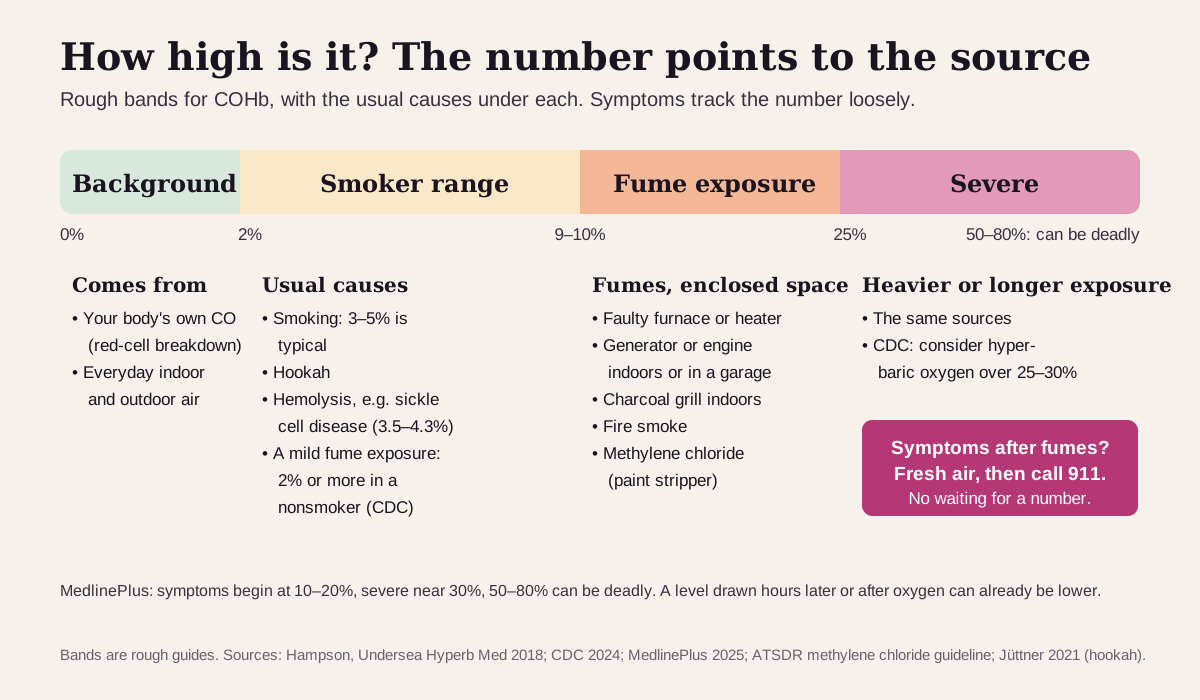
The size of the number is the first clue to the source.1
The usual suspects
- Smoking. Cigarettes, cigars and hookah. Smokers usually sit at 3–5%, and each pack a day adds roughly 2.5 points.1 Hookah use is a recognized cause of outright CO poisoning.8
- Fumes in an enclosed space. Furnaces, heaters, gas stoves, portable generators, charcoal grills, and cars, boats or small engines. The CDC counts more than 400 US deaths, 100,000 emergency visits and 14,000 hospital stays a year from unintentional CO poisoning outside of fires.13 Power outages are a classic setup, when people run generators or grills indoors.6
- Fire smoke. Of more than 25,000 US residential-fire injuries treated in emergency departments in 2001, more than half carried a diagnosis suggesting CO poisoning from smoke.9 Smoke can also carry cyanide.8
Less common
- Faster red-cell breakdown (hemolysis). Your body makes CO when it breaks down heme, so conditions that destroy red cells faster raise COHb. Nonsmokers with sickle cell disease have measured 3.5–4.3%.16 In one study, COHb in sickle cell disease tracked the reticulocyte count, bilirubin and hematocrit.14
- Methylene chloride. This solvent in some paint strippers and degreasers is turned into CO by the liver. COHb rarely passes 15%, but it can keep rising for hours after the exposure ends and stay up for one to two days.12
Serious poisoning
MedlinePlus lists symptoms starting at 10–20%, severe symptoms near 30%, and 50–80% as potentially deadly.3 The number tracks the illness only loosely, though, because it falls fast once someone leaves the fumes or gets oxygen.61 What happens next matters more:
- Heart. In 230 patients treated for moderate to severe CO poisoning, 37% had heart-muscle injury. By a median of 7.6 years later, 38% of them had died, versus 15% of those without it.15
- Brain. Memory, concentration and mood problems can show up later, after the poisoning itself seems over.86 In a randomized trial of 152 patients, 25% of those given hyperbaric oxygen had cognitive problems at 6 weeks, versus 46% of those given oxygen at normal pressure.16
Get care now if you have headache, dizziness, weakness, nausea or vomiting, chest pain or confusion, especially with no fever, near a fuel-burning appliance, engine or fire, or if others around you feel sick too. Get everyone into fresh air and call 911. If you're pregnant, the CDC calls hyperbaric oxygen the treatment of choice even for milder poisoning, because the fetus holds CO longer.6138
A low COHb
A result under 1% is what clean air looks like: the median US never-smoker was at 0.72%.2 The one catch is timing. COHb falls within hours of leaving the fumes, so a normal result drawn late, or after oxygen in the ambulance, can follow a real poisoning.16
COHb reads best next to its neighbors
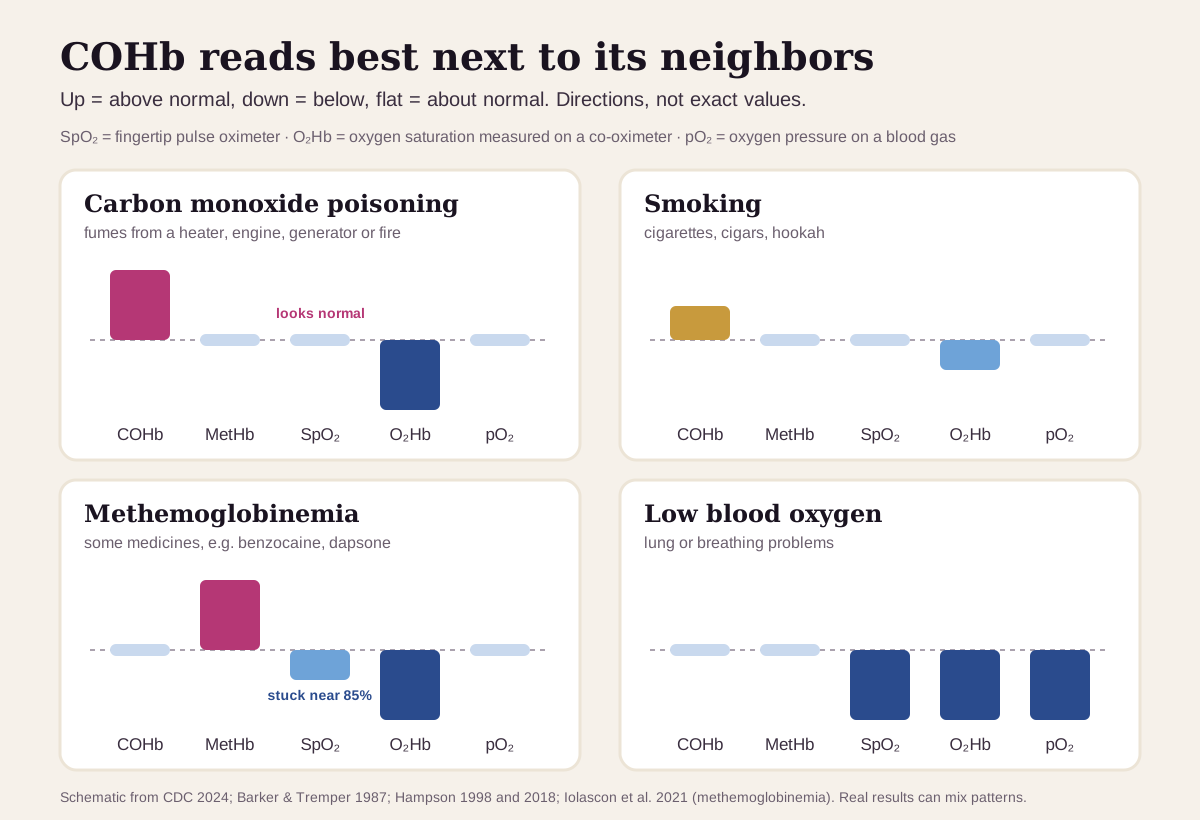
A co-oximetry panel reports COHb next to methemoglobin and a measured oxygen saturation, often with a blood gas. Read together, and against the fingertip pulse oximeter, they sort the common patterns:
| If you see… | It often points to… |
|---|---|
| High COHb with a normal-looking pulse-oximeter reading and a normal pO₂, plus headache or several sick people | carbon monoxide poisoning: the oximeter counts COHb as oxygen, and pO₂ measures dissolved oxygen rather than what hemoglobin carries |
| COHb 3–5%, up to about 9%, in someone who smokes and feels fine | smoking. Above 9–10%, look for another source, even in a smoker |
| COHb 3–5% in a nonsmoker with anemia, high bilirubin or a high reticulocyte count | faster red-cell breakdown (hemolysis), for example sickle cell disease |
| High methemoglobin, a pulse oximeter stuck near 85%, and bluish skin that extra oxygen barely changes | methemoglobinemia, often from a medicine such as benzocaine (in some teething gels) or dapsone |
| Low pO₂ and a low pulse-oximeter reading, with normal COHb and methemoglobin | too little oxygen reaching the blood: a lung or breathing problem |
How fast COHb changes
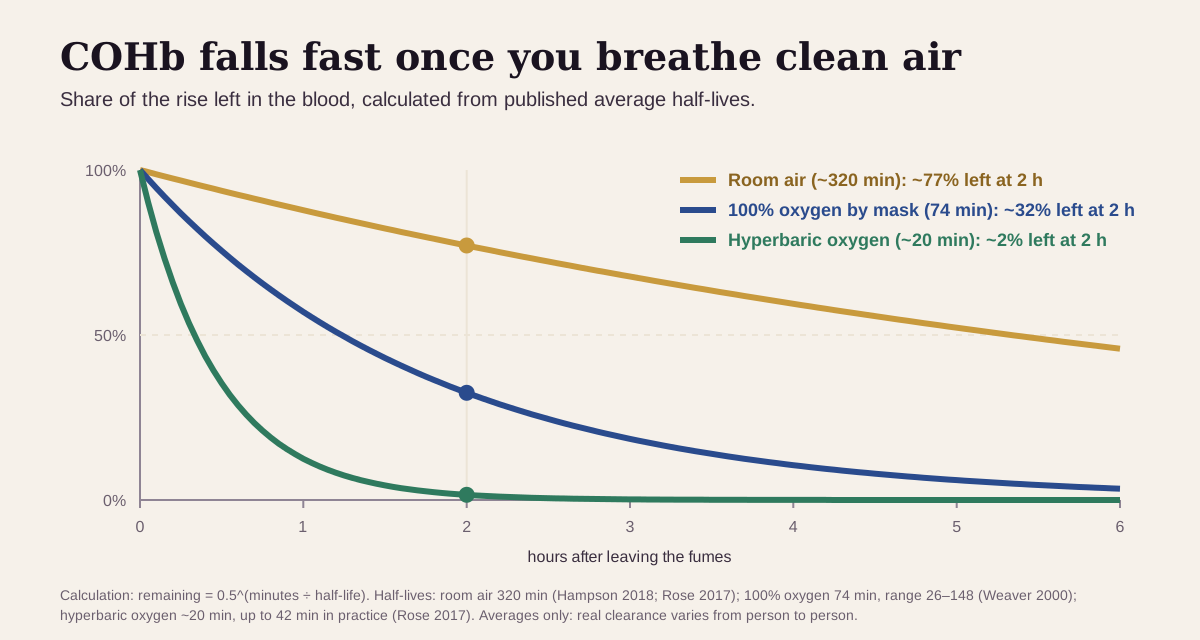
COHb falls quickly once you breathe clean air, and much faster on oxygen. Average half-lives:
- about 320 minutes on room air, with a range of 128–409;19
- 74 minutes on 100% oxygen by mask, ranging from 26 to 148 in 93 poisoned patients;19
- about 20 minutes in a hyperbaric chamber, and up to 42 minutes in practice.9
What that means in practice:
- The clock matters. The CDC notes that time since leaving the exposure changes the level, and after several hours on room air the test may be less useful. Tell the clinician when you left the fumes and whether you got oxygen on the way.6
- Treatment takes hours. The CDC advises 100% oxygen until symptoms resolve, usually about 4–5 hours.6
- Smokers' levels swing through the day. COHb clears too fast to be a good test of tobacco use; Labcorp points to urine cotinine for that.5 In NHANES II, 9.1% of current smokers had COHb of 1% or less, many of them light smokers.2
- Methylene chloride runs late. COHb can keep climbing for hours after the exposure, as the liver keeps converting the solvent.12
- Trends beat snapshots. In NHANES II, former smokers' median (0.77%) nearly matched never-smokers' (0.74%), so quitting brings COHb back to background. For a nonsmoker, the survey's authors treated anything above 2% as a sign of an unusual exposure, so a level that stays there on repeat tests has a source worth finding.2
Going deeper: why a pulse oximeter misses carbon monoxide
A standard fingertip pulse oximeter shines two colors of light through your finger. It reads COHb as if it were oxygen-carrying hemoglobin. In a dog experiment, pulse oximeters kept reading over 90% while the true oxygen-carrying hemoglobin fell below 30%: the reading was roughly oxyhemoglobin plus COHb.7 In 30 patients with COHb over 25%, pulse oximeters consistently overestimated oxygen saturation.17
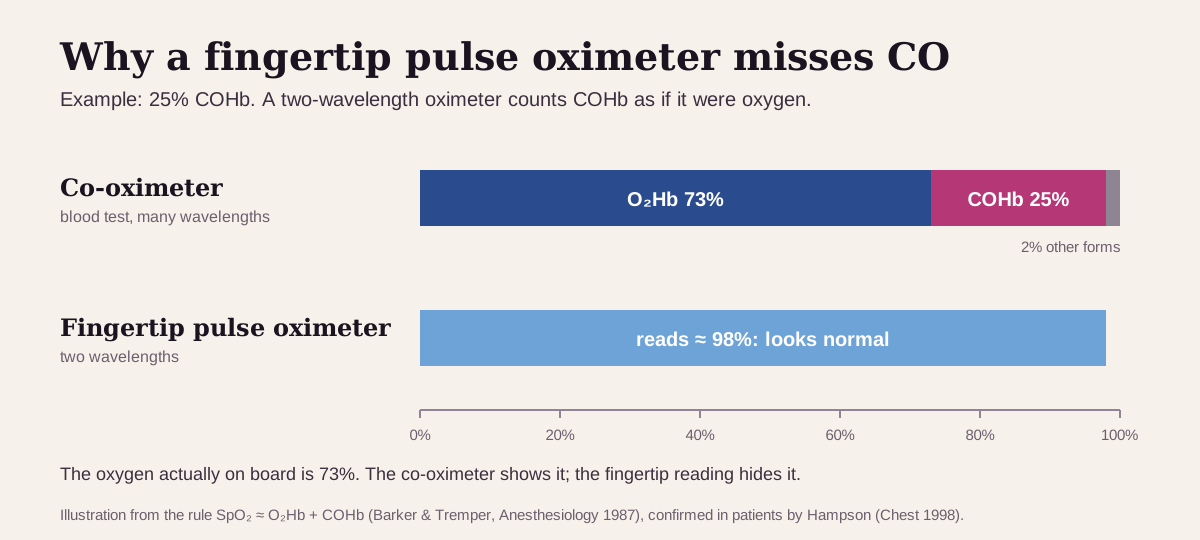
pO₂ is blind to it too, for a different reason. A blood gas's pO₂ measures oxygen dissolved in plasma, so it can look normal while hemoglobin carries far less oxygen. Hampson's arithmetic: at 70% COHb, with every other seat full, arterial saturation is 30%, a level that lack of oxygen alone would produce only at a pO₂ of about 20 mmHg.1 Accurate oxygen content in CO poisoning takes a lab co-oximeter.17
Pulse CO-oximeters (SpCO) use more wavelengths to estimate COHb at the fingertip, and paramedics use them to screen.8 In a 2023 meta-analysis they flagged 77% of elevated levels and correctly cleared 83% of normal ones, and a single reading could differ from the blood value by about 7–9 points either way.20 The blood COHb is what confirms the diagnosis.6
CO reaches beyond hemoglobin. Myoglobin, the oxygen store in heart muscle, binds CO 60 times more tightly than oxygen, and CO also blocks the last step of the energy chain inside mitochondria. That's one reason the heart and brain take the hardest hit, and why damage can outlast the COHb itself.9
Questions worth asking
- Was my COHb measured on a co-oximeter from a blood sample, or estimated with a fingertip device?
- How long after I left the exposure, and after how much oxygen, was my blood drawn?
- Does my level fit my smoking, or does it point to another source?
- Should my home, car or workplace be checked for CO, and where should my CO alarms go?
- Given my symptoms, do I need an ECG or a troponin test?
- What symptoms over the next few weeks should bring me back?
FAQ
What is a normal carboxyhemoglobin level? Under about 2% if you don't smoke; labs print upper limits of 1.5–2.0%. Smokers usually run 3–5%, and up to about 9%.134
What COHb level means carbon monoxide poisoning? The CDC says 2% or more in a nonsmoker, or over 9% in a smoker, strongly supports it when the history and symptoms fit. A sample drawn late can already look lower, so symptoms and the exposure count as much as the number.61
Can a pulse oximeter detect carbon monoxide? A standard fingertip pulse oximeter reads COHb as oxygen, so it can show a normal number during serious poisoning. A co-oximeter blood test measures COHb directly.67
How long does carbon monoxide stay in your blood? On average, half of it clears in about 5 hours on room air, about 74 minutes on 100% oxygen, and about 20 minutes with hyperbaric oxygen.1199
This guide is for education. Your own clinician, who knows your history, is the one to interpret your results.
Footnotes
-
Hampson NB. Carboxyhemoglobin: a primer for clinicians. Undersea Hyperb Med. 2018;45(2):165–171. A hyperbaric-medicine review: nonsmokers typically under 2%, smokers under 5% (3–5% usual, about 2.5 points per daily pack), over 9% almost always an outside source; room-air half-time 320 minutes (range 128–409); hemolysis levels (sickle cell 3.5–4.3%); arterial and venous COHb equivalent; a low level after delay or oxygen. PubMed ↩ ↩2 ↩3 ↩4 ↩5 ↩6 ↩7 ↩8 ↩9 ↩10 ↩11 ↩12 ↩13 ↩14 ↩15 ↩16
-
Radford EP, Drizd TA. Blood carbon monoxide levels in persons 3–74 years of age: United States, 1976–80. Advance Data from Vital and Health Statistics, No. 76. National Center for Health Statistics; 1982. NHANES II, Table 1: never-smokers median 0.72%, 95th percentile 1.65% (n=5,459); current smokers median 4.15%, 95th percentile 8.68% (n=2,533); plus the winter, heating and city findings. CDC/NCHS ↩ ↩2 ↩3 ↩4 ↩5 ↩6 ↩7 ↩8 ↩9 ↩10
-
National Library of Medicine. Abnormal hemoglobins testing. MedlinePlus Medical Encyclopedia. Reviewed April 1, 2025. Normal COHb under 1.5% (up to 9% in smokers); symptoms from 10–20%, severe near 30%, potentially deadly at 50–80%. MedlinePlus ↩ ↩2 ↩3 ↩4 ↩5 ↩6 ↩7 ↩8
-
ARUP Laboratories. Carboxyhemoglobin Quantitation, Whole Blood by Co-Oximetry (test 2005757). Opened September 23, 2026. ARUP is the University of Utah's nonprofit reference laboratory; this is its commercial test directory: nonsmokers 0–2.0%, 1–2 packs a day 0–5.0%, 3–4 packs a day 0–9.0%. ARUP ↩ ↩2 ↩3 ↩4 ↩5 ↩6
-
Labcorp. Carbon Monoxide, Whole Blood (test 007187). Opened September 23, 2026. A commercial laboratory's published test page: co-oximetry, nonsmoker under 2.0%, smoker under 9.0%, and urine cotinine as the better test for tobacco use. labcorp.com ↩ ↩2 ↩3 ↩4 ↩5 ↩6
-
Centers for Disease Control and Prevention. Clinical Guidance for Carbon Monoxide Poisoning Following Disasters and Severe Weather. Published July 2024, reviewed August 21, 2026. The source for the 2% (nonsmoker) and over 9% (smoker) diagnostic points, the over 25–30% hyperbaric threshold, pregnancy, co-oximetry on venous or arterial blood, the two-wavelength pulse-oximeter problem, elapsed time, 4–5 hours of 100% oxygen, cellular effects, and sickle cell disease. CDC ↩ ↩2 ↩3 ↩4 ↩5 ↩6 ↩7 ↩8 ↩9 ↩10 ↩11 ↩12 ↩13 ↩14 ↩15 ↩16 ↩17 ↩18 ↩19 ↩20
-
Barker SJ, Tremper KK. The effect of carbon monoxide inhalation on pulse oximetry and transcutaneous PO2. Anesthesiology. 1987;66(5):677–679. In dogs with COHb raised to 75%, pulse oximeters read over 90% while oxyhemoglobin fell below 30%; SpO2 ≈ COHb + O2Hb. PubMed ↩ ↩2 ↩3 ↩4 ↩5
-
Jüttner B, Busch HJ, Callies A, et al. S2k guideline diagnosis and treatment of carbon monoxide poisoning. Ger Med Sci. 2021;19:Doc13. The German multi-society guideline: CO binds heme 230–300 times more tightly than oxygen; 3–4% or more is elevated; smokers up to 10% without symptoms; hookah and fire smoke as sources; cyanide in smoke; delayed neurological problems; slower fetal elimination. PMC ↩ ↩2 ↩3 ↩4 ↩5 ↩6 ↩7 ↩8 ↩9
-
Rose JJ, Wang L, Xu Q, et al. Carbon monoxide poisoning: pathogenesis, management, and future directions of therapy. Am J Respir Crit Care Med. 2017;195(5):596–606. Oxygen held more tightly by the remaining seats; myoglobin's 60-fold affinity; mitochondrial effects; half-lives of 320 minutes (room air), 74 minutes (100% oxygen) and about 20 minutes (hyperbaric, up to 42 in practice); fire-injury data. PMC ↩ ↩2 ↩3 ↩4 ↩5 ↩6 ↩7
-
Hedblad B, Engström G, Janzon E, Berglund G, Janzon L. COHb% as a marker of cardiovascular risk in never smokers: results from a population-based cohort study. Scand J Public Health. 2006;34(6):609–615. 2,893 never-smoking men followed 19 years: top quarter (above 0.67%) vs bottom quarter (below 0.50%), relative risk 3.7 (95% CI 2.0–7.0) for cardiac events and 2.2 (1.4–3.5) for death. PubMed ↩ ↩2
-
Fazekas AS, Wewalka M, Zauner C, Funk GC. Carboxyhemoglobin levels in medical intensive care patients: a retrospective, observational study. Crit Care. 2012;16(1):R6. 868 patients; minimum COHb 0.9% in non-survivors vs 1.2% in survivors. PMC ↩
-
Agency for Toxic Substances and Disease Registry. Medical Management Guidelines for Methylene Chloride. Page last reviewed January 12, 2017. The solvent in paint strippers and degreasers is metabolized to CO; COHb rarely exceeds 15%, can rise for hours after exposure and stay elevated for 1–2 days. CDC/ATSDR ↩ ↩2 ↩3
-
Centers for Disease Control and Prevention. About Carbon Monoxide Poisoning. January 12, 2026. More than 400 deaths, 100,000 emergency visits and 14,000 hospital stays a year in the US from unintentional, non-fire CO poisoning; flu-like symptoms; CO alarms near every sleeping area. CDC ↩ ↩2
-
Sears DA, Udden MM, Thomas LJ. Carboxyhemoglobin levels in patients with sickle-cell anemia: relationship to hemolytic and vasoocclusive severity. Am J Med Sci. 2001;322(6):345–348. COHb correlated with hematocrit, reticulocyte count and unconjugated bilirubin. PubMed ↩
-
Henry CR, Satran D, Lindgren B, Adkinson C, Nicholson CI, Henry TD. Myocardial injury and long-term mortality following moderate to severe carbon monoxide poisoning. JAMA. 2006;295(4):398–402. 230 patients: myocardial injury in 37%; 38% vs 15% mortality at a median 7.6 years (adjusted hazard ratio 2.1). PubMed ↩
-
Weaver LK, Hopkins RO, Chan KJ, et al. Hyperbaric oxygen for acute carbon monoxide poisoning. N Engl J Med. 2002;347(14):1057–1067. Double-blind randomized trial, 76 patients per group: cognitive sequelae at 6 weeks in 25.0% with hyperbaric oxygen vs 46.1% with normobaric oxygen. PubMed ↩
-
Hampson NB. Pulse oximetry in severe carbon monoxide poisoning. Chest. 1998;114(4):1036–1041. 30 patients with COHb over 25%: pulse oximetry consistently overestimated oxygen saturation; accurate assessment needs a laboratory co-oximeter. PubMed ↩ ↩2 ↩3
-
Iolascon A, Bianchi P, Andolfo I, et al. Recommendations for diagnosis and treatment of methemoglobinemia. Am J Hematol. 2021;96(12):1666–1678. Normal methemoglobin under 1%; pulse oximeters read about 85% with significant methemoglobin; cyanosis that oxygen barely changes; benzocaine, lidocaine and dapsone as common causes; co-oximetry for diagnosis. PMC ↩
-
Weaver LK, Howe S, Hopkins R, Chan KJ. Carboxyhemoglobin half-life in carbon monoxide-poisoned patients treated with 100% oxygen at atmospheric pressure. Chest. 2000;117(3):801–808. 93 patients: half-life 74 ± 25 minutes, range 26–148. PubMed ↩ ↩2 ↩3
-
Papin M, Latour C, Leclère B, Javaudin F. Accuracy of pulse CO-oximetry to evaluate blood carboxyhemoglobin level: a systematic review and meta-analysis of diagnostic test accuracy studies. Eur J Emerg Med. 2023;30(4):233–243. Sensitivity 0.77, specificity 0.83, limits of agreement −7.08 to +8.57 points. PMC ↩
Educational content, not medical advice. Libby is a personal record tool, not a medical service — it doesn't diagnose, treat, or prescribe. Reference ranges vary by lab and by person. Talk to a qualified healthcare professional about your results.
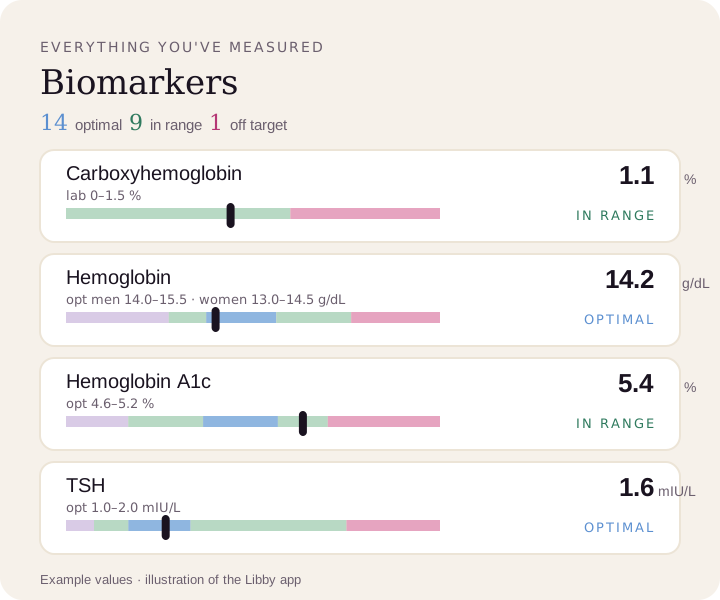
See every result against your lab's range.
Upload a lab PDF or a photo of your report. Libby puts every marker on your lab's range and tracks your trends over time.
View your carboxyhemoglobin ›