Methemoglobin: normal level, high causes, and when to worry
Methemoglobin is hemoglobin that holds no oxygen. Here's the normal level, what raises it, why pulse oximeters misread it, and when a high level is urgent.
Methemoglobin (MetHb) is hemoglobin whose iron has been pushed into the wrong chemical state, so it holds no oxygen. Your red cells make a little all the time and repair it just as fast, which keeps it under about 1% of your hemoglobin.1 A high level usually means a medicine or chemical is oxidizing hemoglobin faster than your red cells can fix it. In hospital records the most common culprits are the antibiotic dapsone and numbing sprays such as benzocaine.2
The short version
- Normal: healthy blood holds less than 1% methemoglobin. Lab ranges run up to about 1.5–2%.13
- Mildly high (about 2–10%) usually causes no symptoms. The most common cause is a medicine: in a series of 138 hospital cases, dapsone accounted for 42%, and benzocaine numbing spray caused the highest levels.2
- Very high is an emergency. Experts treat at 20% with symptoms or 30% without, and at lower levels in people with anemia or heart or lung disease. Levels above 70% can be fatal.1
- A standard fingertip pulse oximeter misreads it. The reading tends to sit near 85% whatever the real level. A blood test on a co-oximeter measures methemoglobin directly.45
What methemoglobin is
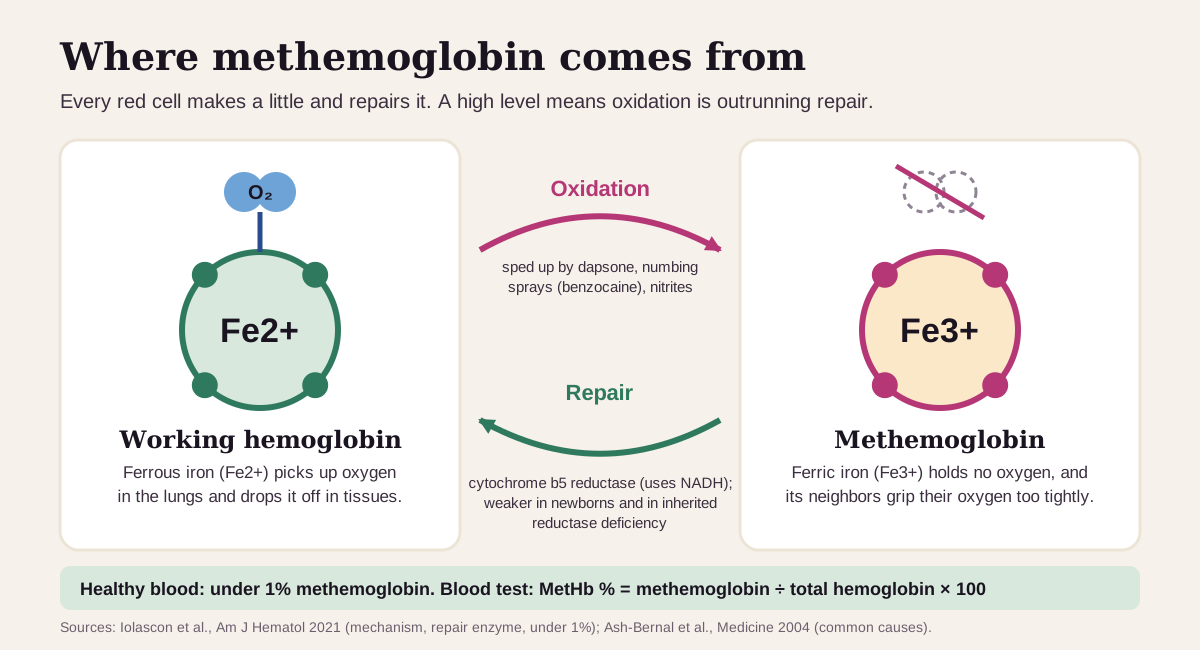
Hemoglobin is the protein in red blood cells that carries oxygen. Its iron normally sits in the ferrous (Fe2+) form, which picks up oxygen in the lungs and drops it off in your tissues.1
When something oxidizes that iron to the ferric (Fe3+) form, the molecule becomes methemoglobin. Ferric iron holds no oxygen, and it makes the other iron atoms in the same hemoglobin grip their oxygen too tightly, so tissues get less. The expert panel calls this a "functional anemia": your hemoglobin count looks normal, but less of it is working.1
Every red cell repairs this constantly. An enzyme called cytochrome b5 reductase, powered by NADH, turns ferric iron back into ferrous iron. Trouble starts when oxidation outruns repair: a drug or chemical speeds oxidation up, or an inherited problem slows the repair.1
You usually meet this test on a blood gas, not a routine checkup. Blood gas machines with co-oximetry (a light measurement at many wavelengths) report methemoglobin alongside oxygen and carbon monoxide levels. That's how a high level most often turns up: on a blood gas done for some other reason.14
What's a normal methemoglobin level?
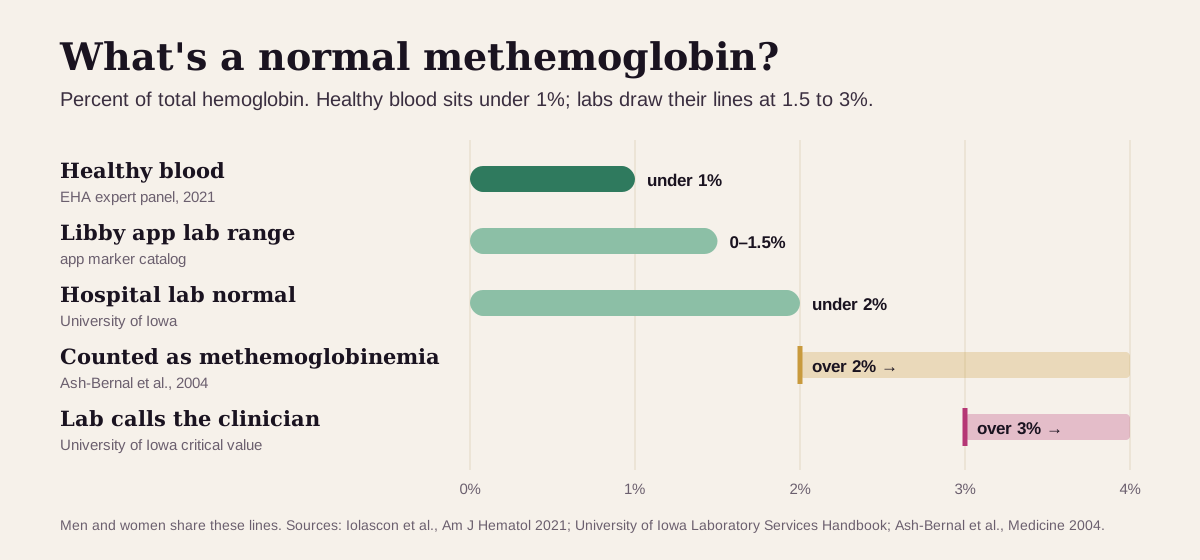
Healthy blood contains less than 1% methemoglobin, according to a 2021 expert panel of the European Hematology Association (EHA).1 Lab upper limits sit a little above that:
- The Libby app's marker catalog uses a lab range of 0–1.5%.
- The University of Iowa hospital lab reports under 2% as normal, and calls the clinician for any result over 3%.3
- A Johns Hopkins case series counted anything over 2% as methemoglobinemia.2
Men and women share the same range. A study of about 300 healthy children and teens, measured on a modern blood gas analyzer, needed no separate ranges for boys and girls for any of its tests, methemoglobin included.6
Babies are more vulnerable. Newborns have only about 50–60% of adult repair-enzyme activity, and their fetal hemoglobin oxidizes more easily.1 That's why nitrate in well water is mainly a danger for babies under 6 months.7
Because the result is a percentage, it reads best next to your total hemoglobin. Anemia, heart failure and lung disease all make the same percentage harder to tolerate.1
"Optimal" methemoglobin: no wellness target, clear danger lines
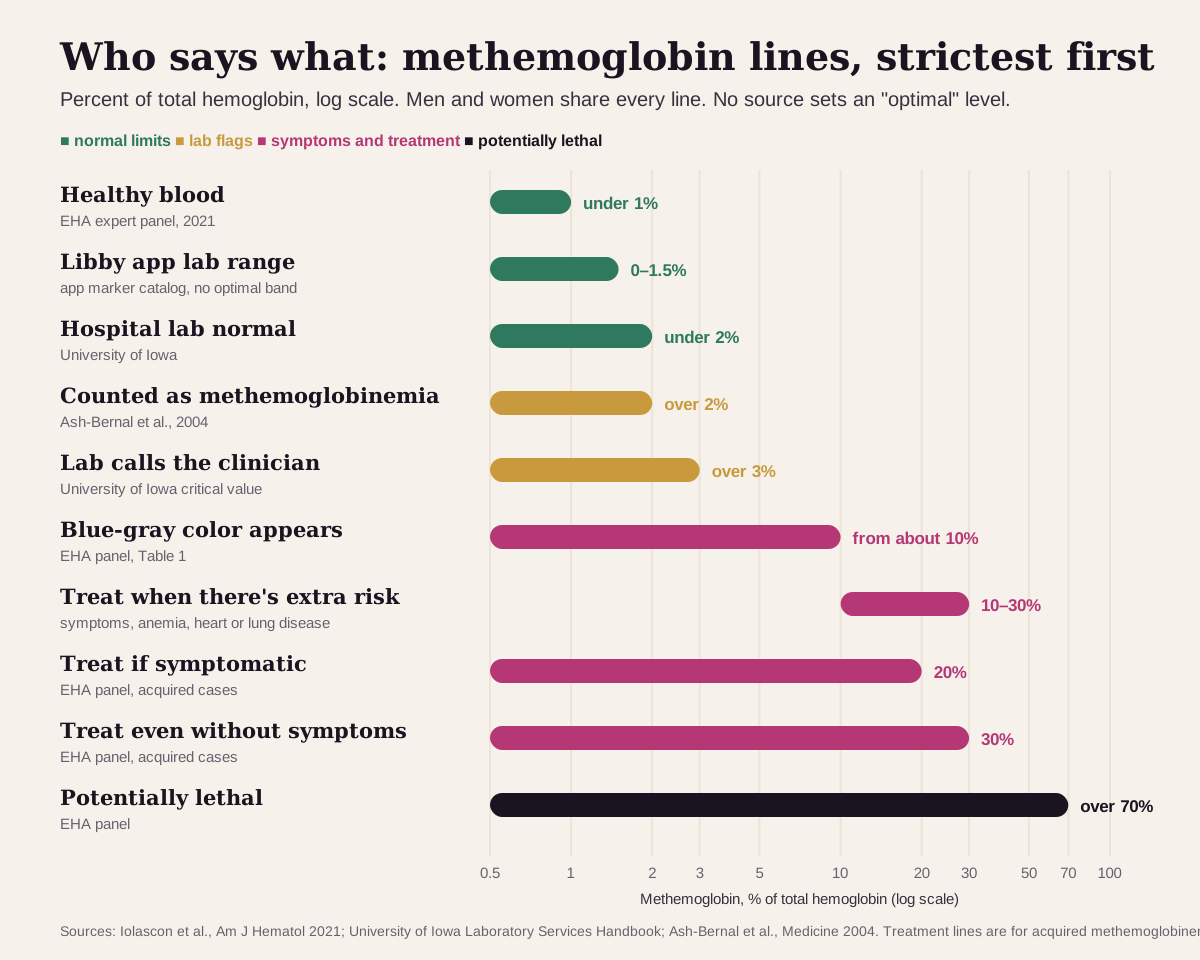
Methemoglobin has no "optimal" band: less is simply what healthy blood looks like, and the Libby app shows your result against your lab's range. What the research does give is a ladder of lines that matter, from the strictest lab limit to the point of danger:
| Line | Level (men and women) | Who uses it |
|---|---|---|
| Healthy blood | under 1% | EHA expert panel1 |
| Libby app lab range | 0–1.5% | The lab range in the Libby app's marker catalog, with no separate optimal band |
| Hospital lab normal | under 2% | University of Iowa3 |
| Counted as methemoglobinemia | over 2% | Johns Hopkins case series2 |
| Lab calls your clinician | over 3% | University of Iowa critical value3 |
| Blue-gray color appears | about 10% and up | Cyanosis and chocolate-brown blood at 10–30%1 |
| Treat when there's extra risk | 10–30% | Symptoms, significant anemia, heart or lung disease, or carbon monoxide poisoning1 |
| Treat if symptomatic | 20% | Acquired methemoglobinemia1 |
| Treat even without symptoms | 30% | Acquired methemoglobinemia1 |
| Urgent: potentially lethal | over 70% | EHA expert panel1 |
Why the lines drop for people who are already sick:
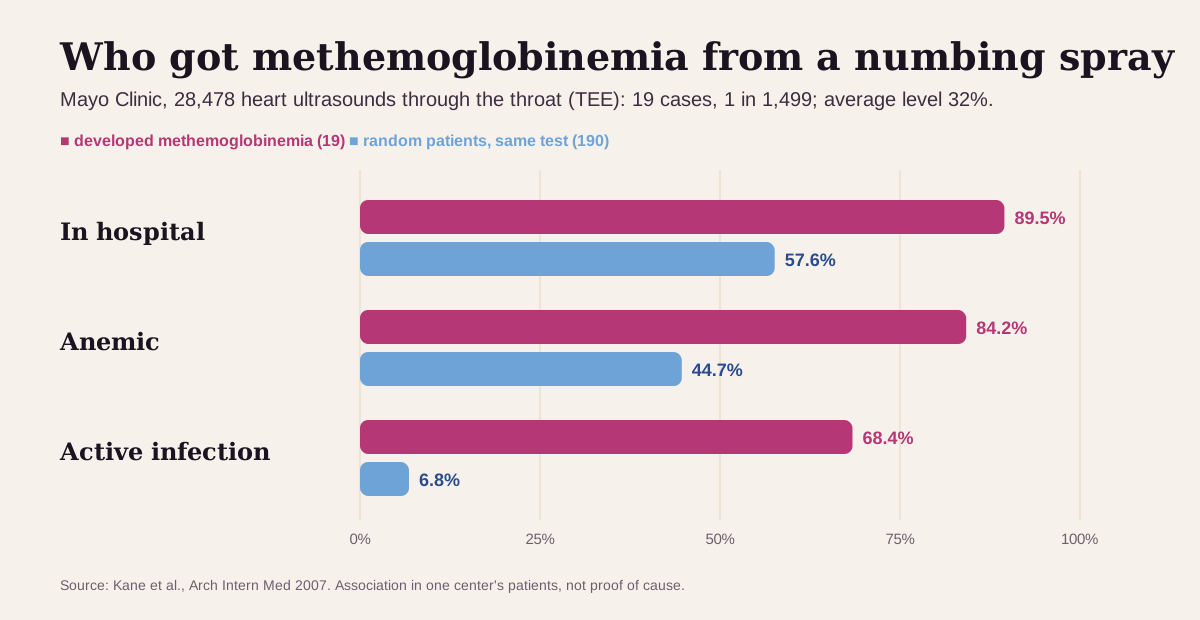
- At the Mayo Clinic, 19 of 28,478 people given a benzocaine throat spray for a transesophageal echocardiogram (a heart ultrasound through the throat) developed methemoglobinemia, about 1 in 1,500. Their average level was 32%. Compared with 190 random patients having the same test, they were far more likely to be anemic (84% vs 45%), to have an active infection (68% vs 7%), and to be in hospital (90% vs 58%).8
- In the Johns Hopkins series, 94% of people with methemoglobinemia were anemic.2
- Dose matters too. Among 167 children taking dapsone to prevent pneumonia during treatment for blood cancers or aplastic anemia, about 1 in 5 developed methemoglobinemia (median 9.0%). Doses 20% or more above the target raised the risk 6.25 times; doses 20% or more below it cut the risk by 73%.9
Keep these numbers in perspective: they're lines for acting, not goals. A result of 0.4% is no healthier than 0.9%; both are what healthy blood looks like. What matters is a rise above your lab's limit, how fast it happened, and how you feel, because symptoms depend on all three.1
What a high methemoglobin usually means
The level is the first clue, and the speed of the rise is the second. Symptoms track the percentage, but they also depend on how fast it climbed, your hemoglobin, and your heart and lungs.1
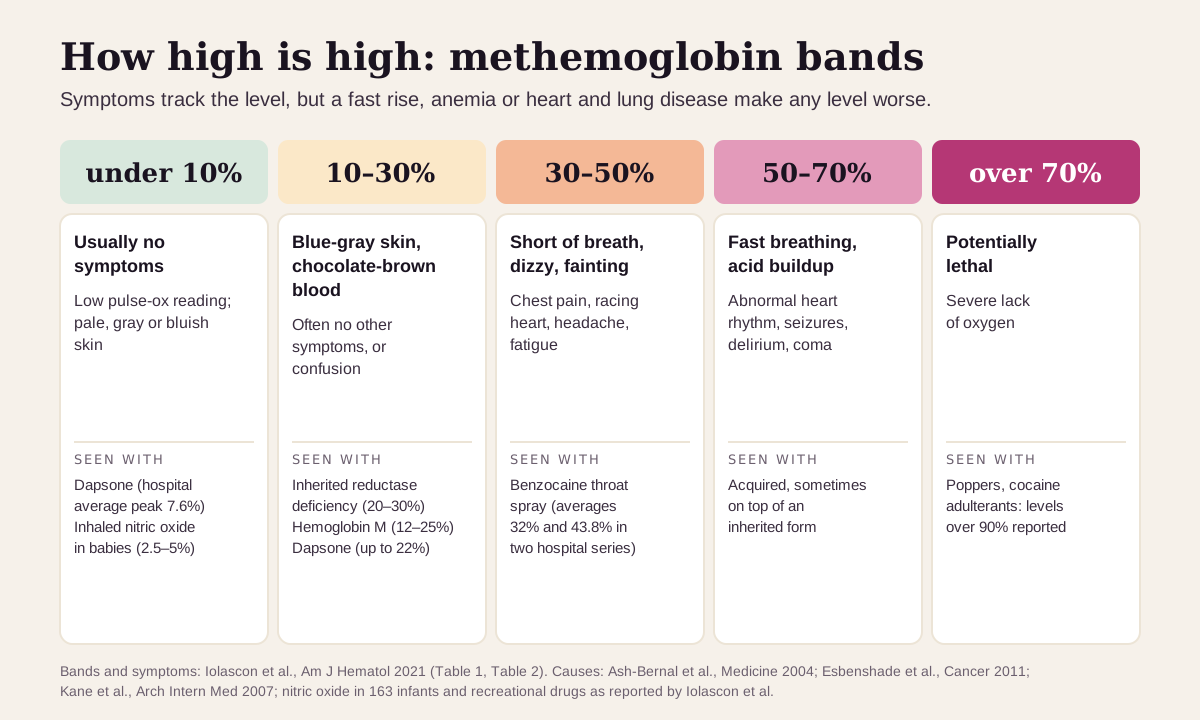
Mildly high (2–10%): common, usually a medicine
When a high level turns up by chance on a blood gas, it's usually 3–10%, often with no symptoms beyond a low pulse-oximeter reading or a change in skin color.1 Acquired causes are far more common than inherited ones.10
The usual suspects:
- Dapsone. This antibiotic, often used to prevent Pneumocystis pneumonia, was the most common cause in the Johns Hopkins series: 42% of cases, with an average peak of 7.6%.2 Dapsone keeps making methemoglobin for a long time, so levels can climb again after treatment.1
- Numbing sprays, gels and creams. Benzocaine and lidocaine are the drugs most often behind it, and prilocaine is on the list too.1 The FDA counted 119 cases tied to benzocaine products from 2009 to 2017, including 4 deaths. It warns that a single use can trigger it, even in someone who used benzocaine before without trouble, and that oral benzocaine products shouldn't be used in children under 2.11
- Other medicines. The EHA list includes sulfamethoxazole, phenazopyridine (a urinary pain reliever), primaquine, chloroquine, metoclopramide, rasburicase, and nitrates such as nitroglycerin.1 Don't stop a prescribed medicine on your own. Bring your full list to your clinician.
- Nitrate and nitrite in water or food. Fertilizer, septic systems and animal waste can contaminate private wells. The EPA's drinking-water limit is 10 mg/L of nitrate (as nitrogen), and it warns that babies under 6 months who drink water above it could become seriously ill.7 MedlinePlus also advises against homemade purees of high-nitrate vegetables, such as carrots, beets and spinach, for babies 6 months or younger.10
- Illness in babies. Infants can develop it with gut infections and dehydration.2 Babies treated with inhaled nitric oxide are watched for it: in one study of 163 treated infants, 16 reached 2.5–5% and one went above 5%.1
Inherited: lifelong and steady (10–30%)
- Cytochrome b5 reductase deficiency is inherited from both parents. In type I, people are blue-gray from birth, usually at 20–30%, and most feel fine. Type II also affects the brain and causes serious developmental problems.110
- Hemoglobin M disease comes from a change in a globin gene, inherited from one parent. Levels run about 12–25%, usually with the blue-gray color as the main sign.1
Very high (over 30%): an emergency
At 30–50%, people get short of breath, dizzy or faint, with chest pain, a racing heart and headache. From 50–70%, fast breathing, acid buildup in the blood, abnormal heart rhythms, seizures and coma can follow. Levels over 70% can be fatal.1 In hospital series, benzocaine spray caused many of the highest levels, averaging 32–44%.82 "Poppers" (amyl or isobutyl nitrite), nitrous oxide and cocaine cut with local anesthetics have pushed levels above 90%.1
Get care now if you or your child turns blue or gray around the lips, face or nails, especially with shortness of breath, headache, lightheadedness, a racing heart or fatigue, after a numbing spray, a new medicine or a chemical exposure. Call 911 for severe shortness of breath.1110
Methemoglobin reads best next to its neighbors
The pattern across your oxygen and blood tests says more than methemoglobin alone. Five results do most of the work: methemoglobin, the pulse-oximeter reading (SpO2), the oxygen pressure in arterial blood (pO2), hemoglobin, and LDH, an enzyme that rises when red cells break apart.412
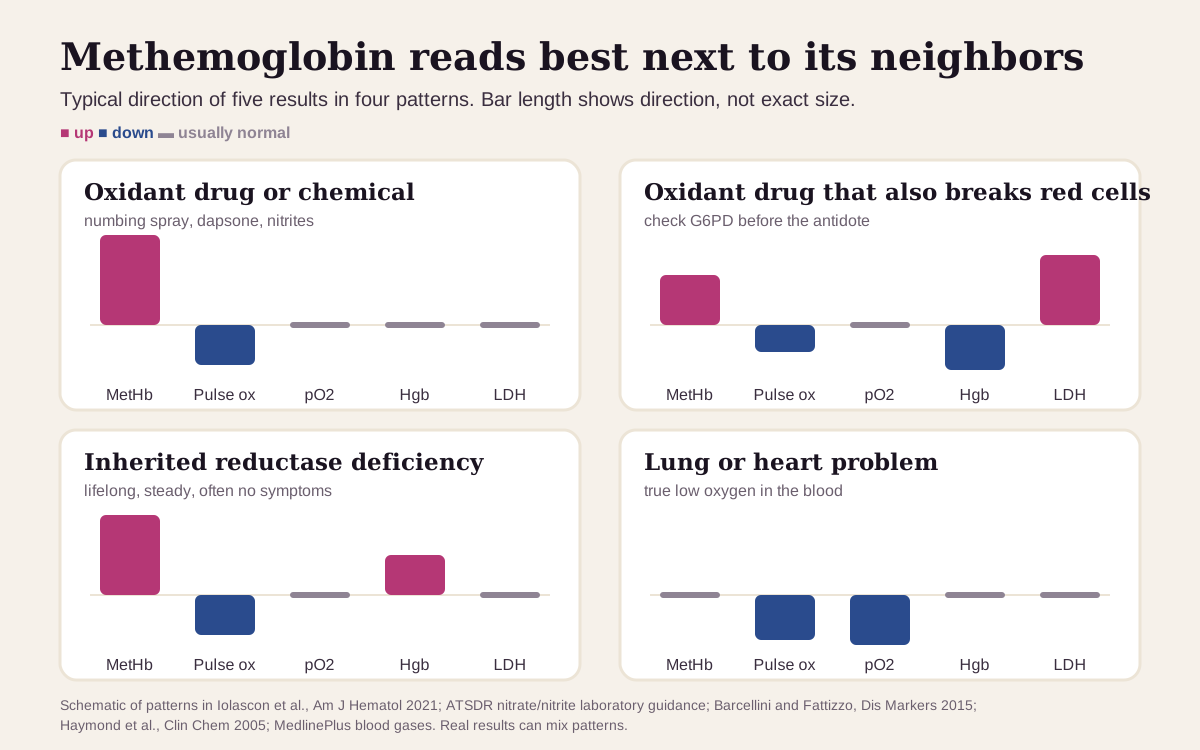
| If you see… | It often points to… |
|---|---|
| MetHb high, pulse ox stuck near 85%, pO2 normal, hemoglobin normal | a drug or chemical oxidizing hemoglobin: numbing spray, dapsone, nitrites |
| MetHb up with hemoglobin falling and LDH rising | an oxidant drug that is also breaking red cells. A G6PD test matters here, because the usual antidote can break red cells in G6PD deficiency |
| MetHb steady at 20–30% since birth, hemoglobin normal or high | inherited reductase deficiency (type I): the body often makes extra red cells to compensate |
| pO2 low and pulse ox low, MetHb normal | low oxygen from a lung or heart problem |
Real results often mix these patterns. In two hospital series, most people with drug-related methemoglobinemia were also anemic, which makes any level harder to tolerate.28
Two more clues come from the blood gas itself. With methemoglobin, arterial blood looks chocolate-brown and stays brown when exposed to air, and the pO2 is usually normal.4 A "saturation gap" of more than 5 points, between the oxygen saturation a blood gas machine calculates from pO2 and the one actually measured, points to methemoglobin, carbon monoxide or a rarer cousin, sulfhemoglobin.4
Is a low methemoglobin a problem?
No. Healthy blood carries less than 1%, and a result at or near zero simply means your red cells are keeping up with repairs.1
How fast methemoglobin changes
Methemoglobin moves in minutes to hours. The level reflects a running balance between new oxidation and repair, so it can rise quickly after an exposure and fall once the exposure stops.1
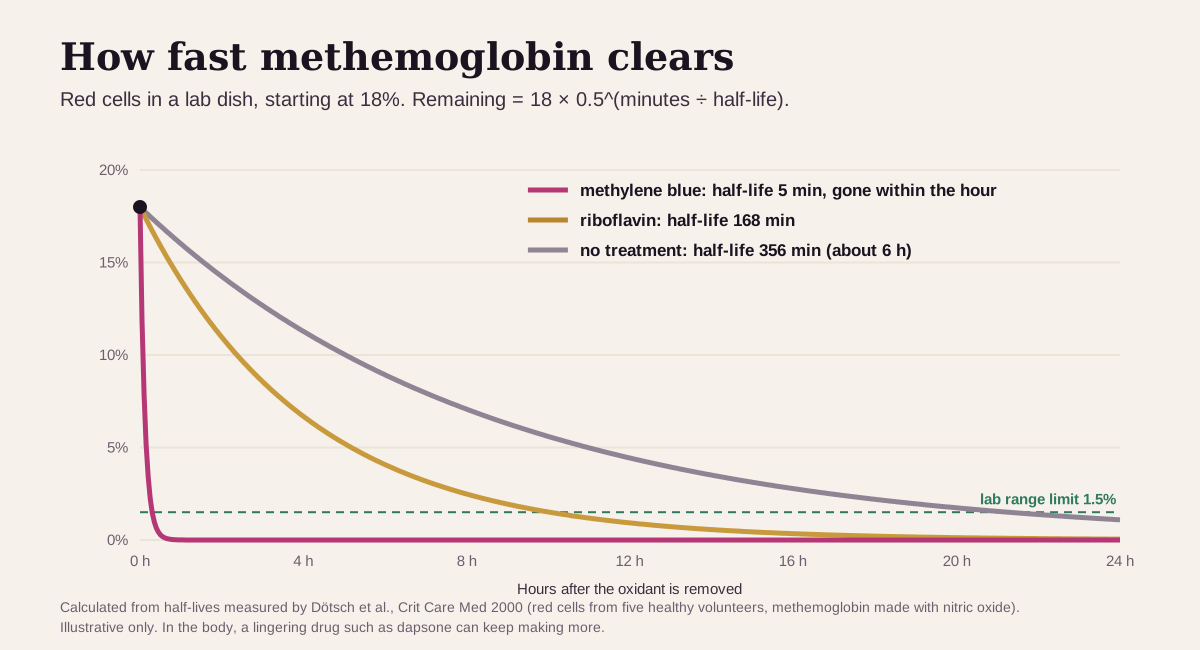
What that means in practice:
- Treatment works fast. In red cells from healthy volunteers, methylene blue cut methemoglobin's half-life from about 6 hours (356 minutes) to 5 minutes.14 In patients, the EHA panel expects intravenous methylene blue to lower the level substantially within an hour. Vitamin C (ascorbic acid) works too, but slowly, often over 24 hours or more.1
- Methylene blue has limits. In G6PD deficiency it can fail and can break red cells, so the panel advises a G6PD test in symptomatic patients with no known history. It also has no effect on hemoglobin M.110
- Some causes keep going. Dapsone keeps producing methemoglobin, so treatment may need repeating every 6–8 hours for 2–3 days.1 Nitrate poisoning from water can build up over a few days.7
- Inherited forms hold steady. In type I reductase deficiency the level stays about the same for life. A stable result over years points toward an inherited cause; a sudden rise points toward an exposure.1
- The sample needs to be fresh. The University of Iowa lab asks for delivery within 30 minutes of the draw.3
Going deeper: the two repair routes, and the 85% pulse-ox reading
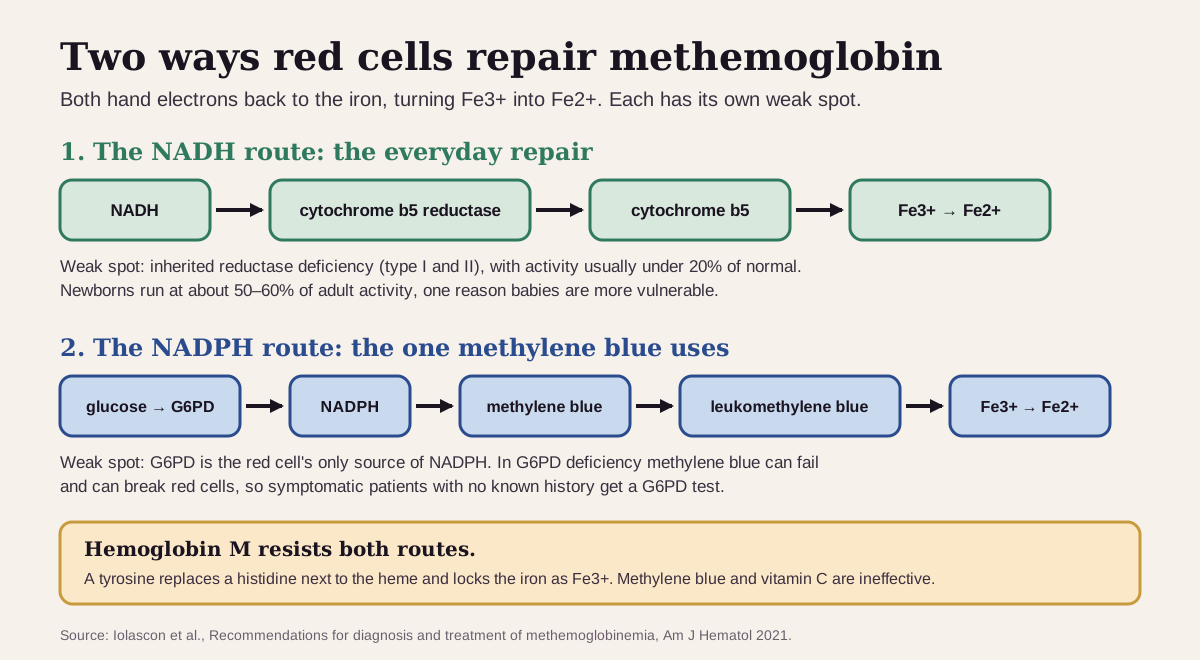
Red cells have two ways to turn ferric iron back into ferrous iron:1
- The NADH route (the everyday one). Cytochrome b5 reductase passes electrons from NADH through cytochrome b5 to the iron. This is the enzyme missing in inherited type I and II; residual activity is usually below 20% of normal. Newborns run at about 50–60% of adult activity.
- The NADPH route (the one methylene blue uses). Methylene blue takes an electron from NADPH and becomes leukomethylene blue, which reduces the iron. NADPH comes from G6PD, the first enzyme of the pathway that is the red cell's only source of NADPH. With too little G6PD, methylene blue has nothing to work with.
- Hemoglobin M resists both. In most M variants, a tyrosine replaces a histidine next to the heme and locks the iron in the ferric form. Methylene blue and vitamin C are ineffective, and the panel advises avoiding them.
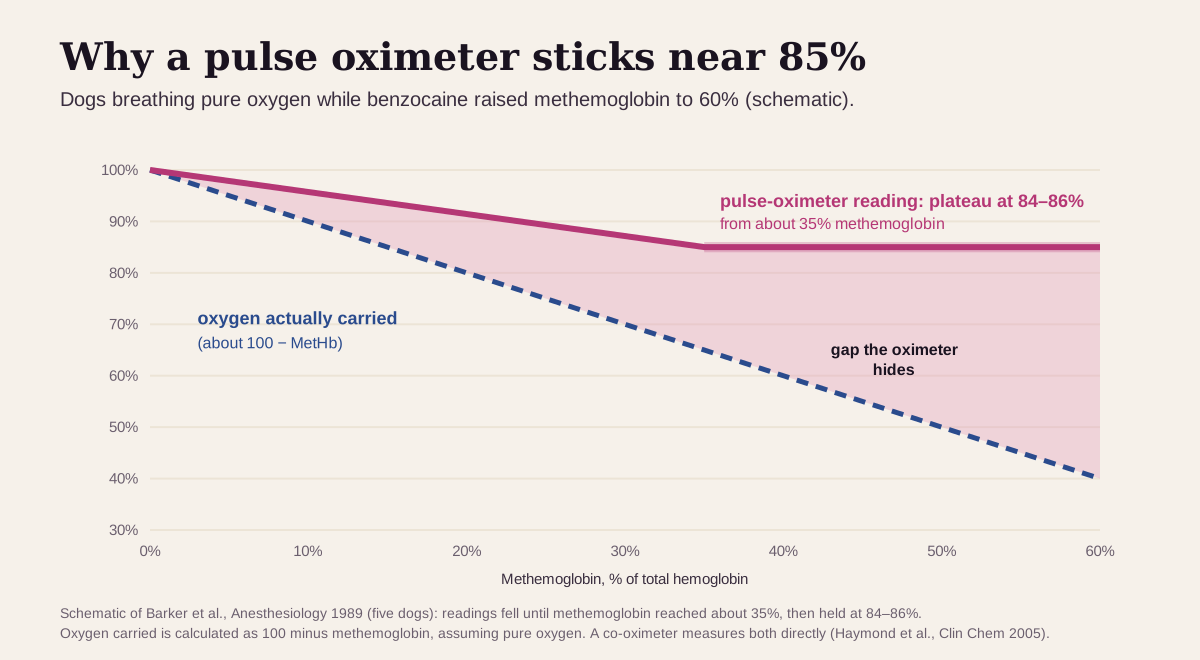
Why a pulse oximeter reads about 85%. A standard pulse oximeter shines two colors of light and assumes all hemoglobin is either oxygenated or deoxygenated.4 Methemoglobin absorbs light differently, which throws off that calculation, so most devices settle near 85% once methemoglobin is significant.1 In a classic study of five anesthetized dogs breathing pure oxygen, the reading fell only until methemoglobin reached about 35%, then held at 84–86% while methemoglobin kept rising toward 60%.15 The upshot: the number on the screen stops tracking how much oxygen your blood actually carries.4
The same blind spot affects many routine blood gas reports. When the machine calculates oxygen saturation from pO2 and pH, it assumes normal hemoglobin, so the number can look reassuring. A co-oximeter measures each form of hemoglobin at several wavelengths and reports the methemoglobin fraction directly.54 Newer multi-wavelength "pulse co-oximeters" can estimate methemoglobin through the skin.4
Questions worth asking
- Was my methemoglobin measured by co-oximetry on a blood sample, and what was the exact percentage?
- Could any of my medicines, numbing sprays or recent procedures explain it?
- What did my hemoglobin, pO2 and LDH show at the same time?
- Have I been tested for G6PD deficiency?
- If it stays high without an exposure, should we test the reductase enzyme or look for hemoglobin M?
- If we have a private well, should we test it for nitrate?
FAQ
What is a normal methemoglobin level? Healthy blood holds less than 1%. Lab ranges usually run up to 1.5–2%.13
What is the most common cause of high methemoglobin? A medicine. In one hospital series, dapsone caused 42% of cases, and benzocaine numbing spray caused the highest levels.2
Can a pulse oximeter detect methemoglobin? A standard one misreads it and tends to sit near 85%. A blood test on a co-oximeter, or a multi-wavelength pulse co-oximeter, measures it.4
When is high methemoglobin an emergency? When it comes with blue-gray skin and shortness of breath, confusion or chest pain. Experts treat at 20% with symptoms or 30% without, and levels over 70% can be fatal.1
This guide is for education. Your own clinician, who knows your history, is the right person to interpret your result.
Footnotes
-
Iolascon A, Bianchi P, Andolfo I, et al. Recommendations for diagnosis and treatment of methemoglobinemia. Am J Hematol. 2021;96(12):1666–1678. The EHA and EuroBloodNet expert consensus (22 experts, over 75% agreement on every recommendation). Source for the under-1% healthy level, the symptom bands (Table 1), the 20%/30% and 10–30% treatment lines, inherited forms (Table 2), the drug list, newborn enzyme activity, and methylene blue and vitamin C timing. PMC ↩ ↩2 ↩3 ↩4 ↩5 ↩6 ↩7 ↩8 ↩9 ↩10 ↩11 ↩12 ↩13 ↩14 ↩15 ↩16 ↩17 ↩18 ↩19 ↩20 ↩21 ↩22 ↩23 ↩24 ↩25 ↩26 ↩27 ↩28 ↩29 ↩30 ↩31 ↩32 ↩33 ↩34 ↩35 ↩36 ↩37 ↩38 ↩39 ↩40 ↩41 ↩42
-
Ash-Bernal R, Wise R, Wright SM. Acquired methemoglobinemia: a retrospective series of 138 cases at 2 teaching hospitals. Medicine (Baltimore). 2004;83(5):265–273. Johns Hopkins hospitals over 28 months; methemoglobinemia defined as over 2%. Dapsone caused 42% of cases (mean peak 7.6%); benzocaine spray caused the 5 most severe (mean peak 43.8%); 94% were anemic. PubMed ↩ ↩2 ↩3 ↩4 ↩5 ↩6 ↩7 ↩8 ↩9 ↩10 ↩11 ↩12 ↩13 ↩14
-
University of Iowa Health Care, Department of Pathology. Laboratory Services Handbook: Methemoglobin. Heparinized whole blood, oximetric method, reference range under 2%, critical value over 3%, delivery within 30 minutes. uiowa.edu ↩ ↩2 ↩3 ↩4 ↩5 ↩6 ↩7 ↩8
-
Agency for Toxic Substances and Disease Registry (CDC). Nitrate/Nitrite Toxicity: Clinical Assessment, Laboratory Tests. Case Studies in Environmental Medicine; last reviewed May 24, 2023. Pulse oximetry near 85%, normal arterial pO2, the saturation gap over 5%, chocolate-brown blood, co-oximetry and multi-wavelength pulse co-oximeters. CDC archive ↩ ↩2 ↩3 ↩4 ↩5 ↩6 ↩7 ↩8 ↩9 ↩10 ↩11
-
Haymond S, Cariappa R, Eby CS, Scott MG. Laboratory assessment of oxygenation in methemoglobinemia. Clin Chem. 2005;51(2):434–444. Explains pulse oximetry, co-oximetry and calculated saturation, and why pulse-oximeter values trend toward 85%. PubMed ↩ ↩2 ↩3 ↩4
-
Bohn MK, Hall A, Wilson S, Henderson T, Adeli K. Pediatric Reference Intervals for Critical Point-of-Care Whole Blood Assays in the CALIPER Cohort of Healthy Children and Adolescents. Am J Clin Pathol. 2021;156(6):1030–1037. About 300 healthy children and teens, venous blood on a Radiometer ABL90 FLEX PLUS; none of the 10 analytes, methemoglobin included, needed separate ranges by sex. PubMed ↩
-
U.S. Environmental Protection Agency. National Primary Drinking Water Regulations (nitrate limit 10 mg/L as nitrogen; infants under 6 months above it "could become seriously ill") and Potential Well Water Contaminants and Their Impacts (sources in fertilizer, sewage and animal waste; "can occur rapidly over a period of days"). EPA regulations; EPA private wells ↩ ↩2 ↩3
-
Kane GC, Hoehn SM, Behrenbeck TR, Mulvagh SL. Benzocaine-induced methemoglobinemia based on the Mayo Clinic experience from 28 478 transesophageal echocardiograms: incidence, outcomes, and predisposing factors. Arch Intern Med. 2007;167(18):1977–1982. 19 cases (1 per 1,499), mean level 32% ± 15%; compared with 190 random patients: hospitalized 89.5% vs 57.6%, anemic 84.2% vs 44.7%, active infection 68.4% vs 6.8%. PubMed ↩ ↩2 ↩3 ↩4 ↩5
-
Esbenshade AJ, Ho RH, Shintani A, et al. Dapsone-induced methemoglobinemia: a dose-related occurrence? Cancer. 2011;117(15):3485–3492. 167 children with blood cancers or aplastic anemia on dapsone to prevent Pneumocystis pneumonia; 32 (19.8%) developed methemoglobinemia, median 9.0% (range 3.5–22.4%). PMC ↩ ↩2
-
National Library of Medicine. Methemoglobinemia. MedlinePlus Medical Encyclopedia. Reviewed June 17, 2024. Inherited and acquired causes, symptoms, methylene blue and G6PD, when to call 911, and high-nitrate vegetable purees for babies. MedlinePlus ↩ ↩2 ↩3 ↩4 ↩5
-
U.S. Food and Drug Administration. Letter concerning OTC oral health care drug products containing benzocaine. May 21, 2018. 119 cases reported or published February 2009 to October 2017, 4 deaths; can occur after a single exposure; symptoms; no use in children under 2. FDA ↩ ↩2
-
Barcellini W, Fattizzo B. Clinical Applications of Hemolytic Markers in the Differential Diagnosis and Management of Hemolytic Anemia. Dis Markers. 2015;2015:635670. Red-cell breakdown raises LDH and bilirubin and lowers haptoglobin; hemoglobin sets the severity. PMC ↩ ↩2
-
National Library of Medicine. Blood gases. MedlinePlus Medical Encyclopedia. Reviewed August 19, 2024. Normal arterial pO2 of 75–100 mm Hg and oxygen saturation of 94–100%; abnormal results may come from lung disease. MedlinePlus ↩
-
Dötsch J, Demirakça S, Kratz M, et al. Comparison of methylene blue, riboflavin, and N-acetylcysteine for the reduction of nitric oxide-induced methemoglobinemia. Crit Care Med. 2000;28(4):958–961. Red cells from five healthy volunteers, 16–18% methemoglobin generated in the lab: half-life 356 min untreated, 168 min with riboflavin, 5 min with methylene blue. PubMed ↩ ↩2
-
Barker SJ, Tremper KK, Hyatt J. Effects of methemoglobinemia on pulse oximetry and mixed venous oximetry. Anesthesiology. 1989;70(1):112–117. Five anesthetized dogs, methemoglobin raised up to 60% with benzocaine; pulse-oximeter readings plateaued at 84–86% once methemoglobin reached about 35%. PubMed ↩ ↩2
Educational content, not medical advice. Libby is a personal record tool, not a medical service — it doesn't diagnose, treat, or prescribe. Reference ranges vary by lab and by person. Talk to a qualified healthcare professional about your results.
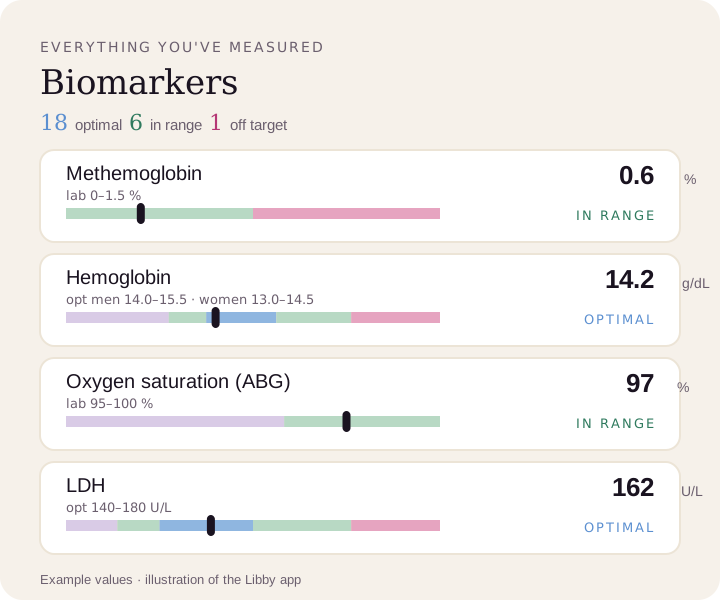
See every result against your lab's range.
Upload a lab PDF or a photo of your report. Libby puts every marker on your lab's range, adds the optimal range where one exists, and tracks your trends over time.
View your methemoglobin ›