Urine ketones test: what trace, small or large means
Urine ketones show your body burning fat. Here's what negative, trace, small and large mean, why strips miss mild ketosis, and when ketones are urgent.
Urine ketones are a sign that your body is burning fat for fuel. When you fast, eat very few carbs, exercise hard or have trouble keeping food down, your liver turns fat into ketones and a little spills into your urine. A trace or small amount is common and usually harmless. A moderate or large amount, especially if you have diabetes or feel sick, can be an early warning of diabetic ketoacidosis (DKA), a medical emergency.12
The short version
- Normal: most labs and strip makers expect negative. A trace (about 5 mg/dL) or small (about 15 mg/dL) result often follows an overnight fast, a low-carb diet, hard exercise or pregnancy.342
- The usual reasons for a positive result are fasting or skipped meals, a keto diet, a stomach bug with vomiting, long or hard exercise, and pregnancy. Diabetes that's out of control is the dangerous one.1
- Moderate or large (2+, about 40 mg/dL or more) with diabetes, high blood sugar, vomiting, belly pain or fast breathing needs prompt medical care. Guidelines use 2+ as the ketone part of the DKA diagnosis.54
- The strip reacts to acetoacetate. Blood tests measure beta-hydroxybutyrate (BHB), the main ketone in DKA, so a blood test is the more exact check.62
What urine ketones are
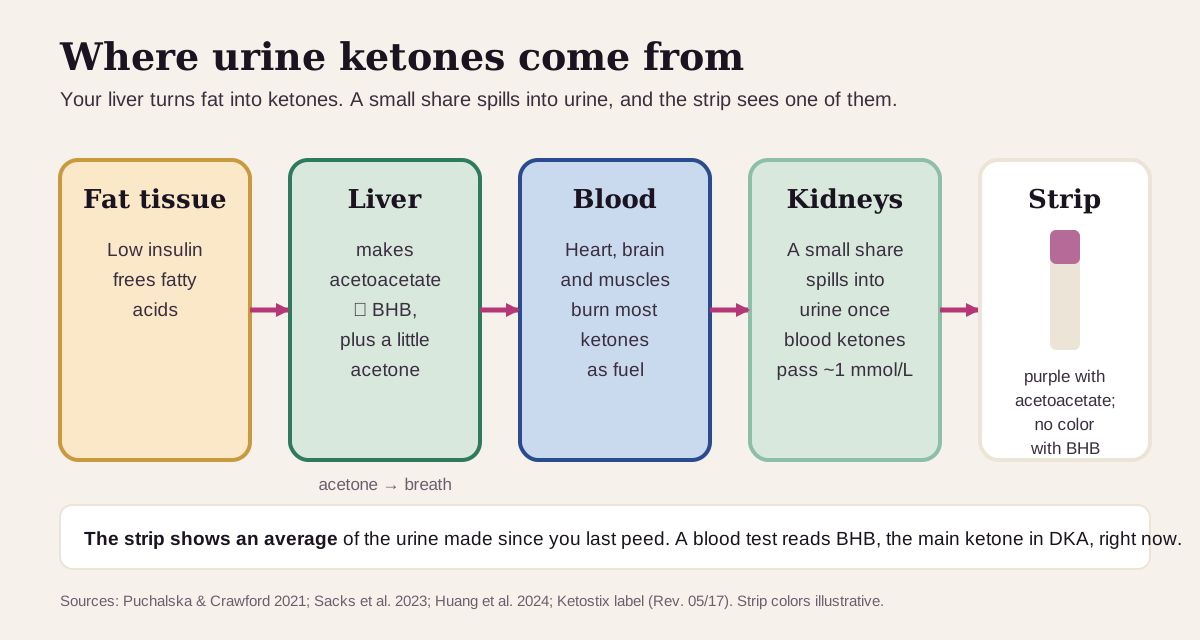
Your body's first choice of fuel is glucose. When glucose runs short, or when insulin is low, fat tissue releases fatty acids and your liver turns them into three ketones: acetoacetate, beta-hydroxybutyrate (BHB) and a small amount of acetone, which you breathe out.26 Your heart, brain and muscles burn most of these ketones as fuel. Only a small fraction ends up in urine, and urine levels climb once blood ketones pass about 1 mmol/L.7
A urine ketone test is one pad on a routine urinalysis, the strip-based urine test labs run on a random sample.9 You can also buy the same strips at a pharmacy and test at home.1 Either way, the pad turns from buff-pink toward purple or maroon when it meets acetoacetate.43 (More on the chemistry at the end.)
The strip reads the urine that collected in your bladder since you last peed, so it shows an average over that stretch, not a single moment.8
What's a normal urine ketone result?
Negative is the expected result. The FDA's review of one home strip states that "normally, no ketones are present in urine," and the Ketostix label says normal urine "ordinarily" reads negative.34 MedlinePlus puts it more loosely: having some ketones in your urine is normal, and what's normal for you depends on your diet and activity.1
Both are right. A lab report expects negative, but plenty of healthy people test positive at the right moment:
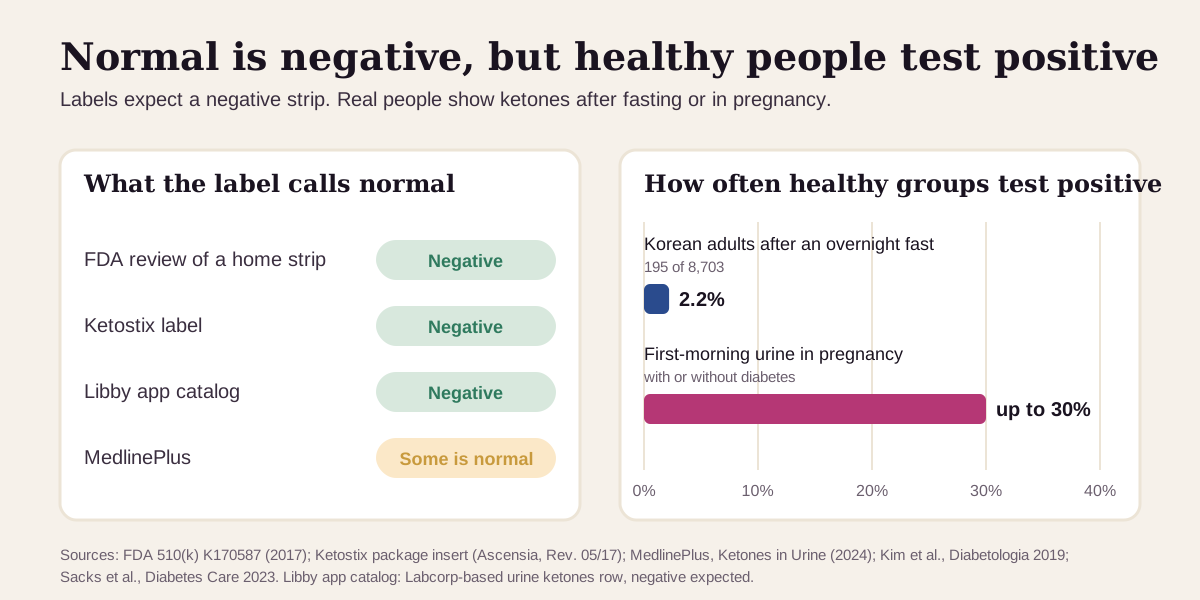
- In a Korean community study of 8,703 adults without diabetes, 195 (2.2%) had ketones in their urine after an overnight fast.10
- A joint laboratory-medicine and diabetes guideline notes positive readings in up to 30% of first-morning urine samples from pregnant women, with or without diabetes, and during starvation or after a low blood sugar.2
Men and women use the same scale. The guidelines and strip labels above use one scale for every sex and age. Pregnancy is the big exception in practice: the ADA calls pregnancy "a ketogenic state."11
"Optimal" urine ketones: what health optimizers aim for
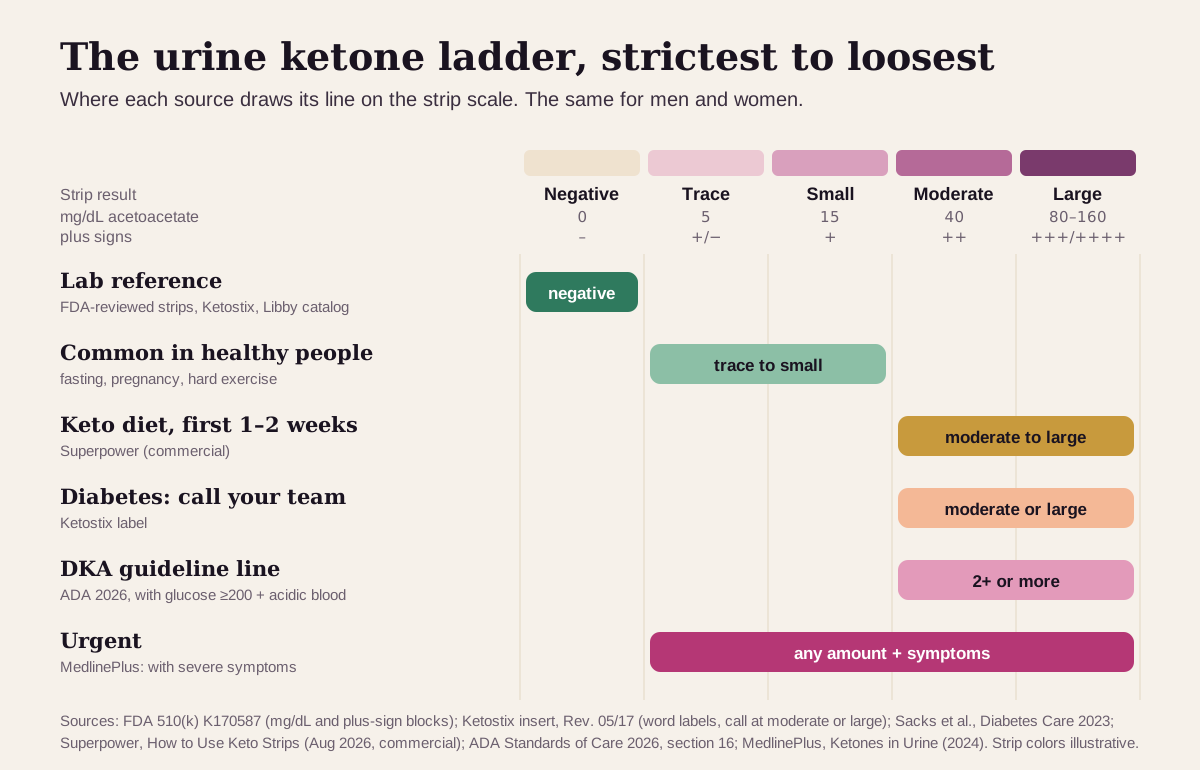
For most people the target is simple: negative on a routine urinalysis. Keto dieters flip that around and look for ketones on purpose. Here's the full ladder, from strictest to loosest, on the strip's own scale:
| Level | Result (men and women) | Who uses it |
|---|---|---|
| Strictest: lab reference | negative | FDA-reviewed strips and the Libby app's catalog both expect negative34 |
| Common in healthy people | trace to small (5–15 mg/dL) | After fasting, in pregnancy and with frequent hard exercise32 |
| Keto diet, first 1–2 weeks | moderate to large | Superpower's guide to keto strips; readings often fade after 3–4 weeks12 |
| Diabetes: call your care team | moderate or large (40 mg/dL or more) | The Ketostix instructions for people with diabetes4 |
| DKA guideline line | 2+ or more, plus glucose of 200 mg/dL or known diabetes, plus acidic blood | American Diabetes Association Standards of Care 20265 |
| Urgent | any amount with vomiting, belly pain, confusion, fruity breath or trouble breathing | MedlinePlus: seek immediate medical help1 |
The Libby app shows your urine ketone result exactly as your lab reported it and flags anything above negative. It has no numeric optimal range for this marker, because the result is a color category.
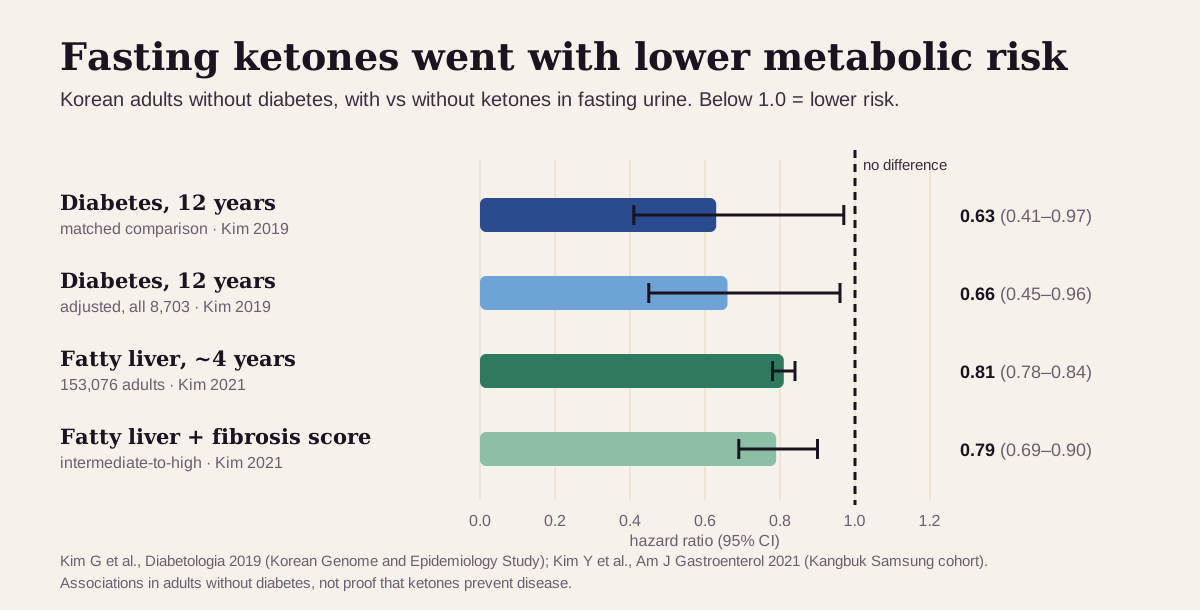
Why some people like seeing a trace: in the Korean study above, adults with ketones in their fasting urine had a 37% lower risk of developing diabetes over 12 years (hazard ratio 0.63) than matched adults without.10 In 153,076 Korean adults followed for about 4 years, fasting ketonuria went with a 19% lower risk of developing fatty liver (hazard ratio 0.81).13
Why a strip is a blunt tool for keto: in 263 paired samples from 50 women on a very-low-calorie diet, Ketostix picked up ketosis only 35% of the time at a blood BHB of 0.3 mmol/L or more, 52% at 0.5 or more, and 76% at 1.0 or more. It rarely turned positive without ketosis: specificity was 100%, 97% and 78%.14
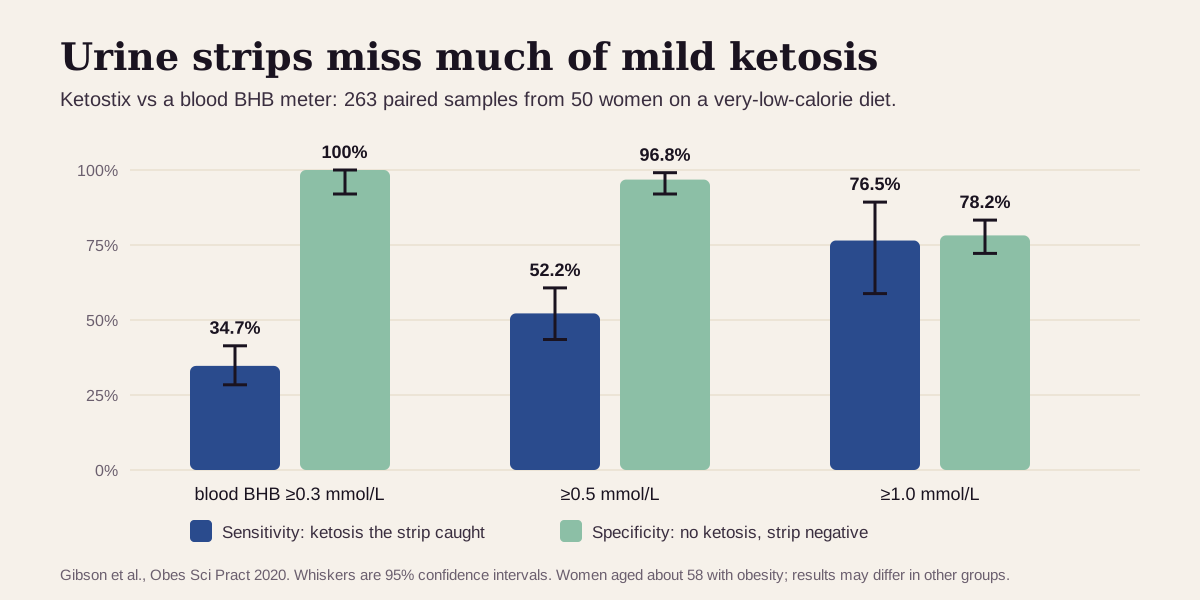
Keep "optimal" in perspective. A trace after an overnight fast simply shows your body switched to fat for a while. On a keto diet, a strip shows the ketones you're spilling, not how well the diet is working, and Superpower's guide notes that readings often get lighter after 3 to 4 weeks as muscles burn more of the ketones they make.12 If you want a number, a blood BHB meter gives one.8
What positive urine ketones usually mean
Start with how dark the strip is and how you feel. A trace in a healthy person who skipped breakfast is a different story from a large reading in someone with type 1 diabetes and a stomach bug.15
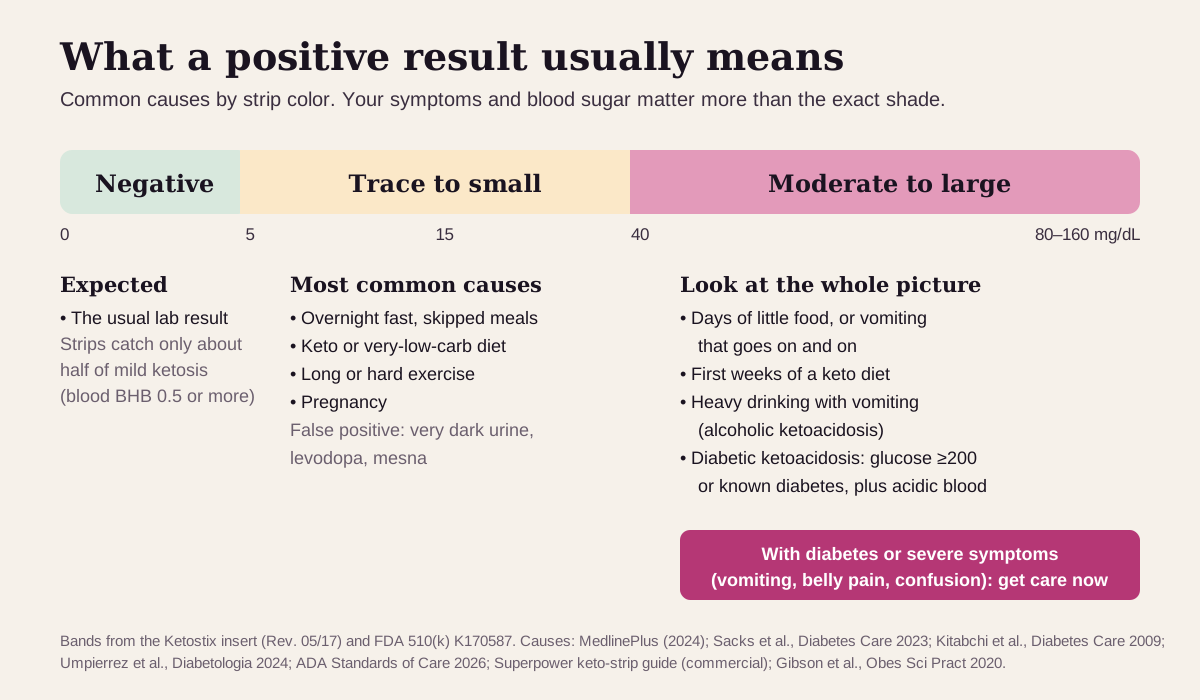
Trace or small (about 5–15 mg/dL): common, usually harmless
The usual suspects:
- Fasting or skipped meals. An overnight fast is enough for some people.102
- A keto or very-low-carb diet. MedlinePlus lists the keto diet among the common reasons for ketones in urine.1 Researchers consider strips fine for showing that a low-carb diet or exercise has raised ketone production.8
- Long or hard exercise. Strip makers list frequent strenuous exercise as a cause of detectable urine ketones.34
- Pregnancy. Up to 30% of first-morning samples in pregnancy test positive.2
- A false positive. Very dark urine, large amounts of levodopa (a Parkinson's medicine) and mesna (a chemotherapy drug) can make a strip read trace or show an odd color.4 Captopril, other ACE inhibitors and valproate have also been reported.26
Moderate or large (about 40 mg/dL or more): look at the whole picture
- Days of little food, or vomiting that goes on and on. Starvation ketosis usually comes with blood sugar that's low, normal or only mildly high, and a bicarbonate of 18 or higher.151 The consensus report ties it to eating under 500 calories a day.6
- The first weeks of a keto diet often read moderate to large on a strip, according to Superpower's guide.12
- Heavy drinking with vomiting. Alcoholic ketoacidosis gives positive urine ketones, usually without high blood sugar.2
- Diabetic ketoacidosis. DKA needs three things together: blood sugar of 200 mg/dL or more (or known diabetes), ketones (urine 2+ or more, or blood BHB 3.0 mmol/L or more), and acidic blood (pH under 7.3 or bicarbonate under 18).5 About 1 in 10 people with DKA have blood sugar under 200, most often with SGLT2 inhibitor medicines, in pregnancy, after little food or with alcohol.6
Get care now if you have diabetes and moderate or large ketones, or any ketones with nausea or vomiting, belly pain, confusion, trouble breathing, unusual sleepiness or fruity-smelling breath. Large amounts of ketones can be life-threatening.14 If you take an SGLT2 inhibitor (such as empagliflozin), check for ketones when you feel sick, even if your blood sugar is under 250 mg/dL.16
Urine ketones read best next to their neighbors
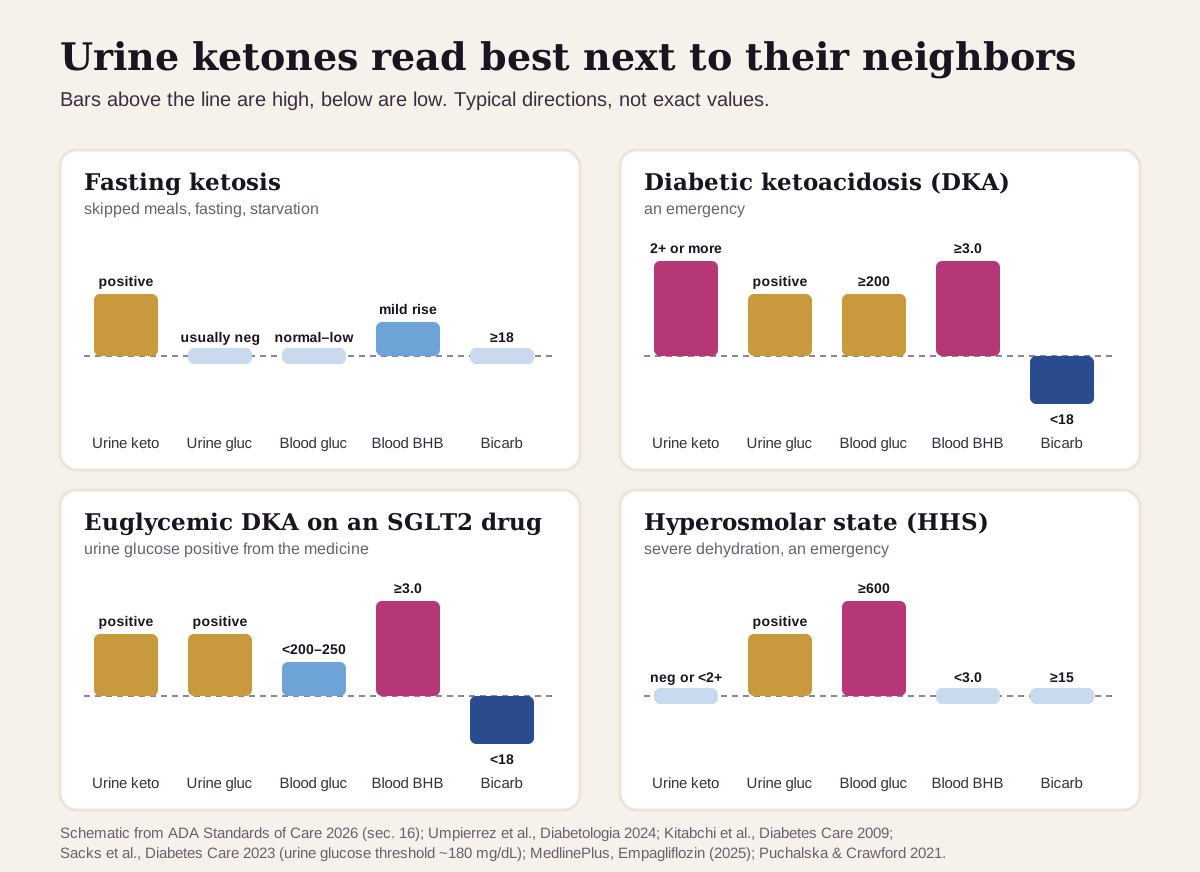
A positive strip says your body is making ketones. The other markers say whether that's harmless fasting or a crisis:515
| If you see… | It often points to… |
|---|---|
| Urine ketones positive, urine glucose usually negative, blood sugar normal or low, bicarbonate 18 or more | fasting or starvation ketosis: your body is running on fat |
| Urine ketones 2+ or more, urine glucose positive, blood sugar 200 or more, bicarbonate under 18 | diabetic ketoacidosis: an emergency |
| Urine glucose positive while blood sugar is under 200–250, ketones positive, bicarbonate low | euglycemic DKA, most often on an SGLT2 inhibitor, which pushes glucose into the urine on purpose |
| Blood sugar 600 or more, urine glucose positive, urine ketones negative or under 2+, bicarbonate 15 or more | hyperosmolar hyperglycemic state (HHS): severe dehydration, also an emergency |
Urine glucose is a useful partner because it shows up only once blood sugar passes about 180 mg/dL, the kidney's usual threshold.2 SGLT2 medicines are the exception: they can make your urine test positive for glucose even when your blood sugar is normal.16
How fast urine ketones change
Urine ketones move within hours, and they lag your blood. Each strip averages the urine made since your last trip to the bathroom.8
What that means in practice:
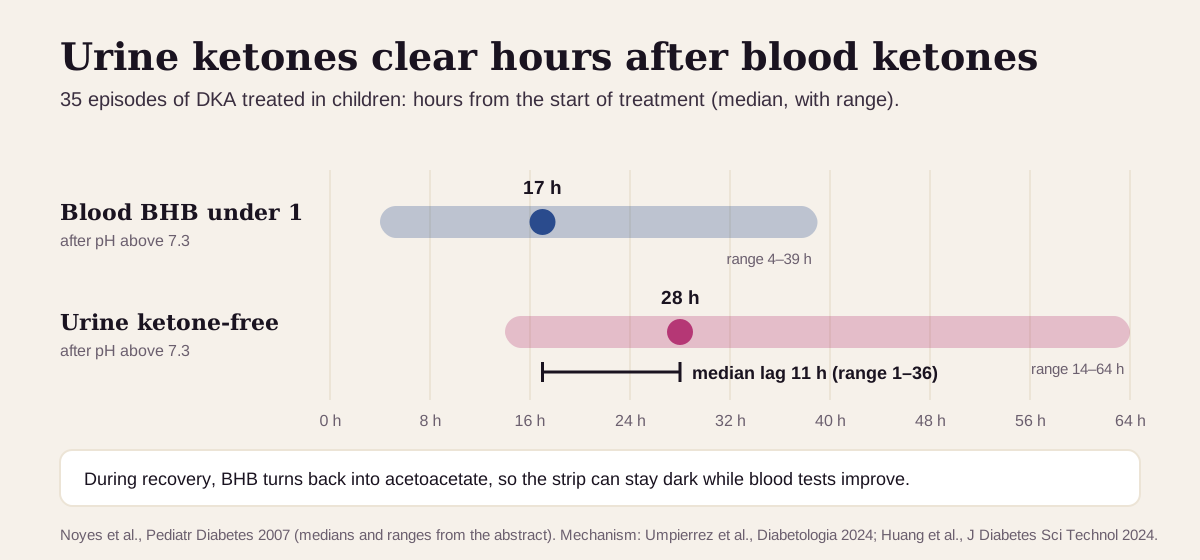
- Urine can look better or worse than your blood. Early in DKA, urine can understate how many ketones are in your blood. During recovery, BHB turns back into acetoacetate, so the strip can stay dark, or even get darker, while you're improving.68
- In children treated for DKA, blood ketones cleared at a median of 17 hours, and urine ketones at 28 hours: a median lag of 11 hours, and up to 36.17 That's why the consensus report recommends following blood BHB, pH and bicarbonate rather than urine.6
- Test the same way each time. Dip the strip in fresh urine and read it at exactly 15 seconds for Ketostix; other brands allow different times.43 Keep the bottle tightly capped: air exposure, expired strips and old urine all make readings too low. So can very acidic urine, for example after large doses of vitamin C.24 Ketostix says to throw out a bottle 6 months after opening.4
- Hydration shifts the color. Concentrated morning urine reads darker than dilute urine from the same body, Superpower's guide notes.12
- For young people with type 1 diabetes, a blood meter helps. In a trial of 123 young people, the blood-ketone group checked on 90% of sick days (versus 61% with urine strips) and had fewer emergency visits and hospital stays.8
Going deeper: what the strip actually detects
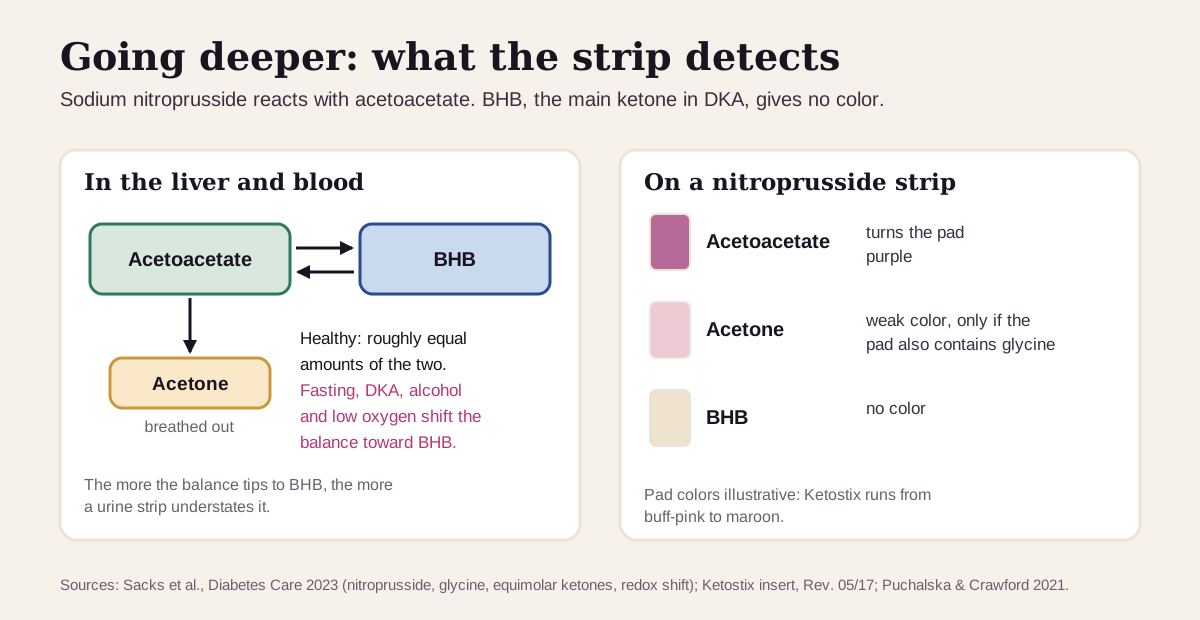
Most urine strips use sodium nitroprusside, which reacts with acetoacetate to make a purple color. Pads that also contain glycine pick up acetone too, but far more weakly. BHB gives no color at all.24
That matters because acetoacetate and BHB constantly convert into each other inside the liver. In a healthy person they're present in roughly equal amounts. Fasting, DKA, alcoholic ketoacidosis and low oxygen push the balance toward BHB, which the strip misses.2 So the sicker the situation, the more a urine strip tends to understate it, and the more useful a blood BHB test becomes.615
Blood BHB of 3.0 mmol/L or more tracks acid–base changes with over 90% sensitivity and specificity for DKA.6 Urine strips remain useful: they're cheap and painless, and a negative result makes DKA unlikely in someone with high blood sugar.2814
Questions worth asking
- Was this a random sample, first-morning urine, or taken after fasting?
- Does a trace or small result mean anything, given my diet, exercise and medicines?
- What were my blood sugar, bicarbonate and anion gap on the same day?
- If I have diabetes, at what strip color or blood BHB level should I call you?
- Would a blood ketone meter work better than urine strips for me?
- Could any of my medicines cause a false positive or push glucose into my urine?
FAQ
What is a normal urine ketone result? Negative. A trace or small amount often follows fasting, a low-carb diet, hard exercise or pregnancy, and is usually harmless in people without diabetes.342
What does "trace" ketones in urine mean? It's the lightest positive color, about 5 mg/dL of acetoacetate on Ketostix. It usually means your body burned some fat overnight or during exercise.43
Are moderate or large urine ketones dangerous? They can be. With diabetes, high blood sugar or symptoms like vomiting, belly pain or fast breathing, they're a warning sign of DKA and need prompt care. On a keto diet with no symptoms, they're common in the first weeks.5112
Are urine ketone strips accurate for keto? Only roughly. In one study they missed about half of mild ketosis (blood BHB 0.5 mmol/L or more). A blood BHB meter is more exact.14
This guide is for education. It can't diagnose you or replace care from a clinician who knows your history.
Footnotes
-
National Library of Medicine. Ketones in Urine. MedlinePlus. Updated November 12, 2024. Common reasons for ketones in urine, result wording, and symptoms that need immediate help. MedlinePlus ↩ ↩2 ↩3 ↩4 ↩5 ↩6 ↩7 ↩8 ↩9 ↩10 ↩11 ↩12
-
Sacks DB, Arnold M, Bakris GL, et al. Guidelines and Recommendations for Laboratory Analysis in the Diagnosis and Management of Diabetes Mellitus. Diabetes Care. 2023;46(10):e151–e199. The joint laboratory-medicine and ADA guideline. Source for ketone chemistry, the nitroprusside and glycine reaction, false positives and negatives, roughly equal acetoacetate and BHB, up to 30% positive first-morning samples in pregnancy, alcoholic ketoacidosis, and the ~180 mg/dL urine-glucose threshold. PMC ↩ ↩2 ↩3 ↩4 ↩5 ↩6 ↩7 ↩8 ↩9 ↩10 ↩11 ↩12 ↩13 ↩14 ↩15 ↩16 ↩17 ↩18 ↩19 ↩20 ↩21 ↩22
-
U.S. Food and Drug Administration. 510(k) K170587: On Call and Healthy Me Ketone Reagent Strips for Urinalysis (ACON Laboratories). May 2017. Sodium nitroprusside test for acetoacetic acid; color blocks negative, 5 (+/−), 15 (+), 40 (++), 80 (+++) and 160 (++++) mg/dL; read at 15–120 seconds; "normally, no ketones are present in urine." FDA ↩ ↩2 ↩3 ↩4 ↩5 ↩6 ↩7 ↩8 ↩9 ↩10 ↩11
-
Ascensia Diabetes Care. KETOSTIX Reagent Strips package insert (TN06516D, Rev. 05/17). A commercial source: the manufacturer's own label. Trace 5, small 15, moderate 40 and large 80–160 mg/dL; read at exactly 15 seconds; call your doctor at moderate or large; false-positive causes; discard 6 months after opening. ascensiadiabetes.com ↩ ↩2 ↩3 ↩4 ↩5 ↩6 ↩7 ↩8 ↩9 ↩10 ↩11 ↩12 ↩13 ↩14 ↩15 ↩16 ↩17 ↩18
-
American Diabetes Association Professional Practice Committee. 16. Diabetes Care in the Hospital: Standards of Care in Diabetes—2026. Diabetes Care. 2026;49(Suppl 1):S339–S355. Diagnostic criteria table: DKA with urine ketone strip 2+ or greater; HHS with glucose ≥600 mg/dL, urine strip under 2+ and bicarbonate ≥15. PMC ↩ ↩2 ↩3 ↩4 ↩5 ↩6 ↩7 ↩8 ↩9
-
Umpierrez GE, Davis GM, ElSayed NA, et al. Hyperglycaemic crises in adults with diabetes: a consensus report. Diabetologia. 2024;67(8):1455–1479. The ADA/EASD/JBDS/AACE/DTS consensus. Urine testing understates DKA early and overstates it late; BHB ≥3.0 mmol/L >90% sensitive and specific; euglycemic DKA in about 10%; false-positive drugs; starvation ketosis under 500 kcal/day. PMC ↩ ↩2 ↩3 ↩4 ↩5 ↩6 ↩7 ↩8 ↩9 ↩10 ↩11
-
Puchalska P, Crawford PA. Metabolic and Signaling Roles of Ketone Bodies in Health and Disease. Annu Rev Nutr. 2021;41:49–77. Ketone physiology: only a small fraction of ketones is lost in urine, and urine ketones rise once blood ketones exceed about 1 mM. PMC ↩ ↩2 ↩3 ↩4
-
Huang J, Yeung AM, Bergenstal RM, et al. Update on Measuring Ketones. J Diabetes Sci Technol. 2024;18(3):714–726. A urine reading averages the urine since the last void; strips are acceptable for low-carb diets and exercise; urine lags as DKA resolves; the 123-youth blood-versus-urine trial (90% versus 61% of sick days checked). PMC ↩ ↩2 ↩3 ↩4 ↩5 ↩6 ↩7 ↩8
-
Labcorp. Urinalysis, Complete (test 003038). A commercial laboratory's own test page, accessed September 23, 2026. Ketones are one of the reagent-strip tests on every routine urinalysis. labcorp.com ↩
-
Kim G, Lee SG, Lee BW, et al. Spontaneous ketonuria and risk of incident diabetes: a 12 year prospective study. Diabetologia. 2019;62(5):779–788. Korean Genome and Epidemiology Study: 195 of 8,703 adults without diabetes had fasting ketonuria; hazard ratio for diabetes 0.63 (95% CI 0.41–0.97) matched, 0.66 (0.45–0.96) adjusted. PubMed ↩ ↩2 ↩3 ↩4 ↩5
-
American Diabetes Association Professional Practice Committee. 15. Management of Diabetes in Pregnancy: Standards of Care in Diabetes—2026. Diabetes Care. 2026;49(Suppl 1):S321–S338. "Pregnancy is a ketogenic state"; DKA can occur at lower blood glucose in pregnancy. PMC ↩
-
Superpower. How to Use Keto Strips to Test Ketosis. Last updated August 31, 2026. A commercial source, listed as what the optimizer community uses: moderate to large readings in the first one to two weeks of keto, lighter readings after three to four weeks, and hydration effects. superpower.com ↩ ↩2 ↩3 ↩4 ↩5 ↩6
-
Kim Y, Chang Y, Kwon MJ, et al. Fasting Ketonuria and the Risk of Incident Nonalcoholic Fatty Liver Disease With and Without Liver Fibrosis in Nondiabetic Adults. Am J Gastroenterol. 2021;116(11):2270–2278. 153,076 Korean adults, median 4.1 years; hazard ratio for fatty liver 0.81 (0.78–0.84), and 0.79 (0.69–0.90) with an intermediate-to-high fibrosis score. PubMed ↩ ↩2
-
Gibson AA, Eroglu EI, Rooney K, et al. Urine dipsticks are not accurate for detecting mild ketosis during a severely energy restricted diet. Obes Sci Pract. 2020;6(5):544–551. 263 paired samples from 50 postmenopausal women; Ketostix sensitivity 34.7%, 52.2% and 76.5% and specificity 100%, 96.8% and 78.2% at blood BHB ≥0.3, ≥0.5 and ≥1.0 mmol/L. PMC ↩ ↩2 ↩3 ↩4
-
Kitabchi AE, Umpierrez GE, Miles JM, Fisher JN. Hyperglycemic crises in adult patients with diabetes. Diabetes Care. 2009;32(7):1335–1343. Starvation ketosis: glucose from mildly high (rarely over 200 mg/dL) to low, bicarbonate usually not under 18. PMC ↩ ↩2 ↩3 ↩4 ↩5
-
National Library of Medicine. Empagliflozin. MedlinePlus Drug Information. Last revised July 15, 2025. The medicine removes glucose through the urine, urine may test positive for glucose, and ketones should be checked with symptoms even when blood sugar is under 250 mg/dL. MedlinePlus ↩ ↩2 ↩3
-
Noyes KJ, Crofton P, Bath LE, et al. Hydroxybutyrate near-patient testing to evaluate a new end-point for intravenous insulin therapy in the treatment of diabetic ketoacidosis in children. Pediatr Diabetes. 2007;8(3):150–156. 35 episodes; blood end-point at a median of 17 h (4–39) versus ketone-free urine at 28 h (14–64); median lag 11 h (1–36). PubMed ↩ ↩2
Educational content, not medical advice. Libby is a personal record tool, not a medical service — it doesn't diagnose, treat, or prescribe. Reference ranges vary by lab and by person. Talk to a qualified healthcare professional about your results.
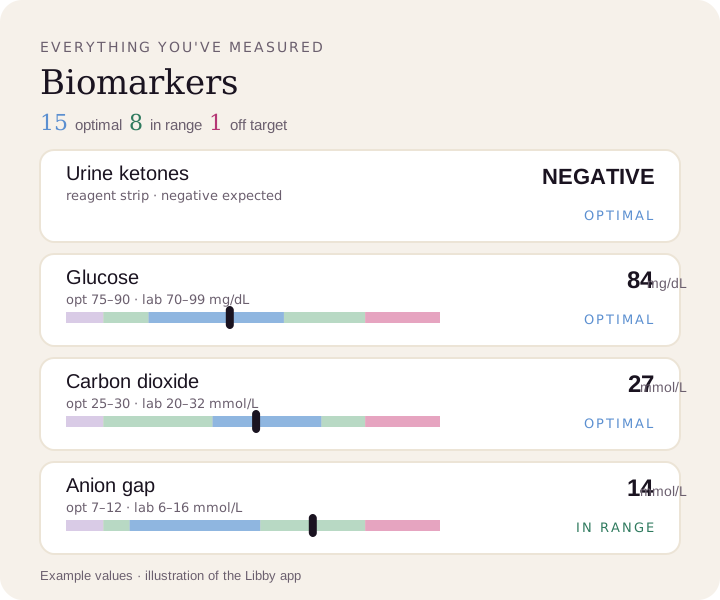
See every result against your lab's range.
Upload a lab PDF or a photo of your report. Libby shows each urine result as your lab reported it, flags anything above negative, puts your blood markers on your lab's range, and tracks your trends over time.
View your urine ketones ›