Urine glucose test: what negative, trace and positive mean
Glucose in urine usually means blood sugar passed your kidneys' limit. What a normal result is, the common causes of a positive, and when it's urgent.
Urine glucose is sugar that has spilled from your blood into your urine. Your kidneys filter about 160–180 grams of glucose a day and pump more than 99% of it back, so a normal result is negative.1 Glucose shows up when blood sugar climbs past what the kidneys can carry back, roughly 180 mg/dL, or when a medicine switches that pump off.23
The short version
- Normal: negative on a dipstick. Healthy kidneys pass under about 30 mg/dL, below what a strip can see.4 On a quantitative lab test, ARUP's upper limit is 15 mg/dL for a random sample.5
- Positive most often means high blood sugar from diabetes.6 The other common causes are SGLT2-inhibitor medicines such as dapagliflozin, which put glucose in urine on purpose, and pregnancy.37
- Urgent: glucose in urine together with ketones, plus vomiting, belly pain or deep, fast breathing, can mean diabetic ketoacidosis. Get care right away.8
- Urine only shows blood sugar above the kidney's spill point. Diabetes is diagnosed with blood tests: an A1c of 6.5% or more, or a fasting glucose of 126 mg/dL or more.2
What urine glucose is
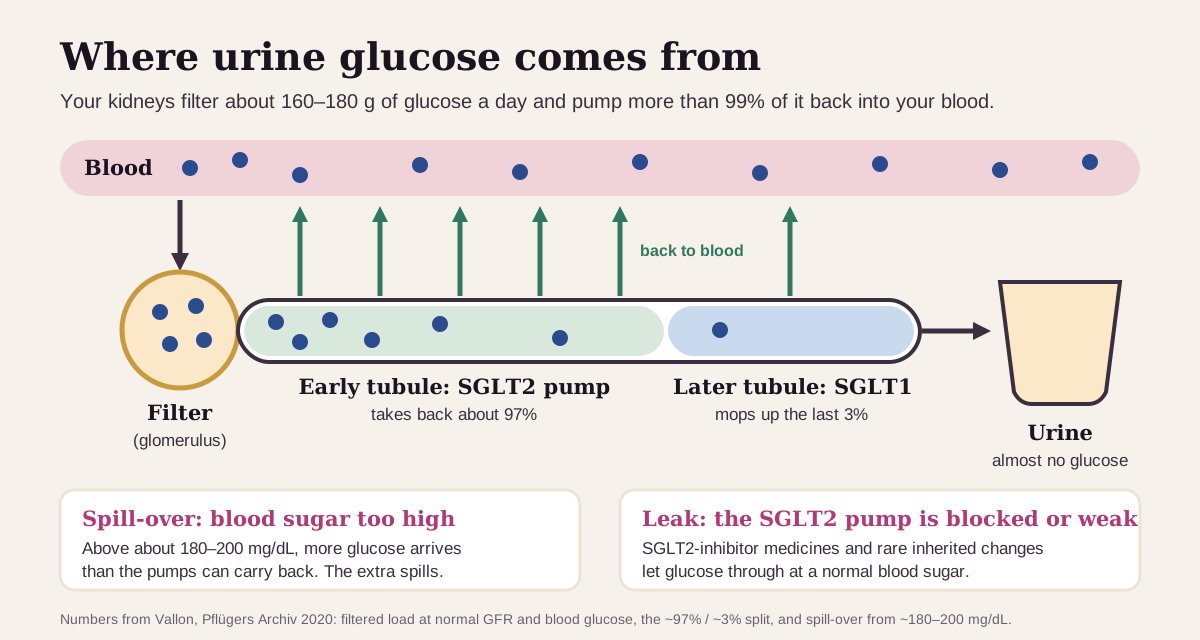
Glucose is the sugar your blood carries to every cell. It's small enough to pass freely through the kidney's filters, so at a normal blood sugar your kidneys filter about 160–180 g a day, roughly a third of the energy you burn.1
Two pumps in the kidney tubule pull it back. SGLT2, in the early tubule, returns about 97% of the filtered glucose. SGLT1, further along, mops up the last 3%.1 The result is urine that's almost free of glucose.
Those pumps have a top speed. When blood sugar runs high enough, more glucose arrives than they can carry, and the rest spills into urine. That's why urine strips were once the main home test for diabetes, before blood and sensor glucose monitoring replaced them.2
Most people see urine glucose as one line on a urinalysis, the routine urine test done at checkups and in pregnancy.6
What's a normal urine glucose?
Normal is negative. Healthy kidneys let a trace through: Siemens, which makes the common Multistix strips, puts normal output under about 30 mg/dL (1.67 mmol/L). The strip starts to detect glucose at about 72–126 mg/dL (4–7 mmol/L), so a normal amount reads negative.4
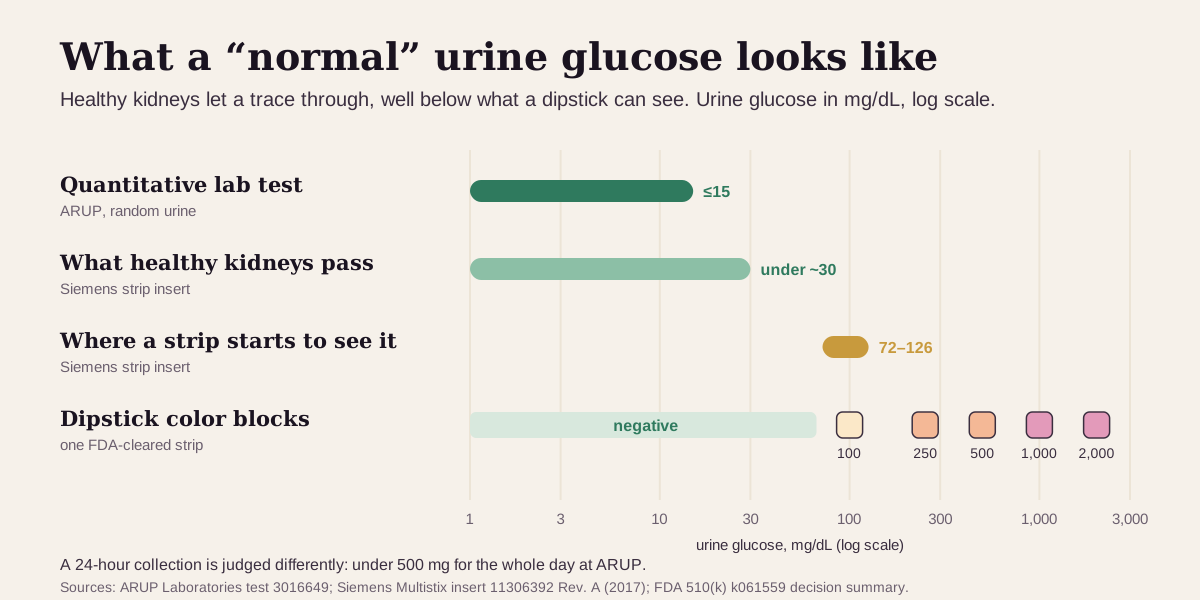
- On a dipstick, the expected result is negative. The color blocks step up from there: 100, 250, 500, 1,000 and 2,000 mg/dL on one FDA-cleared strip.9
- On a quantitative lab test, ARUP Laboratories sets the upper limit at 15 mg/dL for a random sample and under 500 mg for a full 24-hour collection.5
- A first-positive or trace result can turn up once in healthy people. The strip maker says it may be significant if it keeps coming back.4
Reference ranges are the same for men and women. No major source splits urine glucose by sex. Pregnancy is the exception: the kidneys filter more, so glucose can spill at a lower blood sugar,1 and up to half of pregnant women have glucose in their urine at some point.7
"Optimal" urine glucose: what health optimizers aim for
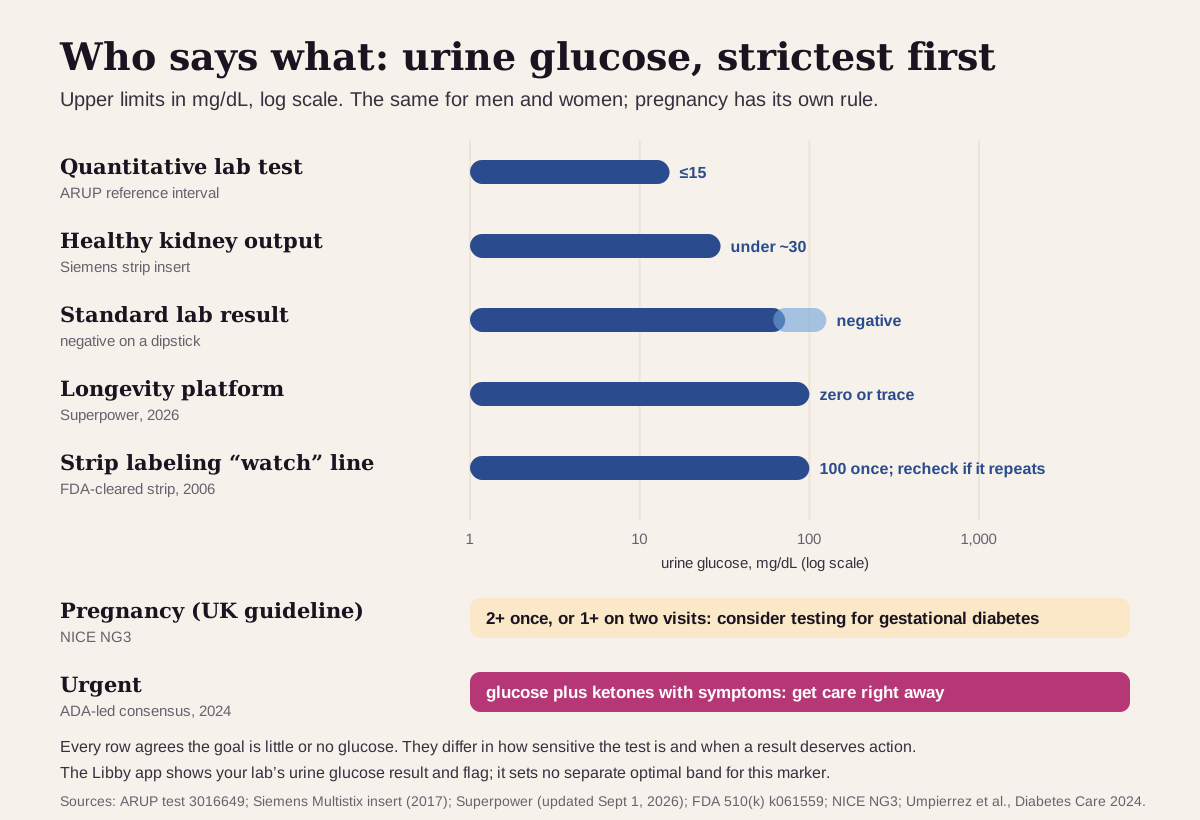
For urine glucose, everyone agrees on the goal: nothing, or almost nothing. The sources differ in how sensitive the test is and when a result deserves action. Here's the ladder, from strictest to loosest:
| Target | Men and women | Who uses it |
|---|---|---|
| Strictest (quantitative lab test) | 15 mg/dL or less (random); under 500 mg/day (24-hour) | ARUP Laboratories' reference interval5 |
| Healthy kidney output | under about 30 mg/dL | Siemens strip insert: the normal loss, below what a strip detects4 |
| Standard lab result | negative (under the strip's 72–126 mg/dL detection limit) | Routine urinalysis4 |
| Longevity platform | "zero or trace" | Superpower's published optimal10 |
| Strip labeling "watch" line | 100 mg/dL once can be normal; abnormal if it repeats | FDA-cleared strip labeling9 |
| Pregnancy (UK guideline) | 2+ once, or 1+ on two or more visits: consider testing for gestational diabetes | NICE11 |
| Urgent | glucose with ketones and symptoms of ketoacidosis | Get care right away8 |
The Libby app shows your urine glucose the way your lab reported it, with your lab's flag. It sets no separate optimal band for this marker.
Why a negative result is only half the story:
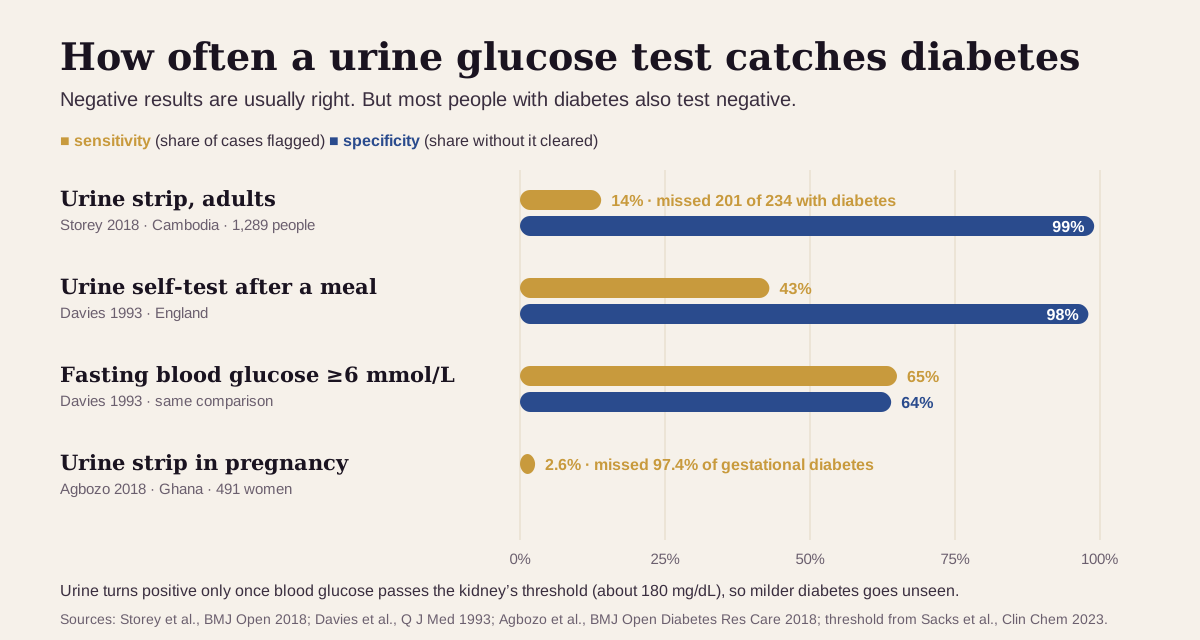
- A negative strip misses most diabetes. Among 1,289 adults in Cambodia, a urine strip caught only 14% of people with diabetes, missing 201 of 234, while giving just 7 false alarms (99% specificity).12
- Testing urine after a meal did better in England, catching 43% of cases with 98% specificity.13
- In pregnancy, glycosuria screening missed 97.4% of gestational diabetes among 491 women in Ghana.14 That's why NICE advises against using urine glucose to judge the risk of gestational diabetes.11
Keep "optimal" in perspective: glucose in urine is a signal, and what matters is why it's there. People taking dapagliflozin, an SGLT2 inhibitor, pass about 70 g of glucose a day in their urine,3 and in the EMPA-REG OUTCOME trial of 7,020 people with type 2 diabetes, empagliflozin cut deaths from cardiovascular causes by 38%.15 People born with inherited renal glycosuria spill glucose for life, and most do well.16
What a positive urine glucose usually means
Most positives come down to blood sugar or medicine. The grade matters less than whether it repeats and what comes with it.
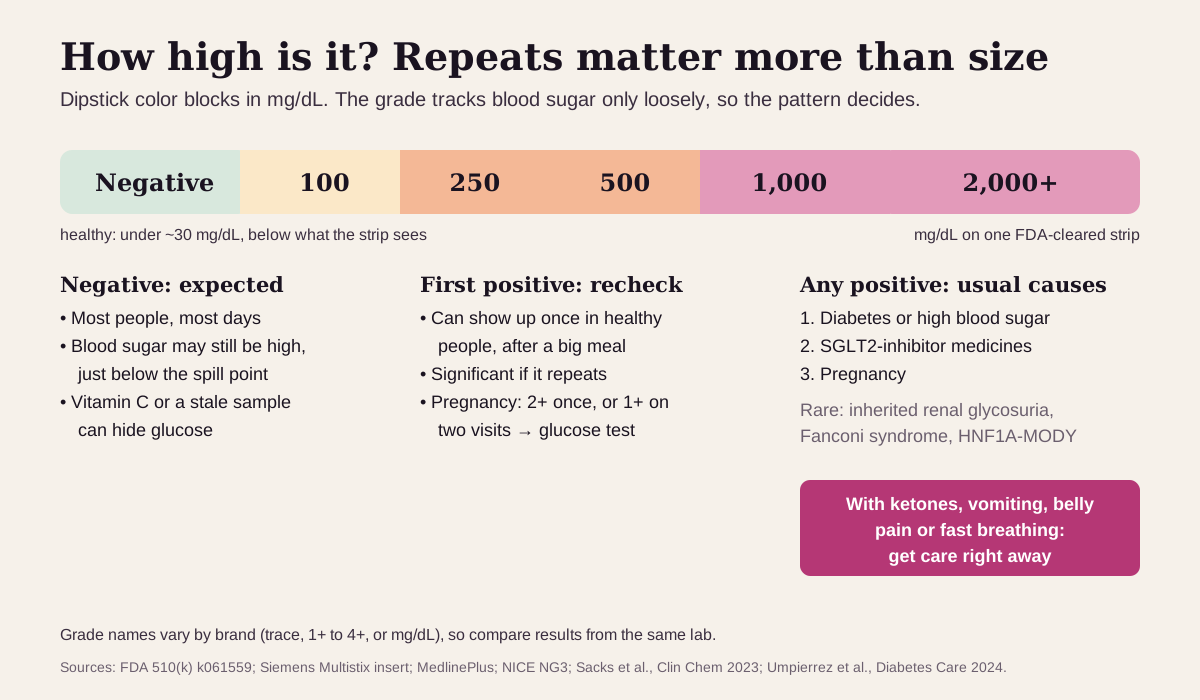
The usual suspects, most common first
- Diabetes or high blood sugar. Diabetes is the most common cause of glucose in urine.6 Glucose spills once blood sugar passes the kidney's threshold of about 180 mg/dL, so a positive usually means your blood sugar has run well above normal since you last emptied your bladder.2 If you already have diabetes, it can mean your blood sugar needs attention.6
- SGLT2-inhibitor medicines. Dapagliflozin (Farxiga), empagliflozin (Jardiance) and similar drugs block SGLT2, so they turn urine glucose positive by design. The FDA label says to use other tests to check blood sugar while you take them. Many people take them for heart failure or kidney disease, too.3
- Pregnancy. Up to half of pregnant women have glucose in their urine at some point.7 It can also be a sign of gestational diabetes, so the UK's NICE suggests further testing after 2+ once or 1+ on two or more visits.11
- A big meal. A small rise after a large meal is often harmless.7
- Less common: inherited renal glycosuria, where the SGLT2 pump is weak but blood sugar is normal (one estimate, cited in a 2025 study, puts it at 0.044% of Israeli teenagers);17 Fanconi syndrome, where the tubule also leaks amino acids, bicarbonate and phosphate;18 and HNF1A-MODY, an inherited form of diabetes that lowers the renal threshold.2
Results that mislead
- False negatives: high-dose vitamin C (2–15 g a day) can hide glucose on a strip, so repeat the test at least a day after your last dose. A urinary infection, very concentrated urine or alkaline urine can also blunt the strip.19 So can high ketones, when glucose is low.4
- False positives: strong oxidizing cleaners (such as peroxide) or hydrochloric acid in the collection cup.19
- A sample left sitting: on a strip, glucose holds for under 2 hours at room temperature, and the strip maker says to test within two hours of collection.194
Get care right away if glucose in your urine comes with ketones, or with vomiting, belly pain, deep or fast breathing, fruity breath, strong thirst, or confusion. These can be signs of diabetic ketoacidosis (DKA).8 On an SGLT2-inhibitor medicine, DKA can happen with a blood sugar under 250 mg/dL, so ketones matter even when your sugar looks fine.3
Urine glucose reads best next to its neighbors
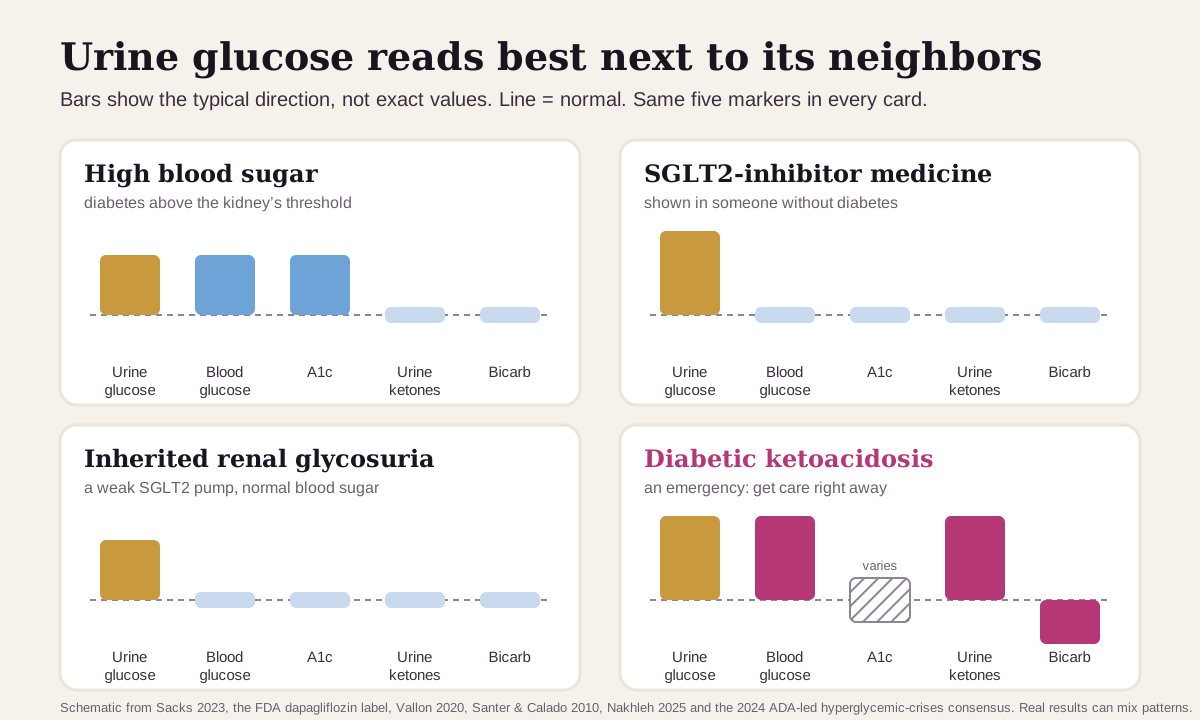
The same positive urine glucose can mean very different things. Your blood glucose, A1c, urine ketones and bicarbonate (a measure of the blood's acid balance) sort out four patterns:
| If you see… | It often points to… |
|---|---|
| Urine glucose up, blood glucose and A1c up, ketones negative | high blood sugar from diabetes spilling over the kidney's threshold |
| Urine glucose strongly positive, blood glucose normal, on a "-gliflozin" drug | an SGLT2-inhibitor medicine working as designed (in people with diabetes, blood glucose and A1c may still run high) |
| Urine glucose up again and again, blood glucose and A1c normal, on no such drug | renal glycosuria, usually inherited: in one matched study, fasting glucose (88 mg/dL) and A1c (5.1%) were the same as in people without it |
| Urine glucose and ketones both up, bicarbonate low | diabetic ketoacidosis: an emergency, get care right away |
A1c is often the best partner test. It reflects your average blood sugar over the preceding 60–90 days,2 while urine glucose only shows the hours since you last urinated.
How fast urine glucose changes
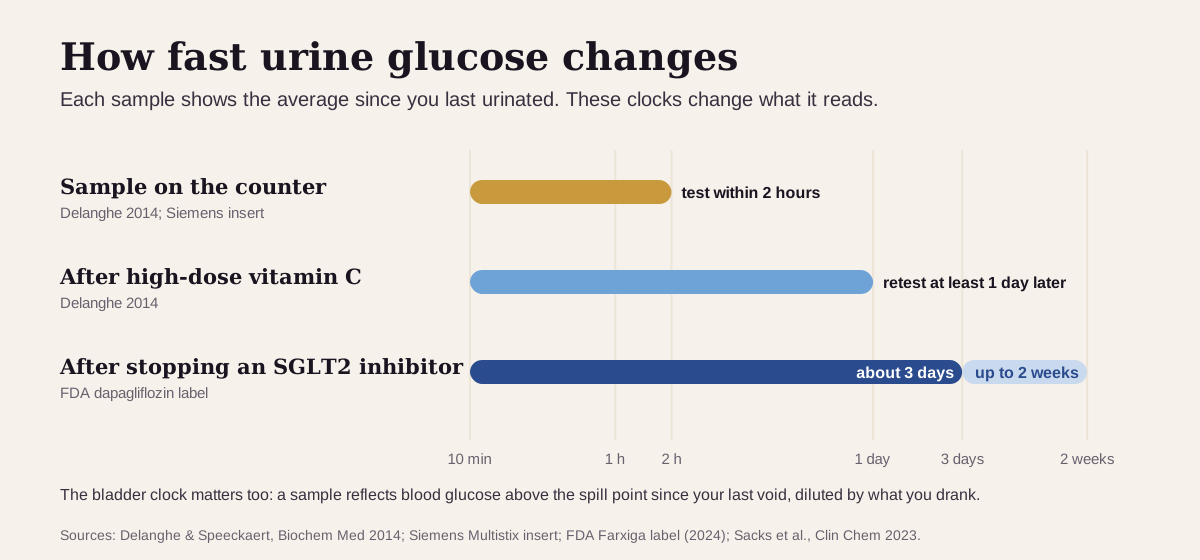
- It reflects the hours since you last urinated. A sample shows the average glucose between bathroom trips, and how much you drank dilutes or concentrates it.2 Two samples on the same day can disagree.
- Medicines linger. After stopping dapagliflozin, urine glucose returns to baseline in about 3 days. Glucose in urine has been reported for more than 6 days, and up to 2 weeks, after stopping SGLT2 inhibitors.3
- Trends beat snapshots. One positive can be a big meal or a sample problem. A positive that keeps coming back deserves a blood glucose and an A1c.46
Going deeper: the kidney's glucose valve
The amount of glucose that reaches urine follows a simple balance:
urine glucose = filtered glucose − glucose the tubule carries back
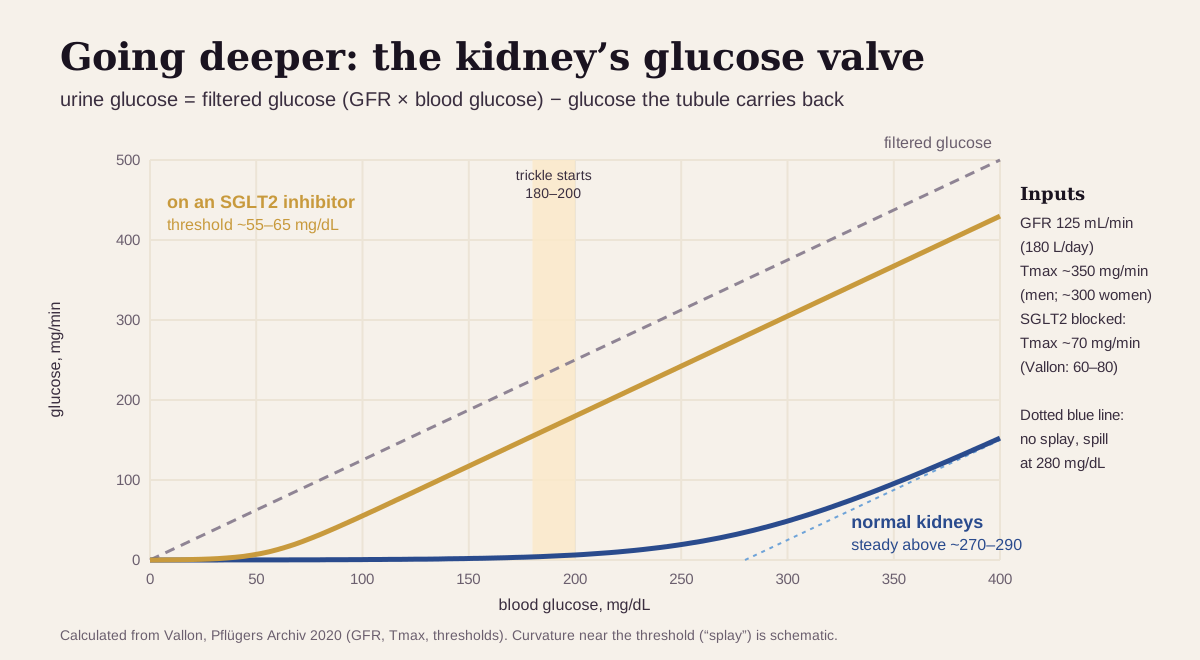
In theory, a Tmax of 350 mg/min at a normal GFR puts the spill point at about 280 mg/dL. Real nephrons vary, so glucose starts to trickle out at 180–200 mg/dL, and the loss climbs steadily once blood glucose passes 270–290 mg/dL. That rounded bend is called splay.1
The threshold moves. When GFR falls, as in kidney disease, glucose needs a higher blood sugar to spill. When GFR rises, as in pregnancy and early diabetes, it spills sooner. Diabetes also raises the transport maximum by about 20–30%.1
An SGLT2 inhibitor leaves only SGLT1 working. That drops the threshold to about 55–65 mg/dL, below a normal fasting blood sugar, so glucose spills all day: 40–80 g a day depending on the dose.1 These drugs rarely push blood sugar too low on their own, because once the filtered load falls to about 80 g a day, SGLT1 can carry it all back.1
Questions worth asking
- Was this a dipstick or a quantitative test, and how did the lab flag it?
- What were my blood glucose and A1c around the same time?
- Could any of my medicines, including an SGLT2 inhibitor, explain it?
- Were there ketones in the same sample?
- If I'm pregnant, do I need a glucose tolerance test?
- If my blood sugar is normal, should we look for renal glycosuria?
FAQ
What is a normal urine glucose level? Negative on a dipstick. Healthy kidneys pass under about 30 mg/dL, below what the strip detects.4 On a quantitative test, ARUP's upper limit is 15 mg/dL for a random sample.5
What is the most common cause of glucose in urine? Diabetes, meaning blood sugar high enough to pass the kidney's threshold of about 180 mg/dL.62 SGLT2-inhibitor medicines and pregnancy are the other common causes.37
Can you have glucose in your urine without diabetes? Yes. SGLT2-inhibitor medicines, pregnancy and inherited renal glycosuria can all put glucose in urine at a normal blood sugar.3716
When is glucose in urine an emergency? When it comes with ketones, or with vomiting, belly pain, deep fast breathing or confusion. These can be signs of diabetic ketoacidosis and need care right away.8
This guide is for education. It can't diagnose you or replace care from a clinician who knows your history.
Footnotes
-
Vallon V. Glucose transporters in the kidney in health and disease. Pflügers Arch. 2020;472(9):1345–1370. The source for the 160–180 g/day filtered load, the ~97% (SGLT2) and ~3% (SGLT1) split, the transport maximum, spill-over at ~180–200 mg/dL, the SGLT2-inhibitor threshold of ~55–65 mg/dL and 40–80 g/day loss, and the effects of GFR, pregnancy and diabetes. PMC ↩ ↩2 ↩3 ↩4 ↩5 ↩6 ↩7 ↩8 ↩9 ↩10
-
Sacks DB, Arnold M, Bakris GL, et al. Guidelines and Recommendations for Laboratory Analysis in the Diagnosis and Management of Diabetes Mellitus. Clin Chem. 2023;69(8):808–868. The ADA/AACC laboratory guideline: urine glucose is not recommended for routine diabetes care, the renal threshold is about 180 mg/dL, urine reflects glucose between voids, diabetes diagnostic cutoffs, the 60–90-day A1c window, and HNF1A-MODY. PMC ↩ ↩2 ↩3 ↩4 ↩5 ↩6 ↩7 ↩8 ↩9 ↩10
-
AstraZeneca. FARXIGA (dapagliflozin) prescribing information. U.S. Food and Drug Administration; revised June 2024. Positive urine glucose tests, about 70 g of glucose a day in urine, return to baseline about 3 days after stopping, reports up to 2 weeks, ketoacidosis at glucose under 250 mg/dL, and the heart and kidney indications. FDA ↩ ↩2 ↩3 ↩4 ↩5 ↩6 ↩7 ↩8 ↩9 ↩10
-
Siemens Healthcare Diagnostics. Multistix 10 SG, Multistix 8 SG, Labstix and Uristix Reagent Strips for Urinalysis (package insert 11306392 Rev. A). 2017. A commercial source: the strip maker's insert. Normal excretion under 1.67 mmol/L, glucose sensitivity 4–7 mmol/L, the first positive level "may be significantly abnormal if found consistently", ketones reduce sensitivity, test within two hours. Siemens Healthineers ↩ ↩2 ↩3 ↩4 ↩5 ↩6 ↩7 ↩8 ↩9 ↩10 ↩11 ↩12 ↩13
-
ARUP Laboratories. Urine, Glucose (test 3016649). Laboratory test directory. A commercial source: a reference laboratory's own catalog (ARUP describes itself as a national, academic, nonprofit reference laboratory). Random urine 15 mg/dL or less; 24-hour urine under 500 mg/day; quantitative enzymatic assay. ARUP ↩ ↩2 ↩3 ↩4 ↩5 ↩6
-
National Library of Medicine. Glucose in Urine Test. MedlinePlus. Diabetes as the most common cause, renal glycosuria and Fanconi syndrome, and follow-up with blood tests. MedlinePlus ↩ ↩2 ↩3 ↩4 ↩5 ↩6 ↩7
-
National Library of Medicine. Glucose urine test. MedlinePlus Medical Encyclopedia. Reviewed February 27, 2026. Up to half of pregnant women have glucose in their urine at some time; a small rise after a large meal. MedlinePlus ↩ ↩2 ↩3 ↩4 ↩5 ↩6
-
Umpierrez GE, Davis GM, ElSayed NA, et al. Hyperglycemic Crises in Adults With Diabetes: A Consensus Report. Diabetes Care. 2024;47(8):1257–1275. The ADA-led definition of DKA (glucose of 200 mg/dL or more or known diabetes, plus ketones and acidosis) and its symptoms. PMC ↩ ↩2 ↩3 ↩4 ↩5 ↩6
-
U.S. Food and Drug Administration. 510(k) Substantial Equivalence Determination Decision Summary k061559: ACON Urinalysis Reagent Strips. 2006. Glucose color blocks at 100, 250, 500, 1,000 and 2,000 mg/dL; 100 mg/dL "may be considered abnormal if results are consistent". FDA ↩ ↩2 ↩3 ↩4 ↩5
-
Superpower. Urinary Glucose: Best Biomarkers to Monitor. Last updated September 1, 2026. States that "optimal" urinary glucose "is essentially zero or trace". A commercial source, listed as what the optimizer community uses. superpower.com ↩ ↩2
-
National Institute for Health and Care Excellence. Diabetes in pregnancy: management from preconception to the postnatal period (NG3). Published 2015, updated December 2020. Recommendations 1.2.3 (don't use urinalysis for glucose to assess gestational diabetes risk) and 1.2.4 (2+ once or 1+ on two or more occasions). NICE ↩ ↩2 ↩3 ↩4 ↩5
-
Storey HL, van Pelt MH, Bun S, et al. Diagnostic accuracy of self-administered urine glucose test strips as a diabetes screening tool in a low-resource setting in Cambodia. BMJ Open. 2018;8(3):e019924. 1,289 adults; 14% sensitive, 99% specific. PMC ↩ ↩2
-
Davies MJ, Williams DR, Metcalfe J, Day JL. Community screening for non-insulin-dependent diabetes mellitus: self-testing for post-prandial glycosuria. Q J Med. 1993;86(10):677–684. After-meal self-testing: 43% sensitive, 98% specific. PubMed ↩ ↩2
-
Agbozo F, Abubakari A, Narh C, Jahn A. Accuracy of glycosuria, random blood glucose and risk factors as selective screening tools for gestational diabetes mellitus in comparison with universal diagnosing. BMJ Open Diabetes Res Care. 2018;6(1):e000493. 491 pregnant women; glycosuria missed 97.4% of cases. PMC ↩ ↩2
-
Zinman B, Wanner C, Lachin JM, et al. Empagliflozin, Cardiovascular Outcomes, and Mortality in Type 2 Diabetes. N Engl J Med. 2015;373(22):2117–2128. 7,020 patients; cardiovascular death 3.7% vs 5.9%, a 38% relative reduction. PubMed ↩
-
Santer R, Calado J. Familial renal glucosuria and SGLT2: from a mendelian trait to a therapeutic target. Clin J Am Soc Nephrol. 2010;5(1):133–141. Glucose loss without high blood sugar or other tubular problems; most patients do well. PubMed ↩ ↩2 ↩3
-
Nakhleh A, Adler L, Ayada G, et al. Clinical and biochemical profile of individuals with renal glucosuria: A matched cohort study. Diabetes Obes Metab. 2025;27(6):3242–3251. 220 adults with renal glucosuria vs 660 matched controls: same fasting glucose and A1c. Cites a 0.044% prevalence among 2.5 million Israeli adolescents. PMC ↩ ↩2
-
National Institute of Diabetes and Digestive and Kidney Diseases. Renal Tubular Acidosis. NIH. Fanconi syndrome: abnormal excretion of glucose, amino acids, citrate, bicarbonate and phosphate. NIDDK ↩
-
Delanghe J, Speeckaert M. Preanalytical requirements of urinalysis. Biochem Med (Zagreb). 2014;24(1):89–104. Glucose stability on strips, vitamin C (2–15 g/day) and other causes of false negatives, oxidizing cleaners and acid as false positives. PMC ↩ ↩2 ↩3 ↩4
Educational content, not medical advice. Libby is a personal record tool, not a medical service — it doesn't diagnose, treat, or prescribe. Reference ranges vary by lab and by person. Talk to a qualified healthcare professional about your results.
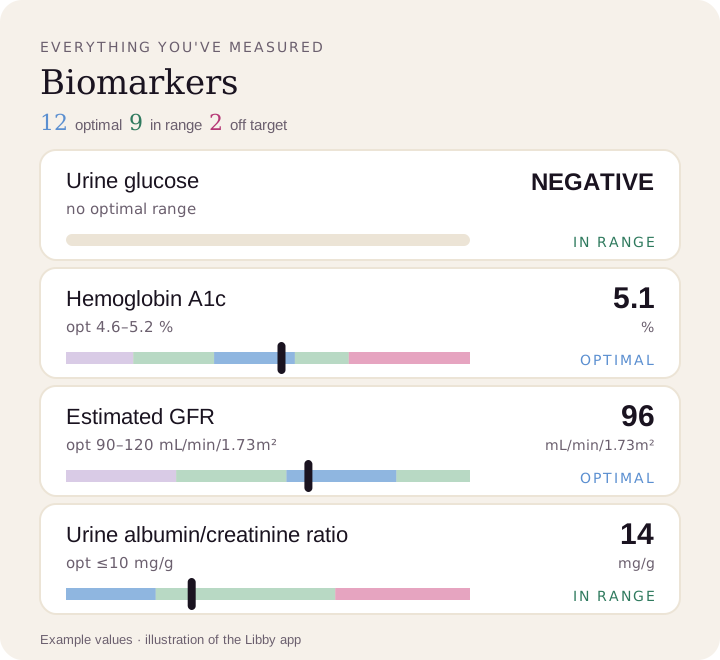
See every result against your lab's range.
Upload a lab PDF or a photo of your report. Libby shows each result with your lab's range or flag, files urine glucose with your blood glucose and A1c, and tracks every marker over time.
View your urine glucose ›