Magnesium blood test: normal range, low and high causes
Magnesium keeps your nerves, muscles and heart working. Here's the normal range, why it runs low, how to read it with potassium and calcium, and when it's urgent.
Magnesium is a mineral your nerves, muscles and heart run on. It powers more than 600 chemical reactions in your cells, most of them as a partner to ATP, the molecule cells use for energy.1 A low blood magnesium is the common problem, usually from losses through the gut or kidneys, and it often drags potassium and calcium down with it.12
The short version
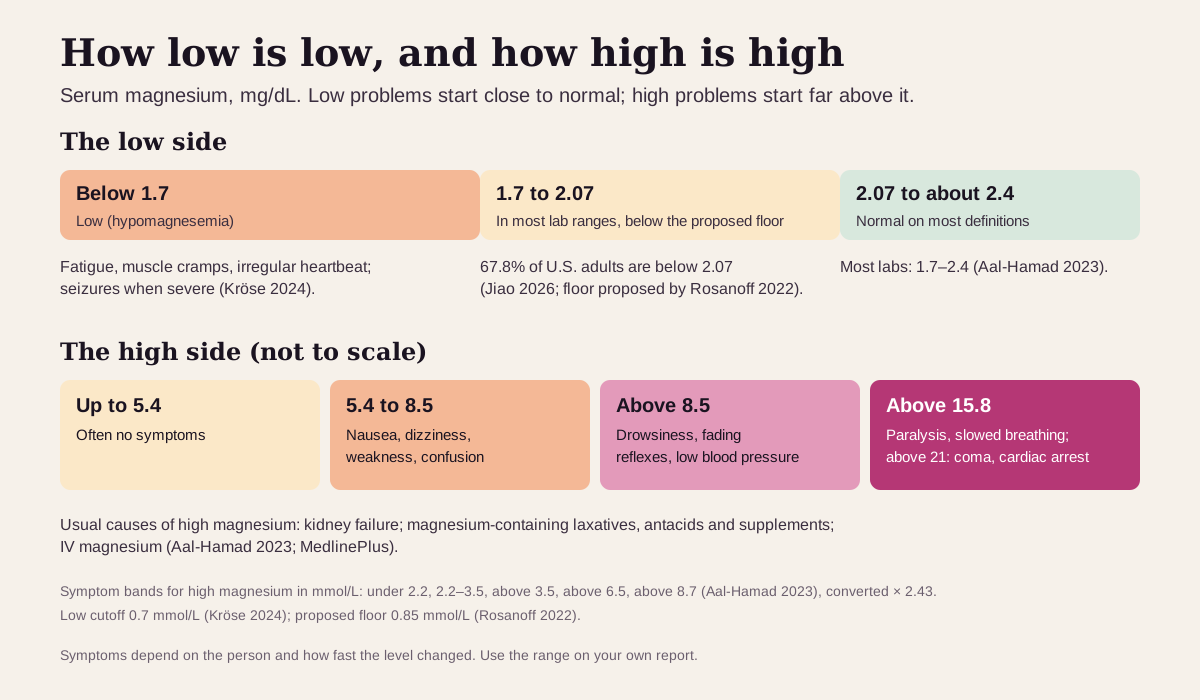
- Normal: check your report. Most labs use a range close to 1.7–2.4 mg/dL (0.7–1.0 mmol/L).3 A group of magnesium researchers argues the floor should be 2.07 mg/dL (0.85 mmol/L), and by that line about two in three U.S. adults run low.45
- Low is common: about 2.5% of people overall and 12–20% of hospital patients. The usual reasons are long-lasting diarrhea, acid-reducing PPIs and water pills, heavy drinking and poorly controlled diabetes.12
- High is rare and usually means kidney failure or a magnesium-containing laxative or antacid. Symptoms start above about 5.4 mg/dL, and very high levels can stop the heart.32
- Blood holds only 1–2% of your body's magnesium. A low result is meaningful; a normal one can still sit on top of low stores.12
What magnesium is
Magnesium is the second most common charged mineral inside your cells. Most of its work happens bound to ATP: the magnesium–ATP pair is the active form your cells use to turn food into energy, repair DNA, fire nerves and contract muscle, including your heart.1
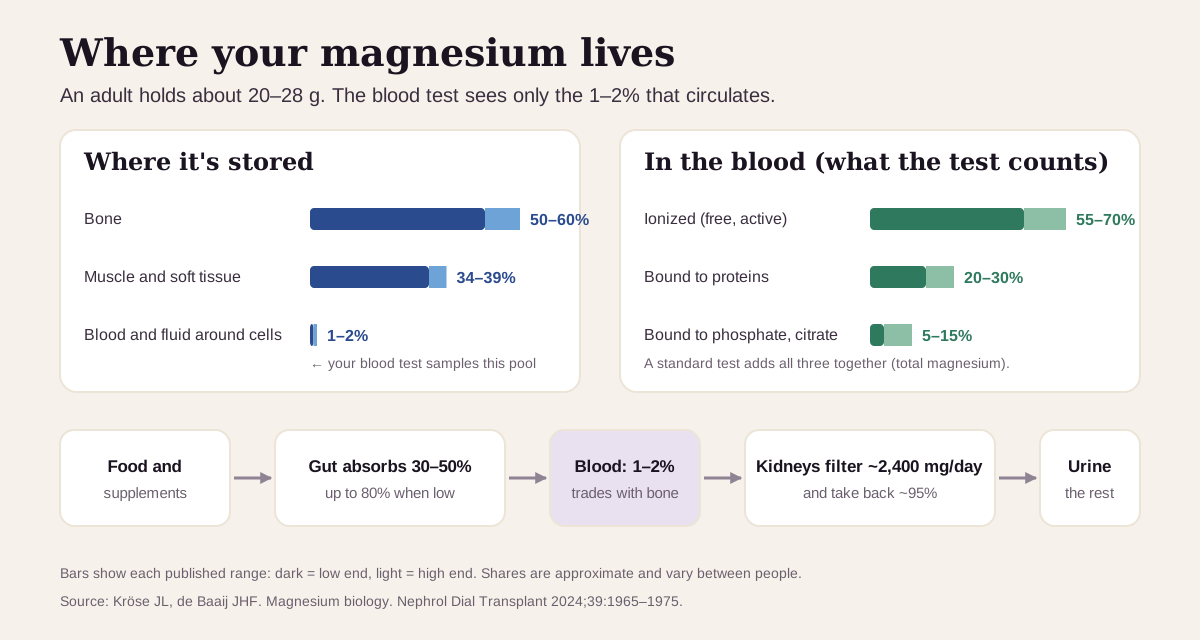
An adult body holds about 20–28 grams. Half or more sits in bone, about a third in muscle and other soft tissue, and only 1–2% in blood and the fluid around cells. In the blood, about 55–70% floats free (the "ionized", active form), 20–30% rides on proteins, and the rest is bound to small molecules like phosphate.1
Two organs set the level. Your gut absorbs about 30–50% of the magnesium you eat, and up to 80% when you're running low. Your kidneys filter about 2,400 mg a day and take back about 95% of it, letting less go when you're short.12 That's why a blood level stays steady for a long time, then drops when losses outrun what the gut and kidneys can make up.
Clinicians order magnesium for symptoms like cramps, weakness or an irregular heartbeat, for a low potassium or calcium, and for people with kidney disease, diabetes or medicines that lower it.2
What's a normal magnesium?
Start with the range on your own report. Labs set their ranges differently: when a magnesium research group collected 43 reference ranges from 16 countries, the lower limits varied widely, and only 2 put the floor as high as 2.07 mg/dL.4
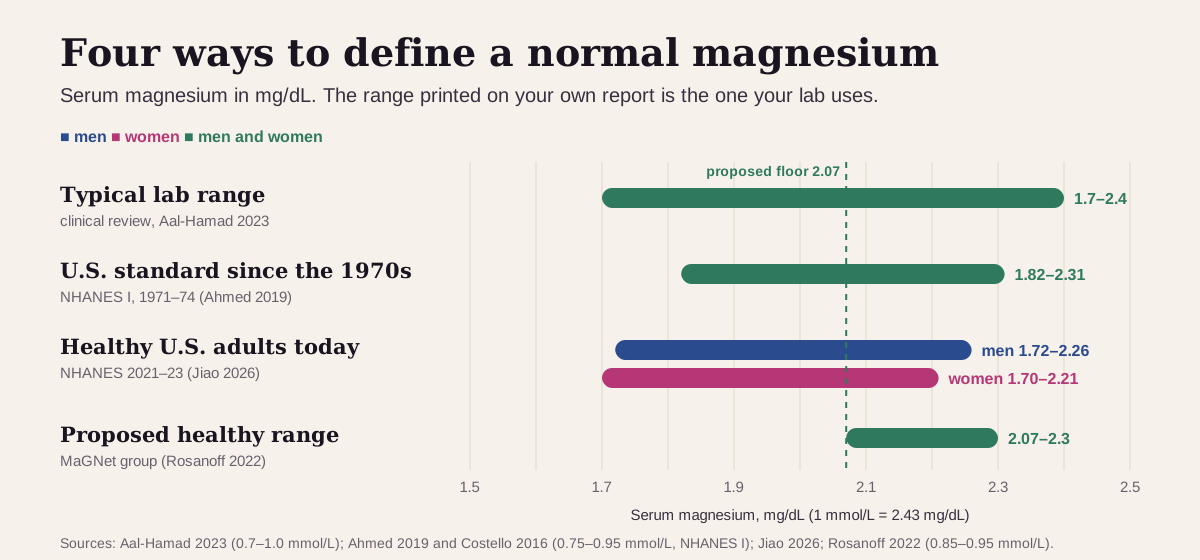
- Typical lab range: about 1.7–2.4 mg/dL (0.7–1.0 mmol/L), as summed up in a 2023 clinical review.3
- The older U.S. standard, 1.82–2.31 mg/dL (0.75–0.95 mmol/L), comes from about 15,000 adults tested in the NHANES I survey of 1971–1974.75 It describes a population, not health outcomes.6
- A 2026 update from the 2021–2023 NHANES survey, using only metabolically healthy adults, found 1.72–2.26 mg/dL for men and 1.70–2.21 mg/dL for women. Women ran slightly lower than men, and people with diabetes, high blood pressure or kidney disease ran lower than healthy adults.5
"Optimal" magnesium: what health optimizers aim for
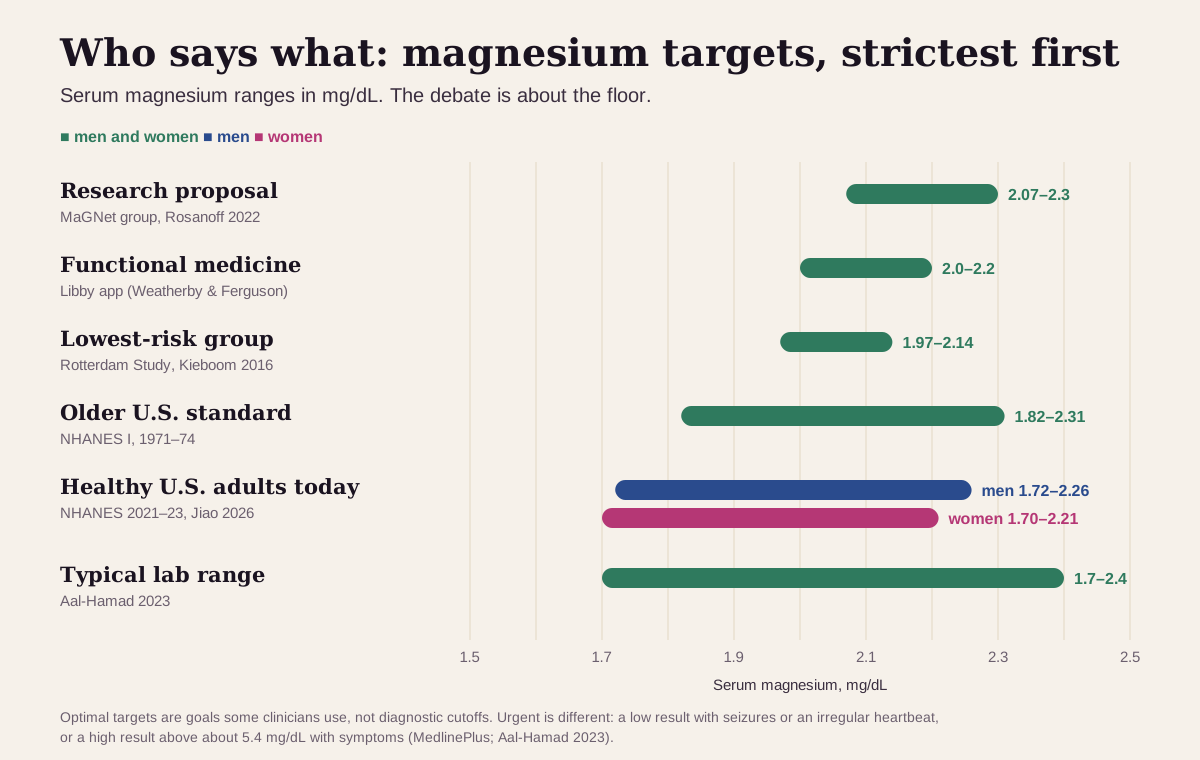
With magnesium, the debate is about the floor. Functional-medicine practitioners and a group of magnesium researchers want results well above the bottom of the lab range. Here's the ladder, from strictest to loosest:
| Target | Men | Women | Who uses it |
|---|---|---|---|
| Strictest (research proposal) | 2.07–2.3 mg/dL | 2.07–2.3 mg/dL | The MaGNet magnesium research group's proposed range (0.85–0.95 mmol/L)4 |
| Functional medicine | 2.0–2.2 mg/dL | 2.0–2.2 mg/dL | The optimal range shown in the Libby app, which its catalog credits to a functional-medicine textbook8 |
| Lowest-risk group in a large cohort | 1.97–2.14 mg/dL | 1.97–2.14 mg/dL | The reference group in the Rotterdam Study (0.81–0.88 mmol/L)9 |
| Older U.S. standard | 1.82–2.31 mg/dL | 1.82–2.31 mg/dL | Based on the NHANES I survey of the early 1970s76 |
| Healthy U.S. adults today | 1.72–2.26 mg/dL | 1.70–2.21 mg/dL | NHANES 2021–2023, metabolically healthy adults5 |
| Typical lab range | about 1.7–2.4 mg/dL | about 1.7–2.4 mg/dL | Common hospital reference range (0.7–1.0 mmol/L)3 |
| Urgent | low with symptoms; high above ~5.4 | low with symptoms; high above ~5.4 | Seizures, an irregular heartbeat, or fading reflexes: get care now23 |
Why the higher floor isn't just a trend:
- In the Rotterdam Study (9,820 adults, followed a median of 8.7 years), people with serum magnesium at or below 1.94 mg/dL (0.80 mmol/L) had a 36% higher risk of dying from coronary heart disease and a 54% higher risk of sudden cardiac death than people at 1.97–2.14 mg/dL. Each 0.1 mmol/L (0.24 mg/dL) higher was linked to 18% lower coronary death risk.9
- In the Framingham Offspring Study (3,530 adults free of heart disease), people in the lowest quarter, 1.77 mg/dL or less, were about 50% more likely to develop atrial fibrillation over up to 20 years.10
- A meta-analysis of 16 studies and 313,041 people found 30% lower cardiovascular risk per 0.2 mmol/L (0.49 mg/dL) higher blood magnesium.11
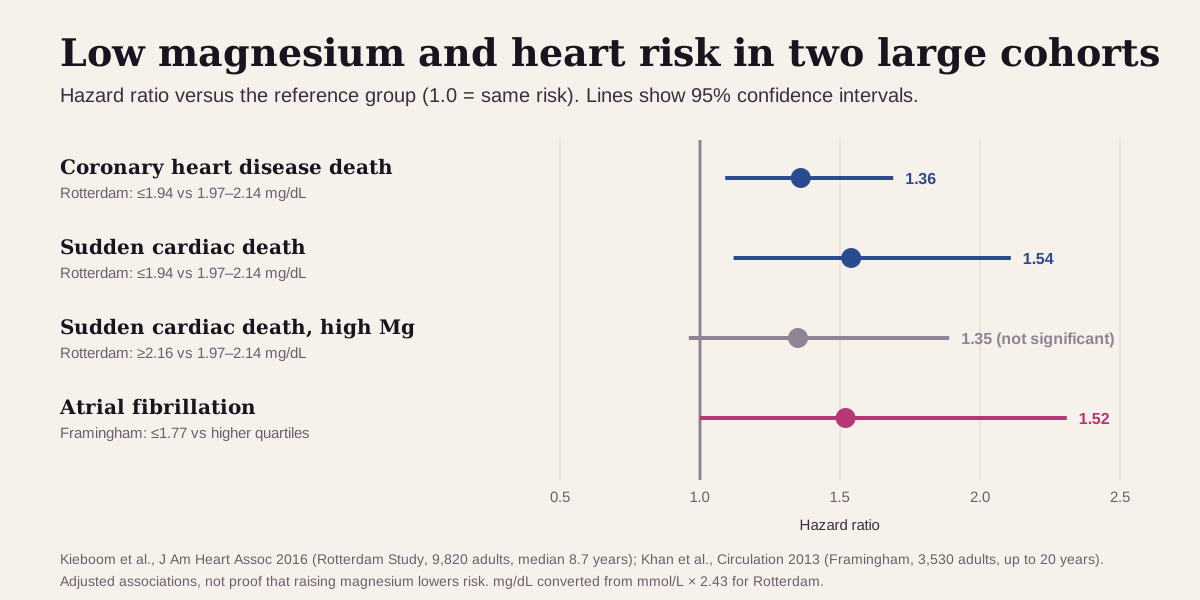
Keep "optimal" in perspective. These are targets, not diagnoses, and the push for a 2.07 floor comes from a small circle of magnesium researchers: the MaGNet group proposed it, and several of the same people, from the Center for Magnesium Education and Research, wrote the 2026 NHANES analysis. By their line, 67.8% of U.S. adults fall short, a figure that depends entirely on where the line is drawn.45 Higher isn't automatically better either: in the Rotterdam Study, people at 2.16 mg/dL or more had a sudden-death risk that trended up, not down (hazard ratio 1.35, not statistically significant).9
What a low magnesium usually means
Low magnesium (hypomagnesemia) is far more common than high.2 It usually comes from losing magnesium faster than your gut can replace it.
Low: the usual suspects
- Gut losses. Long-lasting diarrhea, malabsorption and bowel diseases like Crohn's disease cut how much you absorb.27
- Medicines. The most common culprits are proton pump inhibitors (PPIs) for reflux, diuretics ("water pills") and immunosuppressants. PPIs are taken by 10–20% of people in Western countries, and the risk rises with dose and years of use.1 Certain antibiotics also lower magnesium.2 Don't stop a prescribed medicine on your own. Bring your full list, supplements included, to your clinician.
- Diabetes. Poorly controlled blood sugar pushes magnesium out in urine; 10–45% of people with type 2 diabetes have low magnesium.12
- Alcohol. Heavy drinking makes the kidneys waste magnesium, and the vomiting, diarrhea and poor diet that often come with it add to the loss.112
- Low intake, more likely in older adults and people with malnutrition.2 About half of Americans eat less than the estimated average requirement.6
- Less common causes: refeeding after a long stretch of very little food, some cancer drugs, underactive parathyroid glands, pregnancy, and rare inherited kidney conditions.7212
Get prompt care if a low magnesium comes with an irregular heartbeat, muscle spasms or tremor, numbness or tingling, or a seizure.27
High: rare, and usually the kidneys
High magnesium (hypermagnesemia) mostly happens in kidney failure. The kidneys hold the level steady through moderate kidney disease; it starts to rise once kidney filtration falls below about 20–30 mL/min, and people below 10 mL/min are likely to run high.13 About 10–15% of hospital patients with kidney failure develop it.3
The other common cause is magnesium-containing products: laxatives, antacids, supplements and Epsom salts, especially with weak kidneys or a slow bowel. Magnesium sulfate given by IV in pregnancy (for preeclampsia) raises it on purpose.1312 Food alone rarely raises magnesium.2
Symptoms track the number. Levels up to about 5.4 mg/dL are often silent; 5.4–8.5 mg/dL brings nausea, dizziness and weakness; above 8.5 mg/dL, drowsiness, fading reflexes and low blood pressure; above 15.8 mg/dL, paralysis and slowed breathing; and above about 21 mg/dL, coma and cardiac arrest.3
Get care now for a high magnesium with drowsiness, weak muscles, slow breathing or a slow heartbeat, especially if you have kidney disease or have taken a lot of a laxative or antacid.312
Magnesium reads best next to its neighbors
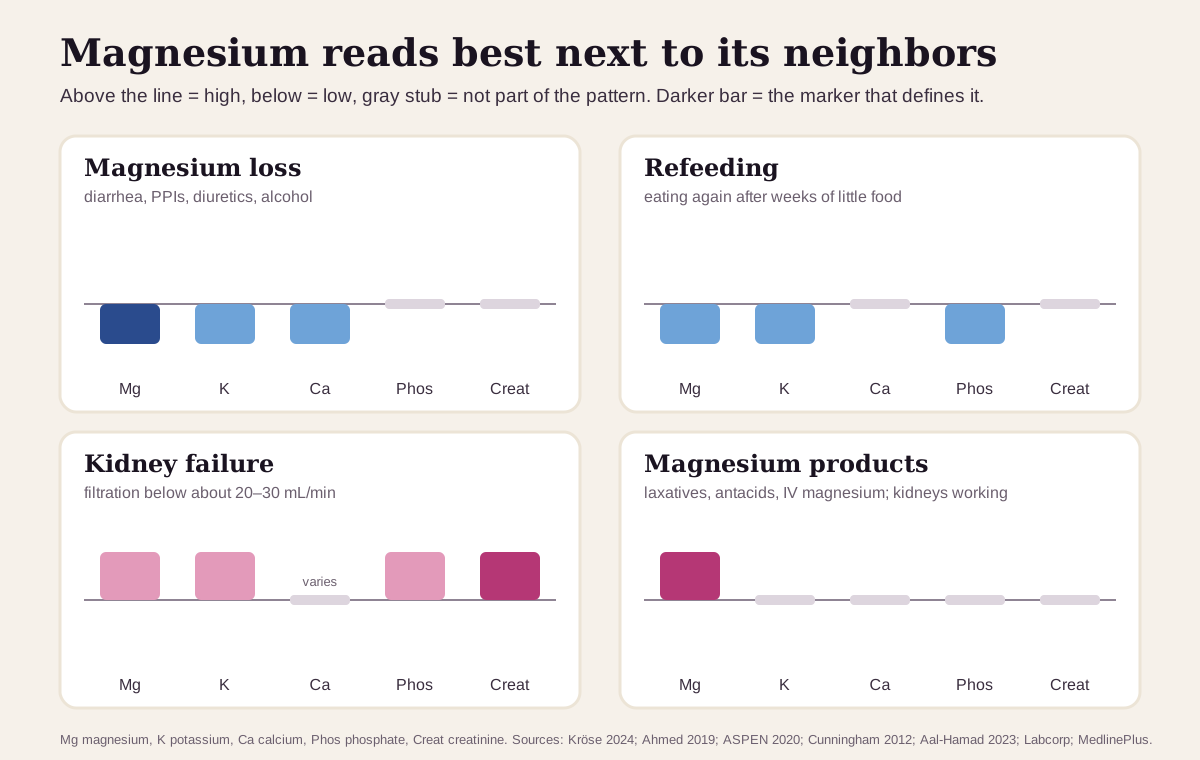
Magnesium travels with potassium, calcium and phosphate, and your kidneys filter all of them. The pattern across these tests, plus creatinine for kidney function, often says more than magnesium does alone:1214
| If you see… | It often points to… |
|---|---|
| Magnesium low, with potassium and/or calcium low | magnesium loss through the gut or kidneys (diarrhea, PPIs, diuretics, alcohol). The low potassium and calcium often won't correct until magnesium is replaced |
| Phosphate, potassium and magnesium all falling within about 5 days of eating again after a long stretch of little food | refeeding syndrome, a hospital problem that needs close monitoring |
| Magnesium high, with creatinine, potassium and phosphate high | advanced kidney disease: the kidneys can no longer clear any of them |
| Magnesium high, creatinine normal | too much magnesium going in: laxatives, antacids, supplements or IV magnesium |
The first row is the one to remember. Low magnesium makes the kidneys leak potassium and blunts the parathyroid hormone that holds calcium up, so a low potassium or calcium that won't budge with treatment is a classic reason to check magnesium.1712
How fast magnesium changes
Magnesium refills slowly. The blood level is guarded by bone stores, the gut and the kidneys, so it moves little from month to month and responds slowly to supplements.12
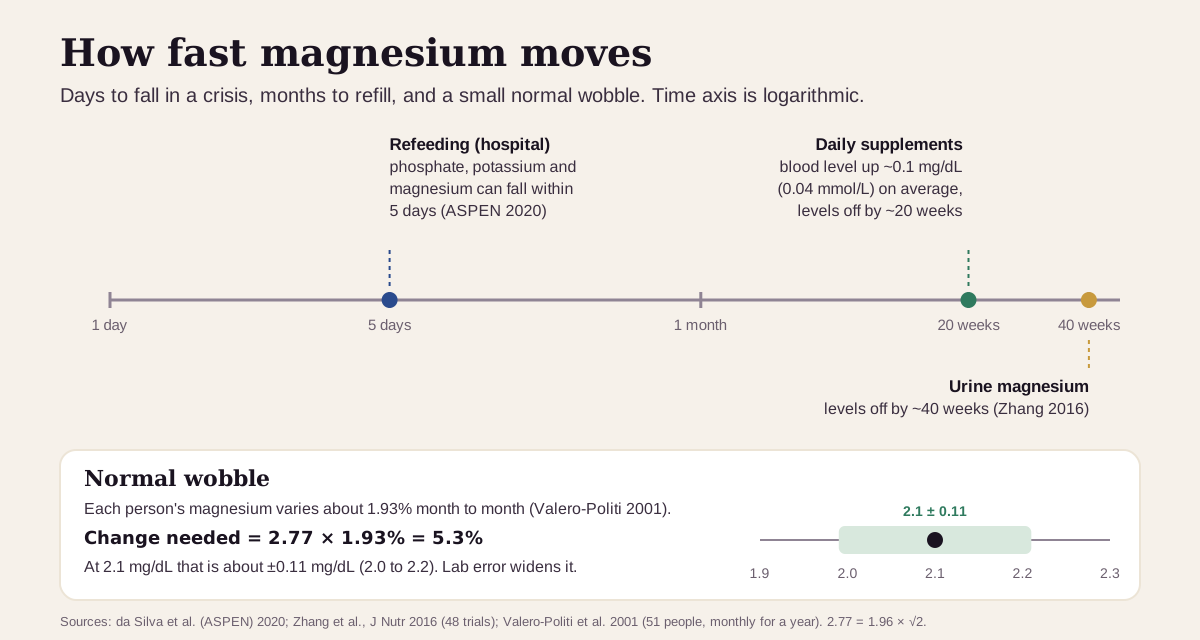
- Supplements work slowly and modestly. In a meta-analysis of 48 randomized trials, oral magnesium raised blood magnesium by about 0.04 mmol/L (about 0.1 mg/dL) on average. The level kept rising for about 20 weeks before leveling off, and it rose least in people who started highest.16
- Fast drops happen in the hospital. In refeeding syndrome, phosphate, potassium and magnesium can fall within 5 days of restarting food.15
- Day-to-day wobble is small. In 51 healthy people tested monthly for a year, each person's magnesium varied by about 1.9%.17 By the standard formula, a change needs to be about 5% (about 0.1 mg/dL) before it's more than normal variation, and lab error widens that. At 2.1 mg/dL, that's about the whole width of the app's 2.0–2.2 optimal band.
- A tube problem can fake a high. Red cells hold two to three times more magnesium than serum, so a damaged (hemolyzed) sample can read high.12
Trends beat snapshots. A magnesium that slides from 2.2 to 1.8 over a year tells a different story than one that bounces between 1.9 and 2.0, and comparing results works best from the same lab.4
Going deeper: serum, ionized and RBC magnesium
Your standard test measures total serum magnesium: the free, protein-bound and complexed forms added together.1 Because blood holds so little of the body's supply, the body can pull magnesium from bone to keep the blood level normal while stores run down.2
That's why other tests exist:
- Ionized magnesium measures only the free, active fraction. It needs a special electrode, and methods still need standardizing.3
- RBC magnesium measures magnesium inside red blood cells. It rose with supplements in randomized trials,16 and MedlinePlus says it may catch low magnesium better,2 but one clinical review found it correlates poorly with whole-body magnesium status.3 The Libby app tracks it too, with a lab range of 4.0–6.4 mg/dL and an optimal band of 5.5–6.4 mg/dL from a functional-medicine textbook.18
- 24-hour urine magnesium shows whether the kidneys are wasting magnesium or holding on to it, which separates kidney losses from gut losses.32
The link to potassium runs through a kidney channel called ROMK. Magnesium inside kidney cells normally keeps that channel partly closed. When magnesium runs low, the channel opens up and potassium pours into the urine.1
Questions worth asking
- Is my magnesium low, low-normal or normal, and against which range?
- What do my potassium, calcium, phosphate and creatinine show next to it?
- Could any of my medicines, especially a PPI or a diuretic, be lowering it?
- Is my kidney function normal enough that magnesium supplements are safe for me?
- Would a urine magnesium or an RBC magnesium test add anything?
- When should we repeat it, and what change would matter?
FAQ
What is a normal magnesium level? Most labs use a range close to 1.7–2.4 mg/dL (0.7–1.0 mmol/L). Some magnesium researchers argue anything under 2.07 mg/dL is too low.34
What is the most common cause of low magnesium? Losses through the gut or kidneys: long-lasting diarrhea, PPIs and diuretics, heavy drinking and poorly controlled diabetes are the usual causes.12
How long do magnesium supplements take to raise my level? Slowly. In randomized trials, blood magnesium kept rising for about 20 weeks and went up about 0.1 mg/dL on average.16
When is a magnesium result an emergency? A low result with seizures, spasms or an irregular heartbeat needs care now. So does a high result with drowsiness, weakness or slow breathing, usually in people with kidney failure.23
This guide is for education. It can't diagnose you or replace care from a clinician who knows your history.
Footnotes
-
Kröse JL, de Baaij JHF. Magnesium biology. Nephrol Dial Transplant. 2024;39(12):1965–1975. A current physiology review: body stores, blood fractions, gut and kidney handling, causes of low magnesium, and the links to potassium and calcium. PMC ↩ ↩2 ↩3 ↩4 ↩5 ↩6 ↩7 ↩8 ↩9 ↩10 ↩11 ↩12 ↩13 ↩14 ↩15 ↩16 ↩17 ↩18 ↩19 ↩20
-
National Library of Medicine. Magnesium Blood Test. MedlinePlus. Last updated October 25, 2023. Symptoms, common causes, medicines that raise or lower magnesium, and why a normal blood level can hide low stores. MedlinePlus ↩ ↩2 ↩3 ↩4 ↩5 ↩6 ↩7 ↩8 ↩9 ↩10 ↩11 ↩12 ↩13 ↩14 ↩15 ↩16 ↩17 ↩18 ↩19 ↩20 ↩21 ↩22
-
Aal-Hamad AH, Al-Alawi AM, Kashoub MS, Falhammar H. Hypermagnesemia in Clinical Practice. Medicina (Kaunas). 2023;59(7):1190. The typical 0.7–1.0 mmol/L range, causes of high magnesium, and the symptoms at each level. PMC ↩ ↩2 ↩3 ↩4 ↩5 ↩6 ↩7 ↩8 ↩9 ↩10 ↩11 ↩12 ↩13 ↩14 ↩15 ↩16 ↩17 ↩18
-
Rosanoff A, West C, Elin RJ, et al. Recommendation on an updated standardization of serum magnesium reference ranges. Eur J Nutr. 2022;61(7):3697–3706. The MaGNet group's case for a 0.85 mmol/L (2.07 mg/dL) floor and a 0.85–0.95 mmol/L range; only 2 of 43 labs surveyed used that floor. PMC ↩ ↩2 ↩3 ↩4 ↩5 ↩6 ↩7 ↩8 ↩9 ↩10
-
Jiao K, Costello R, Gahche J, Rosanoff A, Wallace TC. Serum Magnesium Concentrations in the United States: An Updated Population Reference Interval in Children and Adults. J Nutr. 2026;156(6):101539. NHANES 2021–2023, 5,474 adults; healthy-adult ranges by sex and the 67.8% below 2.07 mg/dL. Several authors are fellows of the Center for Magnesium Education and Research. PMC ↩ ↩2 ↩3 ↩4 ↩5 ↩6 ↩7 ↩8
-
Costello RB, Elin RJ, Rosanoff A, et al. Perspective: The Case for an Evidence-Based Reference Interval for Serum Magnesium: The Time Has Come. Adv Nutr. 2016;7(6):977–993. Why the 0.75–0.95 mmol/L range from NHANES I describes a population rather than health, and U.S. intake. PMC ↩ ↩2 ↩3 ↩4
-
Ahmed F, Mohammed A. Magnesium: The Forgotten Electrolyte—A Review on Hypomagnesemia. Med Sci (Basel). 2019;7(4):56. The NHANES I reference interval, causes of low magnesium, and the low potassium and calcium that come with it. PMC ↩ ↩2 ↩3 ↩4 ↩5 ↩6 ↩7 ↩8
-
Weatherby D, Ferguson S. Blood Chemistry and CBC Analysis: Clinical Laboratory Testing from a Functional Perspective. 2nd ed. Bear Mountain Publishing; 2004. ISBN 978-0976136712. Widely used functional-medicine reference. The Libby app's marker catalog credits this book for its 2.0–2.2 mg/dL optimal magnesium band. ↩ ↩2
-
Kieboom BC, Niemeijer MN, Leening MJ, et al. Serum Magnesium and the Risk of Death From Coronary Heart Disease and Sudden Cardiac Death. J Am Heart Assoc. 2016;5(1):e002707. Rotterdam Study, 9,820 adults, median follow-up 8.7 years. PMC ↩ ↩2 ↩3 ↩4 ↩5
-
Khan AM, Lubitz SA, Sullivan LM, et al. Low serum magnesium and the development of atrial fibrillation in the community: the Framingham Heart Study. Circulation. 2013;127(1):33–38. 3,530 adults, up to 20 years of follow-up. PMC ↩ ↩2
-
Del Gobbo LC, Imamura F, Wu JH, et al. Circulating and dietary magnesium and risk of cardiovascular disease: a systematic review and meta-analysis of prospective studies. Am J Clin Nutr. 2013;98(1):160–173. 16 studies, 313,041 people. PMC ↩
-
Labcorp. Test directory entries for Magnesium (001537), Potassium (001180) and Phosphorus (001024). A commercial laboratory, cited for its published test notes: low magnesium with low potassium and calcium, high magnesium in kidney failure and with magnesium-containing antacids and laxatives, and hemolysis raising the result. Magnesium · Potassium · Phosphorus ↩ ↩2 ↩3 ↩4 ↩5 ↩6 ↩7
-
Cunningham J, Rodríguez M, Messa P. Magnesium in chronic kidney disease Stages 3 and 4 and in dialysis patients. Clin Kidney J. 2012;5(Suppl 1):i39–i51. When kidney disease starts to raise blood magnesium. PMC ↩ ↩2
-
National Library of Medicine. Phosphate in Blood (last updated October 25, 2023), Potassium Blood Test (last updated November 12, 2024) and Creatinine Test (last updated December 5, 2023). MedlinePlus. High phosphate, potassium and creatinine in kidney disease or failure; low potassium with diarrhea and vomiting. Phosphate · Potassium · Creatinine ↩ ↩2 ↩3
-
da Silva JSV, Seres DS, Sabino K, et al. ASPEN Consensus Recommendations for Refeeding Syndrome. Nutr Clin Pract. 2020;35(2):178–195. Defines refeeding syndrome as falling phosphorus, potassium and/or magnesium within 5 days of restarting calories. PubMed ↩ ↩2 ↩3
-
Zhang X, Del Gobbo LC, Hruby A, et al. The Circulating Concentration and 24-h Urine Excretion of Magnesium Dose- and Time-Dependently Respond to Oral Magnesium Supplementation in a Meta-Analysis of Randomized Controlled Trials. J Nutr. 2016;146(3):595–602. 48 trials, 2,131 people: +0.04 mmol/L on average, steady state after about 20 weeks. PubMed ↩ ↩2 ↩3 ↩4
-
Valero-Politi J, Ginard-Salvá M, González-Alba JM. Annual rhythmic and non-rhythmic biological variation of magnesium and ionized calcium concentrations. Clin Chem Lab Med. 2001;39(1):45–49. 51 volunteers sampled monthly for a year; within-person variation 1.93%. PubMed ↩ ↩2
-
Lord RS, Bralley JA. Laboratory Evaluations for Integrative and Functional Medicine. 2nd ed. Metametrix Institute; 2008. ISBN 978-0967394947. The Libby app's marker catalog credits this book for its 5.5–6.4 mg/dL optimal RBC magnesium band. ↩
Educational content, not medical advice. Libby is a personal record tool, not a medical service — it doesn't diagnose, treat, or prescribe. Reference ranges vary by lab and by person. Talk to a qualified healthcare professional about your results.
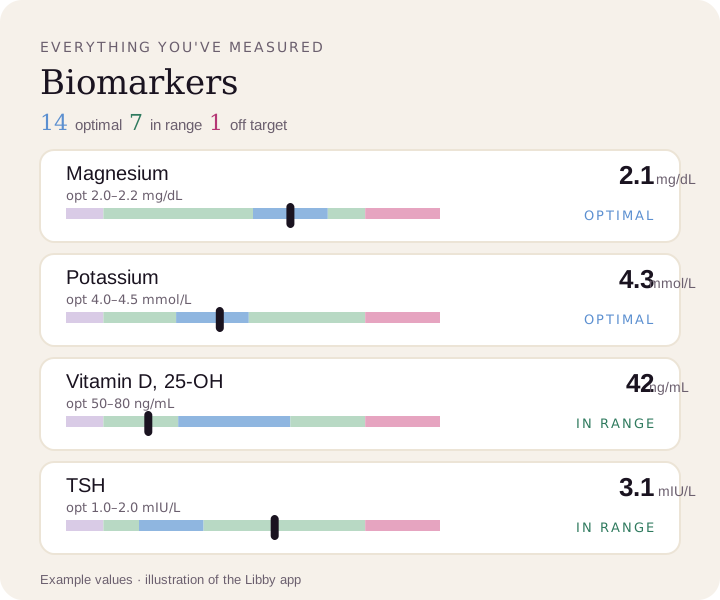
Compare your results to optimal ranges.
Upload a lab PDF or a photo of your report. Libby puts every marker on your lab's range and, where the app has one, the optimal range, and tracks your trends over time.
View your magnesium ›