Urobilinogen in urine: normal levels, high and low causes
Urine urobilinogen tracks bilirubin's trip from liver to gut and back. Here's the normal 0.2–1.0 range, what high or low means, and when it's urgent.
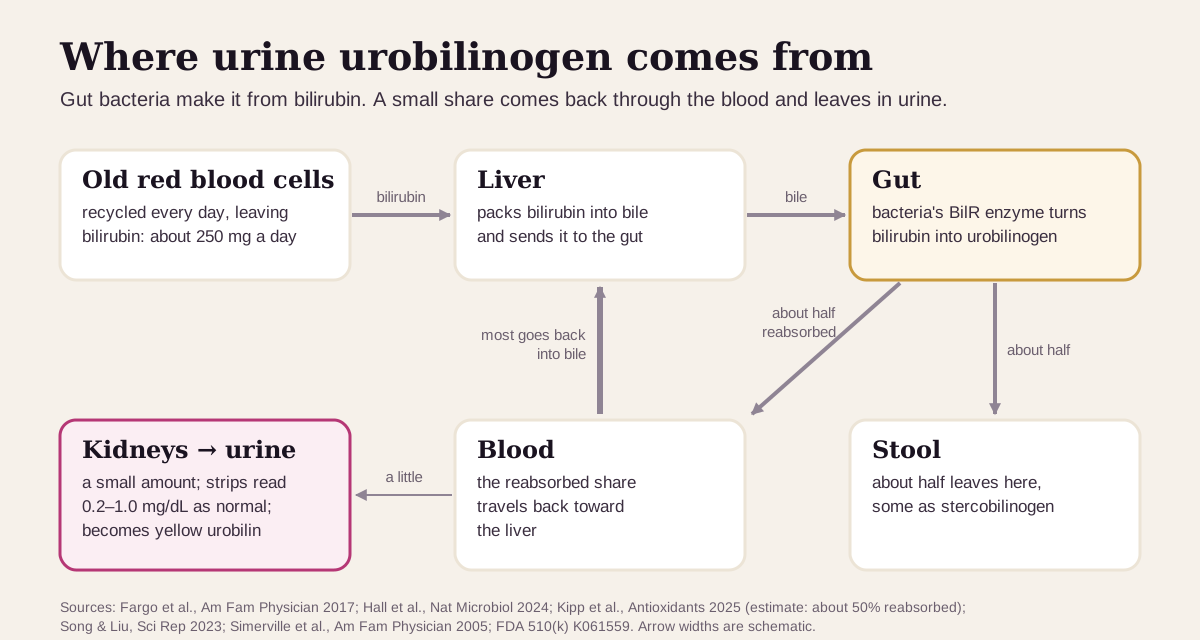
Urobilinogen is what your gut bacteria make from bilirubin, the yellow pigment left over when old red blood cells are recycled. Much of it leaves in your stool, and some returns to your liver to be recycled. A small amount passes out through your kidneys, so healthy urine always holds a little.12 A high result usually means your body is breaking down red cells faster or your liver is struggling to recycle urobilinogen. A very low result can mean bile is blocked from reaching your gut.21
The short version
- Normal: most urine strips read 0.2 to 1.0 mg/dL. The lowest block on the strip is 0.2, so a normal-low result prints as 0.2.34
- High (2 mg/dL or more) is where strip makers say to look further. The usual reasons are liver-cell injury (hepatitis, cirrhosis, medicines) and red cells breaking down (hemolysis). A mild rise is sometimes a normal finding.536
- Low or absent points to bile blocked from reaching the gut or recent antibiotics. A standard strip reads both as 0.2, so the urine bilirubin pad next to it is the better clue.15
- Get care promptly for yellow skin or eyes, tea-colored urine with pale stools, fever or chills, or belly pain lasting hours.7
What urobilinogen is
Every day an average adult makes about 250 mg of bilirubin from worn-out red blood cells. The liver packages it into bile and sends it to the gut.8 There, gut bacteria use an enzyme called bilirubin reductase (BilR) to turn bilirubin into urobilinogen. BilR is nearly universal in healthy adults: in one analysis of 1,801 stool gene samples, it was missing from just 0.1%.9
From the gut, urobilinogen splits three ways:
- About half leaves in stool, some of it after bacteria reduce it further to a related pigment, stercobilinogen. One review estimates that the other half of these gut pigments is absorbed back into the blood.109
- Most of what's absorbed goes back to the liver, which sends it out in bile again.11
- A small amount is filtered by the kidneys into urine.1 In urine it oxidizes to urobilin, the pigment that makes urine yellow.109
A urine urobilinogen test is one pad on the dipstick part of a routine urinalysis.6 It needs no special preparation.2 (More on the chemistry at the end.)
What's a normal urine urobilinogen?
Healthy urine holds a little urobilinogen, and most strips call 0.2 to 1.0 mg/dL normal. An FDA review of one strip lists 0.2–1.0 mg/dL as the expected range and calls anything above 1 mg/dL abnormal.3 Siemens, which makes the widely used Multistix strips, says urobilinogen is normally present up to 1 Ehrlich unit per dL and treats 2 as the step from normal to abnormal.5 The Libby app checks your result against a 0–1.0 mg/dL lab range.
Strips report in steps, not a smooth number. Here's what that means for your result:
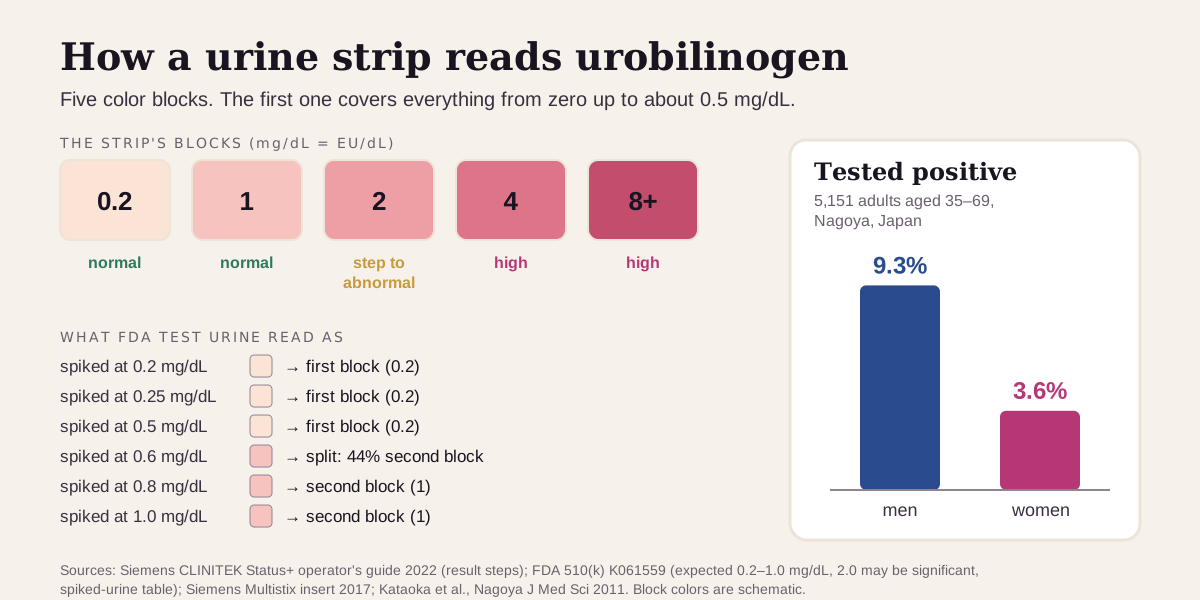
- The strip steps are 0.2, 1, 2, 4 and 8 or more. A common Siemens urine analyzer prints exactly those values.4
- The first block covers a wide span. In the FDA's testing, urine spiked with 0.2, 0.25 and 0.5 mg/dL all read in the first block; 0.8 and 1.0 read in the second.3 So "0.2" on your report means "low-normal," not a precise 0.2.
- Some labs print a slightly different range. UW Medicine in Seattle, for example, uses 0.1–1.9 Ehrlich units.13
Men and women share one range. UW Medicine lists the same range for female, male and unknown sex.13 Men test positive more often, though: in a community study of 5,151 adults aged 35–69 in Nagoya, Japan, 9.3% of men and 3.6% of women had a positive urobilinogen.12 A clinician review notes that a positive result is sometimes a normal finding.6
"Optimal" urobilinogen: what health optimizers aim for
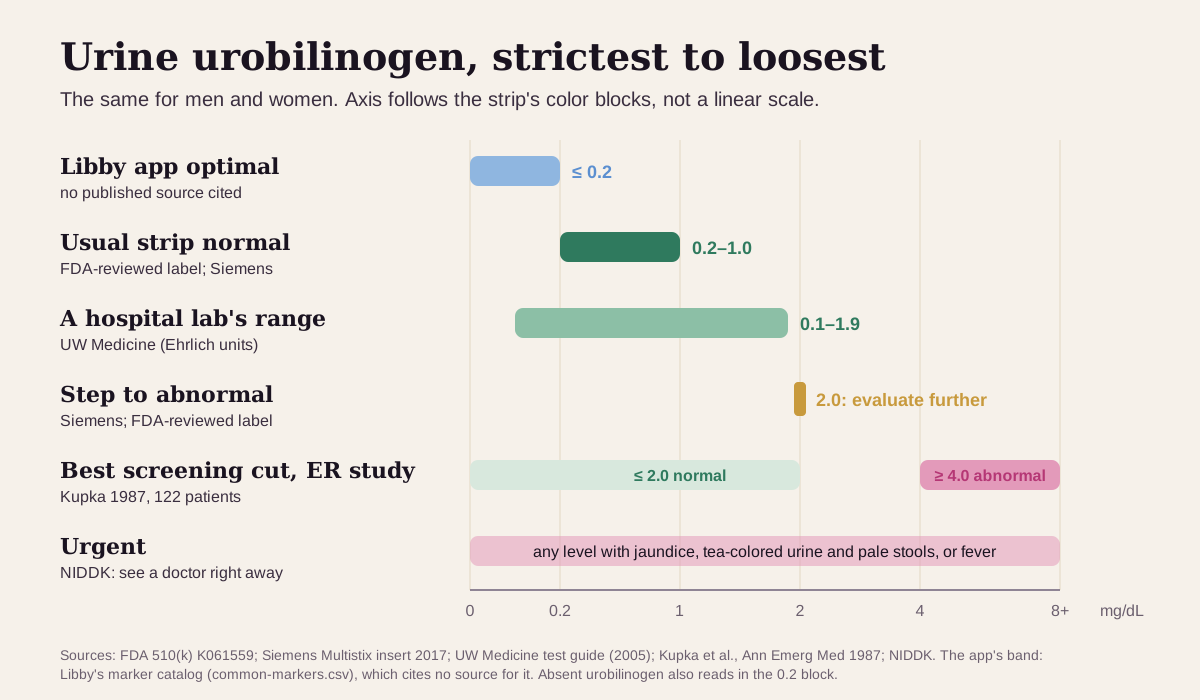
We found no published longevity or functional-medicine target for urobilinogen. Superpower, a commercial testing company, offers the test and publishes no range for it.14 The strictest number you'll meet is the Libby app's own optimal band. Here's the full ladder, from strictest to loosest, on the strip's own scale:
| Level | Result (men and women) | Who uses it |
|---|---|---|
| Strictest: the Libby app's optimal band | 0.2 mg/dL or less | The optimal range shown in the Libby app. The app's catalog cites no published source for it; it matches the strip's lowest block |
| Usual strip "normal" | 0.2–1.0 mg/dL | An FDA-reviewed strip label3 and Siemens Multistix ("up to 1 EU/dL")5 |
| A hospital lab's range | 0.1–1.9 Ehrlich units | UW Medicine13 |
| Step to abnormal | 2.0 mg/dL (EU/dL) | Siemens and the FDA-reviewed strip: evaluate further53 |
| Best screening cut in one ER study | 2.0 normal / 4.0 abnormal | Kupka et al., 122 emergency patients15 |
| Urgent | any level with jaundice, tea-colored urine and pale stools, fever or lasting belly pain | NIH's digestive-disease institute: see a doctor right away7 |
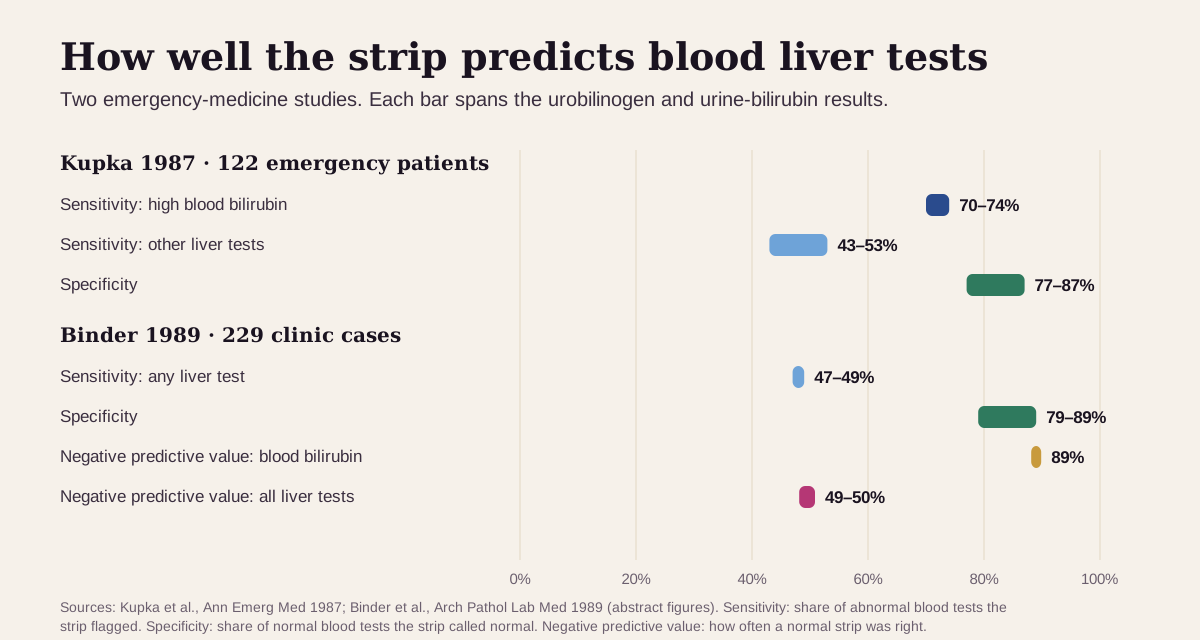
What the cut-offs rest on. Two studies from one Texas emergency group tested the strip against blood liver tests:
- In 122 emergency patients, urobilinogen and urine bilirubin caught 70–74% of high blood bilirubin but only 43–53% of other abnormal liver tests. The best urobilinogen cut-off was 2.0 mg/dL for normal and 4.0 for abnormal.15
- In 229 clinic cases, both urine tests missed about half of abnormal liver tests (sensitivity 47–49%), and a normal strip ruled out a liver problem only about half the time.16
- The flip side: in 324 clinic cases from the same group, a positive urine screen came with at least one abnormal blood liver test 88% of the time. The authors said a positive strip found at a routine checkup deserves follow-up.17
Keep "optimal" in perspective. The app's 0.2 band is simply the strip's floor, the first color block, which covers everything up to about 0.5 mg/dL.3 Lower is also no goal in itself: an absent urobilinogen can mean bile is blocked from reaching the gut, and a standard strip reads that as 0.2 too.15 A positive result is a reason to check a blood liver panel, not a diagnosis.17
What a high or low urobilinogen usually means
The size and direction of the result are the first clues. Strips give a rough scale, and the causes differ at each end:
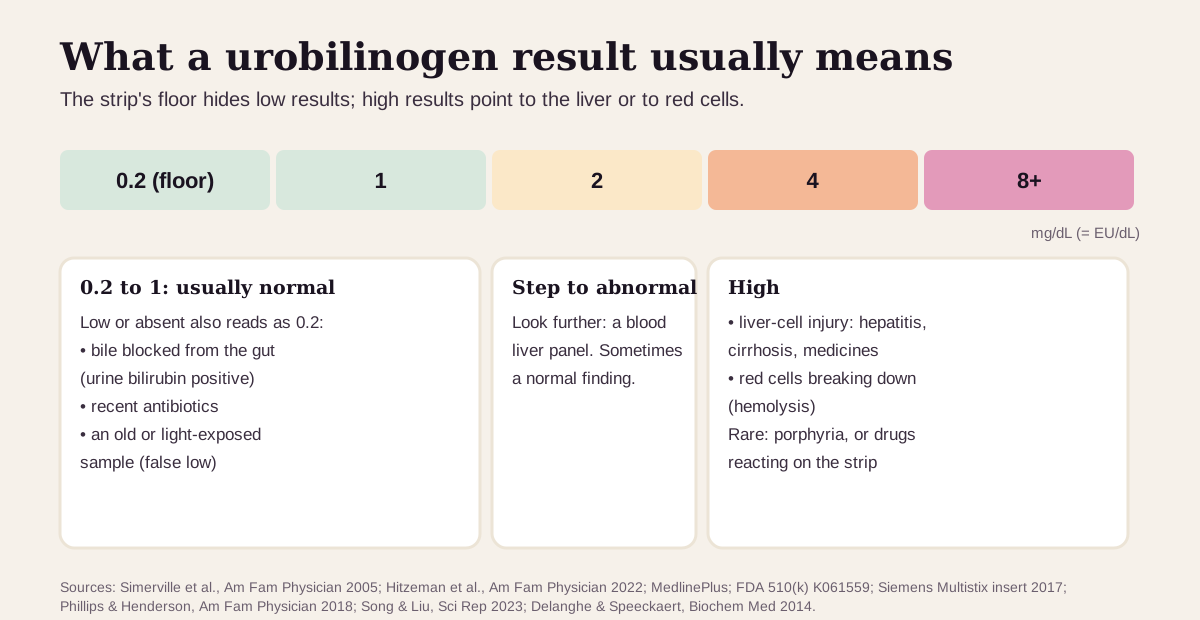
High (2 mg/dL or more): the usual suspects
- Liver-cell injury. Hepatitis, cirrhosis and liver damage from medicines all raise urine urobilinogen, because a struggling liver recycles less of what comes back from the gut.21 Liver causes are the most common reason for new jaundice: in a study of more than 700 adults, 55% of cases came from inside the liver, mostly viral hepatitis, alcohol and drug injury.8
- Red cells breaking down (hemolysis). When red cells break down faster than usual, your body makes more bilirubin and the gut makes more urobilinogen. Clinicians check urobilinogen along with LDH, haptoglobin, reticulocytes and unconjugated bilirubin when they suspect hemolytic anemia.182
- A normal variation. A mild positive is sometimes a normal finding,6 as the Japanese community numbers above show.12
- Less common: something on the strip reacting. Phenazopyridine (Pyridium), sulfa drugs and para-aminosalicylic acid can give false highs.16519 Rarely, a high reading with a normal blood bilirubin comes from porphobilinogen in acute porphyria. In one study, the ratio of strip urobilinogen to blood bilirubin separated all 11 tested porphyria patients from 100 people with other causes of belly pain.11
Low or absent: blocked bile or a quiet gut
- Bile blocked from reaching the gut. A gallstone in the bile duct, a narrowing or a tumor can stop bile from reaching the gut, so bacteria have no bilirubin to work with.12 Stones in the bile duct cause about 14% of new jaundice, and tumors about 6%.8 The giveaways are a positive urine bilirubin, dark urine and pale stools.86
- Recent antibiotics. They thin out the gut bacteria that make urobilinogen.1 In healthy volunteers given one of 10 antibiotics for 6 days, five of them (including ampicillin, clindamycin and erythromycin) sharply cut the urobilinogen in stool.20
- An old or light-exposed sample. Urobilinogen breaks down in light and at room temperature, which can give a falsely low result.519
Get prompt care if a urobilinogen result comes with yellow skin or eyes, tea-colored urine and light-colored stools, fever or chills, belly pain lasting several hours, or nausea and vomiting.7 Tiredness, dizziness, a racing heart and yellowing together are typical of hemolytic anemia.2
Urobilinogen reads best next to its neighbors
Urobilinogen on its own is a rough signal. Next to urine bilirubin and a blood liver panel, it helps sort out where the bilirubin pathway is jammed:
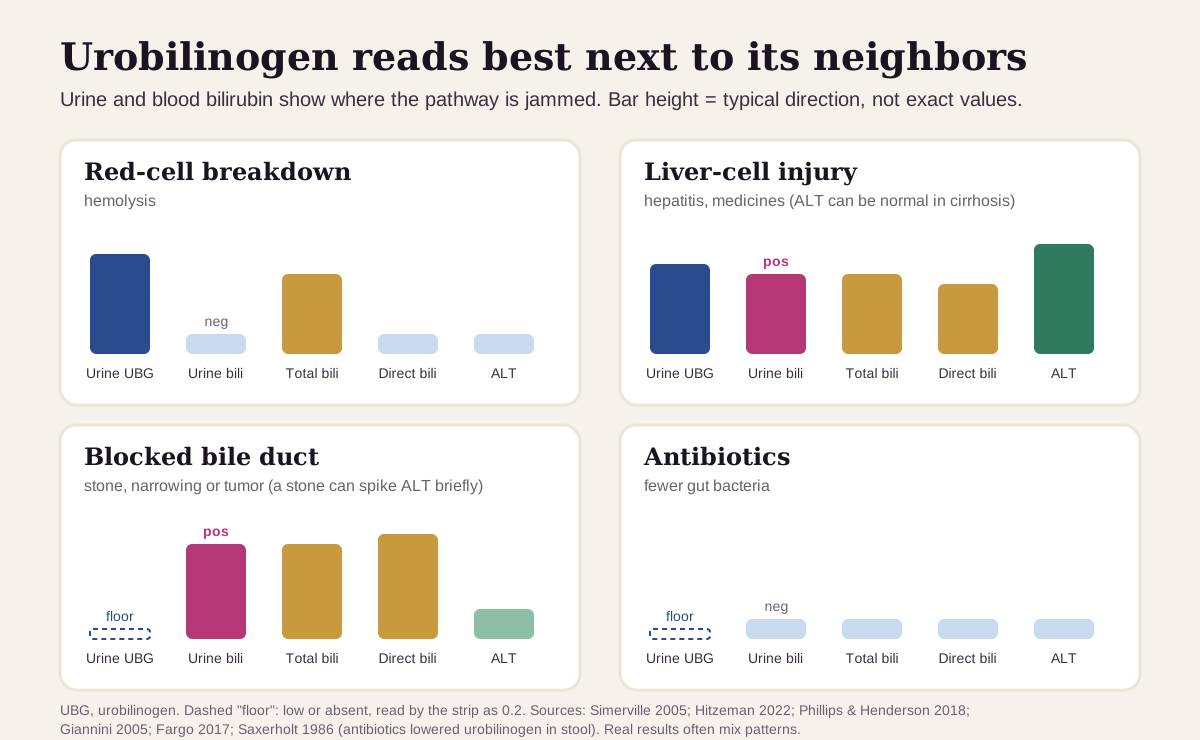
| If you see… | It often points to… |
|---|---|
| Urobilinogen high, urine bilirubin negative, blood bilirubin up with mainly the indirect (unconjugated) part | red cells breaking down faster: hemolysis |
| Urobilinogen high, urine bilirubin positive, ALT high | liver-cell injury: hepatitis, medicines (in long-standing cirrhosis ALT can be normal) |
| Urobilinogen at the strip floor, urine bilirubin positive, direct bilirubin and ALP up | bile blocked on its way to the gut: a stone, narrowing or tumor |
| Urobilinogen at the floor, urine bilirubin negative, blood liver tests normal | recent antibiotics, or simply a low-normal result |
| Urobilinogen high, blood bilirubin normal, severe belly pain | rare: porphobilinogen from acute porphyria reacting on the strip |
The key pairing is urobilinogen with urine bilirubin. Only the conjugated form of bilirubin, the kind the liver has already processed, dissolves in water and reaches urine. So hemolysis raises urobilinogen with a negative urine bilirubin, while liver and bile-duct problems push conjugated bilirubin into the urine.121
How fast urobilinogen changes
Urobilinogen follows the traffic of bilirubin through your gut, so it can shift within days. The antibiotic effect above showed up over a 6-day course.20
It also changes in the cup. That matters more than most people expect:
- Fresh urine gives the truest result. Siemens calls urobilinogen "very unstable" at room temperature and in light, and says to read the pad within 2 minutes of dipping.5 Labs keep light-sensitive samples in amber containers.19
- A short delay changes little in a closed tube. In 321 samples tested within 90 minutes and again later, 1.9% of urobilinogen results changed category at 2 hours and 1.2% at 4 hours.22
- Trends beat snapshots. A result that climbs over repeat tests, or rises with urine bilirubin and blood bilirubin, tells a different story than a single 2.0 that settles back to 0.2. Strip makers warn against basing a decision on any single result.5
Going deeper: the strip chemistry and the gut bacteria behind it
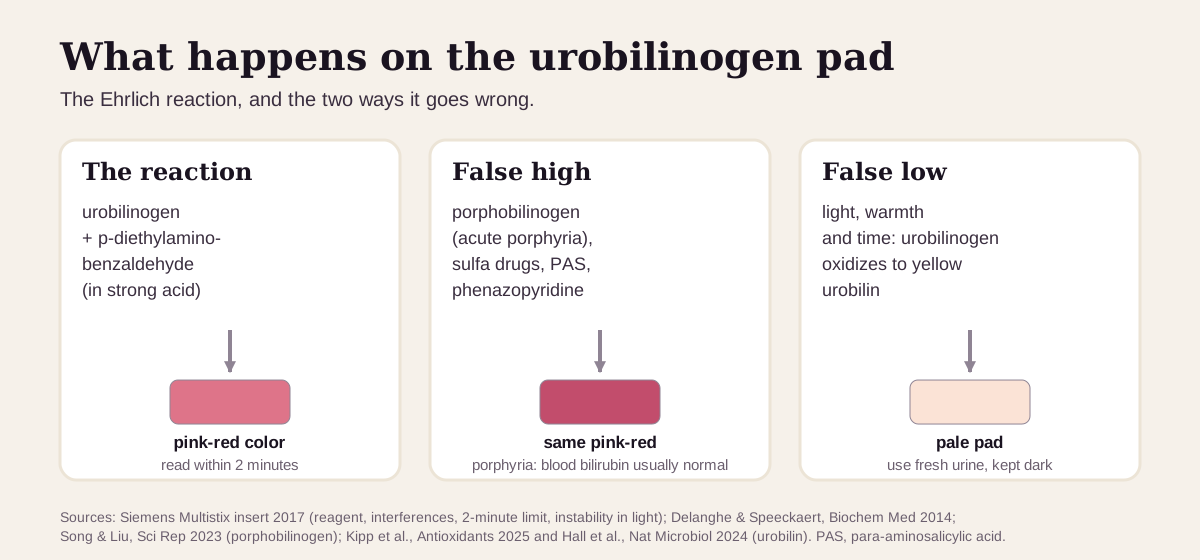
The urobilinogen pad uses the Ehrlich reaction. A chemical called p-diethylaminobenzaldehyde reacts with urobilinogen in strong acid to make a pink-red color.5 Porphobilinogen reacts the same way, which is why acute porphyria can masquerade as a high urobilinogen. Labs tell the two apart with a chloroform extraction step.11
Urobilinogen is also fragile. It oxidizes readily to urobilin, the yellow pigment of urine,109 and it breaks down in light and at room temperature. That's why an old or light-exposed sample can read falsely low.519
The gut enzyme behind all this was only identified in 2024. Researchers found that BilR, made mainly by Firmicutes bacteria, reduces bilirubin to urobilinogen. It was often missing in young infants, the age when newborn jaundice peaks, and in people with inflammatory bowel disease.9 That makes urine urobilinogen, in part, a readout of your gut bacteria.
Questions worth asking
- Was my urobilinogen high, low or at the strip floor, and how far off?
- What did the urine bilirubin pad show next to it?
- Should I get a blood liver panel with direct and indirect bilirubin?
- Could any of my medicines, including antibiotics or phenazopyridine, have affected the result?
- If hemolysis is possible, should I get a CBC, reticulocyte count, LDH and haptoglobin?
- Should we repeat it on a fresh sample, and when?
FAQ
What is a normal urine urobilinogen level? Most strips call 0.2 to 1.0 mg/dL normal, and 2 mg/dL or more a reason to look further.35
What does high urobilinogen in urine mean? It most often points to liver-cell injury, such as hepatitis or cirrhosis, or to red blood cells breaking down faster than usual. A mild rise is sometimes a normal finding.26
What does low or absent urobilinogen mean? Bile may be blocked from reaching your gut, or antibiotics may have thinned the gut bacteria that make it. Standard strips read absent as 0.2, so a positive urine bilirubin is the clearer clue.15
Is urobilinogen in urine dangerous? The number itself is harmless; it's a signpost. Get prompt care if it comes with yellow skin or eyes, tea-colored urine, pale stools, fever or belly pain lasting hours.7
This guide is for education. Your own clinician, who knows your history, is the right person to interpret your result.
Footnotes
-
Simerville JA, Maxted WC, Pahira JJ. Urinalysis: a comprehensive review. Am Fam Physician. 2005;71(6):1153–1162. The source for urobilinogen's route to urine, the rise with hemolysis and liver-cell disease, the fall with antibiotics and bile-duct obstruction, and why only conjugated bilirubin reaches urine. AAFP · PubMed ↩ ↩2 ↩3 ↩4 ↩5 ↩6 ↩7 ↩8 ↩9 ↩10 ↩11 ↩12 ↩13 ↩14
-
National Library of Medicine. Urobilinogen in Urine. MedlinePlus. Updated November 25, 2024. Plain-language causes of high and low results, symptoms of liver disease and hemolytic anemia, and no special preparation. MedlinePlus ↩ ↩2 ↩3 ↩4 ↩5 ↩6 ↩7 ↩8 ↩9
-
U.S. Food and Drug Administration. 510(k) Substantial Equivalence Determination Decision Summary, K061559: ACON Urinalysis Reagent Strips. Expected urobilinogen 0.2–1.0 mg/dL (3.5–17 µmol/L); above 1 mg/dL "abnormal"; 2.0 mg/dL "may be of clinical significance"; minimum sensitivity 0.2 mg/dL; absence "cannot be detected"; spiked-urine results by color block. FDA ↩ ↩2 ↩3 ↩4 ↩5 ↩6 ↩7 ↩8 ↩9 ↩10 ↩11 ↩12
-
Siemens Healthcare Diagnostics. CLINITEK Status+ Analyzer Operator's Guide (U.S.), 10490853 Rev. E, 2022. A commercial source, cited for the analyzer's own result table: urobilinogen reported as 0.2, 1.0, 2.0, 4.0 and ≥8.0 E.U./dL. Siemens Healthineers ↩ ↩2 ↩3
-
Siemens Healthcare Diagnostics. Multistix 10 SG, Multistix 8 SG, Labstix and Uristix Reagent Strips for Urinalysis, package insert 11306392 Rev. A, 2017. A commercial source, cited for the manufacturer's own label: urobilinogen normally present "up to 16 µmol/L (1 Ehrlich Unit/dL)"; 33 µmol/L (2 EU/dL) "represents the transition from normal to abnormal"; detects down to 0.2 EU/dL; "absence of urobilinogen in the specimen cannot be determined"; Ehrlich reaction; interferences; read within 2 minutes; "very unstable when exposed to room temperature and light." Siemens Healthineers ↩ ↩2 ↩3 ↩4 ↩5 ↩6 ↩7 ↩8 ↩9 ↩10 ↩11 ↩12 ↩13 ↩14 ↩15 ↩16 ↩17 ↩18
-
Hitzeman N, Greer D, Carpio E. Office-based urinalysis: a comprehensive review. Am Fam Physician. 2022;106(1):27–35B. Urobilinogen suggests hemolysis or hepatic disease and is "sometimes a normal finding"; lists false positives (phenazopyridine, sulfonamides) and false negatives (improper storage, preservatives). AAFP · PubMed ↩ ↩2 ↩3 ↩4 ↩5 ↩6 ↩7 ↩8 ↩9
-
National Institute of Diabetes and Digestive and Kidney Diseases. Symptoms & Causes of Gallstones. NIH. "See a doctor right away" for lasting belly pain, nausea and vomiting, fever or chills, jaundice, and tea-colored urine and light-colored stools. NIDDK ↩ ↩2 ↩3 ↩4 ↩5
-
Fargo MV, Grogan SP, Saguil A. Evaluation of jaundice in adults. Am Fam Physician. 2017;95(3):164–168. About 250 mg of bilirubin made per day; 55% of acute adult jaundice intrahepatic; bile-duct stones 14% and tumors 6.2% of new jaundice; dark urine and pale stools with obstruction. AAFP · PubMed ↩ ↩2 ↩3 ↩4 ↩5 ↩6
-
Hall B, Levy S, Dufault-Thompson K, et al. BilR is a gut microbial enzyme that reduces bilirubin to urobilinogen. Nat Microbiol. 2024;9(1):173–184. BilR was absent in 0.1% of 1,801 healthy-adult metagenomes, less common in young infants and in IBD; urobilin is urine's yellow pigment. PMC ↩ ↩2 ↩3 ↩4 ↩5 ↩6 ↩7
-
Kipp ZA, Pauss SN, Martinez GJ, Hinds TD Jr, Lee WH. Bilirubin hepatic and intestinal transport and catabolism: physiology, pathophysiology, and benefits. Antioxidants (Basel). 2025;14(11):1326. Review estimating that about 50% of gut urobilinoids are reabsorbed. PMC ↩ ↩2 ↩3 ↩4
-
Song C, Liu Y. A high urinary urobilinogen/serum total bilirubin ratio indicates acute hepatic porphyria in patients with abdominal pain. Sci Rep. 2023;13(1):21330. 12 porphyria patients and 100 controls with other causes of abdominal pain; porphobilinogen gives a false-high strip urobilinogen; most reabsorbed urobilinogen is re-excreted in bile. PMC ↩ ↩2 ↩3 ↩4 ↩5
-
Kataoka R, Kimata A, Yamamoto K, et al. Association of UGT1A1 Gly71Arg with urine urobilinogen. Nagoya J Med Sci. 2011;73(1–2):33–40. 5,151 residents of Nagoya aged 35–69; positive urobilinogen in 9.3% of men and 3.6% of women. PMC ↩ ↩2 ↩3
-
UW Medicine Department of Laboratory Medicine and Pathology. Urobilinogen, URN (UURBIL). Online Test Guide. Reference range 0.1–1.9 Ehrlich units for female, male and unknown sex, effective February 1, 2005. UW Medicine ↩ ↩2 ↩3 ↩4
-
Superpower. Urobilinogen (Urine) Test. Last updated September 1, 2026. A commercial source, checked for an optimal target: the page describes the test ("a byproduct of bilirubin metabolism produced by intestinal bacteria") and publishes no range. superpower.com ↩
-
Kupka T, Binder LS, Smith DA, et al. Accuracy of urine urobilinogen and bilirubin assays in predicting liver function test abnormalities. Ann Emerg Med. 1987;16(11):1231–1235. 122 emergency patients; best urobilinogen threshold 2.0/4.0 mg/dL. DOI · PubMed ↩ ↩2 ↩3 ↩4
-
Binder L, Smith D, Kupka T, et al. Failure of prediction of liver function test abnormalities with the urine urobilinogen and urine bilirubin assays. Arch Pathol Lab Med. 1989;113(1):73–76. 229 ambulatory cases. PubMed ↩ ↩2
-
Binder L, Smith D, Kupka T, et al. Abnormalities of urine urobilinogen and urine bilirubin assays and their relation to abnormal results of serum liver function tests. South Med J. 1988;81(10):1229–1232. 324 cases; positive predictive value 88% for at least one abnormal liver test. PubMed ↩ ↩2
-
Phillips J, Henderson AC. Hemolytic anemia: evaluation and differential diagnosis. Am Fam Physician. 2018;98(6):354–361. Table 3: in hemolysis, urinalysis shows urobilinogen and blood, unconjugated bilirubin and LDH rise, haptoglobin falls. AAFP · PubMed ↩ ↩2
-
Delanghe J, Speeckaert M. Preanalytical requirements of urinalysis. Biochem Med (Zagreb). 2014;24(1):89–104. Amber containers for light-sensitive urobilinogen; false positives from sulfonamides, para-aminosalicylic acid and phenazopyridine; false negatives from light exposure, formaldehyde and nitrite. PMC ↩ ↩2 ↩3 ↩4 ↩5
-
Saxerholt H, Carlstedt-Duke B, Høverstad T, et al. Influence of antibiotics on the faecal excretion of bile pigments in healthy subjects. Scand J Gastroenterol. 1986;21(8):991–996. Ten antibiotics for 6 days; bacitracin, vancomycin, clindamycin, erythromycin and ampicillin suppressed fecal urobilinogen. Measured in stool, not urine. PubMed ↩ ↩2 ↩3
-
Giannini EG, Testa R, Savarino V. Liver enzyme alteration: a guide for clinicians. CMAJ. 2005;172(3):367–379. Conjugated bilirubin is virtually absent in health; hepatitis pairs it with markedly high aminotransferases; a purely cholestatic picture pairs it with high ALP and little aminotransferase rise, though acute bile-duct obstruction can briefly spike aminotransferases; hemolysis is a leading cause of unconjugated hyperbilirubinemia. PMC ↩ ↩2
-
Dolscheid-Pommerich RC, Klarmann-Schulz U, Conrad R, Stoffel-Wagner B, Zur B. Evaluation of the appropriate time period between sampling and analyzing for automated urinalysis. Biochem Med (Zagreb). 2016;26(1):82–89. 321 samples; urobilinogen misclassified in 6 (1.9%) at 120 minutes and 4 (1.2%) at 240 minutes. PMC ↩
Educational content, not medical advice. Libby is a personal record tool, not a medical service — it doesn't diagnose, treat, or prescribe. Reference ranges vary by lab and by person. Talk to a qualified healthcare professional about your results.
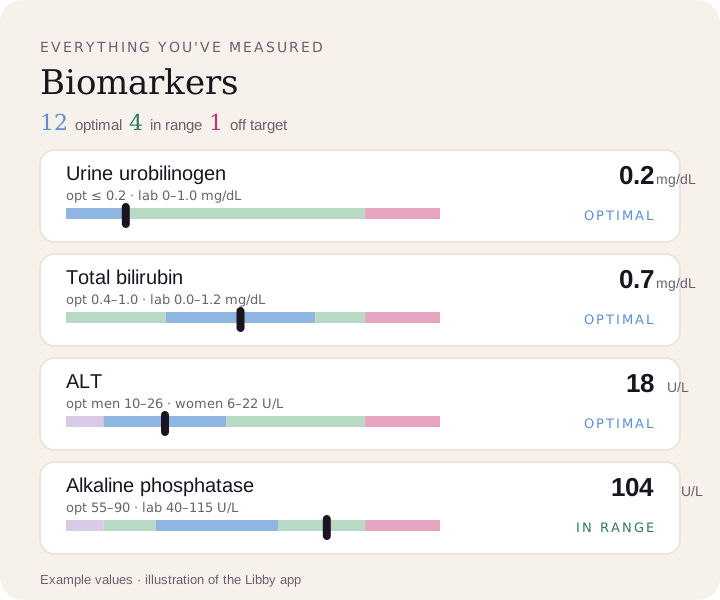
See your urinalysis next to your liver panel.
Upload a lab PDF or a photo of your report. Libby puts your urobilinogen, bilirubin and liver enzymes on your lab's range and the optimal range, and tracks your trends over time.
View your urine urobilinogen ›