Total T3 test: normal range, optimal levels, high and low
Total T3 counts all the T3 in your blood, bound and free. Here's the normal and optimal range, why pregnancy and estrogen raise it, and what high or low means.
Total T3 measures all the triiodothyronine (T3) in your blood: the 99.7% riding on carrier proteins plus the small free part that can enter your cells.12 T3 is the active thyroid hormone. A high total T3 with a low TSH usually means an overactive thyroid. And because the carriers hold almost all of it, anything that changes the carriers, such as pregnancy or estrogen pills, moves total T3 too, even when your thyroid is working normally.34
The short version
- Normal: check the range on your report. Labcorp puts total T3 for anyone over age 10 at 71–180 ng/dL.5 The Libby app shows 100–180 ng/dL as optimal, from a functional-medicine thyroid book.6
- High with a low TSH usually means an overactive thyroid, most often Graves disease.7 Low usually reflects being sick, eating much less, or a medicine such as a steroid or amiodarone.41
- Carriers move the number. Pregnancy lifts total T3 to about 1.5 times its usual level, and estrogen pills raise it too, while TSH and free T4 usually stay in the normal range.43
- Urgent: high thyroid hormone plus fever, a pounding heart, confusion or agitation can be thyroid storm, a medical emergency. Call 911.8
What total T3 is
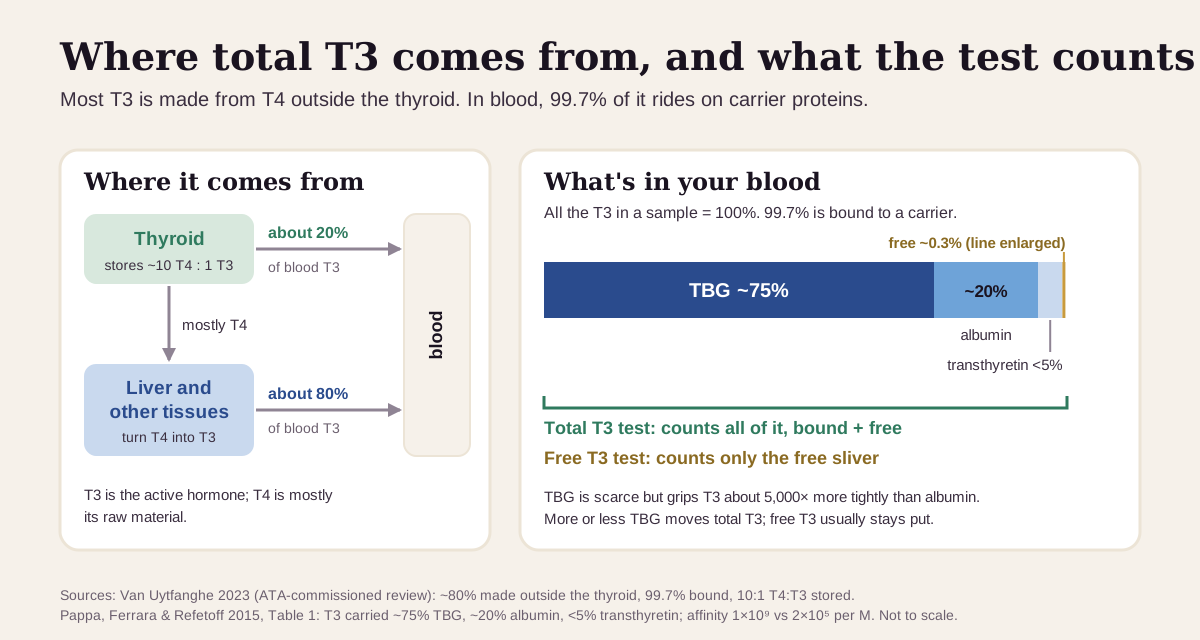
T3 is the thyroid hormone that does the work inside your cells.3 Your thyroid releases mostly T4 (thyroxine), about ten T4 for every T3 in its stored hormone, and about 80% of your T3 is made from T4 outside the thyroid, by enzymes in the liver and other tissues.13
In your blood, 99.7% of T3 is bound to carrier proteins.1 Three proteins share the load:10
- TBG (thyroxine-binding globulin) carries about 75%. It's scarce, but it grips T3 about 5,000 times more tightly than albumin does.
- Albumin, the most plentiful protein in blood, carries about 20%.
- Transthyretin carries under 5%.
A total T3 test counts the bound and free hormone together. A free T3 test counts only the unbound sliver.2 Doctors usually order T3 when TSH is low, to confirm and size an overactive thyroid, because T3 rises before T4 in that condition.13
Total or free: which one to trust?
Free T3 is the part that acts, so it sounds like the better test. In practice, T3 circulates at low levels and binds its carriers more loosely than T4 does, so routine free T3 tests are less precise than free T4 tests. Many labs prefer to run total T3 instead, and a 2023 review commissioned by the American Thyroid Association recommends total T3 over free T3.1 MedlinePlus calls total T3 the more accurate way to measure T3.2
Total T3 gets misleading when the carriers change. More TBG raises total T3; less TBG lowers it. Free hormone and TSH usually stay put, because the thyroid is working normally.4 That's why, in pregnancy or on estrogen, the American Thyroid Association suggests checking TSH and free T4 instead.3
What's a normal total T3?
Start with the range printed on your report. Labs use different machines and methods, so their ranges differ.1
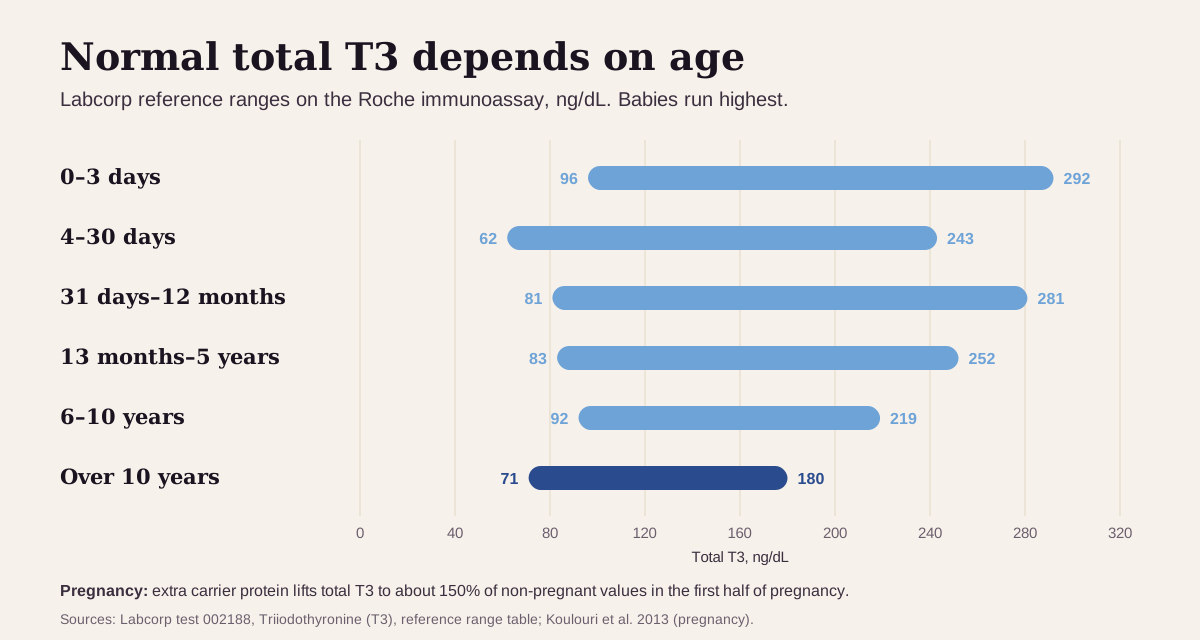
- Routine test (most labs): Labcorp's Roche immunoassay puts everyone over age 10 at 71–180 ng/dL. Babies and young children run higher, up to 292 in the first 3 days of life.5
- General reference: MedlinePlus lists 78–158 ng/dL as a typical normal range.9
- Mass-spectrometry research range: a study of 159 healthy adults from the U.S., South Africa and Turkey found 62–202 ng/dL in the morning and 65–192 in the evening. Values drifted lower from morning to evening, with no significant difference between men and women.11
Pregnancy raises it. Estrogen makes the liver produce more TBG, so total T4 and total T3 climb to about 150% of non-pregnant values during the first half of pregnancy and stay there until delivery.4 A total T3 above the usual range in pregnancy often reflects that extra carrier protein rather than an overactive thyroid.
"Optimal" total T3: what health optimizers aim for
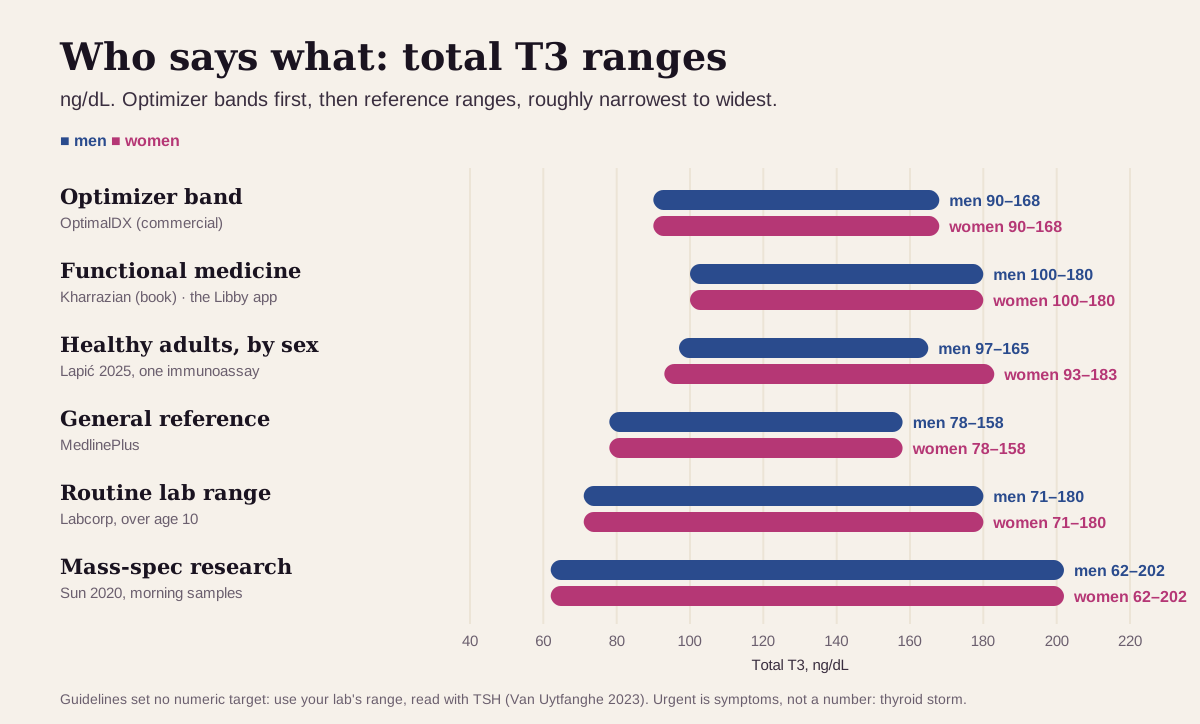
The functional-medicine range in the Libby app keeps Labcorp's upper limit of 180 but raises the floor from 71 to 100 ng/dL.65 For total T3, "strict" mostly means a higher floor. Here's the ladder, from the optimizer bands to the widest research range:
| Target | Men | Women | Who uses it |
|---|---|---|---|
| Optimizer band (commercial) | 90–168 ng/dL | 90–168 ng/dL | OptimalDX's published "ODX Range"12 |
| Functional medicine | 100–180 ng/dL | 100–180 ng/dL | A widely read functional-medicine thyroid book,6 and the optimal range shown in the Libby app |
| Healthy adults, one immunoassay | 97–165 ng/dL | 93–183 ng/dL | 305 healthy Croatian adults, the one source here that splits by sex13 |
| General reference | 78–158 ng/dL | 78–158 ng/dL | MedlinePlus9 |
| Routine lab range | 71–180 ng/dL | 71–180 ng/dL | Labcorp, over age 10, Roche immunoassay5 |
| Mass-spectrometry research range | 62–202 ng/dL (morning) | 62–202 ng/dL (morning) | 159 healthy adults, no sex difference11 |
| Guidelines | no numeric target | no numeric target | Use your own lab's range, read with TSH13 |
| Urgent | symptoms, not a number | symptoms, not a number | Thyroid storm: fever, pounding heart, confusion. Call 9118 |
Why optimizers want a higher floor. The evidence comes from people who were already sick:
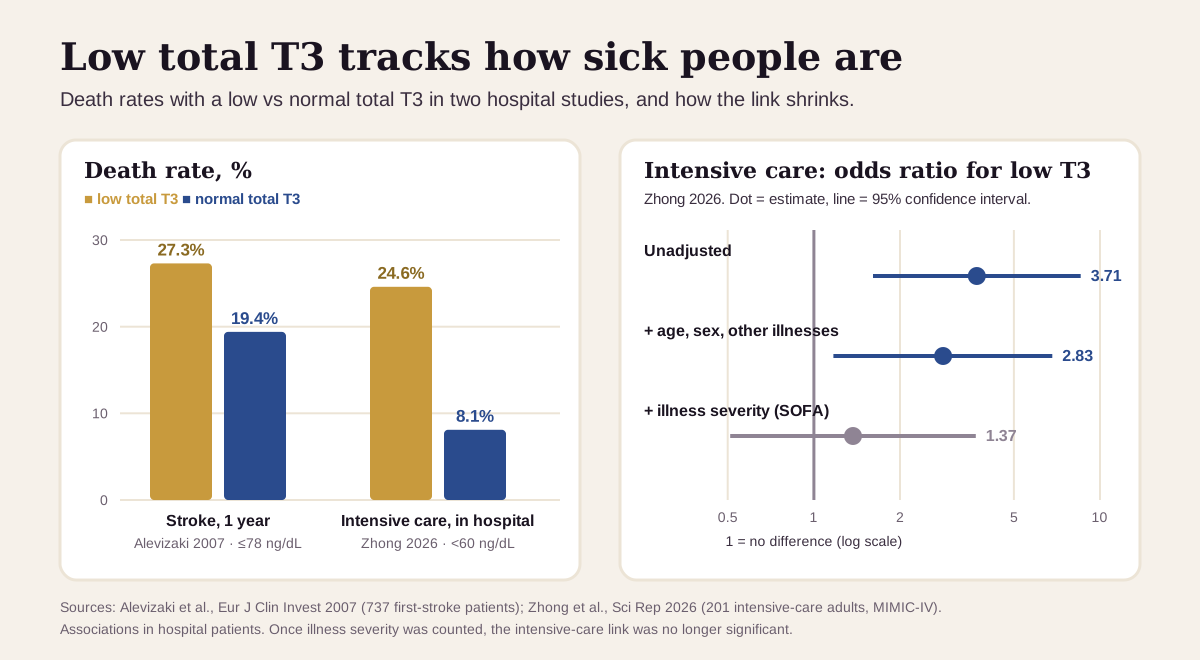
- In 737 people admitted with a first stroke, the 56% with a total T3 of 78 ng/dL or less had a 27.3% risk of dying within a year, versus 19.4% for those with a normal T3. Fewer were living independently a year later (54.2% vs 68.7%).14
- In 187 people starting dialysis whose thyroid tests were otherwise normal, a low total T3, but not a low free T3, predicted death from any cause and from cardiovascular disease.15
- In 201 adults in intensive care, a total T3 under 60 ng/dL went with 24.6% in-hospital mortality versus 8.1%. Once the researchers accounted for how sick people were, most of that link disappeared.16
Keep "optimal" in perspective. A low total T3 mostly tracks how sick or underfed the body is, and giving thyroid hormone for that pattern lacks compelling evidence in most people with illness.4 Lower can even come with healthy habits: in people who had practiced calorie restriction for 3 to 15 years, total T3 averaged 73.6 ng/dL, versus 91.0 in similar people eating a Western diet, and the researchers suggest the drop may help slow aging.17 Both of those averages, from healthy people, sit below the app's optimal floor of 100. And above the range is how an overactive thyroid shows up.7
What a high or low total T3 usually means
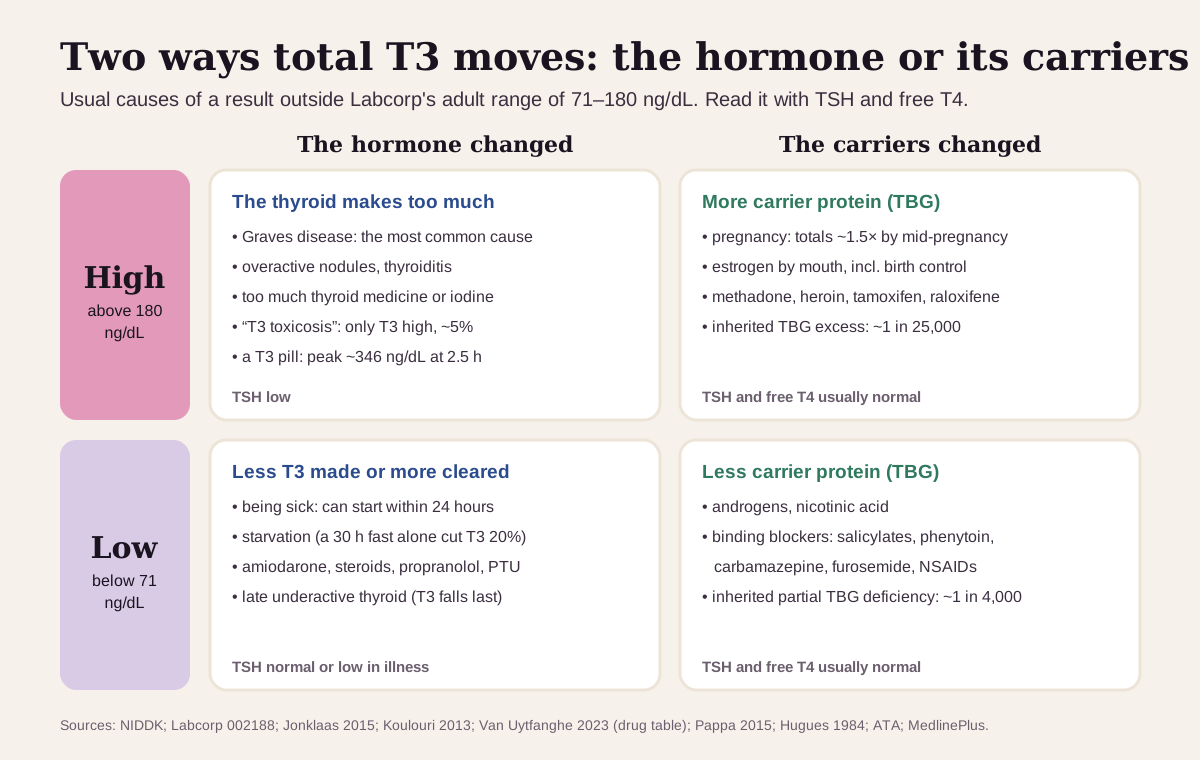
Ask two questions: did the hormone change, or did its carriers? Read total T3 with TSH and free T4 from the same blood draw.31
High total T3
About 1 in 100 Americans aged 12 and over has an overactive thyroid (hyperthyroidism).7 The usual suspects:
- Graves disease, an autoimmune condition, is the most common cause. Others include overactive thyroid nodules (found most often in older adults), thyroiditis, too much iodine and too much thyroid medicine.7
- "T3 toxicosis." In about 5% of overactive thyroids, only T3 is high and T4 stays normal. It shows up with a single overactive nodule, a multinodular goiter, T3 treatment, and occasionally Graves disease.5
- A recent T3 pill. In 12 healthy adults given one 50-mcg dose of liothyronine (T3), total T3 peaked 2.5 hours later at an average of 346 ng/dL, nearly twice the top of Labcorp's range.185 If you take T3 or desiccated thyroid, tell your clinician when you took your last dose.
- More carrier protein. Pregnancy, estrogen taken by mouth (including birth-control pills), methadone, heroin, tamoxifen and raloxifene all raise TBG. Total T3 and total T4 go up while free hormone stays normal.43 An inherited excess of TBG is rare, about 1 in 25,000 people.10
- A lab artifact. High-dose biotin supplements can throw off this test. Labcorp asks people to stop biotin at least 72 hours before the draw.5
Call 911 if you have an overactive thyroid and develop fever, agitation or confusion, a pounding heart, shaking, sweating or diarrhea. These can be signs of thyroid storm, a life-threatening emergency.8
Low total T3
The usual suspects:
- Being sick. A T3 below the range is the hallmark of "nonthyroidal illness," the low-T3 state of the body under strain.1 It can start within 24 hours of getting ill and shows up with sepsis, surgery, heart attack, burns, cancer, and chronic liver and kidney disease. Total T3 usually falls further than free T3.4
- Eating much less. Starvation can cause a low T3.9 Even a 30-hour fast in 8 healthy men lowered total T3 from 150 to 120 ng/dL, still inside the range but 20% lower, and an 800-calorie meal hadn't brought it back 5 hours later.19 Labcorp notes that fasting lowers T3.5
- Medicines that slow T4-to-T3 conversion: amiodarone, glucocorticoid steroids, propranolol, propylthiouracil and X-ray contrast agents.1 Don't stop a prescribed medicine on your own. Bring your list to the clinician who prescribes it.
- Less carrier protein. Androgens, long-term steroid treatment and nicotinic acid lower TBG (steroids also slow T4-to-T3 conversion).41 Salicylates (aspirin-type drugs), phenytoin, carbamazepine, furosemide and NSAID painkillers push T3 off its carriers.1 Inherited partial TBG deficiency affects about 1 in 4,000 newborns. People with it have normal thyroid function.10
- An underactive thyroid (hypothyroidism). T3 is the last test to fall: people can be severely hypothyroid, with a high TSH and a low free T4, and still have a normal T3.3 TSH and free T4 make that diagnosis.1
Total T3 reads best next to its neighbors
The pattern across your thyroid panel tells a hormone problem apart from a carrier change:41
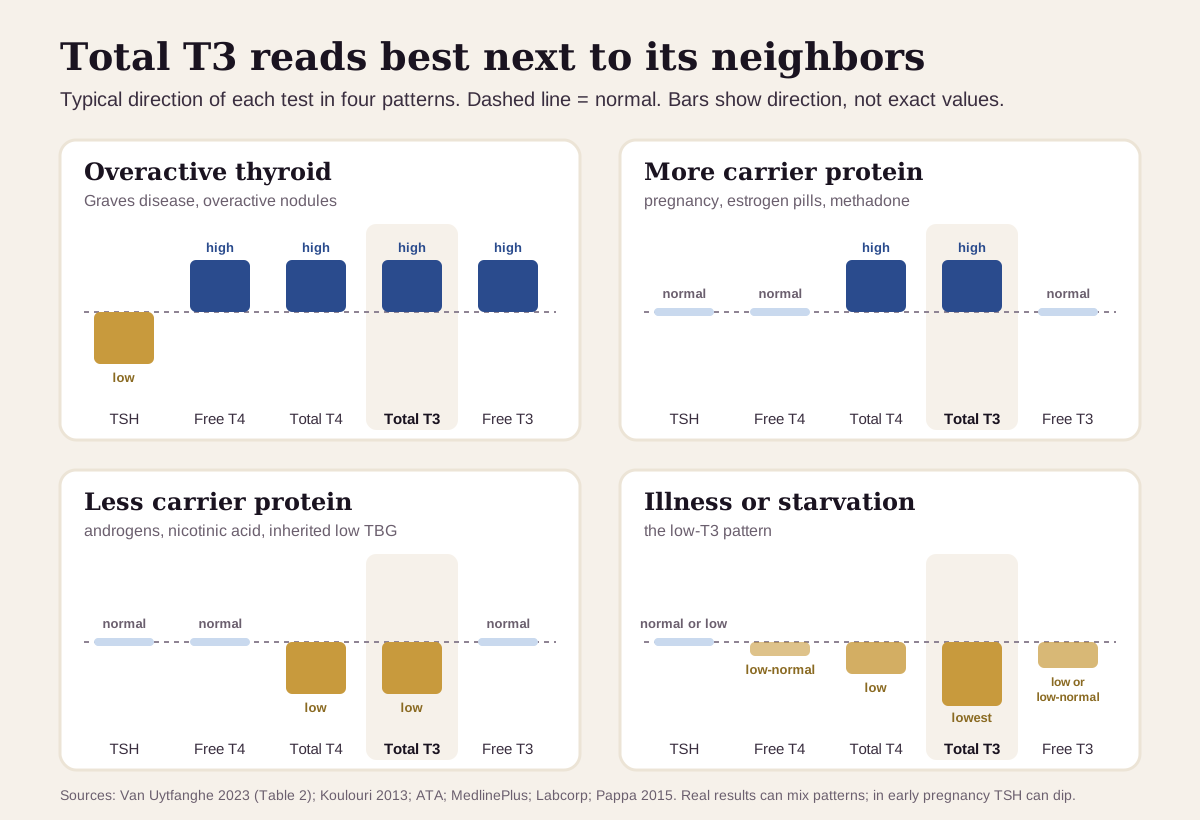
| If you see… | It often points to… |
|---|---|
| Low TSH, high free T4, high total T4 and total T3 | an overactive thyroid, most often Graves disease3257 |
| Low TSH, total T3 high, T4 normal | "T3 toxicosis," about 5% of overactive thyroids53 |
| Normal TSH and free T4, total T4 and total T3 both high | more carrier protein: pregnancy, estrogen pills, methadone. In early pregnancy TSH can dip for a while143 |
| Normal TSH and free T4, total T4 and total T3 both low | less carrier protein: androgens, nicotinic acid, inherited TBG deficiency1410 |
| Total T3 low, free T3 low or low-normal, TSH normal or low, during an illness | the low-T3 pattern of illness or starvation4 |
| High TSH, low free T4, total T3 still normal | an underactive thyroid: T3 is the last to fall3 |
How fast total T3 changes
T3 turns over in about a day. Its half-life is about 1 day in people with normal thyroid function, as reported in Jonklaas 2015, so total T3 can move within hours to days.18 Its carriers change more slowly: TBG itself lasts about 5 days in the blood.10
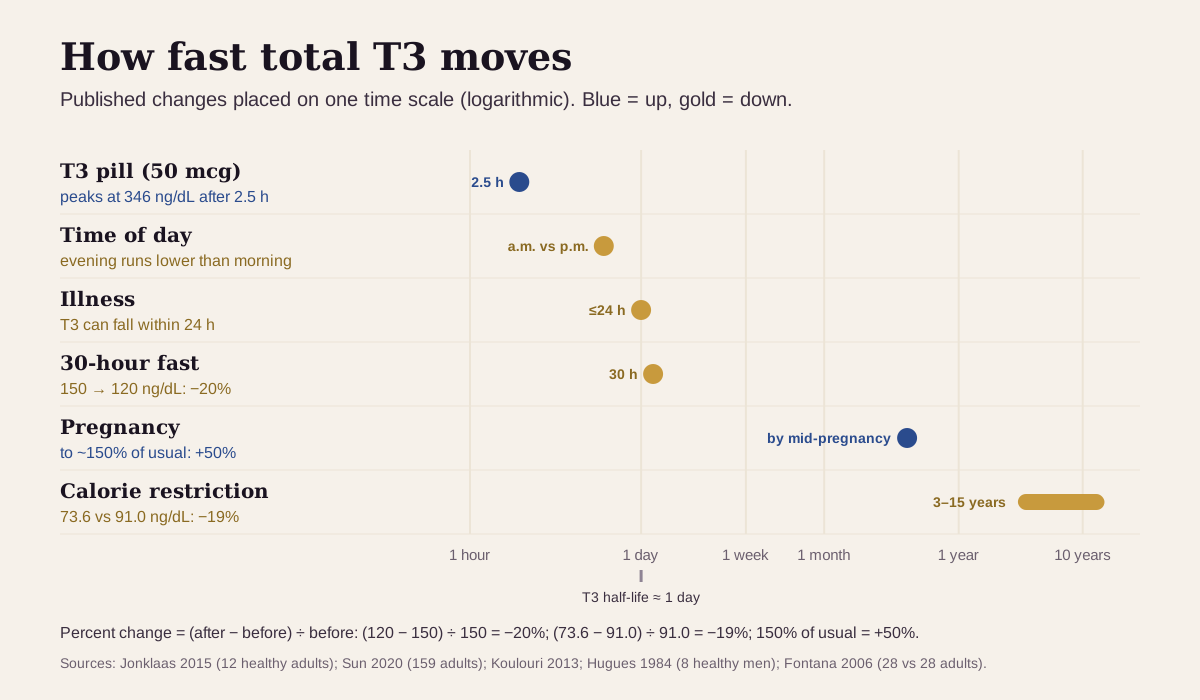
What that means in practice:
- Dose timing moves the number most. If you take T3, draw blood at a consistent time relative to your dose.18
- Illness and fasting pull it down fast. A low total T3 drawn while you were sick, or after a long fast, is worth repeating once you're well and eating normally.419
- Time of day matters a little. Evening total T3 runs lower than morning total T3.11 Test at the same time of day to compare.
- Carrier changes build over weeks. In pregnancy, total T3 climbs through the first half as TBG rises.410
- Trends beat snapshots. Compare results from the same lab and method, because methods differ.1
Going deeper: the T3-to-T4 ratio
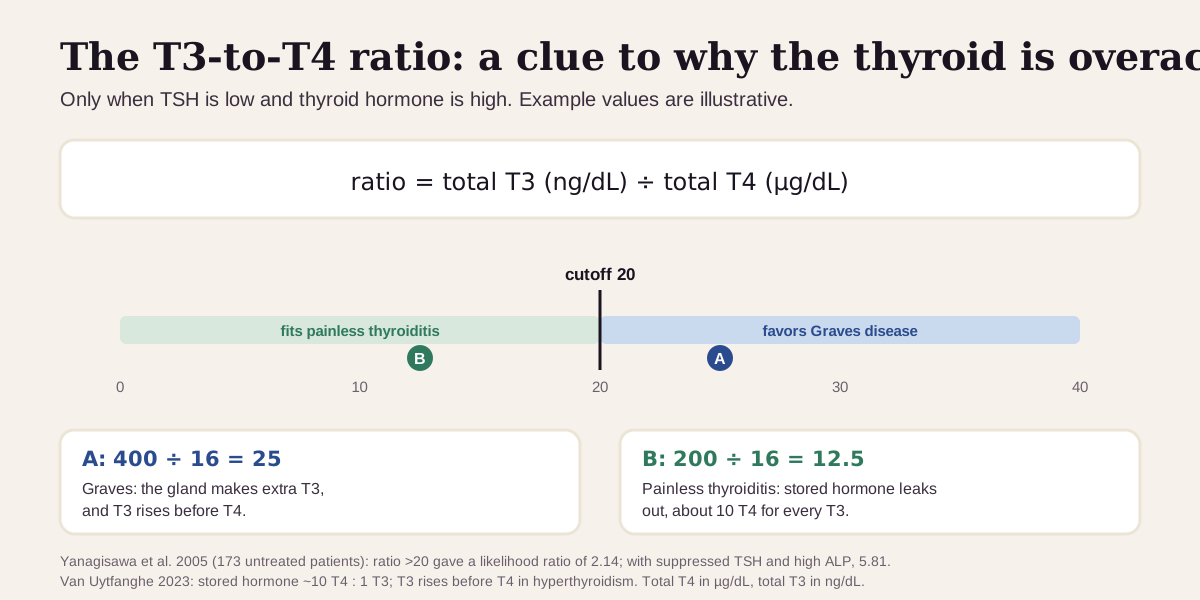
Total T3 has one more use: the ratio of total T3 to total T4. In Graves disease, the overactive gland makes extra T3, and T3 rises before T4.1 In painless thyroiditis, the gland leaks the hormone it has stored, which is about ten parts T4 to one part T3.17
In 173 untreated people with an overactive thyroid, a ratio above 20 pointed toward Graves disease over painless thyroiditis with a likelihood ratio of 2.1, a modest clue on its own. Together with a fully suppressed TSH and a high alkaline phosphatase, the likelihood ratio rose to 5.8, and in that hospital all three results came back within an hour.20 The American Thyroid Association-commissioned review adds that changes in the ratio can help flag Graves patients whose disease may go into remission.1
Questions worth asking
- What were my TSH and free T4 on the same draw, and which pattern do they fit?
- Could pregnancy, birth-control pills, hormone therapy or another medicine be changing my carrier proteins?
- Was I sick, fasting or dieting hard when my blood was drawn?
- If I take T3 or desiccated thyroid, when should I take my dose relative to the blood draw?
- Do I take biotin, and should I stop it before the next test?
- When should we repeat it, and should it be at the same lab?
FAQ
What is a normal total T3 level? It depends on your lab's method. Labcorp's range for anyone over age 10 is 71–180 ng/dL. The Libby app shows 100–180 ng/dL as the optimal range.56
What's the difference between total T3 and free T3? Total T3 counts all the T3 in your blood, including the 99.7% bound to carrier proteins. Free T3 counts only the unbound part. Total T3 is measured more reliably, but it shifts when carrier proteins change.12
Why is my total T3 high in pregnancy or on birth control? Estrogen raises TBG, the main carrier protein, so total T3 and total T4 go up while free hormone and TSH usually stay normal. In pregnancy, totals climb to about 1.5 times non-pregnant levels.43
What does a low total T3 mean? Most often illness, starvation or eating much less, or a medicine that slows T4-to-T3 conversion. Less carrier protein lowers it too. In an underactive thyroid, T3 is usually the last test to fall.413
This guide is for education. It can't diagnose you or replace care from a clinician who knows your history.
Footnotes
-
Van Uytfanghe K, Ehrenkranz J, Halsall D, et al. Thyroid Stimulating Hormone and Thyroid Hormones (Triiodothyronine and Thyroxine): An American Thyroid Association-Commissioned Review of Current Clinical and Laboratory Status. Thyroid. 2023;33(9):1013–1028. The source for 99.7% protein binding, ~80% of T3 made outside the thyroid, the 10:1 T4:T3 ratio in stored hormone, total T3 being preferred over free T3, T3 rising before T4, and the drug-effects table. PMC ↩ ↩2 ↩3 ↩4 ↩5 ↩6 ↩7 ↩8 ↩9 ↩10 ↩11 ↩12 ↩13 ↩14 ↩15 ↩16 ↩17 ↩18 ↩19 ↩20 ↩21 ↩22 ↩23 ↩24 ↩25 ↩26
-
National Library of Medicine. Triiodothyronine (T3) Tests. MedlinePlus. Last updated January 10, 2024. Total versus free T3, and how T3 is read with TSH and free T4. MedlinePlus ↩ ↩2 ↩3 ↩4 ↩5 ↩6
-
American Thyroid Association. Thyroid Function Tests. Patient information: estrogen and pregnancy raise total T4 and T3, T3 in overactive and underactive thyroid. thyroid.org ↩ ↩2 ↩3 ↩4 ↩5 ↩6 ↩7 ↩8 ↩9 ↩10 ↩11 ↩12 ↩13 ↩14 ↩15 ↩16 ↩17
-
Koulouri O, Moran C, Halsall D, Chatterjee K, Gurnell M. Pitfalls in the measurement and interpretation of thyroid function tests. Best Pract Res Clin Endocrinol Metab. 2013;27(6):745–762. The source for the illness pattern (changes within 24 hours; total T3 falls more than free), total T4 and T3 at ~150% in pregnancy, and drugs that change TBG altering total but not free hormone. PMC ↩ ↩2 ↩3 ↩4 ↩5 ↩6 ↩7 ↩8 ↩9 ↩10 ↩11 ↩12 ↩13 ↩14 ↩15 ↩16 ↩17 ↩18 ↩19 ↩20
-
Labcorp. Triiodothyronine (T3) (test 002188). Roche cobas electrochemiluminescence immunoassay; age-specific ranges in ng/dL, the 72-hour biotin instruction, T3 toxicosis in about 5% of cases, and fasting lowering T3. Labcorp is a commercial clinical laboratory, cited for its own published test catalog; the Libby app uses its standard ranges. labcorp.com ↩ ↩2 ↩3 ↩4 ↩5 ↩6 ↩7 ↩8 ↩9 ↩10 ↩11 ↩12 ↩13 ↩14 ↩15
-
Kharrazian D. Why Do I Still Have Thyroid Symptoms? When My Lab Tests Are Normal. Elephant Press; 2010. ISBN 978-0985690403. A widely read functional-medicine thyroid book. The Libby app's marker catalog records its optimal total T3 range as 100–180 ng/dL (the book was not opened for this article). ↩ ↩2 ↩3 ↩4 ↩5
-
National Institute of Diabetes and Digestive and Kidney Diseases. Hyperthyroidism (Overactive Thyroid). Prevalence, causes (Graves disease most common) and thyroiditis letting stored hormone leak out. niddk.nih.gov ↩ ↩2 ↩3 ↩4 ↩5 ↩6 ↩7
-
National Library of Medicine. Thyroid storm. MedlinePlus Medical Encyclopedia. Reviewed January 25, 2026. Symptoms, and why it's an emergency. MedlinePlus ↩ ↩2 ↩3
-
National Library of Medicine. T3 test. MedlinePlus Medical Encyclopedia. Reviewed January 25, 2026. Normal range 78–158 ng/dL (1.2–2.4 nmol/L), and medicines that raise or lower T3. MedlinePlus ↩ ↩2 ↩3 ↩4 ↩5 ↩6
-
Pappa T, Ferrara AM, Refetoff S. Inherited defects of thyroxine-binding proteins. Best Pract Res Clin Endocrinol Metab. 2015;29(5):735–747. Table 1: T3 carried ~75% by TBG, ~20% by albumin, <5% by transthyretin; TBG's affinity for T3 (1×10⁹/M) vs albumin's (2×10⁵/M). Prevalence of partial TBG deficiency (1:4,000 newborns) and TBG excess (~1:25,000); estrogen is the most common cause of high TBG. PMC ↩ ↩2 ↩3 ↩4 ↩5 ↩6 ↩7 ↩8 ↩9
-
Sun Q, Avallone L, Stolze B, et al. Demonstration of reciprocal diurnal variation in human serum T3 and rT3 concentration demonstrated by mass spectrometric analysis and establishment of thyroid hormone reference intervals. Ther Adv Endocrinol Metab. 2020;11:2042018820922688. 159 healthy adults (110 women, 49 men); total T3 62–202 ng/dL (6–9 a.m.) and 65–192 ng/dL (6–9 p.m.); morning-to-evening decline; no sex differences. PMC ↩ ↩2 ↩3 ↩4 ↩5
-
OptimalDX. Thyroid Biomarkers: Total T3. Undated page, opened September 23, 2026. Lists a "Standard Range" of 76–181 ng/dL and "The ODX Range" of 90–168 ng/dL. A commercial source (blood-test analysis software), listed as what the optimizer community uses. optimaldx.com ↩ ↩2
-
Lapić I, Šegulja D, Jakoplić Ž, Lukić I, Rogić D. Reference Intervals and Cut-Off Values for Thyroid Tests in the Croatian Adult Population on the Snibe MAGLUMI X6 Immunoassay Analyzer. Diagnostics (Basel). 2025;15(18):2360. 305 healthy adults; total T3 1.49–2.53 nmol/L (men) and 1.43–2.81 nmol/L (women), converted here to ng/dL with T3's molar mass of 650.97 g/mol (PubChem). PMC ↩ ↩2
-
Alevizaki M, Synetou M, Xynos K, Pappa T, Vemmos KN. Low triiodothyronine: a strong predictor of outcome in acute stroke patients. Eur J Clin Invest. 2007;37(8):651–657. 737 people with a first stroke; low T3 defined as total T3 ≤78 ng/dL (the median). PubMed ↩ ↩2
-
Carrero JJ, Qureshi AR, Axelsson J, et al. Clinical and biochemical implications of low thyroid hormone levels (total and free forms) in euthyroid patients with chronic kidney disease. J Intern Med. 2007;262(6):690–701. 187 euthyroid people starting dialysis, median follow-up 20 months. PubMed ↩
-
Zhong S, Yu Y, Sun Q. Early total triiodothyronine, illness severity, and in-hospital mortality in critically ill adults. Sci Rep. 2026;16:23027. 201 intensive-care adults without known thyroid disease; odds ratios 3.71 (unadjusted), 2.83 (age, sex, comorbidity) and 1.37 (plus illness-severity score). PMC ↩ ↩2
-
Fontana L, Klein S, Holloszy JO, Premachandra BN. Effect of long-term calorie restriction with adequate protein and micronutrients on thyroid hormones. J Clin Endocrinol Metab. 2006;91(8):3232–3235. 28 people on calorie restriction for 3–15 years vs 28 Western-diet and 28 exercising controls: total T3 73.6, 91.0 and 94.3 ng/dL. PubMed ↩ ↩2
-
Jonklaas J, Burman KD, Wang H, Latham KR. Single-dose T3 administration: kinetics and effects on biochemical and physiological parameters. Ther Drug Monit. 2015;37(1):110–118. 12 healthy adults, 50 mcg liothyronine; mean peak total T3 346 ng/dL at 2.5 hours; cites Nicoloff 1972 for a T3 half-life of about 1 day in normal thyroid function. PMC ↩ ↩2 ↩3 ↩4 ↩5
-
Hugues JN, Burger AG, Pekary AE, Hershman JM. Rapid adaptations of serum thyrotrophin, triiodothyronine and reverse triiodothyronine levels to short-term starvation and refeeding. Acta Endocrinol (Copenh). 1984;105(2):194–199. 8 healthy men; total T3 120 vs 150 ng/dL after a 30-hour fast. PubMed ↩ ↩2 ↩3 ↩4
-
Yanagisawa T, Sato K, Kato Y, Shimizu S, Takano K. Rapid differential diagnosis of Graves' disease and painless thyroiditis using total T3/T4 ratio, TSH, and total alkaline phosphatase activity. Endocr J. 2005;52(1):29–36. 173 untreated people with thyrotoxicosis; ratio >20 ng/µg, likelihood ratio 2.14; all three signs together 5.81. PubMed ↩ ↩2
Educational content, not medical advice. Libby is a personal record tool, not a medical service — it doesn't diagnose, treat, or prescribe. Reference ranges vary by lab and by person. Talk to a qualified healthcare professional about your results.
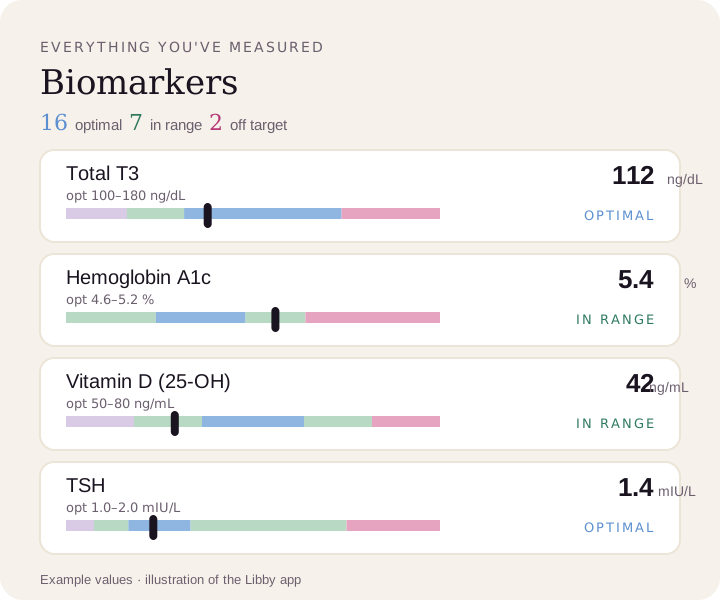
Compare your results to optimal ranges.
Upload a lab PDF or a photo of your report. Libby puts every marker on your lab's range and the optimal range, and tracks your trends over time.
View your total T3 ›