Total T4 test: normal range, high and low, and pregnancy
Total T4 counts all the thyroxine in your blood, bound and free. Here's the normal range, why pregnancy and estrogen raise it, and when to check free T4.
Total T4 measures all the thyroxine in your blood: the hormone riding on carrier proteins plus the tiny free part. Thyroxine (T4) is the main hormone your thyroid makes. About 99.97% of it travels bound to three proteins, mostly thyroxine-binding globulin (TBG), so total T4 rises and falls with those carriers as well as with your thyroid.1 That's why pregnancy and estrogen pills push total T4 up while the thyroid itself stays normal, and why most clinicians now check free T4 first.23
The short version
- Normal: check the range on your report. Labcorp's adult range is 4.5–12.0 µg/dL.4 The optimal range shown in the Libby app is 6–12 µg/dL, from functional-medicine thyroid references.5
- High total T4 most often means more carrier protein, from pregnancy or estrogen taken by mouth, rather than more hormone. It can also mean an overactive thyroid, most often Graves' disease, when free T4 is high too and TSH is low.1678
- Low total T4 usually means less carrier protein (androgens, protein loss from the kidneys, an inherited TBG deficiency) or an underactive thyroid, most often Hashimoto's disease. In very sick hospital patients, a total T4 under 3 µg/dL has been linked to high mortality.4910
- Total vs free: when total T4 and free T4 disagree, the carriers are usually the reason.1 In pregnancy, total T4 read against a pregnancy yardstick tracks TSH better than many free T4 kits do.1112
What total T4 is
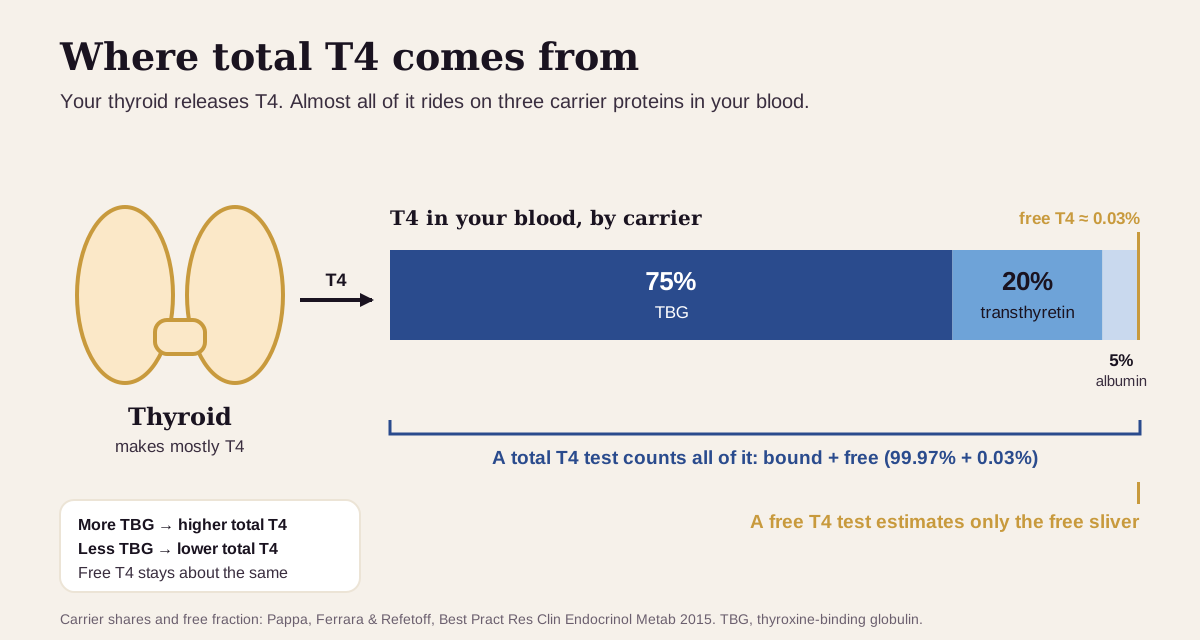
T4 is the main hormone your thyroid makes. Most of it is a backup supply: bound T4 stays in your bloodstream, and the free T4 is the part that enters your tissues.3
In your blood, about 75% of T4 rides on TBG, 20% on transthyretin and 5% on albumin. Only about 0.03% floats free.1 TBG grips T4 about 50 times more tightly than transthyretin and 7,000 times more tightly than albumin, so the amount of TBG largely sets the total.1 The carriers act as a buffer that keeps the free level steady.1
That gives you two different tests. A total T4 test counts bound and free T4 together. A free T4 test estimates only the free part.3 Because carrier levels shift with pregnancy, hormones, medicines and illness, the American Thyroid Association's lab review says free T4 should be measured in preference to total T4.2 Total T4 still appears on many thyroid panels, often next to a T3 uptake test, and it has a real job in pregnancy.412 (More on T3 uptake at the end.)
What's a normal total T4?
Start with the range printed on your report.
- Labcorp's adult reference range is 4.5–12.0 µg/dL, measured on a Roche immunoassay.4
- In NHANES III, a national U.S. health survey, the average total T4 in 16,533 people without known thyroid disease was 112.3 nmol/L, about 8.7 µg/dL.14
- Soldin and colleagues, who measured total T4 by mass spectrometry, describe typical immunoassay ranges for women who aren't pregnant of about 4.5–12.6 µg/dL.7
Normal moves with your carrier proteins. Pregnancy is the biggest example. In 47 healthy pregnant women, total T4 averaged 10.0 µg/dL in every trimester, versus 7.0 µg/dL a year after delivery. Free T4 went the other way: 0.96 ng/dL in the first trimester and 0.82 in the second and third, versus 1.07 after delivery.7
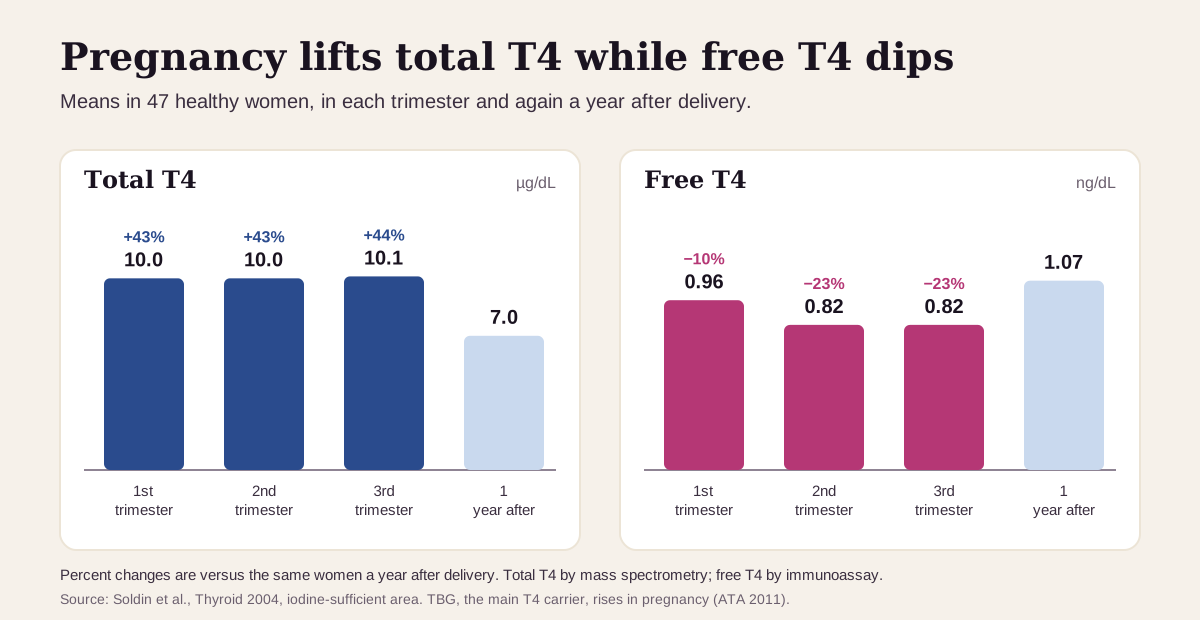
Total T4 and TBG start rising by weeks 6–8 of pregnancy and stay high until delivery.12 A workshop run by the CDC and the American Thyroid Association called these changes "predictable and not method-specific", and proposed a total T4 below 100 nmol/L (7.8 µg/dL) as a reasonable sign of low T4 in pregnancy.15
"Optimal" total T4: what health optimizers aim for
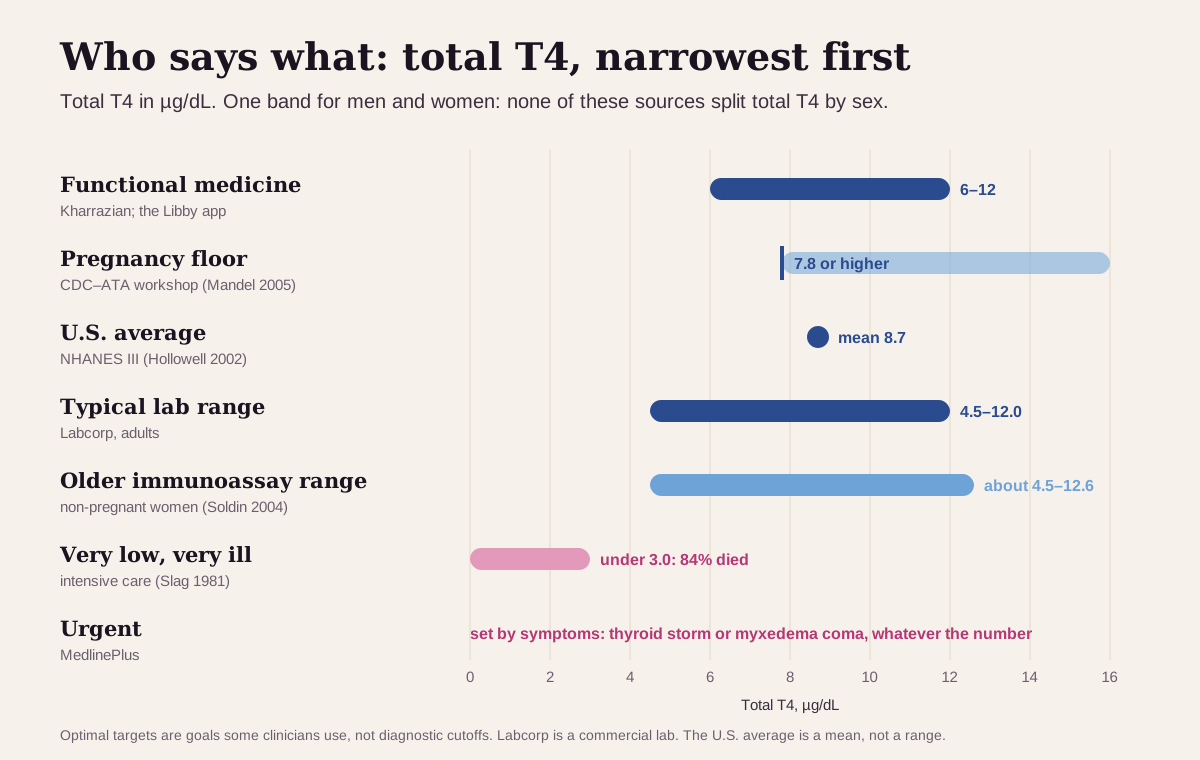
Optimizers mostly target free T4 and TSH, and few sources set a total T4 goal. Here's the ladder, from narrowest to widest:
| Target | Total T4 (µg/dL) | Who uses it |
|---|---|---|
| Functional medicine | 6–12 | Functional thyroid references such as Kharrazian,5 and the optimal range shown in the Libby app |
| Pregnancy floor | 7.8 or higher | Below this, a CDC–ATA workshop called total T4 a reasonable sign of low T4 in pregnancy15 |
| U.S. average | about 8.7 | The NHANES III mean in people without known thyroid disease: an average, not a range14 |
| Typical lab range (adults) | 4.5–12.0 | Labcorp's published reference range4 |
| Older immunoassay range | about 4.5–12.6 | The typical range for non-pregnant women cited by Soldin 20047 |
| Very low in the very ill | under 3.0 | In an intensive-care study, 84% of patients below this level died10 |
| Urgent | set by symptoms | Thyroid storm and myxedema coma are emergencies1617 |
Where the targets come from:
- The large outcome studies behind "optimal" thyroid ranges were built on TSH and free T4. The biggest, a pooled analysis of prospective cohorts, set its healthy bands with those two tests.18 Total T4 targets rest on reference ranges and expert opinion.
- The functional floor of 6 µg/dL sits above the lab's 4.5. A total T4 in that gap is worth reading next to free T4, TSH and T3 uptake, because low carriers and a slow thyroid both land there.41
- The clearest outcome signal sits at the extreme low end, in very sick people. In one intensive-care study, mortality was 84% with a total T4 under 3.0 µg/dL, 50% at 3.0–5.0 and 15% above 5.0.10 Labcorp notes that T4 can be abnormal in serious illness outside the thyroid.4
Keep "optimal" in perspective: these are targets, not diagnoses. A total T4 around 10 is typical in pregnancy, and a similar number in someone on estrogen pills usually reflects extra TBG, not extra hormone.713 Read total T4 next to free T4 and TSH before deciding it's too high or too low.
What a high or low total T4 usually means
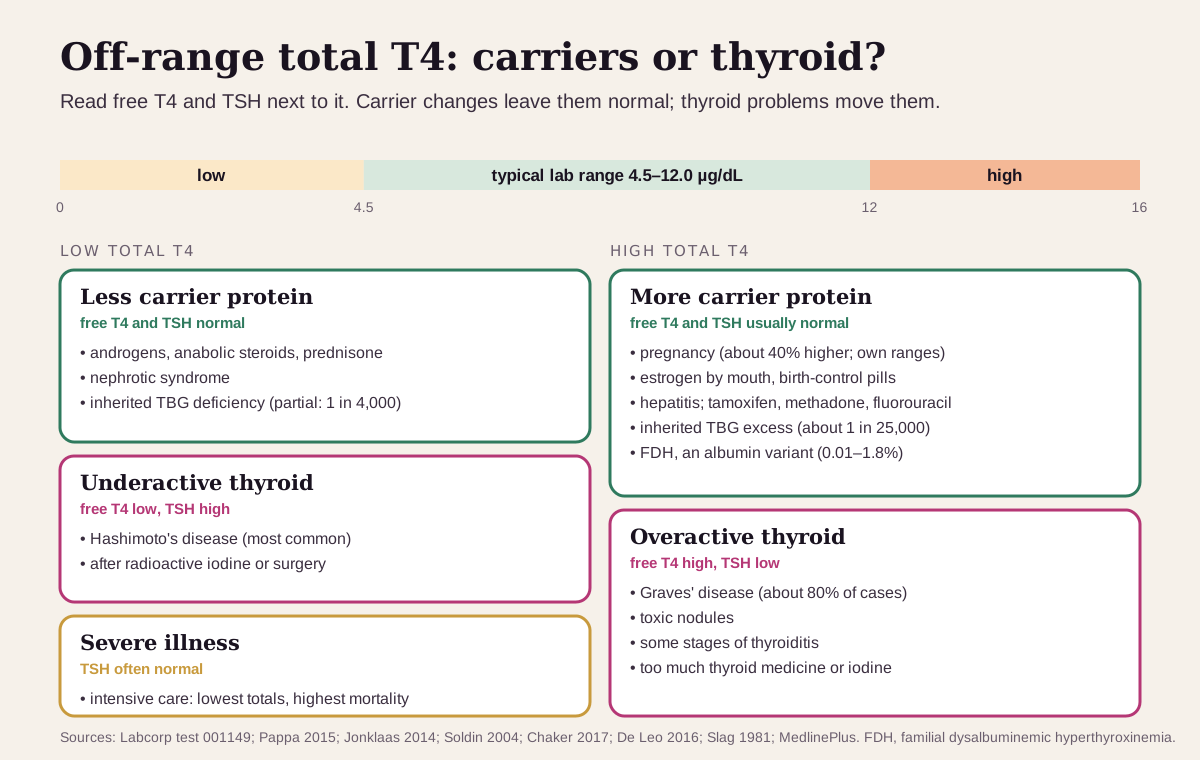
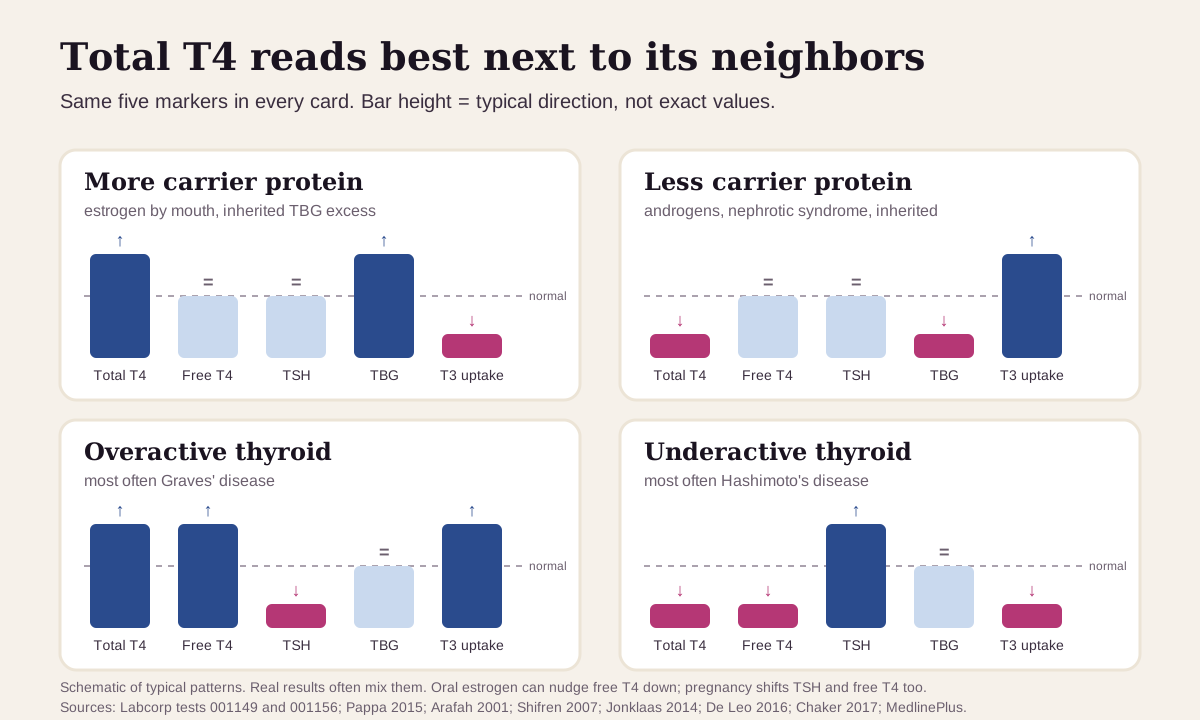
The first question is carriers or thyroid. Labcorp's rule of thumb: when total T4 and the T3 uptake test move in the same direction, the thyroid hormone itself is off. When they move in opposite directions, a change in TBG is the likely cause.4 A free T4 and a TSH answer the same question more directly.2
High total T4: usually more carrier protein
The usual suspects:
- Pregnancy. Total T4 runs about 40% higher than after delivery (see above).7
- Estrogen taken by mouth, including birth-control pills and oral menopause hormone therapy, raises TBG.43 In a randomized crossover trial in 25 menopausal women, 12 weeks of oral conjugated estrogens raised TBG by 39.9% and total T4 by 28.4%, while free T4 fell slightly (−10.4%). An estradiol skin patch barely moved any of them (+0.4%, −0.7% and +0.2%).6
- An overactive thyroid. When free T4 is high too and TSH is low, the thyroid is making too much hormone. Graves' disease causes about 80% of cases where diets have enough iodine. Toxic nodules and some stages of thyroiditis are other causes.83
- Other TBG raisers: hepatitis, several medicines (tamoxifen, raloxifene, opioids such as methadone, fluorouracil, mitotane) and, rarely, inherited TBG excess, about 1 in 25,000 people.4191
- Familial dysalbuminemic hyperthyroxinemia (FDH), an inherited albumin variant that grips T4 harder. It raises total T4 with an unsuppressed TSH, and some free T4 methods read falsely high, which has led to unneeded thyroid treatment. It affects 0.01% to 1.8% of people, depending on ancestry.1
- Too much thyroid hormone by mouth, or a lot of iodine.43
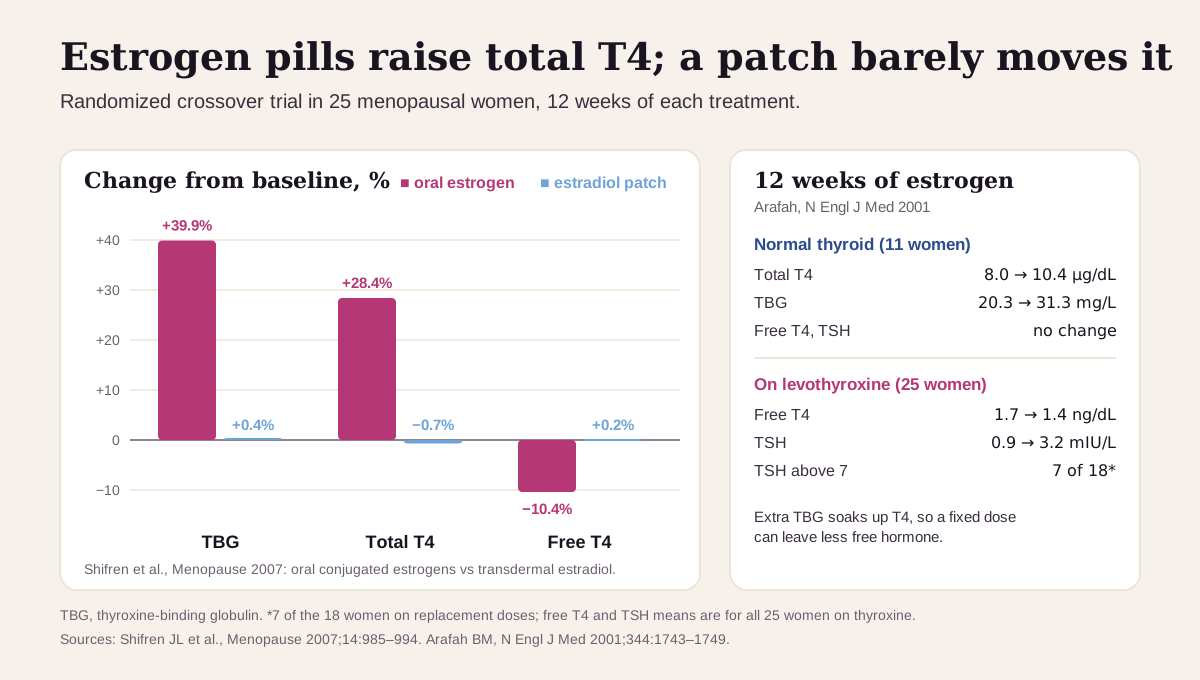
That last panel matters if you take levothyroxine. Extra TBG soaks up more T4, so starting estrogen can push TSH up. In Arafah's study, TSH rose above 7 mIU/L in 7 of 18 women on replacement doses.13 Don't stop a prescribed medicine on your own. Bring the full list, hormones and supplements included, to your clinician.
Low total T4: carriers, a slow thyroid, or illness
- An underactive thyroid. With a low free T4 and a high TSH, the most common cause where diets have enough iodine is Hashimoto's disease, an autoimmune condition.9 Treatment for an overactive thyroid (radioactive iodine or surgery) is another.3
- Less carrier protein. Androgens and anabolic steroids, prednisone, and nephrotic syndrome (heavy protein loss in the urine) lower TBG.419 Inherited partial TBG deficiency affects about 1 in 4,000 newborns and complete deficiency about 1 in 15,000 newborn boys. People with these variants have normal thyroid function and need no treatment.1
- Medicines such as salicylates (aspirin and its relatives), phenytoin and carbamazepine can lower total T4.4
- Severe illness. In 86 intensive-care patients, 22% had a low total T4 with a normal TSH, and the lowest levels went with the highest mortality.10
Get emergency care if a thyroid problem comes with fever, a pounding heart, agitation, confusion or diarrhea (possible thyroid storm), or with a low body temperature, slow breathing and unresponsiveness (possible myxedema coma). Both are emergencies, whatever the total T4.1617
Total T4 reads best next to its neighbors
The pattern across your thyroid panel says more than total T4 does by itself:41
| If you see… | It often points to… |
|---|---|
| Total T4 high, T3 uptake low, free T4 and TSH normal | more TBG: estrogen by mouth, or (rarely) inherited TBG excess. Pregnancy raises TBG too, but read its TSH and free T4 against pregnancy ranges4136112 |
| Total T4 low, T3 uptake high, free T4 and TSH normal | less TBG: androgens, nephrotic syndrome, or inherited TBG deficiency4191 |
| Total T4, free T4 and T3 uptake high, TSH low | an overactive thyroid, most often Graves' disease438 |
| Total T4, free T4 and T3 uptake low, TSH high | an underactive thyroid, most often Hashimoto's disease439 |
| Total T4 high, T3 uptake and TSH normal | FDH, the albumin variant: free T4 by equilibrium dialysis sorts it out41 |
| Total T4 low, TSH normal, in a very sick person | the illness itself (nonthyroidal illness)109 |
How fast total T4 changes
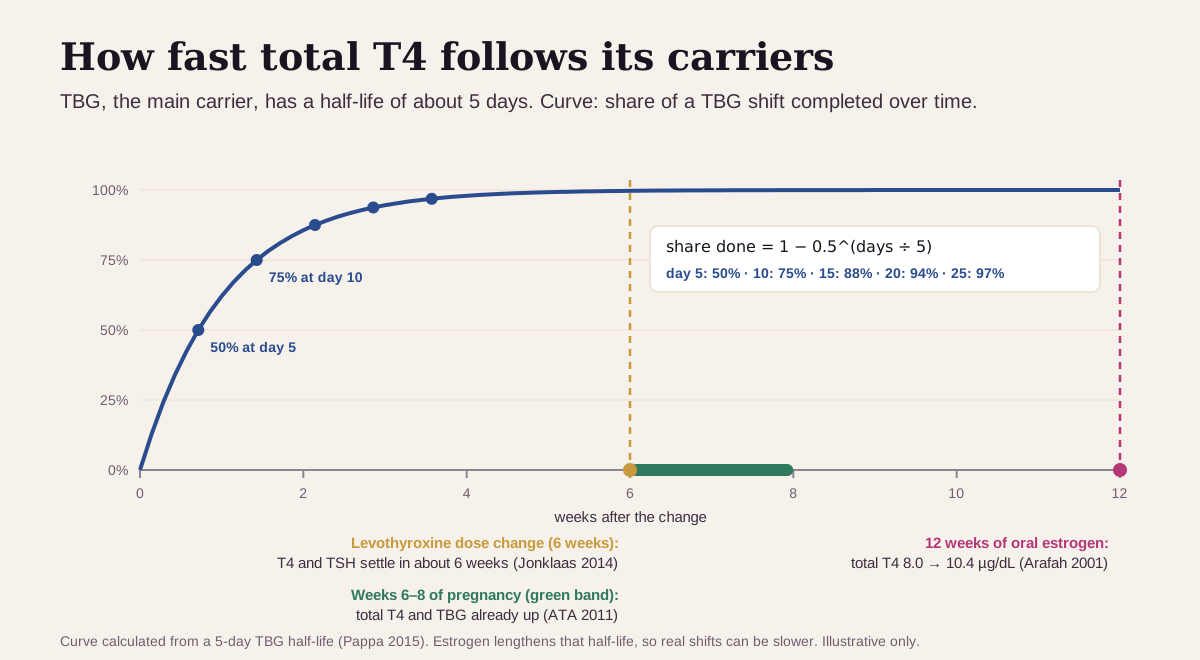
Total T4 follows its carriers, and TBG turns over in days. TBG has a half-life of about 5 days, and estrogen makes it last longer.1 That is the main reason estrogen raises TBG: the protein is cleared more slowly.1
What that means in practice:
- Pregnancy shows up early. Total T4 and TBG are already rising by weeks 6–8.12
- Estrogen needs weeks. In Arafah's study, total T4 rose from 8.0 to 10.4 µg/dL and TBG from 20.3 to 31.3 mg/L by 12 weeks, while free T4 and TSH held steady in women with a normal thyroid.13
- If you take levothyroxine, the American Thyroid Association recommends rechecking TSH once things settle after starting or stopping estrogen or androgens. After a levothyroxine dose change, T4 and TSH take about 6 weeks to settle.19
- Tell the lab about biotin. Labcorp asks people to stop high-dose biotin at least 72 hours before this test.4
- Trends beat snapshots. Compare results from the same lab, and note any pregnancy, new hormone or new medicine next to each one.47
Going deeper: T3 uptake and the free T4 index
Before direct free T4 tests were common, labs estimated free T4 from two numbers: total T4 and a T3 uptake test, now also called a thyroid hormone binding ratio. The uptake test gauges how many empty TBG binding sites a sample has.2 Multiplying the two gives the free T4 index (FTI):12
FTI = total T4 × T3 uptake
The trick is that the two move in opposite directions when only the carriers change. More TBG raises total T4 but leaves more empty sites, which lowers the uptake, so the index stays about the same.42 Labcorp's adult T3 uptake range is 24–39%, and it lists pregnancy, birth-control pills, androgens, nephrotic syndrome and cirrhosis among the things that shift it.20
The index has one well-known blind spot. In FDH, total T4 and the index are both high, while T3 uptake is normal.4 For that and other unusual binding states, free T4 measured after physically separating it from the carriers (equilibrium dialysis or ultrafiltration) is the recommended test.1
Questions worth asking
- Is my total T4 off because of my carrier proteins or my thyroid? What do my free T4 and TSH show?
- Could pregnancy, birth-control pills, oral hormone therapy or another medicine be raising my TBG?
- Would a T3 uptake, a free T4 index or a TBG test help sort this out?
- If I'm pregnant, which range applies to me, and is total T4 or free T4 the better test at my stage?
- If I take levothyroxine and start or stop estrogen, when should we recheck my TSH?
- If my total T4 is high with a normal TSH, should we check free T4 by equilibrium dialysis before any treatment?
FAQ
What is a normal total T4 level? It depends on your lab. Labcorp's adult range is 4.5–12.0 µg/dL.4 The optimal range shown in the Libby app is 6–12 µg/dL.5
Why is my total T4 high when my free T4 is normal? Usually because you have more TBG, the main carrier protein. Pregnancy and estrogen taken by mouth are the most common reasons.16
Is total T4 or free T4 better? Free T4 is preferred for most people, because carrier proteins sway total T4.2 In pregnancy, total T4 read against a pregnancy yardstick can be the more reliable of the two.1115
Do birth-control pills affect thyroid tests? Yes. Estrogen by mouth raises TBG and total T4, while free T4 and TSH usually stay in range. An estrogen skin patch has little effect.613
This guide is for education. It can't diagnose you or replace care from a clinician who knows your history.
Footnotes
-
Pappa T, Ferrara AM, Refetoff S. Inherited defects of thyroxine-binding proteins. Best Pract Res Clin Endocrinol Metab. 2015;29(5):735–747. Source for the carrier split (TBG 75%, transthyretin 20%, albumin 5%), the 0.03% free fraction, TBG's binding strength, the 5-day TBG half-life (longer with estrogen), inherited TBG deficiency and excess, and FDH. PMC ↩ ↩2 ↩3 ↩4 ↩5 ↩6 ↩7 ↩8 ↩9 ↩10 ↩11 ↩12 ↩13 ↩14 ↩15 ↩16 ↩17 ↩18 ↩19 ↩20 ↩21 ↩22 ↩23
-
Van Uytfanghe K, Ehrenkranz J, Halsall D, et al. Thyroid Stimulating Hormone and Thyroid Hormones (Triiodothyronine and Thyroxine): An American Thyroid Association-Commissioned Review of Current Clinical and Laboratory Status. Thyroid. 2023;33(9):1013–1028. The ATA-commissioned lab review: free T4 should be measured in preference to total T4; how uptake tests and the free T4 index work. PMC ↩ ↩2 ↩3 ↩4 ↩5 ↩6
-
National Library of Medicine. Thyroxine (T4) Test. MedlinePlus. Free vs total T4, why the test is paired with TSH, and common causes of low and high results. MedlinePlus ↩ ↩2 ↩3 ↩4 ↩5 ↩6 ↩7 ↩8 ↩9 ↩10 ↩11
-
Labcorp. Thyroxine (T4), test 001149: reference range, interpretation, causes of increased and decreased TBG binding, and biotin instructions. Opened September 23, 2026. A commercial laboratory; its adult reference range is 4.5–12.0 µg/dL. labcorp.com ↩ ↩2 ↩3 ↩4 ↩5 ↩6 ↩7 ↩8 ↩9 ↩10 ↩11 ↩12 ↩13 ↩14 ↩15 ↩16 ↩17 ↩18 ↩19 ↩20 ↩21 ↩22 ↩23 ↩24 ↩25 ↩26 ↩27
-
Kharrazian D. Why Do I Still Have Thyroid Symptoms? When My Lab Tests Are Normal. Elephant Press; 2010. ISBN 978-0985690403. A functional-medicine thyroid reference, and the source behind the total T4 optimal range (6–12 µg/dL) in the Libby app's marker catalog. ↩ ↩2 ↩3 ↩4
-
Shifren JL, Desindes S, McIlwain M, Doros G, Mazer NA. A randomized, open-label, crossover study comparing the effects of oral versus transdermal estrogen therapy on serum androgens, thyroid hormones, and adrenal hormones in naturally menopausal women. Menopause. 2007;14(6):985–994. 25 women completed 12 weeks of each: oral conjugated estrogens changed TBG +39.9%, total T4 +28.4%, free T4 −10.4%; transdermal estradiol +0.4%, −0.7%, +0.2%. PubMed ↩ ↩2 ↩3 ↩4 ↩5 ↩6 ↩7
-
Soldin OP, Tractenberg RE, Hollowell JG, et al. Trimester-specific changes in maternal thyroid hormone, thyrotropin, and thyroglobulin concentrations during gestation: trends and associations across trimesters in iodine sufficiency. Thyroid. 2004;14(12):1084–1090. 47 women; total T4 by mass spectrometry 10.0, 10.0 and 10.1 µg/dL by trimester vs 7.0 a year postpartum; free T4 0.96, 0.82 and 0.82 vs 1.07 ng/dL; typical non-pregnant immunoassay range about 4.5–12.6 µg/dL. PMC ↩ ↩2 ↩3 ↩4 ↩5 ↩6 ↩7 ↩8 ↩9
-
De Leo S, Lee SY, Braverman LE. Hyperthyroidism. Lancet. 2016;388(10047):906–918. Graves' disease as about 80% of hyperthyroidism in iodine-sufficient areas; toxic nodules and thyroiditis. PMC ↩ ↩2 ↩3 ↩4 ↩5
-
Chaker L, Bianco AC, Jonklaas J, Peeters RP. Hypothyroidism. Lancet. 2017;390(10101):1550–1562. Hashimoto's disease as the most common cause of hypothyroidism in iodine-sufficient areas; in severe illness, low thyroid hormone with TSH generally in the normal range. PMC ↩ ↩2 ↩3 ↩4 ↩5 ↩6
-
Slag MF, Morley JE, Elson MK, et al. Hypothyroxinemia in critically ill patients as a predictor of high mortality. JAMA. 1981;245(1):43–45. 86 intensive-care patients: low T4 with normal TSH in 22%; mortality 84% with T4 under 3.0 µg/dL, 50% at 3.0–5.0 and 15% above 5.0. PubMed ↩ ↩2 ↩3 ↩4 ↩5 ↩6 ↩7
-
Lee RH, Spencer CA, Mestman JH, et al. Free T4 immunoassays are flawed during pregnancy. Am J Obstet Gynecol. 2009;200(3):260.e1–6. Total T4 was higher than in non-pregnant controls in all three trimesters; total T4 and the free T4 index kept the expected inverse relationship with TSH, while two free T4 immunoassays fell to about 65% of control values. PubMed ↩ ↩2
-
Stagnaro-Green A, Abalovich M, Alexander E, et al. Guidelines of the American Thyroid Association for the diagnosis and management of thyroid disease during pregnancy and postpartum. Thyroid. 2011;21(10):1081–1125. Total T4 and TBG rise by weeks 6–8 and stay high until delivery; free T4 immunoassays are unreliable in pregnancy; the free T4 index is total T4 × T3 uptake. The 2011 edition, since updated in 2017 and 2026. PMC ↩ ↩2 ↩3 ↩4 ↩5 ↩6 ↩7 ↩8
-
Arafah BM. Increased need for thyroxine in women with hypothyroidism during estrogen therapy. N Engl J Med. 2001;344(23):1743–1749. 11 women with normal thyroid function and 25 on thyroxine: total T4 8.0 to 10.4 µg/dL and TBG 20.3 to 31.3 mg/L at 12 weeks of estrogen; in treated women, free T4 1.7 to 1.4 ng/dL and TSH 0.9 to 3.2 mIU/L, above 7 in 7 of 18. PubMed ↩ ↩2 ↩3 ↩4 ↩5 ↩6 ↩7 ↩8 ↩9
-
Hollowell JG, Staehling NW, Flanders WD, et al. Serum TSH, T4, and thyroid antibodies in the United States population (1988 to 1994): National Health and Nutrition Examination Survey (NHANES III). J Clin Endocrinol Metab. 2002;87(2):489–499. Mean total T4 of 112.3 nmol/L in 16,533 people without reported thyroid disease. PubMed ↩ ↩2 ↩3
-
Mandel SJ, Spencer CA, Hollowell JG. Are detection and treatment of thyroid insufficiency in pregnancy feasible? Thyroid. 2005;15(1):44–53. Report of a CDC and American Thyroid Association workshop: total T4 changes in pregnancy are predictable and not method-specific; below 100 nmol/L (7.8 µg/dL) is a reasonable sign of low T4 in pregnancy. PubMed ↩ ↩2 ↩3 ↩4
-
National Library of Medicine. Thyroid storm. MedlinePlus Medical Encyclopedia. Symptoms, and why it is a medical emergency. MedlinePlus ↩ ↩2 ↩3
-
National Library of Medicine. Hypothyroidism. MedlinePlus Medical Encyclopedia. Signs of myxedema coma, a medical emergency. MedlinePlus ↩ ↩2 ↩3
-
Xu Y, Derakhshan A, Hysaj O, et al. The optimal healthy ranges of thyroid function defined by the risk of cardiovascular disease and mortality: systematic review and individual participant data meta-analysis. Lancet Diabetes Endocrinol. 2023;11(10):743–754. Pooled prospective cohorts that collected TSH or free T4. PubMed ↩
-
Jonklaas J, Bianco AC, Bauer AJ, et al. Guidelines for the treatment of hypothyroidism: prepared by the American Thyroid Association Task Force on Thyroid Hormone Replacement. Thyroid. 2014;24(12):1670–1751. Medicines that raise TBG, androgens lowering it, rechecking TSH after starting or stopping estrogen or androgens, and 6 weeks to steady state. PMC ↩ ↩2 ↩3 ↩4 ↩5 ↩6 ↩7
-
Labcorp. T3 Uptake, test 001156: adult reference range 24–39% and the conditions that change TBG binding. Opened September 23, 2026. A commercial laboratory. labcorp.com ↩ ↩2
Educational content, not medical advice. Libby is a personal record tool, not a medical service — it doesn't diagnose, treat, or prescribe. Reference ranges vary by lab and by person. Talk to a qualified healthcare professional about your results.
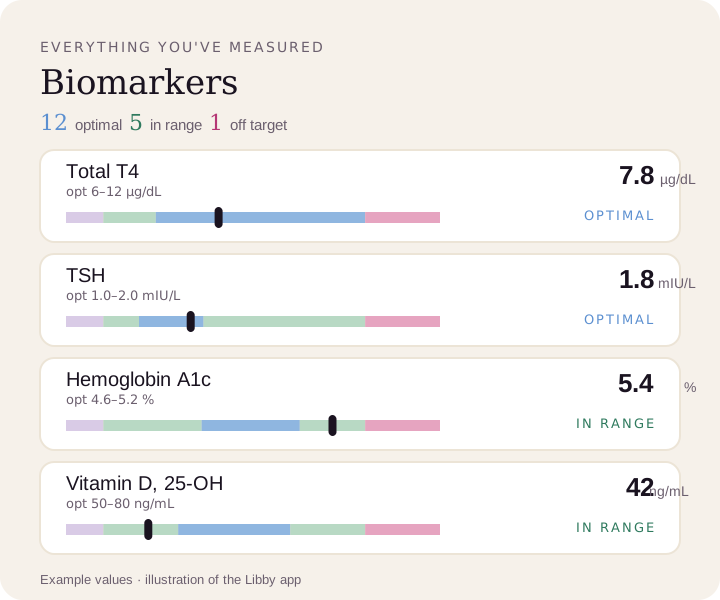
Compare your results to optimal ranges.
Upload a lab PDF or a photo of your report. Libby puts each marker on your lab's range and, where one exists, the optimal range, and tracks your trends over time.
View your total T4 ›