Lead blood test: normal levels, sources, and when to act
A blood lead test shows recent lead exposure. Here are the CDC and workplace thresholds, the common sources, what low levels are linked to, and when to retest.
A blood lead test measures the lead circulating in your blood, which mostly reflects exposure over the past few weeks to months. Most of the lead in an adult's body, 90–95%, is stored in bone, and some of it seeps back into the blood for years.1 In 2011–2012 the average U.S. adult had about 1 µg/dL. A result of 3.5–5 µg/dL or more means more exposure than most people get.234
The short version
- Typical: U.S. adults averaged about 1 µg/dL in 2011–2012.2 Labcorp prints an adult reference range of 0.0–3.4 µg/dL.5
- Above normal: the CDC flags children at 3.5 µg/dL or more, and the U.S. surveillance definition counts adults as elevated at 5 µg/dL or more. The usual adult sources are work, old paint dust from renovation, and imported products such as some spices, cosmetics and pottery.3467
- Urgent: 80 µg/dL or more calls for urgent medical evaluation. Vomiting or seizures with possible lead exposure need emergency care.89
- Confirm a high fingerstick with a vein sample. Lead on the skin can contaminate a fingerstick, so a venous (arm) draw is the result to act on.34
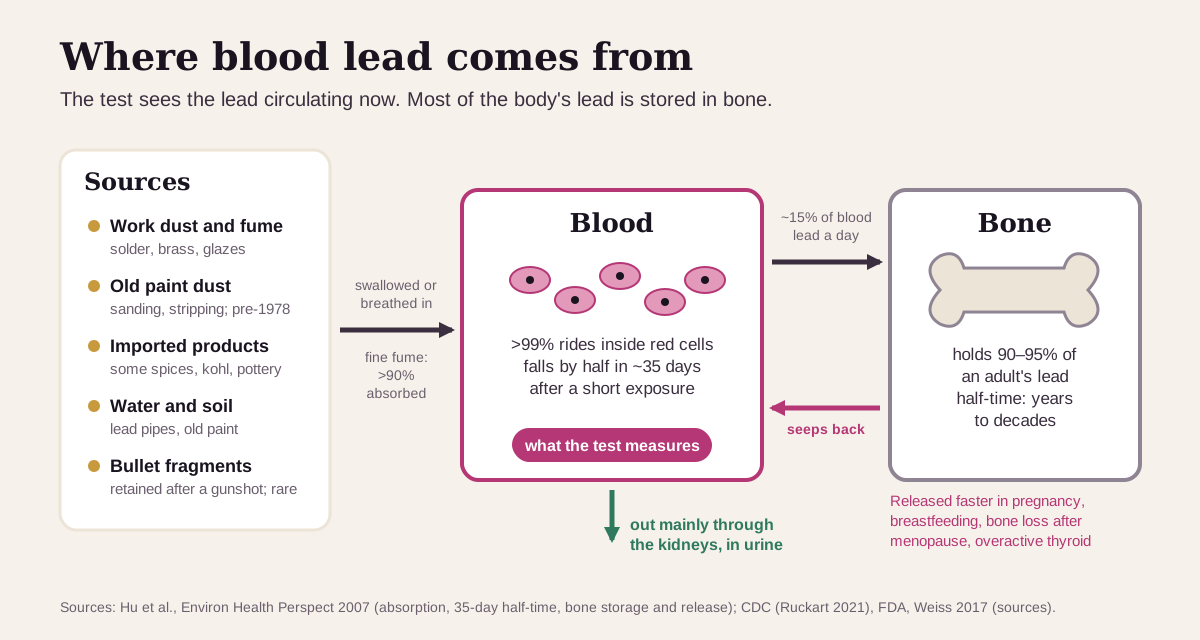
What blood lead measures
Lead gets in two ways: you swallow it (dust on hands, food, water) or you breathe it in (fumes and fine dust). Very fine fume, like the smoke from burning lead paint, is more than 90% absorbed in the lungs. How much you absorb from the gut depends on the form of lead and on your diet, including iron and zinc.1
Once absorbed, more than 99% of the lead in your blood rides inside red blood cells. After a short exposure, blood lead falls by half in about 35 days as lead moves into soft tissue and bone or leaves through the kidneys.1
Bone is the long-term store. In adults it holds 90–95% of the body's lead, with a clearance half-time of years to decades. Bone releases lead back into the blood faster during pregnancy and breastfeeding, bone loss after menopause, and an overactive thyroid.1 So a blood lead result is a mix of recent exposure and old lead coming back out of bone, and one number rarely tells you which.18
The test is usually ordered for people with a known risk, such as a lead job, and for anyone with symptoms that could fit lead poisoning.9 If your panel also lists mercury, our mercury guide covers that metal.
What's a normal blood lead?
Start with the range on your own report. Labcorp, a commercial lab, prints 0.0–3.4 µg/dL for adults.5
"Normal" has fallen a long way. When OSHA adopted its lead standard in the late 1970s, the average U.S. blood lead was about 12.8 µg/dL. By 2011–2012, U.S. adults averaged 1.09 µg/dL.2 Children's levels fell from 15.2 µg/dL (1976–1980) to 0.83 µg/dL (2011–2016).3
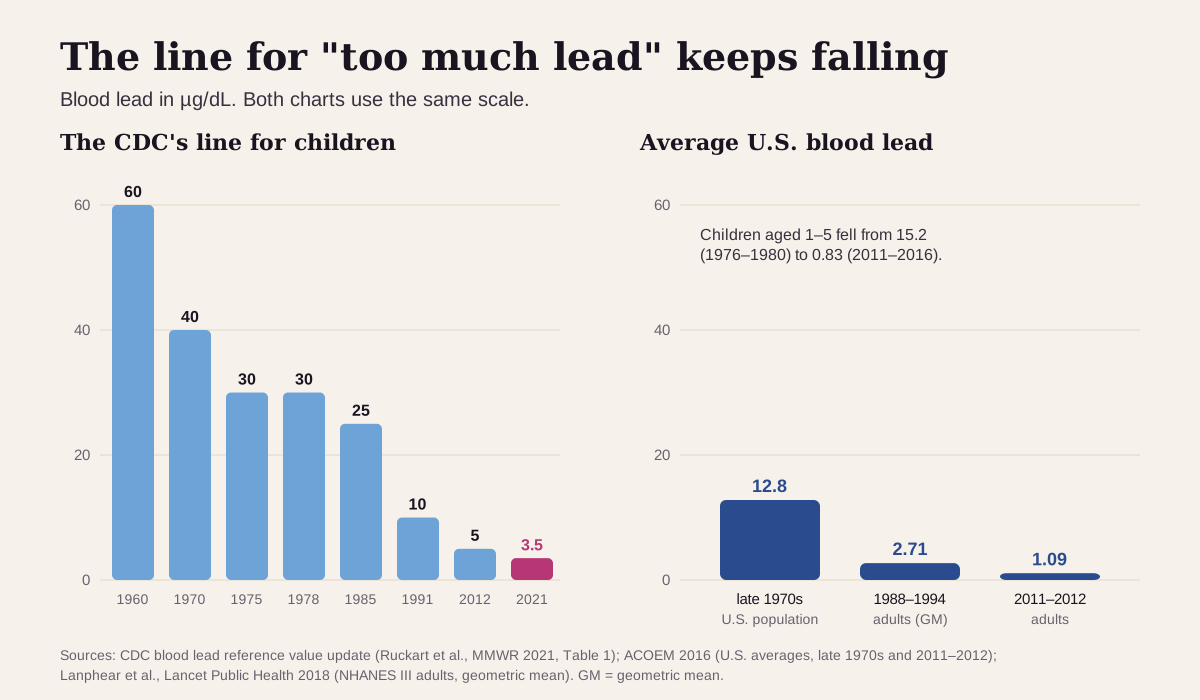
- The CDC's blood lead reference value is 3.5 µg/dL (2021). It is the 97.5th percentile for U.S. children aged 1–5, so only 2.5% of young children are at or above it. The CDC describes it as a yardstick for spotting unusual exposure rather than a toxicity threshold.3
- For adults, the U.S. surveillance case definition (CSTE and CDC, 2016) counts a venous blood lead of 5 µg/dL or more as elevated in anyone 16 or older.4
- Some references still list under 10 µg/dL as a normal adult result. MedlinePlus does, while also calling 5 or more elevated.9
"Optimal" blood lead: as low as you can get it
For lead, lower is better all the way down. The CDC's position is that no safe blood lead level in children has been found.3 Here are the lines in use, from strictest to loosest:
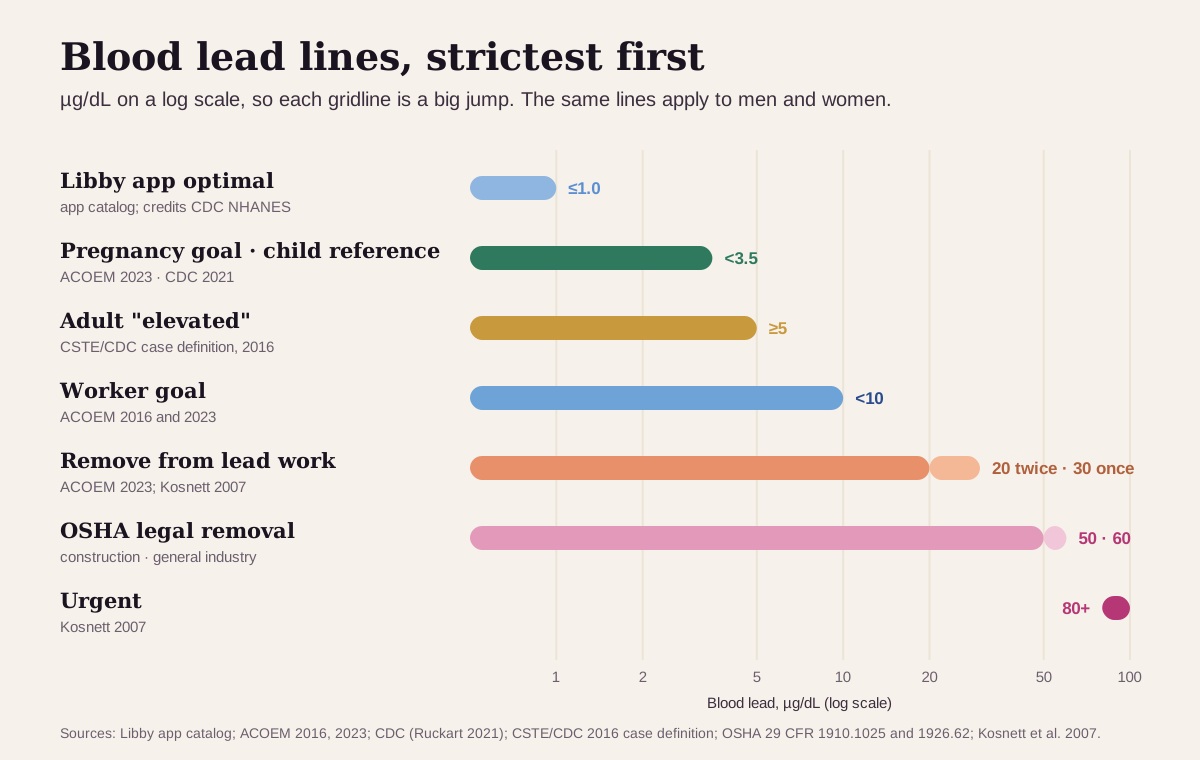
| Line | Blood lead | Who uses it |
|---|---|---|
| Libby app optimal | 1.0 µg/dL or less | The optimal range shown in the Libby app; its catalog credits CDC population data12 |
| Pregnancy goal, child reference value | under 3.5 µg/dL | ACOEM's goal for women who are or may become pregnant;13 the CDC's reference value for children3 |
| Adult "elevated" | 5 µg/dL or more | U.S. surveillance case definition, venous sample4 |
| Worker goal | under 10 µg/dL | The American College of Occupational and Environmental Medicine (ACOEM)13 |
| Remove from lead work | 20 µg/dL twice, 4 weeks apart, or 30 once | ACOEM 2023 and an expert panel in 2007138 |
| OSHA legal removal | 50 µg/dL (construction); 60, or an average of 50 (general industry) | The federal lead standards, adopted in 1978 (general industry) and 1993 (construction)108 |
| Urgent | 80 µg/dL or more | Urgent medical evaluation8 |
Why the low targets exist:
- The U.S. National Toxicology Program found sufficient evidence that in adults, blood lead under 5 µg/dL is linked to lower kidney function and under 10 µg/dL to higher blood pressure and hypertension.14
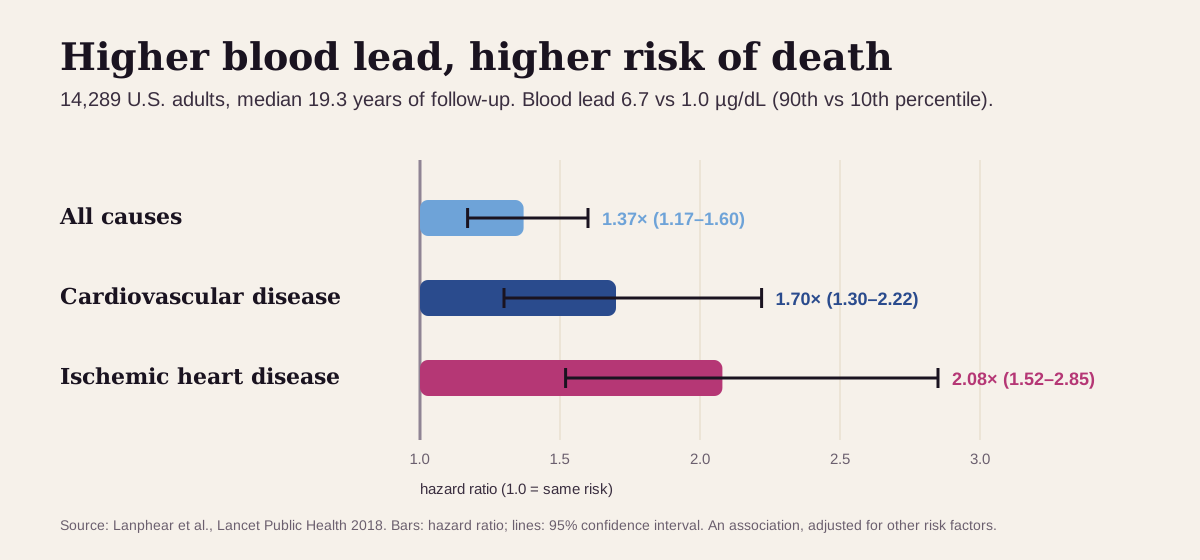
- In 14,289 U.S. adults followed for a median of 19.3 years, a blood lead of 6.7 µg/dL versus 1.0 µg/dL (the 90th versus the 10th percentile) was linked to 1.37 times the risk of death from any cause, 1.70 times from cardiovascular disease and 2.08 times from ischemic heart disease.11
- ACOEM calls the evidence that years at 10–25 µg/dL raise the risk of death from heart disease and stroke "particularly compelling," and says its own under-10 goal provides "at best a slim margin of safety."13
Keep "optimal" in perspective. The app's band of 1.0 µg/dL or less sits close to the average U.S. adult's level,2 and its catalog credits CDC population data rather than a published cutoff.12 ACOEM notes that the evidence behind its own goals identifies no threshold below which harm becomes unlikely.13 The practical target is the lowest level you can reach by removing the sources you control.
What a high blood lead usually means
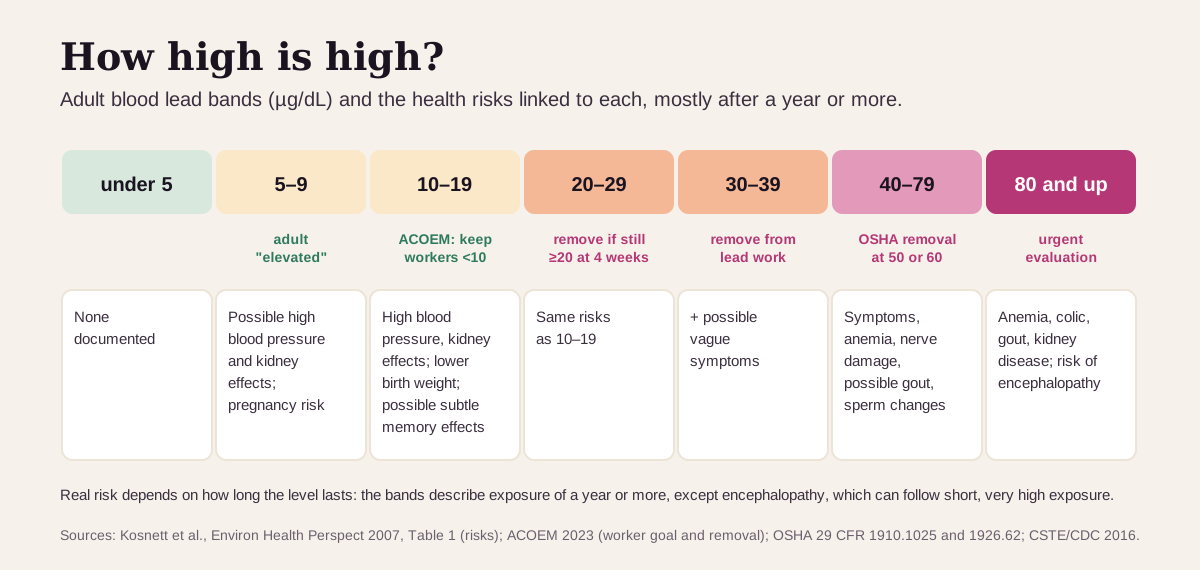
The size of the number is the first clue. An expert panel's guidance for adults ties each band of blood lead to the health risks seen at that level, especially after a year or more of exposure:8
Where the lead usually comes from
The usual suspects in adults:
- Work. In state and CDC surveillance of adults with blood lead of 10 µg/dL or more (2003–2012), only 6.6% of cases with a known source (bullet cases aside) came from outside work.6 High-risk jobs grind, polish or disturb brass, tin-lead solder, pottery glaze, lead weights and bullet fragments. ACOEM estimates that up to 2 million U.S. workers have enough exposure to push blood lead above 5–10 µg/dL, most of them outside OSHA's lead rules.13 Lead dust can also ride home on work clothes and shoes.8
- Old paint and renovation. Homes painted before 1978 can hold lead paint. Stripping or sanding it releases fine lead dust.9 Lead paint and dust, soil, and water from lead pipes are the most common U.S. sources overall.3
- Imported spices, cosmetics, pottery and remedies. New York City tested 1,496 spice samples from 41 countries during lead-poisoning investigations and store surveys: more than half had detectable lead, and more than 30% had over 2 parts per million.7 The FDA warns that traditional eyeliners (kohl, kajal, surma) often contain large amounts of lead, and that lead from badly fired glazes on traditional pottery can leach into food.15 Imported candies and traditional home remedies are also known sources.3
- Old exposure coming back out of bone. Pregnancy, breastfeeding, bone loss after menopause and an overactive thyroid all speed the release.1 Someone with years of past exposure can keep an elevated blood lead long after the source is gone.28
- Retained bullet fragments (rare but important). They caused only 0.3% of elevated adult results in that surveillance, but 4.9% of results of 80 µg/dL or more, with a top value of 306. Symptoms can start years after the wound.6
Pregnancy changes the numbers. ACOEM's goal for women who are or may become pregnant is under 3.5 µg/dL,13 and the 2007 expert panel advised avoiding job or hobby exposure that would push blood lead above 5 during pregnancy.8
Symptoms
Lead that builds up slowly often causes no obvious symptoms.9 From about 30–40 µg/dL, symptoms tend to be vague: headache, fatigue, poor sleep, poor appetite, constipation, joint and muscle aches, and low sex drive.8 Belly cramps ("lead colic") rarely appear below 80 µg/dL.10 Anemia, gout and nerve damage belong to long exposure at 40 or more.8
Get care now if your blood lead is 80 µg/dL or more, or if possible lead exposure comes with vomiting, a staggering walk, muscle weakness or seizures: call 911 for severe symptoms. For questions about an exposure, U.S. Poison Help is 1-800-222-1222.89
Blood lead reads best next to its neighbors
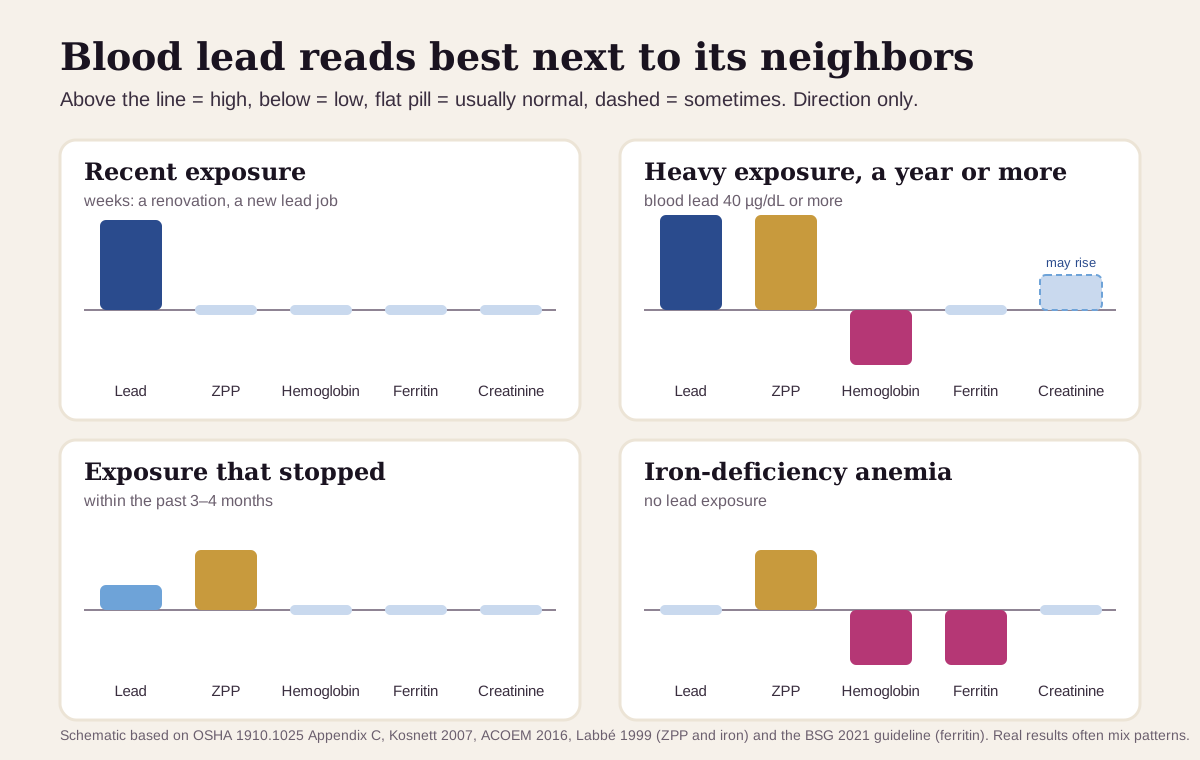
Blood lead tells you about exposure. A few other markers show how long it has been going on and whether it has started to cause harm. The key neighbor is zinc protoporphyrin (ZPP), a compound that builds up in red cells when lead blocks the last step of making heme. Iron deficiency raises it too.1016
| If you see… | It often points to… |
|---|---|
| High lead, normal ZPP and blood count | recent exposure, or a level too low to move ZPP: ZPP starts rising only around 20–30 µg/dL and rises later than lead |
| High lead and high ZPP, low hemoglobin | heavy exposure lasting a year or more: OSHA notes hemoglobin can drop from 50 µg/dL, with most lead anemia above 80 |
| High ZPP, low ferritin, normal lead | iron deficiency (iron-deficiency anemia if hemoglobin is also low), where ferritin is the single most useful marker |
| High ZPP, normal ferritin, lead near normal | lead exposure in the past 3–4 months that has since stopped, since ZPP reflects the red cells made over that time; a repeat blood lead helps confirm |
| Creatinine creeping up after years of exposure | possible lead-related kidney damage; creatinine is a late sign |
Two other results matter. Hemoglobin shows anemia, and a smear may show dotted red cells (basophilic stippling).10 Ferritin usually separates iron deficiency from lead as the cause of a high ZPP, though inflammation can make ferritin look falsely normal, and low iron and lead exposure can occur together.17161 For the kidneys, blood creatinine rises only after about two-thirds of kidney function is lost, and a measured creatinine clearance can pick up damage earlier.10 Our eGFR and creatinine guide explains both numbers.
Fingerstick or vein? Getting a result you can trust
- A vein sample is the one to act on. Fingersticks are easily contaminated by lead on the skin; blood drawn from a vein is less likely to be.3 The adult surveillance definition counts only venous results, and a child needs one venous result or two fingersticks within 12 weeks to count as a case.4 For a fingerstick, the skin should be washed thoroughly first.5
- Small changes can be lab noise. Federal proficiency testing accepts a blood lead within ±4 µg/dL or ±10% of the target, whichever is greater.3 So a move from 2.5 to 4.0 can fall within that tolerance.
- Stick with blood. Hair and urine lead tests seldom add useful exposure information beyond a blood test.8
How fast blood lead changes
After a short exposure, blood lead falls by half about every 35 days. That figure only holds for exposures shorter than about a month.1
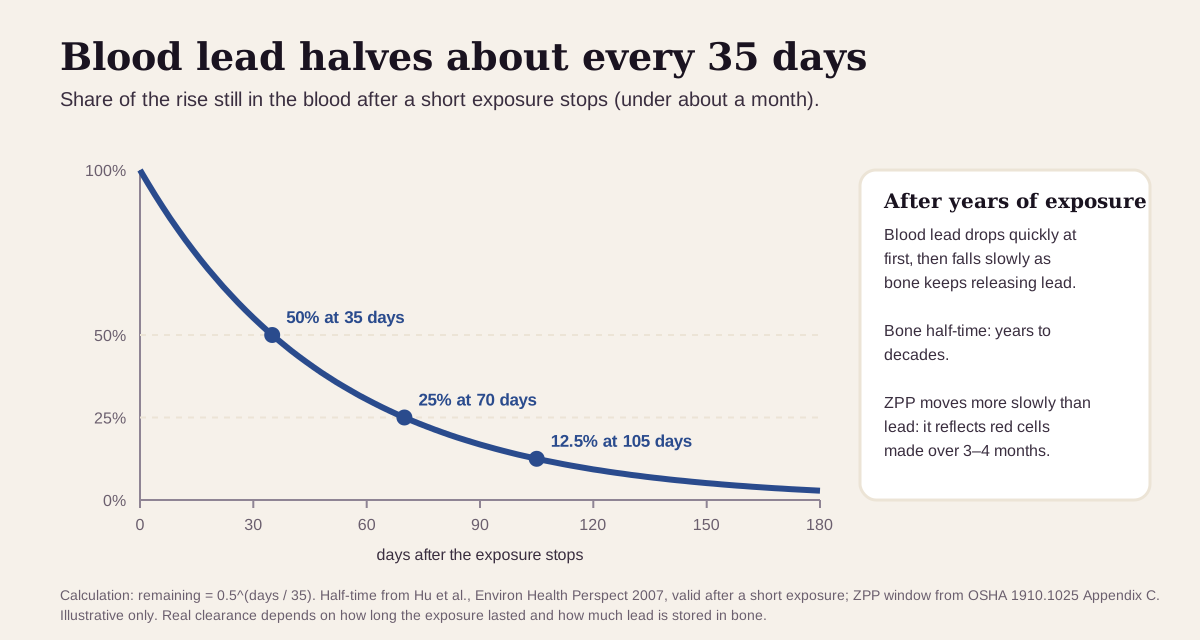
After years of exposure, the fall has two phases: a quick drop, then a slow tail as bone keeps refilling the blood.1 A worker with a large bone store can stay elevated long after the exposure ends.8 ZPP moves more slowly than lead in both directions, because it reflects the red cells made over the past 3–4 months.10
When a result needs repeating:
- Any high fingerstick: repeat with a vein sample.3 For children, the CDC's schedule for the confirming test runs from within 3 months at 3.5–9 µg/dL to within 48 hours at 45 or more, as reproduced on Labcorp's test page.5
- 20 µg/dL or more in an adult: repeat in about 4 weeks; a second result of 20 or more is the expert line for leaving lead work.813
- At work under OSHA: blood lead at least every 6 months, every 2 months at 40 µg/dL or more, and a follow-up test within 2 weeks of a result at the removal line.10 The 2007 expert panel suggested monthly tests for the first 3 months of lead work, then every 6 months below 10 µg/dL and every 3 months at 10–19.8
- After a source is found and removed: a later test shows whether the change worked. Single results bounce; the trend is what counts.3810
Going deeper: how lead jams heme
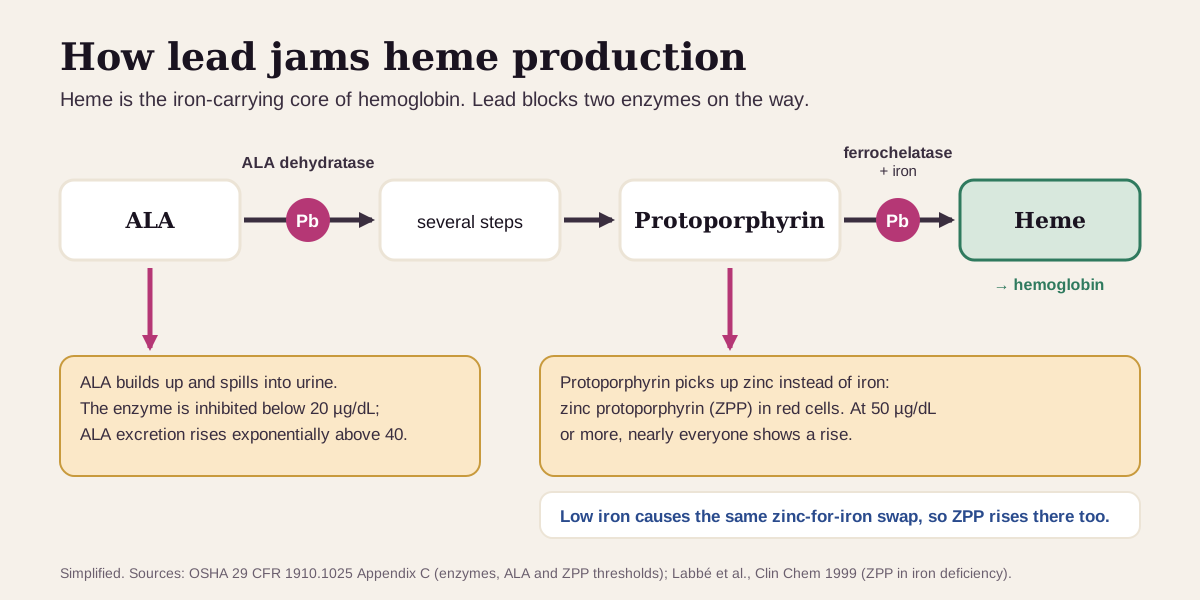
Heme is the iron-carrying core of hemoglobin. Lead's earliest measurable effect is on two enzymes that build it:10
- ALA dehydratase is inhibited at blood lead below 20 µg/dL. Above 40, excretion of its substrate, ALA, rises exponentially.
- Ferrochelatase, which inserts iron into protoporphyrin to finish heme, is also inhibited. Protoporphyrin piles up and grabs zinc instead, forming ZPP. At 50 µg/dL or more, nearly everyone shows a rise.
A shortage of iron causes the same zinc-for-iron swap, which is why ZPP rises in iron deficiency too.16 ZPP is also a blunt tool at the levels most people have today: ACOEM calls it insufficiently sensitive below 25 µg/dL and no longer recommends routine ZPP testing,2 although OSHA's standard still requires it alongside blood lead.10
The kidneys take a slower hit. Years of high exposure can scar the kidney's tubules and tissue (chronic lead nephropathy), sometimes with high blood pressure and high uric acid or gout.10 The 2007 expert panel treats existing kidney disease (creatinine above 1.5 mg/dL in men or 1.3 in women) as a reason for extra caution with continued exposure.8
Questions worth asking
- Was this a fingerstick or a vein sample, and should we confirm it?
- Where could this lead be coming from: my job, a renovation, a hobby, imported spices, cosmetics, pottery or remedies?
- Does my work fall under the OSHA lead standard, and what have my past workplace blood lead results been?
- Should anyone else at home be tested, especially children or someone who is pregnant?
- Given this level, should we check my blood pressure, creatinine or eGFR, and hemoglobin?
- When should we repeat the test, and what result would change the plan?
FAQ
What is a normal blood lead level for adults? Most U.S. adults are around 1 µg/dL. Labcorp's adult reference range is 0.0–3.4 µg/dL, and U.S. surveillance counts 5 µg/dL or more as elevated.254
Is there a safe level of lead? The CDC says no safe blood lead level in children has been found. In adults, levels under 5 µg/dL are linked to lower kidney function and under 10 µg/dL to higher blood pressure.314
Why was my fingerstick lead test high? Lead on the skin can contaminate a fingerstick. A vein sample confirms whether the level is real.3
How long does lead stay in your body? In blood, it falls by half in about 35 days after a short exposure. In bone, it stays for years to decades.1
This guide is for education. It can't diagnose you or replace care from a clinician who knows your history.
Footnotes
-
Hu H, Shih R, Rothenberg S, Schwartz BS. The epidemiology of lead toxicity in adults: measuring dose and consideration of other methodologic issues. Environ Health Perspect. 2007;115(3):455–462. The source for absorption, the 35-day blood half-time after short exposure, bone storage (90–95% of adult body lead, half-times of years to decades) and release during pregnancy, lactation, osteoporosis and hyperthyroidism. PMC ↩ ↩2 ↩3 ↩4 ↩5 ↩6 ↩7 ↩8 ↩9 ↩10 ↩11 ↩12
-
Holland MG, Cawthon D; ACOEM Task Force on Blood Lead Levels. Workplace Lead Exposure. J Occup Environ Med. 2016;58(12):e371–e374. U.S. averages (12.8 µg/dL in the late 1970s, 1.09 µg/dL in adults in 2011–2012), ZPP sensitivity, and persistent blood lead from bone stores. DOI ↩ ↩2 ↩3 ↩4 ↩5 ↩6 ↩7 ↩8 ↩9
-
Ruckart PZ, Jones RL, Courtney JG, et al. Update of the Blood Lead Reference Value — United States, 2021. MMWR Morb Mortal Wkly Rep. 2021;70(43):1509–1512. The CDC's 3.5 µg/dL reference value, its history since 1960, children's averages, common sources, and why venous samples are preferred. PMC ↩ ↩2 ↩3 ↩4 ↩5 ↩6 ↩7 ↩8 ↩9 ↩10 ↩11 ↩12 ↩13 ↩14 ↩15 ↩16 ↩17
-
Centers for Disease Control and Prevention, National Notifiable Diseases Surveillance System. Lead, Elevated Blood Levels: 2016 Case Definition (CSTE position statement). Adults 16 and older: venous blood lead of 5 µg/dL or more. CDC NNDSS ↩ ↩2 ↩3 ↩4 ↩5 ↩6 ↩7 ↩8
-
Labcorp. Lead, Whole Blood (Adult), test 007625; and Lead, Capillary (Fingerstick) Blood Pediatric, test 717016. A commercial laboratory's published reference range (0.0–3.4 µg/dL) and its copy of the CDC's confirmation schedule for children. 007625, 717016 ↩ ↩2 ↩3 ↩4 ↩5
-
Weiss D, Tomasallo CD, Meiman JG, et al. Elevated Blood Lead Levels Associated with Retained Bullet Fragments — United States, 2003–2012. MMWR Morb Mortal Wkly Rep. 2017;66(5):130–133. 145,811 adults with blood lead of 10 µg/dL or more from state surveillance programs. PMC ↩ ↩2 ↩3
-
Hore P, Alex-Oni K, Sedlar S, Nagin D. A Spoonful of Lead: A 10-Year Look at Spices as a Potential Source of Lead Exposure. J Public Health Manag Pract. 2019;25(Suppl 1):S63–S70. PubMed ↩ ↩2
-
Kosnett MJ, Wedeen RP, Rothenberg SJ, et al. Recommendations for medical management of adult lead exposure. Environ Health Perspect. 2007;115(3):463–471. An expert panel's health-based blood lead bands for adults, monitoring schedule, pregnancy advice and symptoms. PMC ↩ ↩2 ↩3 ↩4 ↩5 ↩6 ↩7 ↩8 ↩9 ↩10 ↩11 ↩12 ↩13 ↩14 ↩15 ↩16 ↩17 ↩18 ↩19 ↩20 ↩21
-
National Library of Medicine. Lead levels - blood; and Lead poisoning. MedlinePlus Medical Encyclopedia. Adult and child result bands, symptoms, older housing and Poison Help. Lead levels - blood, Lead poisoning ↩ ↩2 ↩3 ↩4 ↩5 ↩6
-
Occupational Safety and Health Administration. Lead standards 29 CFR 1910.1025 (general industry), including Appendix C, Medical Surveillance Guidelines, and 29 CFR 1926.62 (construction). Removal lines, testing schedules, and the ZPP, anemia and kidney material in Appendix C. 1910.1025, Appendix C, 1926.62 ↩ ↩2 ↩3 ↩4 ↩5 ↩6 ↩7 ↩8 ↩9 ↩10 ↩11 ↩12 ↩13 ↩14 ↩15 ↩16
-
Lanphear BP, Rauch S, Auinger P, et al. Low-level lead exposure and mortality in US adults: a population-based cohort study. Lancet Public Health. 2018;3(4):e177–e184. NHANES III, 14,289 adults, median follow-up 19.3 years. DOI ↩ ↩2 ↩3
-
Libby app marker catalog (common-markers.csv, row LEAD_BLOOD): lab range 0–3.5 µg/dL, optimal 1.0 µg/dL or less, credited to Centers for Disease Control and Prevention, NHANES reference values and population-health cutoffs. CDC NHANES ↩ ↩2 ↩3
-
Kosnett MJ, Berenji M, Burton AD, et al. ACOEM Position Statement: Workplace Health and Safety Necessitates an Update to Occupational Lead Standard Provisions for Medical Removal Protection, Medical Surveillance Triggers, and the Action Level and Permissible Exposure Level for Lead in Workplace Air. J Occup Environ Med. 2023;65(3):e170–e176. The worker goal (under 10 µg/dL; under 3.5 in pregnancy), removal at 30 once or 20 twice, and the 2 million workers estimate. DOI ↩ ↩2 ↩3 ↩4 ↩5 ↩6 ↩7 ↩8 ↩9 ↩10
-
National Toxicology Program. NTP Monograph on Health Effects of Low-Level Lead. NTP Monogr. 2012;(1):xiii, xv–148. Evidence ratings for health effects at blood lead under 10 and under 5 µg/dL. NTP ↩ ↩2
-
U.S. Food and Drug Administration. Lead in Cosmetics; and Questions and Answers on Lead-Glazed Traditional Pottery. Lead in Cosmetics, Traditional pottery ↩
-
Labbé RF, Vreman HJ, Stevenson DK. Zinc protoporphyrin: A metabolite with a mission. Clin Chem. 1999;45(12):2060–2072. ZPP rises when iron is short or cannot be used. PubMed ↩ ↩2 ↩3 ↩4 ↩5
-
Snook J, Bhala N, Beales ILP, et al. British Society of Gastroenterology guidelines for the management of iron deficiency anaemia in adults. Gut. 2021;70(11):2030–2051. Serum ferritin as the single most useful marker of iron-deficiency anemia. PMC ↩ ↩2
Educational content, not medical advice. Libby is a personal record tool, not a medical service — it doesn't diagnose, treat, or prescribe. Reference ranges vary by lab and by person. Talk to a qualified healthcare professional about your results.
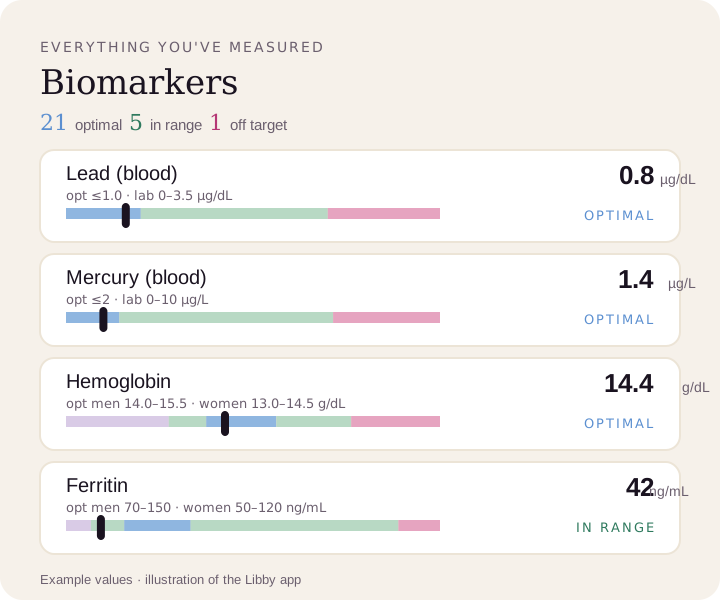
See your lead next to your lab's range and the optimal range.
Upload a lab PDF or a photo of your report. Libby puts every marker on your lab's range and, where the app has one, the optimal range, and tracks your trends over time.
View your lead ›