Mercury blood test: normal levels, fish, and high results
Blood mercury mostly tracks the fish you ate in recent weeks; urine tracks vapor and inorganic mercury. Typical U.S. levels, action levels, and when to worry.
Mercury is a toxic metal that almost everyone carries in small amounts, and a blood mercury test mostly measures methylmercury, the form that comes from eating fish. A high blood result usually means a lot of high-mercury fish in the past few weeks to months. Mercury breathed in as vapor (from spills, some jobs, or dental fillings) and inorganic mercury (from some imported skin creams) show up better in a urine test.12
The short version
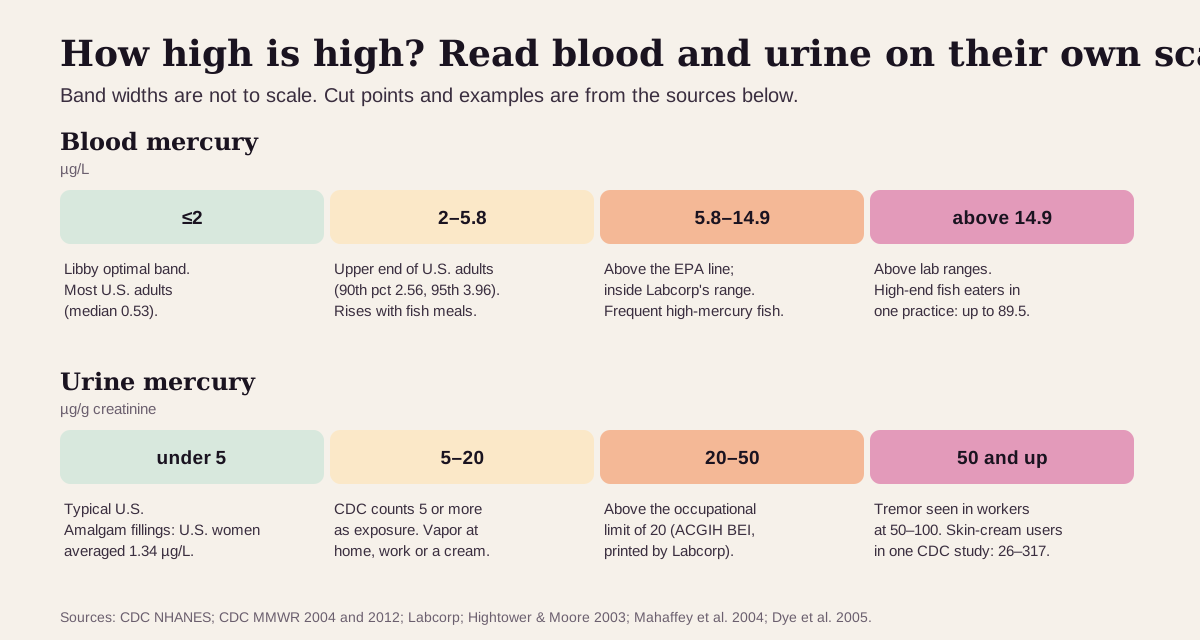
- Typical: half of U.S. adults have a blood mercury at or below 0.53 µg/L, and 95% are at or below 3.96 µg/L (CDC's national survey, 2021–2023).3 Labcorp's printed range runs to 14.9 µg/L.4
- The usual cause of a high blood mercury is fish, especially big predators such as swordfish, shark and bigeye tuna. In a U.S. national survey, women who ate 9 or more fish meals in the past month had seven times the blood mercury of women who ate none.56
- The key public-health line is 5.8 µg/L, the blood level CDC equates with the EPA's reference dose (a daily intake assumed to be without appreciable harm). It was set to protect a baby developing in the womb, so it matters most before and during pregnancy.7
- Blood shows fish; urine shows vapor. Blood mercury falls by half about every 50 days after the fish stops.8 Urine is the test for mercury vapor at work, spills and skin creams. Tremor, numbness or tingling, or trouble breathing after a spill needs care now: call 911 or Poison Help at 1-800-222-1222.910
What mercury is
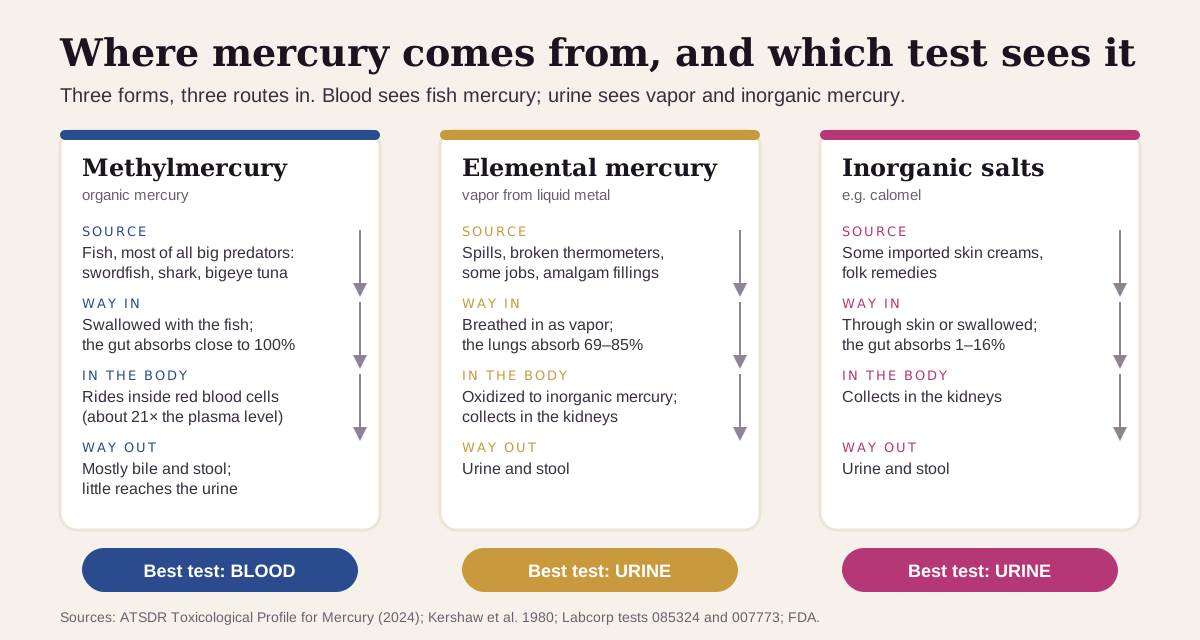
Mercury comes in three forms, and each one gets into you a different way.111
- Methylmercury (organic mercury) builds up in fish, most of all in big, long-lived predators. Your gut absorbs close to 100% of the methylmercury in the fish you eat. Food is the most common way people are exposed.111
- Elemental mercury is the silver liquid in old thermometers. It evaporates into an invisible vapor, and your lungs absorb 69–85% of the vapor you breathe in. Swallowed, it passes through: only about 0.04% of swallowed amalgam filling material is absorbed. Dental amalgam is about half mercury by weight.112
- Inorganic mercury salts include mercurous chloride (calomel), which turns up in some imported skin-lightening and anti-aging creams. The FDA says a label that lists "mercurous chloride," "calomel," "mercuric," "mercurio" or "mercury" means the product contains it.13
All three forms can affect the nervous system and the kidneys.11 Methylmercury matters most for a baby developing in the womb, which is why the FDA/EPA fish advice focuses on people who are pregnant or breastfeeding, and on children.214
What's a normal mercury level?
Almost everyone has some. CDC's national survey (NHANES) measures mercury in thousands of Americans every cycle, and those numbers are the best picture of "typical."3
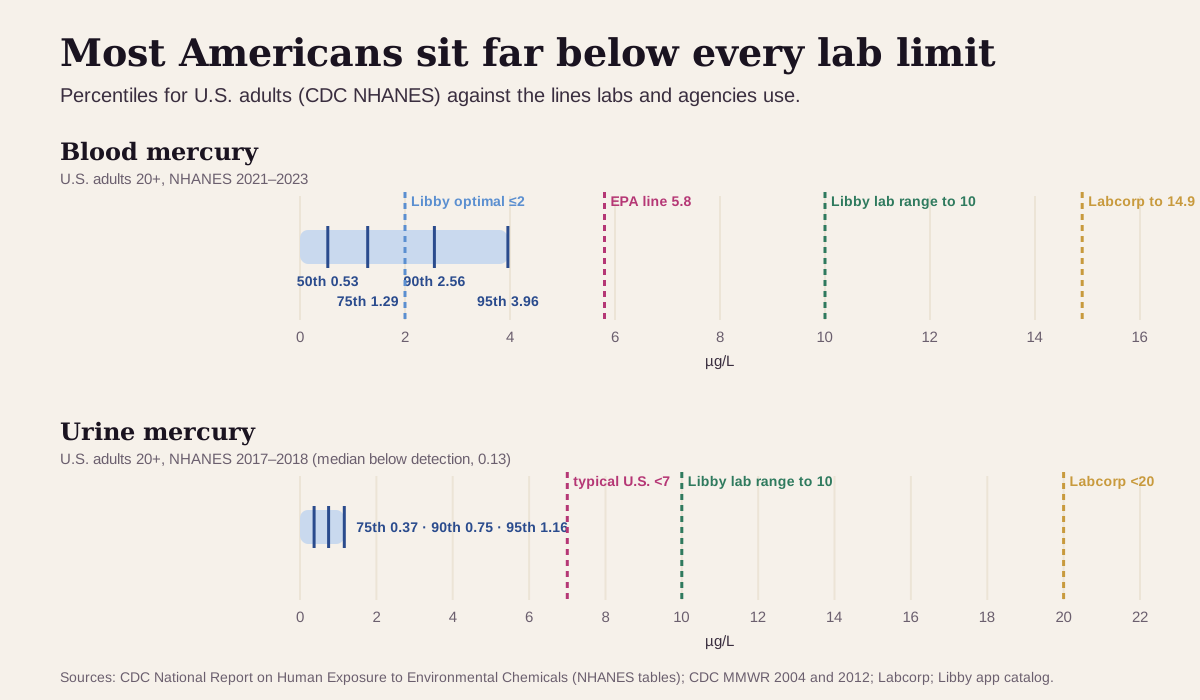
- Blood, U.S. adults (2021–2023): median 0.53 µg/L, 75th percentile 1.29, 90th percentile 2.56, 95th percentile 3.96 µg/L. Most of it is methylmercury: the adult median methylmercury was 0.45 µg/L, while inorganic mercury was below the lab's detection limit for at least three in four adults.3
- Urine, U.S. adults (2017–2018): at least half were below the detection limit (0.13 µg/L), and the 95th percentile was 1.16 µg/L (1.00 µg/g creatinine).3 A CDC report puts typical U.S. urine mercury at under 5 µg/g creatinine or under 7 µg/L.15
- Lab ranges are wider. Labcorp prints 0.0–14.9 µg/L for blood. For urine it prints an "environmental exposure" range of under 5.0 µg/g creatinine or under 20.0 µg/L.410 The Libby app's catalog uses 0–10 µg/L for both. Ranges vary by lab, so compare your result to the range on your own report.
"Optimal" mercury: how low is low enough?
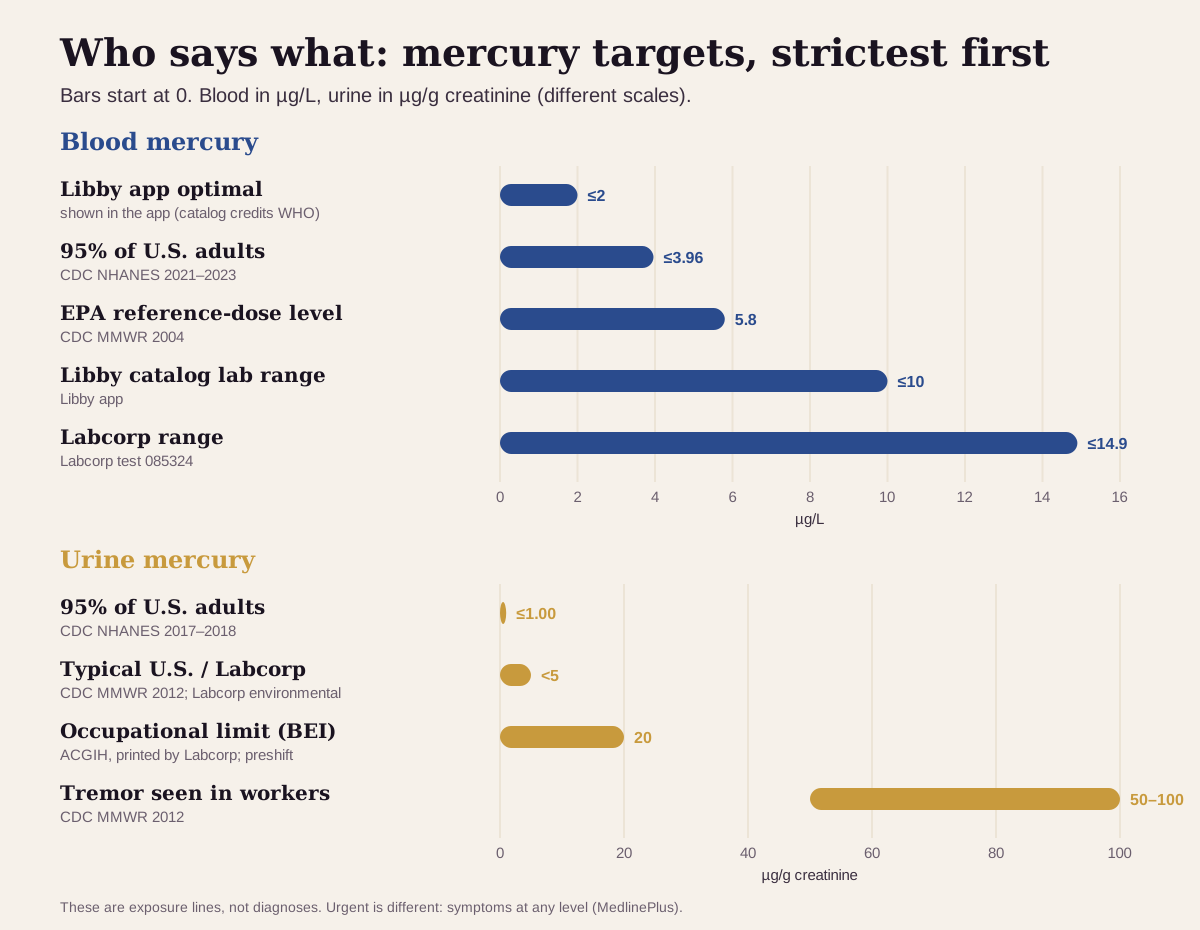
For mercury, the targets are about keeping exposure low, not about finding a healthy middle. Here's the ladder from strictest to loosest:
| Target | Blood mercury | Urine mercury | Who uses it |
|---|---|---|---|
| App optimal | 2 µg/L or less | none set | Shown as optimal in the Libby app. The app's catalog credits it to the World Health Organization; the WHO pages opened for this article give no blood value of 2 µg/L16 |
| 95% of U.S. adults | 3.96 µg/L or less | 1.16 µg/L (1.00 µg/g creatinine) or less | CDC NHANES, blood 2021–2023, urine 2017–20183 |
| Pregnancy-protective line | 5.8 µg/L | n/a | The blood level matching the EPA's reference dose7 |
| Typical U.S. upper end | n/a | under 5 µg/g creatinine or 7 µg/L | CDC's skin-cream investigation15 |
| Lab reference range | 0–10 µg/L (Libby catalog); 0.0–14.9 µg/L (Labcorp) | 0–10 µg/L (Libby catalog); under 20.0 µg/L or 5.0 µg/g creatinine (Labcorp) | 410 |
| Occupational limit | n/a | 20 µg/g creatinine, before the shift | ACGIH's Biological Exposure Index, as printed by Labcorp10 |
| Tremor seen in workers | n/a | 50–100 µg/g creatinine | CDC15 |
| Urgent | symptoms at any level | symptoms at any level | Numbness, tremor, vision changes, or breathing trouble after vapor: get care now92 |
Where the 5.8 comes from. The EPA's reference dose for methylmercury is 0.1 µg per kg of body weight per day.1 CDC translates that to a blood level: researchers found 58 µg/L in cord blood was the lower bound of the dose linked to more abnormal scores on a children's naming test, and the EPA divided by a safety factor of 10 to get 5.8 µg/L.7 In 1999–2002, 5.66% of U.S. women aged 16–49 were at or above it.7
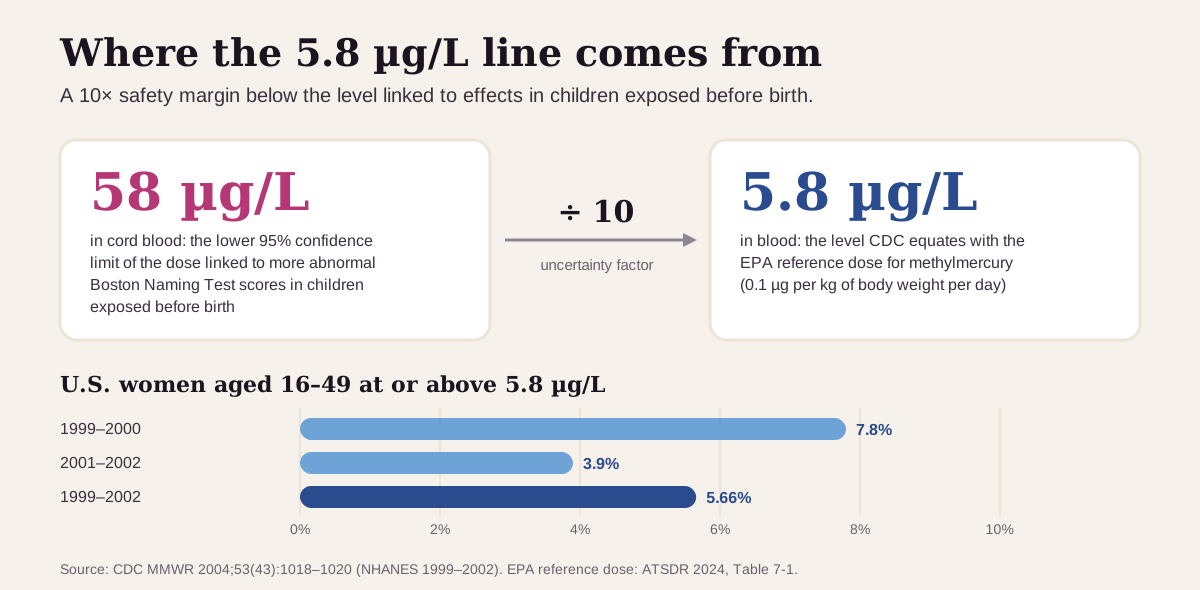
Keep "optimal" in perspective. The EPA assumes intake at its reference dose to be without appreciable harm, and CDC calls harm between 5.8 and 58 µg/L in cord blood "uncertain."7 The lower targets are about keeping exposure small, not a disease threshold. Fish also brings real benefits: the FDA and EPA say fish provide omega-3 fats, iron, iodine and choline, and that fish in pregnancy can help a baby's cognitive development.14 The fish that raise mercury and the fish that raise the omega-3 index overlap only partly: in avid seafood eaters, a salmon-heavy diet went with more omega-3 in the blood, while top-predator fish went with more mercury.17
What a high mercury result usually means
The first clue is which test is high. Blood mercury is the best test for methylmercury, because methylmercury rides inside red blood cells. Urine is the best test for elemental and inorganic mercury, because the kidneys clear it.4101
High blood mercury: usually fish
The usual suspects, most common first:
- High-mercury fish. In one San Francisco internal-medicine practice, 89 fish-eating patients had blood mercury from 2.0 to 89.5 µg/L; the mean was 15 µg/L for women. Swordfish tracked most closely with the level, and levels fell after people stopped eating fish.18
- How often you eat fish. Across U.S. women, blood mercury was seven times higher with 9 or more fish or shellfish meals in the past 30 days than with none.5
- Which fish you eat. FDA testing finds about 45 times more mercury in swordfish than in fresh or frozen salmon, on average.6
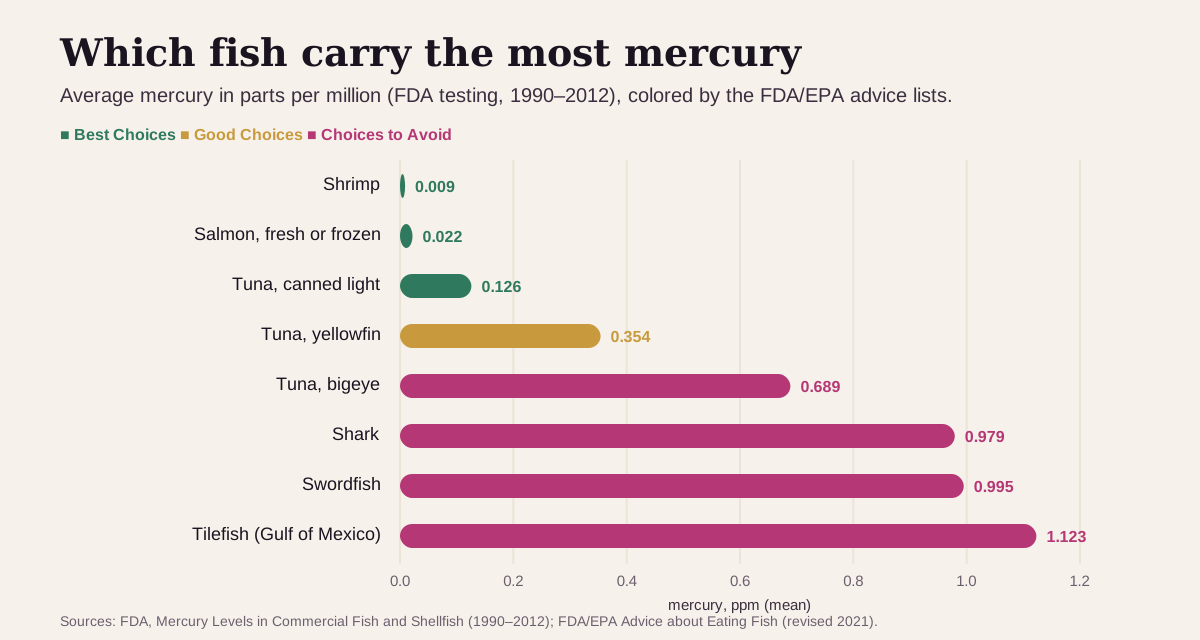
The FDA/EPA advice puts king mackerel, marlin, orange roughy, shark, swordfish, Gulf of Mexico tilefish and bigeye tuna on its "Choices to Avoid" list for people who are pregnant or breastfeeding and for children. Salmon, shrimp and canned light tuna are on its "Best Choices" list, and yellowfin and albacore tuna are "Good Choices." For fish caught by family or friends, it points to local fish advisories.14
High urine mercury: usually vapor or inorganic mercury
- Work. ATSDR lists chloralkali plants, fluorescent-lamp and thermometer production, gold mining, dental offices, battery production and recycling among the jobs with mercury vapor.1 Urine mercury tracks mercury in the air those workers breathe.1
- Skin-lightening and anti-aging creams. In one CDC investigation, nine of 10 people who used a cream made in Mexico had urine mercury of 26–317 µg/g creatinine. Six household members who never used it were high too (20–276 µg/g). The FDA warns that family members can breathe the vapor or pick it up from shared towels.1513
- Spills and broken devices. Exposure to metallic mercury most often happens when it spills or a product that contains it breaks.2 Never vacuum a spill: it spreads the vapor.9
- Dental amalgam fillings. People with many amalgam fillings may have slightly higher mercury in their blood or urine, and the FDA says these levels usually stay in a range it considers safe.12 In a U.S. national sample of women aged 16–49, urine mercury rose with the number of amalgam-filled tooth surfaces, and the average stayed low at 1.34 µg/L.19 The FDA recommends against removing intact fillings to prevent disease, because removal costs healthy tooth and briefly raises vapor exposure.12
- Less common: traditional remedies and religious uses of mercury.11
A sushi-heavy week vs a mercury job
These look alike on a report ("mercury: high") and are very different.
- After a week of tuna rolls, the mercury is methylmercury. Blood mercury peaks within 4–14 hours of a fish meal and then falls by half about every 50 days.8 Urine barely registers it, because methylmercury leaves mainly through bile and stool.10 The level falls once the meals change.
- In a mercury job, the exposure is vapor, day after day. Urine is the test, collected before a shift, and it is judged against the 20 µg/g creatinine occupational limit.10 Blood rises too, as inorganic mercury.1 Tremor has been seen in workers at 50–100 µg/g creatinine.15
Get care now after a mercury spill or heated mercury if you have a cough, trouble breathing, a metallic taste or vomiting, or at any time for numbness or tingling, tremor, trouble walking, or vision changes. Call 911, or Poison Help at 1-800-222-1222.92
Mercury reads best next to its neighbors
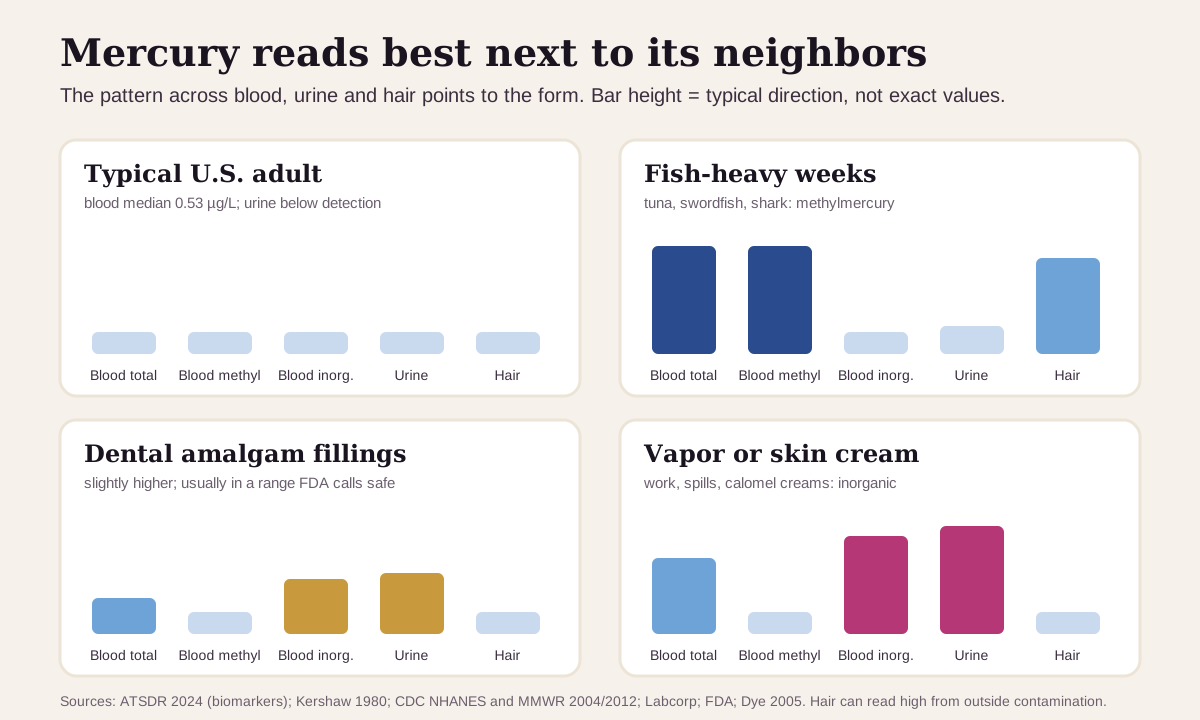
A total mercury number mixes forms. Blood mercury can be split into methylmercury and inorganic mercury (CDC's national survey reports both), and the pattern across blood, urine and hair points to the source.13
| If you see… | It often points to… |
|---|---|
| Low blood and urine mercury, inorganic below detection | the typical U.S. pattern: small amounts, mostly methylmercury from fish371 |
| High blood total and methylmercury, inorganic low, urine near normal, hair up | fish: after a single large test meal of fish, blood total mercury reached 60 µg/L while inorganic stayed at or below 2 µg/L81 |
| Urine and blood inorganic mercury mildly up, methylmercury unchanged | dental amalgam: inorganic mercury tracks the number of filled surfaces, methylmercury tracks fish119 |
| Urine mercury well above 5 µg/g creatinine, blood inorganic up | vapor at work or at home, or a mercury skin cream151 |
A high urine mercury is also a reason to check the kidneys. CDC advises kidney tests, such as a urinalysis, creatinine and a urine albumin check, in people with high urine mercury.15 Lead, the other metal many people see on a report, has its own sources and its own guide: blood lead.
How fast mercury changes
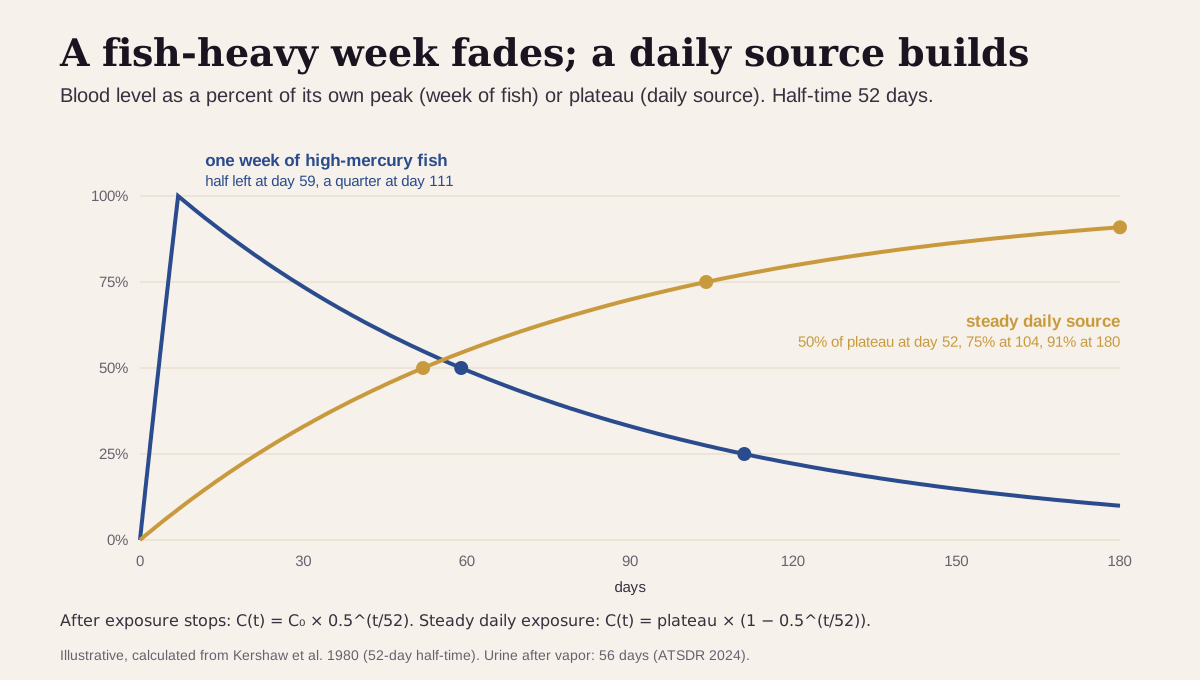
Mercury lingers for weeks to months. After a single fish meal, blood mercury peaked within 4–14 hours and then cleared with a half-time of 52 days.8 Other volunteer studies summarized by ATSDR put the blood half-time for methylmercury at about 45–57 days, and population estimates run longer, to about 80 days.1 After workers' vapor exposure stopped, blood mercury fell with a half-time of 45 days and urine mercury with a half-time of 56 days.1
What that means in practice:
- A high result after a fish-heavy stretch should be about half as high roughly 52 days after those meals stop. Mention recent fish meals (and which fish) when you get tested.8
- Steady exposure keeps climbing for months before it levels off, which is why ongoing sources at work or at home show up as a rising trend.81
- Timing matters for work testing. Labcorp asks for urine before a shift (16 hours without exposure) and blood at the end of a shift at the end of the work week.104 CDC advises repeating urine every 1–2 months after a skin-cream exposure to confirm levels are falling.15
- Trends beat snapshots. With a half-time near 50 days, two results a couple of months apart show whether a source is still active.8
Going deeper: why blood sees fish and urine sees vapor
Methylmercury binds inside red blood cells: in Kershaw's volunteers, red cells held about 21 times as much as plasma.8 The body clears it mostly through bile and stool, turning some of it into inorganic mercury along the way.110 That is why blood (and hair, which records months of blood levels as it grows) is the fish test.1
Elemental mercury vapor crosses from the lungs into the blood, where an enzyme (catalase) oxidizes it to inorganic mercury. The highest concentrations end up in the kidneys, and it leaves in urine and stool.1 Urine mercury in kidney donors tracked the mercury in their kidneys.1
Urine numbers depend on dilution. Labs report urine mercury per liter or per gram of creatinine; the creatinine version corrects for how concentrated the sample is. Urine mercury per liter also falls as kidney function (eGFR) falls, so kidney function matters when reading a urine result.1
Your history ties the number to a source. ATSDR notes that a total blood or urine mercury mixes all forms, and that the tests measure exposure without predicting whether you'll have health problems.111 The pattern above, your fish habits and your work and home history are what connect a result to where it came from.
Questions worth asking
- Was this blood or urine mercury, and was it total mercury or split by form?
- How many fish meals did I eat in the weeks before the test, and which fish?
- Could anything at work, at home or in my skin products contain mercury?
- If I'm pregnant or planning to be, how does my result compare with 5.8 µg/L?
- Should we check my kidneys (creatinine, urinalysis, urine albumin)?
- When should we repeat it, and with which test?
FAQ
What is a normal blood mercury level? Half of U.S. adults are at or below 0.53 µg/L and 95% are at or below 3.96 µg/L (CDC, 2021–2023).3 Labcorp's range runs to 14.9 µg/L.4
Can eating sushi raise my blood mercury? Yes. Fish is the main source of the methylmercury in blood, and tuna species differ a lot: the FDA measures about 0.69 ppm on average in bigeye tuna and 0.13 ppm in canned light tuna.6 Blood mercury peaks within hours of a fish meal and takes about 50 days to fall by half.8
Do dental fillings raise mercury levels? Slightly. People with many amalgam fillings can have somewhat higher urine or blood mercury, which the FDA says usually stays at a level it considers safe. The FDA recommends against removing intact fillings to prevent disease.12
What mercury level is dangerous? The EPA-based line is 5.8 µg/L in blood, set to protect a developing baby.7 In urine, CDC counts 5 µg/g creatinine or more as exposure, and tremor has been seen in workers at 50–100.15 Symptoms such as numbness, tremor or breathing trouble need care at any level.9
This guide is for education. It can't diagnose you or replace care from a clinician who knows your history.
Footnotes
-
Agency for Toxic Substances and Disease Registry. Toxicological Profile for Mercury. U.S. Department of Health and Human Services; October 2024. The federal review of mercury's forms, absorption, biomarkers (blood, urine, hair), half-times and exposure sources. ATSDR PDF ↩ ↩2 ↩3 ↩4 ↩5 ↩6 ↩7 ↩8 ↩9 ↩10 ↩11 ↩12 ↩13 ↩14 ↩15 ↩16 ↩17 ↩18 ↩19 ↩20 ↩21 ↩22 ↩23 ↩24 ↩25 ↩26 ↩27
-
U.S. Environmental Protection Agency. Health Effects of Exposures to Mercury. Last updated November 21, 2025. Symptoms by form and how exposures usually happen. EPA ↩ ↩2 ↩3 ↩4 ↩5
-
Centers for Disease Control and Prevention. National Report on Human Exposure to Environmental Chemicals, biomonitoring data tables: Blood Total Mercury, Blood Methyl Mercury and Blood Inorganic Mercury (NHANES August 2021–August 2023); Urinary Mercury and Urinary Mercury (creatinine corrected) (NHANES 2011–2018). Accessed September 24, 2026. CDC's nationally representative survey; the source for every U.S. percentile in this guide. CDC data tables ↩ ↩2 ↩3 ↩4 ↩5 ↩6 ↩7 ↩8 ↩9 ↩10 ↩11 ↩12
-
Labcorp. Mercury, Whole Blood (test 085324). Test page of a commercial laboratory, accessed September 24, 2026. Reference range 0.0–14.9 µg/L; notes that organic mercury is best detected in whole blood. labcorp.com ↩ ↩2 ↩3 ↩4 ↩5 ↩6 ↩7 ↩8 ↩9 ↩10
-
Mahaffey KR, Clickner RP, Bodurow CC. Blood organic mercury and dietary mercury intake: National Health and Nutrition Examination Survey, 1999 and 2000. Environ Health Perspect. 2004;112(5):562–570. 1,709 U.S. women; blood mercury seven times higher with 9 or more fish meals in 30 days than with none. PMC ↩ ↩2
-
U.S. Food and Drug Administration. Mercury Levels in Commercial Fish and Shellfish (1990–2012). Content current as of February 25, 2022. Mean mercury in ppm by species. FDA ↩ ↩2 ↩3 ↩4
-
Centers for Disease Control and Prevention. Blood mercury levels in young children and childbearing-aged women — United States, 1999–2002. MMWR Morb Mortal Wkly Rep. 2004;53(43):1018–1020. The source for the 5.8 µg/L EPA-equivalent level, its 58 µg/L ÷ 10 derivation, and the 5.66% of women above it. CDC · PubMed ↩ ↩2 ↩3 ↩4 ↩5 ↩6 ↩7 ↩8 ↩9 ↩10 ↩11 ↩12
-
Kershaw TG, Clarkson TW, Dhahir PH. The relationship between blood levels and dose of methylmercury in man. Arch Environ Health. 1980;35(1):28–36. Volunteers ate one fish meal: blood peaked in 4–14 hours, cleared with a 52-day half-time, and red cells held 21 times the plasma level. PubMed · DOI ↩ ↩2 ↩3 ↩4 ↩5 ↩6 ↩7 ↩8 ↩9 ↩10 ↩11
-
National Library of Medicine. Mercury poisoning. MedlinePlus Medical Encyclopedia. Review date July 1, 2025. Symptoms by form, the Poison Help number, and the warning against vacuuming spills. MedlinePlus ↩ ↩2 ↩3 ↩4 ↩5
-
Labcorp. Mercury, Urine (test 007773). Test page of a commercial laboratory, accessed September 24, 2026. Environmental exposure under 5.0 µg/g creatinine or under 20.0 µg/L; ACGIH occupational BEI 20 µg/g creatinine, preshift; methylmercury is excreted mainly in bile and stool and is usually not detected in urine. labcorp.com ↩ ↩2 ↩3 ↩4 ↩5 ↩6 ↩7 ↩8 ↩9 ↩10 ↩11 ↩12 ↩13 ↩14
-
Agency for Toxic Substances and Disease Registry. Mercury ToxFAQs. October 2024. Plain-language summary of forms, exposure routes and testing limits. ATSDR PDF ↩ ↩2 ↩3 ↩4 ↩5
-
U.S. Food and Drug Administration. Information for Patients About Dental Amalgam Fillings. Content current as of September 24, 2020. FDA ↩ ↩2 ↩3 ↩4 ↩5
-
U.S. Food and Drug Administration. Mercury Poisoning Linked to Skin Products. Consumer update; content current as of December 21, 2022. FDA ↩ ↩2
-
U.S. Food and Drug Administration. Advice about Eating Fish (FDA/EPA; advice revised October 2021; content current as of March 5, 2024). The Best Choices, Good Choices and Choices to Avoid lists. FDA ↩ ↩2 ↩3 ↩4
-
Centers for Disease Control and Prevention. Mercury exposure among household users and nonusers of skin-lightening creams produced in Mexico — California and Virginia, 2010. MMWR Morb Mortal Wkly Rep. 2012;61(2):33–36. Typical U.S. urine mercury, the ≥5 µg/g creatinine exposure definition, tremor at 50–100 µg/g, and the kidney-test advice. CDC · PubMed ↩ ↩2 ↩3 ↩4 ↩5 ↩6 ↩7 ↩8 ↩9 ↩10 ↩11 ↩12
-
World Health Organization. Mercury (fact sheet), October 24, 2024, and Preventing disease through healthy environments: exposure to mercury, a major public health concern, 2nd ed. (2021). Opened to check the Libby catalog's WHO attribution for the 2 µg/L band; both give air and water values and no blood cutoff. WHO ↩
-
Karimi R, Fisher NS, Meliker JR. Mercury-nutrient signatures in seafood and in the blood of avid seafood consumers. Sci Total Environ. 2014;496:636–643. Long Island avid seafood eaters: a salmon-dominated diet had relatively high blood omega-3; top-predator eaters had higher mercury with similar blood nutrients. PubMed · DOI ↩
-
Hightower JM, Moore D. Mercury levels in high-end consumers of fish. Environ Health Perspect. 2003;111(4):604–608. 89 patients in a San Francisco practice; blood mercury 2.0–89.5 µg/L, falling after fish stopped. PMC ↩ ↩2
-
Dye BA, Schober SE, Dillon CF, et al. Urinary mercury concentrations associated with dental restorations in adult women aged 16–49 years: United States, 1999–2000. Occup Environ Med. 2005;62(6):368–375. NHANES; average urine mercury 1.34 µg/L, rising with amalgam-filled surfaces. PMC ↩ ↩2 ↩3
Educational content, not medical advice. Libby is a personal record tool, not a medical service — it doesn't diagnose, treat, or prescribe. Reference ranges vary by lab and by person. Talk to a qualified healthcare professional about your results.
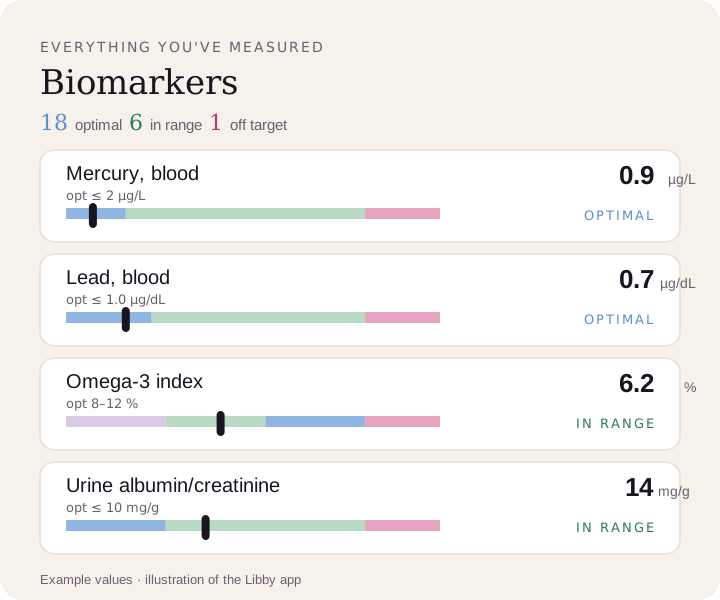
See every result against your lab's range.
Upload a lab PDF or a photo of your report. Libby puts every marker on your lab's range, adds an optimal band where the app has one, and tracks your trends over time.
View your mercury ›