Lymphocyte percentage: high, low and what it means
Your lymphocyte percentage is a share of your white count. Here's the normal range, why it can look off when the count is fine, and when it matters.
Your lymphocyte percentage is the share of your white blood cells that are lymphocytes, the B, T and natural killer (NK) cells of your immune system. In adults it usually runs about 20% to 40%.1 Because it's a share, it moves whenever any other white cell moves, most often the neutrophils. So the first number to check next to it is your absolute lymphocyte count, printed on the same report.23
The short version
- Normal: about 20% to 40% of white cells in adults, per the U.S. National Heart, Lung, and Blood Institute (NHLBI). The optimal range shown in the Libby app is 24% to 40%. Young children run much higher.145
- Low usually means neutrophils took a bigger share: a bacterial infection, surgery or severe illness, a steroid medicine, or a hard workout a few hours earlier.672
- High usually means a viral infection such as mono, where lymphocytes often make up 50% or more, or fewer neutrophils leaving lymphocytes a bigger share.86
- The key distinction: the percentage is a share and the absolute count is the real number. A high percentage with a low white count can hide low neutrophils. Neutrophils under 0.5 thousand/µL are grade 4 on the National Cancer Institute's (NCI) scale, and with a fever that needs care now.2910
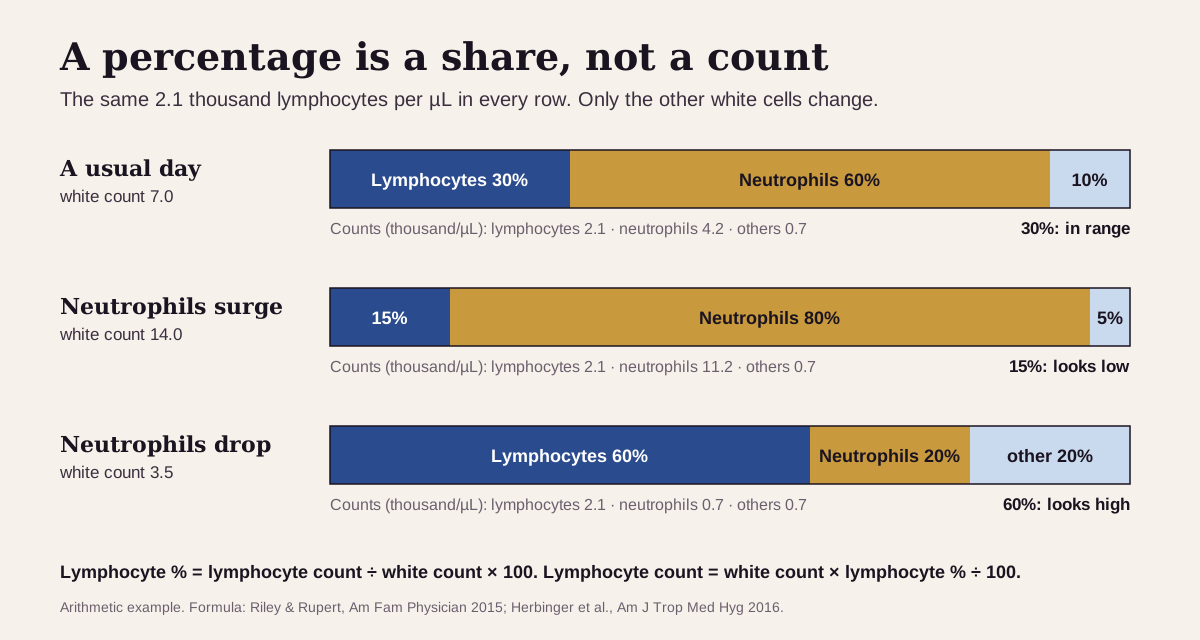
What the lymphocyte percentage is
A complete blood count (CBC) with differential sorts your white cells into five types: neutrophils, lymphocytes, monocytes, eosinophils and basophils. It reports each one as an amount, a percentage, or both.3 Lymphocytes are usually the second-largest group, at about 20% to 40% of white cells, after neutrophils at about 40% to 60%.2
Lymphocytes come in three kinds. B cells make antibodies. T cells kill virus-infected and cancer cells and help B cells make antibodies. NK cells kill infected and cancer cells directly.1
Your report can show lymphocytes twice, and the two numbers answer different questions:
- The percentage tells you how your white cells are split.
- The absolute count tells you how many lymphocytes are in each microliter of blood. It's the white count times the percentage.2
Doctors call a high or low percentage relative lymphocytosis or lymphopenia, and a high or low count absolute.6 The American Academy of Family Physicians (AAFP) review of high white counts suggests thinking in absolute counts when you're working out a cause.2 The same trap runs the other way for neutrophils; the neutrophil percentage guide covers that side.
What's a normal lymphocyte percentage?
Start with the range printed on your report. Labs use different analyzers and reference groups, so their ranges differ.6 Some print none at all: Labcorp's sample report for its CBC with differential shows "Not Estab." (not established) beside all five percentages and gives ranges only for the absolute counts.11
For adults, the common benchmarks overlap:
- The NHLBI says about 20% to 40% of an adult's white cells are lymphocytes, and the AAFP review gives the same span.12
- In 190 healthy adults in Barcelona, tested on a current Sysmex analyzer, the range was 21% to 50%.12
- A Munich lab used 17% to 47% for people over 17 in a study of 17,229 returning travelers.6
- The Libby app's catalog uses a lab range of 14% to 46%.4
Children run much higher. In the Canadian CALIPER study of healthy children, the range was 34.7% to 81.6% under age 2, and it drifted down to 20.1% to 48.8% by ages 12 to 20. Neutrophils do the opposite, taking a bigger share as children grow.5
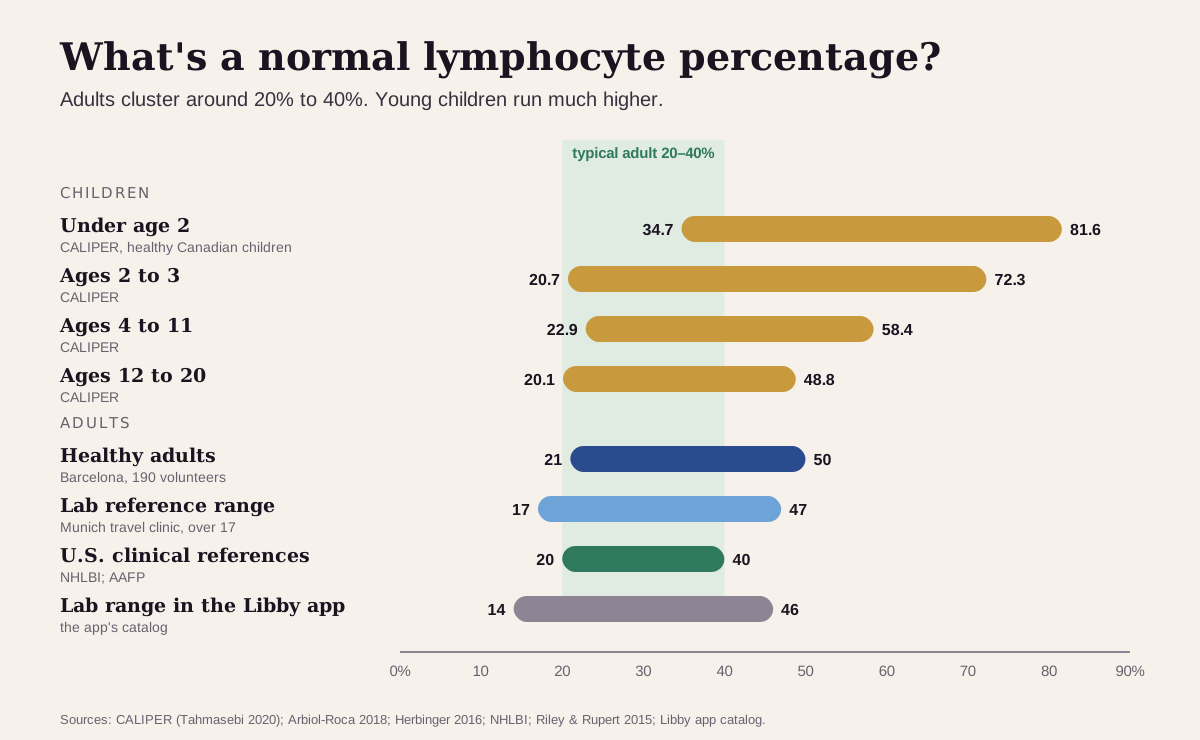
One range for men and women. CALIPER needed no split by sex for any part of the differential, and the Munich study notes no reported difference between adult men and non-pregnant women.56
"Optimal" lymphocyte percentage: what health optimizers aim for
A percentage has a floor and a ceiling, so optimizers aim for the middle of the normal range. Here's the ladder from the narrowest band to the widest:
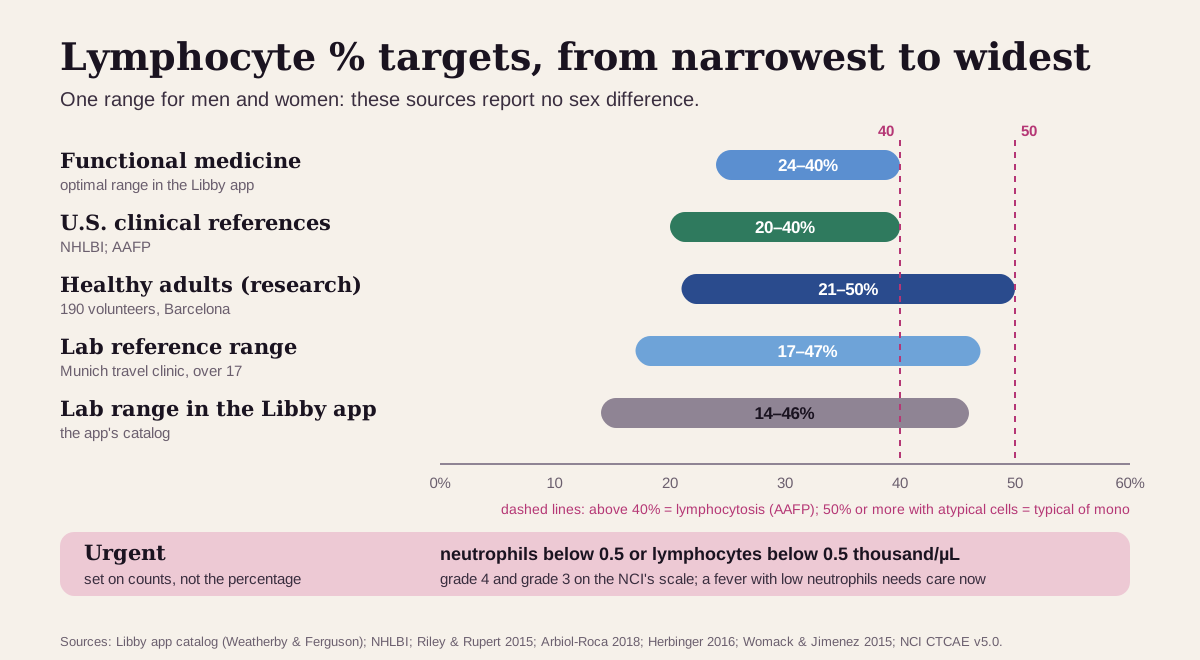
| Target | Range | Who uses it |
|---|---|---|
| Functional medicine | 24–40% | The optimal range shown in the Libby app, whose catalog credits it to the Weatherby & Ferguson textbook4 |
| U.S. clinical references | 20–40% | NHLBI;1 the AAFP review of high white counts2 |
| Healthy adults (research) | 21–50% | 190 healthy Barcelona volunteers, current analyzer12 |
| One lab's reference range | 17–47% | A Munich lab, adults over 176 |
| Lab range in the Libby app | 14–46% | The app's catalog4 |
| Flags | above 40%; 50% or more | Above 40% is lymphocytosis in the AAFP review;2 50% or more, with atypical lymphocytes at least 10% of white cells, is characteristic of mono8 |
| Urgent | set on counts | Neutrophils under 0.5 (grade 4) or lymphocytes under 0.5 thousand/µL (grade 3) on the NCI's grading scale9 |
Why a low share gets attention: the outcome studies come from people who are already sick with heart failure.
- In 1,192 patients hospitalized with acute heart failure, deaths within a year fell from 31.5% in the lowest fifth of lymphocyte percentage (below 9.7%) to 15.5% in the highest. After adjusting for other risk factors, the lowest fifth had 1.76 times the risk.14
- Among 423 adults over 65 with heart failure, 64% of those with lymphocytes at 20% or less died within 3 years, versus 40% above 20%. Adjusted, that's 1.73 times the risk.15
- In 3,717 patients from the EVEREST heart-failure trial, a lower percentage in hospital predicted death in the first 100 days after discharge, on top of 22 known risk factors.16
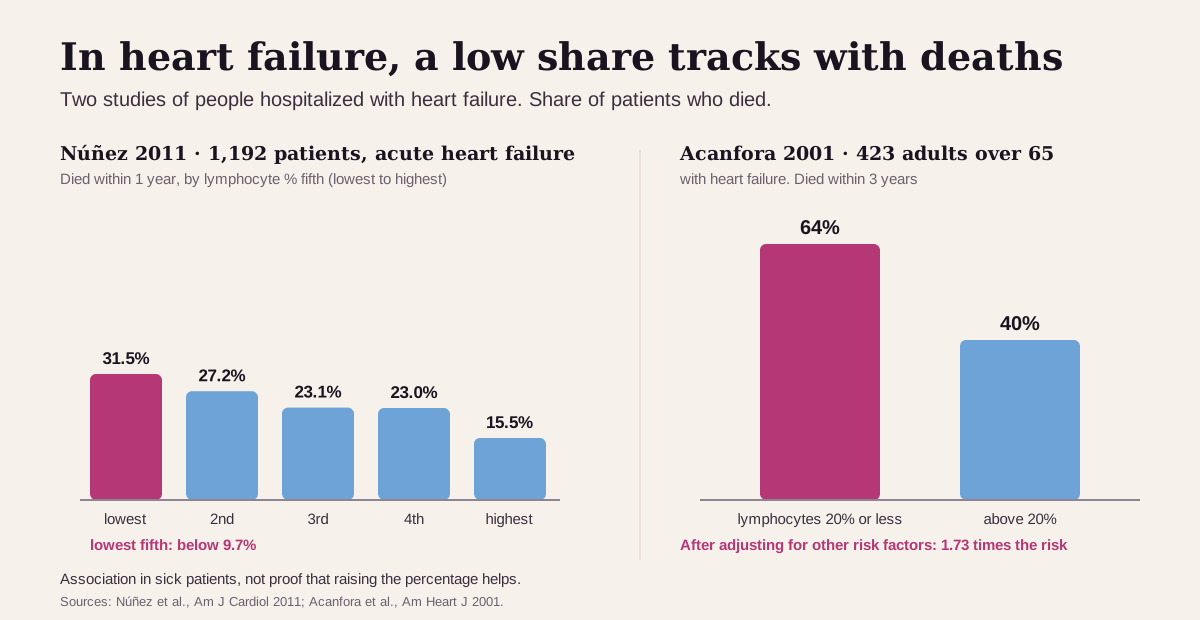
Keep "optimal" in perspective: it's a target, not a diagnosis. In these studies a low share marks the body's stress response, which pushes neutrophils up and lymphocytes down.157 In healthy people, landing a little outside the range is common: in the Munich study, 8.0% of healthy controls were above the lab's range and 3.2% below it.6 Higher is no better, either: the AAFP review calls a share above 40% lymphocytosis.2
What a low or high percentage usually means
Start with the absolute count. If the percentage is out of range but the count sits inside its own range, the change is in the other white cells.26 Labcorp's own sample report shows why this matters: a white count of 1.1 with lymphocytes at 79%, an absolute lymphocyte count of 0.9 (inside its 0.7–3.1 range), and a neutrophil count of 0.1, flagged critical.11
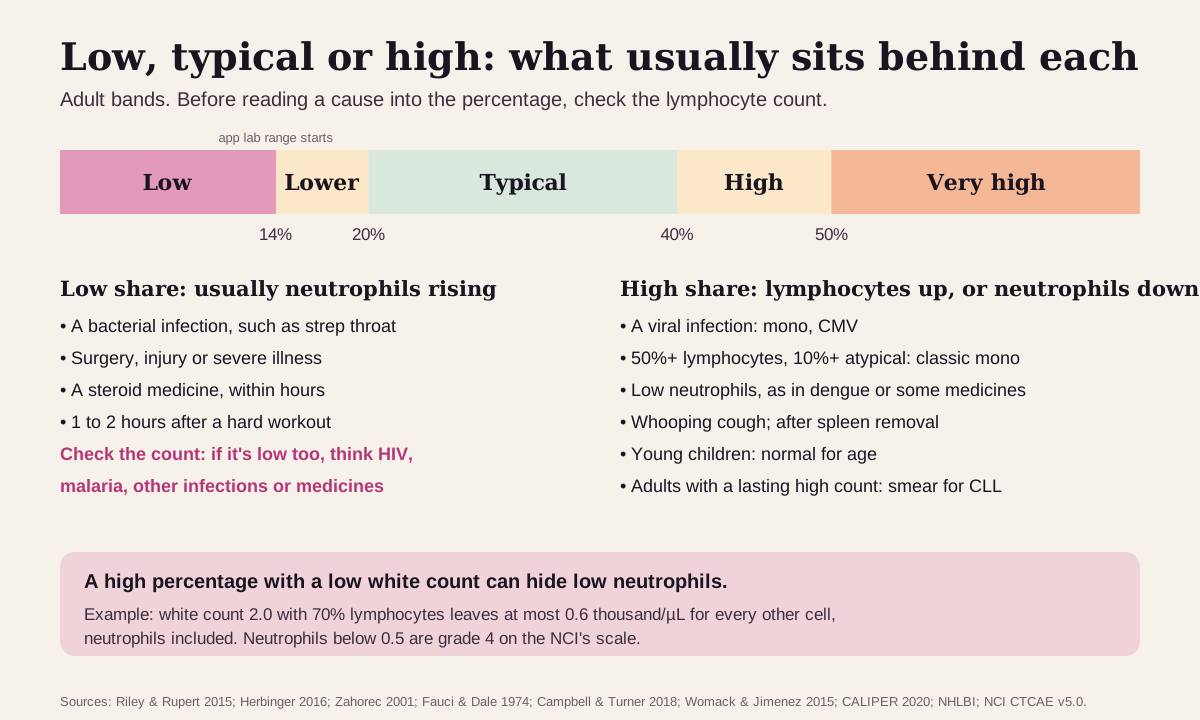
Low percentage: the usual suspects
- A bacterial infection. Neutrophils flood the blood and take a bigger share. Among returning travelers with strep throat, 78% had a high white count and 56% had a low lymphocyte percentage. Strep made the study's list for a low percentage, not for a low count.6
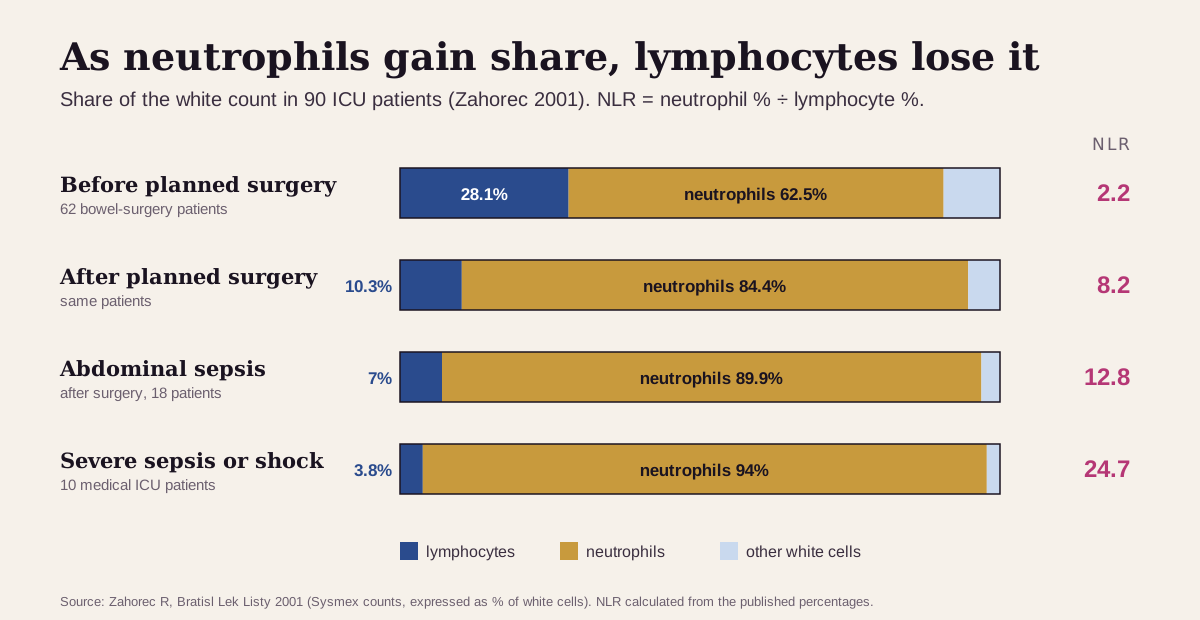
- Surgery, injury or severe illness. After planned bowel surgery, lymphocytes fell from 28% to 10% of white cells while neutrophils rose from 63% to 84%. In severe sepsis or septic shock, lymphocytes were about 4% or less.7
- A steroid medicine. After one IV dose of hydrocortisone, lymphocyte counts hit their lowest point 4 to 6 hours later and were back to normal by 24 hours.17 Steroids also raise neutrophils.2 Don't stop a prescribed steroid on your own; tell your clinician you take it.
- A hard workout in the last few hours. Lymphocyte numbers bottom out 1 to 2 hours after vigorous exercise and recover within a day,18 and exercise pushes neutrophils up.2
- Older age. Among travelers who came back sick, a low percentage showed up in 17% of people aged 65 to 92, versus 6% of those under 20.6
When the count is low too, the lymphocytes really are fewer (lymphopenia). Causes include infections such as HIV, flu, COVID-19, tuberculosis and malaria, autoimmune disease, poor nutrition, heavy drinking, steroid therapy and cancer treatment.1 Among the travelers, 53% of people with HIV had a low lymphocyte count.6
High percentage: the usual suspects
- A viral infection. Mono, from the Epstein-Barr virus, is the classic case: lymphocytes making up 50% or more of white cells, with "atypical" lymphocytes at least 10% of white cells, are characteristic.8 Among the travelers, 51% of people with mono and 56% with cytomegalovirus (CMV) had a high percentage.6
- Fewer neutrophils. When neutrophils fall, lymphocytes take a bigger share even if their number stays the same. Among travelers with dengue fever, 48% had a low white count and 40% a low lymphocyte count, yet 11% had a high percentage.6 Dengue can lower neutrophils, which fits that pattern.2 Some medicines and chemotherapy lower white cells too.310
- Childhood. Under age 2, up to 81.6% is normal.5
- Whooping cough, syphilis, or no working spleen.2
- Rare but important: in adults, a lasting high count made of look-alike cells raises concern for chronic lymphocytic leukemia (CLL). A blood smear tells a reactive rise from a clonal one.2
Get prompt care if you have a fever of 38°C (100.5°F) or higher while your neutrophils are low, for example during chemotherapy.10 Also see a clinician soon if an abnormal result comes with a fever over 100.4°F, night sweats, unexplained weight loss, swollen lymph nodes, or easy bruising or bleeding.2
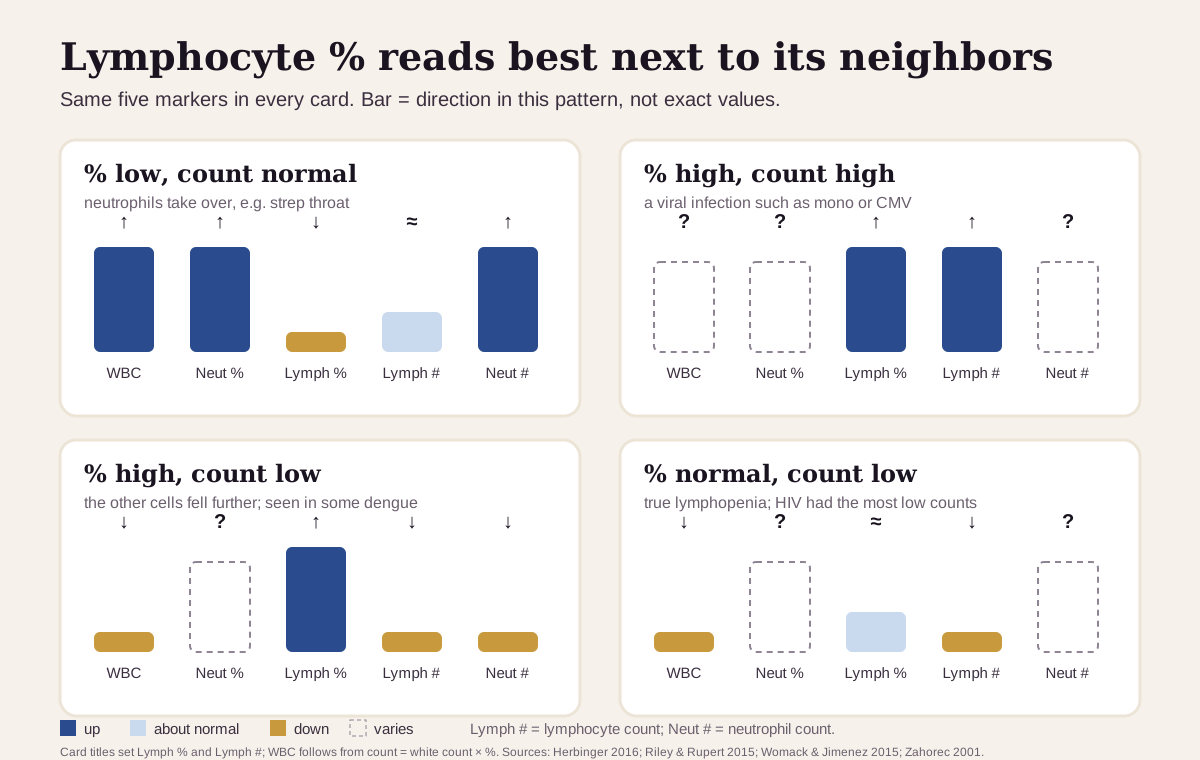
Lymphocyte percentage reads best next to its neighbors
Your percentage arrives with the white count, the neutrophils and the absolute counts. Read together, they tell a share change from a real one:
| If you see… | It often points to… |
|---|---|
| Lymphocyte % low, white count and neutrophils up, lymphocyte count normal | neutrophils taking a bigger share, as in a bacterial infection such as strep throat. Surgery, sepsis and steroids lower the percentage too, but often the count as well6271 |
| Lymphocyte % and count both high | a viral infection such as mono or CMV; in mono, lymphocytes are often 50% or more of white cells, with atypical lymphocytes at least 10%68 |
| Lymphocyte % high, but the white count and lymphocyte count low | the other white cells fell even further, usually neutrophils: check the absolute neutrophil count. Dengue, which can lower neutrophils, did this in some travelers269 |
| Lymphocyte % normal, lymphocyte count low | a true lymphopenia the percentage alone would miss. Causes include HIV, which had the highest rate of low counts among the travelers61 |
| Lymphocyte % above the adult range in a young child | usually normal for age5 |
How fast the percentage changes
Within hours. Both halves of the share move quickly:
- Steroids: lymphocytes bottom out 4 to 6 hours after an IV dose and are back by 24 hours.17
- Exercise: during a hard session, lymphocytes rise (NK cells up to 10-fold). They fall 1 to 2 hours afterward and recover within 24 hours.18
- Surgery: the lymphocyte share dropped from 28% to 10% after planned bowel surgery and started climbing back from the first day after.7
What that means in practice:
- Mention a recent illness, workout, surgery or steroid dose when you get tested.1817
- An unexpected result usually gets a repeat CBC, sometimes with a blood smear.2
- Track the count as well as the share. Ranges differ by lab and analyzer, so compare results from the same lab.6
Going deeper: ratios from percentages
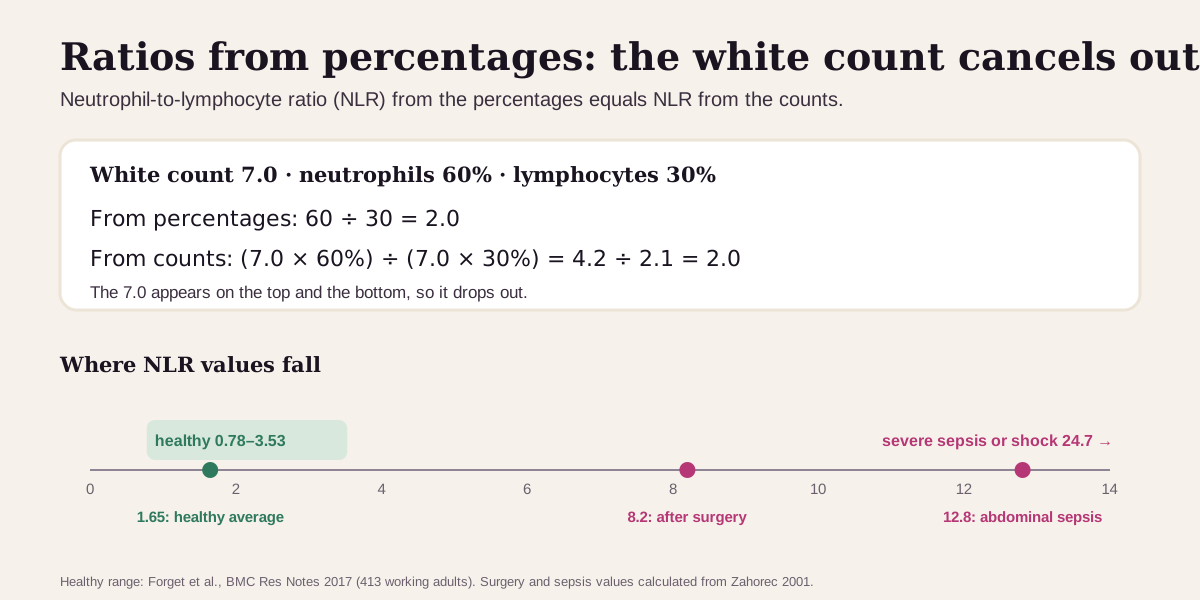
The neutrophil-to-lymphocyte ratio (NLR) works straight from the percentages. Both are shares of the same white count, so the white count cancels: neutrophil % ÷ lymphocyte % gives the same number as the two counts. Zahorec, who proposed the ratio, used "absolute and/or relative % values".7 In 413 healthy working adults, NLR ran from 0.78 to 3.53.19 The neutrophil percentage guide covers NLR in more depth.
The percentage is only as good as the white count behind it. To turn it into a count, multiply: lymphocyte count = white count × lymphocyte % ÷ 100.2 When the white count swings, the percentage swings with it, which is why the same lymphocytes can read as 15%, 30% or 60%.
Questions worth asking
- Is my absolute lymphocyte count out of range, or only the percentage?
- What did my white count and neutrophils do on the same test?
- If my percentage is high and my white count is low, what is my neutrophil count?
- Could a recent infection, workout, surgery or steroid medicine explain it?
- Should we repeat the CBC, and would a blood smear help?
- If my lymphocyte count stays low, should I be tested for HIV or other causes?
FAQ
What is a normal lymphocyte percentage? About 20% to 40% of white cells in adults, per the NHLBI. The optimal range in the Libby app is 24% to 40%. Young children run higher.145
Why is my lymphocyte percentage low when my lymphocyte count is normal? Usually because neutrophils rose and took a bigger share, as in a bacterial infection such as strep throat. A normal count means you have the usual number of lymphocytes.62
What does a high lymphocyte percentage mean? Most often a viral infection such as mono, or fewer neutrophils. If your white count is low, check your absolute neutrophil count.86
Should I look at the percentage or the absolute count? The absolute count. It's the white count times the percentage, and it's the number the lymphocyte limits are set on.29
This guide is for education. It can't diagnose you or replace care from a clinician who knows your history.
Footnotes
-
National Heart, Lung, and Blood Institute. Lymphopenia: What is lymphopenia? and Causes and risk factors. NIH; last updated May 31, 2022. "In adults, about 20% to 40% of the white blood cells in your body are lymphocytes"; B, T and NK cells; acquired causes including infections such as HIV, influenza, SARS-CoV-2, tuberculosis and malaria, autoimmune disorders, steroid therapy, cancer treatment, heavy drinking and poor nutrition. NHLBI · Causes ↩ ↩2 ↩3 ↩4 ↩5 ↩6 ↩7 ↩8 ↩9 ↩10 ↩11 ↩12
-
Riley LK, Rupert J. Evaluation of Patients with Leukocytosis. Am Fam Physician. 2015;92(11):1004–1011. The AAFP review: normal distribution (lymphocytes 20–40%, neutrophils 40–60%); lymphocytosis above 40% of white cells or above 4,500/mm³; think in absolute rather than relative counts, absolute count = white count × percentage; stress, exercise and corticosteroids raise neutrophils; pertussis, syphilis and asplenia; a monomorphic smear is concerning for CLL; red-flag symptoms. AAFP · PubMed ↩ ↩2 ↩3 ↩4 ↩5 ↩6 ↩7 ↩8 ↩9 ↩10 ↩11 ↩12 ↩13 ↩14 ↩15 ↩16 ↩17 ↩18 ↩19 ↩20 ↩21 ↩22 ↩23 ↩24 ↩25 ↩26 ↩27 ↩28
-
National Library of Medicine. Blood Differential. MedlinePlus. The differential measures "the amount and/or percentage of each type of white blood cell"; certain medicines and chemotherapy can lower the white count. MedlinePlus ↩ ↩2 ↩3
-
Weatherby D, Ferguson S. Blood Chemistry and CBC Analysis: Clinical Laboratory Testing from a Functional Perspective. 2nd ed. Bear Mountain Publishing; 2004. ISBN 978-0976136712. Widely used functional-medicine reference. The Libby app credits its 24–40% optimal range for the lymphocyte percentage to this book, and its catalog lists a lab range of 14–46% (range as recorded in the Libby app's marker catalog; book not opened for this article). ↩ ↩2 ↩3 ↩4 ↩5 ↩6 ↩7
-
Tahmasebi H, Higgins V, Bohn MK, Hall A, Adeli K. CALIPER Hematology Reference Standards (I). Am J Clin Pathol. 2020;154(3):330–341. Healthy Canadian children on a Beckman Coulter DxH 900; lymphocyte percentage by age (0–<2 y 34.7–81.6%; 2–<4 y 20.7–72.3%; 4–<12 y 22.9–58.4%; 12–<21 y 20.1–48.8%); no differential parameter needed a sex split. PMC ↩ ↩2 ↩3 ↩4 ↩5 ↩6 ↩7
-
Herbinger KH, Hanus I, Beissner M, et al. Lymphocytosis and Lymphopenia Induced by Imported Infectious Diseases: A Controlled Cross-Sectional Study of 17,229 Diseased German Travelers Returning from the Tropics and Subtropics. Am J Trop Med Hyg. 2016;94(6):1385–1391. Defines relative (percentage) and absolute lymphocytosis and lymphopenia; adult reference range 17–47%; relative lymphocytosis in 8.0% and relative lymphopenia in 3.2% of 1,774 healthy controls; per-infection rates for strep throat, mono, CMV, dengue and HIV. PMC ↩ ↩2 ↩3 ↩4 ↩5 ↩6 ↩7 ↩8 ↩9 ↩10 ↩11 ↩12 ↩13 ↩14 ↩15 ↩16 ↩17 ↩18 ↩19 ↩20 ↩21 ↩22 ↩23 ↩24
-
Zahorec R. Ratio of neutrophil to lymphocyte counts: rapid and simple parameter of systemic inflammation and stress in critically ill. Bratisl Lek Listy. 2001;102(1):5–14. 90 ICU patients, counts as % of white cells: planned colorectal surgery, neutrophils 62.5% to 84.4% and lymphocytes 28.1% to 10.3%, recovering from the first day after; abdominal sepsis 89.9% and 7%; severe sepsis or septic shock 94% and 3.8%; the ratio from "absolute and/or relative % values". PubMed ↩ ↩2 ↩3 ↩4 ↩5 ↩6 ↩7 ↩8 ↩9
-
Womack J, Jimenez M. Common questions about infectious mononucleosis. Am Fam Physician. 2015;91(6):372–376. The Hoagland criteria: lymphocytes at least 50% and atypical lymphocytes at least 10% of the differential are characteristic of mono. AAFP · PubMed ↩ ↩2 ↩3 ↩4 ↩5 ↩6 ↩7 ↩8
-
National Cancer Institute. Common Terminology Criteria for Adverse Events (CTCAE) v5.0. 2017. Neutrophil count decreased: grade 4 below 0.5 ×10⁹/L. Lymphocyte count decreased: grade 3 below 0.5 ×10⁹/L. The NCI's grading scale for side effects in cancer care. NCI ↩ ↩2 ↩3 ↩4 ↩5 ↩6
-
National Cancer Institute. Infection and Neutropenia during Cancer Treatment. NIH. Call your care team for a fever of 100.5°F (38°C) or higher; infections during cancer treatment "can be life threatening and require urgent medical attention". NCI ↩ ↩2 ↩3
-
Labcorp. CBC With Differential/Platelet (005009): sample report. Opened September 23, 2026. All five percentages (neutrophils, lymphs, monocytes, eos, basos) print "Not Estab."; ranges are given for the absolute counts. First sample: WBC 1.1 (3.4–10.8), lymphs 79%, lymphs (absolute) 0.9 (0.7–3.1), neutrophils (absolute) 0.1 "Critical" (1.4–7.0). A commercial source: a national lab's published example report. files.labcorp.com ↩ ↩2
-
Arbiol-Roca A, Imperiali CE, Montserrat MM, et al. Reference intervals for a complete blood count on an automated haematology analyser Sysmex XN in healthy adults from the southern metropolitan area of Barcelona. EJIFCC. 2018;29(1):48–54. Adult lymphocyte range 21–50% (n = 190). PMC ↩ ↩2 ↩3 ↩4
-
Superpower. Lymphocytes: Best Biomarkers to Monitor. Last updated September 1, 2026. "Lymphocytes typically represent 20 to 40 percent of total white blood cells in adults"; optimal "often described as sitting comfortably mid-range", with no number. A commercial source, listed as what the optimizer community uses. superpower.com ↩
-
Núñez J, Núñez E, Miñana G, et al. Effectiveness of the relative lymphocyte count to predict one-year mortality in patients with acute heart failure. Am J Cardiol. 2011;107(7):1034–1039. 1,192 patients; 1-year mortality by quintile 31.5%, 27.2%, 23.1%, 23% and 15.5%; lowest quintile below 9.7%, adjusted HR 1.76. PubMed ↩ ↩2
-
Acanfora D, Gheorghiade M, Trojano L, et al. Relative lymphocyte count: a prognostic indicator of mortality in elderly patients with congestive heart failure. Am Heart J. 2001;142(1):167–173. 423 patients over 65 with heart failure; 3-year mortality 64% at 20% or less vs 40% above 20%; adjusted HR 1.73; "a reduction in the relative lymphocyte count is a marker of the stress response". PubMed ↩ ↩2 ↩3
-
Vaduganathan M, Ambrosy AP, Greene SJ, et al. Predictive value of low relative lymphocyte count in patients hospitalized for heart failure with reduced ejection fraction: insights from the EVEREST trial. Circ Heart Fail. 2012;5(6):750–758. 3,717 patients; lower lymphocyte percentage predicted early post-discharge death after adjustment for 22 risk factors. PubMed ↩
-
Fauci AS, Dale DC. The effect of in vivo hydrocortisone on subpopulations of human lymphocytes. J Clin Invest. 1974;53(1):240–246. A single IV dose of 100 or 400 mg; lowest lymphocyte counts at 4–6 hours, normal by 24 hours. PMC ↩ ↩2 ↩3
-
Campbell JP, Turner JE. Debunking the Myth of Exercise-Induced Immune Suppression: Redefining the Impact of Exercise on Immunological Health Across the Lifespan. Front Immunol. 2018;9:648. Lymphocytosis during vigorous exercise (NK cells up to 10-fold), a nadir 1–2 hours after, back to pre-exercise levels within 24 hours. PMC ↩ ↩2 ↩3
-
Forget P, Khalifa C, Defour JP, Latinne D, Van Pel MC, De Kock M. What is the normal value of the neutrophil-to-lymphocyte ratio? BMC Res Notes. 2017;10(1):12. 413 healthy working adults; mean NLR 1.65, normal 0.78–3.53. PMC ↩ ↩2
Educational content, not medical advice. Libby is a personal record tool, not a medical service — it doesn't diagnose, treat, or prescribe. Reference ranges vary by lab and by person. Talk to a qualified healthcare professional about your results.
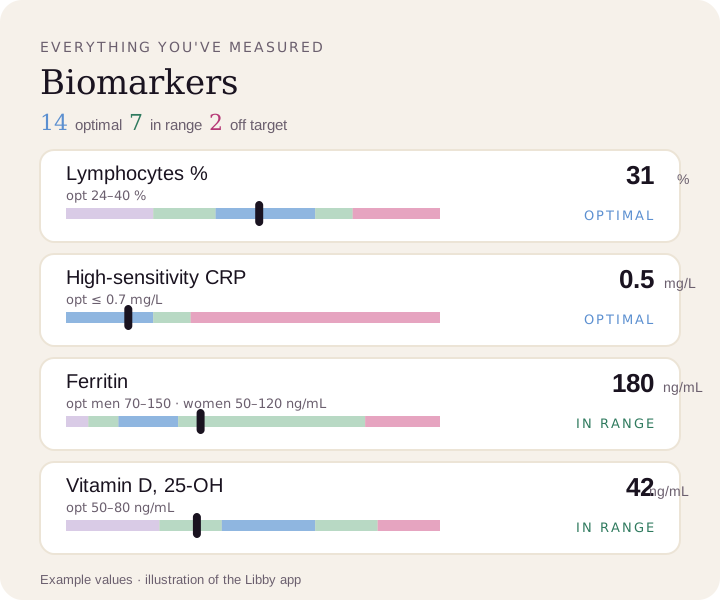
Compare your results to optimal ranges.
Upload a lab PDF or a photo of your report. Libby puts every marker on your lab's range and the optimal range, and tracks your trends over time.
View your lymphocyte % ›