Methylmalonic acid (MMA) test: normal range and high causes
Methylmalonic acid (MMA) shows whether vitamin B12 is working inside your cells. Normal levels, common causes of a high result, and how to read it with B12.
MMA (methylmalonic acid) is a by-product your cells clear with the help of vitamin B12. When B12 runs short inside your cells, MMA backs up and spills into your blood. That makes a high MMA one of the most sensitive signs of B12 deficiency, often showing up while the B12 level on your report still looks normal.12
The short version
- Normal: check the range on your report. Two large U.S. labs put the upper limit at 378 nmol/L (Labcorp) and 400 nmol/L (ARUP).13 Healthy adults with good B12 and normal kidneys usually sit much lower: a median of 120 nmol/L at ages 20–39 and 161 at 70 and older.4
- High is the classic sign of too little usable B12, often from poor absorption (stomach conditions, metformin, acid-reducing medicines, gut surgery) or a diet without animal foods. Weaker kidneys and older age push MMA up too.526
- Get care promptly if a high MMA comes with numbness, tingling, balance trouble, memory problems or confusion. In a baby, a high MMA can signal a rare inherited disorder that needs urgent care.578
- MMA is the B12-specific test. Low folate raises homocysteine but leaves MMA alone, so the two together tell B12 and folate problems apart.62
What MMA is
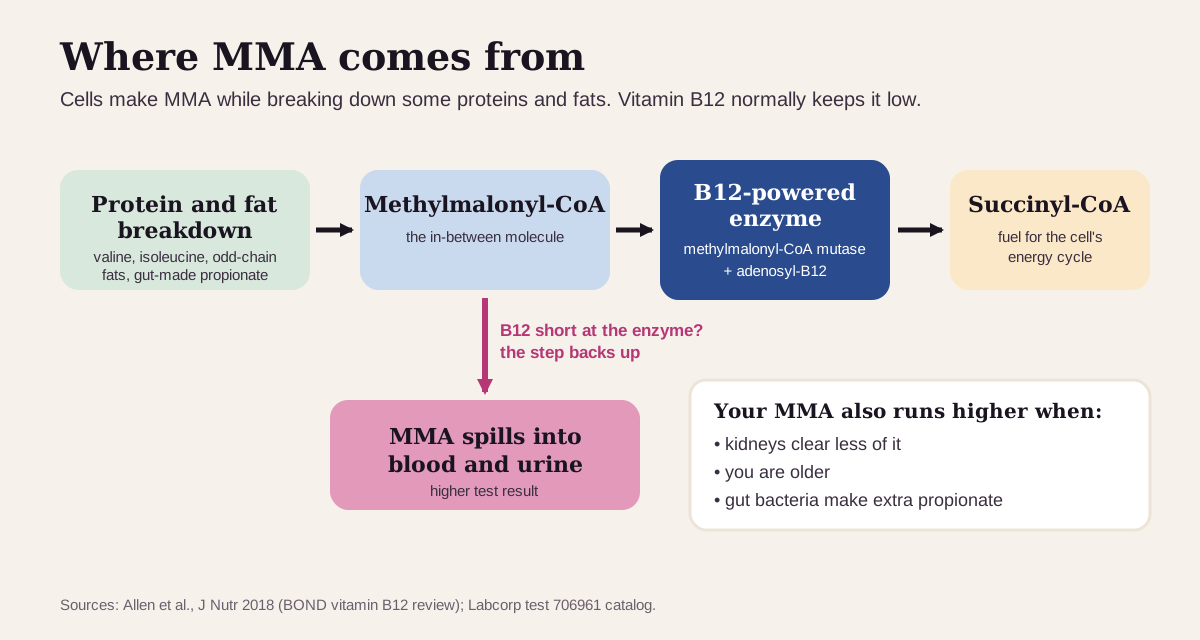
Your cells make MMA while they break down a few amino acids (valine and isoleucine) and certain fats.16 Inside the mitochondria, the cell's power plants, an enzyme called methylmalonyl-CoA mutase turns the in-between molecule into succinyl-CoA, which feeds the cell's energy cycle. That enzyme runs on adenosyl-B12, one of the two working forms of vitamin B12.6
When B12 runs short, the step backs up and MMA spills into your blood and urine.8 So MMA is a functional B12 test: it shows whether B12 is doing its job inside cells, where a standard vitamin B12 test shows how much is circulating. Labcorp notes that MMA often rises early in B12 deficiency, while the blood B12 level is still in the normal range.1
It works. In a classic study of 434 episodes of clear-cut B12 deficiency, 98.4% had a high MMA.2 MMA is measured in blood or urine, and it's part of newborn screening for a rare inherited disorder.8
What's a normal MMA?
Start with the range printed on your report. Labs use different methods, and the U.K.'s NICE guideline tells clinicians to judge MMA against the testing lab's own range.5 Two national U.S. commercial labs list 0–378 nmol/L (Labcorp) and 0.00–0.40 µmol/L, or 0–400 nmol/L (ARUP).13
Healthy people run well below those limits, and MMA climbs with age. A CDC team measured MMA in U.S. adults with good B12 levels and normal kidney function (NHANES 2011–2014).4 The middle 95% ran:
- ages 20–39: 63.5–254 nmol/L (median 120)
- ages 40–59: 70.5–293 (median 133)
- ages 60–69: 72.4–281 (median 143)
- 70 and older: 84.3–317 (median 161)
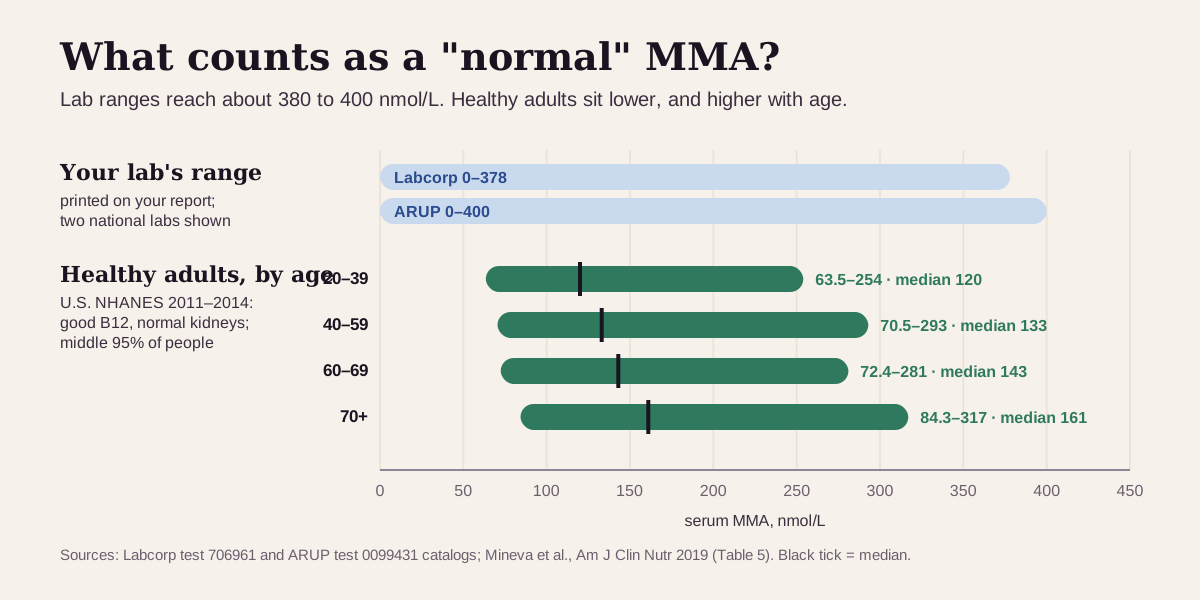
Age raises MMA even in people with good B12 and healthy kidneys, especially after 70, and neither diet nor kidney function fully explains why.6 Labs print one range for men and women.13
"Optimal" MMA: what health optimizers aim for
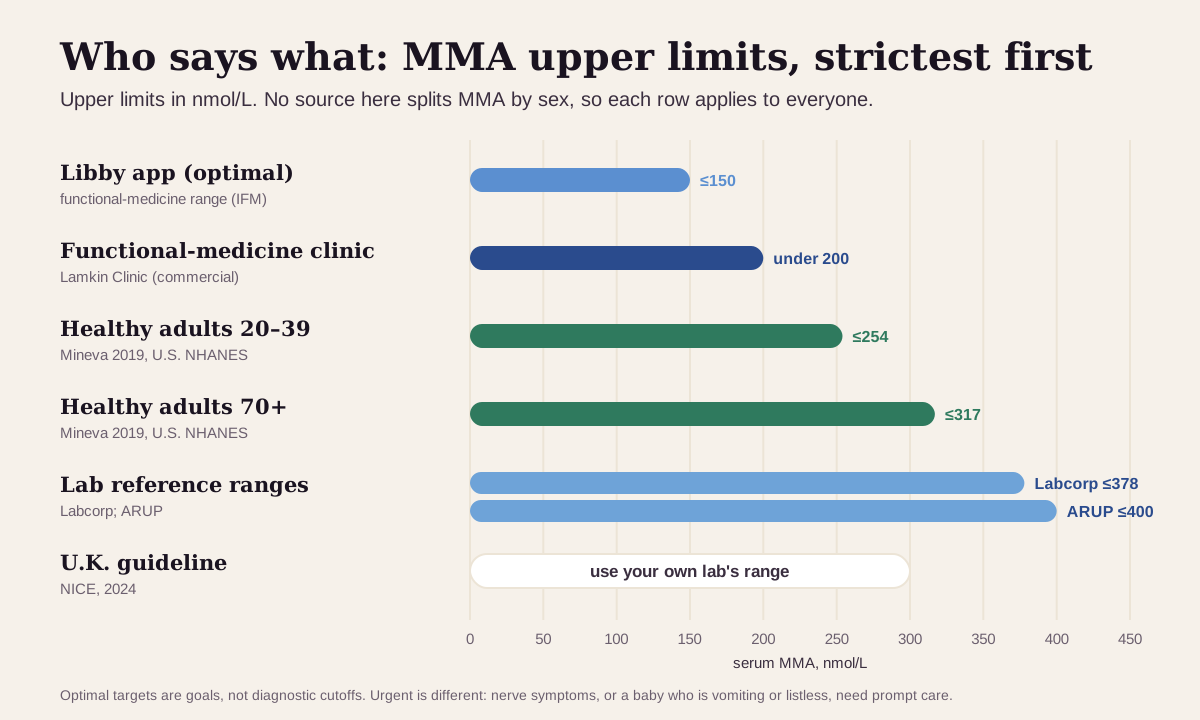
Functional-medicine practitioners aim well below a lab's upper limit, on the idea that a truly B12-replete body keeps MMA low. Here's the ladder, from strictest to loosest. None of these sources sets a separate target for men and women.
| Target | Upper limit | Who uses it |
|---|---|---|
| Strictest (functional medicine) | 150 nmol/L or less | The optimal range shown in the Libby app, from the Institute for Functional Medicine9 |
| Functional-medicine clinic | under 200 nmol/L | Lamkin Clinic's "functional medicine optimal", below 0.20 µmol/L10 |
| Research "healthy" limit | 254 (ages 20–39) to 317 (70+) nmol/L | The top of the middle 95% in U.S. adults with good B12 and healthy kidneys4 |
| Lab reference range | 378–400 nmol/L | Labcorp and ARUP13 |
| Guideline | your lab's range | NICE, the U.K. guideline body, points clinicians to the testing lab's range5 |
| Urgent | symptoms, at any number | Numbness, tingling, balance trouble or confusion; in a baby, vomiting, dehydration or listlessness5711 |
Why the low targets aren't just a trend:
- In 12,940 U.S. adults followed for a median of 13.5 years, people with MMA of 175–250 nmol/L, inside every lab's normal range, had a 37% higher risk of dying from any cause than people under 120, after adjusting for 22 factors including age, kidney function and B12. At 250 and above, the risk was 62% higher. At 120–175 the rise (11%) was too small to rule out chance.12
- In 1,533 Dutch adults aged 60–75, each doubling of MMA carried a 1.67 times higher risk of death over 8.5 years, independent of B12 and kidney function.13
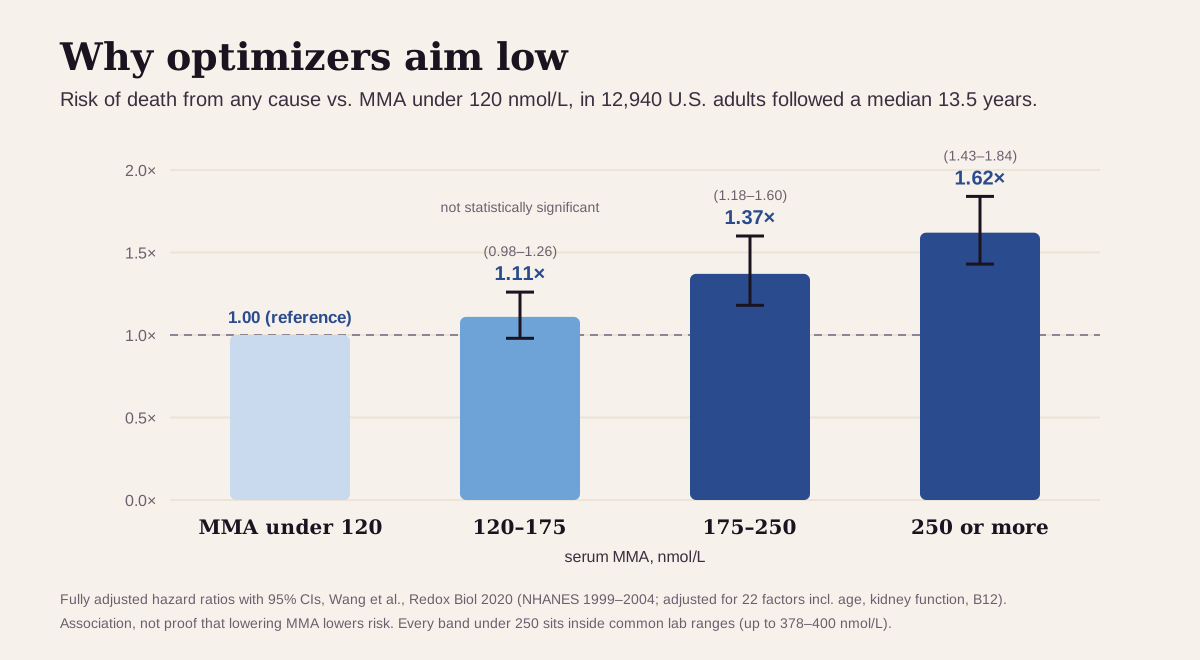
Keep "optimal" in perspective. These are associations, and B12 is only part of the story: in the Dutch study, B12, kidney function, age and sex together explained just 22% of the differences in MMA between people. The authors point to other sources, such as the body's own protein breakdown, diet and gut bacteria.13 Both studies were observational, so they show a link, not that lowering MMA with B12 would extend life. A low MMA is fine: MedlinePlus says low levels are uncommon and not considered a health problem.8
What a high MMA usually means
The usual reasons are B12 that falls short inside your cells, kidneys that clear less MMA, and age. The size of the rise helps a little: in one trial, primary-care patients with low B12 averaged about 300–320 nmol/L at diagnosis, still inside many lab ranges.14 Clear-cut deficiency often runs far higher.27
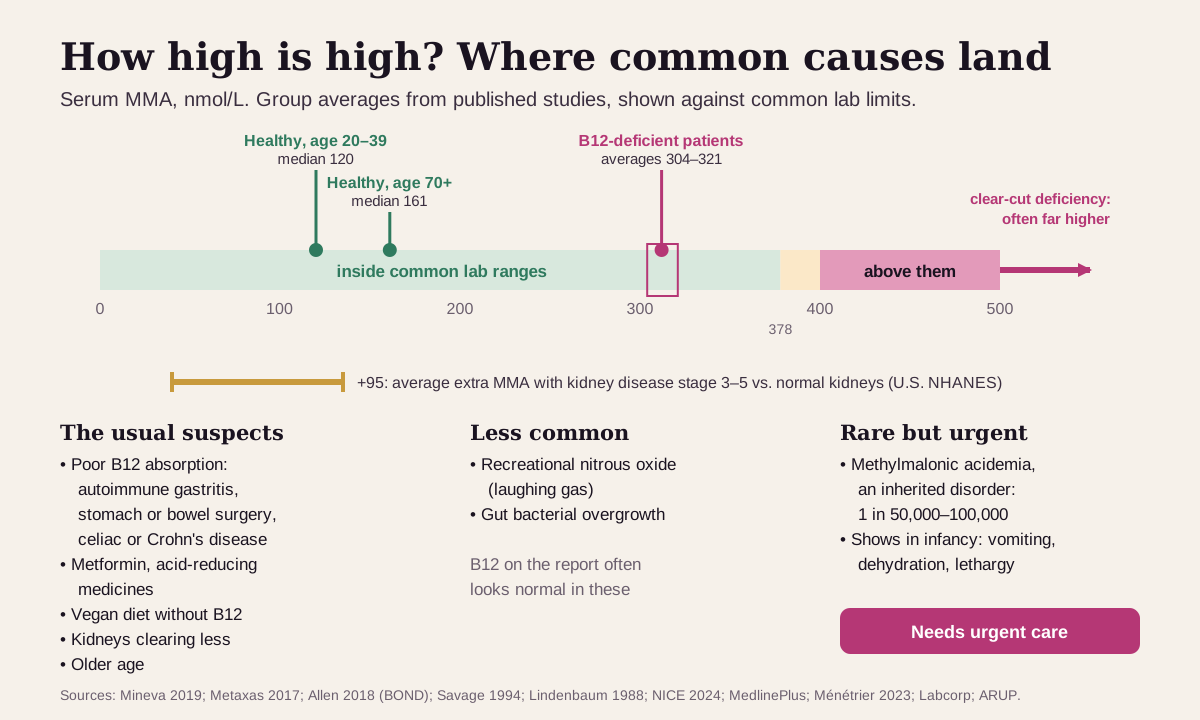
The usual suspects
- Poor B12 absorption. Your stomach has to free B12 from food and make a carrier protein for it. Autoimmune (atrophic) gastritis, the cause of pernicious anemia, blocks that; so can stomach or bowel surgery, including many weight-loss operations, and celiac or Crohn's disease.58 Pernicious anemia was the main cause in the classic 434-episode study.2
- Medicines. NICE lists metformin, acid reducers (proton pump inhibitors and H2 blockers) and several others as B12 risk factors.5 Don't stop a prescribed medicine on your own. Bring your full list, supplements included, to your clinician.
- A diet with little or no animal food. Your body can't make B12, so it comes from animal foods, fortified foods or supplements. Vegans who skip fortified foods or supplements are at risk.58
- Kidneys clearing less. Your kidneys filter MMA out. In U.S. national data, people with chronic kidney disease stage 3–5 averaged about 95 nmol/L more MMA than people with normal kidneys.6 That's why clinicians read MMA next to creatinine and eGFR.
- Older age. MMA drifts up with age on its own, and B12 absorption problems also get more common: MedlinePlus lists age over 75 as a B12 risk factor.48
Less common
- Recreational nitrous oxide (laughing gas, "whippets"). It damages B12 directly. In a review of 574 users, MMA was high in 79.6%, while the standard B12 level was low in only 42.2%.15 NICE recommends MMA or homocysteine as the first test when nitrous oxide is the suspected cause.5
- Gut bacterial overgrowth. Gut bacteria make propionate, which the body can turn into MMA.6
Rare but important
Methylmalonic acidemia is a group of inherited disorders, found in about 1 in 50,000 to 100,000 people, that usually show up in early infancy with vomiting, dehydration, weak muscle tone and extreme tiredness.11 Newborn screening looks for it, and a baby with a high MMA needs prompt specialist care.8
Get prompt care if a high MMA comes with numbness or tingling in your hands or feet, loss of feeling, trouble walking or balancing, memory problems or confusion, or mood changes. NICE advises starting B12 treatment without waiting for test results in people with these nerve symptoms and suspected B12-related anemia.578
A high MMA with a "normal" B12
This is common, and it's exactly why the test exists. Blood B12 is a blunt measure, and MMA can rise first.1 NICE suggests an MMA test when someone has symptoms and a total B12 in the gray zone of 180–350 ng/L (the same number in pg/mL).5 A normal blood count doesn't settle it either: among 141 patients with nerve or mental symptoms from B12 deficiency, 28% had a normal hematocrit or normal-sized red cells (19 had both), yet their MMA was markedly high, and all 39 whose symptoms were followed improved on B12.7
Is a low MMA a problem?
Usually not. Low MMA is uncommon and not considered a health problem.8 Recent B12 tablets or injections lower it, so tell your clinician about any supplements before testing.514
MMA reads best next to its neighbors
MMA is most useful read with vitamin B12, homocysteine, folate and kidney function. B12 powers two enzymes: one clears MMA, the other clears homocysteine with folate's help. That split is what sorts the patterns.6
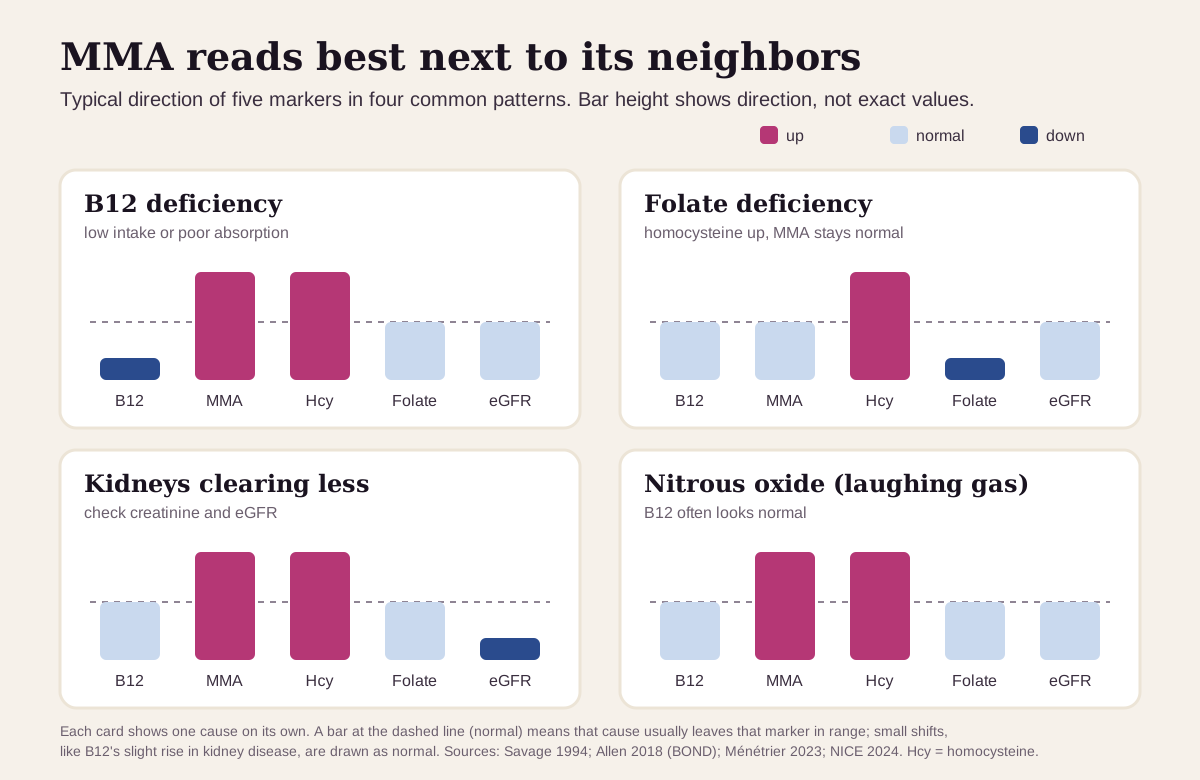
| If you see… | It often points to… |
|---|---|
| MMA and homocysteine both up, B12 low or borderline | B12 deficiency: in the classic study, 98.4% had high MMA and 95.9% high homocysteine |
| Homocysteine up, MMA normal, folate low | folate deficiency: homocysteine was high in 91%, MMA in only 12.2%, and then almost always from kidney problems or low blood volume |
| MMA and homocysteine up, eGFR low | kidneys clearing less: compared with normal kidney function, stage 3–5 chronic kidney disease comes with about 95 nmol/L more MMA and 3.9 µmol/L more homocysteine on average |
| MMA and homocysteine up, B12 normal, recent nitrous oxide use | a functional B12 block: MMA was high in about 4 in 5 users |
| MMA up, MCV or hematocrit normal | B12 deficiency can still be present: 28% of patients with B12-related nerve or mental symptoms had a normal hematocrit or normal-sized red cells |
| MMA and homocysteine both normal | clinically significant B12 deficiency is very unlikely |
Red cells tell their own story. B12 or folate deficiency can make them large (a high MCV), but MMA can be high while they're still normal-sized.67
How fast MMA changes
MMA reflects your B12 stores, not yesterday's meal or pill. A single dose moves the "active B12" test within 6 hours, while MMA tracks the longer picture.6 Once treatment starts, though, MMA falls fast.
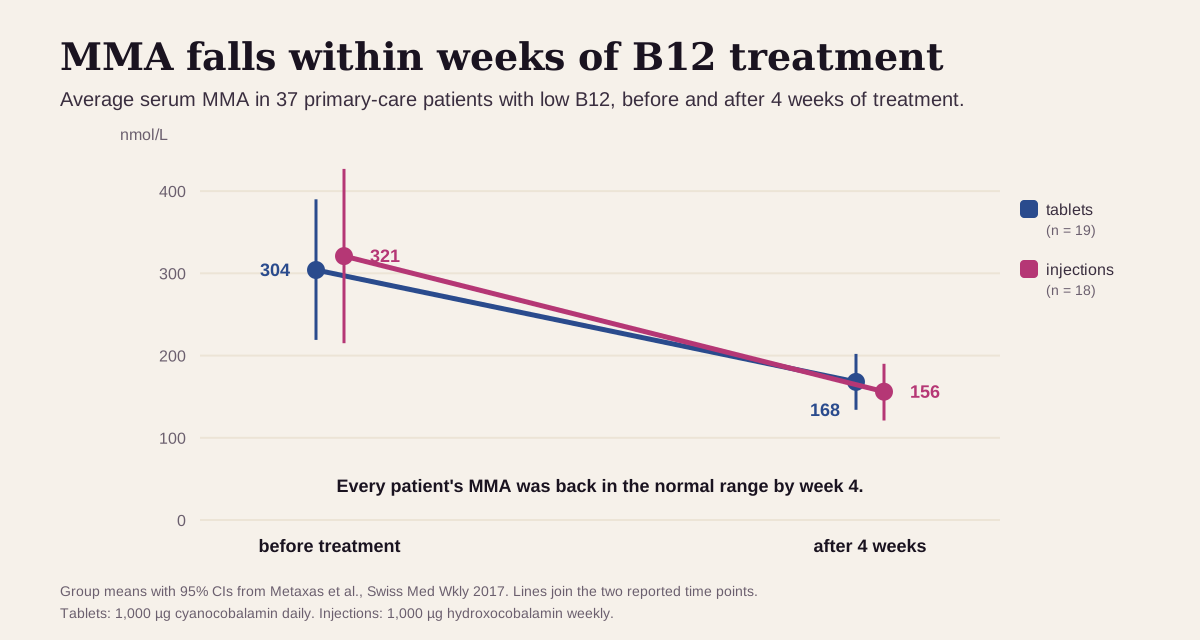
In a Swiss trial of 37 primary-care patients with low B12, average MMA fell from 304 to 168 nmol/L on daily 1,000 µg tablets and from 321 to 156 nmol/L on weekly 1,000 µg injections, and every patient's MMA was normal by week 4.14
What that means in practice:
- Test before you start B12. NICE recommends taking blood before treatment, and asking about any B12 tablets, injections or patches you already use.5 B12 brings MMA down within weeks, so supplements can hide a deficiency on the test.14
- Fasting: follow your lab's instructions. MedlinePlus says you may be asked to fast for several hours, and a major B12 review says fasting is preferred for MMA when possible.86
- A falling MMA on treatment is a good sign that B12 is reaching your cells. In the classic nerve-symptom study, MMA or homocysteine fell by more than half in all 31 patients rechecked after treatment.7
- Trends beat snapshots. Kidney function, age and supplements all move MMA. Compare results from the same lab, and read them next to your creatinine or eGFR.65
Going deeper: B12's two jobs
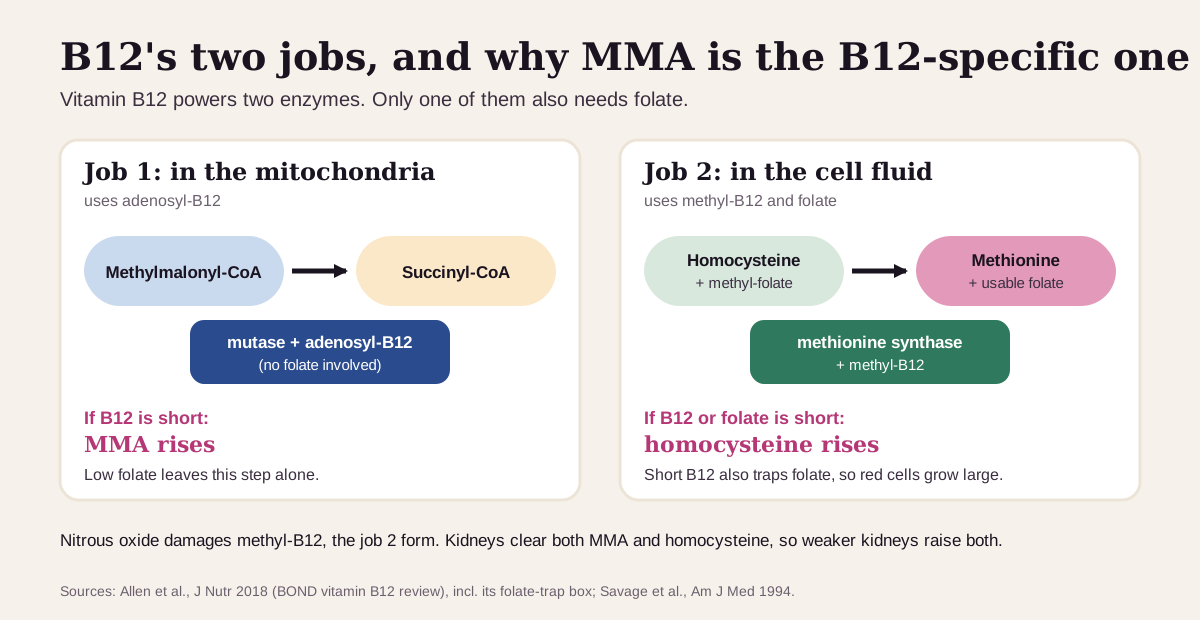
Vitamin B12 comes in two working forms, and each powers one enzyme:6
- Adenosyl-B12, in the mitochondria, helps methylmalonyl-CoA mutase turn methylmalonyl-CoA into succinyl-CoA. This is the step that keeps MMA low. Folate plays no part, so MMA stays untouched by folate or other B vitamins.
- Methyl-B12, in the cell fluid, helps methionine synthase turn homocysteine into methionine, using a folate molecule as the methyl donor. Low B12 or low folate raises homocysteine, and so do low vitamin B6, kidney disease and an underactive thyroid.
When B12 is missing, the second reaction stalls and folate gets stuck in a form the body can't reuse, the so-called folate trap. Red-cell precursors then run short of usable folate for DNA, which is why B12 deficiency and folate deficiency both produce large red cells.6
Nitrous oxide targets methyl-B12, the second job. Homocysteine rises first, and prolonged use can tip people, especially those already low in B12, into nerve damage.6
Urine MMA is an option too. Because urine concentration varies, labs report it per unit of creatinine, and it rises after meals.6
Questions worth asking
- Is my MMA above my lab's range, or only above an optimal target?
- What do my B12, homocysteine and folate show next to it?
- How is my kidney function, and could it explain part of this?
- Could my medicines, such as metformin or acid reducers, or my diet affect my B12?
- Should I be tested for autoimmune gastritis (pernicious anemia)?
- If I start B12, when should we recheck MMA, and what result would change the plan?
FAQ
What is a normal MMA level? Check your lab's range: common U.S. upper limits are 378–400 nmol/L. Healthy adults with good B12 usually sit far lower, with a median of 120 nmol/L at ages 20–39 and 161 at 70 and older.134
What does a high MMA mean? It's the classic sign of too little usable B12 in your cells, from poor absorption, medicines or diet. Weaker kidneys and older age also raise it, so it's read with creatinine or eGFR.56
Can MMA be high if my B12 is normal? Yes. MMA often rises before blood B12 falls, and nitrous oxide can raise MMA while B12 looks normal.115
Can kidney disease raise MMA? Yes. The kidneys clear MMA. In U.S. national data, people with stage 3–5 chronic kidney disease averaged about 95 nmol/L more MMA than people with normal kidneys.6
This guide is for education. It can't diagnose you or replace care from a clinician who knows your history.
Footnotes
-
Labcorp. Methylmalonic Acid, Serum or Plasma (test 706961). A commercial laboratory's test catalog. Reference range 0–378 nmol/L; notes that MMA often rises early in B12 deficiency while serum B12 is still normal. labcorp.com ↩ ↩2 ↩3 ↩4 ↩5 ↩6 ↩7 ↩8 ↩9 ↩10 ↩11 ↩12 ↩13
-
Savage DG, Lindenbaum J, Stabler SP, Allen RH. Sensitivity of serum methylmalonic acid and total homocysteine determinations for diagnosing cobalamin and folate deficiencies. Am J Med. 1994;96(3):239–246. 434 episodes of B12 deficiency and 123 of folate deficiency; the source for the 98.4%, 95.9%, 91% and 12.2% figures. PubMed ↩ ↩2 ↩3 ↩4 ↩5 ↩6 ↩7 ↩8 ↩9 ↩10
-
ARUP Laboratories. Methylmalonic Acid, Serum or Plasma (test 0099431). A commercial laboratory's test catalog. Reference interval 0.00–0.40 µmol/L (0–400 nmol/L). aruplab.com ↩ ↩2 ↩3 ↩4 ↩5 ↩6 ↩7
-
Mineva EM, Sternberg MR, Zhang M, et al. Age-specific reference ranges are needed to interpret serum methylmalonic acid concentrations in the US population. Am J Clin Nutr. 2019;110(1):158–168. CDC analysis of NHANES 2011–2014; age-specific medians and central 95% ranges in adults with serum B12 of at least 300 pmol/L and no chronic kidney disease. PMC ↩ ↩2 ↩3 ↩4 ↩5 ↩6 ↩7 ↩8
-
National Institute for Health and Care Excellence. Vitamin B12 deficiency in over 16s: diagnosis and management (NG239). 2024. The U.K. national guideline: risk factors, when to test MMA, testing before treatment, and not delaying treatment for nerve symptoms. NICE ↩ ↩2 ↩3 ↩4 ↩5 ↩6 ↩7 ↩8 ↩9 ↩10 ↩11 ↩12 ↩13 ↩14 ↩15 ↩16 ↩17 ↩18
-
Allen LH, Miller JW, de Groot L, et al. Biomarkers of Nutrition for Development (BOND): Vitamin B-12 Review. J Nutr. 2018;148(suppl_4):1995S–2027S. NIH-supported expert review; the source for the two B12 enzymes, the folate trap, the kidney effect (NHANES) and the age effect. PMC ↩ ↩2 ↩3 ↩4 ↩5 ↩6 ↩7 ↩8 ↩9 ↩10 ↩11 ↩12 ↩13 ↩14 ↩15 ↩16 ↩17 ↩18 ↩19 ↩20 ↩21 ↩22 ↩23
-
Lindenbaum J, Healton EB, Savage DG, et al. Neuropsychiatric disorders caused by cobalamin deficiency in the absence of anemia or macrocytosis. N Engl J Med. 1988;318(26):1720–1728. 141 patients with B12-related nerve or mental symptoms; 28% had a normal hematocrit or a normal MCV (19 had both). PubMed ↩ ↩2 ↩3 ↩4 ↩5 ↩6 ↩7 ↩8
-
National Library of Medicine. Methylmalonic Acid (MMA) Test. MedlinePlus. Symptoms, risk groups, fasting, and what low and high results mean. MedlinePlus ↩ ↩2 ↩3 ↩4 ↩5 ↩6 ↩7 ↩8 ↩9 ↩10 ↩11
-
Institute for Functional Medicine. Clinical practice guidelines and Advanced Practice Modules (range as recorded in the Libby app's marker catalog; member-only modules not opened for this article). The Libby app's optimal MMA range is 150 nmol/L or less. https://www.ifm.org ↩ ↩2
-
Lamkin Clinic. Methylmalonic Acid (MMA): Optimal Levels, Reference Ranges & B12 Interpretation. Accessed September 23, 2026 (no publication date shown). States a functional-medicine optimal MMA below 0.20 µmol/L (200 nmol/L). A commercial source, listed as what optimizers use. lamkinclinic.com ↩ ↩2
-
National Library of Medicine. Methylmalonic acidemia. MedlinePlus Genetics. Frequency (1 in 50,000 to 100,000) and infant symptoms. MedlinePlus ↩ ↩2
-
Wang S, Liu Y, Liu J, et al. Mitochondria-derived methylmalonic acid, a surrogate biomarker of mitochondrial dysfunction and oxidative stress, predicts all-cause and cardiovascular mortality in the general population. Redox Biol. 2020;37:101741. NHANES 1999–2004, fully adjusted model of 12,940 adults, median follow-up 13.5 years. PMC ↩ ↩2
-
Riphagen IJ, Minović I, Groothof D, et al. Methylmalonic acid, vitamin B12, renal function, and risk of all-cause mortality in the general population: results from the prospective Lifelines-MINUTHE study. BMC Med. 2020;18(1):380. 1,533 Dutch adults aged 60–75, followed 8.5 years. PMC ↩ ↩2
-
Metaxas C, Mathis D, Jeger C, et al. Early biomarker response and patient preferences to oral and intramuscular vitamin B12 substitution in primary care: a randomised parallel-group trial. Swiss Med Wkly. 2017;147:w14421. 37 patients; MMA before and after 4 weeks of tablets or injections. PubMed ↩ ↩2 ↩3 ↩4 ↩5 ↩6
-
Ménétrier T, Denimal D. Vitamin B12 status in recreational users of nitrous oxide: a systematic review focusing on the prevalence of laboratory abnormalities. Antioxidants (Basel). 2023;12(6):1191. 23 case series, 574 users. PMC ↩ ↩2 ↩3 ↩4 ↩5
Educational content, not medical advice. Libby is a personal record tool, not a medical service — it doesn't diagnose, treat, or prescribe. Reference ranges vary by lab and by person. Talk to a qualified healthcare professional about your results.
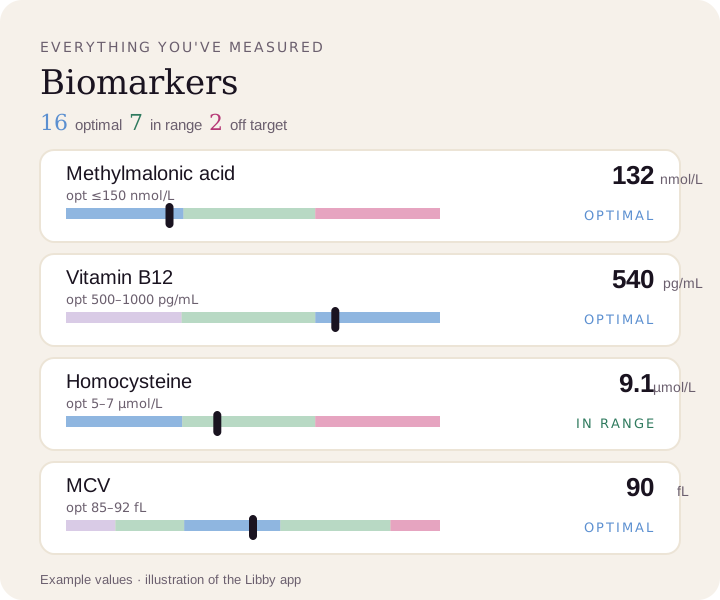
Compare your results to optimal ranges.
Upload a lab PDF or a photo of your report. Libby puts each marker on your lab's range and, where one exists, the optimal range, and tracks your trends over time.
View your MMA ›