Procalcitonin test: normal range, high results, next steps
Procalcitonin rises fast in bacterial infection and sepsis. Here's the normal level, what each cutoff means, how to read it with CRP, and when it's urgent.
Procalcitonin (PCT) is a protein that stays almost undetectable in healthy people and climbs within hours when your body fights a serious bacterial infection. Doctors use it mostly in the emergency room and hospital, to judge whether an infection is bacterial, how likely it is to turn into sepsis, and whether antibiotics are working or can stop.12
The short version
- Normal: under 0.1 ng/mL. In a study of 446 healthy adults, 97.5% were at 0.065 ng/mL or lower.34
- Slightly high (0.1–0.5) usually means a local infection such as a bladder infection, a virus, or an infection that's just starting.15
- 2 ng/mL or more points to a severe body-wide response, most often sepsis, and 10 or more is almost always severe bacterial sepsis. On the first day in intensive care, a value above 2.0 marks a high risk of septic shock. Sepsis needs emergency care.541
- Bacteria push it up; most viruses keep it low. In adults in hospital with pneumonia, the typical level was 2.5 ng/mL with classic bacteria and 0.09 with viruses.62
What procalcitonin is
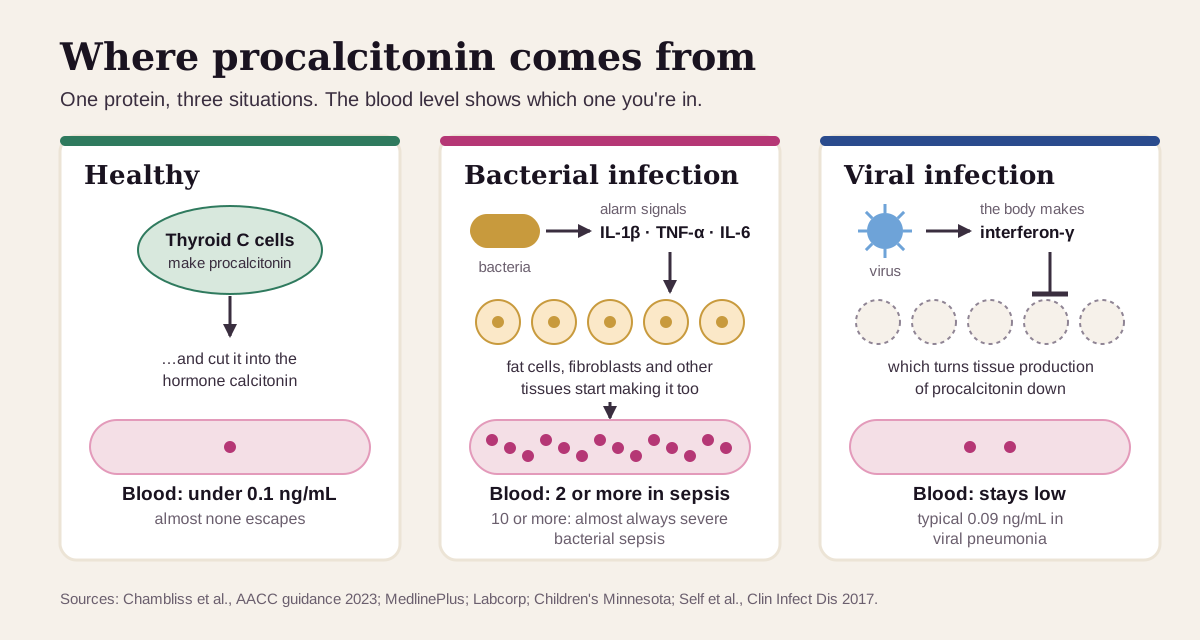
Procalcitonin is the raw material for calcitonin, a thyroid hormone. In a healthy body, the C cells of the thyroid make it and process it straight into calcitonin, so almost none reaches your blood.2
A bacterial infection changes that. Bacterial products and the immune system's alarm signals (interleukin-1 beta, tumor necrosis factor alpha and interleukin-6) switch on procalcitonin production in cells all over the body, including fat cells and connective tissue. Those cells release it straight into the blood.21 That's how a healthy level under 0.1 ng/mL can climb past 10 in severe sepsis.5
Viruses mostly keep the switch off. During a viral infection, the body makes interferon-gamma, which turns procalcitonin production down.2 So a high procalcitonin leans toward bacteria, and a low one leans away from them.
Procalcitonin is a hospital and emergency-room test. It's ordered when someone is seriously ill with a possible infection, and repeated to see whether treatment is working.1
What's a normal procalcitonin?
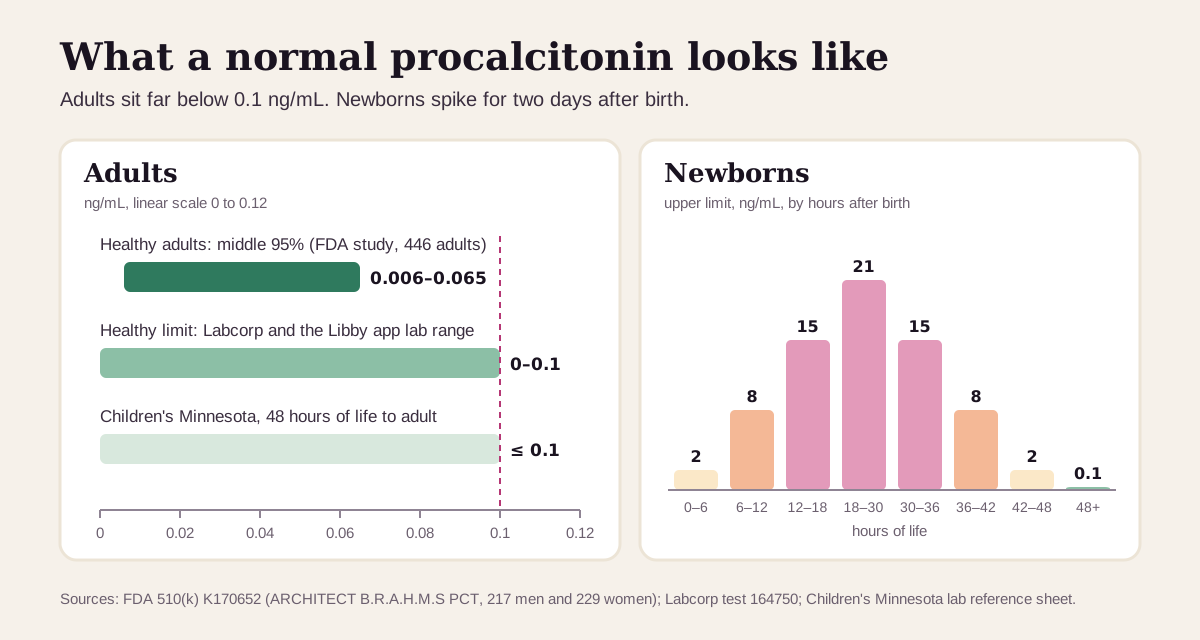
Healthy adults run below 0.1 ng/mL. Labcorp states that level for healthy people, and the Libby app uses 0–0.1 ng/mL as the lab range.3 When the FDA reviewed one widely used test, the maker had measured 446 healthy adults (217 men and 229 women): 95% of them fell between 0.006 and 0.065 ng/mL.4 Labs use one range for men and women.
Newborns are the big exception. A healthy baby's procalcitonin rises sharply after birth and falls back over two days. Children's Minnesota's lab allows up to 21 ng/mL at 18–30 hours of life, and returns to the adult limit of 0.1 ng/mL after 48 hours.5
Two practical points. Different machines give slightly different numbers, so compare repeat results from the same lab.5 And high-dose biotin supplements can interfere with some procalcitonin tests: Labcorp asks people to stop biotin at least 72 hours before the blood draw.3
"Optimal" procalcitonin: lower is the only target
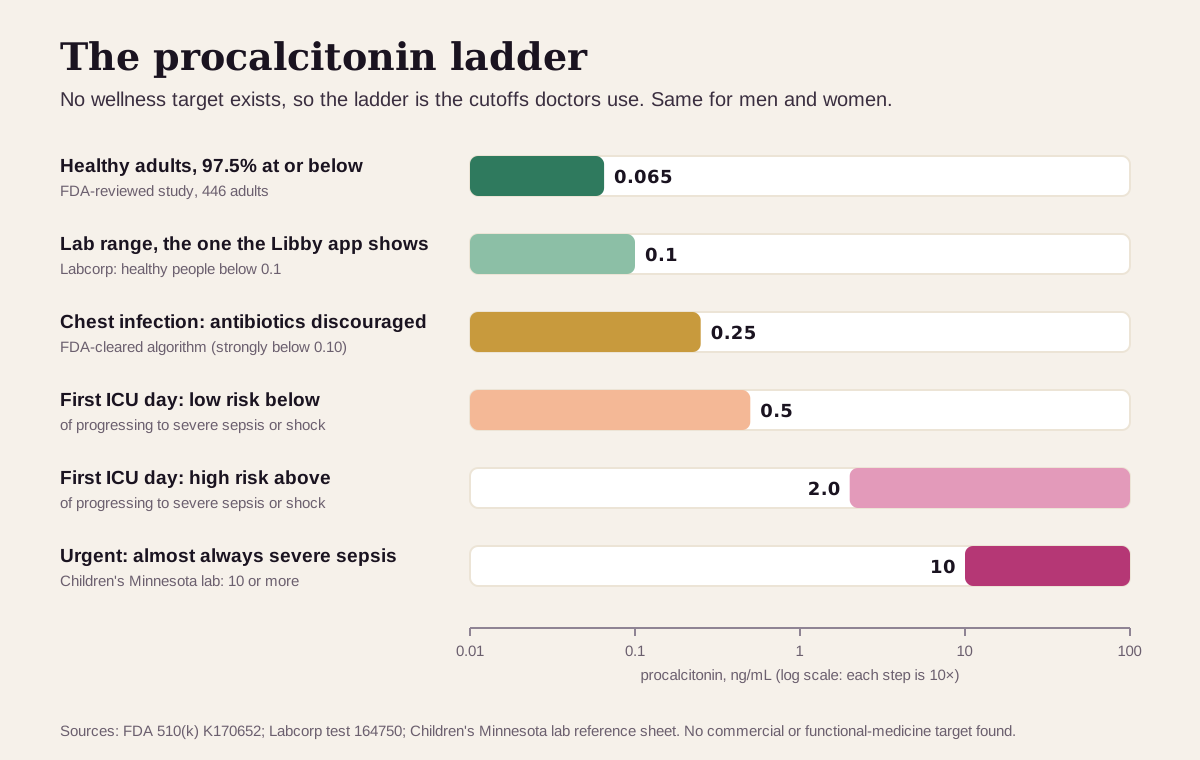
With most markers, longevity clinics publish a stricter "optimal" range. For procalcitonin there's no such thing: no longevity platform or functional-medicine reference we checked publishes a target, and the Libby app shows your procalcitonin against your lab's range, with no separate optimal band. What exists instead is a ladder of cutoffs that doctors use, from strictest to loosest. The same cutoffs apply to men and women.
| Level | Men and women | Who uses it |
|---|---|---|
| Research: healthy adults | 0.065 ng/mL or less | 97.5% of 446 healthy adults in the FDA-reviewed study4 |
| Lab range (the range the Libby app shows) | 0–0.1 ng/mL | Labcorp's healthy level; Children's Minnesota's range from 48 hours of life35 |
| Chest infections: antibiotics discouraged | under 0.25 (strongly under 0.10) | The FDA-cleared algorithm for pneumonia, bronchitis and COPD flare-ups43 |
| Chest infections: antibiotics encouraged | over 0.25 (strongly over 0.50) | The same algorithm4 |
| First ICU day: low risk | under 0.5 | Lower risk of progressing to severe sepsis or septic shock43 |
| First ICU day: high risk | over 2.0 | High risk of progressing to severe sepsis or septic shock43 |
| Urgent | 10 or more | "Almost exclusively" severe bacterial sepsis or septic shock5 |
Why the low cutoffs exist:
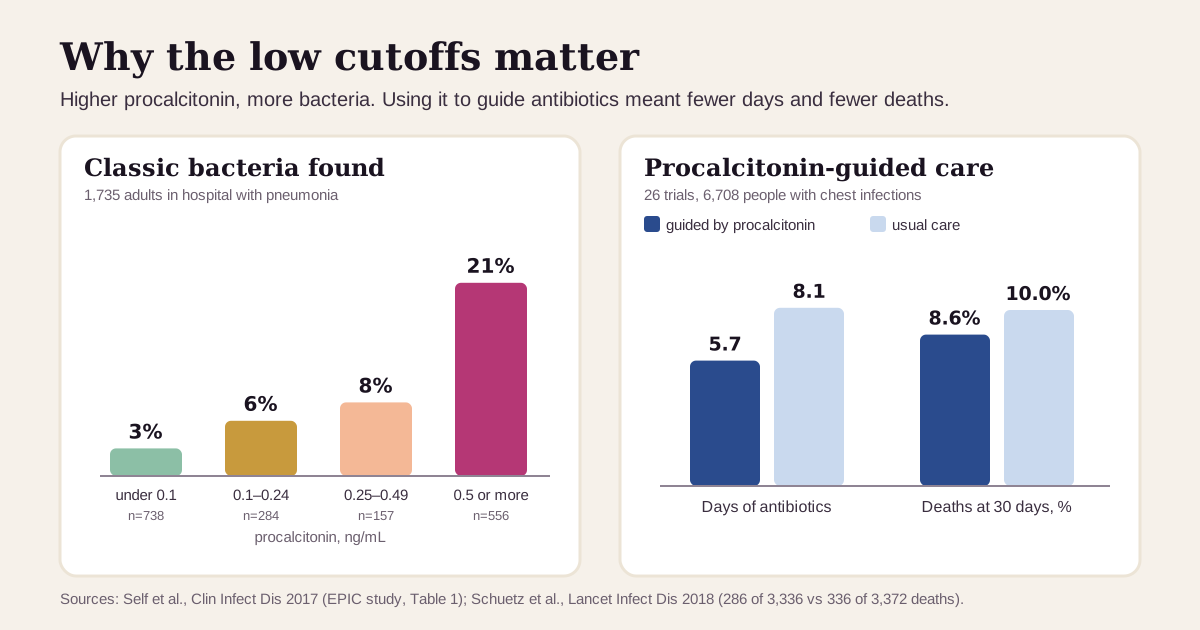
- In 1,735 adults in hospital with pneumonia, classic bacteria were found in 3% of people with procalcitonin under 0.1, 6% at 0.1–0.24, 8% at 0.25–0.49 and 21% at 0.5 or more.6
- Pooling 26 randomized trials (6,708 people with chest infections), using procalcitonin to guide antibiotics cut antibiotic use from 8.1 to 5.7 days. Deaths at 30 days were lower too: 8.6% vs 10.0%. Antibiotic side effects fell from 22% to 16%.7
- In 1,546 intensive-care patients in the Netherlands, stopping antibiotics once procalcitonin fell by 80% from its peak (or to 0.5) shortened treatment from 7 to 5 days, and 28-day deaths were 20% vs 25%.8
Keep these numbers in perspective. Procalcitonin is an alarm, not a dial to tune: in a healthy person it sits under 0.1 with nothing to push lower. It's also a helper, never the whole answer. In the same pneumonia study, 12% of people with classic bacteria had procalcitonin under 0.1,6 which is why labs say to read it together with symptoms, the exam and other tests.3
What a high procalcitonin usually means
The size of the rise is the first clue. Labs group results into bands, and each band has its usual causes.51
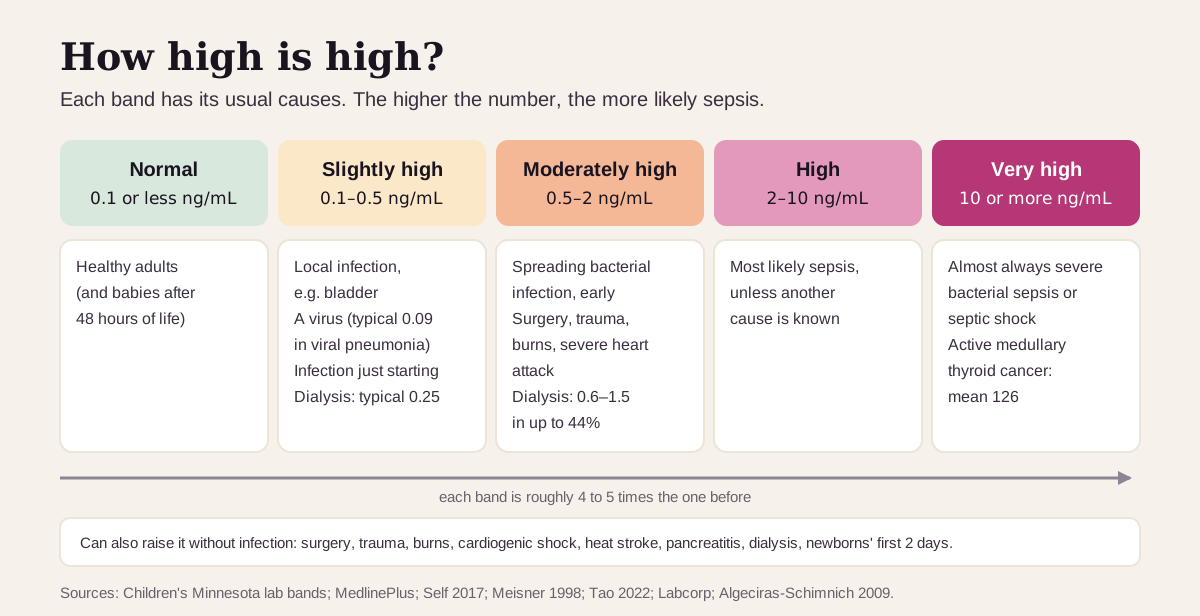
Slightly high (0.1–0.5): local, viral or early
The usual suspects:
- A local bacterial infection, such as a bladder infection, where the infection stays in one place.1
- A virus. In adults in hospital with viral pneumonia, the typical value was 0.09, and the middle half ran up to 0.54.6
- An infection that's just starting. Procalcitonin can still be low in the first 6 hours, so labs recommend retesting within 6–24 hours when a result is under 2 and infection is still suspected.43
- Dialysis. People on hemodialysis without any infection run a median of about 0.24–0.26 ng/mL, higher than the general population.10
Moderately high (0.5–2): a body-wide infection, or a big physical hit
- A bacterial infection that's spreading, in its earlier stages.1
- Major surgery, trauma, serious burns or a severe heart attack, even without infection.1 How much depends on the operation: in one study, procalcitonin rose in 95% of people after bowel surgery, 59% after heart or chest surgery and 32% after minor surgery.9
- Kidney disease and dialysis. Procalcitonin leaves the body mainly through the kidneys, and people with chronic kidney disease often run a higher baseline.212 In one report, up to 44% of people on hemodialysis without any bacterial infection had levels of 0.6–1.5 ng/mL.10
High (2 or more): sepsis first
A procalcitonin of 2–10 means a severe body-wide inflammatory response, most likely sepsis unless another cause is known. Above 10, it's almost always severe bacterial sepsis or septic shock.5
Less common causes of a high level without infection: heat stroke, pancreatitis from gallstones, cardiogenic shock or recovery after cardiac arrest, falciparum malaria, invasive fungal infections, drugs that release inflammatory signals, the first two days of life, and some cancers, especially medullary thyroid cancer, a tumor of the same C cells that make procalcitonin.3 In one study, people with active medullary thyroid cancer averaged 126 ng/mL.11
Get emergency care for signs of sepsis, whatever the number: fever or chills, clammy or sweaty skin, confusion, extreme pain, a racing heart, shortness of breath, low blood pressure, or passing much less urine. Sepsis is a medical emergency.1
When a low result can mislead
A low procalcitonin is most reliable after the first 6 hours of an illness.4 It can also read low in an infection that stays in one spot, in slow heart-valve infections (subacute endocarditis), and with "atypical" germs such as Mycoplasma and Chlamydia pneumoniae.53
Procalcitonin reads best next to its neighbors
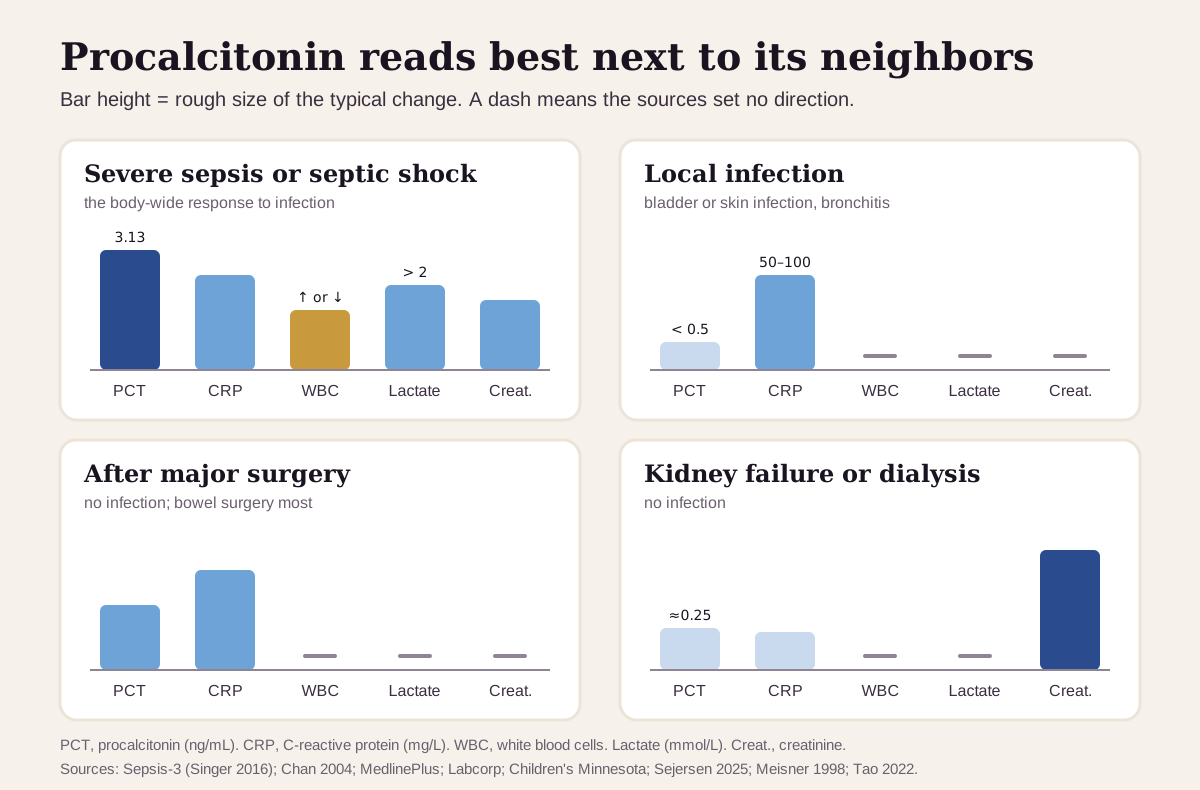
Procalcitonin usually comes with a CRP (C-reactive protein, a general inflammation marker), a white blood cell count, and in sicker people a lactate and a creatinine. The pattern tells you far more than procalcitonin alone. In a meta-analysis of people in hospital, procalcitonin separated bacterial infection from non-infectious inflammation better than CRP (81% vs 67% specificity), though single studies vary.1314
| If you see… | It often points to… |
|---|---|
| Procalcitonin above 2, CRP high, lactate above 2 mmol/L, creatinine rising | severe sepsis or septic shock straining the organs. In one emergency study, the median procalcitonin was 3.13 ng/mL in septic shock |
| CRP clearly up (it can reach 50–100 mg/L) with procalcitonin under 0.5 | a local infection, such as a bladder or skin infection, or bronchitis |
| Procalcitonin and CRP both up in the days after an operation | the surgery itself, especially bowel surgery; the trend over the next days tells you more than one value |
| Procalcitonin mildly up (median about 0.25 on dialysis, up to 1.5), creatinine high, no signs of infection | kidney failure or dialysis raising the baseline; a dialysis meta-analysis favored a higher infection cutoff of 1.5 ng/mL |
The white count is the weakest clue. In the same emergency study, only 36% of people with a bacterial infection had a white count above 12,000 or below 4,000, and sepsis can pull white cells out of the blood into the tissues.1412
How fast procalcitonin changes
Procalcitonin is fast in both directions. It rises within hours of a bacterial insult and peaks at about 12 hours.2 In healthy volunteers given a bacterial toxin, it was measurable within 4 hours.12 Once the infection is under control, it falls with a half-life of about 24 hours: half gone each day.23
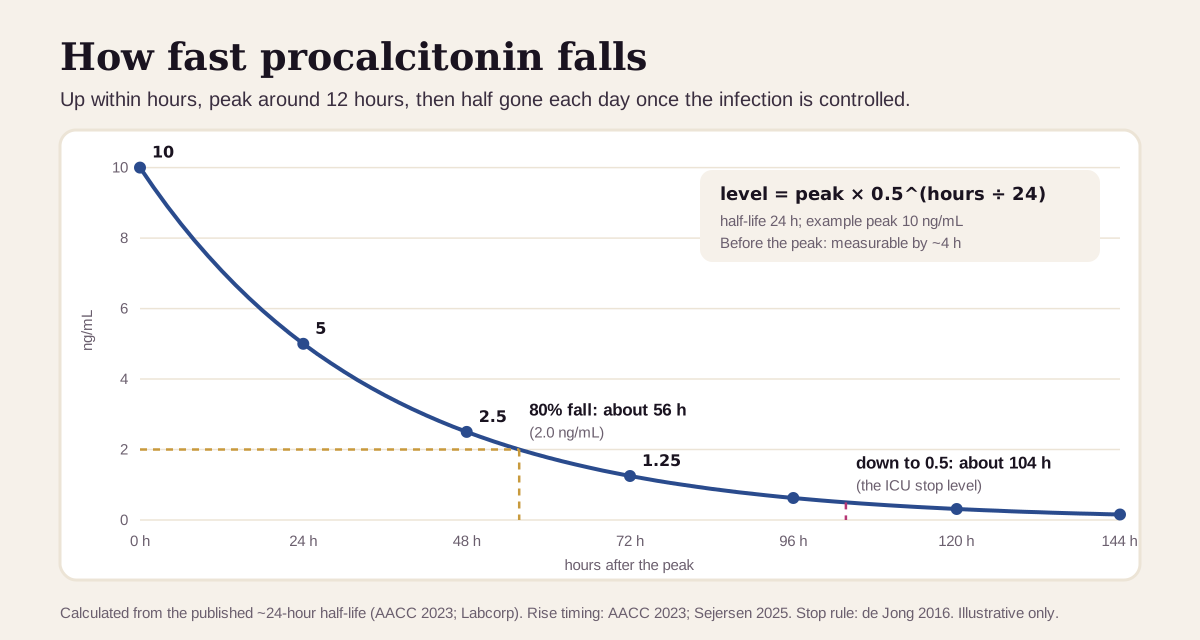
What that means in practice:
- An early low result gets repeated. Labs recommend retesting within 6–24 hours when a result is under 2 and the question is still open.4
- A fast fall is good news. In sepsis patients still in intensive care on day 4, 28-day deaths were 20.7% when procalcitonin had dropped by more than 80% since day 0, versus 30.6% when it hadn't.4
- That fall is also a stop signal. Intensive-care trials let antibiotics stop once procalcitonin fell 80% from its peak or reached 0.5.8 With a 24-hour half-life, an 80% fall takes about 56 hours once production stops.
- Trends beat snapshots, and only from the same lab and machine.5
Going deeper: the calcitonin gene and the sepsis switch
Procalcitonin is a 116-amino-acid protein (14.5 kDa) made from the CALC-1 gene.212 In health, only the thyroid's C cells read that gene, and they cut procalcitonin down to calcitonin before release. During a bacterial infection, cells that normally ignore the gene, such as fat cells and fibroblasts, start making procalcitonin too, and it spills into the blood.23
That same biology explains two special cases:
- Medullary thyroid cancer grows from C cells, so it can raise procalcitonin with no infection at all. In a study of 835 people, procalcitonin picked up active medullary thyroid cancer with 91% sensitivity and 96% specificity.11
- Kidneys clear it, so kidney failure and dialysis shift the baseline up.210
Procalcitonin was first recognized as an infection marker in 1993.12 Hospitals now track its fall as a formula, the delta PCT:3
ΔPCT = (day 0 − day 4) ÷ day 0 × 100%
Questions worth asking
- What was my procalcitonin, and which band does it fall in?
- How long had I been sick when the blood was drawn? Should it be repeated?
- What do my CRP, white count, lactate and creatinine show next to it?
- Could surgery, an injury, kidney disease or dialysis be raising it?
- If I'm on antibiotics, what fall in procalcitonin would let us stop?
- Which symptoms mean I should come back right away?
FAQ
What is a normal procalcitonin level? Below 0.1 ng/mL in healthy adults. In 446 healthy adults, 97.5% were at 0.065 ng/mL or lower.34
Does a high procalcitonin mean sepsis? Often, when it's high enough. A level of 2 or more most likely means sepsis unless another cause is known, and 10 or more almost always does.5 Surgery, trauma, burns and kidney failure can also raise it.13
Can procalcitonin tell bacterial from viral infection? It leans that way. Viruses trigger interferon-gamma, which keeps procalcitonin low. In adults with pneumonia, the typical level was 2.5 ng/mL with classic bacteria and 0.09 with viruses, with overlap in between.26
How quickly does procalcitonin go down? With treatment that works, by about half each day: its half-life is about 24 hours.23
This guide is for education. It can't diagnose you or replace care from a clinician who knows your history.
Footnotes
-
National Library of Medicine. Procalcitonin Test. MedlinePlus. What the test is for, what slightly, moderately and very high levels usually mean, and the symptoms of sepsis. MedlinePlus ↩ ↩2 ↩3 ↩4 ↩5 ↩6 ↩7 ↩8 ↩9 ↩10 ↩11 ↩12 ↩13
-
Chambliss AB, Patel K, Colón-Franco JM, et al. AACC Guidance Document on the Clinical Use of Procalcitonin. J Appl Lab Med. 2023;8(3):598–634. The laboratory-medicine society's guidance: where procalcitonin is made, the cytokines that switch it on, interferon-gamma, the ~12-hour peak and ~24-hour half-life, and kidney clearance. PubMed ↩ ↩2 ↩3 ↩4 ↩5 ↩6 ↩7 ↩8 ↩9 ↩10 ↩11 ↩12 ↩13 ↩14
-
Labcorp. Procalcitonin (test 164750). Healthy people below 0.1 µg/L; the first-ICU-day risk cutoffs of 0.5 and 2.0 ng/mL; the 24-hour half-life; conditions that raise procalcitonin without infection; the biotin warning; the delta PCT formula. A commercial reference laboratory's published test page. labcorp.com ↩ ↩2 ↩3 ↩4 ↩5 ↩6 ↩7 ↩8 ↩9 ↩10 ↩11 ↩12 ↩13 ↩14 ↩15 ↩16 ↩17 ↩18 ↩19 ↩20 ↩21
-
U.S. Food and Drug Administration. 510(k) decision summary K170652: ARCHITECT B.R.A.H.M.S PCT. The healthy-donor study (446 adults, 0.006–0.065 ng/mL), the chest-infection antibiotic cutoffs (0.10, 0.25, 0.50), the ICU risk cutoffs, and 28-day mortality by delta PCT in 598 sepsis patients. FDA ↩ ↩2 ↩3 ↩4 ↩5 ↩6 ↩7 ↩8 ↩9 ↩10 ↩11 ↩12 ↩13 ↩14 ↩15
-
Children's Minnesota Laboratory. Procalcitonin. Lab reference sheet with newborn limits by hour of life, the adult limit of 0.1 ng/mL, the interpretation bands (0.1, 0.5, 2 and 10 ng/mL), and why results from different methods shouldn't be mixed. childrensmn.org ↩ ↩2 ↩3 ↩4 ↩5 ↩6 ↩7 ↩8 ↩9 ↩10 ↩11 ↩12 ↩13 ↩14 ↩15
-
Self WH, Balk RA, Grijalva CG, et al. Procalcitonin as a Marker of Etiology in Adults Hospitalized With Community-Acquired Pneumonia. Clin Infect Dis. 2017;65(2):183–190. The CDC's EPIC study of 1,735 adults: median procalcitonin by germ type and the share with classic bacteria at each level. PMC ↩ ↩2 ↩3 ↩4 ↩5 ↩6
-
Schuetz P, Wirz Y, Sager R, et al. Effect of procalcitonin-guided antibiotic treatment on mortality in acute respiratory infections: a patient level meta-analysis. Lancet Infect Dis. 2018;18(1):95–107. 26 randomized trials, 6,708 patients. PubMed ↩ ↩2
-
de Jong E, van Oers JA, Beishuizen A, et al. Efficacy and safety of procalcitonin guidance in reducing the duration of antibiotic treatment in critically ill patients: a randomised, controlled, open-label trial. Lancet Infect Dis. 2016;16(7):819–827. The SAPS trial in 15 Dutch hospitals. PubMed ↩ ↩2
-
Meisner M, Tschaikowsky K, Hutzler A, Schick C, Schüttler J. Postoperative plasma concentrations of procalcitonin after different types of surgery. Intensive Care Med. 1998;24(7):680–684. 117 patients with a normal recovery. PubMed ↩ ↩2 ↩3
-
Tao M, Zheng D, Liang X, He Q, Zhang W. Diagnostic value of procalcitonin for bacterial infections in patients undergoing hemodialysis: a systematic review and meta-analysis. Ren Fail. 2022;44(1):81–93. Seven studies, 1,444 patients. PMC ↩ ↩2 ↩3 ↩4 ↩5
-
Algeciras-Schimnich A, Preissner CM, Theobald JP, Finseth MS, Grebe SK. Procalcitonin: a marker for the diagnosis and follow-up of patients with medullary thyroid carcinoma. J Clin Endocrinol Metab. 2009;94(3):861–868. 835 people; mean 126.4 ng/mL in active disease. PMC ↩ ↩2 ↩3
-
Sejersen K, Eriksson MB, Larsson AO. Calprotectin as a Biomarker for Infectious Diseases: A Comparative Review with Conventional Inflammatory Markers. Int J Mol Sci. 2025;26(13):6476. Procalcitonin timing in volunteers, CRP in local infections, kidney disease, and non-infectious causes. PMC ↩ ↩2 ↩3 ↩4 ↩5 ↩6
-
Simon L, Gauvin F, Amre DK, Saint-Louis P, Lacroix J. Serum procalcitonin and C-reactive protein levels as markers of bacterial infection: a systematic review and meta-analysis. Clin Infect Dis. 2004;39(2):206–217. PubMed ↩
-
Chan YL, Tseng CP, Tsay PK, et al. Procalcitonin as a marker of bacterial infection in the emergency department: an observational study. Crit Care. 2004;8(1):R12–R20. Median procalcitonin and CRP in sepsis and septic shock, and how often the white count was abnormal. PMC ↩ ↩2 ↩3
-
Singer M, Deutschman CS, Seymour CW, et al. The Third International Consensus Definitions for Sepsis and Septic Shock (Sepsis-3). JAMA. 2016;315(8):801–810. Lactate above 2 mmol/L in septic shock, the white-count criteria, and creatinine in the organ-failure score. PMC ↩
-
National Library of Medicine. Creatinine Test. MedlinePlus. Creatinine rises as kidney disease becomes more serious. MedlinePlus ↩
Educational content, not medical advice. Libby is a personal record tool, not a medical service — it doesn't diagnose, treat, or prescribe. Reference ranges vary by lab and by person. Talk to a qualified healthcare professional about your results.
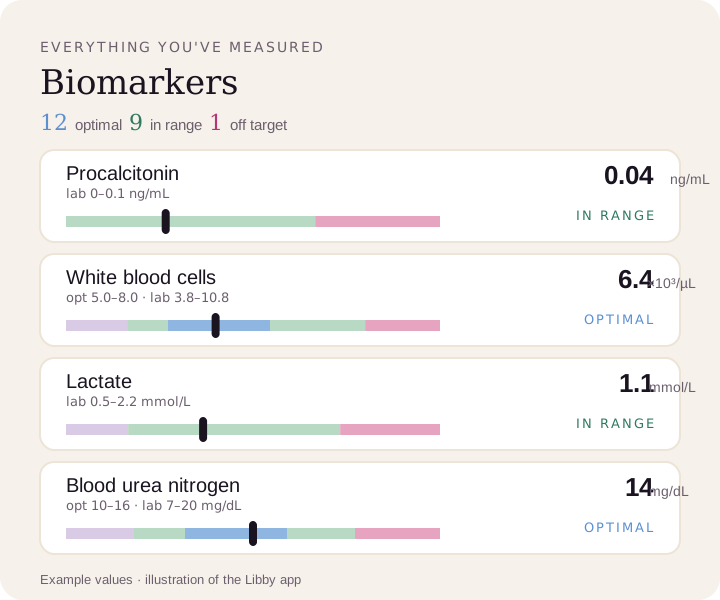
See every result against your lab's range.
Upload a lab PDF or a photo of your report. Libby puts every marker on your lab's range, adds the optimal range where one exists, and tracks your trends over time.
View your procalcitonin ›