Prolactin blood test: normal levels and why it runs high
Prolactin is the milk-making hormone. Here's a normal level, the usual reasons it runs high, how to read it with TSH and kidney tests, and when it's urgent.
Prolactin is the pituitary hormone that tells breast tissue to make milk. Outside pregnancy and breastfeeding, a dopamine signal from your brain keeps it low. A high result is common. It usually traces to a stressful blood draw, a medicine, a mostly inactive "big" form of prolactin called macroprolactin, an underactive thyroid, kidney disease, or a small benign pituitary growth called a prolactinoma.12
The short version
- Normal: check the range on your report. Women run higher than men. Labcorp's adult range for ages 31–50 goes up to 22.7 ng/mL for men and 33.4 ng/mL for women.3
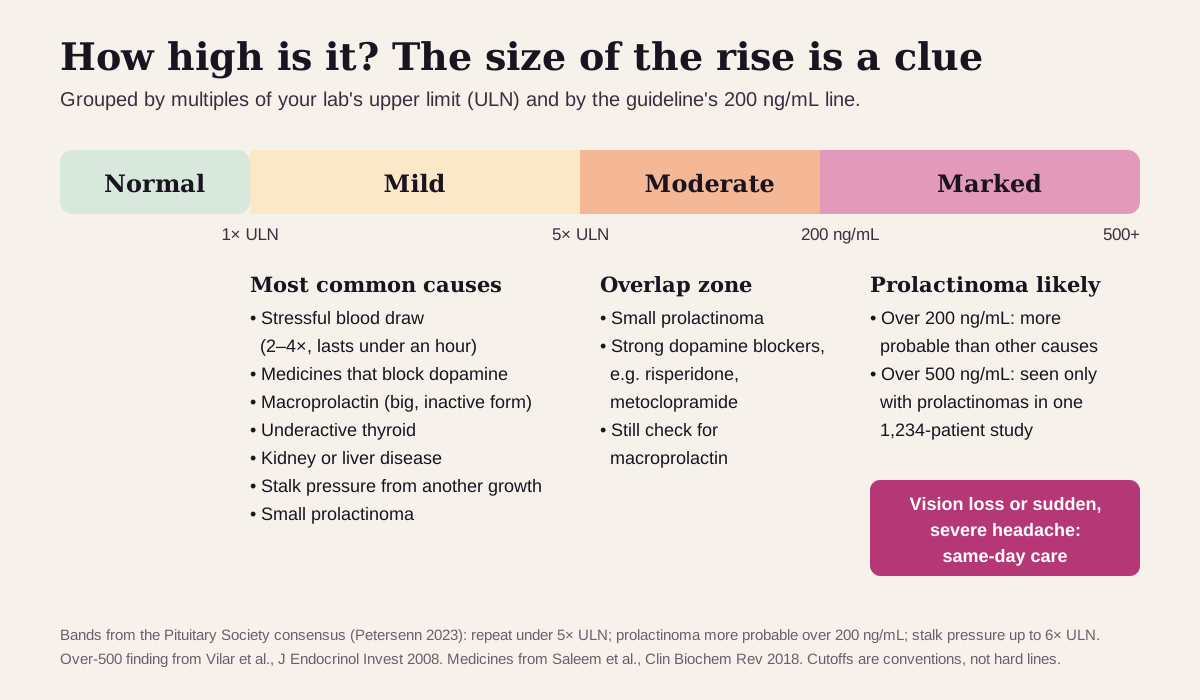
- Mildly high (under 5 times your lab's upper limit) is common. The Pituitary Society says to repeat the test, rested if stress is suspected, because a stressful draw alone can raise prolactin 2 to 4 times.1
- Very high (over 200 ng/mL) makes a prolactinoma more likely. Vision loss or a sudden, severe headache with a pituitary growth needs same-day care.1
- Total vs active prolactin: in 10–25% of people with high prolactin, some of it is macroprolactin, a big, mostly inactive form. A follow-up test called PEG precipitation sorts it out.1
What prolactin is
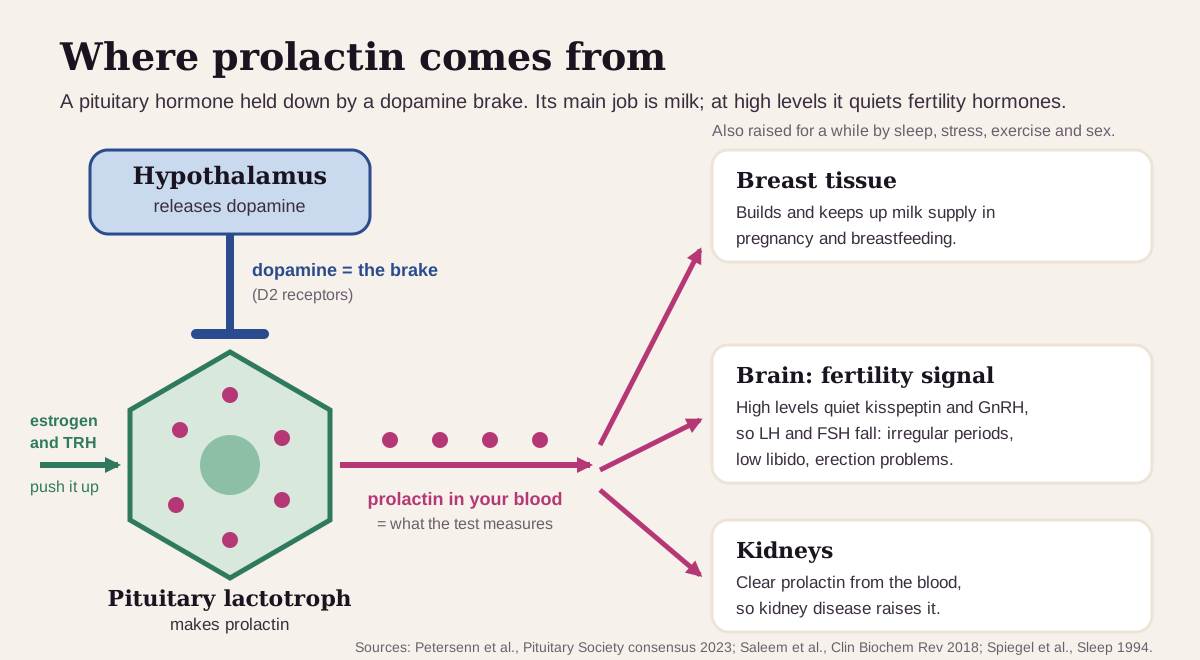
Prolactin is a small protein hormone (199 amino acids) made by lactotroph cells in the front of your pituitary gland. Its main job is to grow breast tissue in pregnancy and to make and keep up milk after birth.4
Most pituitary hormones wait for a "go" signal. Prolactin works the other way: dopamine from the hypothalamus acts as a constant brake, through D2 receptors on the lactotrophs. Anything that blocks dopamine, or pinches the pituitary stalk it travels down, lets prolactin rise. Estrogen and TRH (the brain's thyroid-stimulating signal) push prolactin up, and the kidneys clear it.1
At high levels, prolactin quiets the brain's reproductive signal (kisspeptin, then GnRH), so LH and FSH fall. That's why a high prolactin can show up as irregular or missing periods, milky nipple discharge, low libido, erection problems or trouble conceiving.12
Doctors order prolactin to look into those symptoms, to check for a prolactinoma, and to follow one that's being treated.2
What's a normal prolactin?
Start with the range printed on your report. Labs use different methods, so their ranges differ, and women's ranges run higher than men's.4 Labcorp, for example, uses:3
- Ages 31–50: 3.9–22.7 ng/mL for men and 4.8–33.4 ng/mL for women
- Ages 51–80: 3.6–25.2 ng/mL for both sexes
- Ages 13–30: 3.6–31.5 ng/mL for men and 4.8–33.4 ng/mL for women
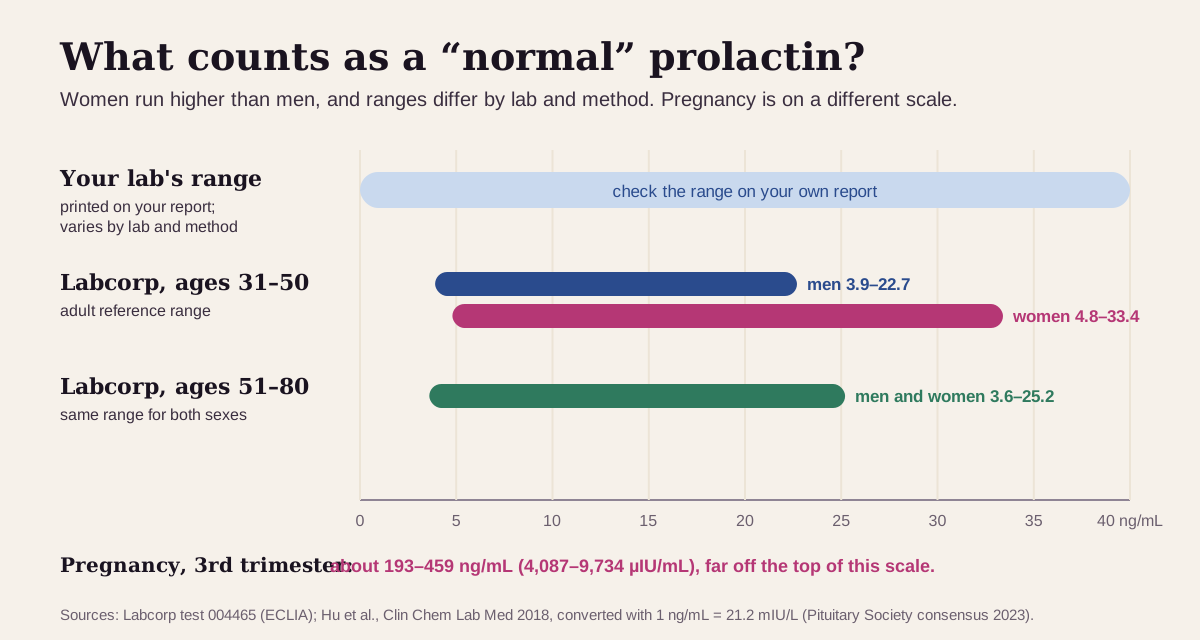
Pregnancy is the normal exception. In a 2018 reference study of 378 healthy pregnant women, prolactin climbed every trimester: about 29–169 ng/mL in the first, 68–252 in the second and 193–459 in the third (621–3,584, 1,432–5,350 and 4,087–9,734 µIU/mL as reported).6 It stays high while you breastfeed.2
Timing matters. Prolactin rises during sleep and switches off quickly when you wake.5 MedlinePlus says the blood draw is usually scheduled 3 to 4 hours after you wake up, and your lab may ask you to fast.2
"Optimal" prolactin: what health optimizers aim for
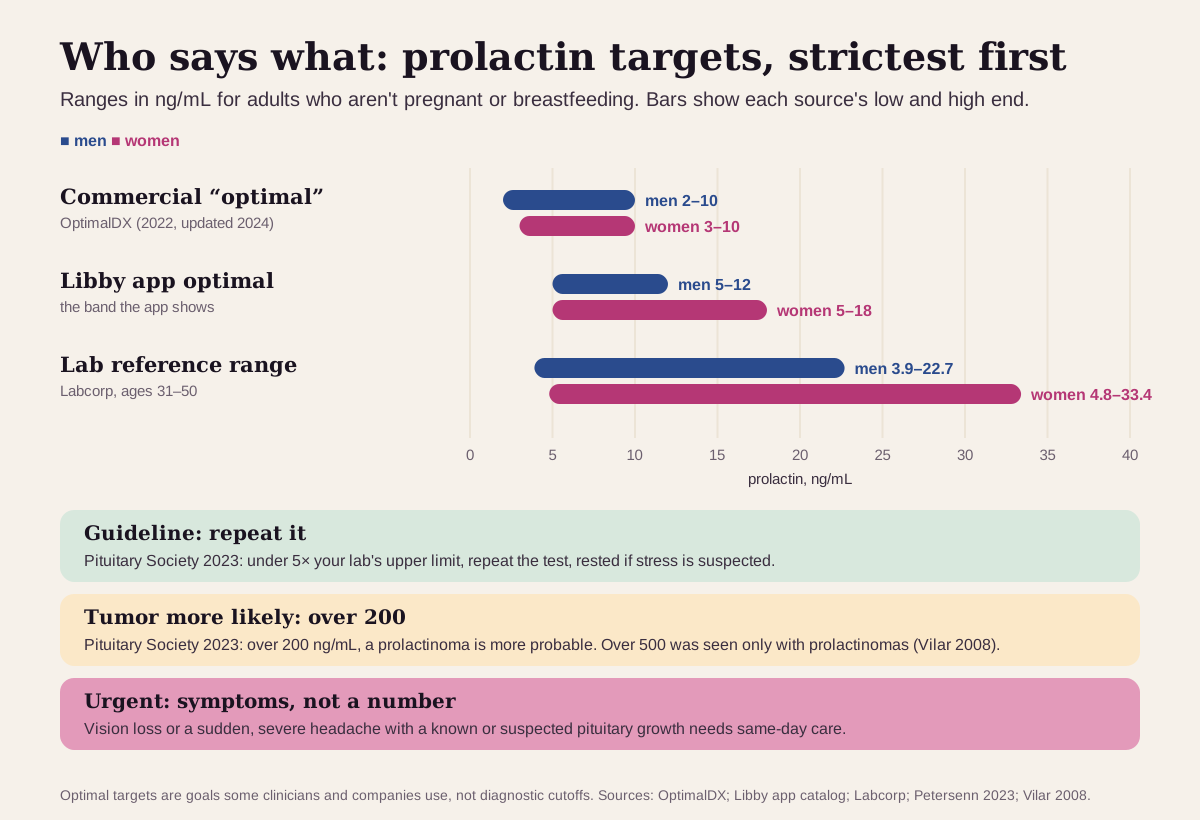
Functional-medicine platforms aim well below a lab's upper limit. Here's the ladder, from strictest to loosest, for adults who aren't pregnant or breastfeeding:
| Target | Men | Women | Who uses it |
|---|---|---|---|
| Strictest (commercial) | 2–10 ng/mL | 3–10 ng/mL | OptimalDX's published "ODX range"7 |
| Libby app optimal | 5–12 ng/mL | 5–18 ng/mL | The optimal range shown in the Libby app. The app's catalog records no published source for this band |
| Lab reference range | 3.9–22.7 ng/mL | 4.8–33.4 ng/mL | Labcorp, ages 31–503 |
| Guideline: repeat it | under 5× the upper limit | under 5× the upper limit | Pituitary Society consensus: repeat the test, rested if stress is suspected1 |
| Tumor more likely | over 200 ng/mL | over 200 ng/mL | Pituitary Society consensus;1 over 500 was seen only with prolactinomas in one large study8 |
| Urgent | vision loss or a sudden, severe headache | same | Possible pressure or bleeding in a pituitary growth: get same-day care12 |
Why optimizers care about both ends:
- In a German population study of 3,929 adults followed for a median of 10 years, people in the top third of prolactin had 1.75 times (men) and 1.66 times (women) the death rate of those in the bottom third, after adjusting for other risk factors. Deaths from heart and blood-vessel disease followed the same pattern.9
- At the other end, among 2,531 men seen for sexual problems, those in the lowest quarter of prolactin (under 5 ng/mL) had higher odds of metabolic syndrome (1.74 times), artery-related erectile dysfunction (1.43) and premature ejaculation (1.38).10
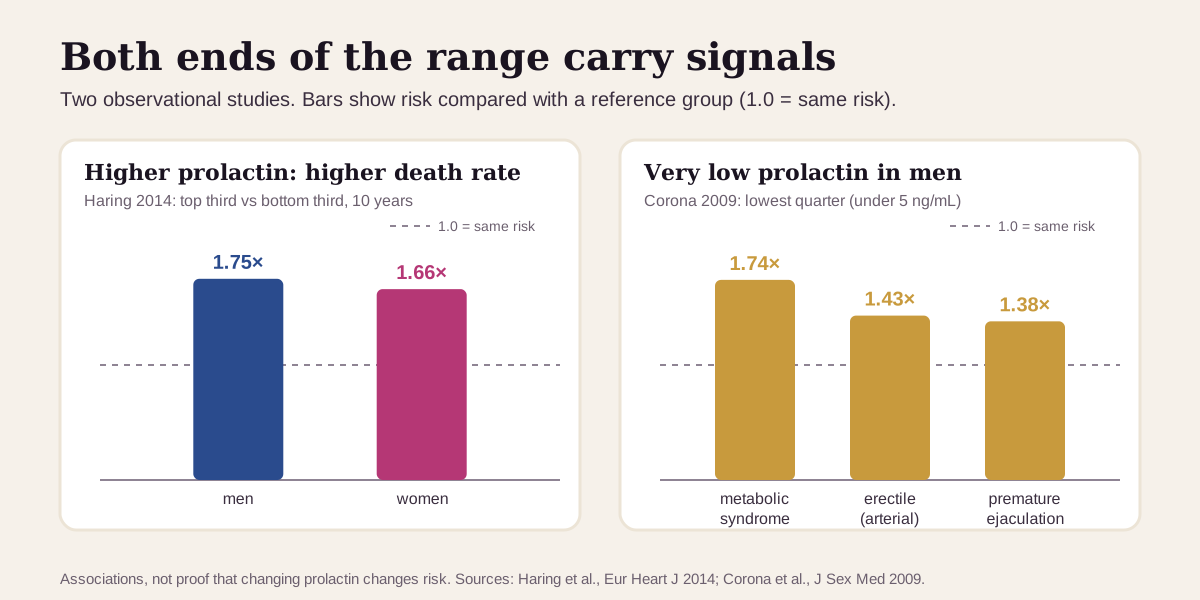
Keep "optimal" in perspective: these are targets, not diagnoses, and both studies show links rather than cause and effect. A prolactin of 20 ng/mL is a reason to repeat the test after a calm, rested draw and to look at your medicines and thyroid. On its own, it sits far below the 200 ng/mL tumor line. And lower isn't automatically better: the evidence above suggests the healthy zone has a floor as well as a ceiling.
What a high prolactin usually means
The size of the rise is the first clue. The Pituitary Society groups results by how far above your lab's upper limit (ULN) they are, and uses 200 ng/mL as the line above which a prolactinoma becomes the likeliest cause.1
First, rule out the blood draw
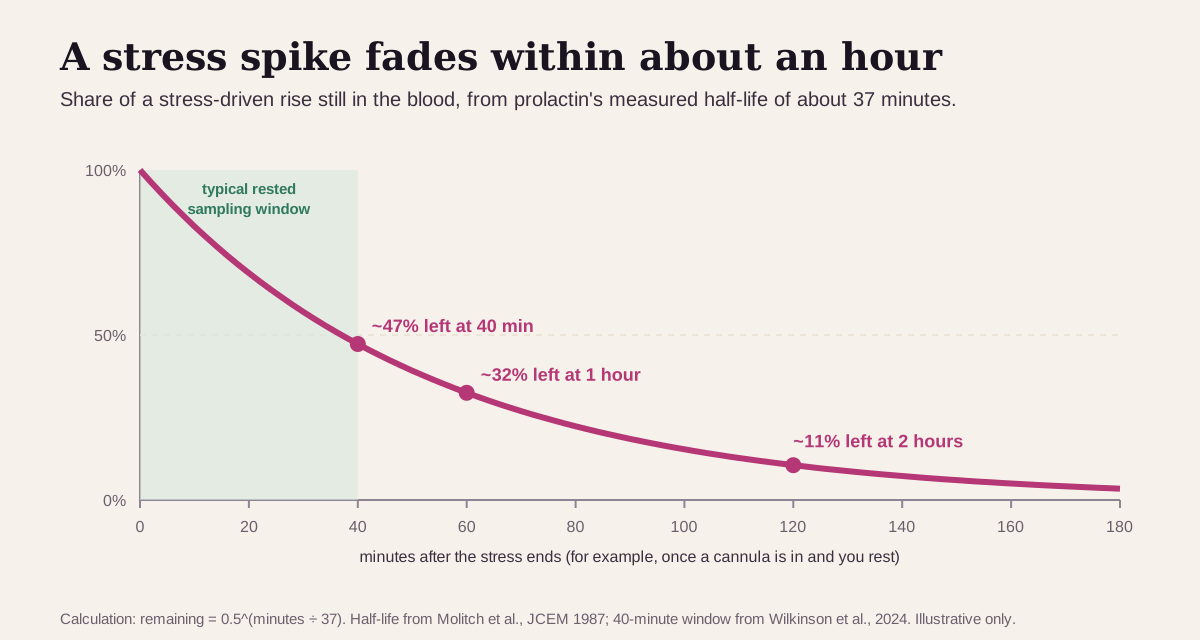
A stressful needle stick can raise prolactin 2 to 4 times for up to an hour.1 In a New Zealand study of 93 people referred with mildly high prolactin (about 17–80 ng/mL), serial samples taken through a resting IV line over about 40 minutes showed prolactin falling in 78% and back to normal in 54%. People whose first result was more than twice the upper limit normalized far less often (15%).11
Sleep, hard exercise, sex, a high-protein meal and alcohol can also nudge it up for a while.514 That's why the guideline's first step for a mild rise is a repeat test.1
The usual suspects
Among 1,234 people with high prolactin seen at 10 Brazilian endocrine centers, here's how the causes ranked, most common first:8
- A prolactinoma (56%). A benign pituitary growth that makes prolactin. The higher the prolactin, the larger the growth tends to be.1
- Medicines (14.5%). Antipsychotics are the most common culprits. Others include some antidepressants, blood-pressure medicines and gut-motility drugs such as metoclopramide.12 Risperidone, paliperidone, amisulpride and domperidone are well-known examples, and some can raise prolactin up to tenfold.4 Never stop a prescribed medicine on your own. Bring the full list to the clinician who prescribes it.2
- Macroprolactin (9%). A big prolactin-antibody complex that labs detect but your body barely uses. Most people with it have no prolactin symptoms.81
- Other pituitary growths (7%). A growth that presses on the pituitary stalk blocks the dopamine brake. This "stalk effect" can raise prolactin up to about 6 times the upper limit.81
- An underactive thyroid (6%). In one study, 36% of people with overt hypothyroidism and 22% with the mild (subclinical) form had high prolactin. It returned to normal in all of them once thyroid treatment normalized their TSH.13
- Less common causes: kidney disease (high prolactin in 23% of people with milder chronic kidney disease and 78% of those on hemodialysis),1 liver cirrhosis, polycystic ovary syndrome, chest-wall injury, seizures and acromegaly.248
Get same-day care if you have a known or suspected pituitary growth and notice vision loss or other changes in your vision, or a sudden, severe headache. Pressure on the nerve to the eyes, or bleeding into the growth (apoplexy), needs urgent treatment.12
In between (5× the upper limit to 200 ng/mL)
This is the overlap zone. Small prolactinomas and strong dopamine blockers such as risperidone or metoclopramide both land here.4 The guideline recommends checking for macroprolactin below 200 ng/mL, at least when the symptoms or a scan don't fit, and reading the result next to the neighbors below.1
Prolactin reads best next to its neighbors
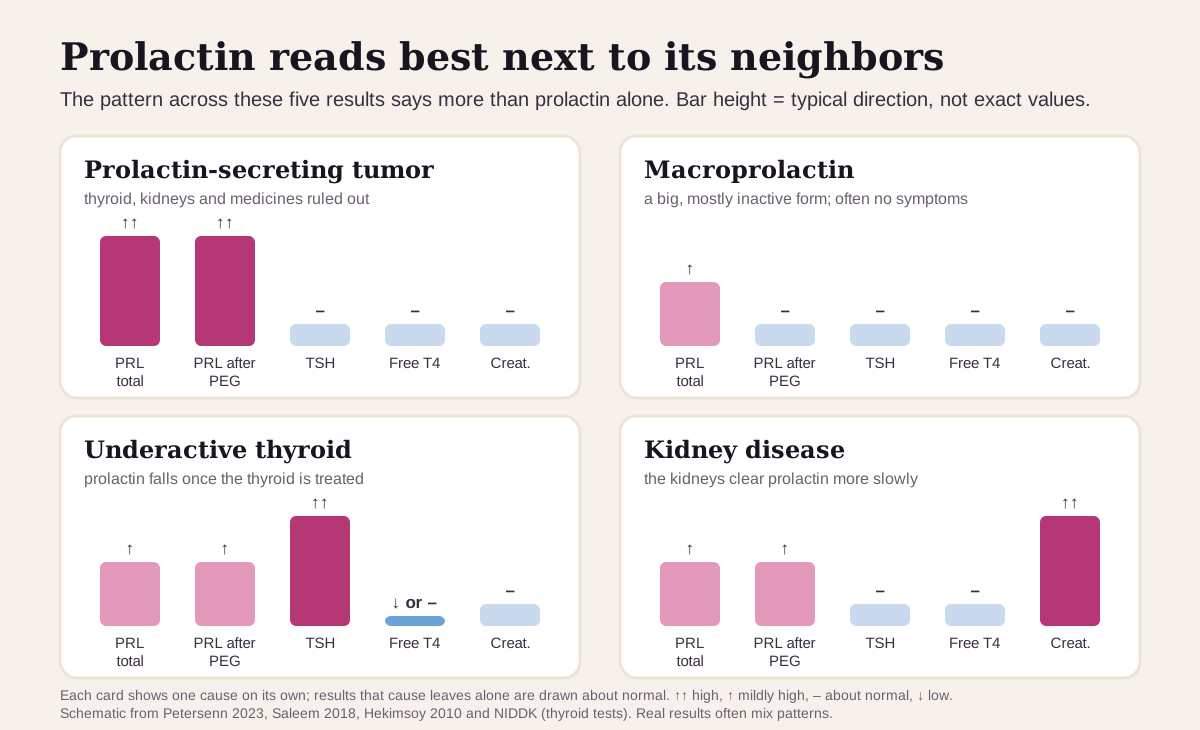
A prolactin result makes the most sense beside a handful of other tests. These five sort four common patterns:1
| If you see… | It often points to… |
|---|---|
| Prolactin high, but normal after PEG | macroprolactin: a big, mostly inactive form, found in 10–25% of people with high prolactin14 |
| Prolactin mildly high with a high TSH, sometimes a low free T4 | an underactive thyroid: prolactin usually returns to normal once the thyroid is treated1314 |
| Prolactin mildly high with a high creatinine | kidney disease, which slows prolactin's clearance and raises its production; the prolactin is mostly the active form14 |
| Prolactin over 200 ng/mL, thyroid and kidney tests normal, no prolactin-raising medicine | a prolactin-secreting pituitary tumor becomes the likeliest cause14 |
| Prolactin high with low LH, FSH and estradiol or testosterone | prolactin is quieting the reproductive axis, whatever is raising the active prolactin14 |
| Prolactin high while taking some antipsychotics or metoclopramide | a medicine effect124 |
A pregnancy test belongs on this list too: the guideline warns that pregnancy is easy to overlook as the reason for a high prolactin.1
Is a low prolactin a problem?
Usually not. MedlinePlus calls low prolactin rare. It can point to a pituitary problem, and its main sign is too little breast milk after birth.2 Dopamine-agonist medicines, the standard treatment for prolactinomas, lower prolactin on purpose.1 In men, prolactin under 5 ng/mL has been linked to metabolic syndrome and sexual problems, as covered above.10
How fast prolactin changes
Prolactin clears fast. In healthy men given purified prolactin, its half-life in the blood was about 37 minutes.15 So a stress spike mostly fades within the hour.
What that means in practice:
- A single mildly high result is often repeated, ideally a few hours after waking, after a quiet rest, without hard exercise beforehand.21
- Medicine and thyroid effects move over weeks, not minutes. Prolactin from an underactive thyroid returned to normal after treatment brought TSH back into range.13 Checking a suspected medicine effect means a planned pause or switch, done only with the prescriber.12
- Trends beat snapshots. In healthy men tested weekly for 10 weeks, prolactin varied about 13% from week to week within the same person.16 Small swings are normal, so compare results from the same lab and look at the direction over several tests.
Going deeper: the three sizes of prolactin
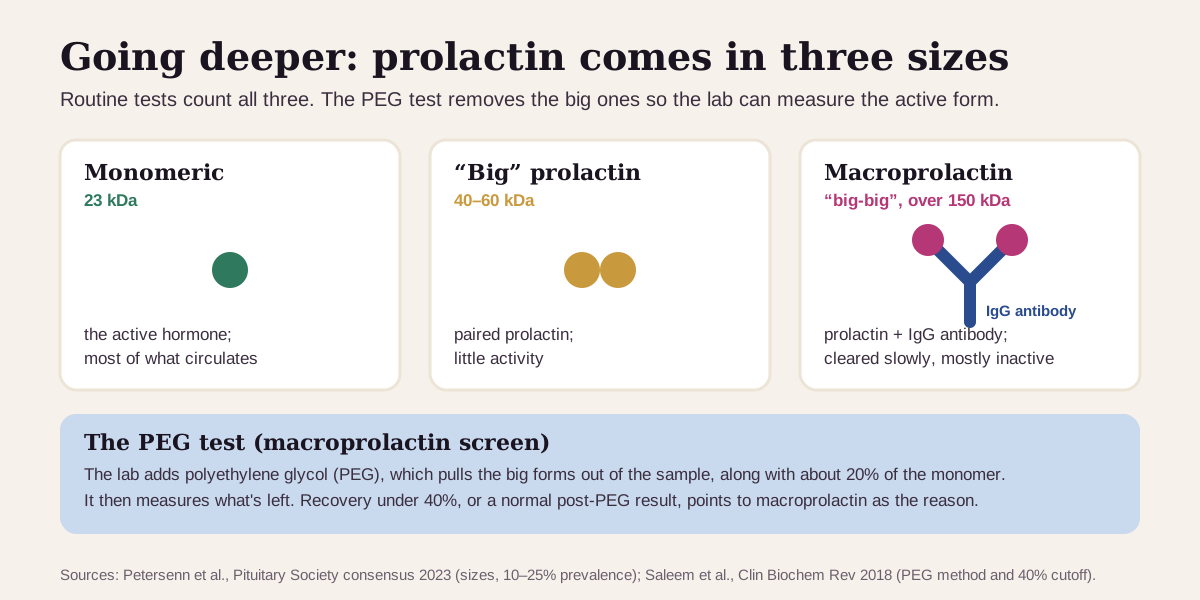
Most of the prolactin in your blood is the monomer, a 23 kDa hormone that does the work. Two larger forms circulate too: "big" prolactin (40–60 kDa) and "big-big" prolactin (over 150 kDa), which is mostly prolactin stuck to an IgG antibody. That antibody complex is macroprolactin. It clears slowly, so it builds up, and routine tests count it along with the monomer.14
To sort it out, the lab mixes the sample with polyethylene glycol (PEG), which pulls antibody complexes out of solution, then measures what's left. PEG also drags down about 20% of the monomer, so labs report either the percent recovered or a post-PEG result with its own range. A recovery under 40% is the usual sign that macroprolactin dominates.4
Two rarer lab traps run in opposite directions:
- The hook effect. With a very large tumor, prolactin can be so high that it swamps the test and reads only slightly high. The guideline advises re-running the sample at a 1:100 dilution when a giant growth and a modest prolactin don't match.1
- Interference. Biotin supplements and unusual antibodies in a person's blood can skew some prolactin tests. Suspect it when the number and the symptoms disagree.1
Prolactin tests are calibrated to one international standard (WHO 84/500), and 1 µg/L equals 21.2 mIU/L. Published healthy upper limits often sit below the limits test makers print.1
Questions worth asking
- How far above the upper limit is my prolactin: under 5 times, or over 200 ng/mL?
- Could the blood draw, a medicine or a supplement explain it? Should we repeat it rested?
- Has macroprolactin been checked (a PEG test)?
- What do my TSH, free T4, creatinine and a pregnancy test show next to it?
- Are my LH, FSH and estradiol or testosterone low, and do my symptoms fit?
- Would a pituitary MRI change the plan, and when should we retest?
FAQ
What is a normal prolactin level? It depends on your lab and your sex. Labcorp's adult range for ages 31–50 is 3.9–22.7 ng/mL for men and 4.8–33.4 ng/mL for women.3
What is the most common cause of high prolactin? A stressful blood draw is the first thing to rule out; it can double to quadruple prolactin for up to an hour.1 Among confirmed cases in endocrine clinics, prolactinomas, medicines and macroprolactin are the three most common causes.8
Can stress raise prolactin? Yes. In one study, 54% of people referred with mildly high prolactin were normal on a rested repeat drawn through an IV line.11
When is high prolactin an emergency? When it comes with vision loss or other vision changes, or a sudden, severe headache, which can mean a pituitary growth is pressing on nearby nerves or bleeding.12
This guide is for education. It can't diagnose you or replace care from a clinician who knows your history.
Footnotes
-
Petersenn S, Fleseriu M, Casanueva FF, et al. Diagnosis and management of prolactin-secreting pituitary adenomas: a Pituitary Society international Consensus Statement. Nat Rev Endocrinol. 2023;19(12):722–740. The current international consensus: repeat testing under 5× ULN, the 2–4× stress rise, the 200 ng/mL line, macroprolactin (10–25%), stalk effect, hook effect, kidney disease and the 21.2 unit factor. PubMed · DOI ↩ ↩2 ↩3 ↩4 ↩5 ↩6 ↩7 ↩8 ↩9 ↩10 ↩11 ↩12 ↩13 ↩14 ↩15 ↩16 ↩17 ↩18 ↩19 ↩20 ↩21 ↩22 ↩23 ↩24 ↩25 ↩26 ↩27 ↩28 ↩29 ↩30 ↩31 ↩32 ↩33 ↩34 ↩35 ↩36 ↩37 ↩38
-
National Library of Medicine. Prolactin Levels. MedlinePlus. Why the test is ordered, timing 3–4 hours after waking, symptoms, causes and low prolactin. MedlinePlus ↩ ↩2 ↩3 ↩4 ↩5 ↩6 ↩7 ↩8 ↩9 ↩10 ↩11 ↩12
-
Labcorp. Prolactin, test 004465. Electrochemiluminescence immunoassay with age- and sex-specific reference ranges. Labcorp is a commercial reference laboratory; its ranges apply to its own method. labcorp.com ↩ ↩2 ↩3 ↩4 ↩5 ↩6
-
Saleem M, Martin H, Coates P. Prolactin Biology and Laboratory Measurement: An Update on Physiology and Current Analytical Issues. Clin Biochem Rev. 2018;39(1):3–16. A laboratory-medicine review of prolactin's forms, the dopamine brake, medicines, PEG testing and the 40% recovery cutoff. PMC ↩ ↩2 ↩3 ↩4 ↩5 ↩6 ↩7 ↩8 ↩9 ↩10 ↩11 ↩12 ↩13 ↩14 ↩15 ↩16
-
Spiegel K, Follenius M, Simon C, et al. Prolactin secretion and sleep. Sleep. 1994;17(1):20–27. Sleep onset raised secretion; waking switched it off. PubMed ↩ ↩2 ↩3
-
Hu Y, Ding Y, Yang M, Xiang Z. Serum prolactin levels across pregnancy and the establishment of reference intervals. Clin Chem Lab Med. 2018;56(5):838–842. 378 healthy pregnant women, electrochemiluminescence immunoassay, ranges in µIU/mL. PubMed ↩ ↩2
-
ODX Research. Hormone Biomarkers: Prolactin in Men and Women. OptimalDX. Published September 6, 2022; updated August 13, 2024. States an "ODX range" of 2.0–10 ng/mL for men and 3.0–10 ng/mL for women. A commercial source, listed as what the optimizer community uses. optimaldx.com ↩ ↩2
-
Vilar L, Freitas MC, Naves LA, et al. Diagnosis and management of hyperprolactinemia: results of a Brazilian multicenter study with 1234 patients. J Endocrinol Invest. 2008;31(5):436–444. Cause frequencies across 10 endocrine centers; prolactin over 500 ng/mL was seen only with prolactinomas. PubMed ↩ ↩2 ↩3 ↩4 ↩5 ↩6 ↩7 ↩8
-
Haring R, Friedrich N, Völzke H, et al. Positive association of serum prolactin concentrations with all-cause and cardiovascular mortality. Eur Heart J. 2014;35(18):1215–1221. Study of Health in Pomerania: 3,929 adults aged 20–81, median follow-up 10.1 years. PubMed ↩ ↩2
-
Corona G, Mannucci E, Jannini EA, et al. Hypoprolactinemia: a new clinical syndrome in patients with sexual dysfunction. J Sex Med. 2009;6(5):1457–1466. 2,531 men; lowest quartile under 5 ng/mL. PubMed ↩ ↩2 ↩3
-
Wilkinson T, Li B, Soule S, Hunt P. The utility of rested prolactin sampling in the evaluation of hyperprolactinaemia. Intern Med J. 2024;54(2):307–311. 93 referred patients with prolactin of 360–1,690 mU/L; serial sampling over about 40 minutes. PubMed ↩ ↩2 ↩3
-
Molitch ME. Medication-induced hyperprolactinemia. Mayo Clin Proc. 2005;80(8):1050–1057. Antipsychotics are the most common medicine cause; also antidepressants, blood-pressure and gut-motility drugs. PubMed ↩ ↩2 ↩3
-
Hekimsoy Z, Kafesçiler S, Güçlü F, Ozmen B. The prevalence of hyperprolactinaemia in overt and subclinical hypothyroidism. Endocr J. 2010;57(12):1011–1015. High prolactin in 36% (overt) and 22% (subclinical); normal in all after thyroid treatment. PubMed ↩ ↩2 ↩3 ↩4
-
National Institute of Diabetes and Digestive and Kidney Diseases. Thyroid Tests. NIH. Last reviewed May 2017. "A high TSH level most often means you have hypothyroidism"; "A low level of T4 may mean you have hypothyroidism." NIDDK ↩ ↩2
-
Molitch ME, Raiti S, Baumann G, Belknap S, Reichlin S. Pharmacokinetic studies of highly purified human prolactin in normal human subjects. J Clin Endocrinol Metab. 1987;65(2):299–304. Plasma disappearance half-life 37 ± 10 minutes. PubMed ↩ ↩2
-
Itkonen O, Jonker N, Aarsand AK, et al. The European biological variation study (EuBIVAS): Biological variation data for testosterone, follicle stimulating hormone, prolactin, luteinizing hormone and dehydroepiandrosterone sulfate in men. Clin Chim Acta. 2024;555:117806. 38 men sampled weekly for 10 weeks; within-person variation 13% for prolactin. PubMed ↩
Educational content, not medical advice. Libby is a personal record tool, not a medical service — it doesn't diagnose, treat, or prescribe. Reference ranges vary by lab and by person. Talk to a qualified healthcare professional about your results.
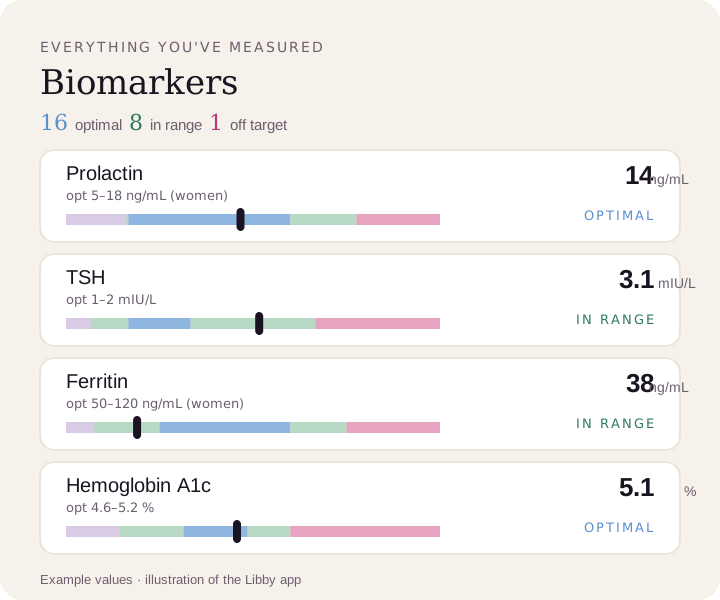
Compare your results to optimal ranges.
Upload a lab PDF or a photo of your report. Libby puts each marker on your lab's range and, where one exists, the optimal range, and tracks your trends over time.
View your prolactin ›