TPO antibodies: normal range, high results and next steps
TPO antibodies show your immune system has targeted your thyroid. What a positive result means, how to read it with TSH, and how fast it changes.
TPO antibodies are proteins your immune system makes against thyroid peroxidase, the enzyme your thyroid uses to build its hormones. A positive result is the classic blood sign of Hashimoto's disease, the most common cause of an underactive thyroid in the U.S.1 It's also common in healthy people: about 1 in 9 Americans without known thyroid disease test positive, and many keep normal thyroid function for years.23
The short version
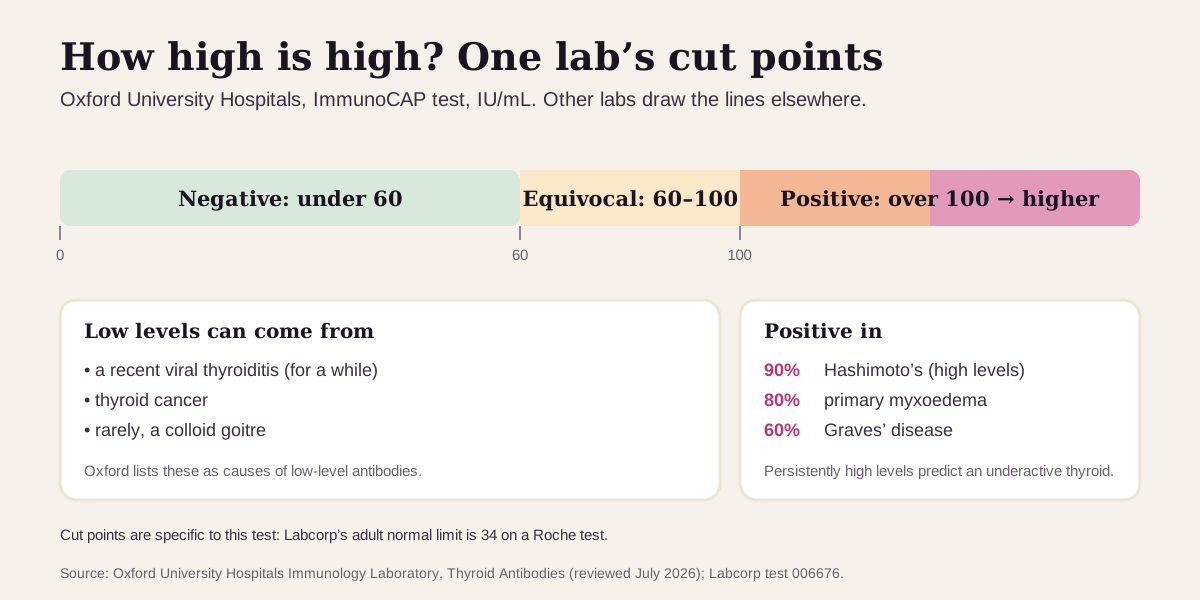
- Normal: below your own lab's cutoff, and cutoffs vary a lot. Labcorp's adult range is 0–34 IU/mL. Oxford University Hospitals calls under 60 negative and over 100 positive.45
- Positive means your immune system has targeted your thyroid. It turns up in 90–95% of people with autoimmune thyroiditis (Hashimoto's), 80% with Graves' disease, and 10–15% of people without thyroid disease.6
- What matters next is your TSH. Among antibody-positive women followed for 13 years, 12% had an underactive thyroid at the end when their starting TSH was 2.5 or lower, and 86% when it was above 4.0.3
- No antibody level is an emergency by itself. Get care now for signs of a severely under- or overactive thyroid: confusion, a very low or high body temperature, slowed breathing, or a pounding heart.7
What TPO antibodies are
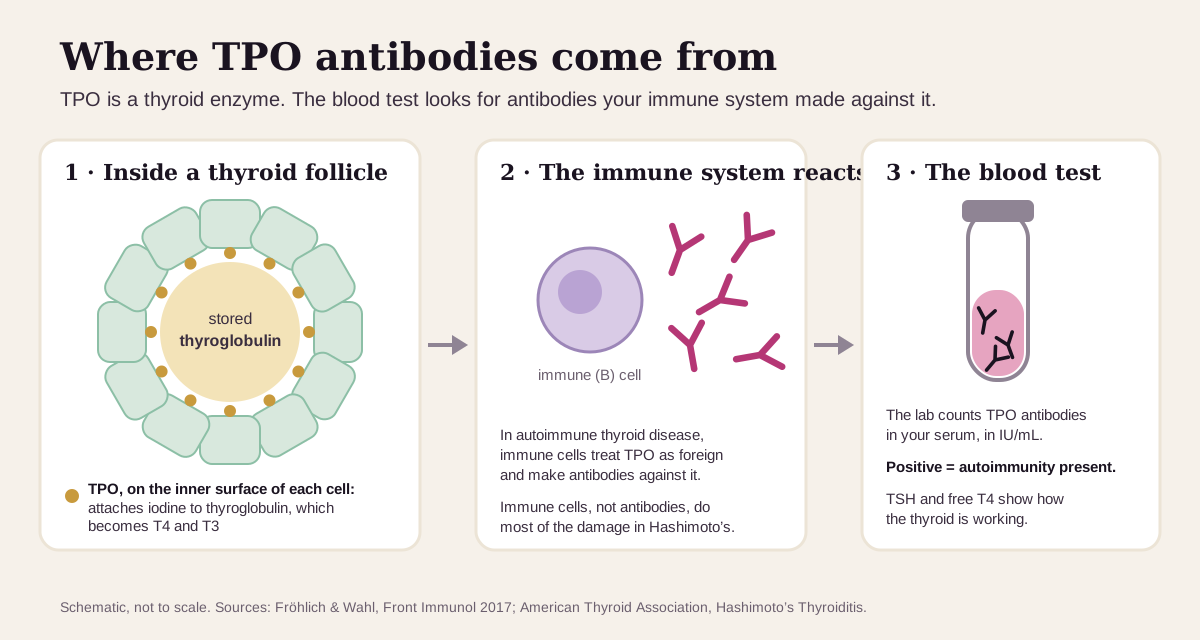
Your thyroid is made of tiny hollow balls of cells called follicles. On the inner surface of those cells sits thyroid peroxidase (TPO), an enzyme that activates iodine and attaches it to thyroglobulin, the large protein your thyroid builds its hormones on.6 (More on the chemistry at the end.)
In autoimmune thyroid disease, the immune system starts treating TPO as foreign and makes antibodies against it. Older reports call the same test antimicrosomal antibodies, an older name based on where TPO sits inside the cell.64
The antibodies are best read as a flag that the immune system is involved. Most of the actual damage in Hashimoto's comes from immune cells inside the gland, with antibodies playing a smaller part.6 That's why the antibody number tells you whether autoimmunity is present, and TSH and free T4 tell you how the thyroid is coping.1
The test is usually ordered when TSH is off, to find out why. England's guideline body, NICE, advises considering it once for adults whose TSH is above the reference range.8
What's a normal TPO antibody level?
Normal is whatever falls below your own lab's cutoff, and those cutoffs differ more for this test than for most. Each lab uses a different antibody test, and each test sets its own line.95
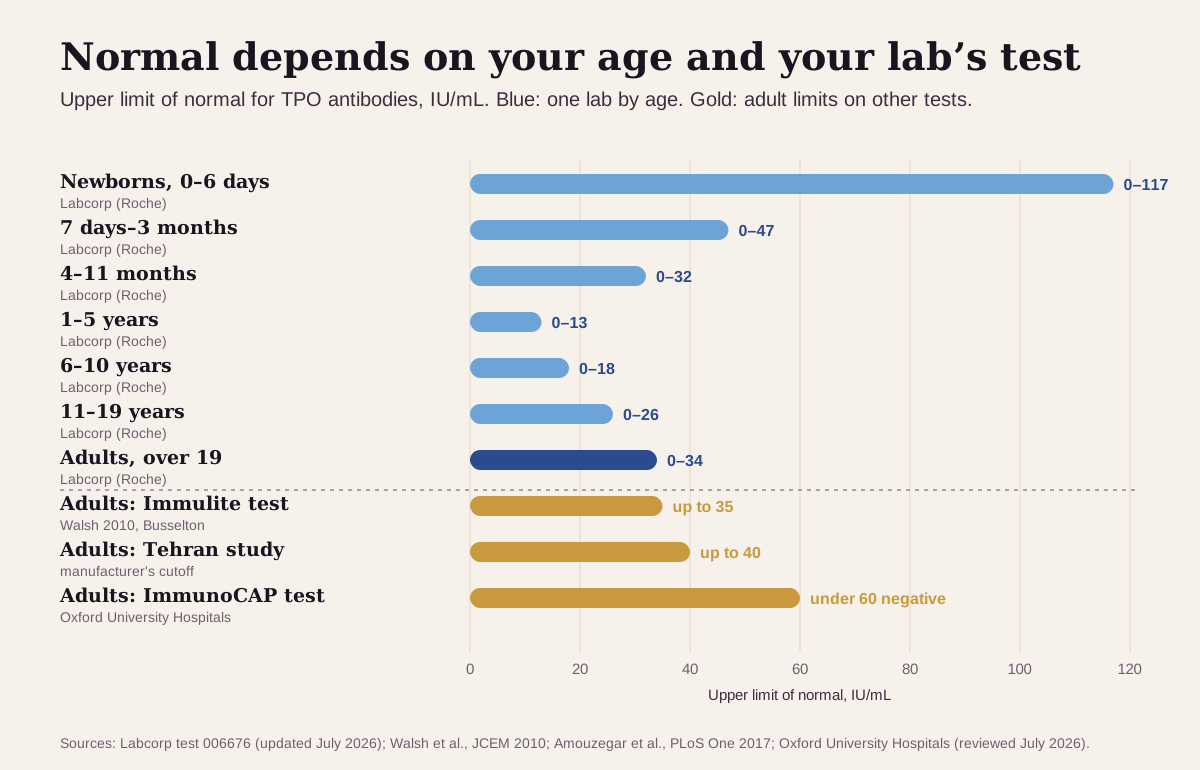
- Labcorp, a commercial lab (using a Roche test), uses 0–34 IU/mL for adults over 19. Children have lower limits: 0–13 at ages 1–5 and 0–26 at 11–19. Newborns in their first week can read up to 117.4
- A 13-year Australian study using the Immulite test had a reference limit of 35.3 The Tehran Thyroid Study used its manufacturer's 40.9
- Oxford University Hospitals (an ImmunoCAP test) calls under 60 negative, 60–100 equivocal, and over 100 positive.5
So a result of 50 can be positive at one lab and negative at another. Compare a new result with earlier ones from the same lab.
Who tests positive? In the U.S. national survey NHANES III, 11.3% of people without known thyroid disease had TPO antibodies. Positive results were more common in women and rose with age.2 In the Tehran study, 16.0% of women and 8.5% of men were positive.9
"Optimal" TPO antibodies: what health optimizers aim for
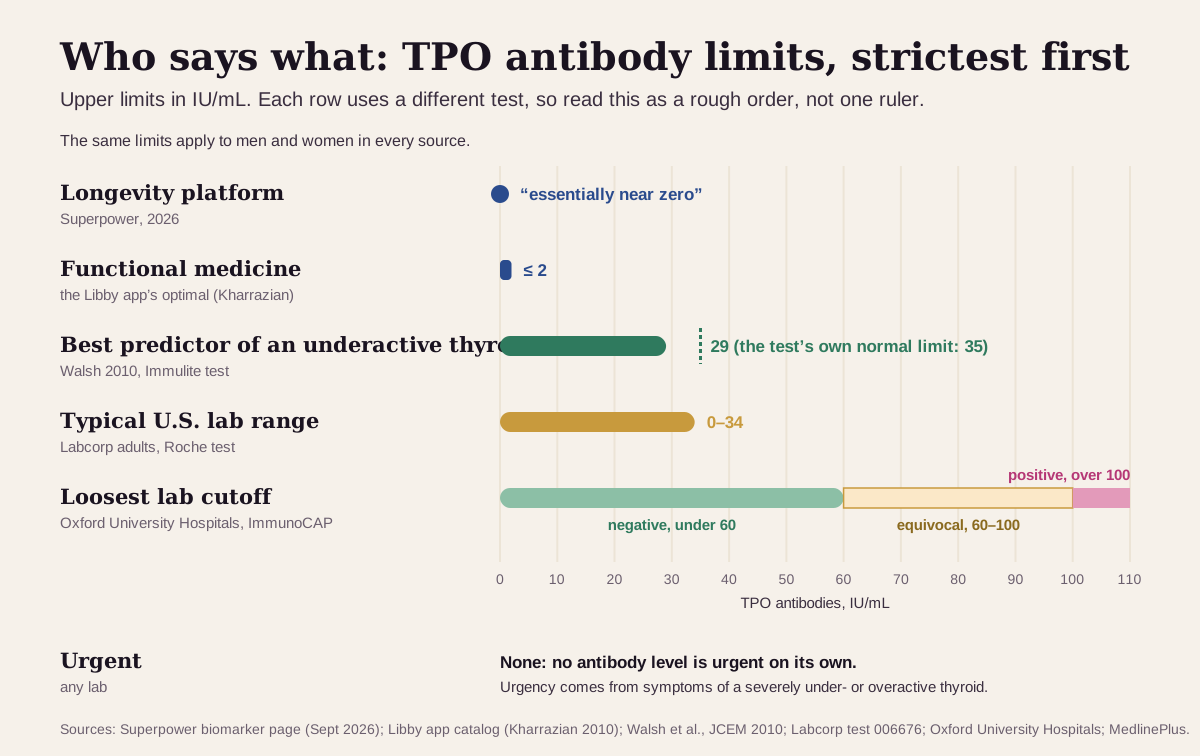
For most markers, optimizers argue over a number. For TPO antibodies the goal is simpler: lower is better, and the strictest aim for as close to zero as the test can read.10 Here's the ladder, strictest first. The numbers come from different tests, so read them as a rough order rather than one ruler.
| Target | Upper limit (IU/mL) | Who uses it |
|---|---|---|
| Strictest (longevity platform) | "essentially near zero" | Superpower's published optimal10 |
| Functional medicine | 2 or less | The optimal range shown in the Libby app, from a functional-medicine thyroid book;11 the same for men and women |
| Research: best predictor | 29 | The level that best predicted an underactive thyroid 13 years later in the Busselton study (Immulite test, whose normal limit was 35)3 |
| Typical U.S. lab range | 34 | Labcorp, adults over 19 (Roche test)4 |
| Loosest lab cutoff | under 60 negative, over 100 positive | Oxford University Hospitals (ImmunoCAP test)5 |
| Urgent | none | No antibody level is urgent on its own. Urgency comes from symptoms of a severely under- or overactive thyroid7 |
Why the low targets aren't just a trend:
- In the Busselton study of 1,184 Australians, the TPO level that best predicted an underactive thyroid 13 years later was 29, just under that test's own normal limit of 35.3
- In 11,212 pregnant women in the Netherlands, TSH rose and free T4 fell step by step as TPO antibodies rose. Women below the manufacturers' cutoffs already had a higher risk of premature delivery, and the authors concluded that current cutoffs "may be too high."12
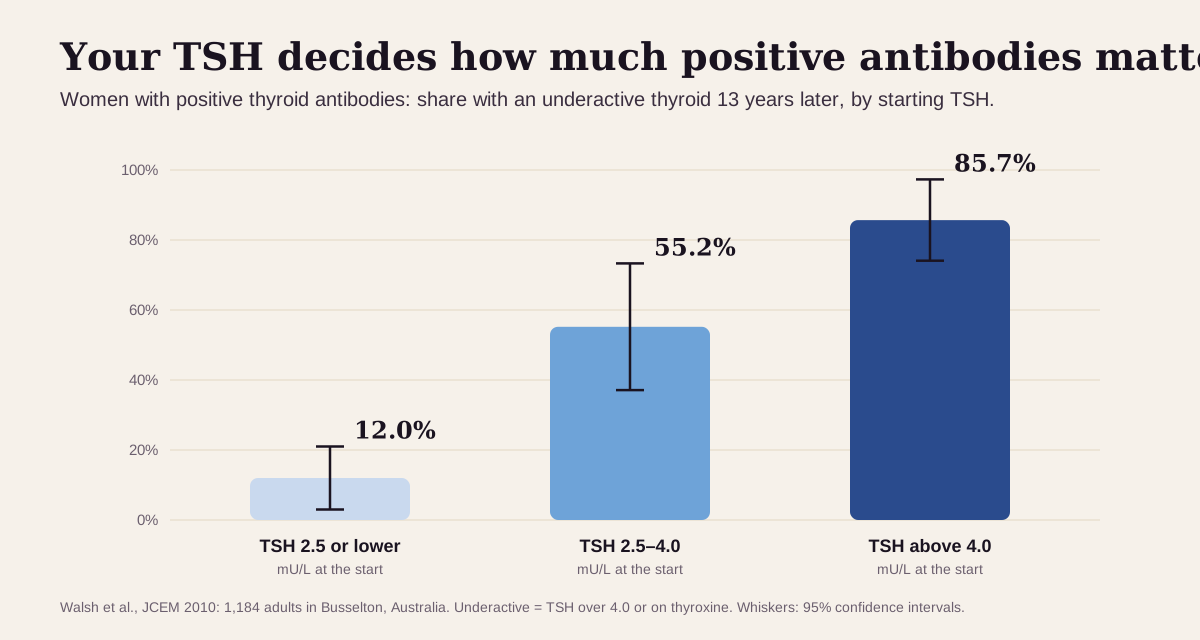
- TSH decides how much the antibodies matter. Among antibody-positive women in Busselton, 12.0% had an underactive thyroid 13 years later if their starting TSH was 2.5 or lower. At 2.5–4.0 it was 55.2%, and above 4.0 it was 85.7%.3
Keep "optimal" in perspective: TPO antibodies are a risk marker, and the treatment decisions follow TSH and free T4. The American Thyroid Association says people with high antibodies and a normal TSH and free T4 need no thyroid hormone, and that the thing to repeat is TSH.1 Selenium supplements lowered TPO antibodies in a 2024 review of randomized trials, with results that varied widely from trial to trial.13 And in the TABLET trial of 952 antibody-positive women with normal thyroid tests, levothyroxine before conception left the live-birth rate unchanged: 37.4% versus 37.9% with placebo.14
What a positive TPO antibody test usually means
A positive result means your immune system has targeted your thyroid. What happens next depends mostly on your TSH and free T4. The usual explanations, most common first:
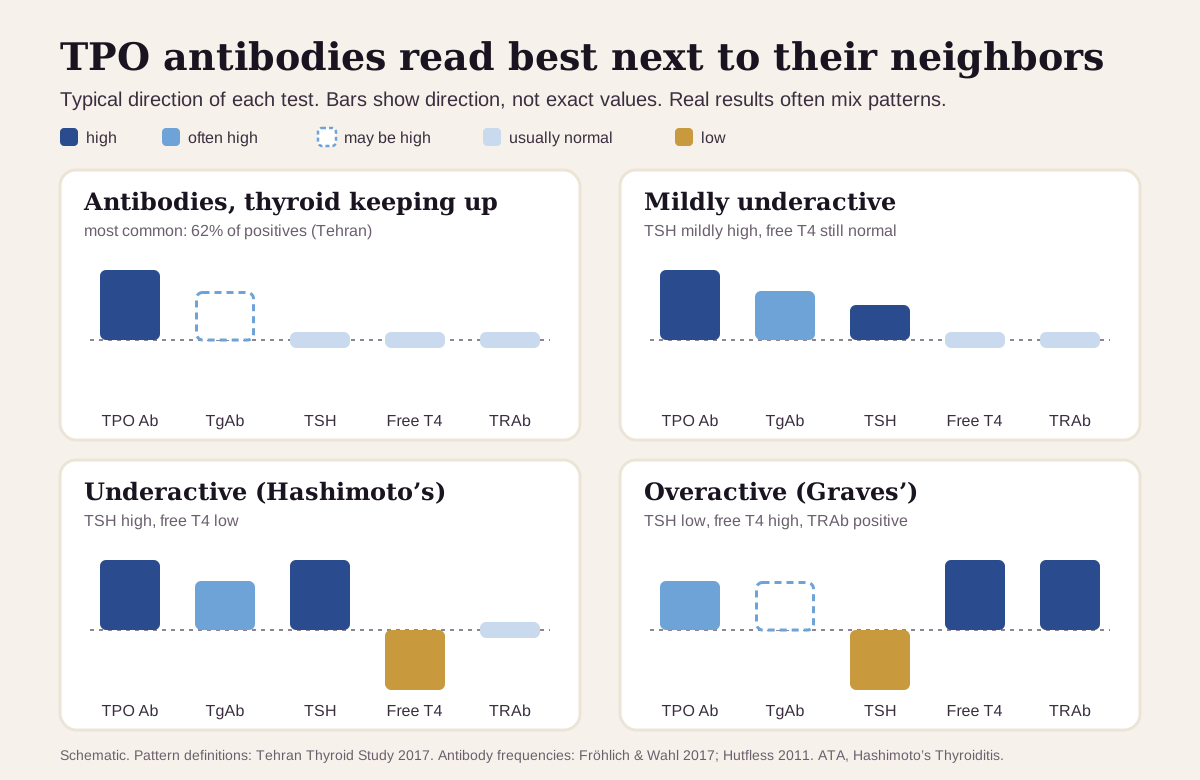
- Antibodies with a normal thyroid. This is the most common finding. In the Tehran study, 62% of antibody-positive adults had normal thyroid function when tested.9 Antibodies can show up years early: in a U.S. military study, they were already present up to 7 years before Hashimoto's was diagnosed.15
- Hashimoto's disease (chronic autoimmune thyroiditis). It's the most common cause of an underactive thyroid in the U.S.,1 and 90–95% of people with it have TPO antibodies.6
- Graves' disease, the autoimmune cause of an overactive thyroid. About 80% have TPO antibodies too, but the test that points to Graves' is TSH-receptor antibodies (TRAb), found in about 90%.6
- Postpartum thyroiditis. It affects about 5–10% of U.S. women after giving birth. Antibody-positive women are at much higher risk, and the higher the antibodies, the higher the risk.16
- Other autoimmune conditions. TPO antibodies turn up in about 40% of people with type 1 diabetes, 12–30% with celiac disease and 16–37% with rheumatoid arthritis.6
- Less common: low levels for a while after a viral thyroid infection, with thyroid cancer, and rarely with a colloid goiter.5
Get care now if you have signs of a severely underactive thyroid (a below-normal body temperature, slowed breathing, unusual confusion or becoming hard to wake) or a severely overactive one (fever, a pounding or racing heart, agitation or confusion). Both are emergencies whatever your antibody result.7
What a negative result means
A negative result makes Hashimoto's much less likely. A minority of people with it still test negative: 5–10% by one review's figures,6 and about a third in the U.S. military study, which tested stored blood from before and at diagnosis.15 If your TSH is high and TPO is negative, the cause is worth a closer look with your clinician.
TPO antibodies read best next to their neighbors
TPO antibodies say whether the immune system has targeted the thyroid. TSH and free T4 say how the thyroid is working. TSH-receptor antibodies (TRAb) point to Graves' disease rather than Hashimoto's, and thyroglobulin antibodies turn up in both:16
| If you see… | It often points to… |
|---|---|
| TPO antibodies high, TSH and free T4 normal | thyroid autoimmunity with a thyroid that's keeping up. The ATA advises no thyroid hormone and a TSH check over time |
| TPO high, TSH mildly high, free T4 normal | a mildly underactive ("subclinical") thyroid from Hashimoto's. In Busselton, 86% of women positive for TPO or thyroglobulin antibodies with a TSH above 4.0 still had a raised TSH or were on thyroid hormone 13 years later |
| TPO high, TSH high, free T4 low | an underactive thyroid from Hashimoto's disease |
| TSH low, free T4 high, TSH-receptor antibodies positive (TPO often too) | an overactive thyroid from Graves' disease |
| Thyroglobulin antibodies high, TPO negative | on its own, no significant link to thyroid disease in the U.S. national survey |
The table rows come from the ATA,1 Walsh 2010,3 Fröhlich & Wahl6 and NHANES III.2 For adults with an untreated, mildly underactive thyroid, NICE suggests checking TSH and free T4 once a year when thyroid antibodies are raised, and every 2–3 years when there are no signs of underlying thyroid disease.8
How fast TPO antibodies change
Slowly, and with a lot of test-to-test noise.
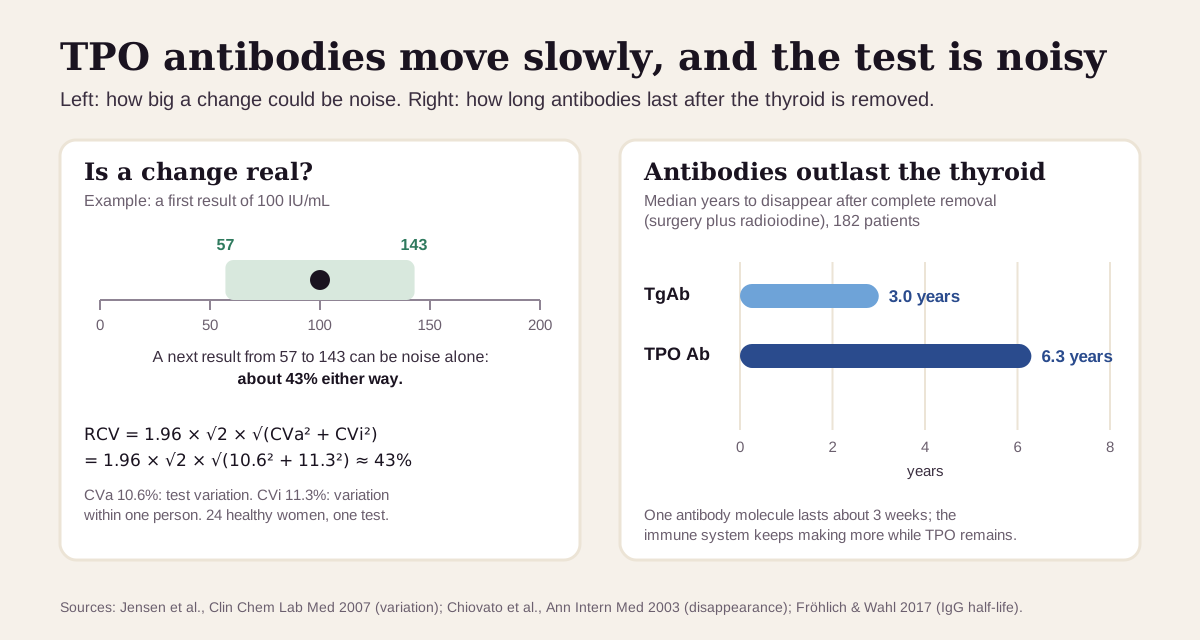
- Noise is large. In 24 healthy women tested twice a week, TPO antibodies varied 11.3% on their own, and the test added 10.6%. Together, two results can differ by about 43% from normal variation alone.17
- They come early. TPO antibodies were present up to 7 years before Hashimoto's was diagnosed. In Graves' disease, the share with TPO antibodies rose from 31% 5–7 years before diagnosis to 57% at diagnosis.15
- They fade slowly, even without a thyroid. A single antibody molecule lasts about 3 weeks,6 but the immune system keeps making more as long as TPO is around. After complete removal of the thyroid, TPO antibodies took a median of 6.3 years to disappear, versus 3.0 years for thyroglobulin antibodies.18
- Retesting is rarely useful. NICE advises testing adults once, without routine repeats. The ATA says to follow TSH instead.81
Going deeper: the enzyme and the antibodies
TPO is a membrane enzyme on the inner (apical) surface of thyroid cells, facing the follicle's stored thyroglobulin. It oxidizes iodine and fixes it onto tyrosine building blocks in thyroglobulin, the protein T4 and T3 are made from.6
TPO antibodies are mostly of the IgG1 and IgG4 types: in one study, 70% of patients had IgG1 and 66% IgG4 antibodies. Antibodies from people with autoimmune thyroid disease can activate complement (a blood defense system), damage thyroid cells and block the enzyme. Antibodies from healthy people, in contrast, left TPO's activity intact in lab tests.6
Because TPO sits on the inner surface, antibodies reach it more easily once the junctions between thyroid cells loosen. That's one reason immune cells, rather than antibodies, drive most of the damage in Hashimoto's.6
The number itself depends on the test. Assays differ in their technical details and their cutoffs, which is why the same blood can read differently on two platforms.9
Questions worth asking
- What are my TSH and free T4, and where do they sit in the range?
- How far above my lab's cutoff is my TPO result?
- How often should my TSH be rechecked from here?
- Would a TSH-receptor antibody test help, given my TSH?
- I'm planning a pregnancy: should my TSH be checked before and during it?
- Do my other results suggest another autoimmune condition worth testing for?
FAQ
What is a normal TPO antibody level? Below your own lab's cutoff. Labcorp uses 0–34 IU/mL for adults, while Oxford University Hospitals calls under 60 negative.45
Can TPO antibodies be positive with a normal TSH? Yes, and it's the most common pattern: 62% of antibody-positive adults in the Tehran study had normal thyroid function. The ATA says no thyroid hormone is needed then, and TSH is the test to repeat.91
Do positive TPO antibodies mean Hashimoto's? They're its main blood marker: 90–95% of people with autoimmune thyroiditis have them. But 10–15% of people without thyroid disease do too, so TSH and free T4 show whether the thyroid is affected.6
Can TPO antibodies go down? Slowly. Selenium lowered them in randomized trials, with results that varied widely,13 and they fade over years after the thyroid is removed.18 The ATA advises following TSH rather than the antibody number.1
This guide is for education. It can't diagnose you or replace care from a clinician who knows your history.
Footnotes
-
American Thyroid Association. Hashimoto's Thyroiditis (patient page). The most common cause of hypothyroidism in the U.S.; no thyroid hormone for high antibodies with a normal TSH and free T4; monitor TSH rather than antibodies. thyroid.org ↩ ↩2 ↩3 ↩4 ↩5 ↩6 ↩7 ↩8 ↩9 ↩10
-
Hollowell JG, Staehling NW, Flanders WD, et al. Serum TSH, T4, and thyroid antibodies in the United States population (1988 to 1994): National Health and Nutrition Examination Survey (NHANES III). J Clin Endocrinol Metab. 2002;87(2):489–499. 17,353 people aged 12 and older; TPO antibodies in 11.3% of the disease-free population. PubMed ↩ ↩2 ↩3
-
Walsh JP, Bremner AP, Feddema P, Leedman PJ, Brown SJ, O'Leary P. Thyrotropin and thyroid antibodies as predictors of hypothyroidism: a 13-year, longitudinal study of a community-based cohort using current immunoassay techniques. J Clin Endocrinol Metab. 2010;95(3):1095–1104. 1,184 adults in Busselton, Australia, Immulite assay. The source for the 29 vs 35 cutoffs and the 12.0%, 55.2% and 85.7% outcomes. PubMed ↩ ↩2 ↩3 ↩4 ↩5 ↩6 ↩7 ↩8 ↩9 ↩10
-
Labcorp. Thyroid Peroxidase (TPO) Antibodies, test 006676. Updated July 16, 2026. Roche electrochemiluminescence immunoassay; reference ranges by age, adults over 19: 0–34 IU/mL. Labcorp is a commercial laboratory, cited for its published reference range. labcorp.com ↩ ↩2 ↩3 ↩4 ↩5 ↩6 ↩7
-
Oxford University Hospitals NHS Foundation Trust, Immunology Laboratory. Thyroid Antibodies. Last reviewed July 6, 2026. ImmunoCAP enzyme immunoassay: under 60 IU/mL negative, 60–100 equivocal, over 100 positive; how often each thyroid disease is positive, and the causes of low-level antibodies. ouh.nhs.uk ↩ ↩2 ↩3 ↩4 ↩5 ↩6 ↩7 ↩8 ↩9
-
Fröhlich E, Wahl R. Thyroid Autoimmunity: Role of Anti-thyroid Antibodies in Thyroid and Extra-Thyroidal Diseases. Front Immunol. 2017;8:521. How often TPO, thyroglobulin and TSH-receptor antibodies appear in each disease; what TPO does; antibody types. PMC ↩ ↩2 ↩3 ↩4 ↩5 ↩6 ↩7 ↩8 ↩9 ↩10 ↩11 ↩12 ↩13 ↩14 ↩15 ↩16
-
National Library of Medicine. Hypothyroidism (signs of myxedema crisis) and Thyroid storm. MedlinePlus Medical Encyclopedia. Hypothyroidism; Thyroid storm ↩ ↩2 ↩3
-
National Institute for Health and Care Excellence. Thyroid disease: assessment and management (NG145). Last updated October 12, 2023. Recommendations 1.3.1, 1.5.1 and 1.5.7. nice.org.uk ↩ ↩2 ↩3
-
Amouzegar A, Gharibzadeh S, Kazemian E, Mehran L, Tohidi M, Azizi F. The Prevalence, Incidence and Natural Course of Positive Antithyroperoxidase Antibodies in a Population-Based Study: Tehran Thyroid Study. PLoS One. 2017;12(1):e0169283. 5,783 adults followed for a median 9.1 years; manufacturer cutoff 40 IU/mL. PMC ↩ ↩2 ↩3 ↩4 ↩5 ↩6 ↩7 ↩8
-
Superpower. Thyroid Peroxidase Antibody biomarker page. Last updated September 1, 2026. States: "'Optimal' is essentially near zero, since any measurable antibody can indicate some immune activation." A commercial source, listed as what the optimizer community uses. superpower.com ↩ ↩2 ↩3
-
Kharrazian D. Why Do I Still Have Thyroid Symptoms? When My Lab Tests Are Normal. Elephant Press; 2010. ISBN 978-0985690403. A functional-medicine thyroid book. The Libby app's marker catalog credits it for the app's optimal TPO antibody range of 2 IU/mL or less (range as recorded in the catalog; the book was not opened for this article). ↩ ↩2
-
Korevaar TIM, Pop VJ, Chaker L, et al. Dose Dependency and a Functional Cutoff for TPO-Antibody Positivity During Pregnancy. J Clin Endocrinol Metab. 2018;103(2):778–789. 11,212 pregnant women in three Dutch cohorts. PubMed ↩
-
Huwiler VV, Maissen-Abgottspon S, Stanga Z, et al. Selenium Supplementation in Patients with Hashimoto Thyroiditis: A Systematic Review and Meta-Analysis of Randomized Clinical Trials. Thyroid. 2024;34(3):295–313. 35 studies; TPO antibodies fell across 29 cohorts (2,358 participants) with high heterogeneity (I² 90%). PMC ↩ ↩2
-
Dhillon-Smith RK, Middleton LJ, Sunner KK, et al. Levothyroxine in Women with Thyroid Peroxidase Antibodies before Conception. N Engl J Med. 2019;380(14):1316–1325. The TABLET trial: 952 antibody-positive women with normal thyroid function and a history of miscarriage or infertility. PubMed ↩
-
Hutfless S, Matos P, Talor MV, Caturegli P, Rose NR. Significance of prediagnostic thyroid antibodies in women with autoimmune thyroid disease. J Clin Endocrinol Metab. 2011;96(9):E1466–E1471. 522 women in the U.S. military, with blood stored up to 7 years before diagnosis. PMC ↩ ↩2 ↩3 ↩4
-
American Thyroid Association. Postpartum Thyroiditis (patient page). About 5–10% of U.S. women; risk rises with antibody levels. thyroid.org ↩
-
Jensen E, Petersen PH, Blaabjerg O, Hegedüs L. Biological variation of thyroid autoantibodies and thyroglobulin. Clin Chem Lab Med. 2007;45(8):1058–1064. 24 healthy women sampled twice a week; for TPO antibodies, biological variation 11.3% and analytical variation 10.6%. PubMed ↩ ↩2
-
Chiovato L, Latrofa F, Braverman LE, et al. Disappearance of humoral thyroid autoimmunity after complete removal of thyroid antigens. Ann Intern Med. 2003;139(5 Pt 1):346–351. 182 patients after total thyroidectomy and radioiodine; median disappearance 6.3 years for TPO and 3.0 years for thyroglobulin antibodies. PubMed ↩ ↩2 ↩3
Educational content, not medical advice. Libby is a personal record tool, not a medical service — it doesn't diagnose, treat, or prescribe. Reference ranges vary by lab and by person. Talk to a qualified healthcare professional about your results.
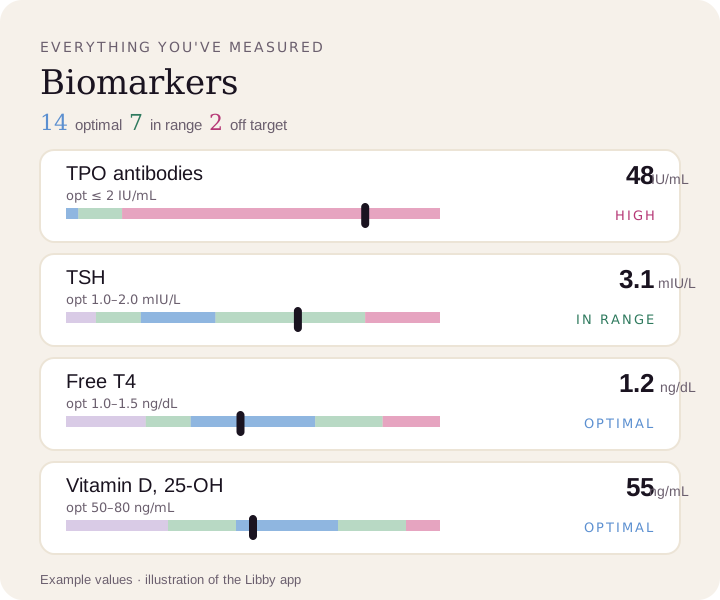
Compare your thyroid results to optimal ranges.
Upload a lab PDF or a photo of your report. Libby puts every marker on your lab's range and the optimal range, and tracks your trends over time.
View your TPO antibodies ›