Anti-CCP test: what a positive result means for RA
Anti-CCP is the most specific blood test for rheumatoid arthritis. What's normal, what a positive means, why the level matters, and when to get care.
Anti-CCP antibodies are antibodies your immune system makes against proteins that carry citrulline, and they are the most specific blood test for rheumatoid arthritis (RA). In a meta-analysis of 37 studies, anti-CCP was positive in about 2 of every 3 people with RA and in only about 5 of every 100 people without it.1 It can also turn positive years before the joints swell, which makes it an early warning as well as a diagnostic clue.2
The short version
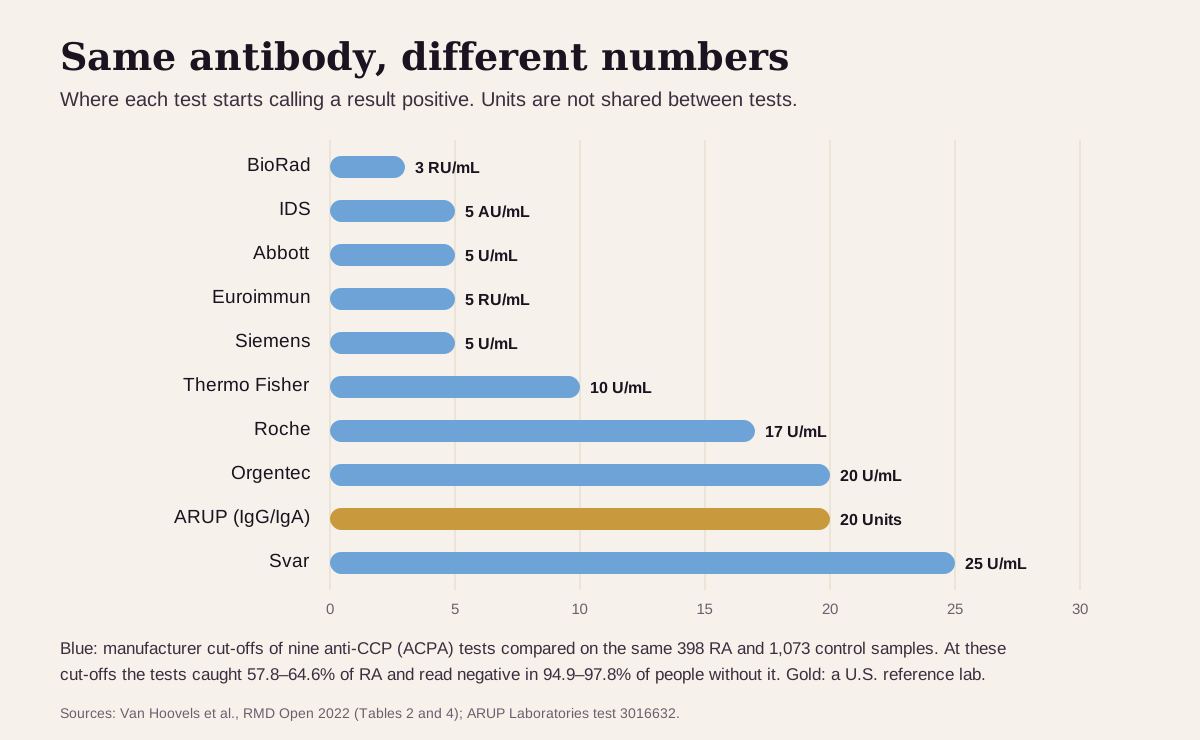
- Normal: negative, which on many U.S. tests means under 20 units. Each test sets its own line, from 3 to 25 units, so check the range on your report.345
- Positive: points strongly to RA, especially next to a positive rheumatoid factor (RF). The higher the level, the stronger the signal: more than 3 times your lab's cutoff counts as "high-positive" in the RA classification criteria.167
- Early warning: about half of people who later got RA had anti-CCP or RF in stored blood a median of 4.5 years before symptoms. Among 100 people with joint aches and a positive anti-CCP, half developed arthritis, most of them within a year.28
- Urgent: new swelling in the small joints of the hands or feet, or in more than one joint, needs prompt care whatever your anti-CCP shows.9
What anti-CCP is
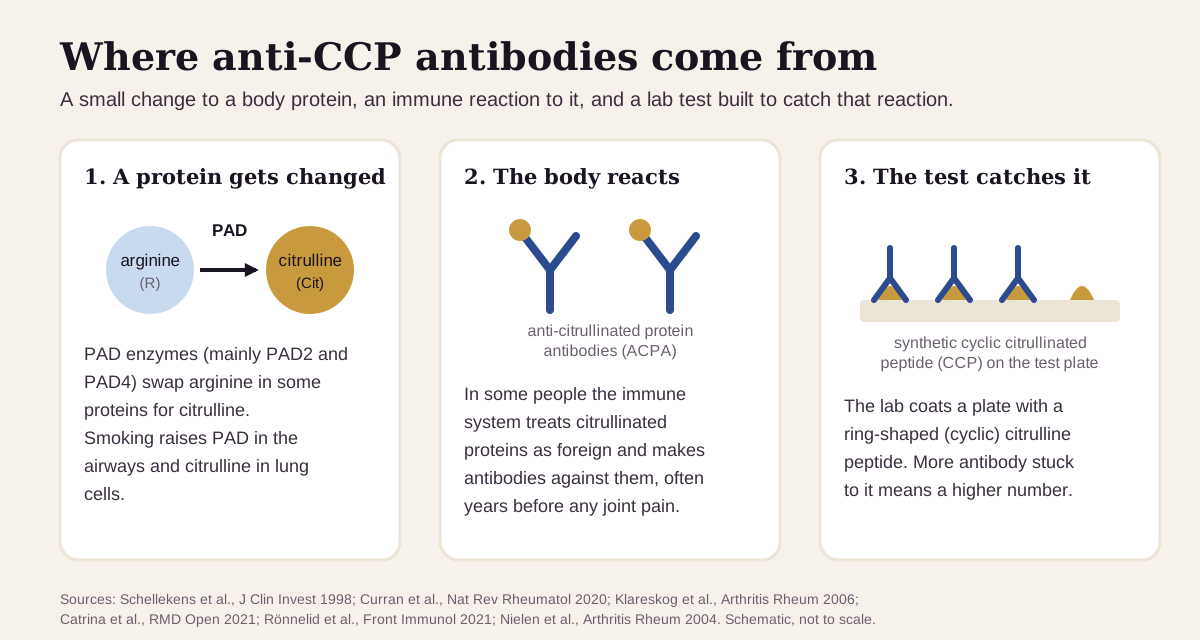
Your body makes small chemical changes to some of its own proteins after they're built. One of them is citrullination: enzymes called PADs turn the amino acid arginine into a close cousin, citrulline.1011 In some people the immune system starts treating these citrullinated proteins as foreign and makes antibodies against them, called anti-citrullinated protein antibodies (ACPA).12
The lab test catches those antibodies with a man-made, ring-shaped ("cyclic") citrullinated peptide, which is where the name anti-CCP comes from. The second-generation peptides (CCP2) are the most widely used, and some tests also count IgA antibodies alongside the usual IgG.133
Anti-CCP is usually ordered when someone has joint pain, stiffness or swelling, often together with or after an RF test.6 Of the two, anti-CCP is the more specific. The Nishimura meta-analysis found anti-CCP positive in 67% of people with RA and negative in 95% of people without it, versus 69% and 85% for IgM RF.1
What's a normal anti-CCP?
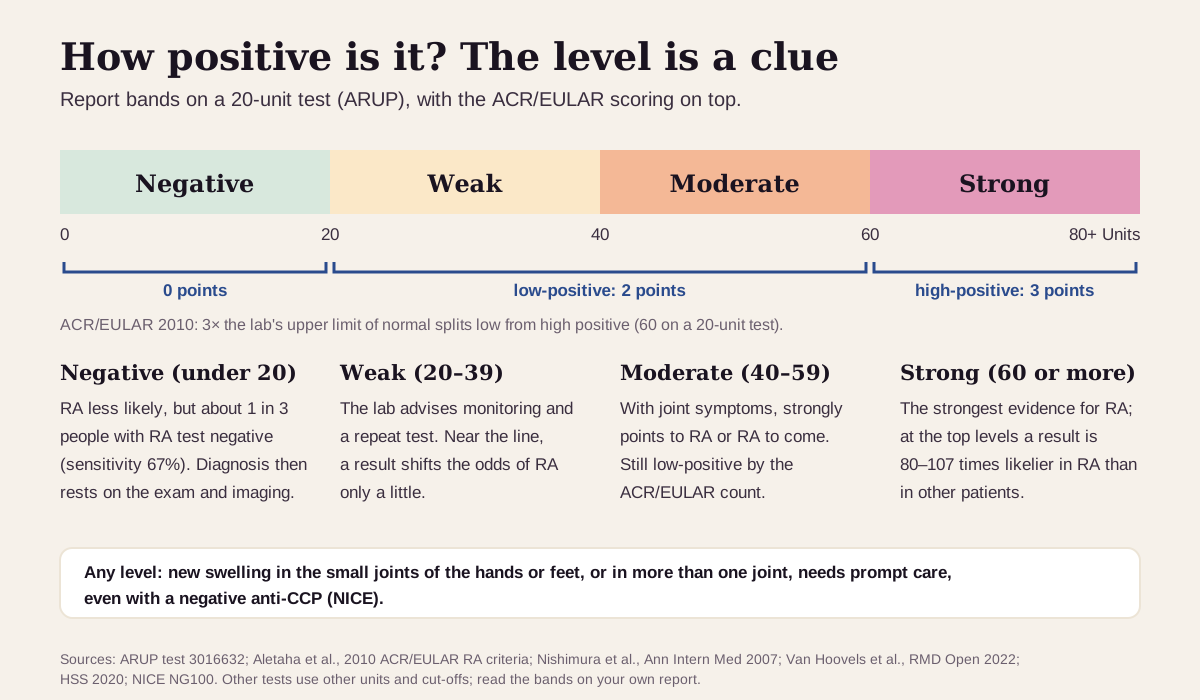
Negative is normal. On many U.S. tests that means under 20 units: ARUP, a commercial reference lab, reports 19 units or less as negative, and the Hospital for Special Surgery (HSS) uses under 20.34
The line moves with the test, though. When researchers ran nine commercial anti-CCP tests on the same 1,471 blood samples, the manufacturers' positive lines ranged from 3 to 25 units. At those lines, each test caught 58–65% of RA and read negative in 95–98% of people without it.5 So read your number against the range printed on your own report.
A positive result in the general population is uncommon. In the Dutch Lifelines study of 40,136 adults, 1.0% tested positive, and 0.8% of those without RA. Positives were more common with older age, in women, in smokers and in people with joint complaints.14 Labs use one cutoff for men and women.3
"Optimal" anti-CCP: what health optimizers aim for
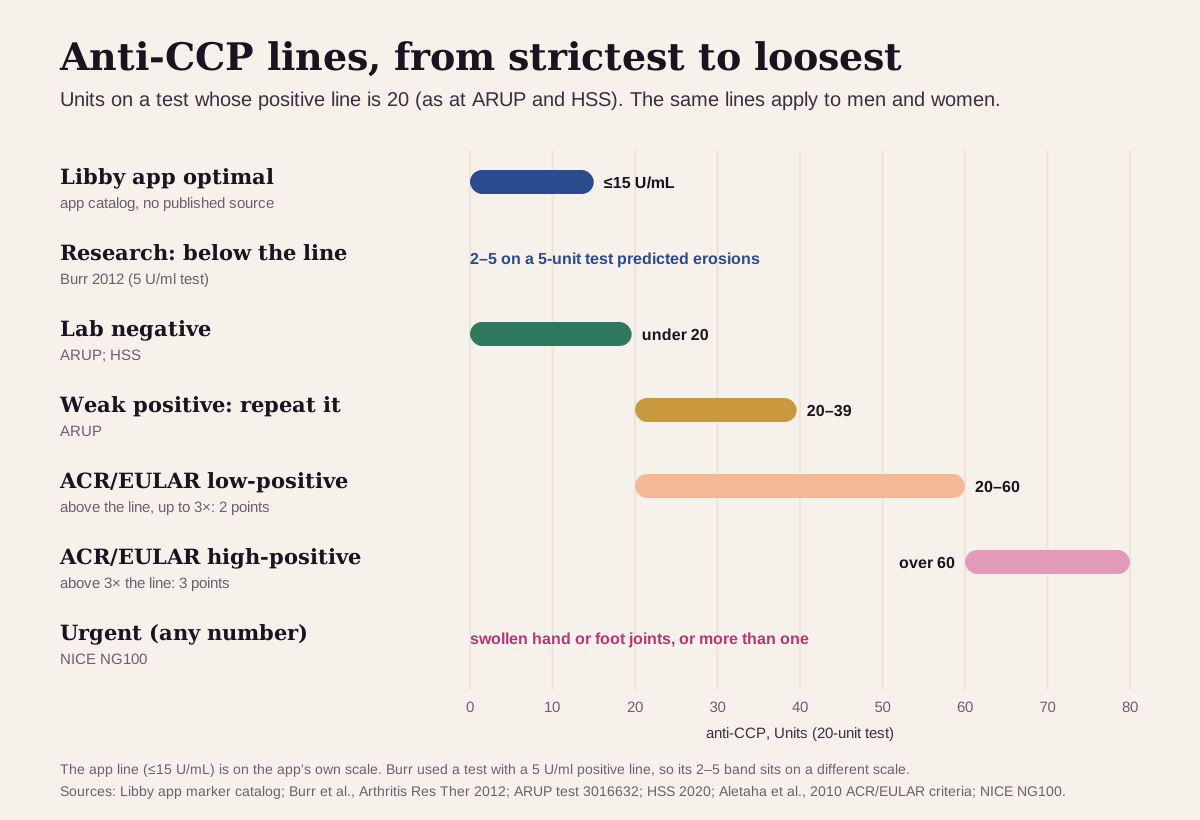
For most markers, optimizers aim for a tighter band inside the lab range. Anti-CCP works differently: it's an antibody most healthy people lack, so "optimal" simply means as low as the test reads. Here's the ladder, from strictest to loosest:
| Target | Men and women | Who uses it |
|---|---|---|
| Libby app optimal | 15 U/mL or less | The optimal range shown in the Libby app. The app's catalog records no published source for this band |
| Research: low still matters | 2–5 U/ml on a test with a 5 U/ml line | In 640 people with early inflammatory arthritis, levels just under the positive line still predicted joint erosions 5 years later15 |
| Lab negative | under 20 units | ARUP (19 or less) and HSS34 |
| Weak positive | 20–39 units | ARUP: monitor and repeat the test3 |
| Low-positive (RA criteria) | above your lab's cutoff, up to 3 times it | 2010 American College of Rheumatology/European League Against Rheumatism (ACR/EULAR) criteria: 2 points7 |
| High-positive (RA criteria) | more than 3 times your lab's cutoff | Same criteria: 3 points7 |
| Urgent | any level | Swelling in the small joints of the hands or feet, or in more than one joint: urgent specialist referral, even with a negative test9 |
Why the level matters, even near "negative":
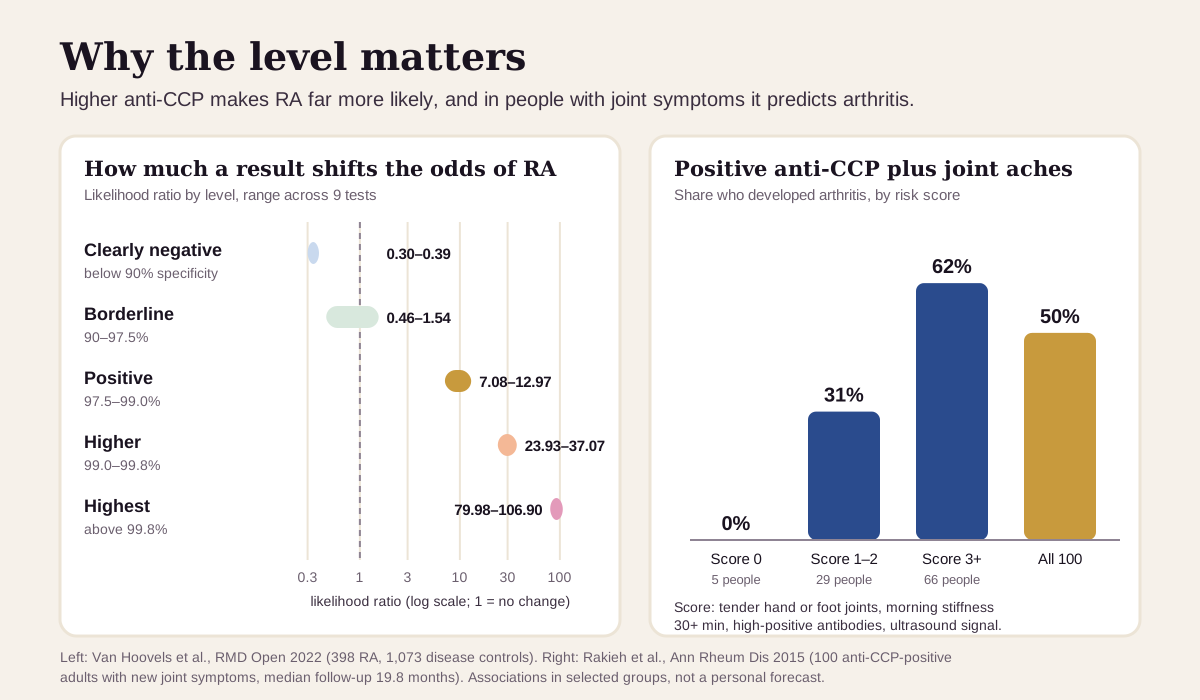
- Across nine tests, results near the manufacturers' cutoffs barely changed the odds of RA. A result in the next band up was 7–13 times more likely in RA than in patients without it, and one in the top band 80–107 times.5
- Among 640 people with early inflammatory arthritis, a higher starting anti-CCP predicted more joint damage on X-rays 5 years later, even below the positive line: levels of 2–5 U/ml carried 3.6 times the odds of erosions.15
- Among 100 people with new joint aches and a positive anti-CCP, half developed arthritis over a median follow-up of about 20 months. A high-positive antibody result was one of four warning signs in the study's risk score. With a score of 3 or more, 62% developed arthritis, versus none of the five people who scored 0.8
Keep "optimal" in perspective: a negative anti-CCP is reassuring, not a clean bill of joint health. About 1 in 5 people with RA have neither anti-CCP nor RF, and their diagnosis rests on the exam and imaging.4 Anti-CCP also behaves differently from cholesterol or blood sugar: once positive, it usually stays positive, even when RA goes into remission.4
What a positive anti-CCP usually means
The level is the first clue. Many labs grade a positive result, and the RA classification criteria split positives at 3 times the lab's cutoff.37
The usual reasons, most common first
- Rheumatoid arthritis. In people tested for joint symptoms, this is the main reason for a positive result: a positive anti-CCP raises the odds of RA about 12-fold.1 MedlinePlus puts it plainly: with symptoms, a positive anti-CCP plus a positive RF means you probably have RA.6
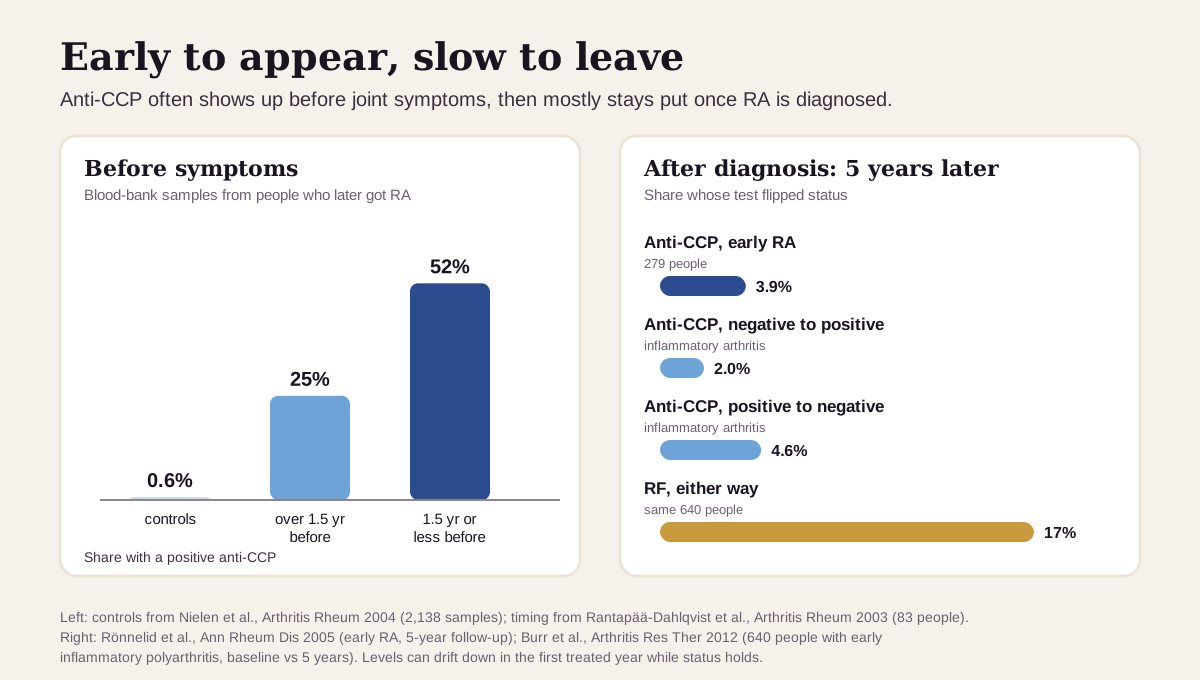
- RA on the way. Anti-CCP can show up years before the joints swell. In blood-bank samples from people who later developed RA, it was positive in 25% of samples taken more than 18 months before symptoms and in 52% of those taken closer to onset.16 Among people with joint aches and a positive anti-CCP, about half developed arthritis in one study, most of them within a year.8 In another, 26 of the 29 people with joint pain who went on to arthritis were anti-CCP positive, and anti-CCP, rather than RF, predicted who would.17
- A positive without RA. About 1 in 125 adults without RA test positive (0.8% in the Dutch study), more often older people, smokers and people with joint complaints.14 People can carry these antibodies for long periods without developing disease.12
- Less common: other autoimmune diseases such as Sjögren's syndrome or lupus, active tuberculosis, and chronic lung disease.6
Seropositive vs seronegative RA
Rheumatologists split RA by these antibodies. Seropositive RA means a positive anti-CCP or RF. Seronegative means both are negative, which is the case for about 1 in 5 people with RA.4
The split matters because the two behave differently:
- Different roots. In a case-control study of recent-onset RA, smoking and certain immune genes (the HLA-DR "shared epitope") were tied to anti-CCP-positive RA and not to the antibody-negative kind. Smokers carrying two copies of those genes had 21 times the RA risk of nonsmokers with none.18
- A harder course. In 279 people with early RA, those who were anti-CCP positive had more active disease and more joint damage on X-rays over 5 years, despite at least as much treatment.19 Three of four studies in the Nishimura meta-analysis found faster X-ray damage with anti-CCP than with RF.1
- A stricter target. The UK's NICE guideline tells people with a positive anti-CCP that their risk of joint damage on X-rays is higher, and suggests considering full remission as the treatment goal.9
Get prompt care if you have new swelling in the small joints of your hands or feet, swelling in more than one joint, or joint symptoms that went 3 months or more before you got them checked. NICE calls for an urgent specialist referral in these cases, even when anti-CCP, RF and inflammation tests are normal.9 Morning stiffness, tiredness and a low-grade fever often travel with RA.6
Anti-CCP reads best next to its neighbors
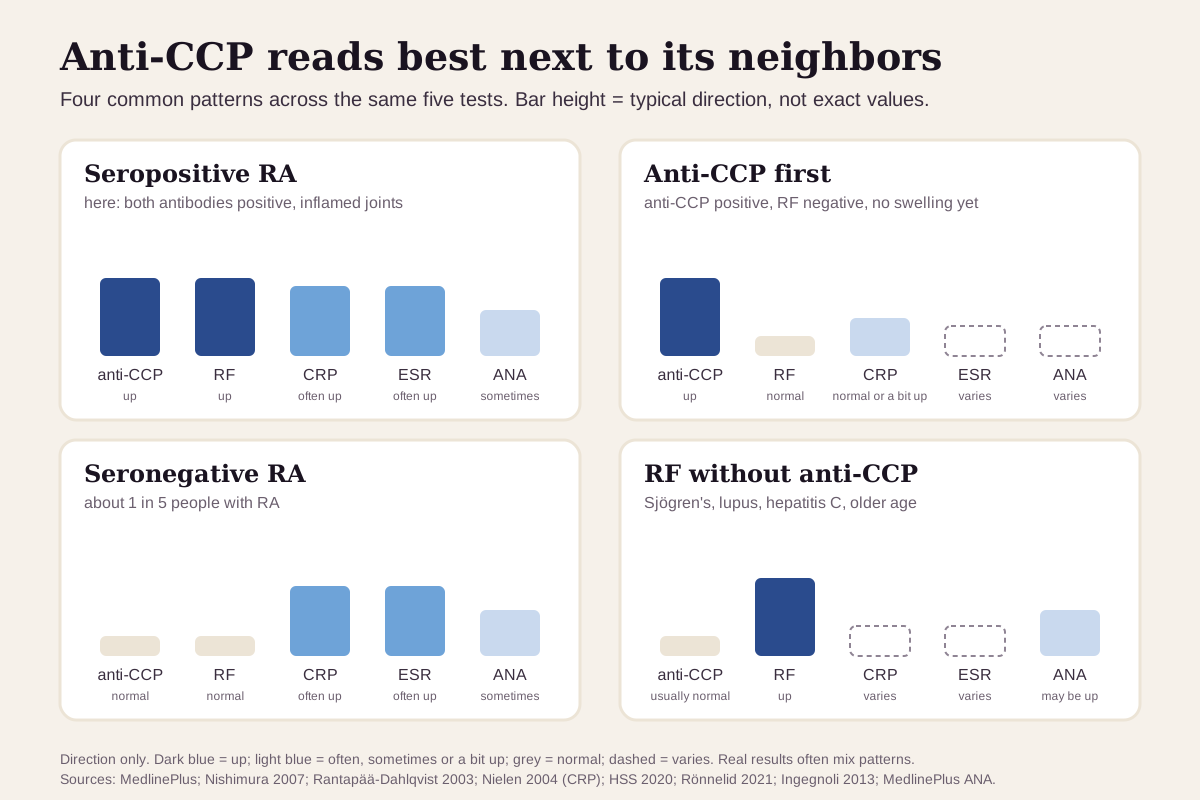
Anti-CCP rarely comes alone. RF, the inflammation tests CRP and ESR, and often an ANA come with it, and the pattern says more than any one number.6
| If you see… | It often points to… |
|---|---|
| Anti-CCP and RF both positive, with joint symptoms | rheumatoid arthritis: MedlinePlus calls RA probable with this pair6 |
| Anti-CCP positive, RF negative, with joint aches | early RA, or RA that may develop later.6 In stored blood, anti-CCP showed up in more future RA patients than IgM RF did (34% vs 19%)16 |
| Both negative, CRP and ESR up | RA is less likely, and more tests are needed to find the cause.6 Still, about 1 in 5 people with RA are seronegative4 |
| RF positive, anti-CCP negative | can point to something other than RA, though RA is still possible: RF is positive in about 60–95% of people with primary Sjögren's syndrome, 40–76% with hepatitis C, and 10–25% of healthy 70-year-olds21 |
CRP and ESR show how inflamed things are right now, so doctors repeat them to follow treatment. Anti-CCP answers a different question, what kind of arthritis it is, so it's usually measured once.4
How fast anti-CCP changes
It comes early and stays. In one study of blood donors, RF or anti-CCP turned up a median of 4.5 years before RA symptoms began, and up to 13.8 years before.2 In another, the share of future RA patients testing positive for anti-CCP climbed from 25% to 52% as onset approached.16
What that means in practice:
- Once positive, usually always positive. Over 5 years of early RA, only 3.9% of people changed anti-CCP status, even though levels fell in the first year of treatment.19 In a group of 640 people, 2% turned positive and 4.6% of positives turned negative, while RF status changed in 17%.15
- After diagnosis, repeat tests add little. Rechecking anti-CCP after 5 years predicted joint damage no better than the first result (75% vs 74% accuracy).15 Changes in the level also fail to track how active the arthritis is.19
- A weak positive is the exception. Labs suggest repeating a result in the 20–39 range, because results near the line shift the odds the least.35
Going deeper: citrulline, smoking and genes
Citrullination is done by a family of five PAD enzymes (peptidylarginine deiminases). PAD2 and PAD4 are the ones most tied to RA.11 Citrulline is an arginine that has been chemically changed after the protein was built, and the antibodies against citrulline-containing peptides are what mark RA: the first research tests found them in 76% of RA blood samples, with 96% specificity.10
The leading theory starts outside the joints. Smoking raises PAD activity in the airways, and smokers' lung cells carry citrullinated proteins that nonsmokers' cells lack.1218 In people with the shared-epitope genes, that may be enough to set off the antibody response,18 years before arthritis appears.2 People who are antibody positive can already have joint pain and bone loss before RA is diagnosed.12
The test itself has changed. The first commercial test used a peptide from the skin protein filaggrin, folded into a ring so antibodies could grip it. The second-generation CCP2 peptides came from screening about 12 million candidates against RA blood.13 Because each company sets its own scale and cutoff, the same blood can give quite different numbers on different tests.513
Questions worth asking
- Is my anti-CCP negative, weak or strongly positive on this lab's scale, and how far above the cutoff is it?
- What did my RF, CRP and ESR show at the same time?
- Do I have swelling you can see or feel, or only aches? Would an ultrasound help?
- If I'm positive without arthritis, how often should my joints be checked, and which symptoms should bring me back sooner?
- Does smoking change my risk, and what would quitting do?
- If I have RA, does my antibody status change the treatment target?
FAQ
What is a normal anti-CCP level? Negative. On many U.S. tests that means under 20 units, but each test sets its own cutoff, so use the range on your report.345
Does a positive anti-CCP mean I have rheumatoid arthritis? It makes RA much more likely, especially with joint symptoms and a positive RF. Some people test positive years before RA starts, and about 0.8% of adults without RA test positive.1614
Can anti-CCP be positive before symptoms? Yes. In stored blood, RF or anti-CCP appeared a median of 4.5 years before RA symptoms. In one study, half of people with joint aches and a positive anti-CCP developed arthritis.28
Can a negative anti-CCP rule out RA? No. About a third of people with RA test negative, and about 1 in 5 have neither anti-CCP nor RF. If your joints are swollen, see a clinician whatever the result.149
This guide is for education. It can't diagnose you or replace care from a clinician who knows your history.
Footnotes
-
Nishimura K, Sugiyama D, Kogata Y, et al. Meta-analysis: diagnostic accuracy of anti-cyclic citrullinated peptide antibody and rheumatoid factor for rheumatoid arthritis. Ann Intern Med. 2007;146(11):797–808. Pooled 37 anti-CCP and 50 RF studies: anti-CCP sensitivity 67%, specificity 95%, positive likelihood ratio 12.46; IgM RF 69% and 85%. PubMed ↩ ↩2 ↩3 ↩4 ↩5 ↩6 ↩7 ↩8 ↩9
-
Nielen MM, van Schaardenburg D, Reesink HW, et al. Specific autoantibodies precede the symptoms of rheumatoid arthritis: a study of serial measurements in blood donors. Arthritis Rheum. 2004;50(2):380–386. 79 future RA patients: 49% positive for IgM RF and/or anti-CCP a median 4.5 years (range 0.1–13.8) before symptoms; 0.6% of 2,138 control samples anti-CCP positive. PubMed ↩ ↩2 ↩3 ↩4 ↩5 ↩6
-
ARUP Laboratories. Cyclic Citrullinated Peptide Antibody, IgG and IgA (test 3016632). Reference interval 19 units or less; 20–39 weak positive, 40–59 moderate, 60 or more strong; weak positives should be monitored and repeated. A commercial reference lab, cited for its published cutoffs. ARUP ↩ ↩2 ↩3 ↩4 ↩5 ↩6 ↩7 ↩8 ↩9 ↩10 ↩11 ↩12
-
Richey M. Understanding Rheumatoid Arthritis Blood Test Results. Hospital for Special Surgery; updated September 9, 2020. Anti-CCP under 20 units is normal; about 20% of RA is seronegative; anti-CCP usually stays positive in remission; ESR and CRP track disease activity. HSS ↩ ↩2 ↩3 ↩4 ↩5 ↩6 ↩7 ↩8 ↩9 ↩10 ↩11 ↩12 ↩13
-
Van Hoovels L, Vander Cruyssen B, Sieghart D, et al. Multicentre study to improve clinical interpretation of rheumatoid factor and anti-citrullinated protein/peptide antibodies test results. RMD Open. 2022;8(1):e002099. Nine anti-CCP tests run on 398 RA and 1,073 control samples; manufacturer cutoffs, sensitivity, specificity and level-specific likelihood ratios. PMC ↩ ↩2 ↩3 ↩4 ↩5 ↩6 ↩7 ↩8 ↩9 ↩10
-
National Library of Medicine. CCP Antibody Test. MedlinePlus. Updated June 3, 2024. How to read anti-CCP with RF, symptoms that prompt the test, and other conditions that can cause a positive result. MedlinePlus ↩ ↩2 ↩3 ↩4 ↩5 ↩6 ↩7 ↩8 ↩9 ↩10 ↩11
-
Aletaha D, Neogi T, Silman AJ, et al. 2010 Rheumatoid arthritis classification criteria: an American College of Rheumatology/European League Against Rheumatism collaborative initiative. Arthritis Rheum. 2010;62(9):2569–2581. The current RA classification criteria. They define low-positive serology (above the lab's upper limit, up to 3 times it) and high-positive (more than 3 times). PubMed · ACR criteria page ↩ ↩2 ↩3 ↩4 ↩5 ↩6
-
Rakieh C, Nam JL, Hunt L, et al. Predicting the development of clinical arthritis in anti-CCP positive individuals with non-specific musculoskeletal symptoms: a prospective observational cohort study. Ann Rheum Dis. 2015;74(9):1659–1666. 100 people followed a median 19.8 months; 50 developed arthritis (median 7.9 months), 34 within 12 months. PubMed ↩ ↩2 ↩3 ↩4 ↩5
-
National Institute for Health and Care Excellence. Rheumatoid arthritis in adults: management (NICE guideline NG100). Published 2018. Recommendations 1.1.1–1.1.6 and 1.2.2 on referral, anti-CCP testing and treatment targets. NICE ↩ ↩2 ↩3 ↩4 ↩5 ↩6
-
Schellekens GA, de Jong BA, van den Hoogen FH, van de Putte LB, van Venrooij WJ. Citrulline is an essential constituent of antigenic determinants recognized by rheumatoid arthritis-specific autoantibodies. J Clin Invest. 1998;101(1):273–281. PMC ↩ ↩2
-
Curran AM, Naik P, Giles JT, Darrah E. PAD enzymes in rheumatoid arthritis: pathogenic effectors and autoimmune targets. Nat Rev Rheumatol. 2020;16(6):301–315. PubMed ↩ ↩2
-
Catrina A, Krishnamurthy A, Rethi B. Current view on the pathogenic role of anti-citrullinated protein antibodies in rheumatoid arthritis. RMD Open. 2021;7(1):e001228. PMC ↩ ↩2 ↩3 ↩4
-
Rönnelid J, Turesson C, Kastbom A. Autoantibodies in rheumatoid arthritis: laboratory and clinical perspectives. Front Immunol. 2021;12:685312. History of the CCP tests; ANA positive in 20–38% of people with RA. PMC ↩ ↩2 ↩3 ↩4
-
van Zanten A, Arends S, Roozendaal C, et al. Presence of anticitrullinated protein antibodies in a large population-based cohort from the Netherlands. Ann Rheum Dis. 2017;76(7):1184–1190. 40,136 Lifelines participants: 1.0% positive, 0.8% of those without RA. PMC ↩ ↩2 ↩3
-
Burr ML, Viatte S, Bukhari M, et al. Long-term stability of anti-cyclic citrullinated peptide antibody status in patients with early inflammatory polyarthritis. Arthritis Res Ther. 2012;14(3):R109. 640 people from the Norfolk Arthritis Register tested at baseline and 5 years, with a 5 U/ml positive line. PMC ↩ ↩2 ↩3 ↩4 ↩5 ↩6
-
Rantapää-Dahlqvist S, de Jong BA, Berglin E, et al. Antibodies against cyclic citrullinated peptide and IgA rheumatoid factor predict the development of rheumatoid arthritis. Arthritis Rheum. 2003;48(10):2741–2749. 83 people who gave blood before RA began: anti-CCP in 33.7% of pre-onset samples (IgM RF 19.3%); 25% more than 1.5 years before symptoms and 52% within 1.5 years. PubMed ↩ ↩2 ↩3 ↩4 ↩5
-
Bos WH, Wolbink GJ, Boers M, et al. Arthritis development in patients with arthralgia is strongly associated with anti-citrullinated protein antibody status: a prospective cohort study. Ann Rheum Dis. 2010;69(3):490–494. 147 people with joint pain; 26 of 29 who developed arthritis were ACPA positive; ACPA, not IgM RF, predicted arthritis. PubMed ↩
-
Klareskog L, Stolt P, Lundberg K, et al. A new model for an etiology of rheumatoid arthritis: smoking may trigger HLA-DR (shared epitope)-restricted immune reactions to autoantigens modified by citrullination. Arthritis Rheum. 2006;54(1):38–46. Case-control study of recent-onset RA with lung-cell staining. PubMed ↩ ↩2 ↩3
-
Rönnelid J, Wick MC, Lampa J, et al. Longitudinal analysis of citrullinated protein/peptide antibodies (anti-CP) during 5 year follow up in early rheumatoid arthritis: anti-CP status predicts worse disease activity and greater radiological progression. Ann Rheum Dis. 2005;64(12):1744–1749. 279 people with early RA; 3.9% changed status over 5 years. PMC ↩ ↩2 ↩3 ↩4
-
Nielen MM, van Schaardenburg D, Reesink HW, et al. Increased levels of C-reactive protein in serum from blood donors before the onset of rheumatoid arthritis. Arthritis Rheum. 2004;50(8):2423–2427. CRP was slightly higher before RA onset than in matched controls. PubMed ↩
-
Ingegnoli F, Castelli R, Gualtierotti R. Rheumatoid factors: clinical applications. Dis Markers. 2013;35(6):727–734. RF frequency by condition (Table 1). PMC ↩ ↩2
-
National Library of Medicine. ANA (Antinuclear Antibody) Test. MedlinePlus. Updated March 19, 2025. A positive ANA may be a sign of lupus or another autoimmune disease. MedlinePlus ↩
Educational content, not medical advice. Libby is a personal record tool, not a medical service — it doesn't diagnose, treat, or prescribe. Reference ranges vary by lab and by person. Talk to a qualified healthcare professional about your results.
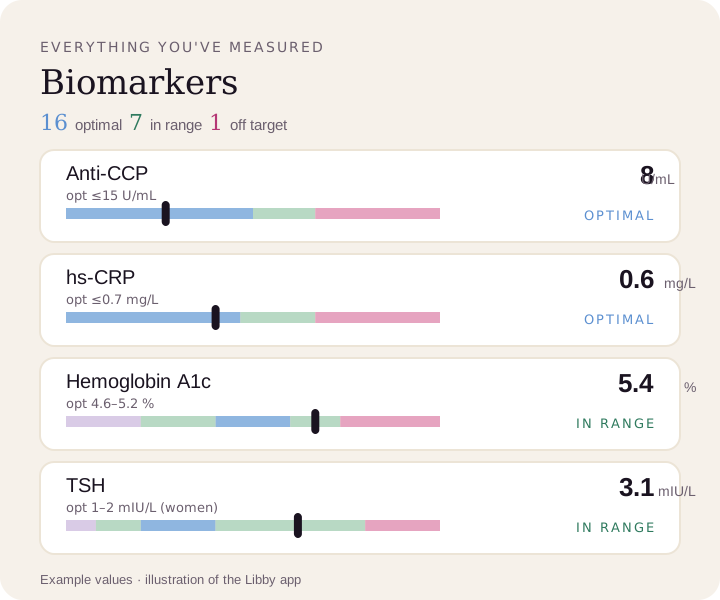
Compare your results to optimal ranges.
Upload a lab PDF or a photo of your report. Libby puts every marker on your lab's range and the optimal range, and tracks your trends over time.
View your anti-CCP ›