ANA test: positive results, titers and patterns explained
A positive ANA is common in healthy people. Here's what your titer and pattern mean, which follow-up antibodies matter, and when a result needs prompt care.
An ANA (antinuclear antibody) test looks for antibodies that stick to the nucleus of your own cells. A positive result is common: about 1 in 7 people in the U.S. has one at the usual 1:80 cutoff, and most of them are healthy.12 The result matters most when the titer is high, the pattern is a telling one, symptoms fit, and follow-up antibodies such as anti-dsDNA come back positive.34
The short version
- Normal: negative, or below your lab's cutoff (Labcorp calls anything below 1:80 negative).5 About 13% of healthy adults test positive at 1:80 and 5% at 1:160.2
- A low positive (1:40 to 1:80) usually has an everyday explanation: healthy people (especially women and older adults), a recent viral infection, other autoimmune conditions such as thyroid disease, or a medicine.67
- No ANA number is an emergency on its own; symptoms are. Get prompt care for pain when you breathe deeply, new swelling in your legs or around your eyes, new confusion or a seizure.8
- 1:160 or higher deserves a closer look, and the pattern plus follow-up antibodies say which disease, if any, it points to.34 A negative ANA makes lupus unlikely: at 1:80 the test picks up about 98% of people with lupus.9
What ANA is
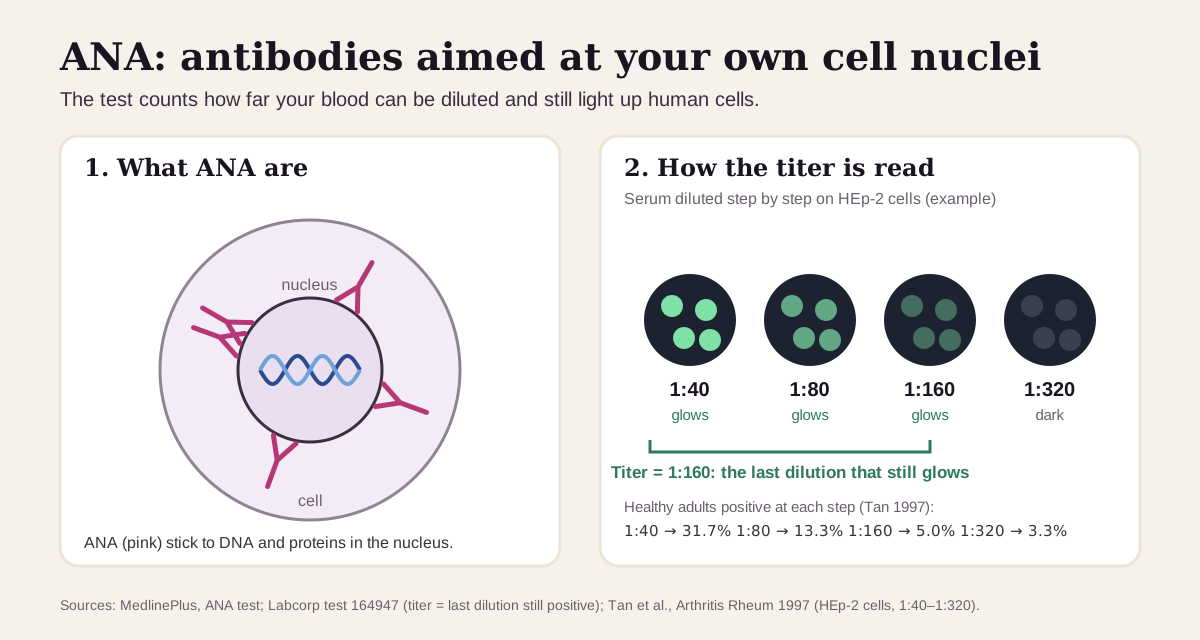
Antibodies are proteins your immune system makes to fight germs. Antinuclear antibodies are ones that target your own cells instead, specifically the nucleus, the control center that holds your DNA.6 A few are normal. A lot of them, especially of certain kinds, can be a sign of an autoimmune disease such as lupus.6
The standard test puts your blood serum on a slide of human cells grown in a lab (called HEp-2 cells), then adds a glowing dye that sticks to any human antibody that has latched on. The lab dilutes your serum in steps (1:40, 1:80, 1:160, 1:320) and reports:25
- positive or negative;
- the titer, the most diluted step that still glows;
- the pattern, the shape of the glow inside the nucleus, which hints at which part of the nucleus the antibodies target.
Clinicians order an ANA when symptoms suggest an autoimmune disease: joint pain and swelling, rashes, fevers, fatigue, muscle pain or swollen glands.6 In one clinic that sees people sent in for a positive ANA, the most common reason the test had been ordered was widespread pain (23% of referrals).3
What's a normal ANA?
Negative, or positive only below your lab's cutoff. Labcorp, for example, calls a result below 1:80 negative, 1:80 borderline, and above 1:80 positive.5 Cutoffs differ between labs, so read yours.
Healthy people test positive surprisingly often:
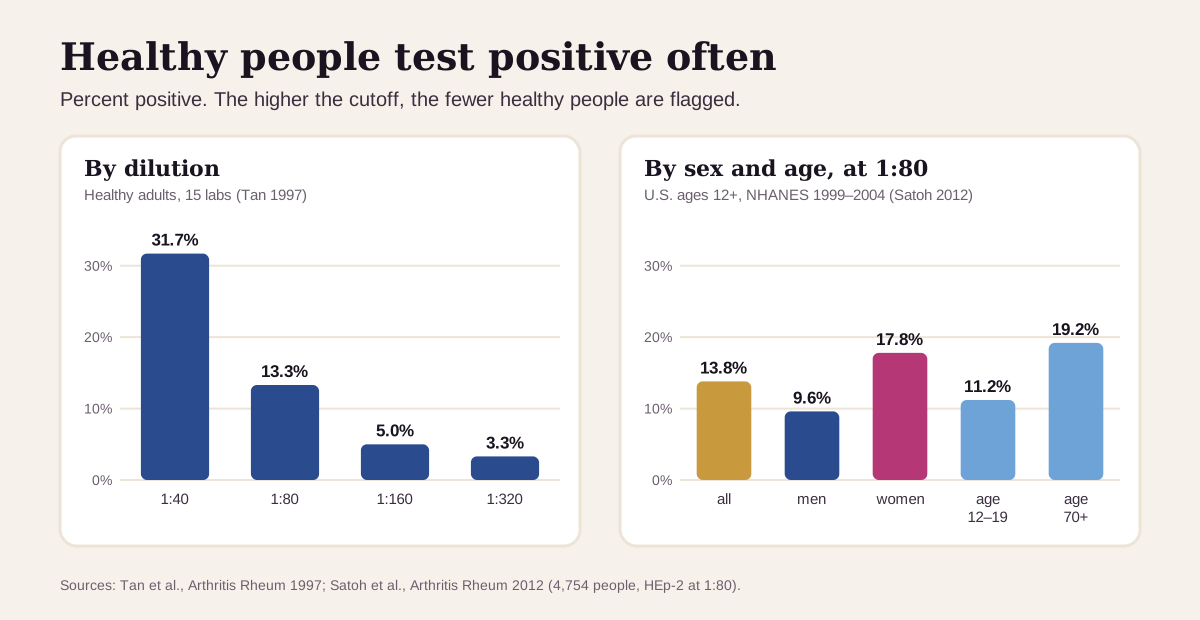
- Fifteen reference labs tested healthy adults at four dilutions. 31.7% were positive at 1:40, 13.3% at 1:80, 5.0% at 1:160 and 3.3% at 1:320. The share was about the same from age 20 to 60.2
- In a U.S. national sample of 4,754 people aged 12 and up, 13.8% were positive at 1:80: 17.8% of women and 9.6% of men, rising to 19.2% at age 70 and older.1
- It's becoming more common. The same survey found 11.0% positive in 1988–1991 and 15.9% in 2011–2012, about 41 million people.10
- Labcorp notes that about half of people over 80 have a low-titer ANA.5
"Optimal" ANA: where the cutoffs sit
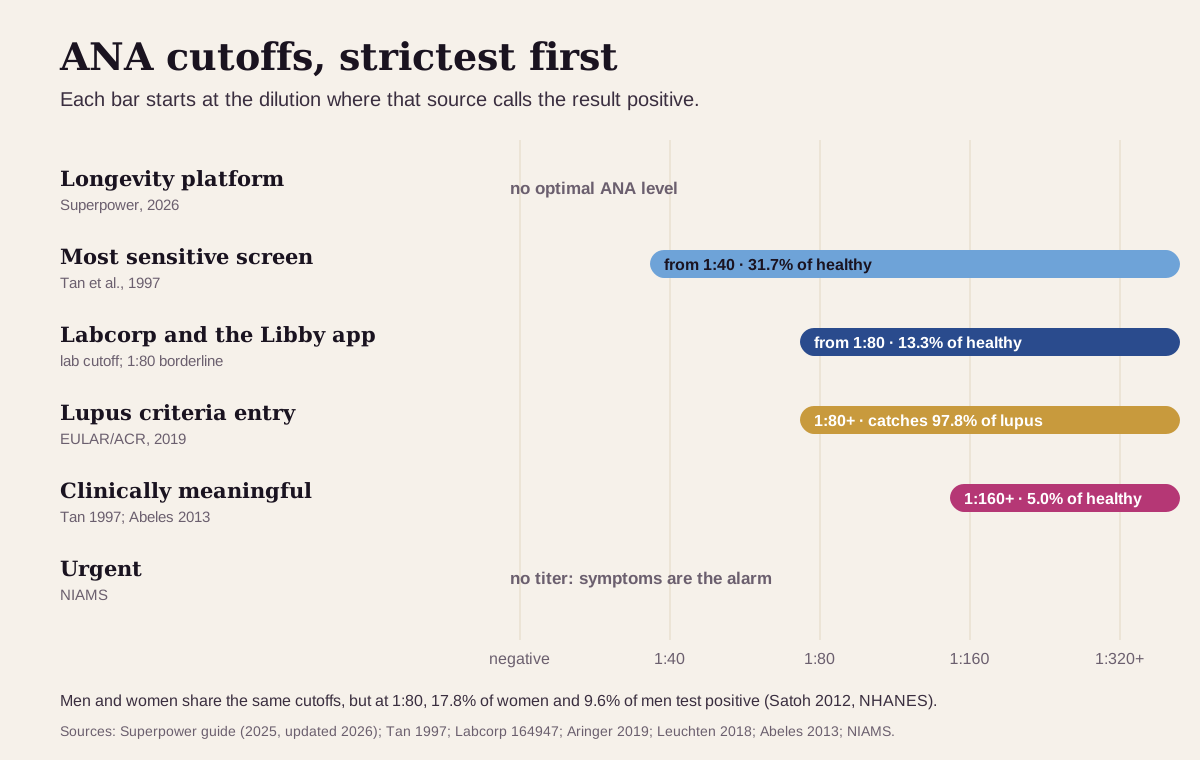
ANA is a yes-or-no test with a strength attached, so there's no "optimal" number to aim for. Even a longevity-testing company says so.11 The real question is where to draw the line between a positive that means little and one that deserves a workup. Here are the lines in use, from strictest to loosest:
| Target | Counts as positive | Healthy adults positive at this cut | Who uses it |
|---|---|---|---|
| Longevity platform | no target of its own | — | Superpower: no "optimal" ANA level, because "this test is about probability, not peak performance"11 |
| Most sensitive screen | 1:40 and up | 31.7% | Catches almost everyone with lupus, Sjögren's or scleroderma2 |
| Labcorp and the Libby app | 1:80 and up | 13.3% | Labcorp's cutoff (1:80 is "borderline").5 The Libby app flags an ANA of 1:80 or higher and has no separate optimal range for ANA |
| Lupus classification entry | 1:80 and up | 13.3% | EULAR/ACR 2019 lupus criteria require this before anything else counts12 |
| Clinically meaningful | 1:160 and up | 5.0% | Tan's group (screens out 95% of healthy people),2 most labs7 |
| Urgent | no titer | — | Symptoms, not the number: see the box below8 |
Men and women: the cutoffs are the same, but positives are about twice as common in women: 17.8% versus 9.6% at 1:80.1
Why higher cutoffs exist. Every step up the ladder flags fewer healthy people and misses a few more people with lupus:
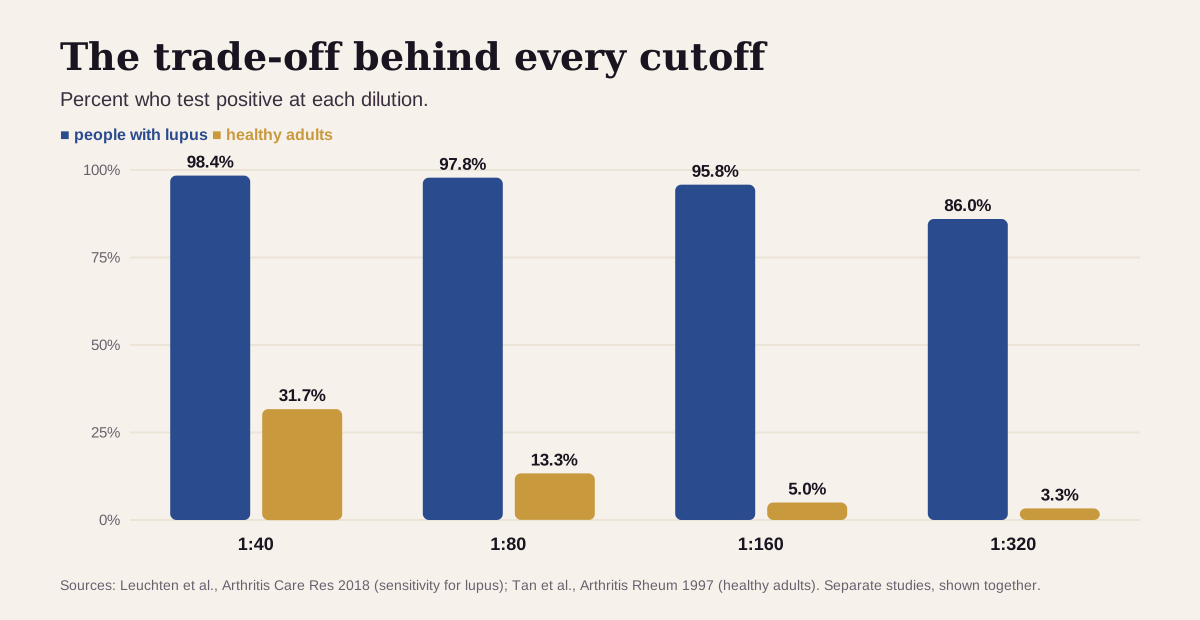
- A review of 13,080 people with lupus found the ANA was positive in 98.4% at 1:40, 97.8% at 1:80, 95.8% at 1:160 and 86.0% at 1:320. That's why the lupus criteria use 1:80 as the entry gate.912
- In the other direction, a rheumatology clinic reviewed 232 people sent in for a positive ANA. Only 2.1% had lupus and 9.1% had any ANA-linked disease, and none of those below 1:160 did.3
Keep "optimal" in perspective. A positive ANA is a reason to look at your symptoms and a few follow-up antibodies, and it's no diagnosis by itself. Healthy people with a positive ANA usually stay well: in one study, none of 40 healthy people followed for about four years developed an autoimmune disease.13
What a positive ANA usually means
The titer is the first clue; the pattern is the second. Low titers are common and usually harmless. From 1:160 up, the ANA-linked diseases start to show up, though many people at these titers are still healthy: 5% of healthy adults test positive at 1:160.23
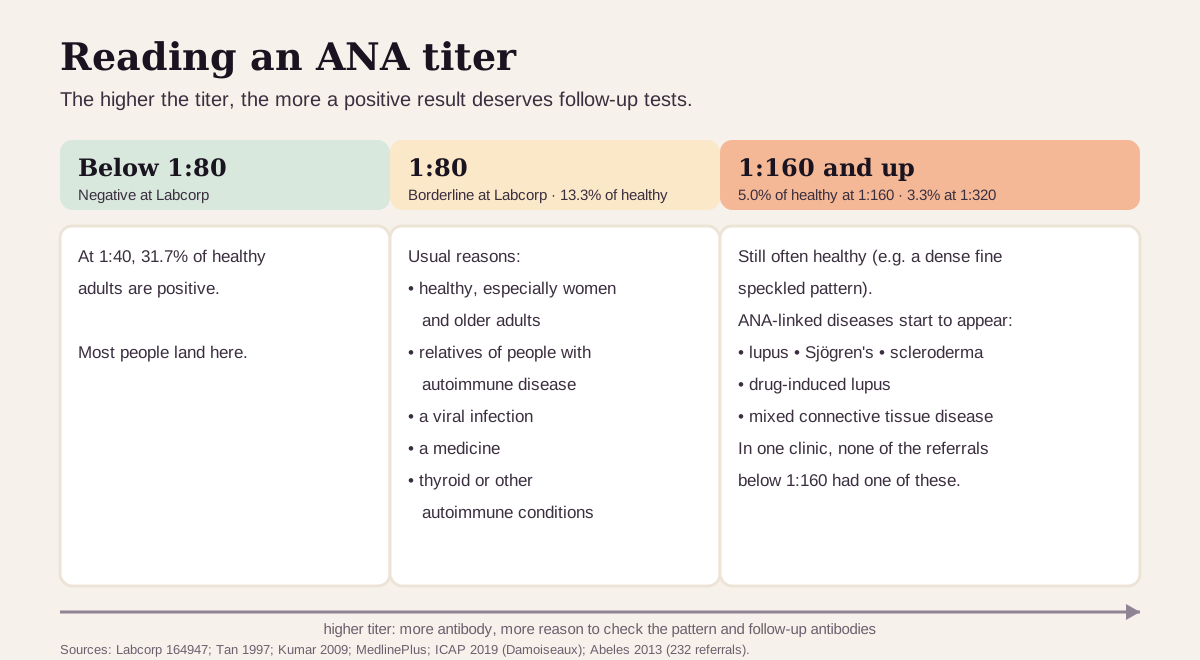
The usual reasons, most common first
- Nothing wrong at all. This is the most common reason by far. About 1 in 7 people in the U.S. is positive at 1:80, while lupus is rare, which is why only about 2% of positives in the clinic study turned out to be lupus.13 Positives are more common in women, older adults and relatives of people with autoimmune disease.17
- Another autoimmune condition. Autoimmune thyroid disease, rheumatoid arthritis, autoimmune liver disease and immune low platelets can all come with a positive ANA.76
- An infection. A viral infection can bring ANA on for a short time; long-lasting infections can too.67
- A medicine. Over 100 drugs can trigger drug-induced lupus. Hydralazine (a blood-pressure drug) carries a 5–8% risk and procainamide (a heart-rhythm drug) about 20%; TNF-blocking drugs were the most often reported cause in recent case reports.14 It usually settles after the drug is stopped.145 Don't stop a prescribed medicine on your own. Bring your full list to your clinician.6
- Less common: cancer can also raise ANA.67
The ANA diseases: less common, and why the test exists
- Lupus (SLE). Almost everyone with lupus has a positive ANA, which is why a negative test makes lupus unlikely.9 Diagnosis rests on symptoms plus specific findings such as anti-dsDNA, anti-Sm and low complement (C3, C4).12
- Sjögren's disease (dry eyes and dry mouth). Estimates of how many have a positive ANA run from about half in one review to 80% at Labcorp, and nearly all at a 1:40 cutoff.752 Anti-SSA (Ro) is the antibody in its classification criteria.15
- Scleroderma (systemic sclerosis). 60% to 90% have a positive ANA.5 A centromere pattern points to the limited form.4
- Mixed connective tissue disease and inflammatory muscle disease show up with certain speckled patterns and their own follow-up antibodies.4
Get prompt care if a positive ANA comes with pain when you breathe deeply or lie down, new swelling in your legs or around your eyes, new confusion, or a seizure. These can be signs of lupus affecting organs, such as inflammation of the lining around the lungs or heart.8
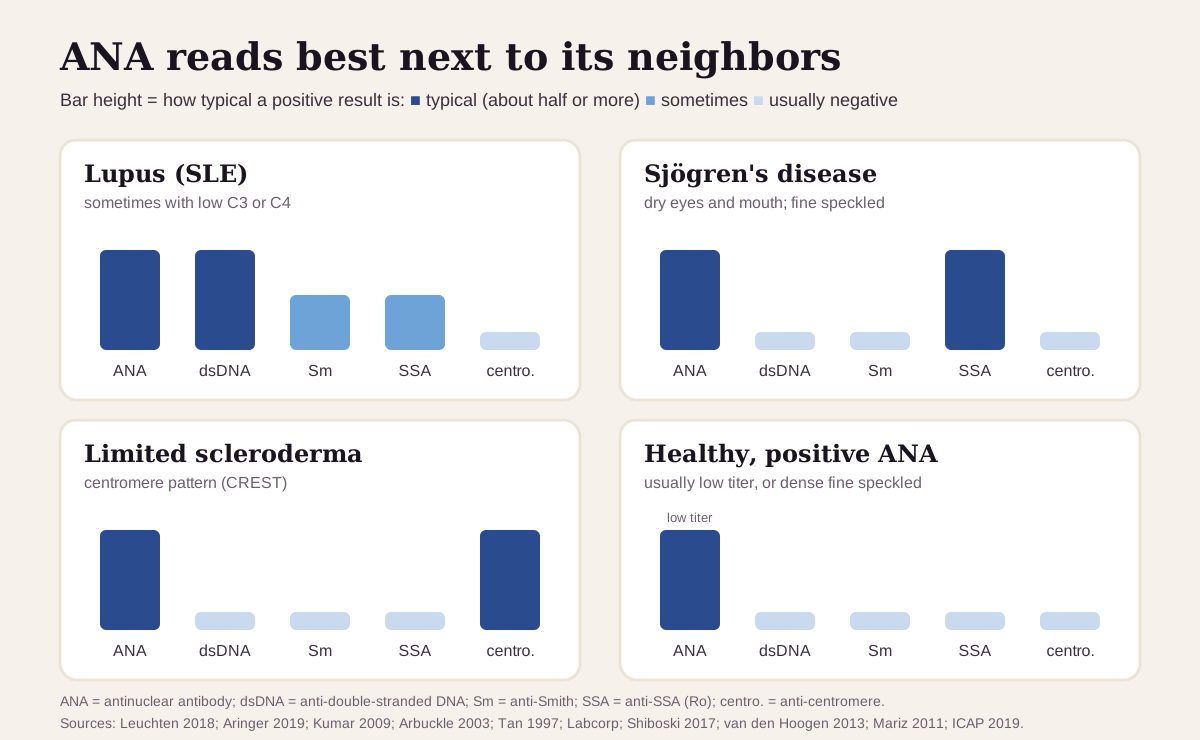
ANA reads best next to its neighbors
A positive ANA opens a question; the follow-up antibodies answer it. The pattern suggests which ones to run next:4
| If you see… | It often points to… |
|---|---|
| ANA plus anti-dsDNA or anti-Sm, especially with low C3 or C4 | lupus: the ANA, anti-dsDNA, anti-Sm and low complement are all part of the lupus criteria, and anti-dsDNA is about 97% specific for lupus127 |
| ANA (fine speckled) plus anti-SSA (Ro) | Sjögren's disease: a positive anti-SSA scores 3 of the 4 points needed to classify it154 |
| ANA with a centromere pattern, anti-centromere positive | limited scleroderma (CREST): anti-centromere is about 99.9% specific7175 |
| ANA (homogeneous) plus anti-histone, on a medicine such as hydralazine or procainamide | drug-induced lupus714 |
| ANA alone, low titer or a "dense fine speckled" pattern, follow-ups negative | a healthy person: common, and usually stable over years134 |
How fast ANA changes
In lupus, antibodies show up years before the diagnosis. In stored blood from 130 U.S. service members who later developed lupus, 88% had at least one lupus antibody before diagnosis, on average 3.3 years earlier and up to 9.4 years. ANA, anti-Ro and anti-La came first (3.4 years ahead on average), anti-dsDNA next (2.2 years), and anti-Sm and anti-RNP last (1.2 years).16
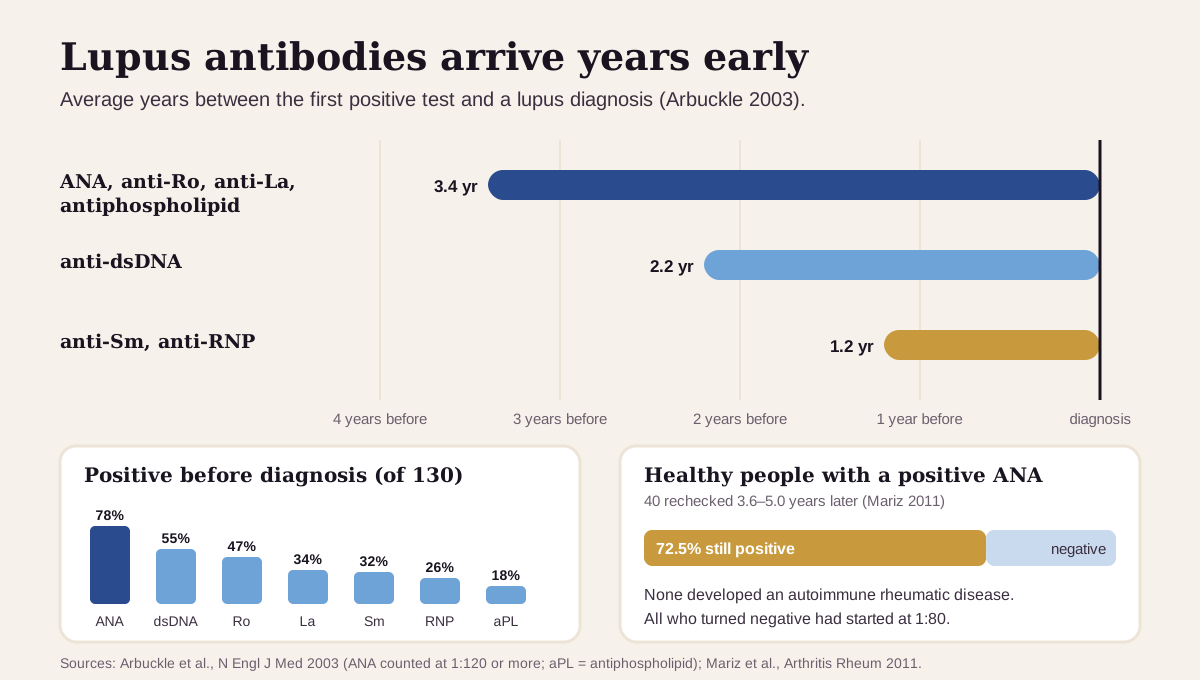
What that means in practice:
- In healthy people, a positive ANA tends to stay put. When 40 healthy people with a positive ANA were retested 3.6 to 5 years later, 72.5% were still positive and none had developed disease. The ones who turned negative had all started at 1:80.13
- Some positives fade. ANA from a viral infection is usually short-lived,6 and after a drug-induced lupus the titer usually falls once the drug is stopped.5
- Trends beat snapshots, but for new antibodies more than for the ANA itself. A repeat ANA mostly confirms it's still there. What changes the picture is a new follow-up antibody or new symptoms.1613 Compare results from the same lab, because methods and cutoffs differ.218
Going deeper: titers, patterns and methods
Titers double. Each step halves the serum's strength, so 1:320 is 8 times as dilute as 1:40, and a one-step change between tests (1:160 to 1:320) is the smallest change the test can show. Tan's group suggested labs report results at both 1:40 and 1:160, with the share of healthy people positive at each.2
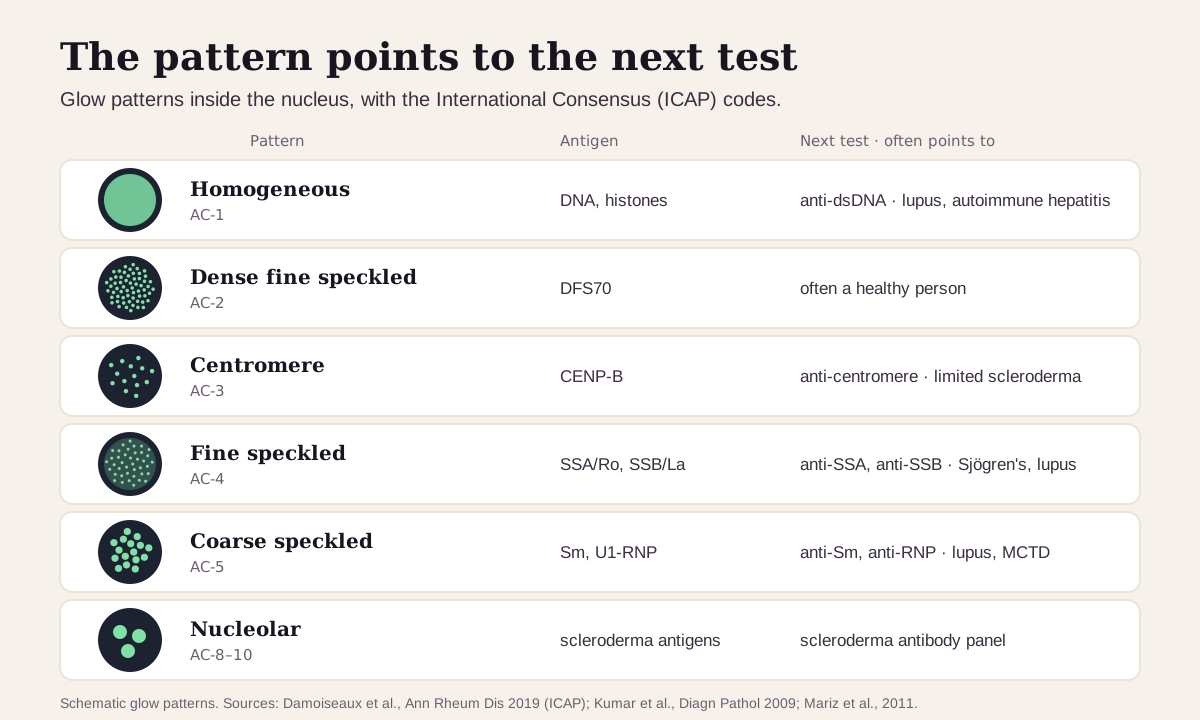
Patterns carry information. An international group has named 29 HEp-2 patterns, each with a code (AC-1, AC-2…) and advice on what to test next:4
- Homogeneous (AC-1): seen in lupus and autoimmune hepatitis; next test, anti-dsDNA.
- Dense fine speckled (AC-2): often found, sometimes at high titer, in healthy people. In one study it turned up only in healthy people, while the homogeneous, coarse speckled and centromere patterns turned up only in people with autoimmune rheumatic disease.413
- Centromere (AC-3): points to limited scleroderma.
- Fine speckled (AC-4): Sjögren's, lupus; next tests, anti-SSA and anti-SSB.
- Coarse speckled (AC-5): lupus, scleroderma, mixed connective tissue disease; next tests, anti-Sm and anti-RNP.
Methods differ. The glowing-cell test (indirect immunofluorescence on HEp-2 cells) is the reference method. Faster automated tests also exist; they detect different sets of antigens, so results between methods can disagree.187
ANA is the gate to the lupus criteria. The 2019 EULAR/ACR criteria first require an ANA of 1:80 or higher, then add weighted points for symptoms and tests. A score of 10 or more classifies lupus, which picked out lupus with 96.1% sensitivity and 93.4% specificity when tested.12
Questions worth asking
- What was my titer and pattern, and what's my lab's cutoff?
- Do my symptoms fit an autoimmune disease, or was this a screening test?
- Which follow-up antibodies were run (anti-dsDNA, anti-Sm, anti-SSA, anti-centromere), and what did they show?
- Should my C3 and C4 be checked?
- Could any of my medicines be involved?
- Do I need a repeat test, or would only new symptoms change the plan?
FAQ
What does a positive ANA mean? That your blood has antibodies to parts of your own cell nuclei. It's common in healthy people: about 1 in 7 in the U.S. at 1:80. It points toward an autoimmune disease mainly at higher titers, with certain patterns, with symptoms, or with positive follow-up antibodies.13
What ANA titer is significant? Many labs flag 1:80 and up.5 Titers of 1:160 and higher are more meaningful: only about 5% of healthy adults reach them, and in one clinic nobody below 1:160 had an ANA-linked disease.23
Can a positive ANA go away? Sometimes. It's often short-lived after a viral infection and usually falls after a drug-induced lupus. In healthy people it more often stays: 72.5% were still positive about four years later.6513
Does a negative ANA rule out lupus? Close to it. At 1:80 the test is positive in about 98% of people with lupus.9 A small group of people with lupus test negative, often with anti-SSA antibodies, so symptoms still matter.5
This guide is for education. It can't diagnose you or replace care from a clinician who knows your history.
Footnotes
-
Satoh M, Chan EK, Ho LA, Rose KM, et al. Prevalence and sociodemographic correlates of antinuclear antibodies in the United States. Arthritis Rheum. 2012;64(7):2319–2327. 4,754 people in NHANES 1999–2004, tested at 1:80. PMC ↩ ↩2 ↩3 ↩4 ↩5 ↩6 ↩7
-
Tan EM, Feltkamp TE, Smolen JS, Butcher B, et al. Range of antinuclear antibodies in "healthy" individuals. Arthritis Rheum. 1997;40(9):1601–1611. Fifteen international labs tested healthy adults on HEp-2 cells at 1:40, 1:80, 1:160 and 1:320 (31.7%, 13.3%, 5.0% and 3.3% positive). PubMed ↩ ↩2 ↩3 ↩4 ↩5 ↩6 ↩7 ↩8 ↩9 ↩10 ↩11 ↩12 ↩13 ↩14 ↩15 ↩16 ↩17
-
Abeles AM, Abeles M. The clinical utility of a positive antinuclear antibody test result. Am J Med. 2013;126(4):342–348. 232 people referred to a rheumatology clinic for a positive ANA. PubMed ↩ ↩2 ↩3 ↩4 ↩5 ↩6 ↩7 ↩8 ↩9 ↩10
-
Damoiseaux J, Andrade LEC, Carballo OG, Conrad K, et al. Clinical relevance of HEp-2 indirect immunofluorescent patterns: the International Consensus on ANA patterns (ICAP) perspective. Ann Rheum Dis. 2019;78(7):879–889. The international naming system for ANA patterns and the follow-up test for each. PMC ↩ ↩2 ↩3 ↩4 ↩5 ↩6 ↩7 ↩8 ↩9 ↩10 ↩11 ↩12 ↩13
-
Labcorp. ANA by IFA, Reflex to Titer and Pattern (test 164947). A commercial laboratory's test page: its cutoffs (negative below 1:80, borderline 1:80), the over-80 and drug-induced notes, and ANA frequency by disease. labcorp.com ↩ ↩2 ↩3 ↩4 ↩5 ↩6 ↩7 ↩8 ↩9 ↩10 ↩11 ↩12 ↩13 ↩14 ↩15 ↩16 ↩17 ↩18
-
National Library of Medicine. ANA (Antinuclear Antibody) Test. MedlinePlus. What ANA are, why the test is ordered, and the causes of a positive result. MedlinePlus ↩ ↩2 ↩3 ↩4 ↩5 ↩6 ↩7 ↩8 ↩9 ↩10 ↩11
-
Kumar Y, Bhatia A, Minz RW. Antinuclear antibodies and their detection methods in diagnosis of connective tissue diseases: a journey revisited. Diagn Pathol. 2009;4:1. Review with the sensitivity and specificity of the follow-up antibodies and the non-autoimmune causes of a positive ANA. PMC ↩ ↩2 ↩3 ↩4 ↩5 ↩6 ↩7 ↩8 ↩9 ↩10 ↩11 ↩12 ↩13
-
National Institute of Arthritis and Musculoskeletal and Skin Diseases. Lupus: symptoms, causes and risk factors. NIH. The symptom list behind the "get prompt care" box. NIAMS ↩ ↩2 ↩3 ↩4
-
Leuchten N, Hoyer A, Brinks R, Schoels M, et al. Performance of Antinuclear Antibodies for Classifying Systemic Lupus Erythematosus: A Systematic Literature Review and Meta-Regression of Diagnostic Data. Arthritis Care Res (Hoboken). 2018;70(3):428–438. 13,080 people with lupus in 64 studies; the evidence behind the 1:80 entry criterion. PubMed ↩ ↩2 ↩3 ↩4 ↩5 ↩6
-
Dinse GE, Parks CG, Weinberg CR, Co CA, et al. Increasing Prevalence of Antinuclear Antibodies in the United States. Arthritis Rheumatol. 2020;72(6):1026–1035. 14,211 NHANES participants across three survey periods. PMC ↩
-
Superpower. ANA Test: Why 1 in 7 Healthy Adults Tests Positive. Published November 15, 2025; updated August 31, 2026. States that "there isn't an 'optimal' ANA level the way there is for cholesterol." A commercial source, listed as what the optimizer community says. superpower.com ↩ ↩2 ↩3
-
Aringer M, Costenbader K, Daikh D, Brinks R, et al. 2019 European League Against Rheumatism/American College of Rheumatology Classification Criteria for Systemic Lupus Erythematosus. Arthritis Rheumatol. 2019;71(9):1400–1412. The current lupus criteria: ANA of 1:80 or higher as the entry, then weighted points including anti-dsDNA, anti-Sm and low C3/C4. PMC ↩ ↩2 ↩3 ↩4 ↩5 ↩6 ↩7
-
Mariz HA, Sato EI, Barbosa SH, Rodrigues SH, et al. Pattern on the antinuclear antibody-HEp-2 test is a critical parameter for discriminating antinuclear antibody-positive healthy individuals and patients with autoimmune rheumatic diseases. Arthritis Rheum. 2011;63(1):191–200. 918 healthy people and 153 patients; ANA-positive healthy people rechecked 3.6–5.0 years later. PubMed ↩ ↩2 ↩3 ↩4 ↩5 ↩6 ↩7 ↩8
-
He Y, Sawalha AH. Drug-induced lupus erythematosus: an update on drugs and mechanisms. Curr Opin Rheumatol. 2018;30(5):490–497. Over 100 implicated drugs; hydralazine and procainamide risks. PMC ↩ ↩2 ↩3
-
Shiboski CH, Shiboski SC, Seror R, Criswell LA, et al. 2016 American College of Rheumatology/European League Against Rheumatism Classification Criteria for Primary Sjögren's Syndrome. Arthritis Rheumatol. 2017;69(1):35–45. Anti-SSA (Ro) scores 3 points; a total of 4 classifies. PMC ↩ ↩2 ↩3
-
Arbuckle MR, McClain MT, Rubertone MV, Scofield RH, et al. Development of autoantibodies before the clinical onset of systemic lupus erythematosus. N Engl J Med. 2003;349(16):1526–1533. Stored serum from 130 U.S. service members before a lupus diagnosis, with matched controls. PubMed ↩ ↩2 ↩3 ↩4
-
van den Hoogen F, Khanna D, Fransen J, Johnson SR, et al. 2013 classification criteria for systemic sclerosis: an American College of Rheumatology/European League against Rheumatism collaborative initiative. Arthritis Rheum. 2013;65(11):2737–2747. Anti-centromere is one of the scleroderma antibodies in the criteria. PMC ↩ ↩2
-
Agmon-Levin N, Damoiseaux J, Kallenberg C, Sack U, et al. International recommendations for the assessment of autoantibodies to cellular antigens referred to as anti-nuclear antibodies. Ann Rheum Dis. 2014;73(1):17–23. International expert recommendations naming immunofluorescence as the reference method. PubMed ↩ ↩2
Educational content, not medical advice. Libby is a personal record tool, not a medical service — it doesn't diagnose, treat, or prescribe. Reference ranges vary by lab and by person. Talk to a qualified healthcare professional about your results.
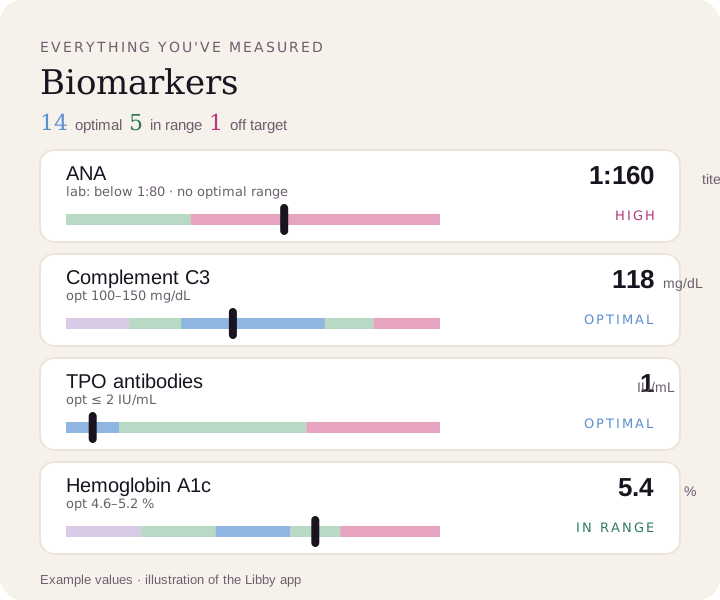
See every result against your lab's range.
Upload a lab PDF or a photo of your report. Libby shows your ANA against a 1:80 lab cutoff, puts markers like C3 on your lab's range and the optimal range, and tracks each new test over time.
View your ANA ›