Band neutrophils (bands): what a high count means
Bands are young neutrophils. Here's what a normal band count is, what a left shift means, why labs disagree on bands, and when high bands are urgent.
Band neutrophils ("bands") are young neutrophils, the white blood cells that fight bacteria, caught one step before they're fully mature. Their nucleus is a single curved band instead of the separate lobes of a mature cell.1 Your bone marrow releases more of them when it's under strain, most often from an infection. A rise in bands is called a left shift.2
The short version
- Normal: a few percent of your white cells. MedlinePlus lists 0–3%, and the Libby app flags bands above 6%. Use the range on your own report.3
- High usually means your marrow is answering a call: bacterial infection most often, but also viruses in young children, surgery or injury, and a hard workout.245
- Over 10% was a classic sepsis flag. In one study of 970 people who had blood cultures, 52% of those with bands over 10% had bacteria in the blood, versus 13% of the rest.67 Fever with confusion, fast breathing or low blood pressure needs care now, whatever the band count.6
- Bands are hard to count. People reading the same slide can disagree several-fold, which is why expert groups now advise folding bands into the neutrophil count.81
What band neutrophils are
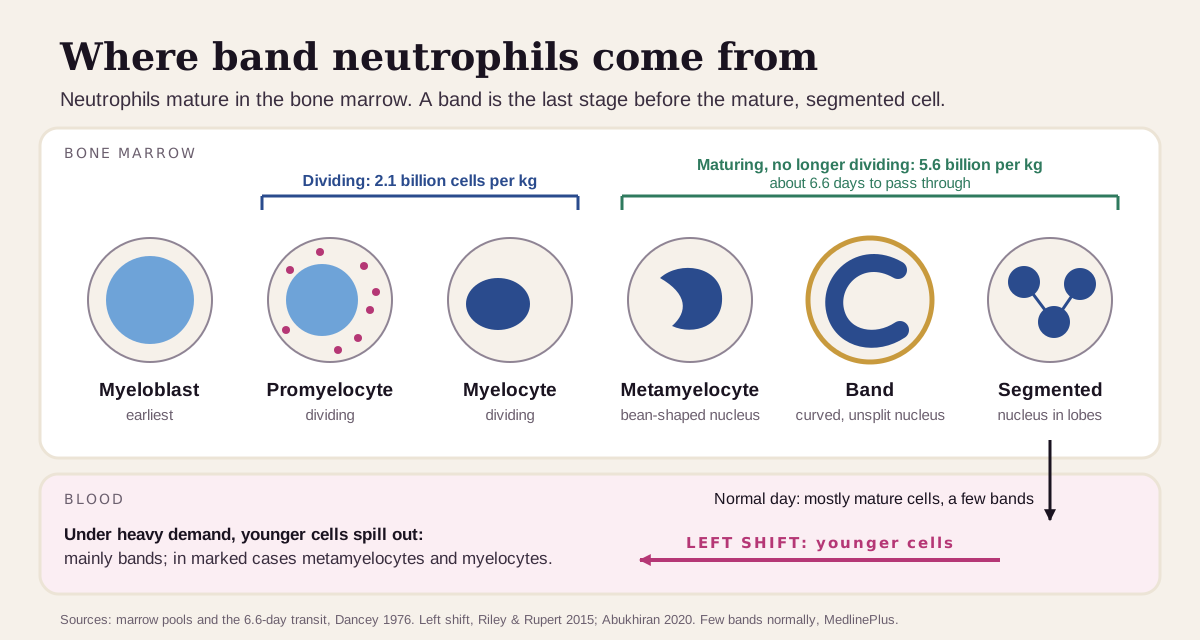
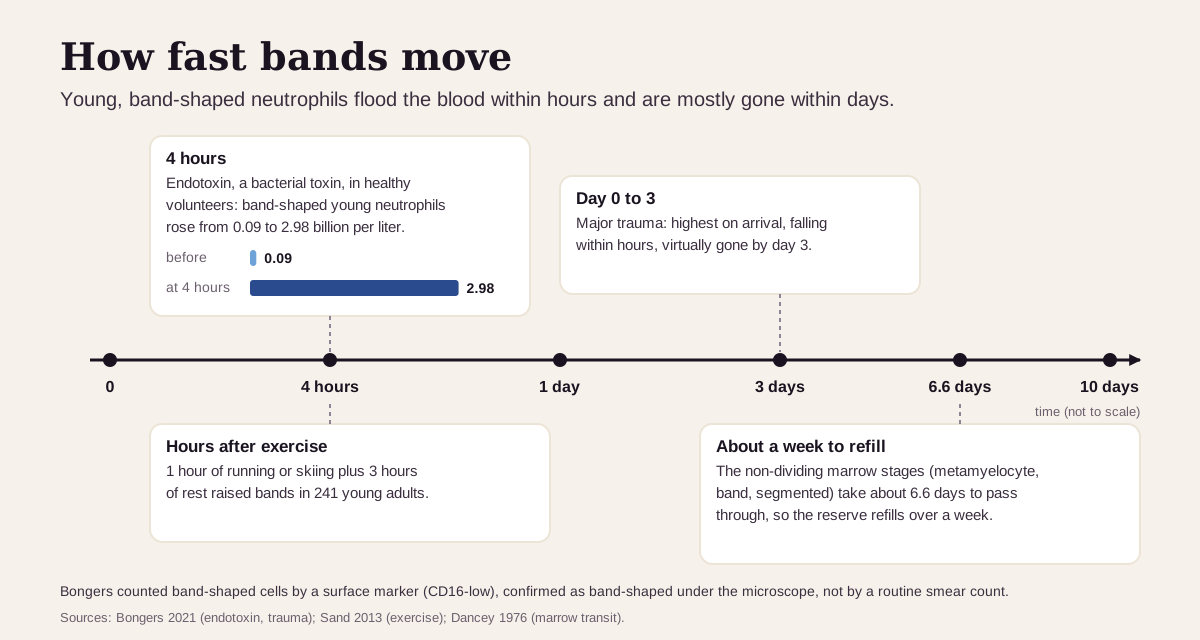
Neutrophils grow up in your bone marrow in stages. The early stages (promyelocytes and myelocytes) still divide. The later ones (metamyelocytes, bands and segmented cells) only mature, and passing through them takes about 6.6 days.9 A band is the second-to-last stage: its nucleus has curved into a thick band but hasn't split into lobes yet.1
Healthy marrow keeps a large reserve of these maturing cells, about 5.6 billion per kilogram of body weight, against 2.1 billion in the dividing stages.9 On a normal day it sends out mostly mature, segmented neutrophils. When demand jumps, as with a bacterial infection, it sends out younger cells too, mainly bands and some metamyelocytes. That's the left shift.2
You'll usually see bands on a manual differential: a lab scientist looks at a stained blood smear under a microscope and sorts 100 white cells by type.1 Most blood counts are run on an analyzer. At Labcorp, a large commercial lab, a person reviews a smear only when the machine flags something, and a bands result appears only after that review.11
What's a normal band count?
Start with the range on your own report. For bands, ranges differ more than for most tests:
- MedlinePlus lists 0–3% of white cells.3
- The Libby app flags bands above 6%.
- One hospital's lab, in a pediatric emergency department study, counted bands above 5% as high.4
Many reports print no band range at all. In a 2024 survey by the College of American Pathologists (CAP), 86% of labs that did manual counts reported bands, but only 73% of those answering gave a band reference range.8
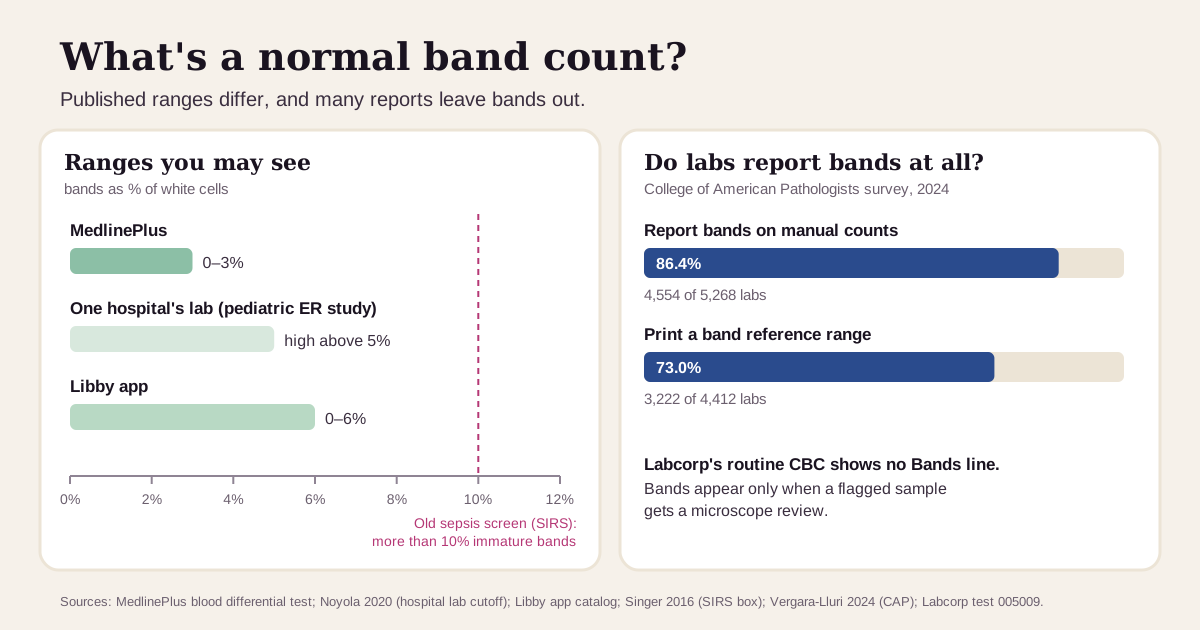
The ranges wobble because a band is a judgment call. The line between a band and a mature cell comes down to how thin the link between lobes looks.1 In the CAP study, labs recognized "easy" bands 78–98% of the time, but only 3–39% of labs called the harder examples bands; most called them mature neutrophils.8
A low count is the normal state: the MedlinePlus range starts at zero.3
Is there an "optimal" band count?
We found no expert group or longevity platform that publishes an optimal band target, and the Libby app shows bands on your lab's range only. What exists instead is a ladder of cut points, from the normal range up to the thresholds researchers tied to infection:
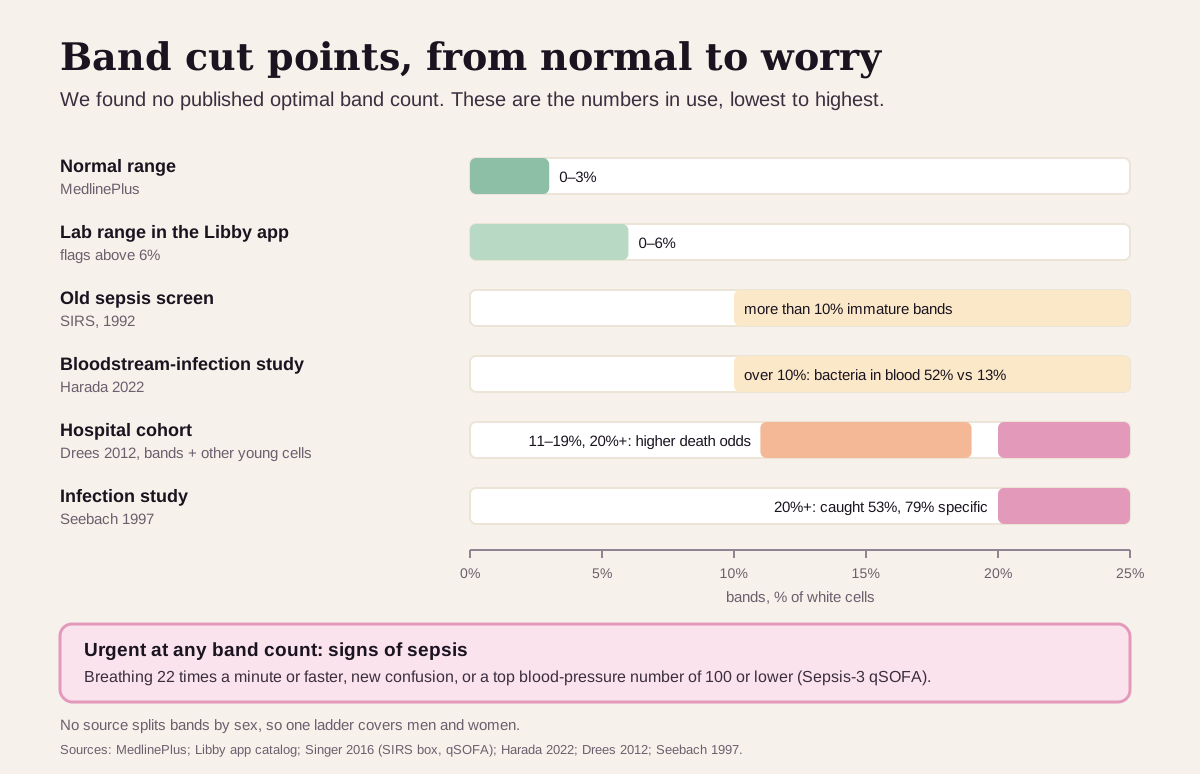
| Cut point | Bands | What it's based on |
|---|---|---|
| Normal range | 0–3% | MedlinePlus3 |
| Lab range in the Libby app | 0–6% | The app flags anything above 6% |
| Old sepsis screen (SIRS) | more than 10% immature bands | One of four signs in the 1992 definition of a body-wide inflammatory response6 |
| Bloodstream-infection study | over 10% | 52% had bacteria in the blood, vs 13% below it7 |
| Hospital cohort | 11–19% and 20% or more | Bands plus other young cells; higher odds of positive cultures and of dying in hospital12 |
| Infection study | 20% or more | Caught 53% of people with infection or inflammation; 79% of those without stayed below it13 |
| Urgent | any level | Signs of sepsis: breathing 22 times a minute or faster, new confusion, or a top blood-pressure number of 100 or lower6 |
No study splits bands by sex, so the same numbers apply to men and women.
Why high bands get attention:
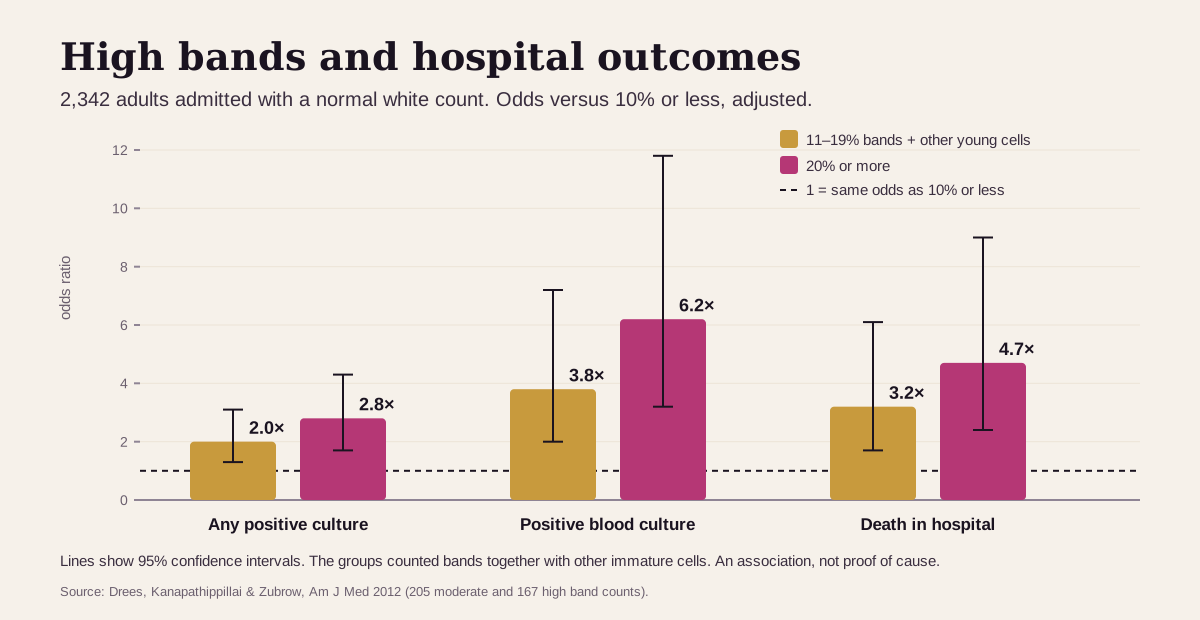
- In 2,342 adults admitted with a normal white count, those whose bands and other young cells made up 11–19% or 20%+ had 2.0 and 2.8 times the odds of a positive culture, 3.8 and 6.2 times the odds of a positive blood culture, and 3.2 and 4.7 times the odds of dying in hospital, compared with people at 10% or less.12
- Among 970 people who had blood cultures, bands over 10% flagged 42% of those with bacteria in the blood, and 91% of those without it stayed at 10% or less.7
Keep these numbers in perspective. They come from people sick enough that their doctors had already ordered a smear or blood cultures. A single 5% or 8% in an otherwise well person can reflect a recent virus, a hard workout or simply who read the slide.451 Bands work best as one clue among several: a count over 10% is a strong hint, while a lower count leaves infection on the table. More than half of the people with bacteremia in the Harada study had counts of 10% or less.7
What high bands usually mean
Bands rise for many of the same reasons neutrophils do. A family-medicine review lists those reasons roughly in order of frequency, with infection first.2 The usual suspects:
- Bacterial infection. The classic cause: pneumonia, urinary and skin infections, and infection in the bloodstream. Bands often rise along with toxic granulation, coarse dark granules in the neutrophils.21413 Timing matters: the left shift is missing in the very earliest and latest phases of an infection, so one count can come too early or too late.15
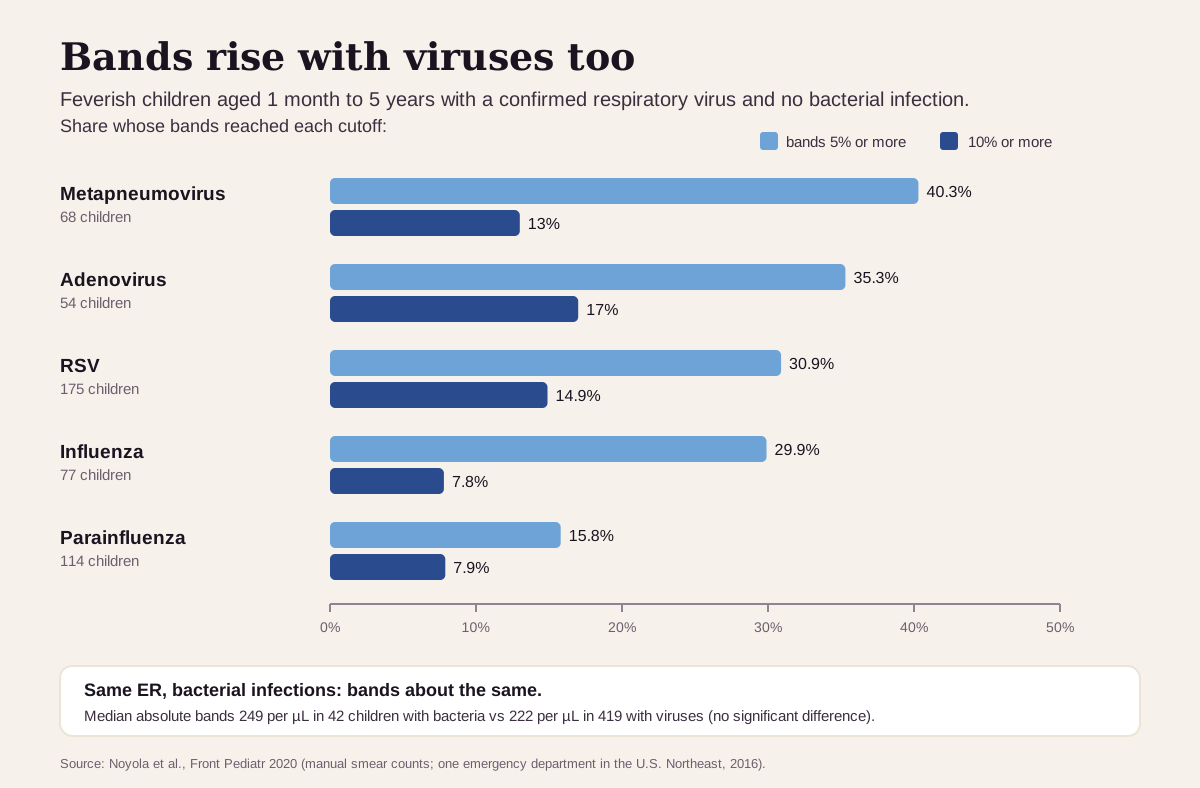
- Viral infections, especially in young children. In an emergency department study of 419 feverish children aged 1 month to 5 years with a confirmed respiratory virus and no bacterial infection, 15% of those with RSV and 17% with adenovirus had bands of 10% or more. Children with bacterial infections in the same ER had about the same band counts.4
- Surgery, injury and other physical stress. Stress hormones push neutrophils off vessel walls and out of the marrow reserve.2 After major trauma, band-shaped neutrophils are high by the time people reach the hospital.16
- Hard exercise. In 241 young adults, an hour of running or skiing followed by 3 hours of rest raised bands; so did 5 minutes of intense cycling in another 273.5
- Medicines. Steroids such as prednisone can push the white count above 20,000, mostly with mature cells. More than 6% bands or toxic granulation are rare with steroids and point toward infection instead.14 Growth-factor medicines (colony-stimulating factors) raise the white count and young granulocytes too.211 Don't stop a prescribed medicine on your own; bring your list to your clinician.
- Less common but important: marrow disorders. Chronic myeloid leukemia (CML) and related conditions can raise bands along with even younger cells. A white count above 100,000 almost always means a leukemia or a related marrow disorder.210
Get care now if high bands come with fever and any sign of sepsis: breathing 22 times a minute or faster, new confusion or drowsiness, or a top blood-pressure number of 100 or lower.6 Also get prompt care for a white count above 30,000, easy bruising or bleeding, night sweats or weight loss, or a report that mentions mostly immature cells.2
Bands read best next to their neighbors
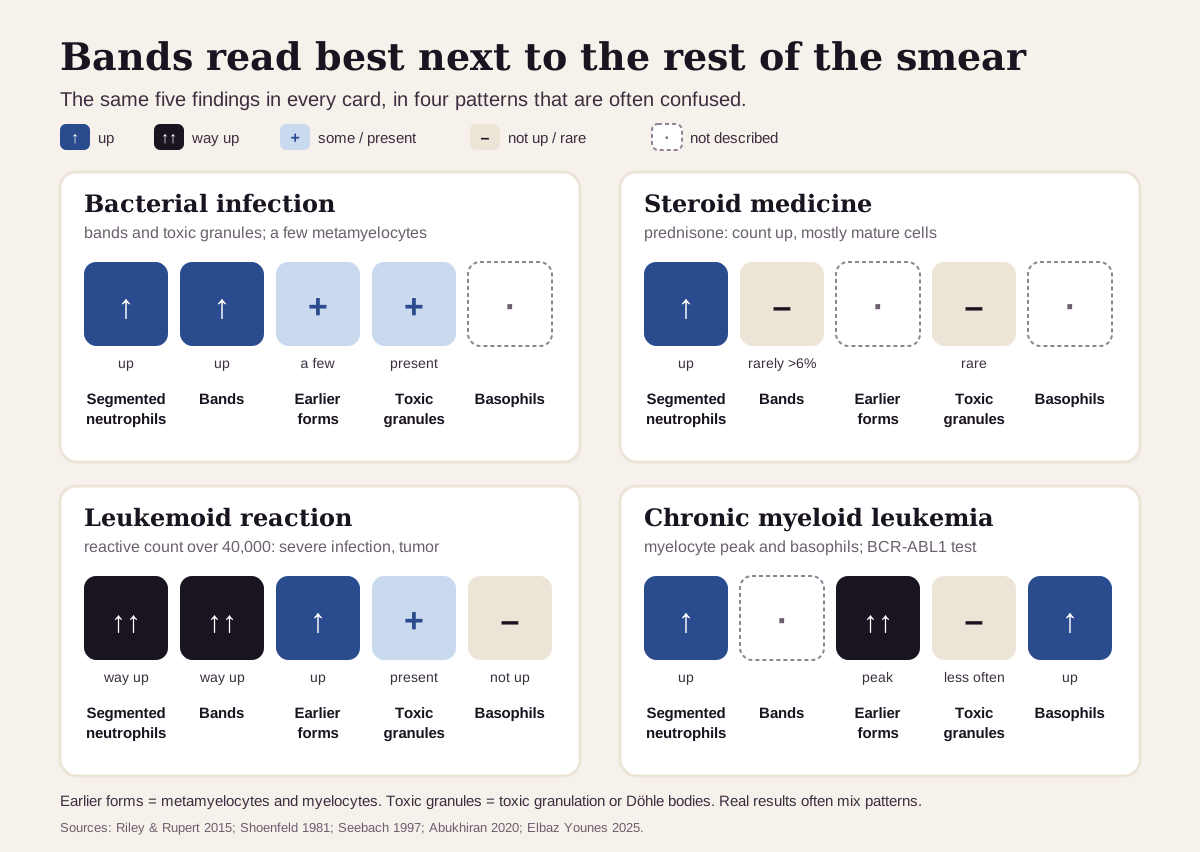
The lines around bands on a smear report usually say more than the band number alone. Four patterns worth knowing:
| If you see… | It often points to… |
|---|---|
| Bands up with toxic granulation, sometimes a few metamyelocytes | bacterial infection or another acute inflammation |
| White count up after starting prednisone, bands 6% or less, no toxic granulation | a steroid effect: in a study of 80 patients on prednisone, the authors found bands over 6% and toxic granulation rare on steroids |
| White count above 40,000 with bands, metamyelocytes, myelocytes, toxic granulation and Döhle bodies, and no extra basophils | a leukemoid reaction: an extreme reactive response to severe infection, bleeding or, rarely, a tumor making growth factors |
| Very high white count with a "myelocyte peak" and extra basophils | chronic myeloid leukemia, which a BCR-ABL1 blood test confirms |
| Bands up in a well-appearing young child with a confirmed RSV or other respiratory virus | can be the virus itself: about 1 in 3 children with RSV had bands of 5% or more in one study |
Sources for the table: bacterial infection;213 steroids;14 leukemoid reaction and CML;1017 viruses in children.4 Ask for your white count and absolute neutrophil count alongside: in adults and most children they are better tests for infection than the band count.18
How fast bands change
Bands move in hours. When healthy volunteers were given a small dose of a bacterial toxin (endotoxin), band-shaped young neutrophils in their blood rose from 0.09 to 2.98 billion per liter within 4 hours. After major trauma the same cells were highest on arrival, fell within hours, and were virtually gone by day 3.16
What that means in practice:
- One count is a snapshot. A repeat a day or two later often tells more, because the left shift and the white count move together through an infection.15
- Mention what happened recently: a fever or cold, a hard workout, surgery or injury, and any new medicine, especially steroids.514
- Compare like with like. Readers and lab rules differ, so trends are most reliable from the same lab.1
Why many labs stopped counting bands separately
Band counts depend heavily on who is looking. In seven Croatian hospital labs, every staff member counted the same smear: in one lab, readers' band counts ranged from 12% to 59% on a single slide. When bands and mature neutrophils were counted together, the spread shrank to a few percent.1
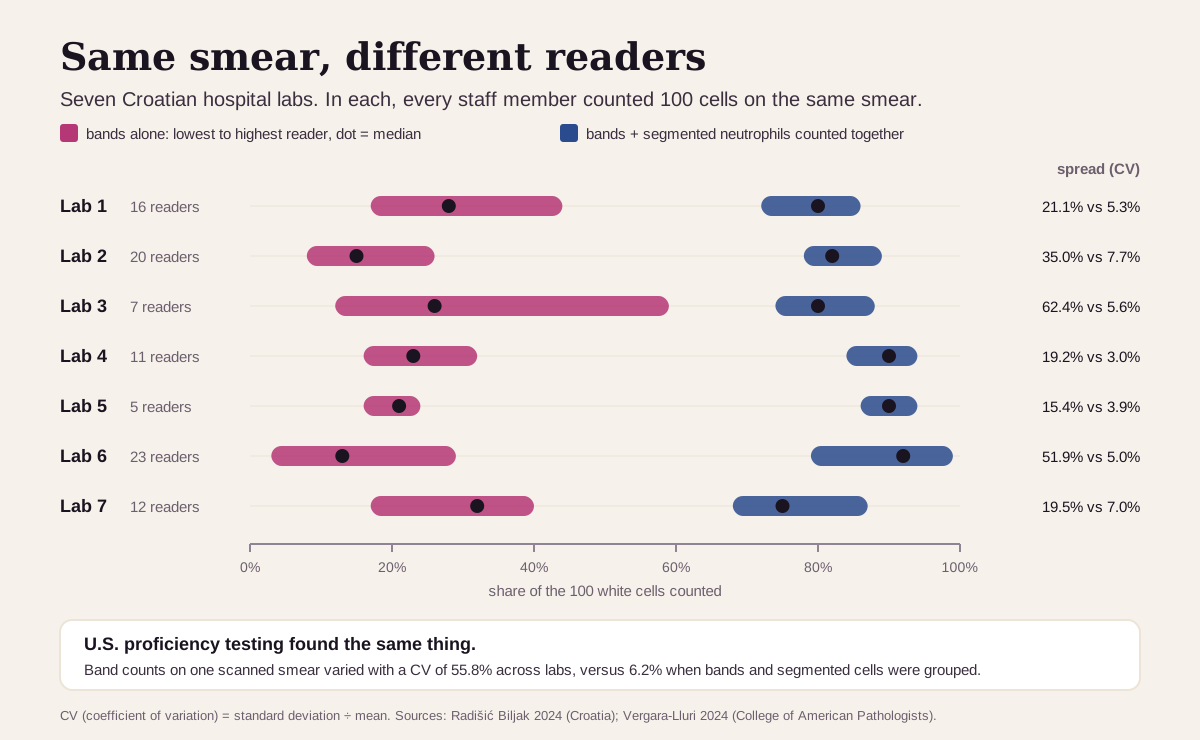
CAP found the same thing across U.S. labs: band counts on one scanned smear varied with a CV of 55.8%, versus 6.2% when bands and segmented cells were grouped. Its hematology committee strongly recommends grouping them.8 The International Council for Standardization in Haematology gave the same advice in 2015.1
The clinical case for bands has also thinned. A Stanford review found little support for band counts in anyone older than 3 months; the white count and the analyzer's neutrophil count did better in adults and most children.18 And the 2016 international sepsis definitions (Sepsis-3) dropped the old SIRS screen, whose white-cell criterion included bands, in favor of signs of organ strain.6
Going deeper: why 100 cells is a small sample
A manual count usually sorts 100 white cells, so each cell is 1%. Even a perfect reader gets a different number on a different patch of the slide. Treating the count as a random sample gives a rough 95% range:
band % ± 1.96 × √(p × (1 − p) ÷ n)
For a true 7%, that's 7% ± 5.0 points, or about 2% to 12%, from counting alone. Counting 200 cells, as the Seebach study did, narrows it to about 3.5% to 10.5%.13 Add reader-to-reader differences on top.1 So a change from 4% to 8% on two manual counts can be noise; a change from 3% to 25% is a real shift.
Band counts still matter most in newborns, where they feed the immature-to-total neutrophil (I:T) ratio used to help diagnose sepsis in newborns, though its accuracy varies from study to study.18
Questions worth asking
- Was this a manual smear count, and does the lab usually report bands?
- What were my white count and absolute neutrophil count on the same sample?
- Did the smear show toxic granulation, Döhle bodies, metamyelocytes or myelocytes?
- Could a recent infection, workout, surgery or medicine, like prednisone, explain it?
- Should we repeat the count, and when?
- Do I need other tests, such as CRP, procalcitonin or blood cultures?
FAQ
What is a normal band neutrophil count? MedlinePlus lists 0–3% of white cells. Many labs flag bands above 5% or 6%; check the range on your report.34
What does a left shift mean? More young neutrophils (bands, sometimes metamyelocytes) in your blood, usually because the marrow is releasing its reserve to fight an infection or another stress.2
Do high bands mean sepsis? On their own, no. Bands over 10% raise the odds of bacteria in the blood (52% vs 13% in one study), but most people with bacteremia in that study had lower counts, and viruses raise bands in children too. Sepsis is recognized by symptoms and organ strain.746
Why are bands missing from my report? Most blood counts are run on an analyzer, and bands appear only when a scientist reviews a smear. Many labs also fold bands into the neutrophil count because readers disagree so much.118
This guide is for education. Your clinician, who knows your history, is the right person to interpret your results.
Footnotes
-
Radišić Biljak V, Jureša V, Vidranski V, et al. The band count imprecision – a Croatian multicentric pilot study. Biochem Med (Zagreb). 2024;34(2):020803. Seven hospital labs; every staff member counted 100 cells on one smear. Defines a band, reports reader ranges and CVs, and notes the 2015 ICSH advice to count bands with segmented neutrophils. PMC ↩ ↩2 ↩3 ↩4 ↩5 ↩6 ↩7 ↩8 ↩9 ↩10 ↩11
-
Riley LK, Rupert J. Evaluation of Patients with Leukocytosis. Am Fam Physician. 2015;92(11):1004–1011. Defines the left shift, lists causes of neutrophilia in approximate order of frequency, and gives the warning signs of a marrow disorder. PubMed ↩ ↩2 ↩3 ↩4 ↩5 ↩6 ↩7 ↩8 ↩9 ↩10 ↩11 ↩12 ↩13 ↩14
-
National Library of Medicine. Blood differential test. MedlinePlus Medical Encyclopedia. Reviewed February 3, 2025. Lists bands (young neutrophils) at 0% to 3% of white cells. MedlinePlus ↩ ↩2 ↩3 ↩4 ↩5 ↩6 ↩7 ↩8
-
Noyola E, Noor A, Sweeney N, et al. Prevalence of Bandemia in Respiratory Viral Infections: A Pediatric Emergency Room Experience. Front Pediatr. 2020;8:576676. 419 febrile children aged 1 month to 5 years with confirmed viral infection; manual smear on every patient; the lab's bandemia cutoff was 5%. PMC ↩ ↩2 ↩3 ↩4 ↩5 ↩6 ↩7 ↩8 ↩9
-
Sand KL, Flatebo T, Andersen MB, Maghazachi AA. Effects of exercise on leukocytosis and blood hemostasis in 800 healthy young females and males. World J Exp Med. 2013;3(1):11–20. Band neutrophils rose after 1 hour of running or skiing plus 3 hours of rest (121 women, 120 men) and after 5 minutes of intense cycling (133 women, 140 men). PMC ↩ ↩2 ↩3 ↩4 ↩5
-
Singer M, Deutschman CS, Seymour CW, et al. The Third International Consensus Definitions for Sepsis and Septic Shock (Sepsis-3). JAMA. 2016;315(8):801–810. Box 1 gives the 1992 SIRS criteria (including more than 10% immature bands); the task force found SIRS unhelpful for identifying sepsis and introduced the qSOFA warning signs. PMC ↩ ↩2 ↩3 ↩4 ↩5 ↩6 ↩7 ↩8 ↩9
-
Harada T, Harada Y, Morinaga K, Hirosawa T, Shimizu T. Bandemia as an Early Predictive Marker of Bacteremia: A Retrospective Cohort Study. Int J Environ Res Public Health. 2022;19(4):2275. 970 adults (median age 73) with two or more blood-culture sets; bands over 10%: bacteremia 52.3% vs 13.3%, sensitivity 0.42, specificity 0.91. PMC ↩ ↩2 ↩3 ↩4 ↩5 ↩6
-
Vergara-Lluri M, Kovach AE, Nakashima MO, et al. Significant Variability in the Identification and Reporting of Band Neutrophils by Participants Enrolled in the College of American Pathologists Proficiency Testing Program: Time for a Change. Arch Pathol Lab Med. 2024;148(6):666–676. Survey of CAP proficiency-testing labs plus a band identification challenge; recommends grouping bands with segmented neutrophils. PubMed ↩ ↩2 ↩3 ↩4 ↩5 ↩6 ↩7
-
Dancey JT, Deubelbeiss KA, Harker LA, Finch CA. Neutrophil kinetics in man. J Clin Invest. 1976;58(3):705–715. Marrow pools in 13 healthy people: dividing pool 2.11 and non-dividing (metamyelocytes, bands, segmented) pool 5.59 billion cells per kg; transit time 6.6 days. PMC ↩ ↩2 ↩3 ↩4
-
Abukhiran IA, Jasser J, Syrbu S. Paraneoplastic leukemoid reactions induced by cytokine-secreting tumours. J Clin Pathol. 2020;73(6):310–313. Defines a leukemoid reaction (white count above 40,000 without a blood cancer) and contrasts its smear with CML: left shift with toxic granulation and Döhle bodies versus a myelocyte peak with basophilia. PMC ↩ ↩2 ↩3 ↩4
-
Labcorp. Complete Blood Count (CBC) With Differential/Platelet, test 005009, and its sample reports. A commercial laboratory's test page: smear review only when the analyzer flags a sample; bands reported under an "Immature Cells" reflex; the immature granulocyte count excludes bands and is associated with cytokine therapy and steroids. labcorp.com ↩ ↩2 ↩3 ↩4
-
Drees M, Kanapathippillai N, Zubrow MT. Bandemia with normal white blood cell counts associated with infection. Am J Med. 2012;125(11):1124.e9–1124.e15. 2,342 adults admitted with a white count of 3,800–10,800; groups defined by bands plus other immature cells. PubMed ↩ ↩2 ↩3 ↩4
-
Seebach JD, Morant R, Rüegg R, Seifert B, Fehr J. The diagnostic value of the neutrophil left shift in predicting inflammatory and infectious disease. Am J Clin Pathol. 1997;107(5):582–591. 292 patients, 200-cell counts; bands of 20% or more: sensitivity 53%, specificity 79%; toxic changes: sensitivity 80%, specificity 58%. PubMed ↩ ↩2 ↩3 ↩4 ↩5 ↩6
-
Shoenfeld Y, Gurewich Y, Gallant LA, Pinkhas J. Prednisone-induced leukocytosis. Influence of dosage, method and duration of administration on the degree of leukocytosis. Am J Med. 1981;71(5):773–778. 80 patients; white count above 20,000 as early as day 1; more than 6% bands and toxic granulation seen with infection and rare with steroids. PubMed ↩ ↩2 ↩3 ↩4 ↩5
-
Honda T, Uehara T, Matsumoto G, Arai S, Sugano M. Neutrophil left shift and white blood cell count as markers of bacterial infection. Clin Chim Acta. 2016;457:46–53. Review arguing that the left shift is absent in the very early and late phases of infection, so time series beat single results. PubMed ↩ ↩2
-
Bongers SH, Chen N, van Grinsven E, et al. Kinetics of Neutrophil Subsets in Acute, Subacute, and Chronic Inflammation. Front Immunol. 2021;12:674079. Band-shaped CD16-low neutrophils after experimental endotoxin (0.09 to 2.98 × 10⁶/mL at 4 hours) and after multitrauma. PMC ↩ ↩2 ↩3
-
Elbaz Younes I, Mroz P, Tashakori M, Hamed A, Sen S. Chronic Neutrophilic Leukemia: Advances in Diagnosis, Genetic Insights, and Management Strategies. Cancers (Basel). 2025;17(2):227. Differential diagnosis: CML usually presents with neutrophilia; the marrow shows a left-shifted leukocytosis with a myelocyte bulge and basophilia. PMC ↩ ↩2
-
Cornbleet PJ. Clinical utility of the band count. Clin Lab Med. 2002;22(1):101–136. Review: little support for band counts after 3 months of age; white count and automated neutrophil count are better tests; bands still feed the neonatal I:T ratio. PubMed ↩ ↩2 ↩3
Educational content, not medical advice. Libby is a personal record tool, not a medical service — it doesn't diagnose, treat, or prescribe. Reference ranges vary by lab and by person. Talk to a qualified healthcare professional about your results.
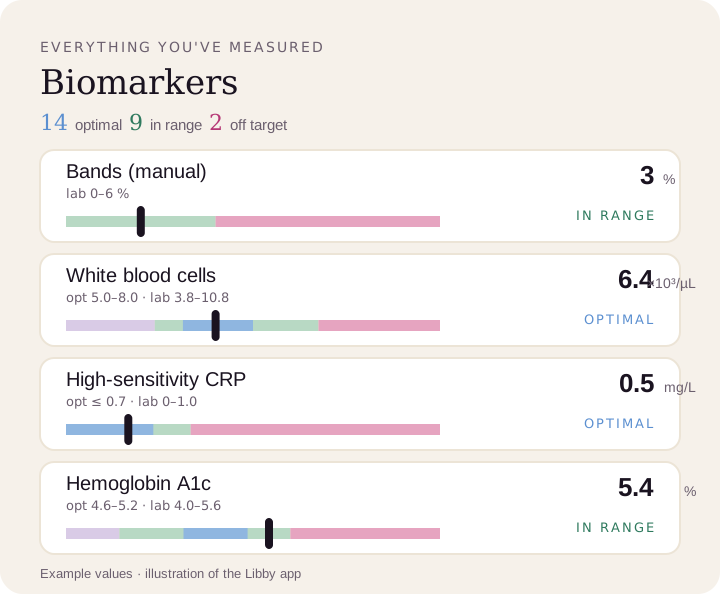
See every result against your lab's range.
Upload a lab PDF or a photo of your report. Libby puts your bands, white count and every other marker on your lab's range, and tracks your trends over time.
View your bands ›