Immature granulocytes (IG): normal range and high causes
Immature granulocytes are young white cells released early. Here's a normal level, why IG runs high, how to read it with your CBC, and when it's urgent.
Immature granulocytes (IG) are young white blood cells that normally stay in your bone marrow until they finish growing. When your body needs infection-fighting neutrophils fast, most often for a bacterial infection, the marrow sends some out early and they show up on your complete blood count (CBC).12 A healthy adult has almost none in the blood, so the questions are how far above zero yours sits and what the rest of your CBC is doing.3
The short version
- Normal: in healthy adults, IG usually runs 0.1–0.6% of white cells, a count of about 0.01–0.04 ×10³/µL. Many lab ranges go up to 1%.3
- Mildly high (about 1–2%) is common. The usual reasons are infection or inflammation, late pregnancy, and steroid medicines.45
- Higher (above 2–3%) makes a bacterial infection in the blood or sepsis more likely, and less often points to a blood cancer such as CML.617 Fever with confusion, fast breathing or clammy skin needs care right away, whatever the number.8
- IG is a sign that the marrow is under demand. Read it next to your white count, neutrophils, hemoglobin and platelets.2
What immature granulocytes are
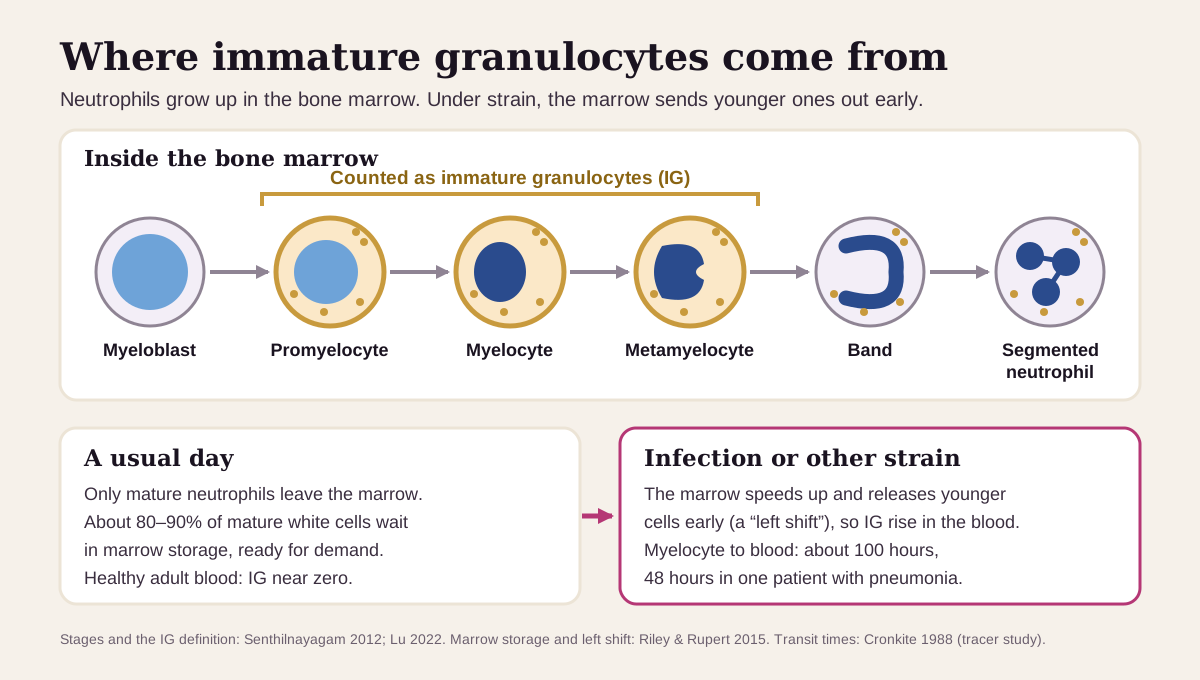
Your bone marrow builds neutrophils, the white cells that fight bacteria, in stages: myeloblast, promyelocyte, myelocyte, metamyelocyte, band, and finally the mature segmented neutrophil. Immature granulocytes are the middle three: promyelocytes, myelocytes and metamyelocytes.17
Most finished neutrophils wait in the marrow. About 80–90% of mature white cells sit in marrow storage, which lets your white count jump within hours when you need it.2 When demand outruns that reserve, the marrow starts releasing cells before they finish growing. Doctors call this a "left shift", and it's the main reason IG rises.21
Modern blood analyzers count IG automatically as part of the CBC with differential, the breakdown of your white cells by type.107 Your report may list it as IG%, IG#, "immature grans", or both a percent and a count.
What's a normal immature granulocyte level?
In a healthy adult, IG sits close to zero. These cells are seldom seen in the blood of healthy people, except during pregnancy and in newborns.7
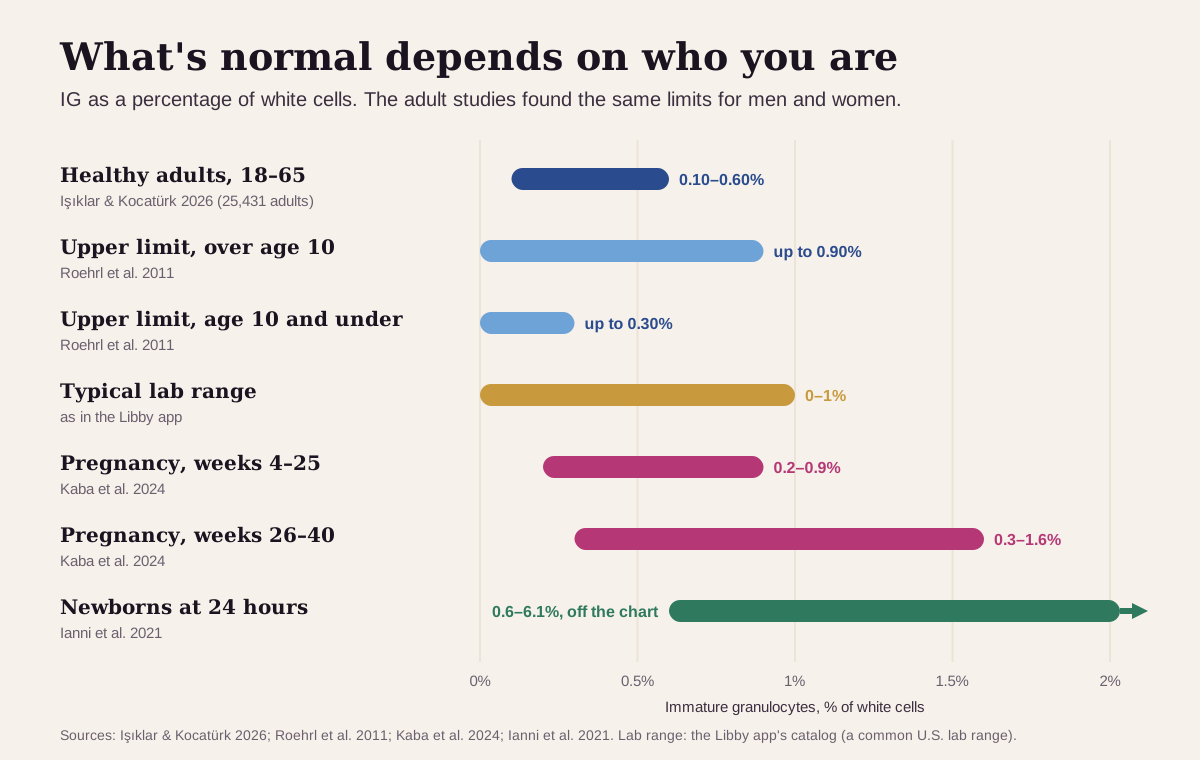
- A 2026 study of 25,431 outpatient adults aged 18–65 put the healthy range at 0.10–0.60%, a count of 0.01–0.04 ×10³/µL. Men and women shared the same range.3
- An outpatient study of more than 2,400 samples recommended upper limits of 0.90% (count 0.07) above age 10 and 0.30% (count 0.04) at age 10 and under. It found no difference between men and women.4
- Pregnancy raises it. In 1,289 healthy pregnancies, the range was 0.2–0.9% in weeks 4–25 and 0.3–1.6% in weeks 26–40.5
- Newborns run far higher. At 24 hours of life, healthy term babies ranged from 0.6% to 6.1%.11
Lab ranges are looser than the research ranges. Many labs print 0–1%, and UW Medicine's lab, for example, uses 0.00–0.05 ×10³/µL for the count. The healthy range shifts with the analyzer and the statistics behind it, so compare results from the same lab when you can.3
"Optimal" immature granulocytes: what health optimizers aim for
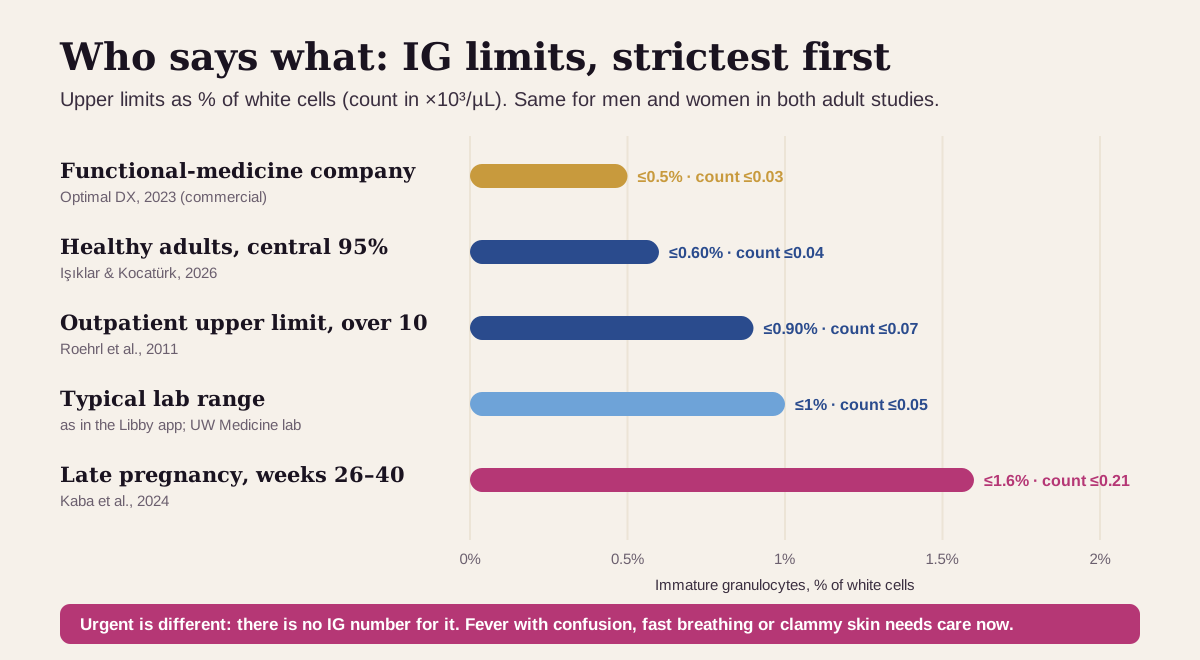
For most markers, optimizers aim tighter than the lab. With IG the aim is simple: stay as close to zero as healthy blood already is. There's nothing to build up; the only question is where to put the ceiling.
| Target | IG% | IG count (×10³/µL) | Who uses it |
|---|---|---|---|
| Strictest (functional-medicine company) | 0.5% or less | 0.03 or less | Optimal DX's published "ODX range"12 |
| Research "healthy" adults | 0.10–0.60% | 0.01–0.04 | 25,431 adults on one analyzer, men and women together3 |
| Research upper limit, over age 10 | 0.90% or less | 0.07 or less | Outpatient study with no male–female difference4 |
| Typical lab range | 0–1% | 0–0.05 | A common U.S. lab range, and the one the Libby app shows for IG |
| Late pregnancy (weeks 26–40) | 0.3–1.6% | 0.02–0.21 | Healthy pregnancies5 |
| Urgent | no IG number | no IG number | Sepsis warning signs: get care right away8 |
We found no medical-society guideline that sets an IG target. Optimal DX draws its line at 0.5%.12 The Libby app shows IG on a standard lab range with no separate optimal band, because we found no outcome study that backs one.
Why a small rise still carries signal:
- In 200 people with fever, an IG of 0.5% or more flagged 92.2% of those whose blood cultures grew bacteria. Above 3%, it was 94.7% specific: few people without a blood infection reached that level.1
- In 137 intensive-care patients, IG was the earliest marker to rise: the median climbed from 0.5% to 1.7% in the 24 hours before sepsis was diagnosed.13
- On its own, IG is a weak screen. In 1,418 emergency patients, an IG above 2% was 72.1% specific but caught only 35.2% of blood infections.6
Keep "optimal" in perspective: IG is a sign of demand, not a score to train. A steady 0.2% in a healthy adult is simply normal, and an IG that rises with an infection and falls afterward is the marrow doing its job. What deserves a closer look is a level that stays up with no clear reason, or one that comes with a low hemoglobin or an abnormal platelet count.2
What a high IG usually means
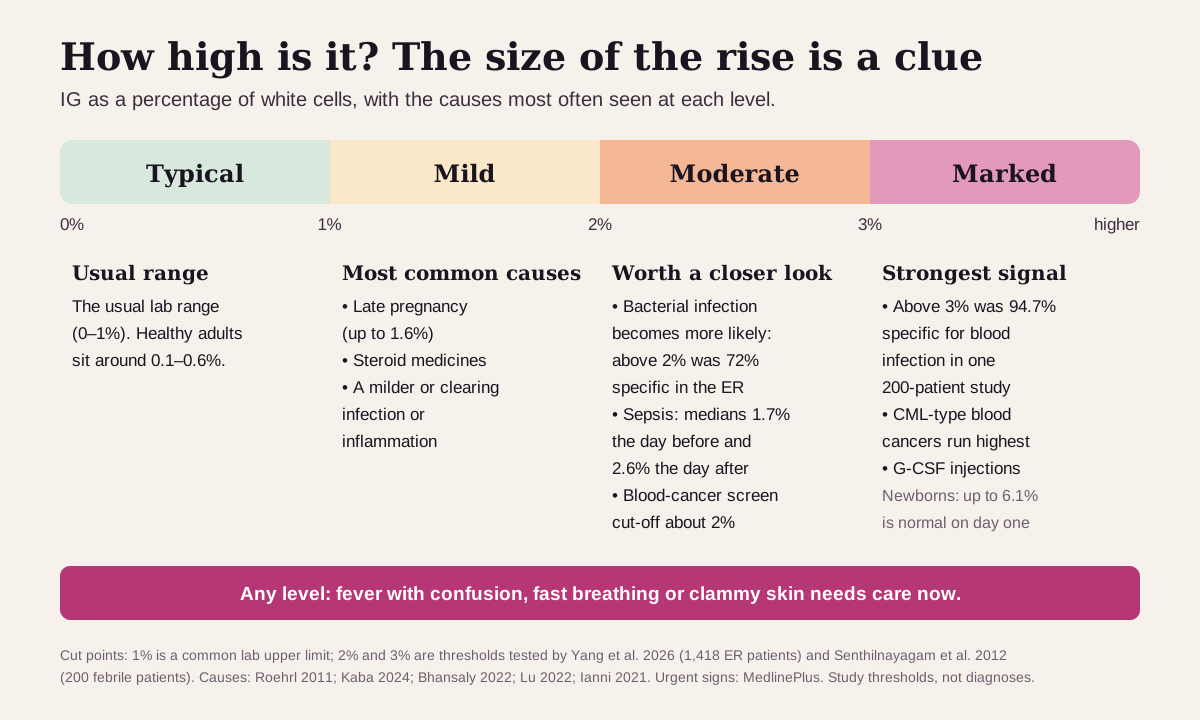
The size of the rise is the first clue. Small rises have many everyday causes. Big ones narrow the list.61
The usual suspects
- Infection or inflammation. A left shift is the marrow's classic answer to bacterial infection.12 IG also rises with tissue injury, heavy bleeding and hemolysis (red cells breaking apart).7 In children the usual causes are ear, chest and stomach infections.4
- Pregnancy. IG climbs in the second half of pregnancy, up to about 1.6% in healthy women.5 Myelocytes and metamyelocytes on a pregnancy blood smear are expected and carry no sign of disease.14
- Medicines. Steroids (corticosteroids) and chemotherapy were among the most common causes in adult outpatients.4 G-CSF, an injection that pushes the marrow to make neutrophils (often given after chemotherapy), raises IG as the marrow recovers.7 Don't stop a prescribed medicine on your own. Bring your full list to your clinician.
- Severe infection (sepsis). IG climbs fast when an infection overwhelms the body: medians of 1.7% in the day before and 2.6% in the day after sepsis began in one ICU study.13
Less common but important: blood cancers. Myeloproliferative disorders, such as chronic myeloid leukemia (CML), push IG highest, usually with a high white count and often a high platelet count.715 In adult outpatients, blood cancers were one of the leading causes of a high IG.4
Get care now if a high IG comes with fever or an infection and any of these: fast breathing or heart rate, shortness of breath, confusion, extreme pain, or clammy, sweaty skin. These are sepsis warning signs.8 See your clinician soon if it comes with easy bruising or bleeding, night sweats, unexplained weight loss, or a white count above 30,000 per µL.2
Is a low IG a problem?
Usually not. Zero or near zero is the healthy norm for adults.37 A low IG on its own says little. If your white count or neutrophils are also low, that is the result to discuss.10
IG reads best next to its neighbors
IG tells you the marrow is under demand. The rest of your CBC suggests why:2
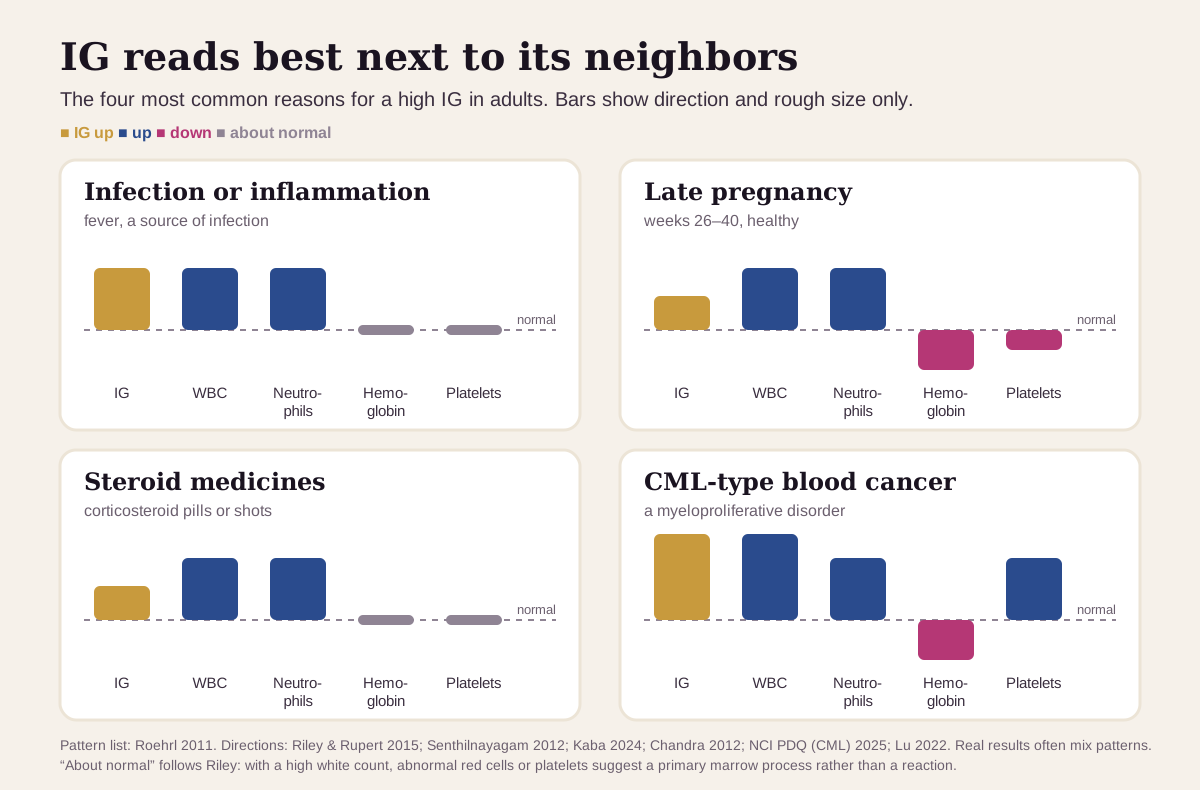
| If you see… | It often points to… |
|---|---|
| IG, white count and neutrophils up, hemoglobin and platelets normal, with a fever | infection or inflammation: the classic left shift |
| The same, but platelets falling and you feel very ill | an infection turning into sepsis: in one ICU study, average platelets fell about 45% from their admission level by the second day of sepsis (about 22% in patients who never developed it) |
| IG mildly up with a lower hemoglobin and slightly lower platelets, late in pregnancy | a normal pregnancy: hemoglobin usually drops 1–2 g/dL |
| IG, white count and neutrophils up after starting a steroid, with no fever | a medicine effect |
| A very high white count with IG, a low hemoglobin, and high or low platelets | a marrow problem such as CML, which needs prompt review |
The platelet figure comes from the ICU study's daily counts.13 Pregnancy's hemoglobin and platelet dips are normal physiology.14 Outside pregnancy and severe infection, a low hemoglobin or an abnormal platelet count next to a high white count and IG is one of the main signs that point from a reaction toward the marrow itself. Doctors read it as a possible primary marrow problem that deserves a hematology review.2
How fast IG changes
IG can move within a day. In the ICU study, median IG rose from 0.5% to 1.7% in the 24 hours before sepsis was diagnosed, and reached 3.0% by the second day.13
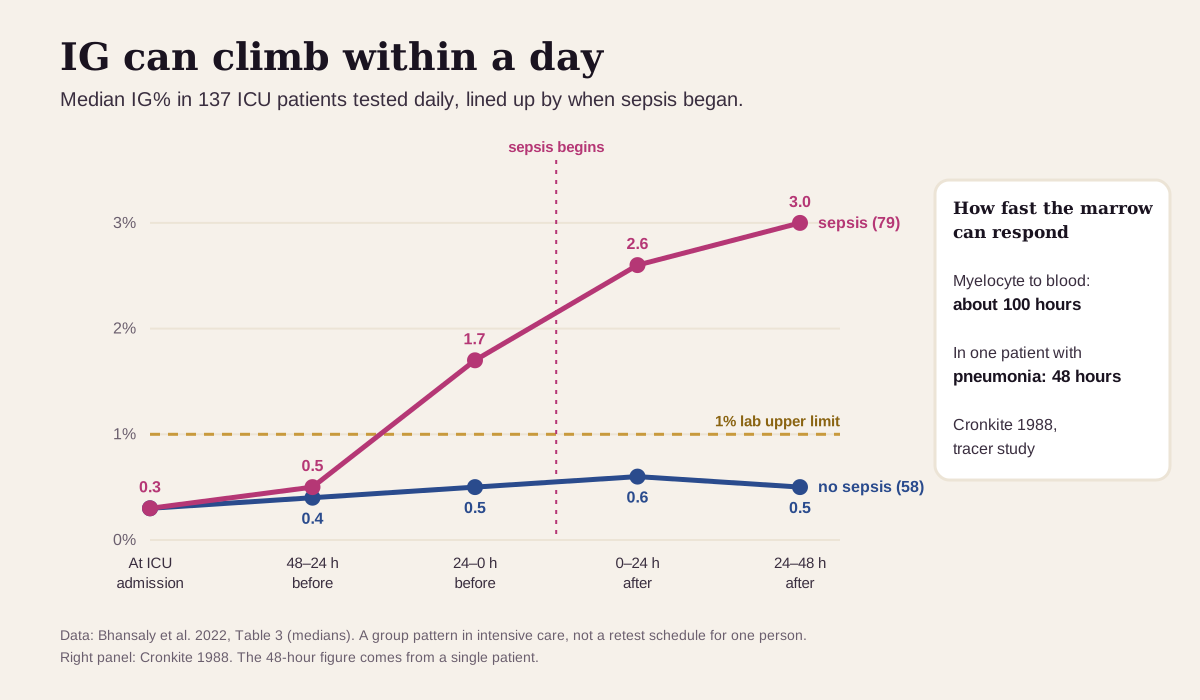
What that means in practice:
- Release is fast; new supply is slower. The marrow can release its reserve within hours, but growing new cells from the myelocyte stage took about 100 hours in tracer studies.29
- Tell whoever orders the test about recent infections, new medicines and pregnancy. Each can raise IG for a while.45
- Trends beat snapshots. An IG that rises and falls with an illness tells a different story from one that stays high while other counts drift.2 Compare results from the same lab, because analyzers and their ranges differ.3
Going deeper: percent vs count
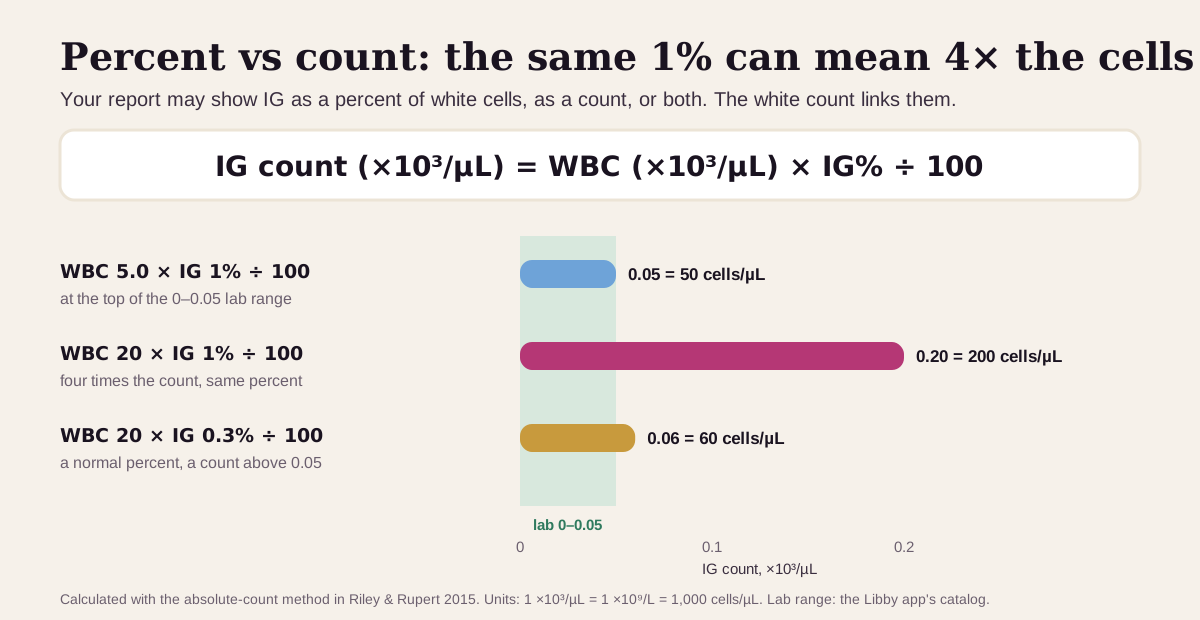
The percent and the count describe the same cells two ways. The count is the percent of your total white count:2
IG count = WBC × IG% ÷ 100
That's why one number can look fine while the other is high. With a white count of 20 during an infection, an IG of only 0.3% is already 0.06 ×10³/µL, above a 0–0.05 lab range. When your report shows both, read both.
How the analyzer finds them. The machine picks out IG by their larger nucleus and brighter fluorescent stain, and in most samples its count closely matches a trained reader's. The match is weaker in acute myeloid leukemia (correlation 0.60, versus 0.83 across all myeloid cancers), and the left shift that follows G-CSF can push the automated count up.7
Questions worth asking
- Is my IG high as a percent, as a count, or both?
- What do my white count, neutrophils, hemoglobin and platelets show next to it?
- Could an infection, a recent illness, pregnancy or a medicine explain it?
- Should we repeat the CBC after I recover, and when?
- Did the lab flag any unusual cells, and would a blood smear help?
- Which symptoms should make me call right away?
FAQ
What is a normal immature granulocyte level? Close to zero. Healthy adults usually run 0.1–0.6%, a count of 0.01–0.04 ×10³/µL, and many labs print 0–1%.3
Is an IG of 1% high? It's at the top of most lab ranges and above the healthy-adult research range. In late pregnancy, up to 1.6% is normal.35 Read it with your white count and how you feel.
Does a high IG mean sepsis? Not by itself. Infection, pregnancy, steroids and other causes raise it. In emergency patients, an IG above 2% was 72% specific for a blood infection but caught only about a third of them.6 Fever with confusion, fast breathing or clammy skin needs care right away, whatever the number.8
Is zero immature granulocytes bad? No. Zero or near zero is normal for adults.37
This guide is for education. It can't diagnose you or replace care from a clinician who knows your history.
Footnotes
-
Senthilnayagam B, Kumar T, Sukumaran J, M J, Rao K R. Automated measurement of immature granulocytes: performance characteristics and utility in routine clinical practice. Patholog Res Int. 2012;2012:483670. 200 febrile patients: the IG definition, the 0.5% screening sensitivity (92.2%) and the >3% specificity (94.7%). PMC ↩ ↩2 ↩3 ↩4 ↩5 ↩6 ↩7 ↩8 ↩9 ↩10
-
Riley LK, Rupert J. Evaluation of patients with leukocytosis. Am Fam Physician. 2015;92(11):1004–1011. Marrow storage, the left shift, medicine and pregnancy effects, and the findings that point to a blood cancer. AAFP ↩ ↩2 ↩3 ↩4 ↩5 ↩6 ↩7 ↩8 ↩9 ↩10 ↩11 ↩12 ↩13 ↩14 ↩15
-
Işıklar ÖÖ, Kocatürk E. Local reference intervals for MacroR, MicroR, IG% and IG# on Sysmex XN-1000: a retrospective indirect LIS-based study. Medicine (Baltimore). 2026;105(29):e49832. 25,431 outpatient adults aged 18–65; pooled range 0.10–0.60% and 0.01–0.04 ×10⁹/L. PMC ↩ ↩2 ↩3 ↩4 ↩5 ↩6 ↩7 ↩8 ↩9 ↩10 ↩11 ↩12
-
Roehrl MH, Lantz D, Sylvester C, Wang JY. Age-dependent reference ranges for automated assessment of immature granulocytes and clinical significance in an outpatient setting. Arch Pathol Lab Med. 2011;135(4):471–477. More than 2,400 outpatient samples; upper limits by age, no sex difference, and the most common causes of a high IG. PubMed ↩ ↩2 ↩3 ↩4 ↩5 ↩6 ↩7 ↩8 ↩9 ↩10 ↩11
-
Kaba K, Ateş FP, Akbaş SB, Tiftik AM. Immature granulocyte reference range levels in pregnancy. J Turk Clin Biochem. 2024;22(2):50–55. 1,289 healthy pregnancies; ranges for weeks 4–25 and 26–40. Journal ↩ ↩2 ↩3 ↩4 ↩5 ↩6 ↩7 ↩8 ↩9 ↩10
-
Yang WH, Yang YJ, Huang CP, Chen TJ. Automated immature granulocyte count as a specific rule-in marker for bacteremia in the emergency department: a retrospective cohort study of 1418 patients. Medicine (Baltimore). 2026;105(28):e49596. IG above 2%: 72.1% specificity, 35.2% sensitivity for bacteremia. PMC ↩ ↩2 ↩3 ↩4 ↩5
-
Lu Q, Li Y, Li T, et al. Evaluation of immature granulocyte parameters in myeloid neoplasms assayed by Sysmex XN hematology analyzer. J Hematop. 2022;15(1):1–6. The IG definition, causes including G-CSF, the highest levels in myeloproliferative cancers, and analyzer-versus-microscope agreement. PMC ↩ ↩2 ↩3 ↩4 ↩5 ↩6 ↩7 ↩8 ↩9 ↩10 ↩11 ↩12 ↩13
-
National Library of Medicine. Sepsis. MedlinePlus. Sepsis warning signs and when to get care right away. MedlinePlus ↩ ↩2 ↩3 ↩4 ↩5
-
Cronkite EP. Analytical review of structure and regulation of hemopoiesis. Blood Cells. 1988;14(2-3):313–328. Tracer studies: about 100 hours from myelocyte to blood, 48 hours in one patient with pneumonia. PubMed ↩ ↩2 ↩3
-
National Library of Medicine. Blood Differential. MedlinePlus. What the differential measures and common causes of a high or low white count. MedlinePlus ↩ ↩2
-
Ianni B, McDaniel H, Savilo E, et al. Defining normal healthy term newborn automated hematologic reference intervals at 24 hours of life. Arch Pathol Lab Med. 2021;145(1):66–74. 120 healthy term newborns; IG 0.6–6.1%. PubMed ↩ ↩2 ↩3
-
Optimal DX (ODX Research). Biomarkers of Immunity: Immature Granulocytes. November 6, 2023. Lists an "ODX range" of 0–0.5% and 0–0.03 k/cumm against a standard range of 0–1%. A commercial source, listed as what the optimizer community uses. optimaldx.com ↩ ↩2 ↩3
-
Bhansaly P, Mehta S, Sharma N, Gupta E, Mehta S, Gupta S. Evaluation of immature granulocyte count as the earliest biomarker for sepsis. Indian J Crit Care Med. 2022;26(2):216–223. 137 ICU patients tested daily; the IG time course and platelet drop around sepsis onset. PMC ↩ ↩2 ↩3 ↩4 ↩5 ↩6
-
Chandra S, Tripathi AK, Mishra S, Amzarul M, Vaish AK. Physiological changes in hematological parameters during pregnancy. Indian J Hematol Blood Transfus. 2012;28(3):144–146. White count and neutrophils up, hemoglobin down 1–2 g/dL, platelets down, and immature forms expected on a pregnancy smear. PMC ↩ ↩2 ↩3
-
PDQ Adult Treatment Editorial Board. Chronic Myeloid Leukemia Treatment (PDQ®)–Health Professional Version. National Cancer Institute. Updated March 13, 2025. Blood findings in CML: a high white count with mature and immature granulocytes, and a high platelet count. NCI ↩ ↩2
-
Weatherby D, Ferguson S. Blood Chemistry and CBC Analysis: Clinical Laboratory Testing from a Functional Perspective. Bear Mountain Publishing. ISBN 978-0976136712. The functional-medicine reference the Libby app uses for the optimal bands of the white count, neutrophils and other companion markers. The app's IG rows cite no optimal source. ↩
Educational content, not medical advice. Libby is a personal record tool, not a medical service — it doesn't diagnose, treat, or prescribe. Reference ranges vary by lab and by person. Talk to a qualified healthcare professional about your results.
See every result against its lab range.
Upload a lab PDF or a photo of your report. Libby puts every marker on a range bar and tracks your trends over time.
View your immature granulocytes ›