Ionized calcium test: normal range, low and high causes
Ionized calcium is the free, active calcium in your blood. Here's the normal range, what low and high levels usually mean, and how to read it with PTH.
Ionized calcium is the free, active calcium in your blood: the part your nerves, muscles and heart actually use. About half of the calcium in your blood floats free. The rest rides on proteins, mostly albumin.1 A standard calcium test counts both. An ionized calcium test measures only the free part, which is why doctors order it when albumin is off, during surgery or serious illness, or when a total calcium result looks odd.23
The short version
- Normal: about 4.65–5.25 mg/dL (1.16–1.31 mmol/L) in the American Board of Internal Medicine's reference list. Ranges vary a little by lab, so use the one on your report.43
- Low usually means low vitamin D, low parathyroid hormone (most often after neck surgery), low magnesium or kidney disease. In the hospital, serious illness and large blood transfusions are common causes. High is usually primary hyperparathyroidism or cancer, which together account for about 90% of high calcium.156
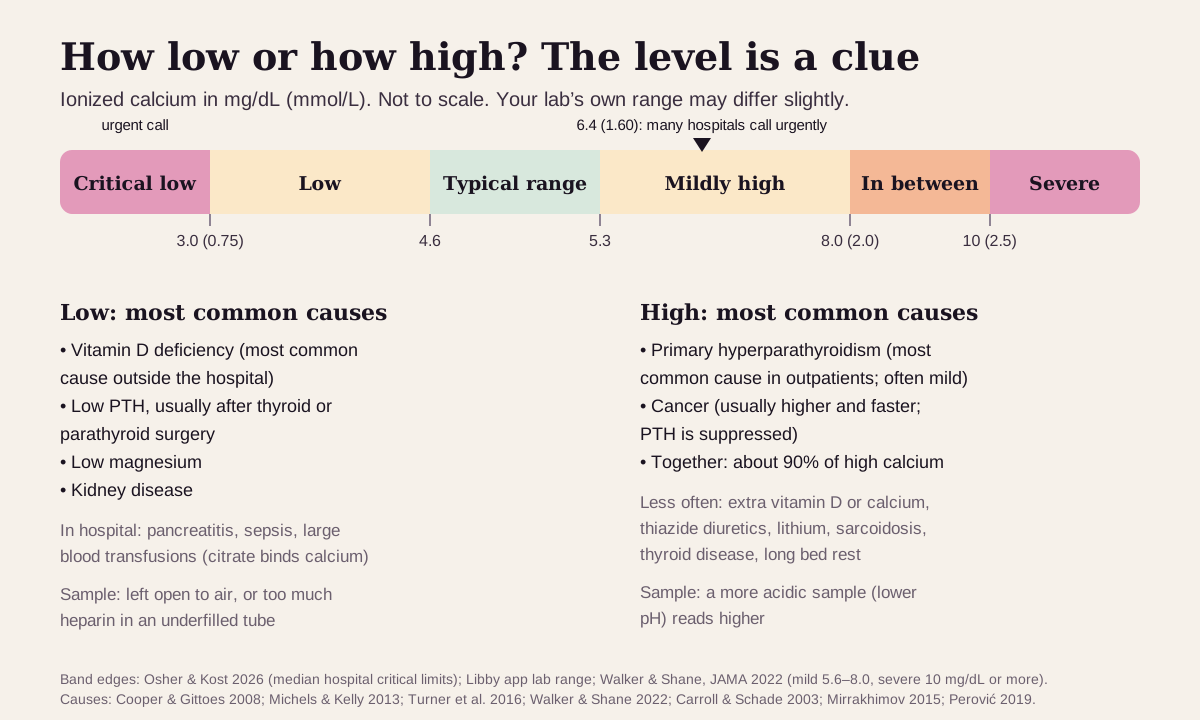
- Urgent: across 21 U.S. hospitals that publish limits, the median urgent-call thresholds are about 3.0 mg/dL (0.75 mmol/L) and 6.4 mg/dL (1.60 mmol/L). Symptoms such as muscle spasms, a seizure, confusion or repeated vomiting with an abnormal result need prompt care.786
- Ionized calcium stays accurate when albumin is low. In a large 2025 study, the albumin-"corrected" calcium many reports calculate disagreed with measured ionized calcium in about 4 of 10 patients.9
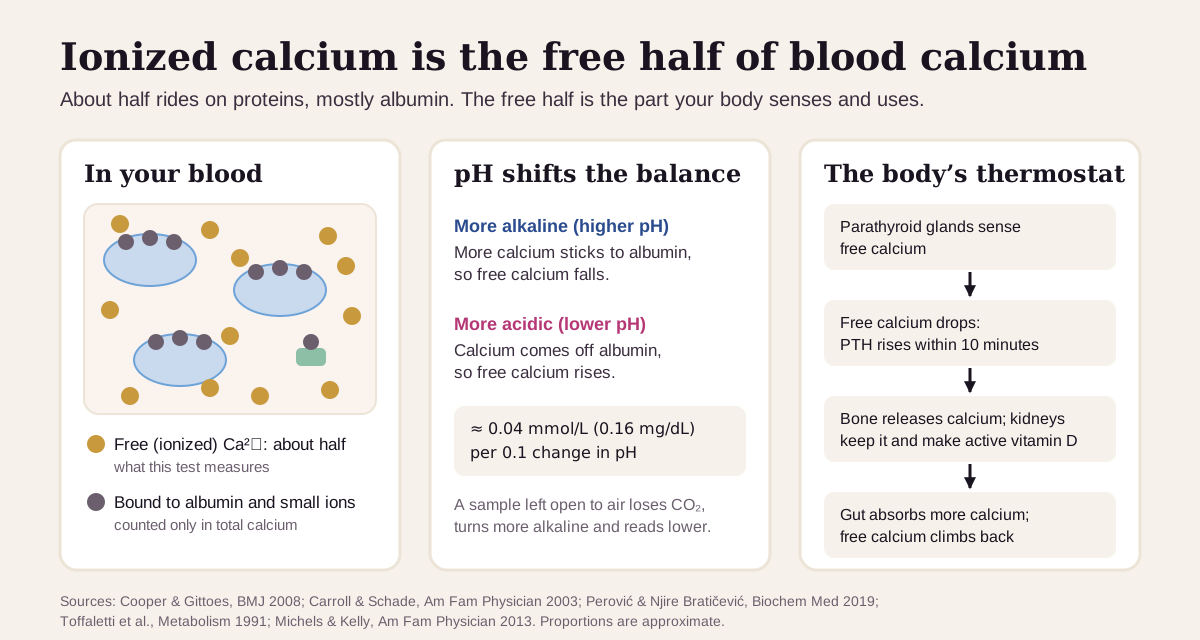
What ionized calcium is
About 1% of your body's calcium is in your blood; the rest is in your bones and teeth. The small amount in blood keeps your nerves, muscles and heart working and helps release hormones.2
Blood calcium comes in two forms. Free (ionized) calcium makes up about half. The other half is bound, mostly to the protein albumin and partly to small ions such as phosphate and citrate.11 Only the free form has effects in the body.121 A total calcium test adds the two together, so a low albumin drags the total down even when free calcium is fine.1
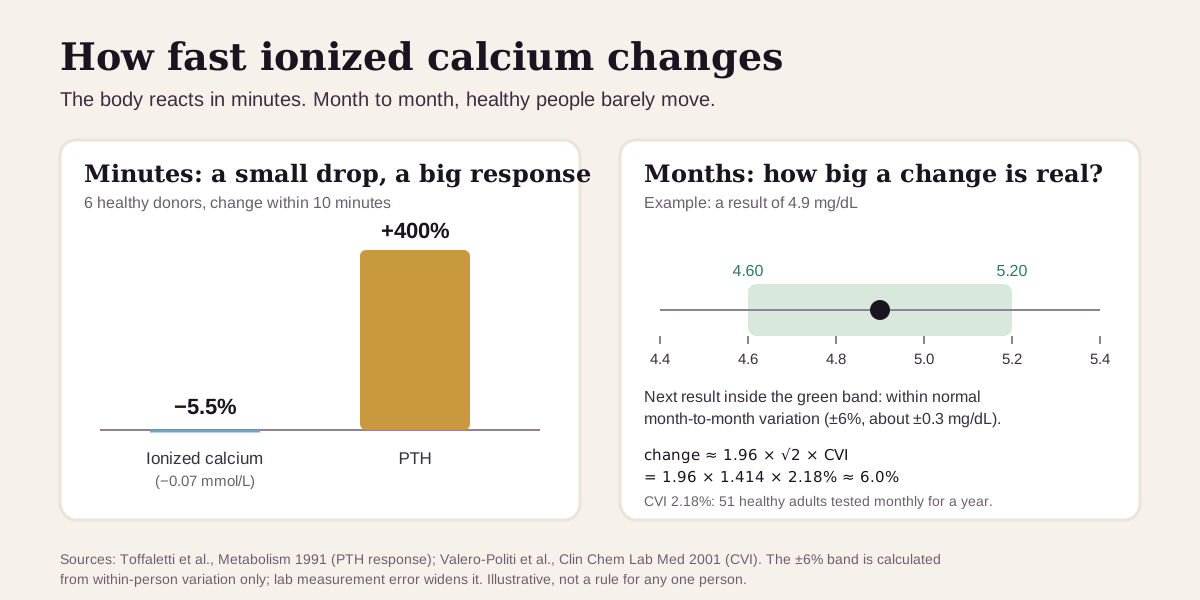
Your body watches the free form closely. The four parathyroid glands in your neck sense free calcium directly.125 In one experiment in healthy blood donors, lowering ionized calcium by just 5.5% raised parathyroid hormone (PTH) by 400% within 10 minutes. Lowering the bound calcium had no effect on PTH.13 PTH then pulls calcium from bone, tells the kidneys to hold on to calcium and make active vitamin D, and that vitamin D raises calcium absorption from food.5
pH moves calcium on and off albumin. When blood becomes more alkaline (a higher pH), more calcium sticks to albumin and free calcium falls, by about 0.04 mmol/L for every 0.1 rise in pH. A more acidic sample does the opposite.11 That's why this test is fussier than most: a sample left open to air loses carbon dioxide, turns more alkaline and reads falsely low.1114
What's a normal ionized calcium?
Start with the range printed on your report. Labs measure ionized calcium in whole blood, plasma or serum, and their ranges differ slightly.143
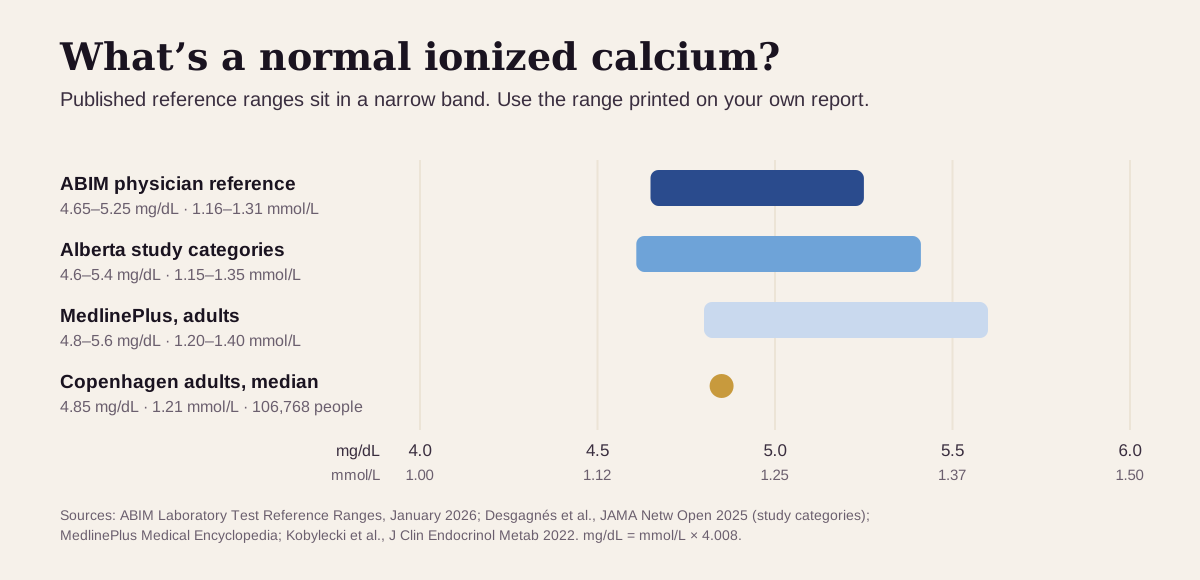
- The American Board of Internal Medicine's laboratory reference list gives 1.16–1.31 mmol/L (4.65–5.25 mg/dL).4
- MedlinePlus, from the U.S. National Library of Medicine, gives a wider 4.8–5.6 mg/dL (1.20–1.40 mmol/L) for adults and 4.8–5.3 mg/dL for children.3
- In 106,768 adults in the Copenhagen General Population Study, the median was 1.21 mmol/L (4.85 mg/dL).15
The range is narrow because your body holds the number tight. In 51 healthy adults tested monthly for a year, a person's ionized calcium varied by a median of only 2.18% from month to month.16 So even a small move outside the range stands out.
"Optimal" ionized calcium: what health optimizers aim for
For ionized calcium, the tighter targets squeeze toward the middle of the lab range rather than one end. Here's the full ladder, from strictest to loosest:
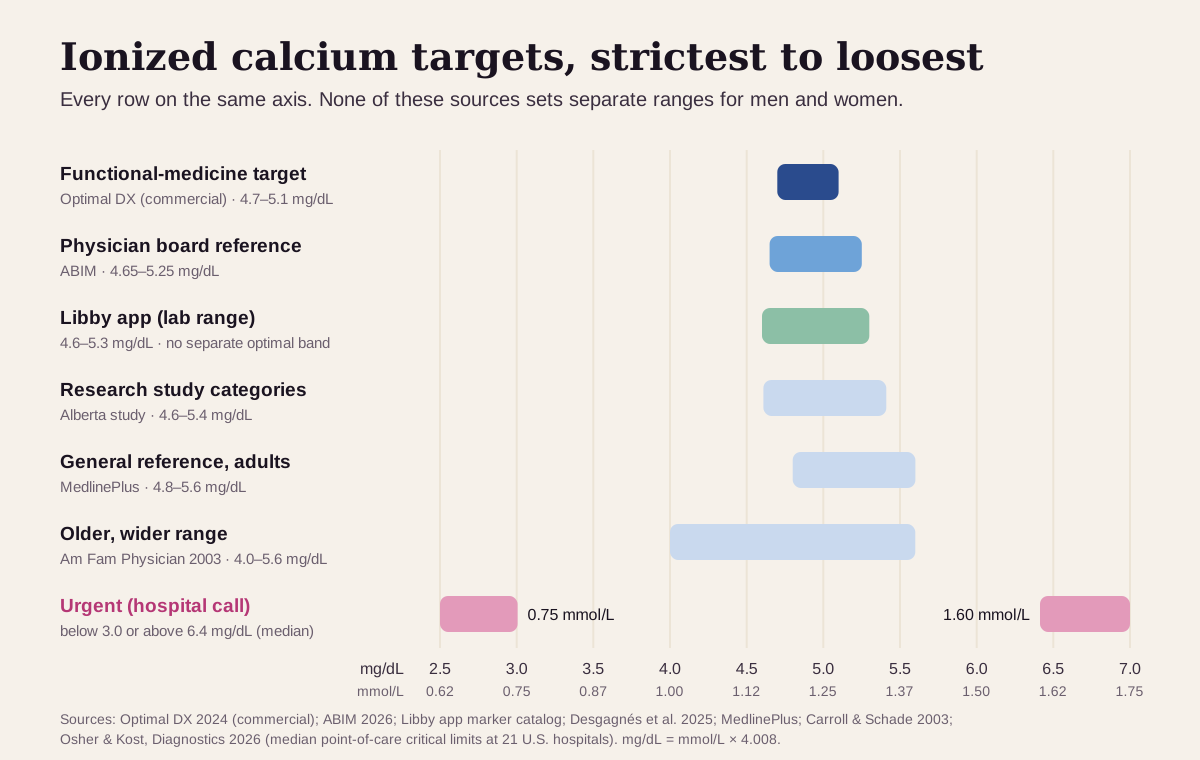
| Target | mg/dL | mmol/L | Who uses it |
|---|---|---|---|
| Strictest (functional medicine) | 4.7–5.1 | 1.18–1.27 | Optimal DX, a functional blood-chemistry company17 |
| Physician board reference | 4.65–5.25 | 1.16–1.31 | American Board of Internal Medicine4 |
| Lab range in the Libby app | 4.6–5.3 | 1.15–1.32 | The app shows ionized calcium on this lab range. It has no separate optimal band for this marker |
| Research study categories | 4.6–5.4 | 1.15–1.35 | A 2025 study of 22,658 adults in Alberta, Canada9 |
| General reference, adults | 4.8–5.6 | 1.20–1.40 | MedlinePlus3 |
| Older, wider range | 4.0–5.6 | 1.0–1.4 | A 2003 review in American Family Physician12 |
| Urgent | below ~3.0 or above ~6.4 | below ~0.75 or above ~1.60 | Median call-back limits at 21 U.S. hospitals7 |
None of these sources sets separate ranges for men and women.
The evidence behind a mid-range target:
- In the Copenhagen study of 106,768 adults followed for a median 9.2 years, each 0.1 mmol/L (0.4 mg/dL) below the median of 1.21 mmol/L came with a 23% higher risk of death from any cause and a 29% higher risk of cancer death.15
- In the same study, each 0.1 mmol/L above the median came with a 17% higher risk of cardiovascular death.15
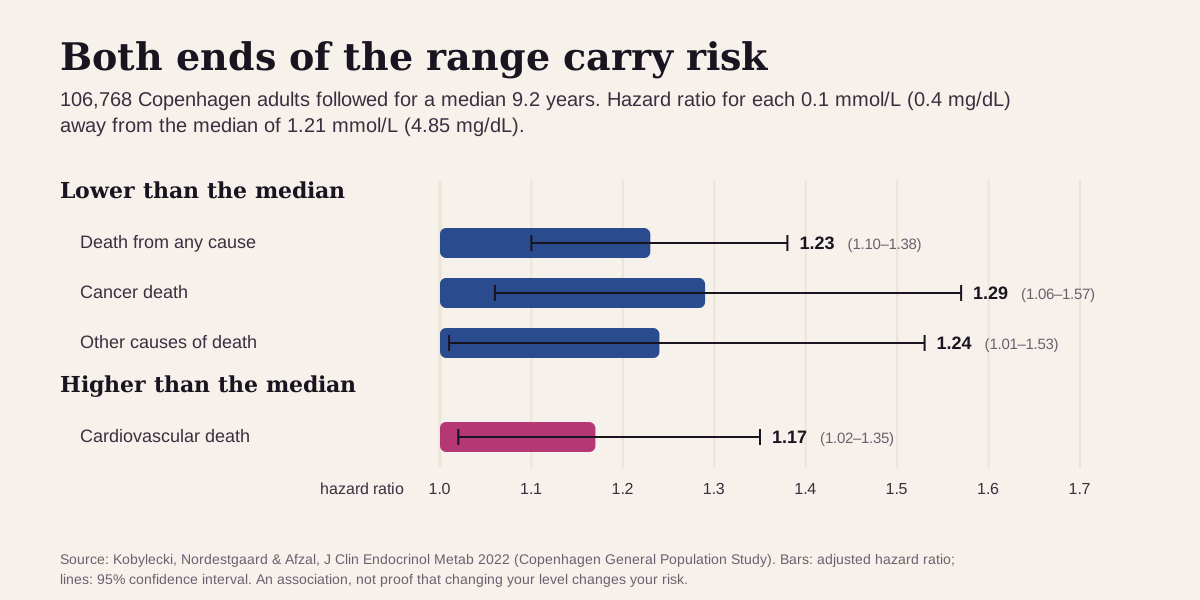
Keep "optimal" in perspective: these are population averages, and they show that both ends carry risk. Ionized calcium is set by your parathyroid glands, vitamin D and kidneys, so a result drifting toward either edge is mostly a reason to look at those, and at how the sample was handled.511
What a low or high ionized calcium usually means
Where the number lands is the first clue. A small dip below the range is very common in the hospital. A level far outside it is an emergency.17
Low ionized calcium
Low calcium is common in sick people: one review puts it at 18% of hospital patients and 85% of people in intensive care.1 Outside the hospital, the usual suspects are:
- Vitamin D deficiency. The most common cause of low calcium in primary care.1 PTH runs high as the body tries to compensate.5
- Low PTH (hypoparathyroidism). Most often it follows thyroid or parathyroid surgery.5 After a total thyroidectomy, it's the most common cause of sudden, symptomatic low calcium in the hospital.8
- Low magnesium. The parathyroid glands need magnesium to release PTH. Heavy drinking, long-lasting diarrhea and some diuretics lower magnesium,1 and so can acid-reducing proton pump inhibitors.8
- Kidney disease. Failing kidneys make less active vitamin D and hold on to phosphate, and PTH rises.5
- In the hospital: pancreatitis, sepsis and other critical illness, and large blood transfusions, whose citrate binds calcium.581
- The sample itself. A tube exposed to air, or too much heparin in an underfilled tube, can read falsely low.11
High ionized calcium
About 1% of people have high calcium, and roughly 90% of cases come from primary hyperparathyroidism or cancer.6
- Primary hyperparathyroidism. One or more parathyroid glands make too much PTH. In 80% of cases a single benign growth (an adenoma) is responsible.12 It's the most common cause of high calcium outside the hospital, and it's often found by chance on routine blood work.5 PTH is high, or "inappropriately normal" for the calcium level, and phosphate tends to run low.612 Kidney stones occur in up to 15%.5
- Cancer. Some tumors release a PTH-like hormone (PTH-related peptide, or PTHrP) or break down bone.12 Cancer-related high calcium is usually higher and rises faster, so it causes more symptoms.18 Here PTH is suppressed, often below about 20 pg/mL.6
- Less common causes: too much vitamin D or calcium from supplements, sarcoidosis and other granulomatous diseases, thyroid disease, long bed rest, and medicines such as thiazide diuretics and lithium.612
- The sample itself. A more acidic sample releases calcium from albumin and reads higher.11
Mild high calcium, defined as an ionized calcium of 5.6–8.0 mg/dL (1.4–2.0 mmol/L), usually causes no symptoms, though about 20% of people notice fatigue or constipation. Severe high calcium starts at 10 mg/dL (2.5 mmol/L).6
Get care now if you have tingling around your mouth or in your fingers, muscle cramps or spasms, a seizure, or an irregular heartbeat (signs of low calcium), or nausea and vomiting, strong thirst, confusion or unusual drowsiness (signs of high calcium). The Society for Endocrinology treats low calcium with symptoms as a medical emergency at any level below the range.286
Ionized calcium reads best next to its neighbors
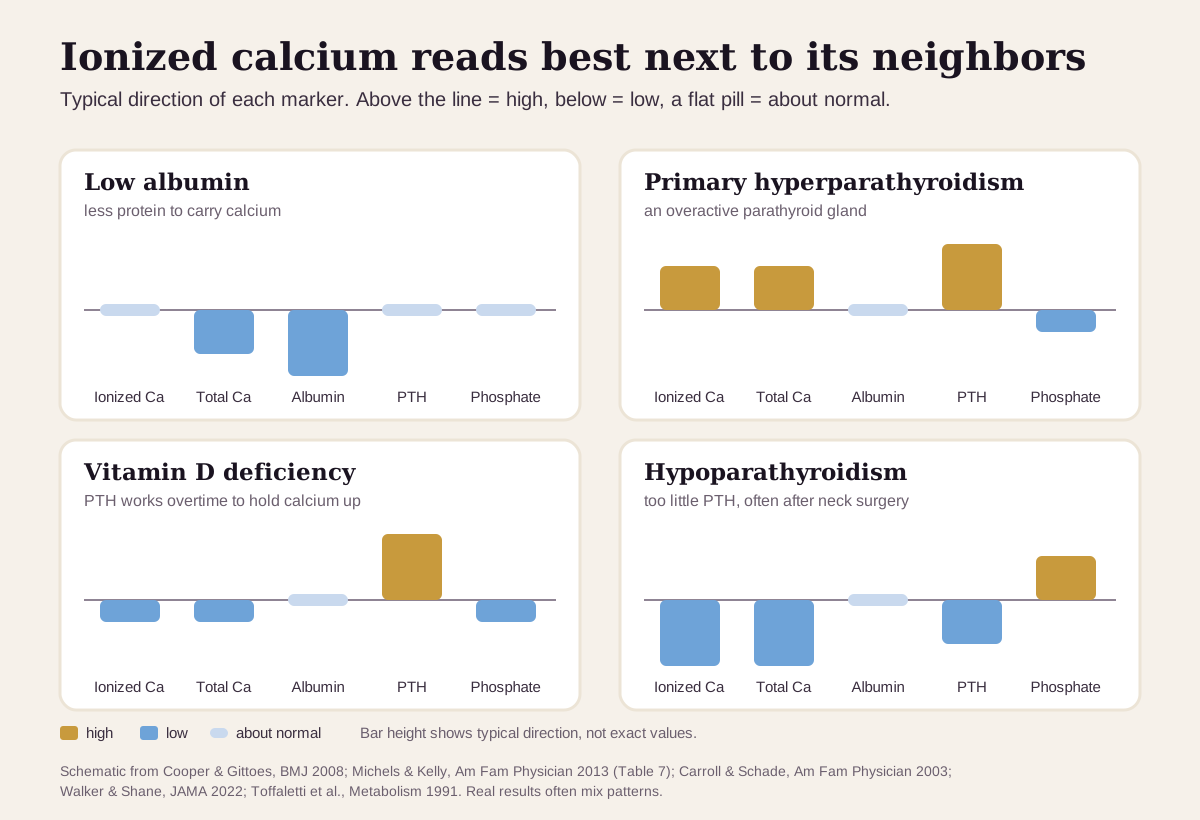
The pattern across your calcium markers usually says more than one number does. PTH is the key partner: it tells you whether the parathyroid glands are causing the problem or reacting to it.16
| If you see… | It often points to… |
|---|---|
| Total calcium low, albumin low, ionized calcium normal | less protein to carry calcium; the free calcium your body uses is fine |
| Calcium high, PTH high or inappropriately normal, phosphate low or low-normal | primary hyperparathyroidism |
| Calcium high, PTH suppressed (often below ~20 pg/mL) | a cause outside the parathyroids: cancer, too much vitamin D, granulomatous disease |
| Calcium low, PTH high, phosphate low or normal, 25-hydroxyvitamin D low | vitamin D deficiency |
| Calcium low, PTH low, phosphate high | hypoparathyroidism, most often after neck surgery |
| Calcium low, PTH high, phosphate high, kidney function reduced | chronic kidney disease |
| Calcium low with low magnesium | magnesium deficiency blocking PTH release |
How fast ionized calcium changes
Your body reacts in minutes. A drop of just 5.5% sends PTH up 400% within 10 minutes.13 The sample can change quickly too: in one study, serum that waited 90–100 minutes after spinning had lost carbon dioxide, risen in pH and dropped in ionized calcium.11
What that means in practice:
- Month to month, healthy people barely move. With within-person variation of 2.18%, a change needs to be larger than about 6%, or roughly 0.3 mg/dL at 4.9 mg/dL, to stand out from normal ups and downs. Lab measurement error widens that band.16
- Handling matters. The IFCC, the international lab-medicine federation, recommends collecting the sample without letting air in, keeping heparin low, and measuring it quickly.14
- Trends beat snapshots. Compare results from the same lab and the same sample type (whole blood or serum), and read them next to PTH, total calcium and albumin.31
Going deeper: pH, "corrected" calcium and units
pH-adjusted results. Some analyzers print a second value "adjusted to pH 7.4", an estimate of what the ionized calcium would be at normal blood pH. The IFCC says that conversion holds only when the sample's pH is between 7.2 and 7.6.14 Check which value your report shows, and compare like with like.
"Corrected" calcium. When albumin is low, many reports adjust total calcium with a formula such as:12
Corrected calcium = measured calcium + 0.8 × (4.0 − albumin)
It's a shortcut, and it often misses. In a 2025 study of 22,658 adults in Alberta, Canada, unadjusted total calcium matched the ionized calcium group (low, normal or high) 74.5% of the time. The albumin-corrected versions matched only 63.0% and 58.7% of the time. In about 3 in 10 patients, they called a truly low ionized calcium normal.9
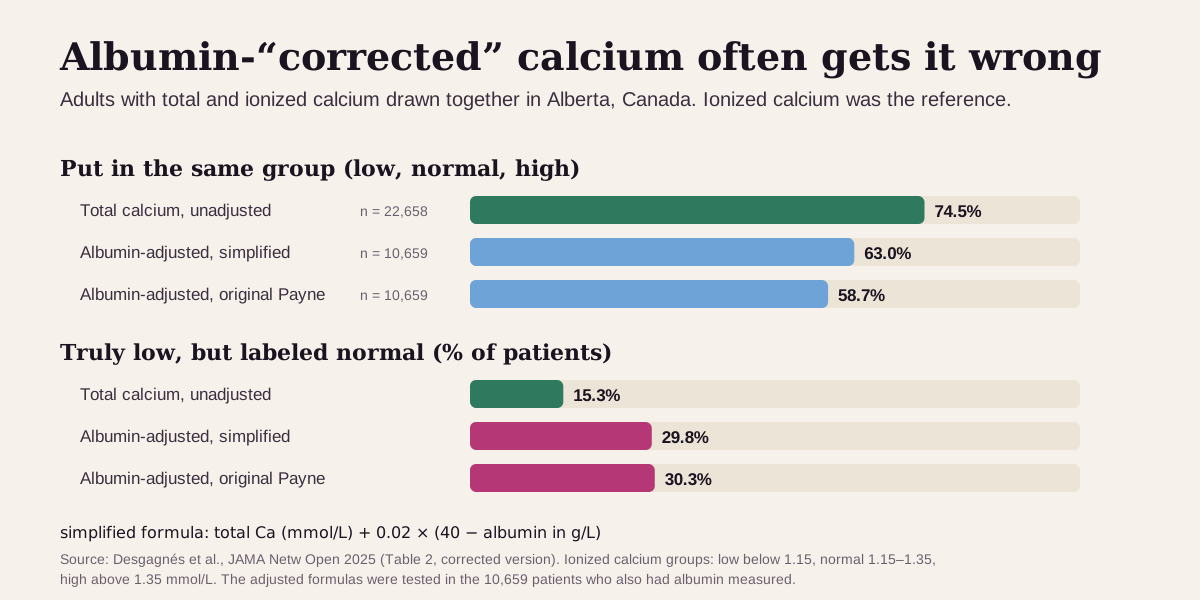
The formulas lean on the albumin level, and they fail most often exactly when albumin is low, the situation they were built for.9 When it's unclear whether total calcium reflects the free calcium, a direct ionized calcium answers the question.1
Units. mg/dL = mmol/L × 4.008. So 1.20 mmol/L is 4.8 mg/dL, and 1.40 mmol/L is 5.6 mg/dL.103
Questions worth asking
- Is my ionized calcium low or high, and by how much?
- What were my PTH, phosphate and magnesium at the same time?
- Was the sample handled so air couldn't get in, and was it measured quickly?
- Does my report show an actual value, a pH-adjusted value, or both?
- Should my 25-hydroxyvitamin D or kidney function be checked?
- Could any of my medicines or supplements, like vitamin D, calcium, a thiazide diuretic or lithium, be involved?
FAQ
What is a normal ionized calcium level? The American Board of Internal Medicine lists 1.16–1.31 mmol/L (about 4.65–5.25 mg/dL); MedlinePlus gives 4.8–5.6 mg/dL for adults. Your lab's own range is the one to use.43
What's the difference between ionized calcium and total calcium? Total calcium counts free calcium plus calcium bound to albumin. Ionized calcium is only the free, active half, so it stays accurate when albumin is low.19
What causes a high ionized calcium? About 90% of high calcium comes from primary hyperparathyroidism or cancer. A PTH test tells the two apart: high or normal PTH points to the parathyroids, suppressed PTH to another cause.6
What causes a low ionized calcium? Outside the hospital, vitamin D deficiency is the most common cause. Low PTH after neck surgery, low magnesium and kidney disease are the others. In the hospital, serious illness and big transfusions are common causes.158
This guide is for education. It can't diagnose you or replace care from a clinician who knows your history.
Footnotes
-
Cooper MS, Gittoes NJ. Diagnosis and management of hypocalcaemia. BMJ. 2008;336(7656):1298–1302. doi:10.1136/bmj.39582.589433.BE. Clinical review: ionized calcium ~50% of serum calcium, prevalence in hospital (18%) and intensive care (85%), vitamin D deficiency as the most common primary-care cause, PTH and phosphate interpretation, magnesium, citrate in massive transfusion. PMC ↩ ↩2 ↩3 ↩4 ↩5 ↩6 ↩7 ↩8 ↩9 ↩10 ↩11 ↩12 ↩13 ↩14 ↩15 ↩16 ↩17
-
National Library of Medicine. Calcium Blood Test. MedlinePlus. Last updated December 2, 2024. Where body calcium lives, bound vs free calcium, when an ionized test is ordered, and symptoms of low and high calcium. MedlinePlus ↩ ↩2 ↩3
-
National Library of Medicine. Ionized calcium. MedlinePlus Medical Encyclopedia. Review date May 19, 2025. Normal values of 4.8–5.6 mg/dL (1.20–1.40 mmol/L) for adults and 4.8–5.3 mg/dL for children; ranges vary among labs and specimens. MedlinePlus ↩ ↩2 ↩3 ↩4 ↩5 ↩6 ↩7 ↩8 ↩9 ↩10
-
American Board of Internal Medicine. ABIM Laboratory Test Reference Ranges. January 2026. Lists ionized serum calcium as 1.16–1.31 mmol/L. abim.org ↩ ↩2 ↩3 ↩4 ↩5 ↩6
-
Michels TC, Kelly KM. Parathyroid disorders. Am Fam Physician. 2013;88(4):249–257. How the parathyroid glands sense calcium and what PTH does; primary hyperparathyroidism as the most common outpatient cause of high calcium; post-surgical hypoparathyroidism; the PTH/phosphorus/vitamin D patterns in Table 7. AAFP ↩ ↩2 ↩3 ↩4 ↩5 ↩6 ↩7 ↩8 ↩9 ↩10 ↩11 ↩12 ↩13 ↩14
-
Walker MD, Shane E. Hypercalcemia: A Review. JAMA. 2022;328(16):1624–1636. doi:10.1001/jama.2022.18331. Prevalence (~1%), the ~90% share of primary hyperparathyroidism and cancer, the mild (ionized 5.6–8.0 mg/dL) and severe (10 mg/dL or more) definitions, symptoms, and PTH as the first test. PubMed ↩ ↩2 ↩3 ↩4 ↩5 ↩6 ↩7 ↩8 ↩9 ↩10 ↩11 ↩12 ↩13
-
Osher K, Kost GJ. Critical Decision Thresholds for Urgent Physician Notification of Point-of-Care Testing Results. Diagnostics (Basel). 2026;16(8):1139. doi:10.3390/diagnostics16081139. Adult point-of-care ionized calcium critical limits at 21 U.S. hospitals: median low 0.75 mmol/L (range 0.50–1.00), median high 1.60 mmol/L (range 1.40–1.75). PMC ↩ ↩2 ↩3 ↩4 ↩5
-
Turner J, Gittoes N, Selby P; Society for Endocrinology Clinical Committee. Society for Endocrinology endocrine emergency guidance: emergency management of acute hypocalcaemia in adult patients. Endocr Connect. 2016;5(5):G7–G8. doi:10.1530/EC-16-0056. Symptoms of low calcium, total thyroidectomy as the most common in-hospital cause, PPI-associated low magnesium, pancreatitis and large transfusions. PMC ↩ ↩2 ↩3 ↩4 ↩5 ↩6 ↩7
-
Desgagnés N, King JA, Kline GA, Seiden-Long I, Leung AA. Use of Albumin-Adjusted Calcium Measurements in Clinical Practice. JAMA Netw Open. 2025;8(1):e2455251. doi:10.1001/jamanetworkopen.2024.55251 (corrected March 18, 2025). 22,658 Alberta adults with simultaneous total and ionized calcium; ionized categories low <1.15, normal 1.15–1.35, high >1.35 mmol/L; agreement 74.5% (total), 63.0% (simplified formula), 58.7% (original Payne). PMC ↩ ↩2 ↩3 ↩4 ↩5 ↩6 ↩7 ↩8 ↩9
-
National Institute of Standards and Technology. Basic Atomic Spectroscopic Data: Calcium. Atomic weight 40.078, used for the mmol/L to mg/dL conversion. NIST ↩ ↩2
-
Perović A, Njire Bratičević M. Time-dependent variation of ionized calcium in serum samples. Biochem Med (Zagreb). 2019;29(3):030708. doi:10.11613/BM.2019.030708. A pH rise lowers ionized calcium by about 0.04 mmol/L per 0.1 pH; air exposure, heparin and delays change the result. PMC ↩ ↩2 ↩3 ↩4 ↩5 ↩6 ↩7 ↩8
-
Carroll MF, Schade DS. A practical approach to hypercalcemia. Am Fam Physician. 2003;67(9):1959–1966. Half of circulating calcium is free; the corrected-calcium formula; normal ionized calcium of 4–5.6 mg/dL (1–1.4 mmol/L); low phosphate in PTH-driven high calcium; PTHrP; single adenoma in 80%. AAFP ↩ ↩2 ↩3 ↩4 ↩5 ↩6 ↩7 ↩8 ↩9 ↩10 ↩11
-
Toffaletti J, Cooper DL, Lobaugh B. The response of parathyroid hormone to specific changes in either ionized calcium, ionized magnesium, or protein-bound calcium in humans. Metabolism. 1991;40(8):814–818. doi:10.1016/0026-0495(91)90008-k. Six healthy donors: a 0.07 mmol/L (5.5%) drop in ionized calcium raised PTH 400% within 10 minutes; lowering protein-bound calcium did not. PubMed ↩ ↩2 ↩3 ↩4
-
Boink AB, Buckley BM, Christiansen TF, et al. IFCC recommendation on sampling, transport and storage for the determination of the concentration of ionized calcium in whole blood, plasma and serum. J Automat Chem. 1991;13(5):235–239. doi:10.1155/S1463924691000391. Anaerobic sampling, heparin limits, and pH-7.4 conversion valid only between pH 7.2 and 7.6. PMC ↩ ↩2 ↩3 ↩4
-
Kobylecki CJ, Nordestgaard BG, Afzal S. Low Plasma Ionized Calcium Is Associated With Increased Mortality: A Population-based Study of 106 768 Individuals. J Clin Endocrinol Metab. 2022;107(7):e3039–e3047. doi:10.1210/clinem/dgac146. Median 1.21 mmol/L; hazard ratios per 0.1 mmol/L below (all-cause 1.23, cancer 1.29, other 1.24) and above (cardiovascular 1.17) the median over a median 9.2 years. PubMed ↩ ↩2 ↩3 ↩4 ↩5
-
Valero-Politi J, Ginard-Salvá M, González-Alba JM. Annual rhythmic and non-rhythmic biological variation of magnesium and ionized calcium concentrations. Clin Chem Lab Med. 2001;39(1):45–49. doi:10.1515/CCLM.2001.011. 51 healthy volunteers sampled monthly for a year; median within-person variation 2.18%. PubMed ↩ ↩2 ↩3
-
Optimal DX. Mineral Biomarkers: Ionized Calcium. Published January 28, 2024; updated August 14, 2024. States an optimal ("ODX") range of 4.7–5.1 mg/dL (1.18–1.27 mmol/L) against a standard range of 4.7–5.5 mg/dL. A commercial source, listed as what the optimizer community uses. optimaldx.com ↩ ↩2
-
Mirrakhimov AE. Hypercalcemia of Malignancy: An Update on Pathogenesis and Management. N Am J Med Sci. 2015;7(11):483–493. doi:10.4103/1947-2714.170600. Cancer-related high calcium is usually higher, develops faster and causes more symptoms. PMC ↩ ↩2
Educational content, not medical advice. Libby is a personal record tool, not a medical service — it doesn't diagnose, treat, or prescribe. Reference ranges vary by lab and by person. Talk to a qualified healthcare professional about your results.
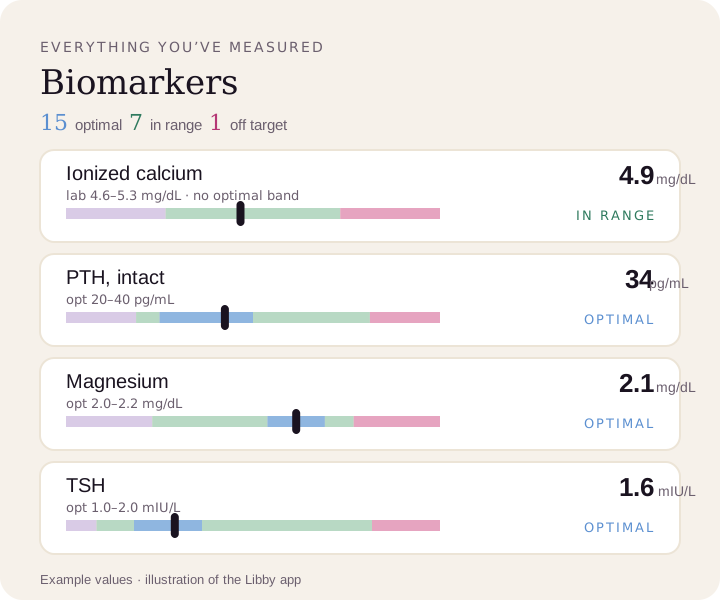
See every result against your lab's range.
Upload a lab PDF or a photo of your report. Libby shows your ionized calcium on your lab's range, adds optimal ranges for markers that have one, like PTH and magnesium, and tracks your trends over time.
View your ionized calcium ›