Anti-Xa test: target levels for heparin, apixaban and more
Anti-Xa measures how much heparin or an Xa-blocking pill is working in your blood. The targets by drug, why draw timing matters, and when to act.
Anti-factor Xa activity, usually shortened to anti-Xa, measures how strongly a blood thinner in your blood is blocking factor Xa, one of the central clotting enzymes. It's a drug-level test. Hospitals use it to dose heparin, and labs use drug-specific versions to measure enoxaparin and pills such as apixaban and rivaroxaban.12 Off those drugs the result is close to zero, so the question is never "is my level healthy?" but "is it on target for my drug, my dose and the time of the draw?"
The short version
- Heparin by IV (unfractionated heparin): the usual target is 0.30–0.70 IU/mL, the level the International Society on Thrombosis and Haemostasis (ISTH) suggests for most uses, drawn about 6 hours after a dose change.31
- Enoxaparin shots: the level peaks 3–5 hours after the injection. Treatment targets are about 0.6–1.0 IU/mL 4 hours after a twice-daily dose and above 1.0 IU/mL after a once-daily dose.45
- Apixaban, rivaroxaban and edoxaban are measured in ng/mL with a calibrator made from the same drug. They have expected ranges, not targets: apixaban runs about 69–321 ng/mL at its peak in people taking it for atrial fibrillation.26
- The draw time is part of the result. One person can read high at the peak and low before the next dose. Bleeding signs such as black stools, vomiting blood or a sudden severe headache need care right away, whatever the number.7
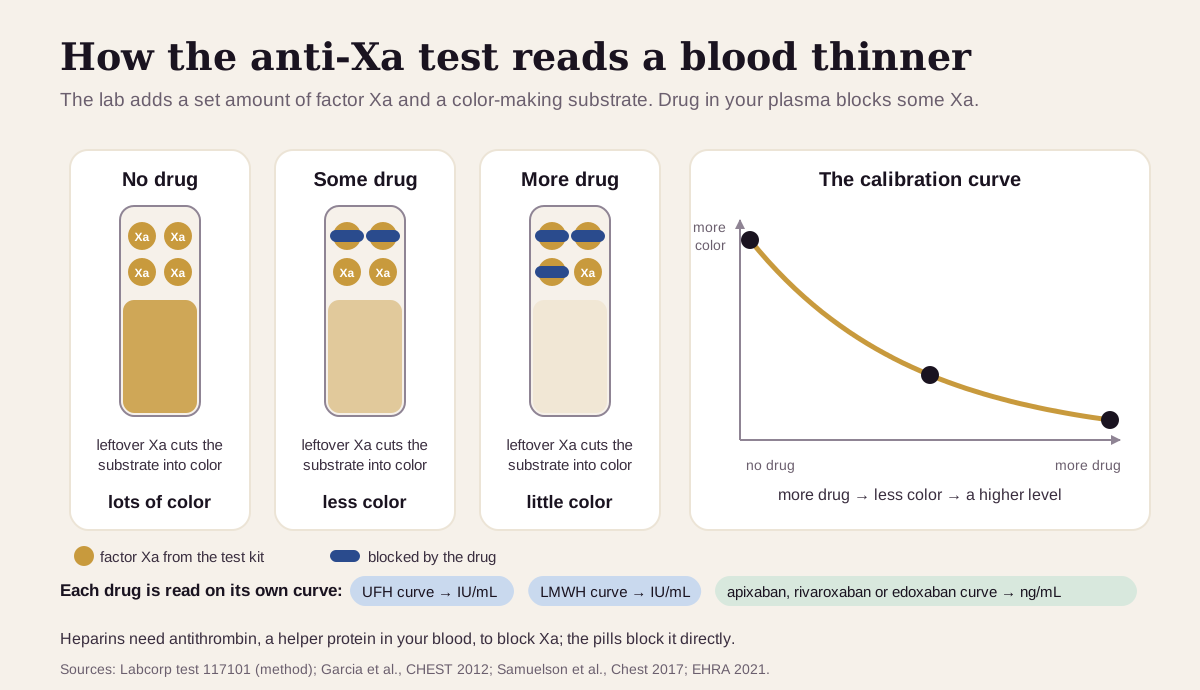
What anti-Xa is
Factor Xa ("ten-a") is one of the clotting enzymes. Blood thinners that block it slow the making of thrombin, the enzyme that builds a clot. Several work this way:4
- Heparin (unfractionated heparin, UFH), given by vein, and the low-molecular-weight heparins (LMWH) such as enoxaparin, dalteparin and tinzaparin, given as shots. Both act through a helper protein in your blood called antithrombin.
- Fondaparinux, a small synthetic cousin of heparin that blocks only factor Xa, also through antithrombin.
- Apixaban, rivaroxaban and edoxaban, pills that block factor Xa directly.2
The test works backward. The lab mixes your plasma with a measured amount of factor Xa and a colorless substrate that Xa cuts into a yellow dye. Whatever drug is in the sample neutralizes part of the Xa, so more drug means less color. A calibration curve made from known amounts of the same drug turns the color into a level.1 That's why each drug needs its own calibrator, and why a heparin result is in IU/mL while an apixaban result is in ng/mL.62 Fondaparinux has its own anti-Xa test at Labcorp, drawn 3 hours after the dose.1
You'll usually meet this test in the hospital, on a heparin drip, where it can be repeated every few hours. Outpatients see it less often: on enoxaparin with weak kidneys, at very high body weight, in pregnancy, or when an apixaban or rivaroxaban level matters before urgent surgery.42
What's a normal anti-Xa level?
Off blood thinners, about zero. With no drug in the sample, nothing blocks the reagent's factor Xa. The European Heart Rhythm Association (EHRA) puts it plainly for the pills: no anti-Xa activity on a calibrated test rules out a clinically relevant drug level.2
On a blood thinner, "normal" means "on target". Labcorp, a large commercial lab, says so on its report: its "reference intervals indicate therapeutic levels", and it prints a separate target for each drug: 0.30–0.70 IU/mL for heparin, 0.60–1.00 IU/mL for twice-daily enoxaparin, and above 1.00 IU/mL for once-daily enoxaparin.1
The number also depends on the test kit. When one lab ran patient samples on eight commercial anti-Xa methods, average enoxaparin results ranged from 0.28 to 0.64 IU/mL depending on the method.8 The aPTT, the older heparin test, spreads even wider: at the same heparin level of 0.3 units/mL, different reagents gave aPTT results from 48 to 108 seconds.4
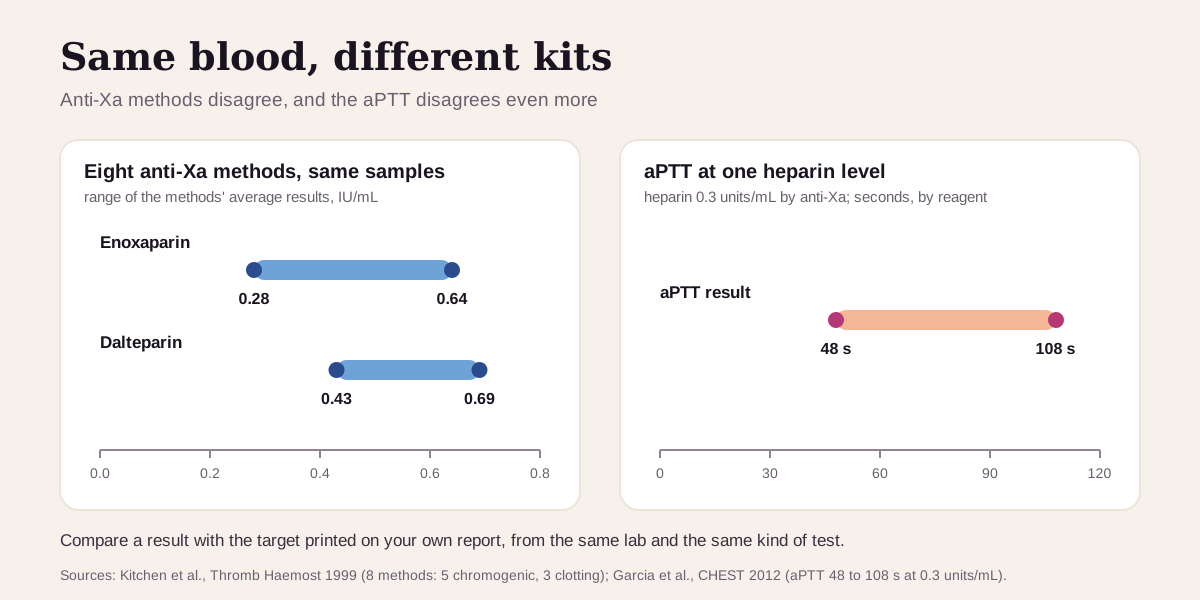
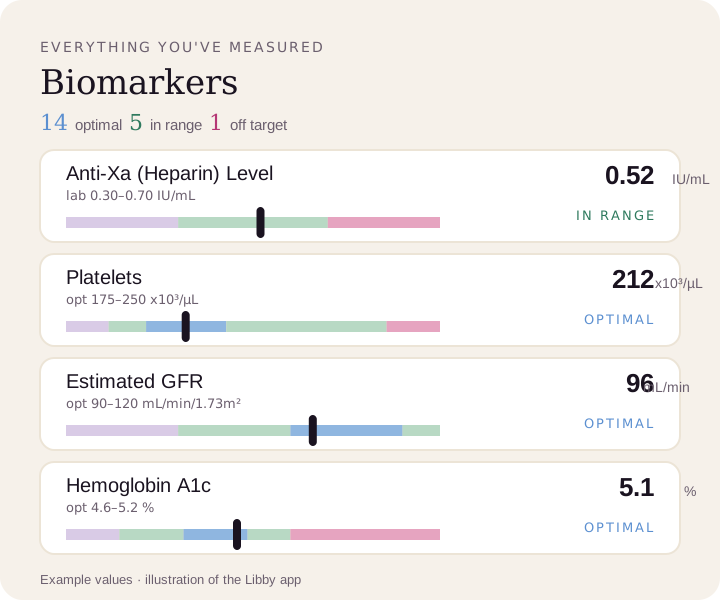
So compare a result with the target printed on your own report, from the same lab. The Libby app shows anti-Xa on a 0.30–0.70 IU/mL range for every result. That's the heparin (UFH) target. A twice-daily enoxaparin peak of 0.85, right where Labcorp aims, shows as high in the app, so read LMWH and pill results against your report's target for that drug.1
"Optimal" anti-Xa: the target depends on the drug and the draw time
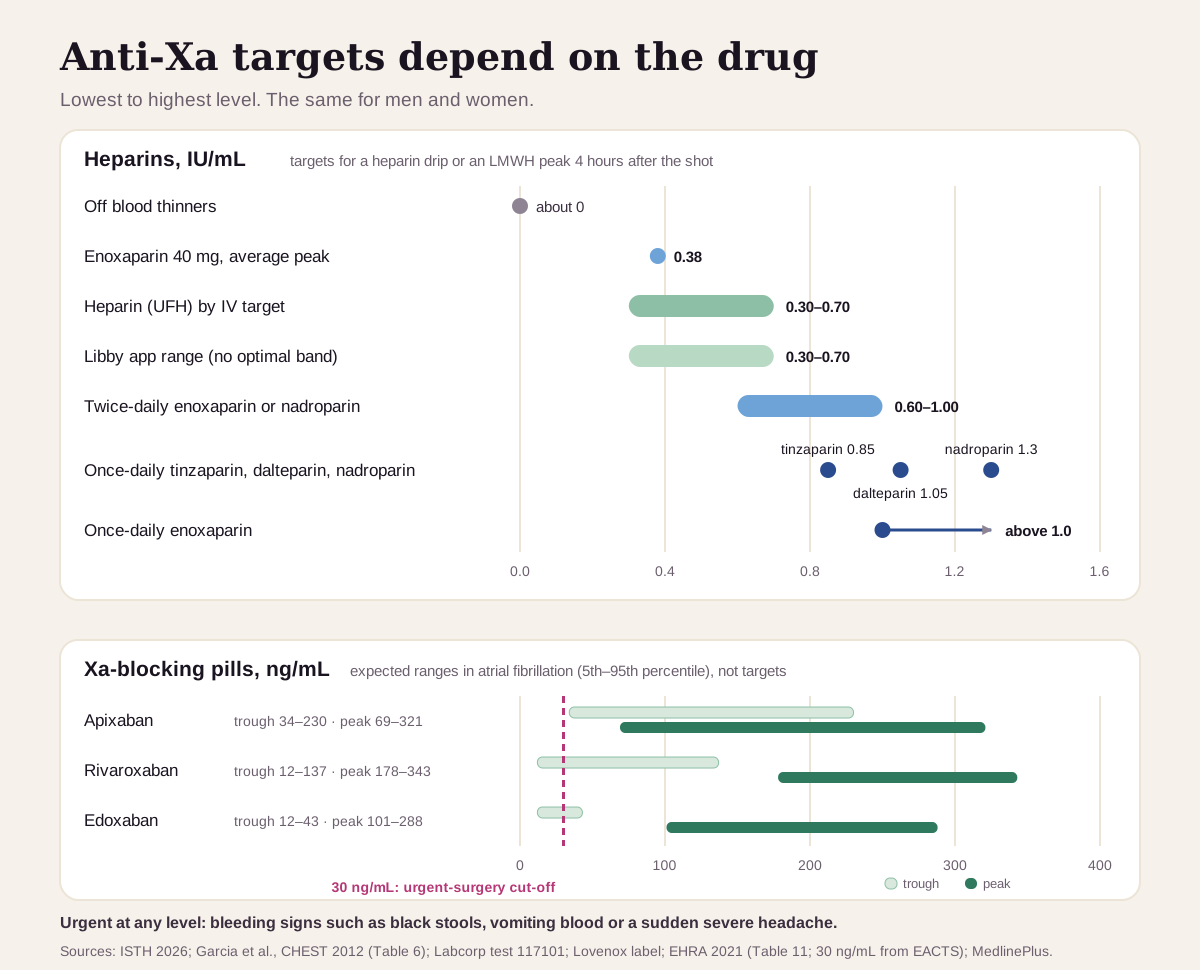
There's no optimal anti-Xa for a healthy person, because without a blood thinner the result is about zero. The ladder that matters is the one below: published targets and expected ranges, drug by drug, from the lowest levels to the highest. They're the same for men and women.
| Drug and draw | Level | Who says so |
|---|---|---|
| No blood thinner | about 0 | No drug, nothing to block the test's Xa2 |
| Enoxaparin 40 mg once daily (prevention dose) | average peak 0.38 IU/mL | A measured average, not a target: the FDA label5 |
| Heparin (UFH) by IV, 6 hours after a change | 0.30–0.70 IU/mL | ISTH 2026 for most uses, including clots, arterial events and mechanical heart valves;3 CHEST 2012;4 Labcorp1 |
| Libby app | 0.30–0.70 IU/mL lab range, no optimal band | The range the app shows for every anti-Xa result: the heparin target above |
| Enoxaparin or nadroparin twice daily, 4 hours after the shot | 0.6–1.0 IU/mL | CHEST 2012 calls it "conservative";4 Labcorp prints 0.60–1.001 |
| Once-daily LMWH, 4 hours after the shot | tinzaparin 0.85; dalteparin 1.05; enoxaparin above 1.0; nadroparin 1.3 IU/mL | CHEST 20124 |
| Apixaban (atrial fibrillation) | trough 34–230, peak 69–321 ng/mL | Expected ranges (5th–95th percentile), not targets: EHRA 20212 |
| Rivaroxaban (atrial fibrillation) | trough 12–137, peak 178–343 ng/mL | EHRA 20212 |
| Urgent | bleeding signs at any level; before urgent surgery, a pill level under 30 ng/mL is treated as safe to operate | Bleeding signs: MedlinePlus.7 The 30 ng/mL cut-off comes from European cardiac surgeons (EACTS), quoted by EHRA, which notes outcome data are lacking2 |
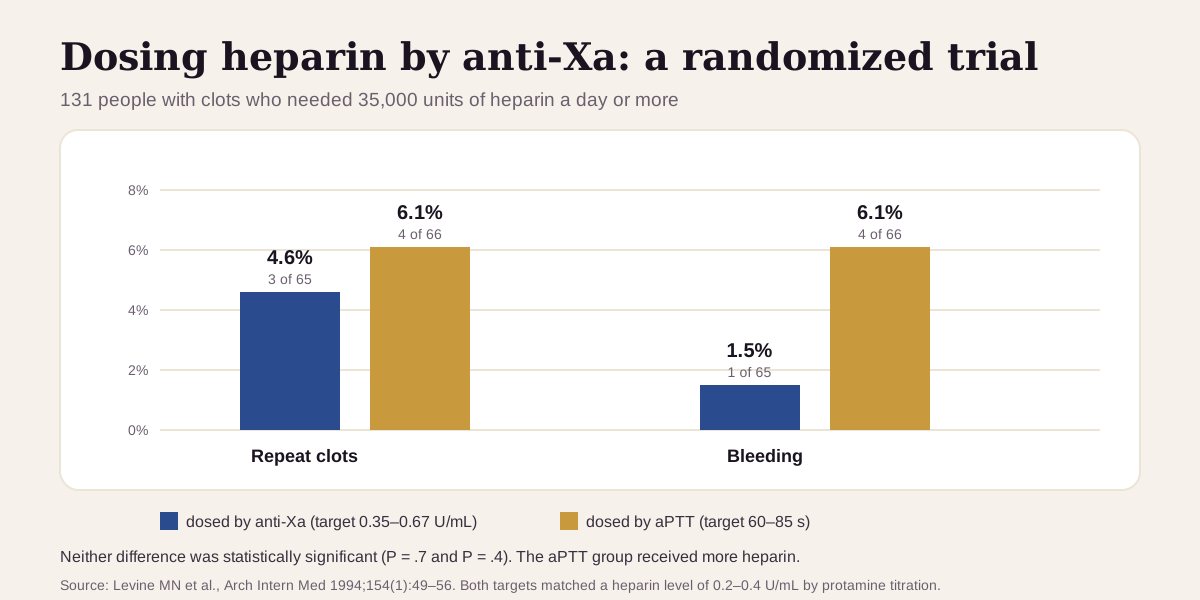
Why hospitals switched heparin checks to anti-Xa. The heparin target started as a translation: in the study behind the old aPTT rule, an aPTT of 1.5–2.5 times control matched a heparin level of 0.3–0.7 units/mL by anti-Xa.4 Measuring the heparin directly skips the translation. In a randomized trial of 131 people who needed very large heparin doses, dosing by anti-Xa (target 0.35–0.67 U/mL) instead of the aPTT (60–85 seconds) gave similar protection with less heparin: repeat clots in 4.6% vs 6.1% and bleeding in 1.5% vs 6.1%, differences too small to be sure of.9 The ISTH now prefers anti-Xa for heparin because it's less thrown off by other conditions and needs no lab-by-lab heparin range.3
Keep these targets in perspective: they're working targets, not proven optimums. The ISTH notes limited outcome data behind heparin dosing and calls for more research.3 For LMWH, some studies tie high anti-Xa levels to bleeding and others find no link, and one randomized trial found no benefit from monitoring.4 Even the enoxaparin label reports an average steady-state peak of about 1.2 IU/mL on a standard twice-daily dose, above CHEST's conservative range, and calls it therapeutic.54 That's why the American Society of Hematology (ASH) suggests against routinely adjusting LMWH by anti-Xa in people with kidney failure, obesity or pregnancy-related clots, while noting the evidence is thin.1011
What a high or low anti-Xa usually means
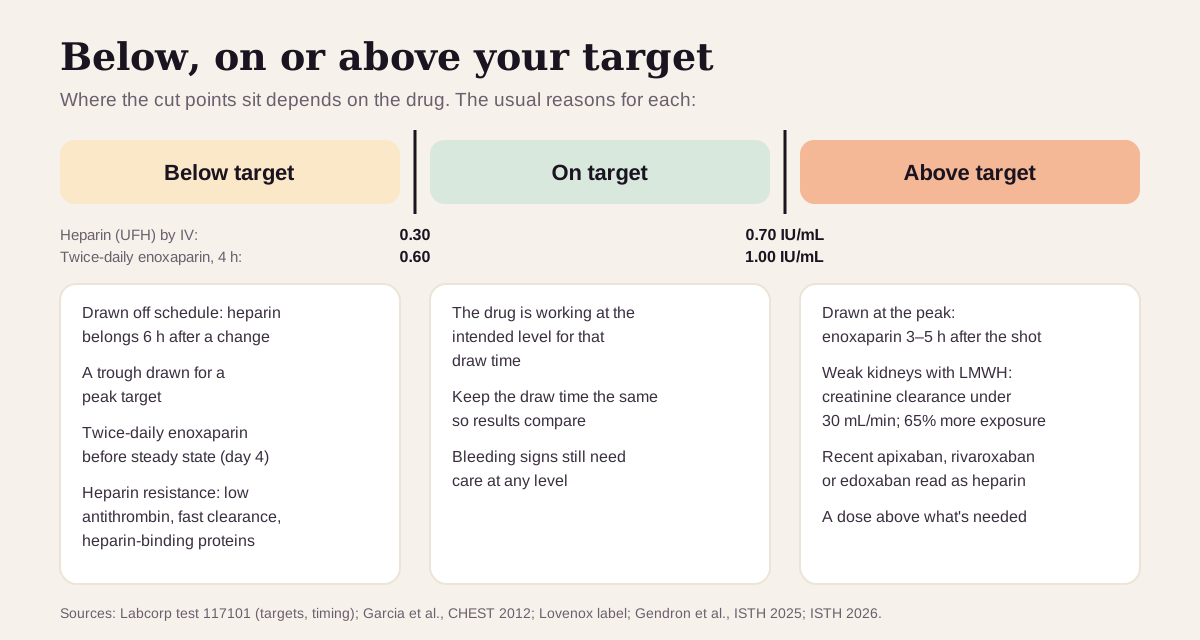
Start with the draw time and the drug. Most off-target results come from timing, dose or kidneys, and a few from the sample.
Below the target
The usual suspects:
- Drawn off schedule. Labcorp asks for heparin samples 6 hours after the drip starts or changes, and for LMWH samples at set hours after the shot.1
- Drawn at the trough. LMWH targets are peaks, measured about 4 hours after the shot. A sample taken just before the next dose reads lower.41
- Not at steady state yet. On twice-daily enoxaparin, levels build until about day 4.5
- Heparin resistance. Some people need unusually large heparin doses. Causes include low antithrombin, faster heparin clearance, and proteins that soak up heparin.4 The ISTH advises against routinely topping up antithrombin when the shortage is acquired.3
Above the target
- Drawn at or near the peak when the target was set for a later draw. Enoxaparin peaks 3–5 hours after the shot.5
- Weak kidneys with LMWH. Enoxaparin's clearance tracks kidney function. With a creatinine clearance under 30 mL/min, anti-Xa levels climb with repeated doses; the label reports 65% more exposure at a prevention dose, and it calls for a lower dose.45
- A recent apixaban, rivaroxaban or edoxaban dose. These pills also block Xa, so after a switch to heparin they can interfere with a heparin-calibrated anti-Xa and push it up. The ISTH has published advice on handling that switch.12
- The dose itself. Sometimes the level is simply above target, which is why a repeat check after a dose change is routine.1
Get care right away if you're on heparin, enoxaparin or an Xa-blocking pill and notice vomit that is bloody or looks like coffee grounds, coughing up blood, black or bright red stools, blood in your urine, a sudden severe headache, or sudden weakness, numbness or trouble speaking.7 After a spinal or epidural procedure, numbness, tingling, leg weakness or trouble controlling your bladder or bowels is an emergency on these drugs.13
Anti-Xa reads best next to its neighbors
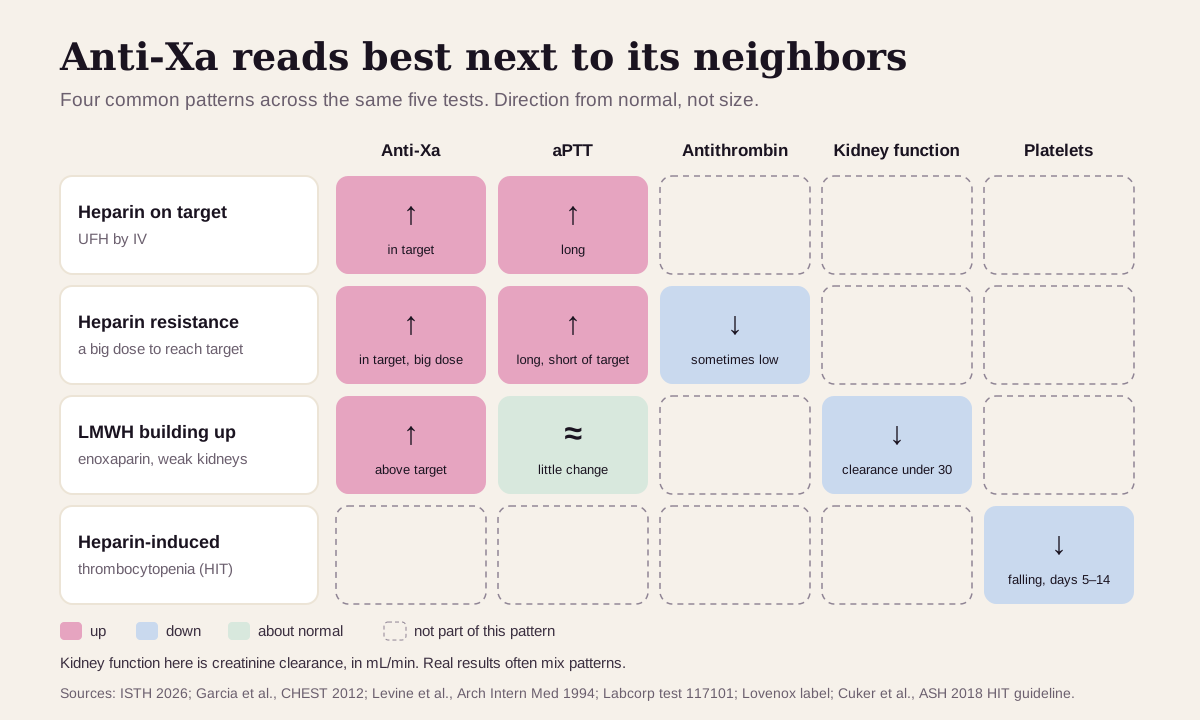
The anti-Xa tells you how much drug is working. The tests around it tell you why, and what else to watch:41
| If you see… | It often points to… |
|---|---|
| On IV heparin, anti-Xa 0.30–0.70 IU/mL and a long aPTT | heparin working as planned: at those levels, aPTT results run from about 1.6 to as much as 6.2 times control, depending on the reagent43 |
| Anti-Xa on target only on a big heparin dose, aPTT long but short of its target | heparin resistance; in the trial above, the anti-Xa group's average aPTT stayed below its target while anti-Xa sat in range94 |
| Anti-Xa above target, low creatinine clearance, aPTT barely moved | LMWH building up in weak kidneys; the aPTT barely registers LMWH, so it misses this415 |
| Platelets falling 5 to 14 days into heparin | possible heparin-induced thrombocytopenia (HIT), an immune reaction to heparin; the platelet count, scored with the "4Ts", flags it14 |
| A high heparin anti-Xa soon after switching from apixaban, rivaroxaban or edoxaban | possibly the pill still on board, read as heparin; how long that lasts depends on the last dose and on kidney function122 |
| A long aPTT before any heparin | among other causes, a lupus anticoagulant or a contact-factor shortage; for these people anti-Xa may be the better heparin test13 |
For the other clotting tests, see the guides to the aPTT, PT and INR and thrombin time.
How fast anti-Xa changes
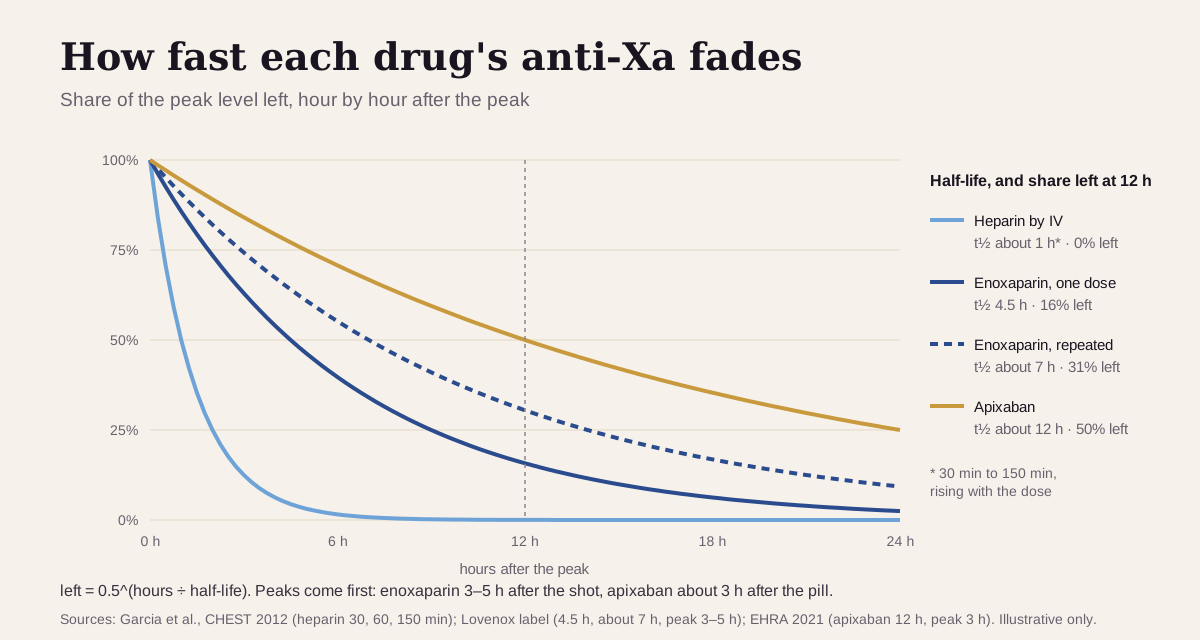
Anti-Xa follows the drug, so it moves in hours. Each drug clears at its own pace:
- Heparin by IV: its effective half-life grows with the dose, from about 30 minutes after a small bolus to 60 minutes after a medium one and 150 minutes after a large one.4
- Enoxaparin: peaks 3–5 hours after the shot, with a half-life of 4.5 hours after one dose and about 7 hours after repeated doses.5
- The pills: apixaban peaks at about 3 hours with a half-life of about 12 hours; rivaroxaban peaks at 2–4 hours with a half-life of 5–9 hours in younger adults and 11–13 hours in older adults; edoxaban's is 10–14 hours.2
What that means in practice:
- Write down two times: your last dose and the blood draw. A result without them is hard to read.12
- A peak and a trough are different tests. On twice-daily enoxaparin at steady state, the label's average peak is about 1.2 IU/mL and its trough about 0.52.5
- Trends only work within one lab and one calibrator, because methods disagree.8
Going deeper: one enzyme, four calibrators
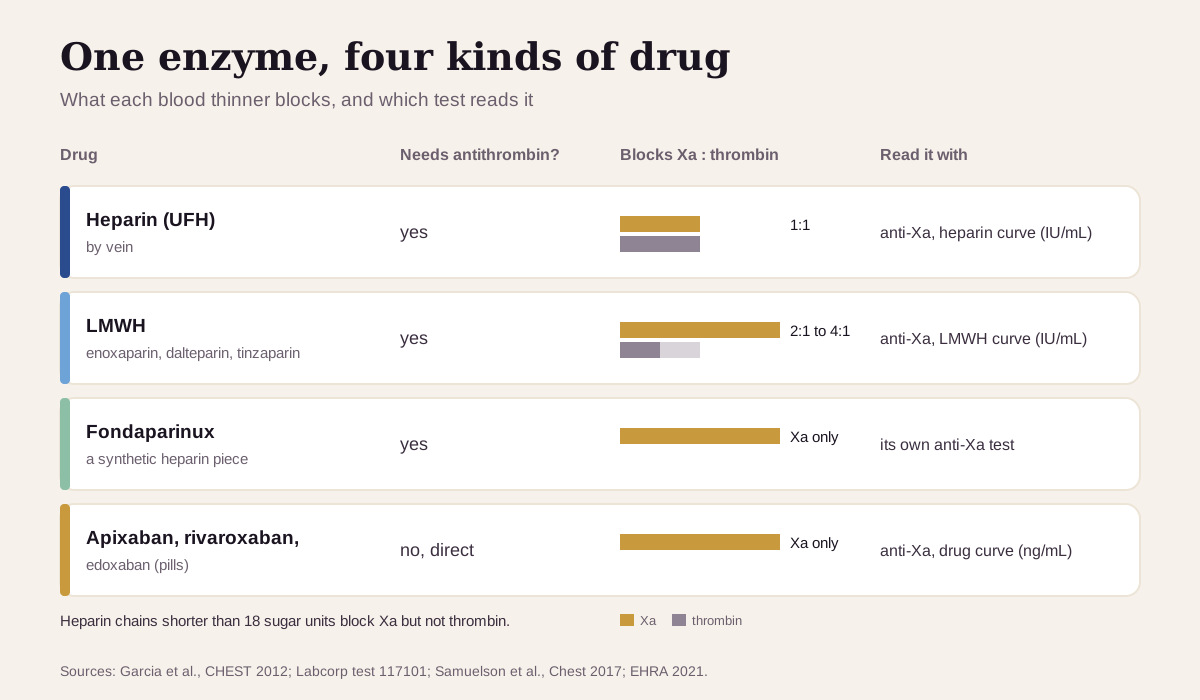
Heparin is a mix of sugar chains. To block thrombin, a chain has to wrap around both antithrombin and thrombin, which takes at least 18 sugar units. To block factor Xa, it only has to switch on antithrombin. Nearly every chain in unfractionated heparin is long enough, so it blocks Xa and thrombin about 1:1. LMWHs are shorter, 2:1 to 4:1 in favor of Xa.4 The aPTT barely moves on LMWH, which is why anti-Xa is the test for it.1
Test add-ons matter. Some anti-Xa kits add extra antithrombin or dextran sulfate to the reaction. The ISTH prefers kits without them for heparin, especially after protamine, the heparin antidote, because the add-ons can overstate heparin activity once protamine has been given.3 Protamine rapidly reverses unfractionated heparin but neutralizes only a variable part of an LMWH's anti-Xa activity.4
The pills need their own curves. A systematic review of 109 studies found that anti-Xa tests calibrated to rivaroxaban, apixaban or edoxaban track the drug level closely (r² 0.78–1.00), and recommends a drug-specific calibrator for each.6 EHRA discourages routine level checks and dose changes for these pills and sees a role in emergencies such as bleeding or urgent surgery.2 ASH, writing for people treated for clots, suggests against measuring the pill's effect while managing bleeding.10
Questions worth asking
- Which drug was this anti-Xa calibrated for: heparin, LMWH, or my specific pill?
- Was this a peak or a trough, and how long after my last dose was it drawn?
- What target are we aiming for with my drug and dose, and where does it come from?
- Could my kidney function be letting the drug build up?
- If I switched from apixaban or rivaroxaban recently, could it be raising a heparin level?
- Should my platelet count be checked while I'm on heparin?
FAQ
What is a normal anti-Xa level? Off blood thinners it's about zero. On heparin by IV, the usual target is 0.30–0.70 IU/mL; LMWH and the pills have their own targets or expected ranges.342
When should anti-Xa be drawn? For heparin by IV, about 6 hours after it starts or changes. For LMWH treatment targets, about 4 hours after the shot (3–4 hours for twice-daily doses at Labcorp).14
Why use anti-Xa instead of the aPTT for heparin? The ISTH prefers anti-Xa because other conditions throw it off less and it needs no lab-by-lab heparin range. In a randomized trial, anti-Xa dosing worked as well with less heparin.39
Can an anti-Xa test measure apixaban or rivaroxaban? Yes, when it's calibrated for that drug, and the result is in ng/mL. Routine checks are discouraged; EHRA sees a role in emergencies such as bleeding or urgent surgery.62
This guide is for education. It can't diagnose you or replace care from a clinician who knows your history.
Footnotes
-
Labcorp. Heparin Anti-Xa, test 117101. Method (chromogenic, UFH and LMWH standard curves, excess antithrombin), draw timing, therapeutic target table, and why the aPTT misleads with lupus anticoagulants and LMWH. A commercial laboratory's published test catalog. labcorp.com ↩ ↩2 ↩3 ↩4 ↩5 ↩6 ↩7 ↩8 ↩9 ↩10 ↩11 ↩12 ↩13 ↩14 ↩15 ↩16 ↩17 ↩18 ↩19 ↩20 ↩21
-
Steffel J, Collins R, Antz M, Cornu P, et al. 2021 European Heart Rhythm Association Practical Guide on the Use of Non-Vitamin K Antagonist Oral Anticoagulants in Patients with Atrial Fibrillation. Europace. 2021;23(10):1612–1676. Expected peak and trough levels (Table 11), time to peak and half-lives (Table 4), drug-calibrated anti-Xa, and the 30 ng/mL surgery cut-off it quotes from EACTS. PMC ↩ ↩2 ↩3 ↩4 ↩5 ↩6 ↩7 ↩8 ↩9 ↩10 ↩11 ↩12 ↩13 ↩14 ↩15 ↩16 ↩17 ↩18 ↩19 ↩20
-
Gouin-Thibault I, Frere C, Castellucci LA, Connors JM, Cuker A, Levy JH, Lecompte T, Mullier F; UFH working group. How to monitor and manage unfractionated heparin in practice (Part 1)? Guidance from the SSC of the ISTH. J Thromb Haemost. 2026;24(8):3051–3062. The newest international guidance: anti-Xa preferred over the aPTT, a suggested target of 0.30–0.70 U/mL for most indications, kits without added antithrombin or dextran sulphate, no routine antithrombin for acquired deficiency, and limited outcome data. PubMed · DOI ↩ ↩2 ↩3 ↩4 ↩5 ↩6 ↩7 ↩8 ↩9 ↩10 ↩11 ↩12 ↩13
-
Garcia DA, Baglin TP, Weitz JI, Samama MM. Parenteral anticoagulants: Antithrombotic Therapy and Prevention of Thrombosis, 9th ed: American College of Chest Physicians Evidence-Based Clinical Practice Guidelines. Chest. 2012;141(2 Suppl):e24S–e43S. Source of the LMWH peak targets (Table 6), the 0.3–0.7 heparin range and its origin, aPTT spread at 0.3 U/mL, heparin half-lives, heparin resistance, kidney accumulation, chain length and protamine. PMC ↩ ↩2 ↩3 ↩4 ↩5 ↩6 ↩7 ↩8 ↩9 ↩10 ↩11 ↩12 ↩13 ↩14 ↩15 ↩16 ↩17 ↩18 ↩19 ↩20 ↩21 ↩22 ↩23 ↩24 ↩25 ↩26 ↩27 ↩28
-
Sanofi-Aventis U.S. Lovenox (enoxaparin sodium injection) prescribing information, DailyMed. Peak 3–5 hours after injection; mean peak 0.38 IU/mL after 40 mg; steady-state peak about 1.2 and trough 0.52 IU/mL on 1 mg/kg every 12 hours; half-life 4.5 to about 7 hours; 65% higher exposure with creatinine clearance under 30 mL/min. DailyMed ↩ ↩2 ↩3 ↩4 ↩5 ↩6 ↩7 ↩8 ↩9 ↩10 ↩11 ↩12 ↩13
-
Samuelson BT, Cuker A, Siegal DM, Crowther M, Garcia DA. Laboratory Assessment of the Anticoagulant Activity of Direct Oral Anticoagulants: A Systematic Review. Chest. 2017;151(1):127–138. 109 studies; calibrated anti-Xa r² 0.78–1.00 for the Xa-blocking pills. PMC ↩ ↩2 ↩3 ↩4 ↩5
-
National Library of Medicine. Heparin Injection. MedlinePlus. Serious side effects that need a call to your doctor right away. MedlinePlus ↩ ↩2 ↩3
-
Kitchen S, Iampietro R, Woolley AM, Preston FE. Anti Xa monitoring during treatment with low molecular weight heparin or danaparoid: inter-assay variability. Thromb Haemost. 1999;82(4):1289–1293. Eight commercial methods; mean enoxaparin results 0.28–0.64 IU/mL and dalteparin 0.43–0.69 IU/mL. PubMed ↩ ↩2 ↩3
-
Levine MN, Hirsh J, Gent M, Turpie AG, et al. A randomized trial comparing activated thromboplastin time with heparin assay in patients with acute venous thromboembolism requiring large daily doses of heparin. Arch Intern Med. 1994;154(1):49–56. 131 patients needing 35,000 units a day or more; recurrent clots 4.6% vs 6.1%, bleeding 1.5% vs 6.1%. PubMed ↩ ↩2 ↩3 ↩4 ↩5
-
Witt DM, Nieuwlaat R, Clark NP, Ansell J, et al. American Society of Hematology 2018 guidelines for management of venous thromboembolism: optimal management of anticoagulation therapy. Blood Adv. 2018;2(22):3257–3291. Recommendations 7 and 8: against routine anti-Xa-guided LMWH dosing in kidney failure (creatinine clearance under 30 mL/min) or obesity; recommendation 9: against measuring the DOAC effect while managing bleeding. PMC ↩ ↩2
-
Bates SM, Rajasekhar A, Middeldorp S, McLintock C, et al. American Society of Hematology 2018 guidelines for management of venous thromboembolism: venous thromboembolism in the context of pregnancy. Blood Adv. 2018;2(22):3317–3359. Recommendation 5: against routine anti-Xa monitoring of treatment-dose LMWH in pregnancy. PMC ↩
-
Gendron N, Cuker A, Gosselin RC, Castellucci LA, Thachil J. How to deal with interference on heparin anti-Xa activity caused by oral factor FXa inhibitors: communication from the ISTH SSC Subcommittee on Control of Anticoagulation. J Thromb Haemost. 2025;23(6):2060–2066. PubMed · DOI ↩ ↩2 ↩3
-
National Library of Medicine. Enoxaparin Injection. MedlinePlus. The spinal or epidural bleeding warning and its symptoms. MedlinePlus ↩
-
Cuker A, Arepally GM, Chong BH, Cines DB, et al. American Society of Hematology 2018 guidelines for management of venous thromboembolism: heparin-induced thrombocytopenia. Blood Adv. 2018;2(22):3360–3392. Typical onset 5 to 14 days after heparin starts, falling platelets, and the 4Ts score. PMC ↩ ↩2
Educational content, not medical advice. Libby is a personal record tool, not a medical service — it doesn't diagnose, treat, or prescribe. Reference ranges vary by lab and by person. Talk to a qualified healthcare professional about your results.
See every result against your lab's range.
Upload a lab PDF or a photo of your report. Libby puts each result on your lab's range, adds an optimal range for the markers that have one, and tracks your trends over time.
View your anti-Xa ›