Thrombin time test: normal range, long results, next steps
The thrombin time checks the last step of clotting. What's normal, why heparin or dabigatran lengthen it, and how labs spot a fibrinogen problem.
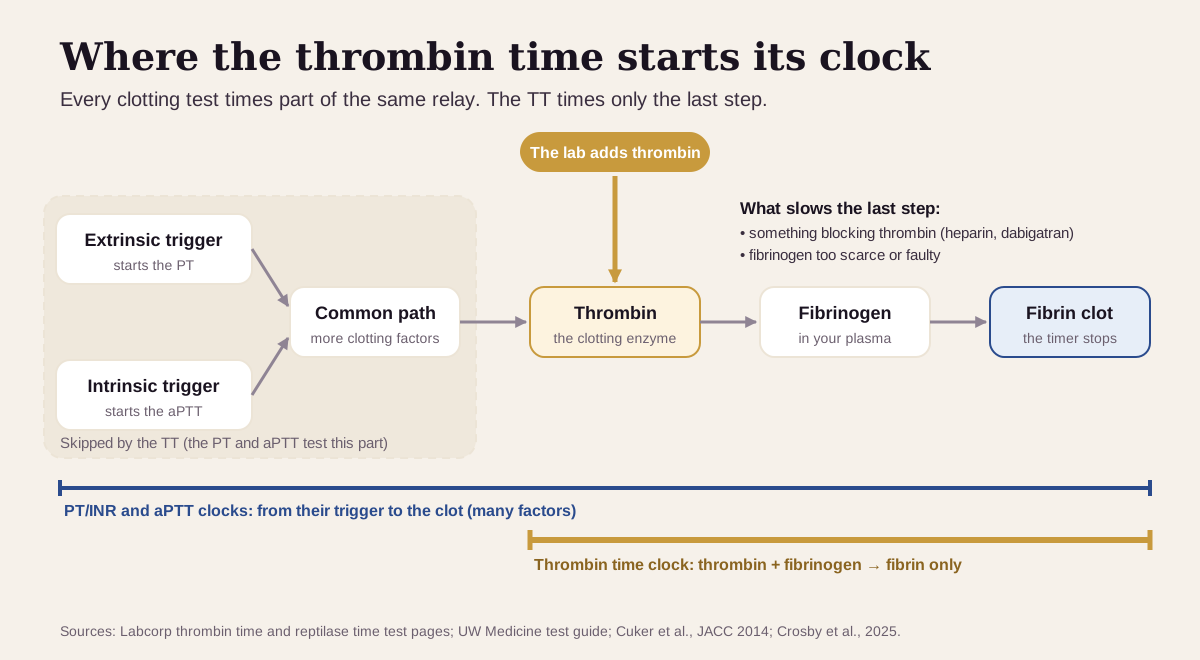
The thrombin time (TT) measures how long your plasma takes to clot after the lab adds thrombin, the enzyme that makes the final clot. It skips every earlier clotting step and times only the last one: fibrinogen turning into fibrin threads. So a long TT points one of two ways. Either something in the sample is blocking thrombin, most often heparin or a thrombin-blocking drug such as dabigatran, or the fibrinogen is too scarce or faulty.12
The short version
- Normal: check your report. The labs we looked at put the top of the range anywhere from 19 to 25 seconds, each for its own thrombin reagent and analyzer.34512
- Long, with a normal reptilase time: usually a thrombin blocker in the sample: heparin (including heparin from an IV line the blood was drawn through) or a direct thrombin inhibitor such as dabigatran.67
- Long, with a long reptilase time too: a fibrinogen problem. The TT lengthens once working fibrinogen falls below 100 mg/dL, or when the fibrinogen itself is abnormal.68
- On dabigatran, a normal TT is reassuring: it effectively rules out a meaningful drug level.910 Heavy or unusual bleeding needs prompt care, whatever the number.11
What the thrombin time is
Clotting is a relay. A chain of clotting factors passes the signal along until it makes thrombin. Thrombin then cuts fibrinogen, a protein dissolved in your plasma, into sticky fibrin strands that knit into a clot.36
The two everyday clotting tests time long stretches of that relay. The prothrombin time (PT/INR) runs through the whole "extrinsic" and common pathways, and the aPTT through the "intrinsic" one.97 The thrombin time starts at the finish line: the lab adds a set dose of thrombin to your plasma and times how long a fibrin clot takes to form.12
That makes the TT a clean test of two things: whether your fibrinogen is present and working, and whether anything in the sample is blocking thrombin.112 Clinicians usually order it to look into bleeding or easy bruising, an unexpected clotting result, a suspected fibrinogen disorder, or whether heparin or dabigatran is in a sample.3112
What's a normal thrombin time?
Start with the range printed on your report. Each lab sets its own range for the thrombin reagent and analyzer it uses, and the reagent matters: how much a given dose of dabigatran lengthens the TT depends on how concentrated the thrombin in the reagent is.139
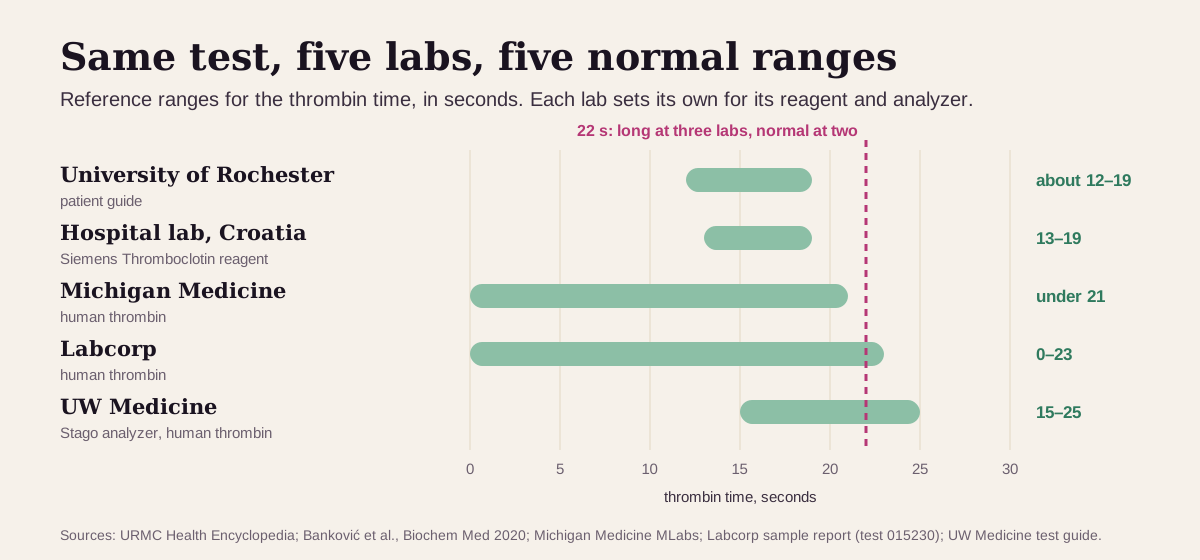
- The University of Rochester's patient guide gives about 12–19 seconds.3
- A Croatian hospital lab using Siemens' Thromboclotin reagent reports 13–19 seconds.4
- Michigan Medicine, using human thrombin, reports under 21 seconds.5
- Labcorp, also using human thrombin, prints 0–23 seconds on its sample report.1
- UW Medicine, on a Stago analyzer, uses 15–25 seconds.2
So a 22-second TT is long at one lab and normal at another. Compare repeat results from the same lab when you can.3
A normal TT tells you two things. Your fibrinogen is present and working at least well enough to clot, and there's no meaningful amount of dabigatran in the tube.19 The TT lengthens once working fibrinogen falls below 100 mg/dL, about half the bottom of Labcorp's adult range (209 mg/dL), so a milder shortage shows up on the fibrinogen test itself.18
Is there an "optimal" thrombin time?
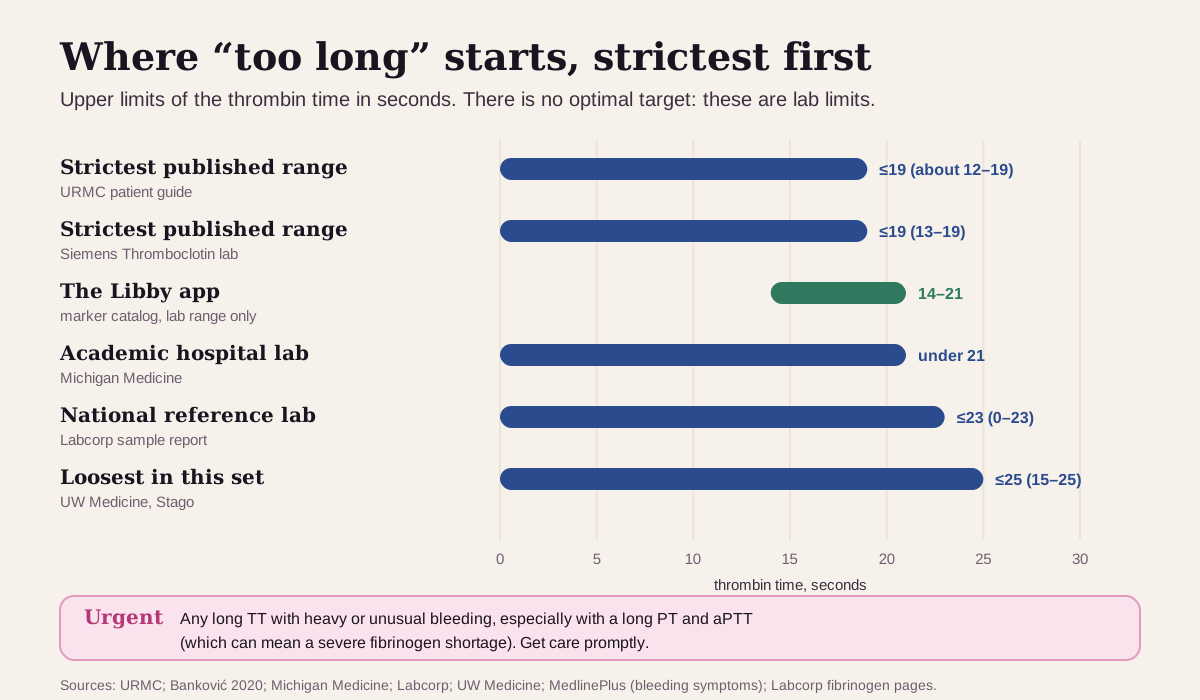
There's no optimal band for the TT in the Libby app's marker catalog, so the app shows your TT on your lab's range only. A TT inside that range is simply normal: a shorter one earns no bonus. For this test the useful question is where "too long" starts. Here is that ladder, from the strictest upper limit to the loosest, plus the point where a long TT becomes urgent:
| Where "too long" starts | Upper limit | Who uses it |
|---|---|---|
| Strictest published range | 19 s | URMC's patient guide (about 12–19 s)3 and a Siemens Thromboclotin lab (13–19 s)4 |
| The Libby app | 21 s | The range in the app's marker catalog, 14–21 s. The app has no optimal band for the TT |
| Academic hospital lab, human thrombin | 21 s | Michigan Medicine (under 21 s)5 |
| National reference lab | 23 s | Labcorp's sample report (0–23 s)1 |
| Loosest in this set | 25 s | UW Medicine on a Stago analyzer (15–25 s)2 |
| Urgent | any long TT with heavy or unusual bleeding | Especially with a long PT and aPTT, which can mean a severe fibrinogen shortage: get care promptly118 |
Why the strict end matters: the TT's sensitivity. Its one-step design makes it the most sensitive routine test for dabigatran:
- In a study of 35 people taking dabigatran 150 mg twice daily, drug levels ran from 27 to 411 ng/mL. Even so, the PT was normal in 29% of samples and the aPTT in 18%. The TT tracked the drug closely at low levels and became too long to measure above the median level.14
- A review of 11 studies found that a normal TT effectively excluded dabigatran in every one.10 Depending on the reagent, as little as 25 to 150 ng/mL pushed the TT past what the analyzer could measure.9
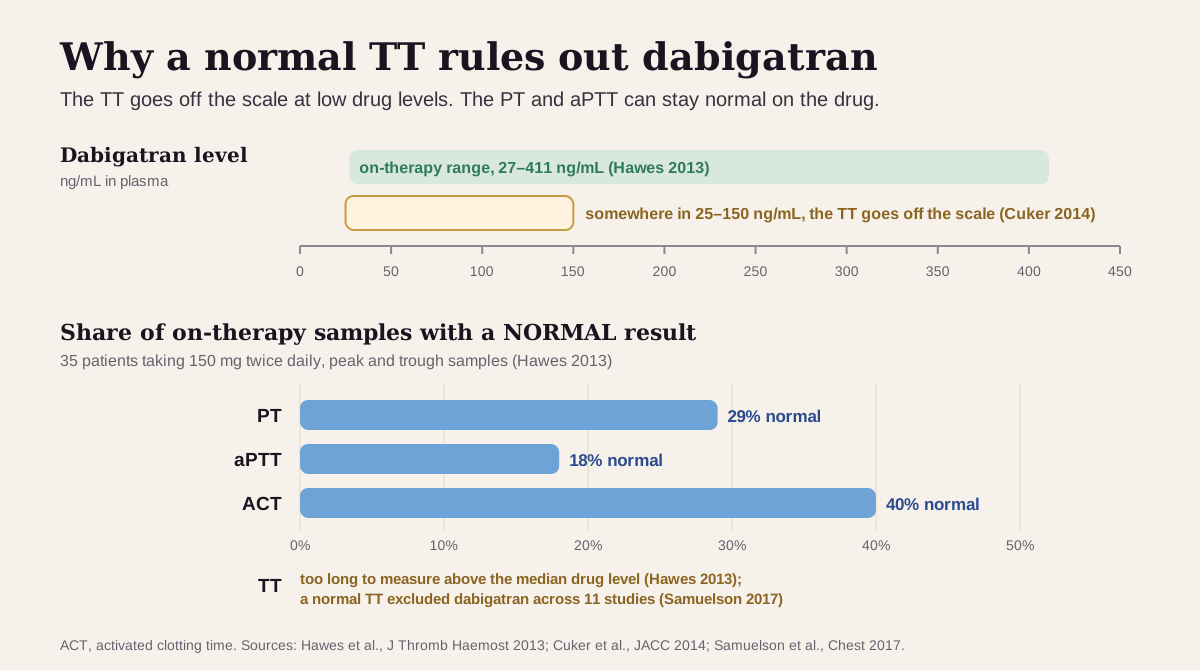
Keep the ladder in perspective: these are lab limits, not targets, and a result a second under your lab's limit carries no special meaning. A result a few seconds over it is a reason to check for heparin or dabigatran first, then fibrinogen. The reptilase time sorts the two apart.126
What a long thrombin time usually means
The reptilase time is the first clue. It's a companion test that clots plasma with a snake-venom enzyme instead of thrombin. Heparin and thrombin-blocking drugs leave it normal. Fibrinogen problems lengthen it.6712
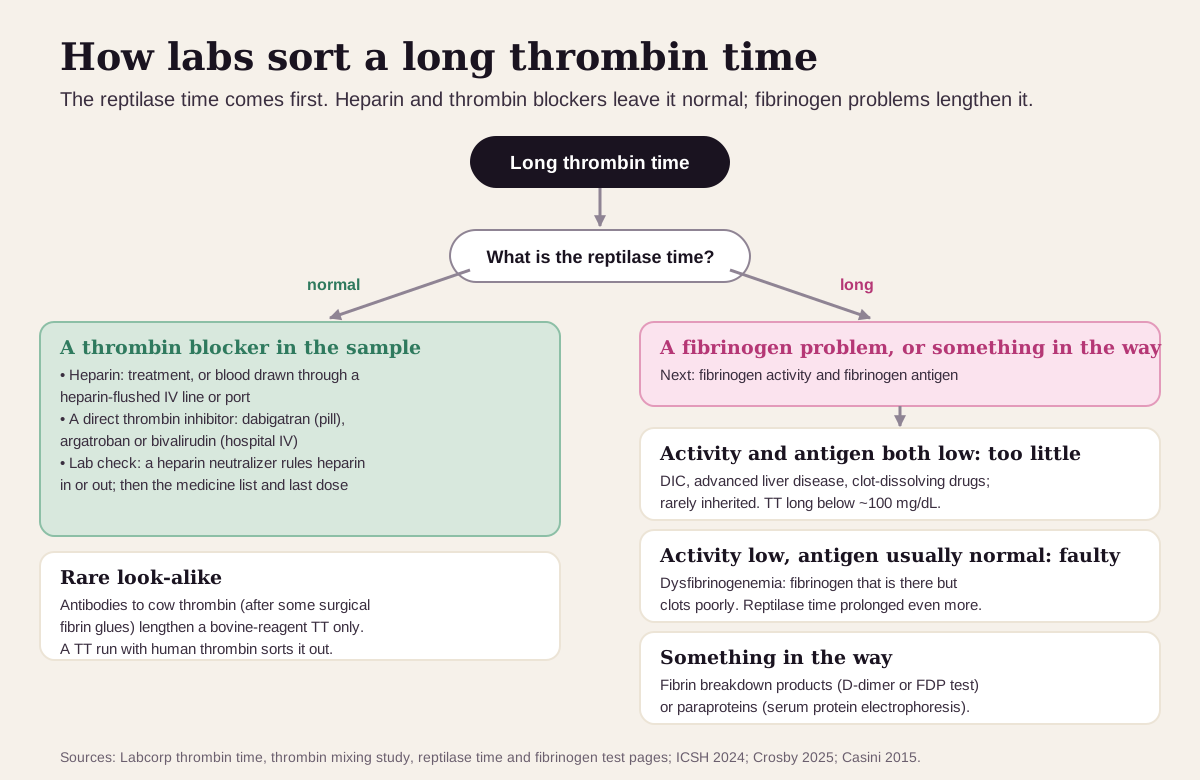
The usual suspects: a thrombin blocker in the sample
- Heparin. Heparin switches on antithrombin, the body's own thrombin brake.16 Any heparin in the tube lengthens the TT while the reptilase time stays normal. It can come from heparin treatment, or from blood drawn through an IV line or port flushed with heparin, even in people not on heparin therapy.72 To measure heparin itself, clinicians use an anti-factor Xa test.1
- Dabigatran (Pradaxa) and other direct thrombin inhibitors. Dabigatran is a pill that blocks thrombin directly; argatroban and bivalirudin are hospital IV drugs that do the same.162 The TT reacts to such small amounts that a normal result effectively rules dabigatran out, while a long one says little about the dose.910
- Other blood thinners behave differently. Apixaban, rivaroxaban and edoxaban block factor Xa and leave the TT unchanged.13
Next: too little fibrinogen
The TT lengthens once working fibrinogen drops below 100 mg/dL.1 The causes Labcorp lists:
- DIC (disseminated intravascular coagulation), a complication of severe illness in which the body uses up fibrinogen.31
- Advanced liver disease. The liver makes fibrinogen.8
- Clot-dissolving (thrombolytic) treatment, kidney disease, amyloidosis, some cancers, and the leukemia drug L-asparaginase.18
- Inherited low fibrinogen is rare. Complete absence (afibrinogenemia) has only about 150 reported cases. People with one faulty gene copy usually have no symptoms unless their level falls under 50 mg/dL.8
Less common: faulty fibrinogen, or something in the way
- Dysfibrinogenemia, fibrinogen that is present, usually in normal amounts, but clots poorly. The typical pattern is a long TT, a reptilase time prolonged even more, and low fibrinogen activity next to a usually normal antigen (amount) level.815 About half of people with the inherited form have no symptoms. About 1 in 4 bleed too long after surgery, and about 20% are prone to clots.8
- Fibrin breakdown products and paraproteins (abnormal antibodies, as in multiple myeloma or amyloidosis) get in the way of fibrin strands joining up. They lengthen both the TT and the reptilase time.63
- Antibodies to cow thrombin. Some surgical fibrin glues contain bovine thrombin, and a few people make antibodies to it. These lengthen a TT run with bovine reagent but leave the reptilase time normal; a TT with human thrombin sorts it out.61
Get prompt care for heavy or unusual bleeding: a cut that keeps bleeding longer than usual, pink or brown urine, red or black tarry stools, vomit that's bloody or looks like coffee grounds, coughing up blood, a headache, or dizziness or fainting. This matters most if you take a blood thinner, or if your TT, PT and aPTT are all long.118
Don't stop a prescribed blood thinner on your own because of a TT result. Bring the result, and the time of your last dose, to your clinician.11
Thrombin time reads best next to its neighbors
The TT is rarely read alone. The pattern across the reptilase time, fibrinogen, the aPTT and the PT/INR says far more than the TT does by itself:121
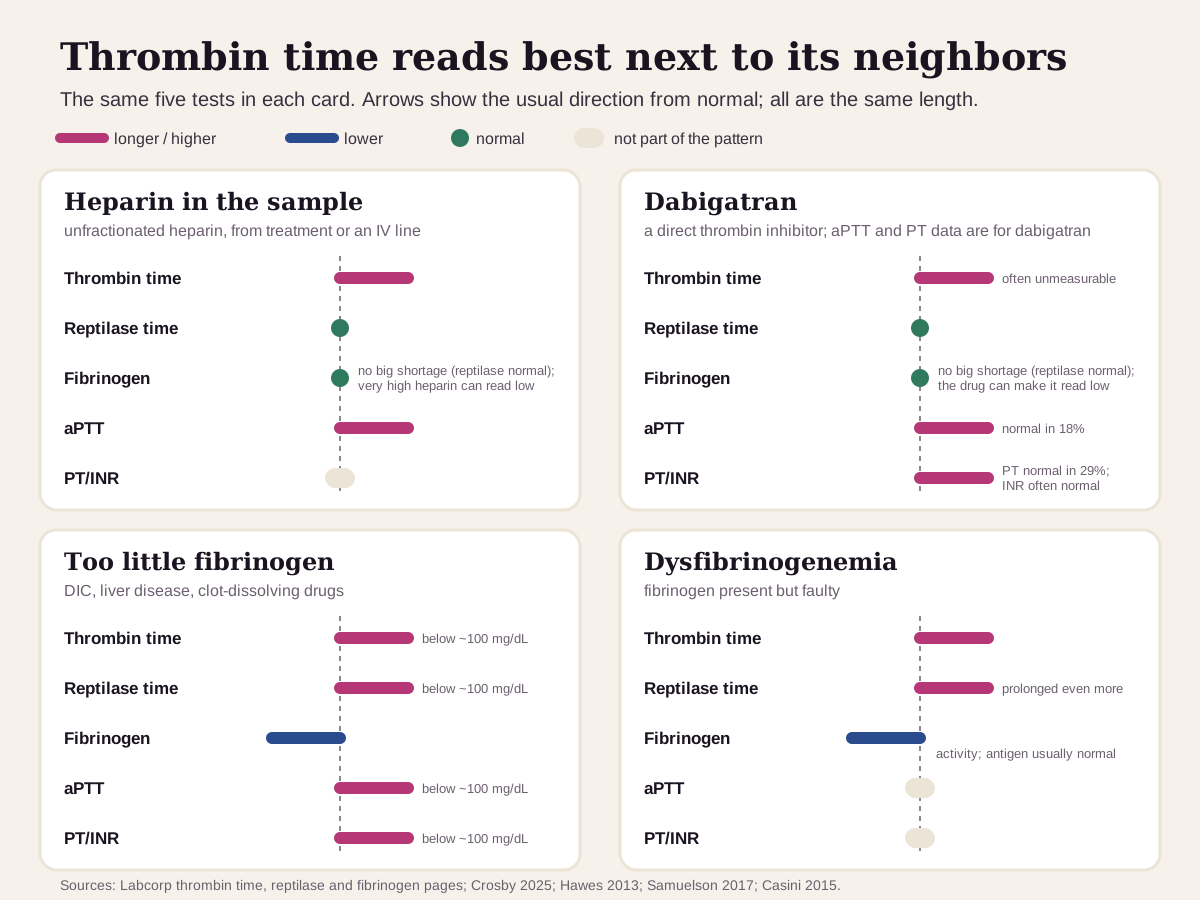
| If you see… | It often points to… |
|---|---|
| Long TT, normal reptilase time, long aPTT | heparin in the sample, from treatment or from an IV line (a heparin neutralizer in the lab tells it apart from a thrombin-blocking drug) |
| Very long or unmeasurable TT, normal reptilase time, aPTT usually long, PT less reliably so | dabigatran or another direct thrombin inhibitor: in one dabigatran study the aPTT was normal in 18% and the PT in 29% of on-drug samples |
| Long TT and long reptilase time, low fibrinogen, and a long PT and aPTT once fibrinogen is below about 100 mg/dL | too little fibrinogen: DIC, advanced liver disease, clot-dissolving treatment |
| Long TT, reptilase time prolonged even more, fibrinogen activity low but antigen usually normal | dysfibrinogenemia: fibrinogen that is there but works poorly |
When the fibrinogen side is the problem and DIC is on the table, a D-dimer shows whether clots are forming and breaking down.1
How fast the thrombin time changes
The TT follows whatever is lengthening it:
- Heparin clears in hours. An IV heparin drip has a half-life of 60 to 90 minutes.16 When heparin from a line is the suspect, labs ask for a fresh sample drawn straight from a vein.12
- Dabigatran takes days. Its half-life is 12 to 17 hours in healthy adults, and longer when the kidneys are weak.17 Because the TT reacts to tiny amounts, it can stay long well after the last dose.9 For a TT meant to look for a fibrinogen problem, Labcorp's instructions are to avoid heparin and thrombin-inhibitor drugs for about three days beforehand, a decision for your prescriber to make with you.1
- Fibrinogen recovers over days. Its half-life is about four days.8 A TT lengthened by low fibrinogen improves as the cause is treated.
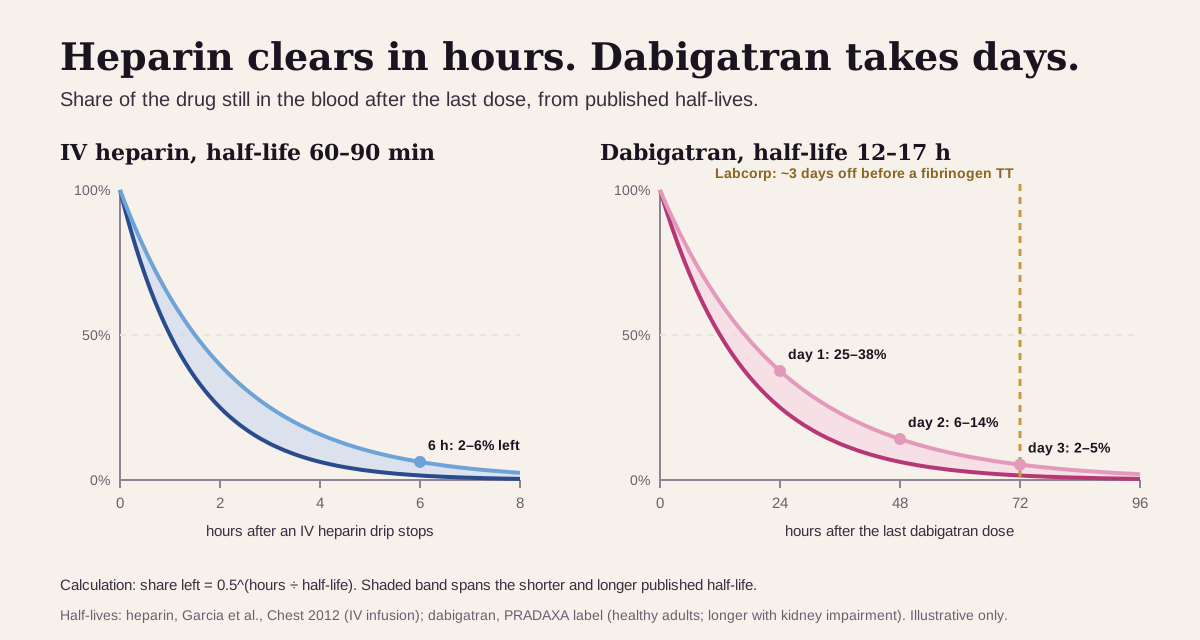
Trends beat snapshots. One long TT from a sample drawn through a line means something different from a TT that stays long on clean samples from the same lab.71
Going deeper: what the thrombin time actually measures
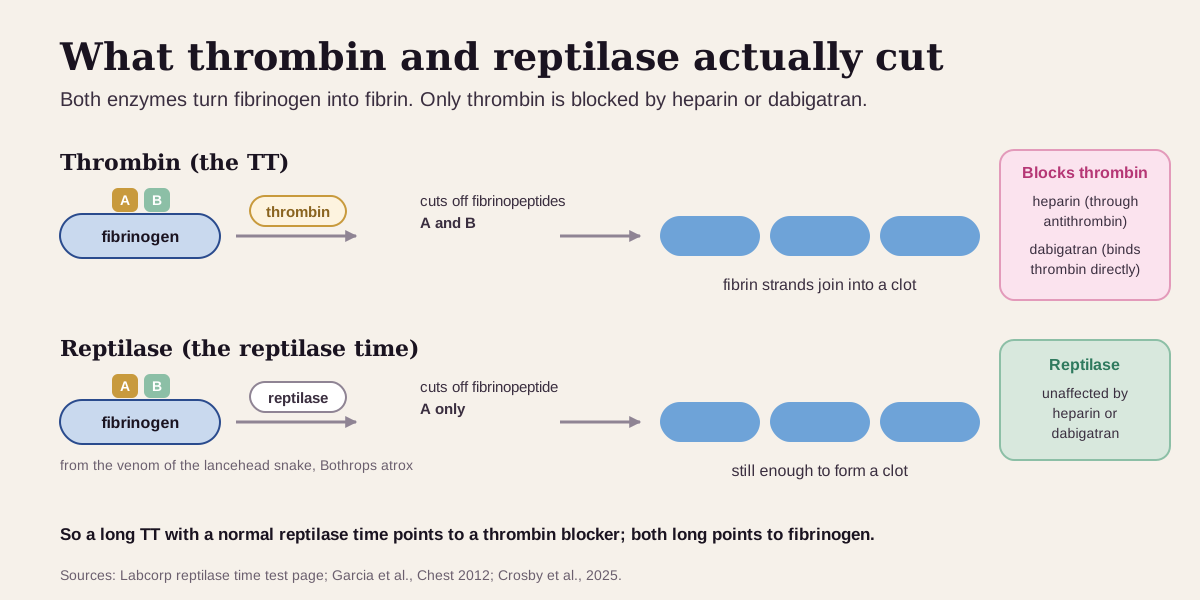
Thrombin cuts two small pieces, fibrinopeptides A and B, off each fibrinogen molecule. The fibrin left behind snaps together into strands. Reptilase, an enzyme from the venom of the lancehead snake Bothrops atrox, cuts off only fibrinopeptide A, and that is enough to form a clot.6
Why the two tests split apart. Heparin works by boosting antithrombin against thrombin and other clotting enzymes, and dabigatran binds thrombin directly.16 Both act on thrombin itself, so reptilase escapes them and the reptilase time stays normal.67
The dilute thrombin time. Labs that need to measure dabigatran dilute the plasma first. This dilute TT tracks the drug level in a straight line (R² 0.92–0.99 across studies).9
The mixing study. When a long TT has no obvious cause, some labs mix your plasma 1:1 with normal plasma. If the TT corrects, something was missing, usually fibrinogen. If it stays long, something is blocking the reaction, and a heparin neutralizer added in the lab separates heparin from other blockers.1
Questions worth asking
- How long is my TT compared with this lab's range, and what was my reptilase time?
- Could heparin have gotten into the sample, for example from an IV line or a port?
- Could any of my medicines, especially dabigatran, affect the result, and when was my last dose?
- What were my fibrinogen activity and fibrinogen antigen levels?
- Do my PT and aPTT fit the same pattern?
- Should we repeat it on a fresh sample drawn straight from a vein, at the same lab?
FAQ
What is a normal thrombin time? It depends on the lab. Published ranges run from about 12–19 seconds to 15–25 seconds, each set for that lab's reagent and analyzer.32
What usually causes a long thrombin time? Labs check first for a thrombin blocker in the sample: heparin, from treatment or an IV line, or a direct thrombin inhibitor such as dabigatran. A normal reptilase time points that way. When the reptilase time is long too, the problem is fibrinogen.6712
Does dabigatran affect the thrombin time? Yes, strongly. Even small amounts lengthen it, so a normal TT effectively rules dabigatran out, while a long TT says little about how much is there.910
When is a long thrombin time urgent? When it comes with heavy or unusual bleeding, especially alongside a long PT and aPTT, which can mean a severe fibrinogen shortage. Get prompt care for bleeding symptoms.118
This guide is for education. It can't diagnose you or replace care from a clinician who knows your history.
Footnotes
-
Labcorp, a commercial laboratory. Thrombin Time (test 015230): method, uses, causes of a long result, patient preparation, and the sample-report reference interval of 0.0–23.0 seconds; Thrombin Mixing Study (test 117170): the stepwise workup of a long TT; Heparin Anti-Xa (test 117101): measures unfractionated and low-molecular-weight heparin. Thrombin time · sample report · mixing study · heparin anti-Xa ↩ ↩2 ↩3 ↩4 ↩5 ↩6 ↩7 ↩8 ↩9 ↩10 ↩11 ↩12 ↩13 ↩14 ↩15 ↩16 ↩17 ↩18 ↩19 ↩20 ↩21 ↩22 ↩23 ↩24 ↩25
-
UW Medicine Department of Laboratory Medicine and Pathology. Thrombin Time (TT). Laboratory Test Guide. Human thrombin on a Stago STA analyzer, reference range 15–25 seconds, and the drugs that lengthen it. Thrombin time · reference range ↩ ↩2 ↩3 ↩4 ↩5 ↩6 ↩7 ↩8 ↩9 ↩10 ↩11 ↩12
-
University of Rochester Medical Center. Thrombin Time. Health Encyclopedia. Plain-language overview; a normal TT of about 12 to 19 seconds. urmc.rochester.edu ↩ ↩2 ↩3 ↩4 ↩5 ↩6 ↩7 ↩8 ↩9 ↩10 ↩11
-
Banković Radovanović P, Živković Mikulčić T, Simović Medica J. Unexpected abnormal coagulation test results in a 2-year-old child: A case report. Biochem Med (Zagreb). 2020;30(1):011002. Table 1 gives the lab's TT reference interval of 13–19 seconds with the Siemens Thromboclotin reagent. PMC ↩ ↩2 ↩3 ↩4 ↩5
-
Michigan Medicine Laboratories (MLabs). Thrombin Time. Human thrombin, reference range under 21 seconds. mlabs.umich.edu ↩ ↩2 ↩3 ↩4 ↩5
-
Labcorp, a commercial laboratory. Reptilase Time (test 117180). How reptilase differs from thrombin, why a normal reptilase time with a long TT points to heparin or a direct thrombin inhibitor, and the effects of dysfibrinogenemia, paraproteins, fibrin breakdown products and bovine-thrombin antibodies. labcorp.com ↩ ↩2 ↩3 ↩4 ↩5 ↩6 ↩7 ↩8 ↩9 ↩10 ↩11 ↩12 ↩13
-
Crosby E, Exner T, Dangol M. Detecting Heparin Contamination in Prolonged APTT with a Heparin-Resistant Solution. Clin Appl Thromb Hemost. 2025;31:10760296251394365. Heparin contamination from lines, and heparin lengthening the TT while the reptilase time stays unaffected. PMC ↩ ↩2 ↩3 ↩4 ↩5 ↩6 ↩7 ↩8 ↩9
-
Labcorp, a commercial laboratory. Fibrinogen Activity (test 001610) and Fibrinogen Antigen (test 117052). Dysfibrinogenemia patterns and outcomes, acquired and inherited deficiency, the 50 and 100 mg/dL thresholds, the four-day half-life, and the adult activity range of 209–464 mg/dL. Activity · antigen ↩ ↩2 ↩3 ↩4 ↩5 ↩6 ↩7 ↩8 ↩9 ↩10 ↩11 ↩12 ↩13
-
Cuker A, Siegal DM, Crowther MA, Garcia DA. Laboratory measurement of the anticoagulant activity of the non-vitamin K oral anticoagulants. J Am Coll Cardiol. 2014;64(11):1128–1139. Systematic review: a normal TT excludes clinically relevant dabigatran; 25–150 ng/mL exceeded TT detection limits depending on the reagent. PMC ↩ ↩2 ↩3 ↩4 ↩5 ↩6 ↩7 ↩8 ↩9 ↩10 ↩11
-
Samuelson BT, Cuker A, Siegal DM, Crowther M, Garcia DA. Laboratory Assessment of the Anticoagulant Activity of Direct Oral Anticoagulants: A Systematic Review. Chest. 2017;151(1):127–138. Across 11 studies, a normal TT effectively excluded dabigatran. PMC ↩ ↩2 ↩3 ↩4 ↩5 ↩6
-
National Library of Medicine. Dabigatran. MedlinePlus Drug Information. Bleeding symptoms that need urgent care, and the advice not to stop the drug without talking to your doctor. MedlinePlus ↩ ↩2 ↩3 ↩4 ↩5 ↩6
-
Mackie I, Casini A, Pieters M, Pruthi R, Reilly-Stitt C, Suzuki A. International council for standardisation in haematology recommendations on fibrinogen assays, thrombin clotting time and related tests in the investigation of bleeding disorders. Int J Lab Hematol. 2024;46(1):20–32. The international lab-standards body's guidance on the TT, the reptilase time and fibrinogen tests. PubMed ↩ ↩2 ↩3 ↩4 ↩5 ↩6 ↩7
-
Dunois C. Laboratory Monitoring of Direct Oral Anticoagulants (DOACs). Biomedicines. 2021;9(5):445. The dabigatran effect on the TT depends on the thrombin concentration in the reagent; direct factor Xa inhibitors leave the TT unchanged. PMC ↩ ↩2
-
Hawes EM, Deal AM, Funk-Adcock D, et al. Performance of coagulation tests in patients on therapeutic doses of dabigatran: a cross-sectional pharmacodynamic study based on peak and trough plasma levels. J Thromb Haemost. 2013;11(8):1493–1502. 35 patients on 150 mg twice daily; on-therapy range 27–411 ng/mL; PT, aPTT and ACT normal in 29%, 18% and 40% of samples. PubMed ↩ ↩2 ↩3
-
Casini A, Neerman-Arbez M, Ariëns RA, de Moerloose P. Dysfibrinogenemia: from molecular anomalies to clinical manifestations and management. J Thromb Haemost. 2015;13(6):909–919. Normal antigen with a dysfunctional fibrinogen, diagnosed from the activity–antigen gap. PubMed ↩ ↩2 ↩3
-
Garcia DA, Baglin TP, Weitz JI, Samama MM. Parenteral anticoagulants: Antithrombotic Therapy and Prevention of Thrombosis, 9th ed: American College of Chest Physicians Evidence-Based Clinical Practice Guidelines. Chest. 2012;141(2 Suppl):e24S–e43S. How heparin and direct thrombin inhibitors work; IV heparin half-life of 60–90 minutes. PMC ↩ ↩2 ↩3 ↩4 ↩5 ↩6
-
Boehringer Ingelheim. PRADAXA (dabigatran etexilate) prescribing information, June 2025. Half-life 12 to 17 hours in healthy adults, longer with kidney impairment. DailyMed ↩ ↩2
Educational content, not medical advice. Libby is a personal record tool, not a medical service — it doesn't diagnose, treat, or prescribe. Reference ranges vary by lab and by person. Talk to a qualified healthcare professional about your results.
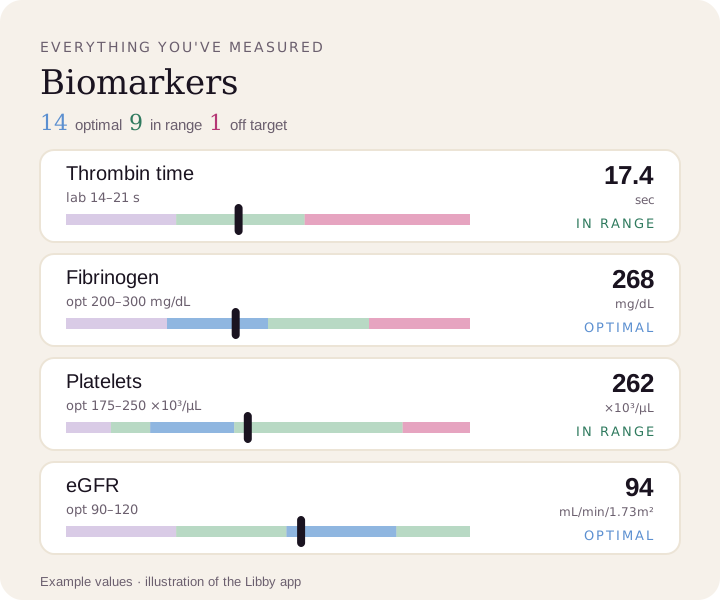
See every result against your lab's range.
Upload a lab PDF or a photo of your report. Libby puts your thrombin time and every other marker on your lab's range, and tracks your trends over time.
View your thrombin time ›