PSA blood test: normal by age, free PSA, high causes
PSA is a prostate protein. Here's what's normal for your age, what percent free PSA adds, the usual reasons PSA runs high, and when a result is urgent.
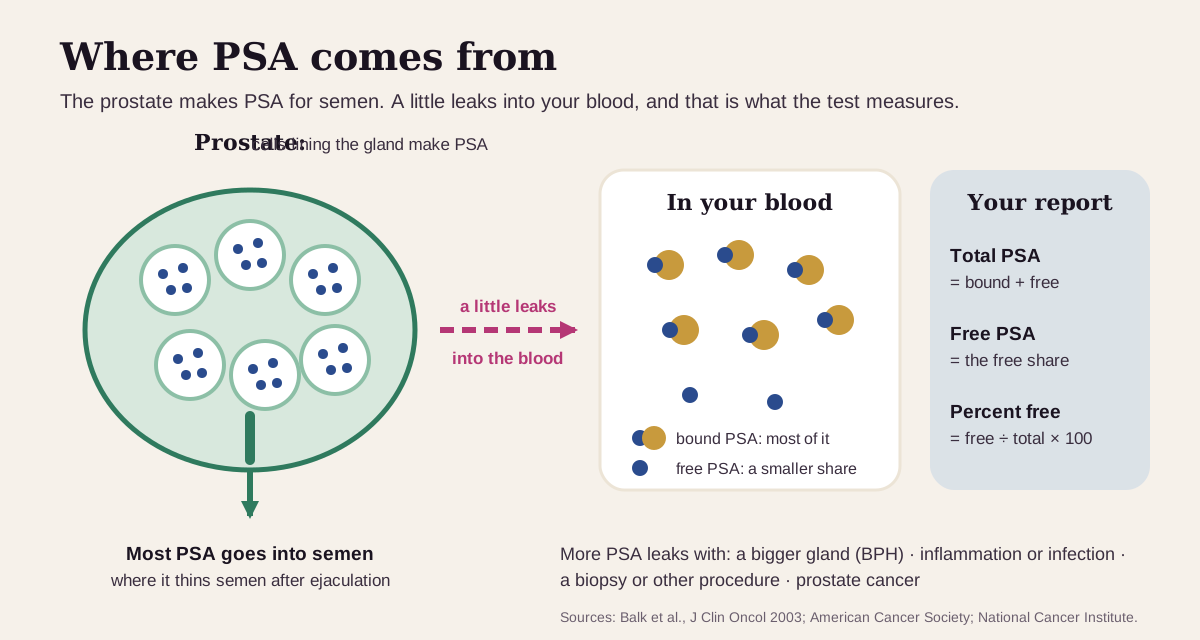
PSA (prostate-specific antigen) is a protein made by the prostate gland. Most of it goes into semen, and a little leaks into your blood. A bigger, irritated or cancerous prostate leaks more, so the blood level rises. That makes PSA the standard first test for prostate cancer, and also a number that many ordinary things push up.12
The short version
- Normal: most labs flag a PSA above 4.0 ng/mL. Many clinicians use age-based limits instead: 2.5 in your 40s, 3.5 in your 50s, 4.5 in your 60s and 6.5 in your 70s.23
- A high PSA most often comes from an enlarged prostate, inflammation or infection, recent ejaculation or a prostate procedure, or cancer. At 4–10 ng/mL, about 1 in 4 men have cancer on biopsy.45
- Over 10 ng/mL, the chance of cancer on biopsy is over 50%: see a clinician promptly. Being unable to pee, or fever with painful urination, needs care now.46
- Free PSA is the share floating unbound. When total PSA is 4–10, a lower percent free (10% or less) raises the odds of cancer and over 25% lowers them.47
What PSA is
PSA is an enzyme made by the cells lining the prostate, the walnut-sized gland under the bladder that makes part of semen. Its job is in semen: it cuts up the proteins that make semen thick right after ejaculation, so semen turns liquid.1
Normal cells and cancer cells both make PSA. Anything that means more prostate tissue (a gland that grows with age) or leakier tissue (inflammation, an infection, a biopsy, cancer) raises the blood level.2
In the blood, most PSA is quickly grabbed by a protein called alpha-1-antichymotrypsin. That's bound PSA. A smaller share circulates on its own as free PSA.1 A standard PSA test reports the total; a free PSA test measures the unbound part, and the lab divides the two to give percent free.4
Most people meet PSA as a screening test. The American Urological Association (AUA) guideline suggests offering a first PSA at 45–50, regular tests every 2 to 4 years from 50 to 69, and starting at 40–45 for people with Black ancestry, certain inherited gene changes or a strong family history.8 The U.S. Preventive Services Task Force calls screening an individual choice at 55–69 and recommends against routine screening from 70. In trials, screening 1,000 men for about 13 years prevented about 1.3 prostate-cancer deaths and 3 cases of cancer that spread, at the cost of false alarms and treatment side effects.9
What's a normal PSA?
Start with the range on your own report. Most U.S. labs print 0–4.0 ng/mL for men; Labcorp's range is exactly that.10 The National Cancer Institute (NCI) notes that a PSA above 4.0 is generally treated as abnormal.2
Because PSA rises as the prostate grows with age, many clinicians use age-specific limits. They come from a Mayo Clinic study of 471 healthy men: 2.5 in your 40s, 3.5 in your 50s, 4.5 in your 60s and 6.5 in your 70s.3 The AUA guideline lists the same four numbers as the thresholds most studies use.8
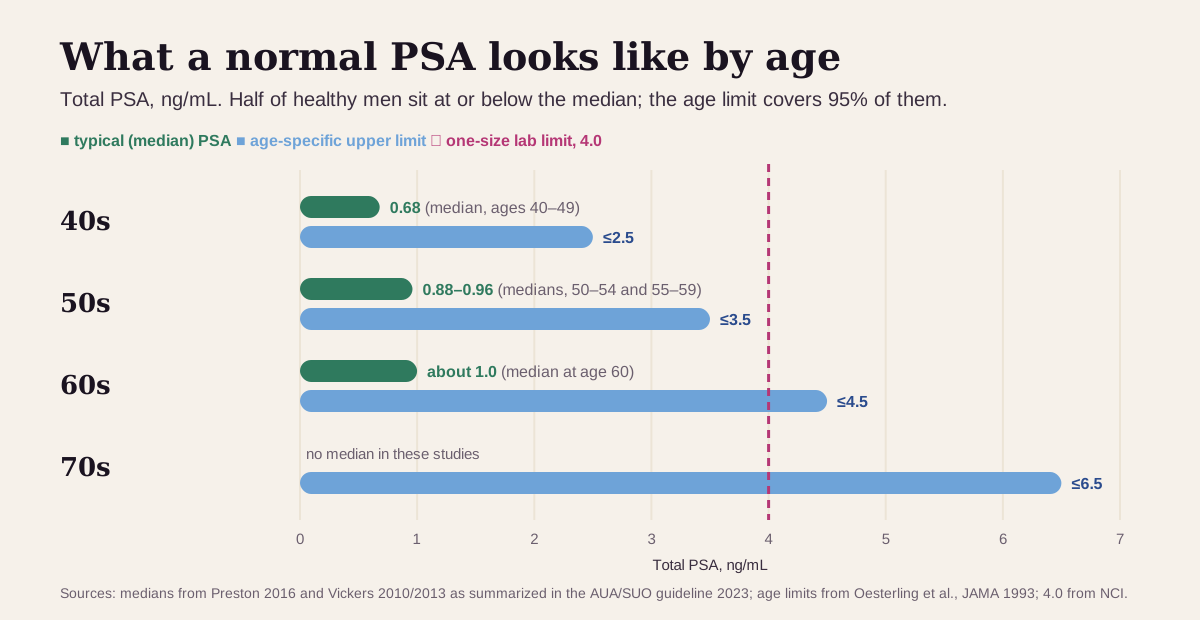
The typical PSA is much lower than any limit. Half of healthy men in their 40s have a PSA of 0.68 or less, and at 60 the midpoint is about 1.0.8 In healthy men, PSA tracks prostate size a little more closely than it tracks age, and it drifts up about 3% a year (0.04 ng/mL) around age 60.3
"Optimal" PSA: what health optimizers aim for
For PSA, "optimal" means low for your age. Guidelines now use a low midlife PSA to spot men whose long-term risk is so small they can test less often. Here's the ladder, strictest first. PSA is a men's marker, so the columns split by age instead of sex:
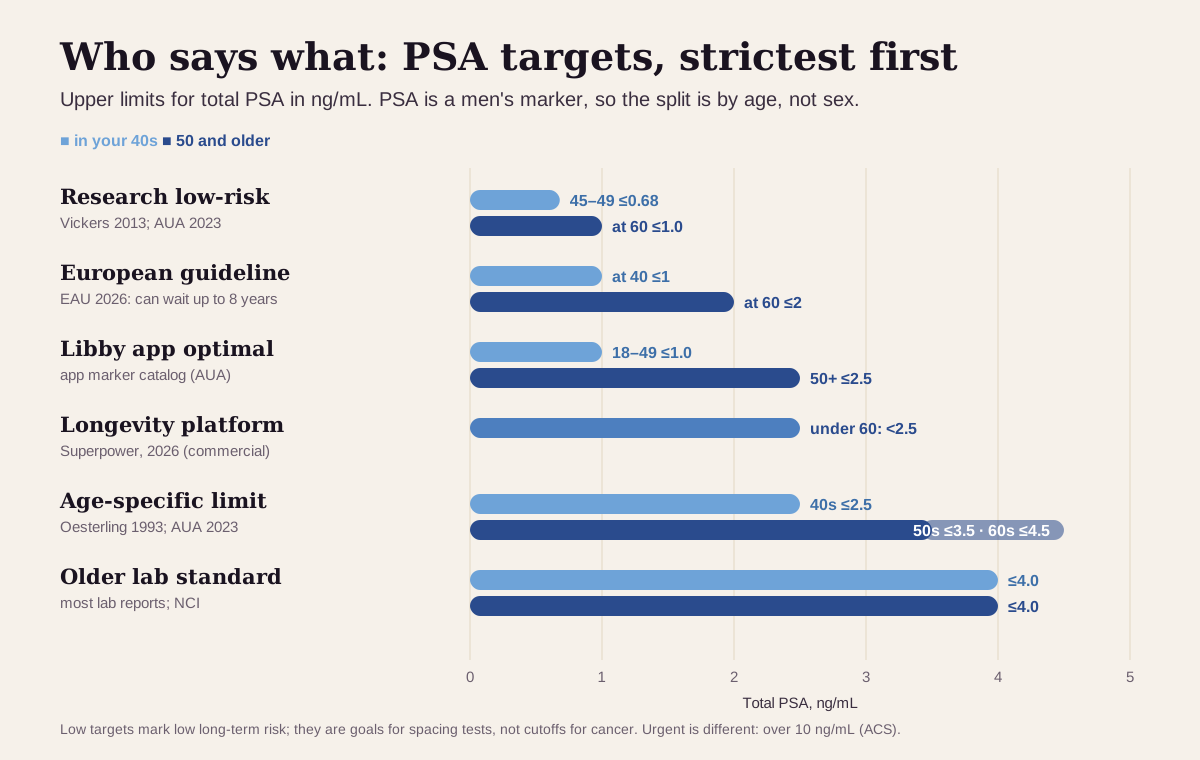
| Target | In your 40s | 50 and older | Who uses it |
|---|---|---|---|
| Strictest (research low-risk) | 0.68 or less | about 1.0 or less at 60 | At or below the median in long-running Swedish and U.S. studies118 |
| European guideline | 1 or less at 40 | 2 or less at 60 | European Association of Urology: below these, the next test can wait up to 8 years12 |
| Functional range (Libby app) | 1.0 or less (ages 18–49) | 2.5 or less | The optimal range shown in the Libby app; its catalog credits AUA screening guidance13 |
| Longevity platform | under 2.5 (men under 60) | under 2.5 (men under 60) | Superpower: "often considered reassuring"14 |
| Age-specific upper limit | 2.5 | 3.5 in your 50s, 4.5 in your 60s | Oesterling 1993; the AUA's commonly cited thresholds38 |
| Older lab standard | 4.0 | 4.0 | Most lab reports; NCI's general cutoff210 |
| Urgent | over 10 | over 10 | Over 50% chance of cancer on biopsy: see a clinician promptly4 |
Why the low targets exist:
- In Sweden's Malmö study, 21,277 men gave blood in midlife and were followed for a median of 27 years. Men with a PSA below the median at 45–49 (0.68) had a 15-year risk of cancer spreading of just 0.09%. At the other end, 44% of prostate-cancer deaths came from the top tenth of PSA at 45–49 (1.6 ng/mL or more).11
- At age 60, a PSA of 1 or less carried a 25-year risk of spread of 0.5% and of death of 0.2%. That's why the AUA allows longer gaps between tests when PSA is under 1.8
- Risk climbs steadily inside the "normal" range. In the U.S. Prostate Cancer Prevention Trial, 2,950 men aged 62–91 whose PSA had never gone above 4.0 had a biopsy at the end. Cancer turned up in 6.6% of those at 0.5 or less and 26.9% of those at 3.1–4.0.15
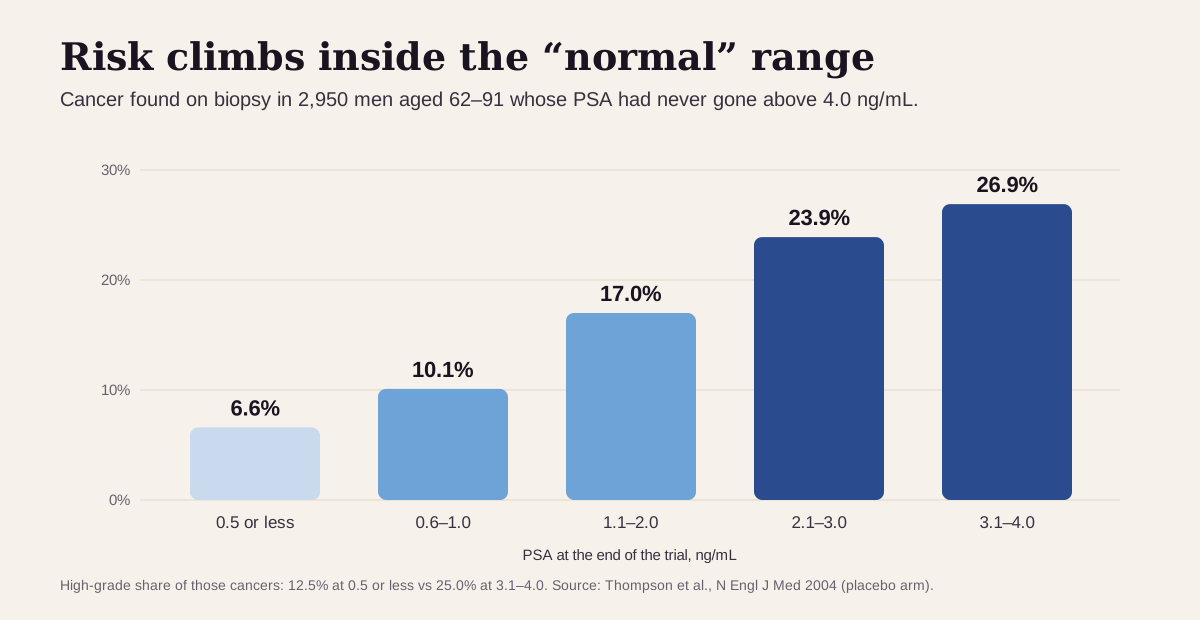
Keep "optimal" in perspective. A low PSA for your age is reassuring and a good reason to space out tests, rather than a score to chase. A PSA above these targets but inside your lab's range is common, and it usually reflects an older, larger prostate.3 What matters most is the trend: a number that climbs across tests from the same lab tells you more than any single value.8 And a PSA that's low because of a medicine such as finasteride needs its own baseline (see below).16
What a high PSA usually means
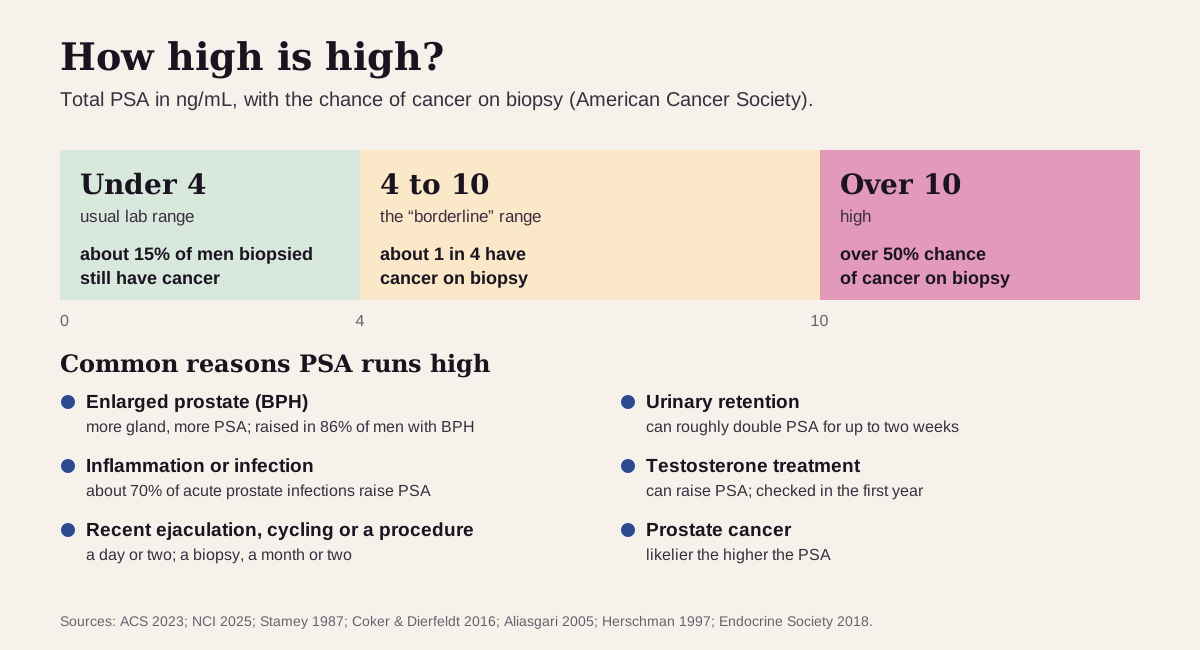
The size of the number is the first clue, and your age is the second. The American Cancer Society (ACS) sums up the odds of cancer on biopsy like this:4
The usual suspects
- An enlarged prostate (BPH). Benign prostatic hyperplasia is the gland's normal growth with age. More gland means more PSA: in a classic study, PSA was raised in 86% of men with BPH.194
- Inflammation or infection. About 70% of men with an acute bacterial prostate infection have a raised PSA, and it can stay up for one to two months after treatment.6 Urinary tract infections can raise it too.5
- Recent ejaculation, cycling or a prostate procedure. After ejaculation, total PSA stayed raised at 24 hours in some men.20 A biopsy or cystoscopy raises it for longer.4
- Urinary retention. Being unable to empty your bladder roughly doubled PSA in one study, and the effect lasted up to two weeks.17
- Testosterone treatment can raise PSA.4 The Endocrine Society advises against starting testosterone when PSA is over 4 (over 3 in men at higher risk) without a urologist's evaluation, and checks PSA during the first year.18
- Prostate cancer. The higher the PSA, the likelier cancer is.5 In the 4–10 range, about 1 in 4 men have it on biopsy.4
Confirm it first
A single high result is usually repeated. The AUA recommends repeating a newly raised PSA before any other blood test, scan or biopsy, because 25–40% come back normal. In one Swedish study, 283 of 1,686 men (17%) with a PSA of 3–10 were under 3 when retested 8 weeks later.8 NCI gives 6 to 8 weeks as a typical wait.2
What percent free adds
When total PSA lands in the 4–10 range, a free PSA test helps sort benign from cancer. Cancer tends to push the free share down.4
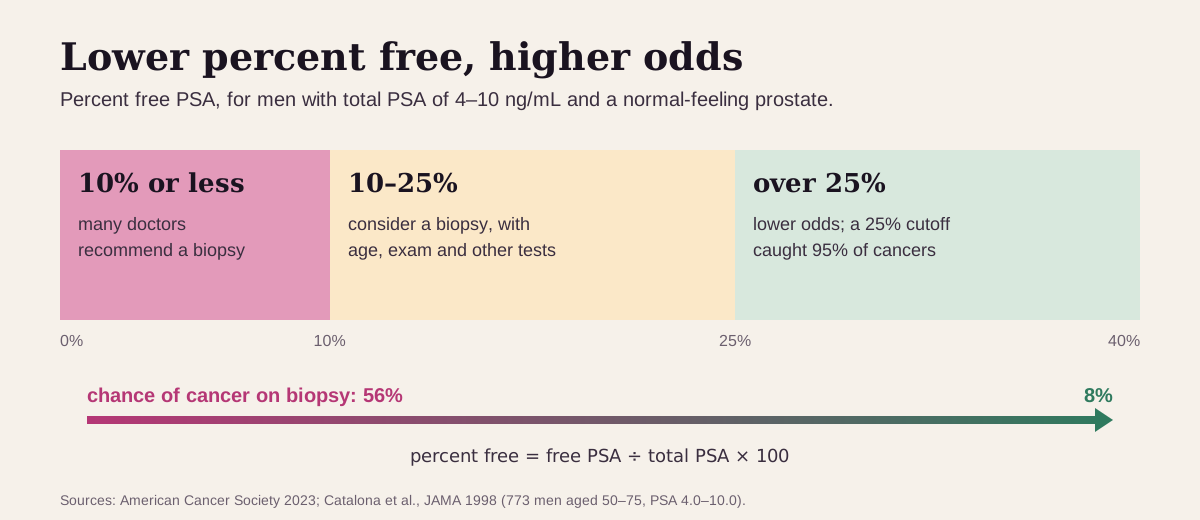
- 10% free or less: many doctors recommend a biopsy.4
- 10–25%: consider a biopsy, together with age, the prostate exam and other tests.4
- Over 25%: lower odds. In a trial of 773 men aged 50–75 with a PSA of 4–10 and a normal-feeling prostate, a 25% cutoff caught 95% of cancers while sparing 20% of unnecessary biopsies. The chance of cancer ran from 56% at the lowest percent free to 8% at the highest.7
Percent free is built for that 4–10 window: Labcorp, for one, only adds free PSA when total PSA is 4.0–10.0.10
Get care now if you're unable to pass urine, or have fever and chills with painful or frequent urination. Those point to urinary retention or an acute prostate infection.6 See a clinician promptly for a PSA over 10, blood in your urine or semen, or new pelvic or back pain.45
When PSA reads low
A low PSA is usually good news. The big exception is medicine. Finasteride and dutasteride (5-alpha-reductase inhibitors, taken for an enlarged prostate or hair loss) lower PSA.4 Finasteride cuts it by about half within six months.1612 Its FDA label tells clinicians to set a new baseline after six months and to double later values when comparing them with the usual ranges. Any confirmed rise while on the drug deserves a look, even inside the normal range. Percent free stays the same.16
Some herbal mixtures sold as supplements can also mask a high PSA.4 Keep taking a prescribed medicine and bring your full list, supplements included, to your clinician.5
PSA reads best next to its neighbors
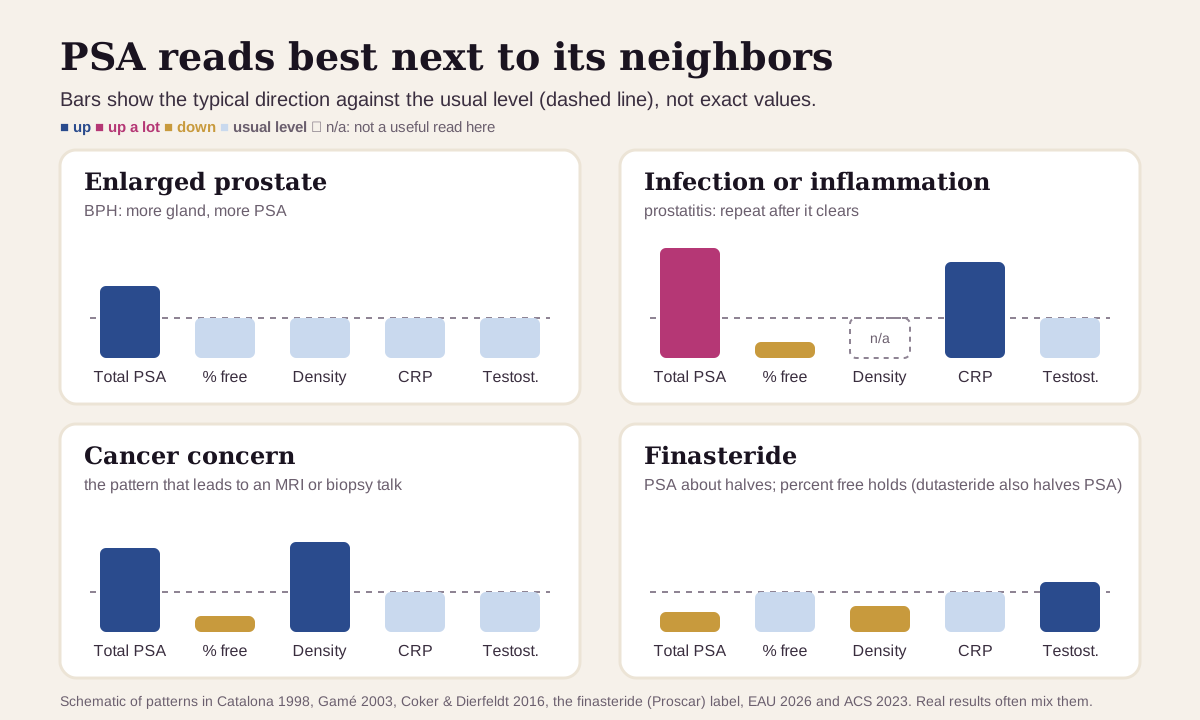
One PSA number looks the same whether it comes from a big prostate, an infection or a cancer. Read with a few neighbors, the patterns separate:
| If you see… | It often points to… |
|---|---|
| Total PSA mildly up, percent free normal (higher than with cancer), slow rise over years | an enlarged prostate, especially after 5073 |
| Total PSA up, percent free low, CRP up, with fever or burning urination | a prostate infection: in one study percent free stayed low for a month, so retest after it clears216 |
| Total PSA up, percent free 10% or less, PSA density high, and it stays up on a repeat test | a higher chance of cancer: the pattern behind an MRI or biopsy discussion48 |
| Total PSA about half your old baseline, percent free unchanged | finasteride; dutasteride also halves PSA1612 |
| Total PSA and testosterone both up after starting testosterone | a known effect of testosterone treatment, which is why PSA is checked in the first year418 |
Two neighbors deserve a note. CRP rises with an acute prostate infection and returned to normal by about day 10 in one study, while PSA was still coming down at one month.21 A raised PSA can last one to two months after treatment.6 PSA density needs a prostate volume from an ultrasound or MRI; a higher density means a higher chance of cancer.4
How fast PSA changes
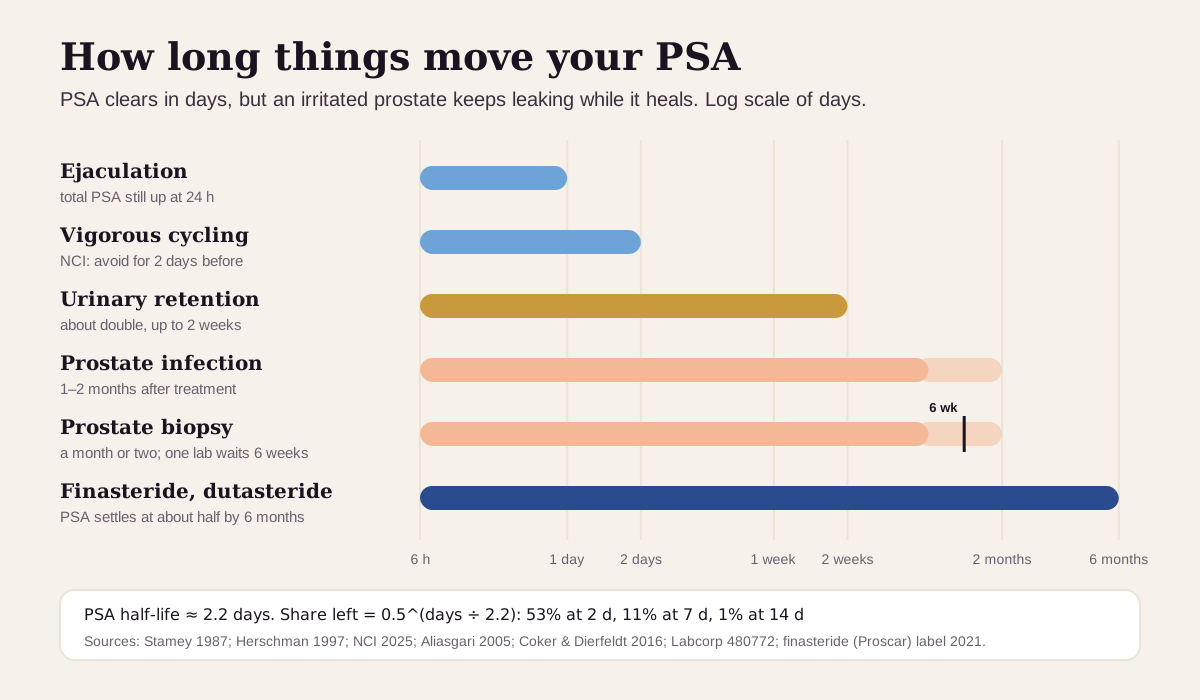
PSA itself clears fast; the things that raise it linger. After the prostate is removed, PSA falls with a half-life of about 2.2 days.19 After ejaculation, free PSA was back to baseline within 6 hours while total PSA was still up at 24.20 An irritated prostate keeps leaking while it heals, so after an infection or a biopsy PSA can stay raised for a month or two.26
What that means in practice:
- Test on a calm week. MedlinePlus asks for no ejaculation for 24 hours before the test; NCI suggests avoiding ejaculation and vigorous cycling for 2 days.52 After a prostate biopsy, Labcorp waits at least six weeks before testing.10
- Small wobbles are noise. In healthy men tested weekly for 10 weeks, total PSA varied by about 7% from week to week, so a rise needs to be around 15–20% before it stands out.22 The European guideline notes that a third of men with a PSA under 10 move by more than 1.0 ng/mL on a repeat test.12
- Trends beat snapshots. A PSA that climbs on several tests tells a different story than one that bounces around in place. Compare results from the same lab: different test methods give different numbers.10
Going deeper: free, bound and density
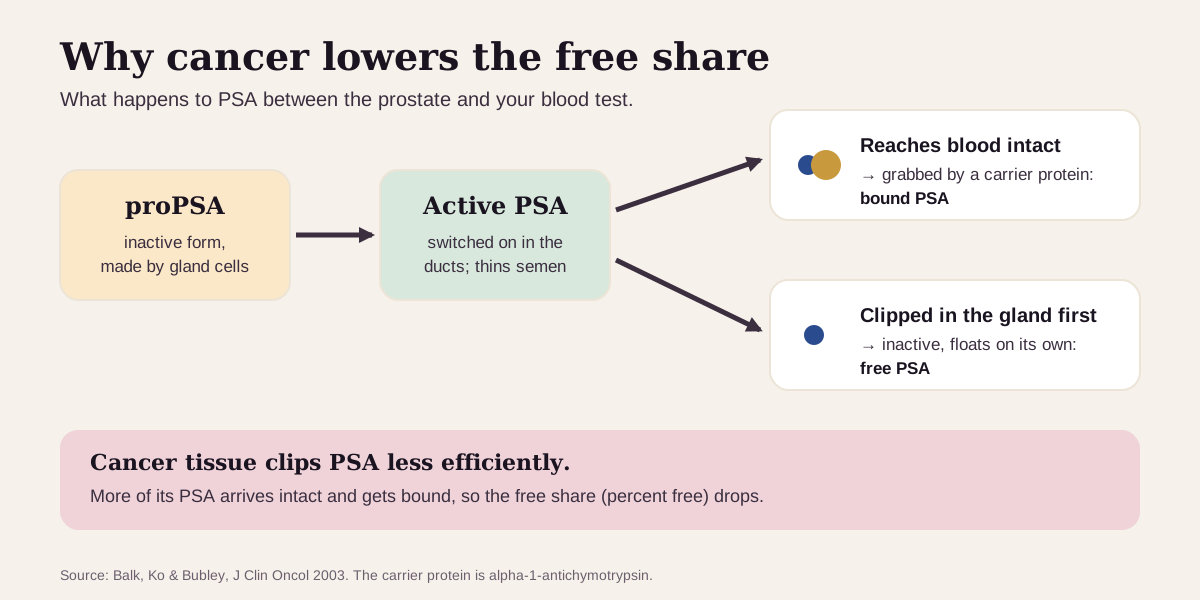
PSA is made as an inactive precursor (proPSA) and switched on in the gland's ducts. PSA that reaches the blood intact is quickly bound by alpha-1-antichymotrypsin. PSA that was already clipped and inactivated in the gland circulates free instead. Cancer tissue does that clipping less efficiently, which is why a lower free share points toward cancer.1
Percent free PSA = free PSA ÷ total PSA × 100. Example: 0.8 ÷ 4.0 × 100 = 20%.
PSA density adjusts total PSA for gland size:
PSA density = total PSA ÷ prostate volume
In men whose MRI looked clear, the European guideline reports clinically significant cancer in 3% when density was under 0.10 and 18% when it was over 0.20.12 Finasteride lowers PSA and shrinks the gland together, so density moves less than PSA does.12
Your first PSA can set your testing schedule. The European guideline suggests retesting every 2 years if PSA is over 1 at 40 or over 2 at 60, and waiting up to 8 years otherwise.12 It also notes that the most common threshold for further checks in screening is 3.0 ng/mL, and that PSA is a continuous scale with no agreed cutoff.12
Questions worth asking
- Is my PSA high for my age, or only against the 4.0 line?
- Could anything in the past few weeks have raised it: ejaculation, cycling, an infection, a catheter or a procedure?
- Should we repeat it before anything else, and when?
- Would a free PSA, PSA density or an MRI change the plan?
- Am I on anything that lowers PSA, like finasteride or dutasteride, and what's my baseline on it?
- Given my age, family history and ancestry, how often should I be tested?
FAQ
What is a normal PSA level? Most labs flag a PSA above 4.0 ng/mL. Age-based limits are 2.5 in your 40s, 3.5 in your 50s, 4.5 in your 60s and 6.5 in your 70s.23
Does a high PSA mean cancer? Usually it means something more common: an enlarged prostate, inflammation or infection, or recent ejaculation or a procedure. About 1 in 4 men with a PSA of 4–10 have cancer on biopsy; over 10, more than half do.4
What does percent free PSA mean? It's the share of PSA floating unbound. When total PSA is 4–10, 10% or less points toward cancer and over 25% points away from it.47
How long should I wait after ejaculation or cycling before a PSA test? MedlinePlus says 24 hours after ejaculation; NCI suggests 2 days for both. After a prostate infection or biopsy, PSA can stay up for a month or two.52
This guide is for education. It can't diagnose you or replace care from a clinician who knows your history.
Footnotes
-
Balk SP, Ko YJ, Bubley GJ. Biology of prostate-specific antigen. J Clin Oncol. 2003;21(2):383–391. How PSA is made, what it does in semen, and why cancer lowers the free share. PubMed ↩ ↩2 ↩3 ↩4 ↩5 ↩6
-
National Cancer Institute. Prostate-Specific Antigen (PSA) Test. Updated January 31, 2025. The general 4.0 cutoff, age-adjusted cutoffs, a month or two after infection or biopsy, 2 days of preparation, and a 6–8 week repeat. cancer.gov ↩ ↩2 ↩3 ↩4 ↩5 ↩6 ↩7 ↩8 ↩9 ↩10 ↩11 ↩12 ↩13 ↩14 ↩15
-
Oesterling JE, Jacobsen SJ, Chute CG, et al. Serum prostate-specific antigen in a community-based population of healthy men: establishment of age-specific reference ranges. JAMA. 1993;270(7):860–864. 471 healthy men; the 2.5/3.5/4.5/6.5 limits and the link to prostate size. PubMed ↩ ↩2 ↩3 ↩4 ↩5 ↩6 ↩7 ↩8 ↩9
-
American Cancer Society. Screening Tests for Prostate Cancer. Last revised November 22, 2023. Biopsy odds below 4, at 4–10 and over 10; percent-free cutoffs; PSA density; what raises and lowers PSA. cancer.org ↩ ↩2 ↩3 ↩4 ↩5 ↩6 ↩7 ↩8 ↩9 ↩10 ↩11 ↩12 ↩13 ↩14 ↩15 ↩16 ↩17 ↩18 ↩19 ↩20 ↩21 ↩22 ↩23 ↩24 ↩25 ↩26
-
National Library of Medicine. Prostate-Specific Antigen (PSA) Test. MedlinePlus. Causes of a high PSA, the 24-hour preparation, and prostate symptoms. MedlinePlus ↩ ↩2 ↩3 ↩4 ↩5 ↩6 ↩7
-
Coker TJ, Dierfeldt DM. Acute bacterial prostatitis: diagnosis and management. Am Fam Physician. 2016;93(2):114–120. About 70% have a raised PSA, lasting one to two months; symptoms that need care. AAFP ↩ ↩2 ↩3 ↩4 ↩5 ↩6 ↩7 ↩8 ↩9
-
Catalona WJ, Partin AW, Slawin KM, et al. Use of the percentage of free prostate-specific antigen to enhance differentiation of prostate cancer from benign prostatic disease: a prospective multicenter clinical trial. JAMA. 1998;279(19):1542–1547. The trial behind the 25% cutoff. PubMed ↩ ↩2 ↩3 ↩4 ↩5 ↩6
-
Wei JT, Barocas D, Carlsson S, et al. Early Detection of Prostate Cancer: AUA/SUO Guideline Part I: Prostate Cancer Screening. J Urol. 2023;210(1):46–53. The U.S. urology guideline: screening ages, repeating a new high PSA (25–40% normalize), the age-based thresholds, midlife medians and longer gaps below 1 ng/mL. Amended in 2026 (Lin DW et al., J Urol 2026;215(5):491–501), with changes centered on MRI, biomarkers and biopsy. PMC ↩ ↩2 ↩3 ↩4 ↩5 ↩6 ↩7 ↩8 ↩9 ↩10 ↩11
-
US Preventive Services Task Force. Screening for Prostate Cancer: US Preventive Services Task Force Recommendation Statement. JAMA. 2018;319(18):1901–1913. Individual decision at 55–69, against routine screening from 70, and the benefit per 1,000 men. PubMed ↩
-
Labcorp. Prostate-Specific Antigen (PSA), test 010322, and PSA Free:Total Ratio Reflex, test 480772. A commercial laboratory's test catalog, accessed September 23, 2026. Men's range 0–4.0 ng/mL; free PSA added when total is 4.0–10.0; no sampling for at least six weeks after a prostate biopsy; different assay methods are not interchangeable. Test 010322 · Test 480772 ↩ ↩2 ↩3 ↩4 ↩5 ↩6
-
Vickers AJ, Ulmert D, Sjoberg DD, et al. Strategy for detection of prostate cancer based on relation between prostate specific antigen at age 40–55 and long term risk of metastasis: case-control study. BMJ. 2013;346:f2023. 21,277 Swedish men followed a median of 27 years. PMC ↩ ↩2 ↩3
-
EAU-EANM-ESTRO-ESUR-ISUP-SIOG Guidelines on Prostate Cancer. EAU Guidelines, edition presented at the EAU Annual Congress, London 2026. EAU Guidelines Office; ISBN 978-94-92671-32-5. The European urology guideline: risk-adapted retesting, the 3.0 ng/mL threshold, the 50% drop on 5-alpha-reductase inhibitors, repeat-test variation and PSA density. uroweb.org ↩ ↩2 ↩3 ↩4 ↩5 ↩6 ↩7 ↩8 ↩9 ↩10
-
Libby app marker catalog: total PSA optimal band of 1.0 ng/mL or less for men 18–49 and 2.5 or less from 50, credited to the American Urological Association's PSA screening guidance (range as recorded in the Libby app's marker catalog); the percent-free band of 15–30% is recorded without a named source. American Urological Association. PSA screening and prostate cancer guidelines. auanet.org ↩ ↩2
-
Superpower. Prostate Specific Antigen (PSA) Test. Last updated September 1, 2026. States that "values under 2.5 ng/mL in men under 60 are often considered reassuring." A commercial source, listed as what the optimizer community sees. superpower.com ↩ ↩2
-
Thompson IM, Pauler DK, Goodman PJ, et al. Prevalence of prostate cancer among men with a prostate-specific antigen level ≤4.0 ng per milliliter. N Engl J Med. 2004;350(22):2239–2246. Biopsy results by PSA band in 2,950 men from the placebo arm of the Prostate Cancer Prevention Trial. PubMed ↩ ↩2
-
Merck. Proscar (finasteride) prescribing information, revised June 2021. U.S. Food and Drug Administration. About a 50% PSA drop within six months, a new baseline and doubling after six months, and unchanged percent free. FDA label ↩ ↩2 ↩3 ↩4 ↩5 ↩6
-
Aliasgari M, Soleimani M, Hosseini Moghaddam SM. The effect of acute urinary retention on serum prostate-specific antigen level. Urol J. 2005;2(2):89–92. 45 men: mean PSA fell from 9.8 to 5.05 ng/mL after two weeks with a catheter. PubMed ↩ ↩2 ↩3
-
Bhasin S, Brito JP, Cunningham GR, et al. Testosterone therapy in men with hypogonadism: an Endocrine Society clinical practice guideline. J Clin Endocrinol Metab. 2018;103(5):1715–1744. PSA limits before starting testosterone and PSA checks in the first year. PubMed ↩ ↩2 ↩3
-
Stamey TA, Yang N, Hay AR, et al. Prostate-specific antigen as a serum marker for adenocarcinoma of the prostate. N Engl J Med. 1987;317(15):909–916. PSA raised in 86% of men with BPH; a 2.2-day half-life after prostate removal. PubMed ↩ ↩2 ↩3
-
Herschman JD, Smith DS, Catalona WJ. Effect of ejaculation on serum total and free prostate-specific antigen concentrations. Urology. 1997;50(2):239–243. 20 men measured 1, 6 and 24 hours after ejaculation. PubMed ↩ ↩2 ↩3
-
Gamé X, Vincendeau S, Palascak R, et al. Total and free serum prostate specific antigen levels during the first month of acute prostatitis. Eur Urol. 2003;43(6):702–705. In 31 men, total PSA rose, free PSA and percent free fell and stayed low for a month, and CRP normalized by about day 10. PubMed ↩ ↩2 ↩3
-
Carobene A, Guerra E, Locatelli M, et al. Biological variation estimates for prostate specific antigen from the European Biological Variation Study; consequences for diagnosis and monitoring of prostate cancer. Clin Chim Acta. 2018;486:185–191. Week-to-week variation of 6.8% for total PSA in 37 healthy men. PubMed ↩
Educational content, not medical advice. Libby is a personal record tool, not a medical service — it doesn't diagnose, treat, or prescribe. Reference ranges vary by lab and by person. Talk to a qualified healthcare professional about your results.
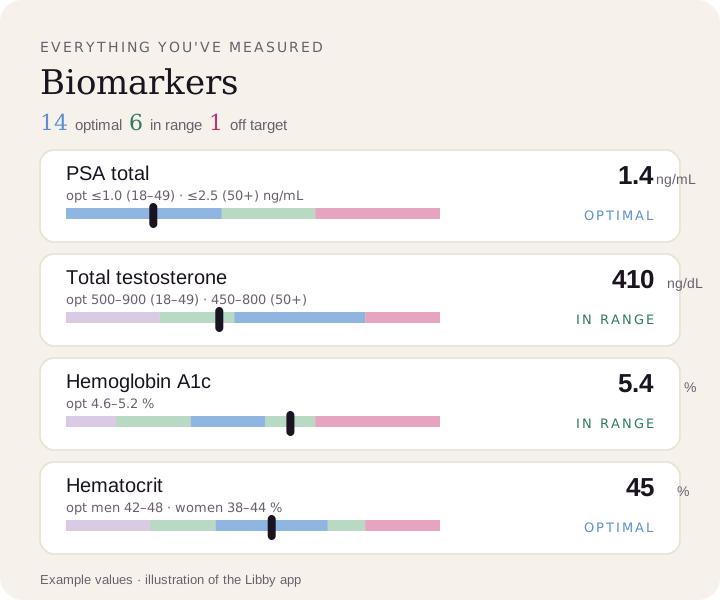
Compare your results to optimal ranges.
Upload a lab PDF or a photo of your report. Libby puts every marker on a lab range and an optimal range, by age and sex where those exist, and tracks your trends over time.
View your PSA ›