Nucleated red blood cells (NRBC): normal and high results
Nucleated red blood cells are young red cells that belong in the marrow. Why adults should have none, what a positive count means, and when it's urgent.
Nucleated red blood cells (NRBCs) are young red blood cells that still carry their nucleus. They normally stay in your bone marrow until they push that nucleus out, so a healthy adult's blood has essentially none.12 Newborns are the exception: a few per 100 white cells is normal in the first days of life.3 In an adult, NRBCs in the blood usually mean the marrow is under heavy strain, from critical illness, very low oxygen, fast red-cell breakdown, or a marrow crowded by cancer or scar tissue.24
The short version
- Normal: 0 in adults. A result of 0 means the analyzer found none above its detection limit, about 20 cells per µL on common machines.15 Healthy term newborns average about 3 per 100 white cells at birth.3
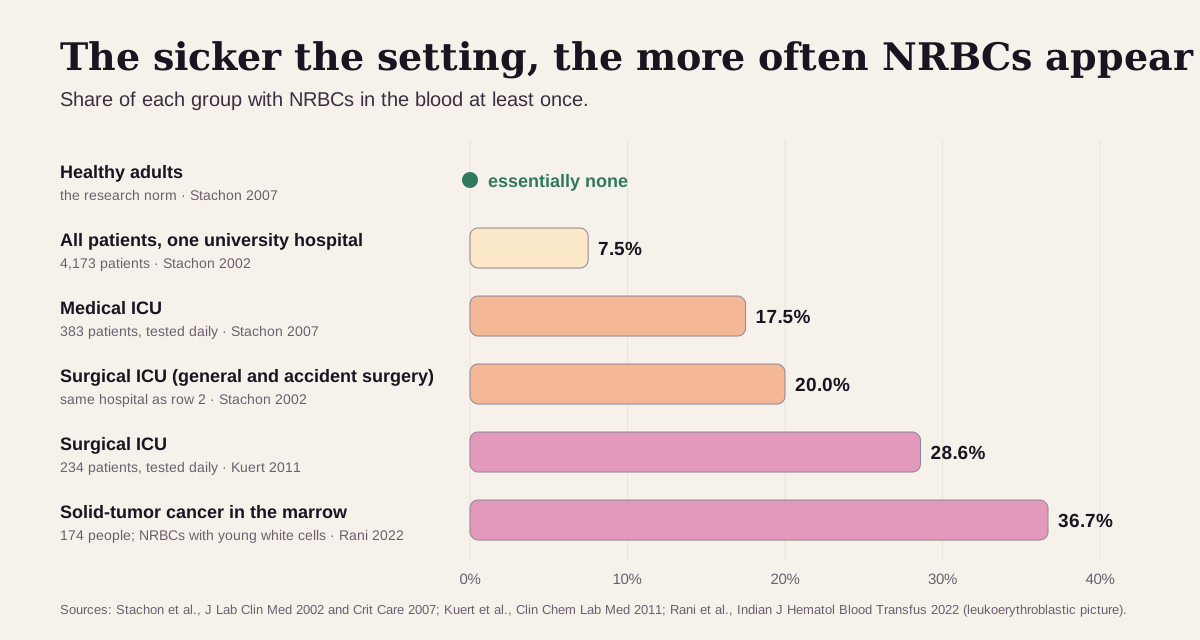
- Any NRBC in an adult deserves an explanation. In one university hospital, 7.5% of all patients had them at least once, most often in intensive care.6 The usual causes are critical illness, severe hemolytic or inherited anemias, and cancer or scarring in the marrow.24
- In intensive care, NRBCs track risk. Half of medical ICU patients with NRBCs died in hospital (50.7%), versus 9.8% of those without. Above 200 per µL, 11 of 14 died.1 Fever with confusion, fast breathing or clammy skin needs care right away.7
- NRBCs can inflate your white count. Many analyzers count them as white cells, so the lab reports a corrected WBC.89
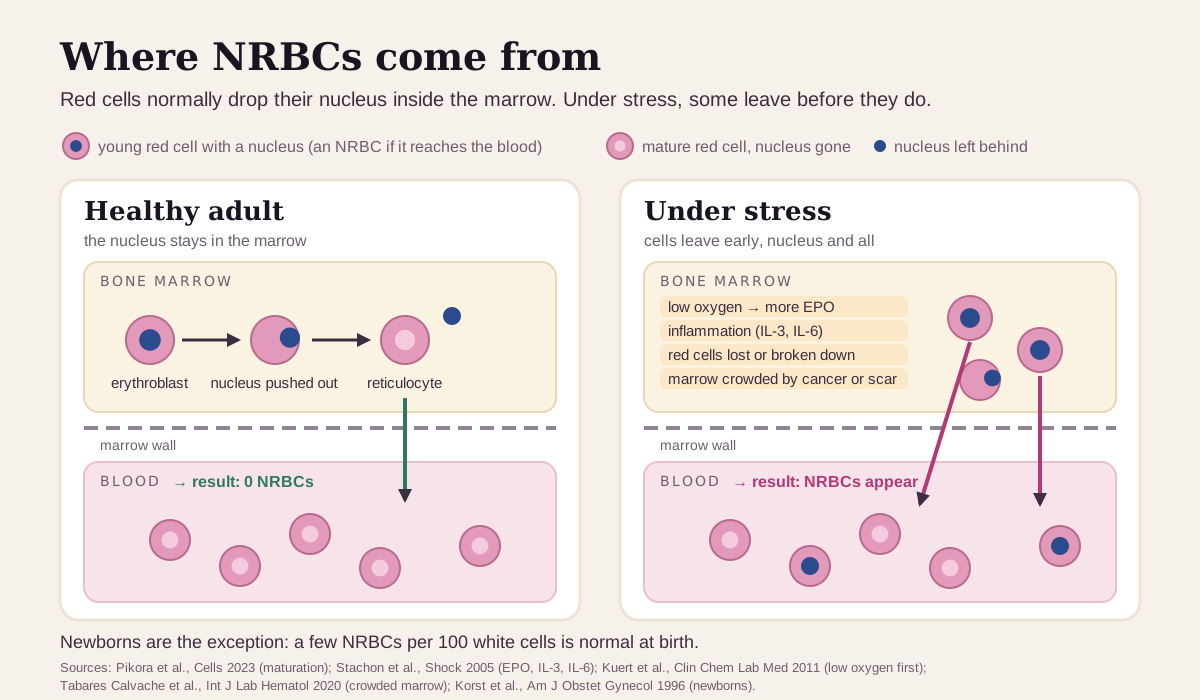
What nucleated red blood cells are
Your bone marrow builds red blood cells in stages. The early cells, called erythroblasts, have a nucleus like most cells in your body. Near the end, each one pushes its nucleus out and becomes a reticulocyte, then a mature red cell.2 An NRBC is a red cell that reached the blood before that last step.
Stress is what lets them out. In hospital patients, NRBCs in the blood went along with higher erythropoietin (EPO, the hormone that drives red-cell production) and the inflammatory signals IL-3 and IL-6. The researchers called NRBCs "a marker that sums up hypoxic and inflammatory injuries."10 Low oxygen tends to come first: in surgical intensive care patients, blood oxygen levels were lower before NRBCs appeared.11 Cancer or scar tissue that crowds the marrow can also push young red cells out, along with young white cells.4
How they're counted. Modern blood analyzers pick out NRBCs and report them separately from white cells. Their detection limits run from about 0.02 to 0.17 ×10⁹/L, that is 19 to 167 cells per µL, depending on the machine.5 Before analyzers did this, labs counted NRBCs by eye on a blood smear, where fewer than about 200 per µL are hard to spot.1
What's a normal NRBC?
For adults, normal is zero. The blood of healthy adults is generally free of NRBCs.1 The CBC range the Libby app's catalog records is 0 per 100 white cells, and the app flags any positive count.
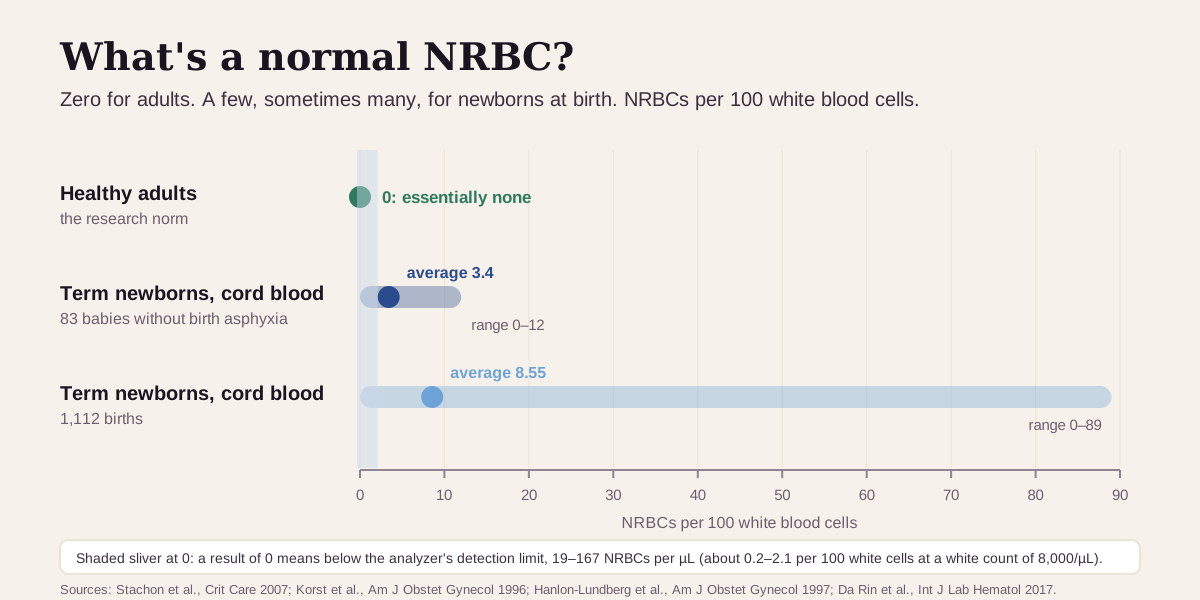
Newborns are different. A baby's marrow is making red cells fast at birth, and NRBCs are normal in cord blood:
- In 83 term newborns without birth asphyxia, the average was 3.4 per 100 white cells (range 0–12).3
- In 1,112 term births, cord blood averaged 8.55 per 100 white cells (range 0–89). Mothers with diabetes and babies who passed meconium had higher counts.12
- NRBCs normally disappear from a healthy baby's blood during the first month of life.2 They are also seen in pregnancy.8
"Optimal" NRBC: what health optimizers aim for
For most markers, optimizers set a target tighter than the lab's. For NRBC the lab range is already as tight as it gets: zero. Research, labs and the Libby app all agree on the target. The useful question is how far above zero a result sits, and in what setting.
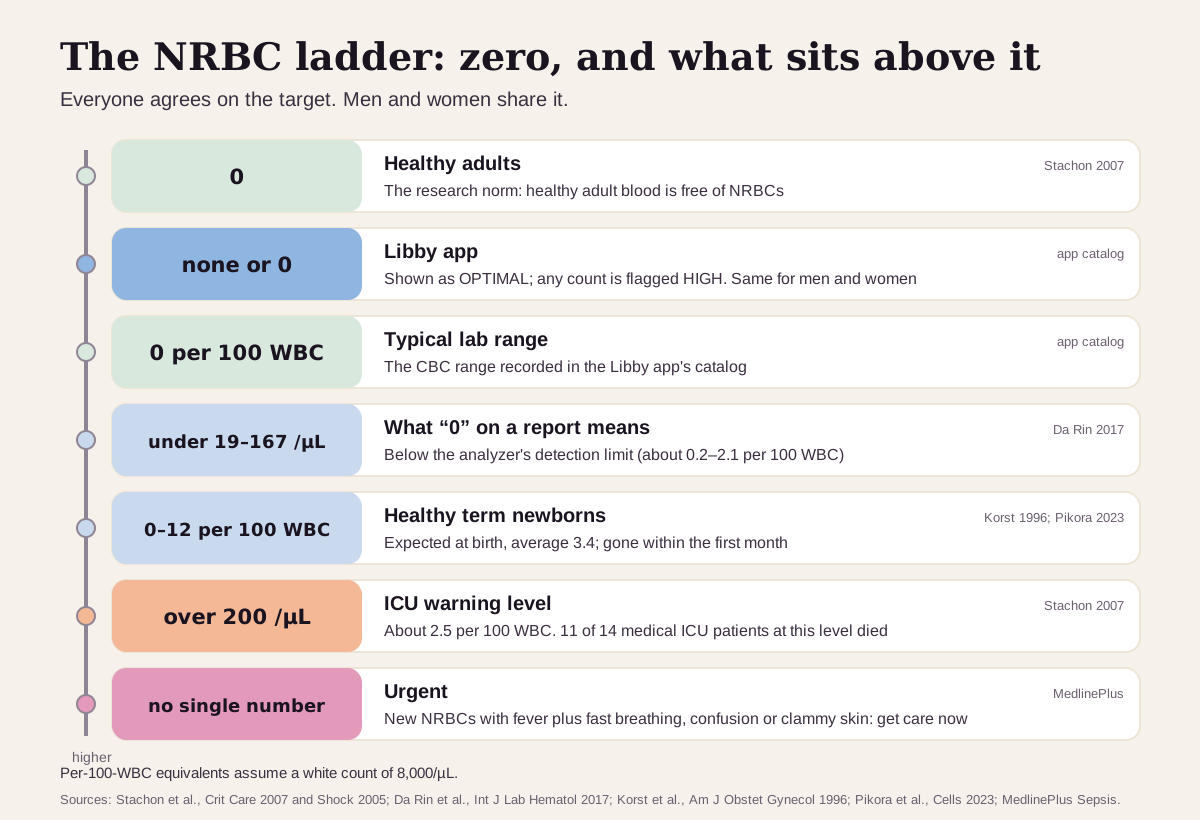
| Level | Per µL | Per 100 WBC | What it means |
|---|---|---|---|
| Healthy adult | 0 | 0 | The research norm1 |
| Libby app | none or 0 | none or 0 | Shown as optimal; any count is flagged high. The same for men and women |
| Typical lab range | 0 | 0 | The CBC range recorded in the Libby app's catalog |
| "0" on a report | under 19–167 | under about 0.2–2 | Below the analyzer's detection limit5 |
| Healthy term newborn | varies | 0–12 (average 3.4) | Expected at birth; gone within the first month32 |
| ICU warning level | over 200 | over 2.5 | 11 of 14 medical ICU patients at this level died1 |
| Urgent | no single number | no single number | New NRBCs with sepsis warning signs: get care right away7 |
Men and women share the target. In a study of 551 hospital patients, sex had no link to having NRBCs; older age did.10
Why zero is the goal:
- In 2,878 adults who survived intensive care in Boston, the risk of dying in the 90 days after discharge was 5.9% with no NRBCs, 11.7% at 1–100 per µL, 15.8% at 101–200, and 21.9% above 200. After adjusting for age, other illnesses, sepsis and organ failure, the odds were 1.77, 2.51 and 3.72 times those of patients with none.13
- In 383 medical ICU patients checked daily, 17.5% developed NRBCs, and half of those (50.7%) died in hospital, versus 9.8% of the rest.1
- A 2026 review of 20 studies and 17,691 critically ill adults found about 3 times the odds of dying within 30 days with NRBCs (odds ratio 3.14). The 90-day difference was not statistically significant, and the authors rated the certainty of several findings as very low.14
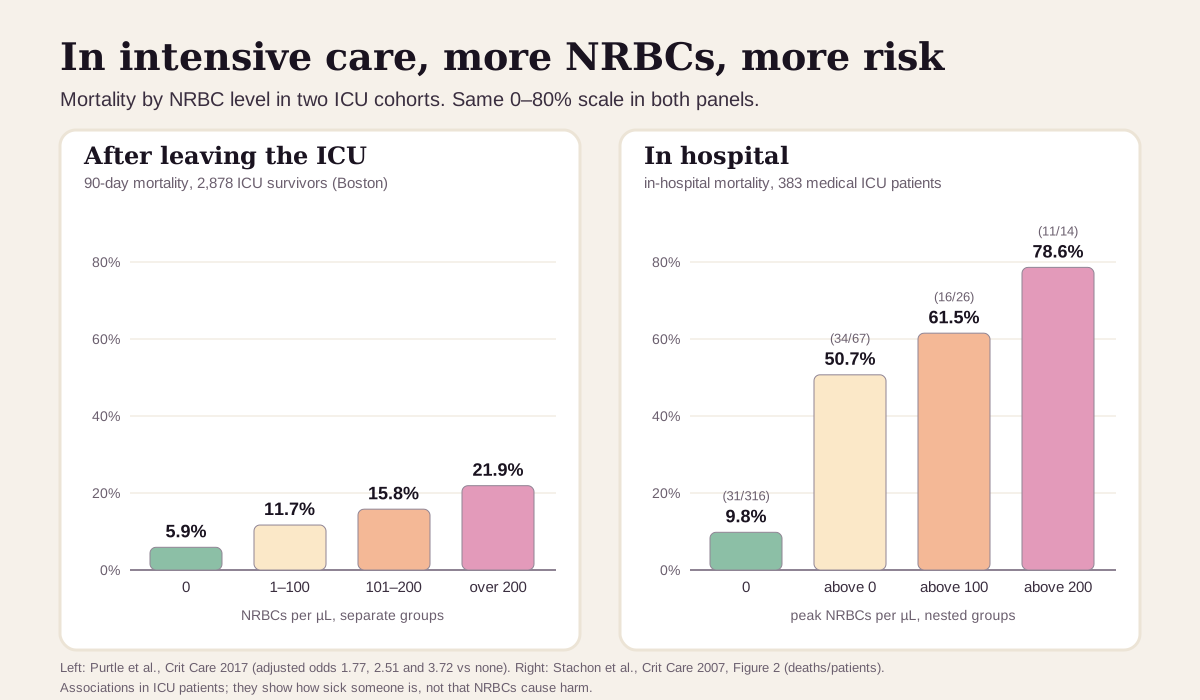
Keep this in perspective. These numbers come from intensive care, where NRBCs mark how sick someone already is; they are a warning light, not a cause. The same count means something different in a newborn, or in someone with a lifelong inherited anemia such as severe thalassemia, where NRBCs are part of the usual blood picture.15 What matters most is a new NRBC in an adult, and whether it heads back to zero.
What NRBCs in an adult usually mean
The setting is the first clue. In hospital data, NRBCs turn up far more often in the sickest patients:6111
The usual causes
- Critical illness. Sepsis, major trauma, severe lung injury (ARDS), acute pancreatitis and severe heart disease are the settings where NRBCs are best studied.2 In one university hospital, the highest rate, 20.0%, was in the general and accident surgery ICU.6
- Very low oxygen. NRBC-positive surgical ICU patients had lower arterial oxygen, and the low oxygen came before the NRBCs appeared.11
- Fast red-cell breakdown or blood loss. When red cells are destroyed early (hemolysis) or lost to bleeding, the marrow speeds up and young cells spill over.2 NRBCs also carry prognostic weight in sickle cell disease.2
- Severe inherited anemias. In thalassemia, the forms where the marrow makes red cells least effectively had the highest NRBC counts. In hereditary spherocytosis, a hemolytic anemia where the marrow keeps up, NRBCs were absent.15
- Cancer or scarring in the marrow. When tumor cells or scar tissue (myelofibrosis) crowd the marrow, NRBCs spill out together with young white cells. Doctors call this a leukoerythroblastic picture. In a systematic review, cancers, both solid tumors that spread to the marrow and blood cancers, were its leading causes, followed by hemolytic diseases, infection and, less often, bleeding.4 In 174 people with solid-tumor spread to the marrow, 36.7% had it.16
Get care now if you have NRBCs with a fever or an infection and any of these: fast breathing or heart rate, shortness of breath, confusion, extreme pain, or clammy, sweaty skin. These are sepsis warning signs.7 See your clinician soon about any new NRBC result in an adult, especially with a low hemoglobin, low platelets or young white cells on the same report.164
NRBC reads best next to its neighbors
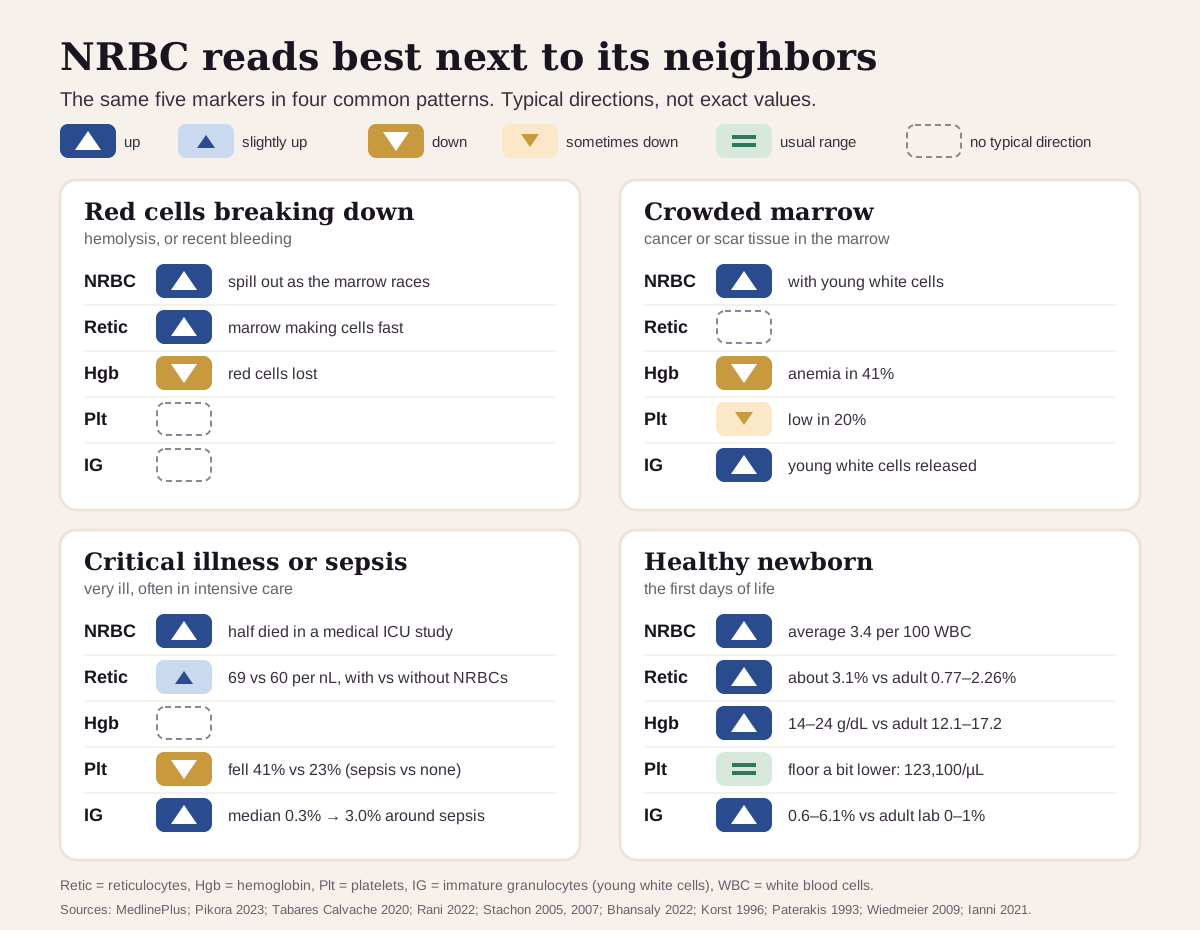
NRBCs tell you the marrow is under strain. The rest of your blood count suggests why:
| If you see… | It often points to… |
|---|---|
| NRBCs and reticulocytes up, hemoglobin down | red cells breaking down early (hemolysis) or recent bleeding, with the marrow racing to replace them217 |
| NRBCs with immature granulocytes and a low hemoglobin, sometimes low platelets | a crowded marrow (leukoerythroblastic picture). In marrow spread from solid tumors, 41% had anemia and 20% low platelets416 |
| NRBCs and immature granulocytes rising while platelets fall, in someone very ill | sepsis or another critical illness: in a study of 137 ICU patients, platelets fell 41% in those who developed sepsis, versus 23% in those who stayed free of it191 |
| NRBCs, reticulocytes and immature granulocytes high, hemoglobin higher than in adults, in the first days of life | a healthy newborn3202218 |
| High NRBCs as a standing finding with a lifelong anemia | thalassemia, especially the forms where the marrow makes red cells least effectively15 |
In the medical ICU study of 383 patients, the size of the NRBC count showed no link to hemoglobin or platelets, but it rose with the white count.1 When an unexplained low hemoglobin and low platelets sit next to NRBCs and young white cells, doctors look at the marrow itself.16
How fast NRBCs change
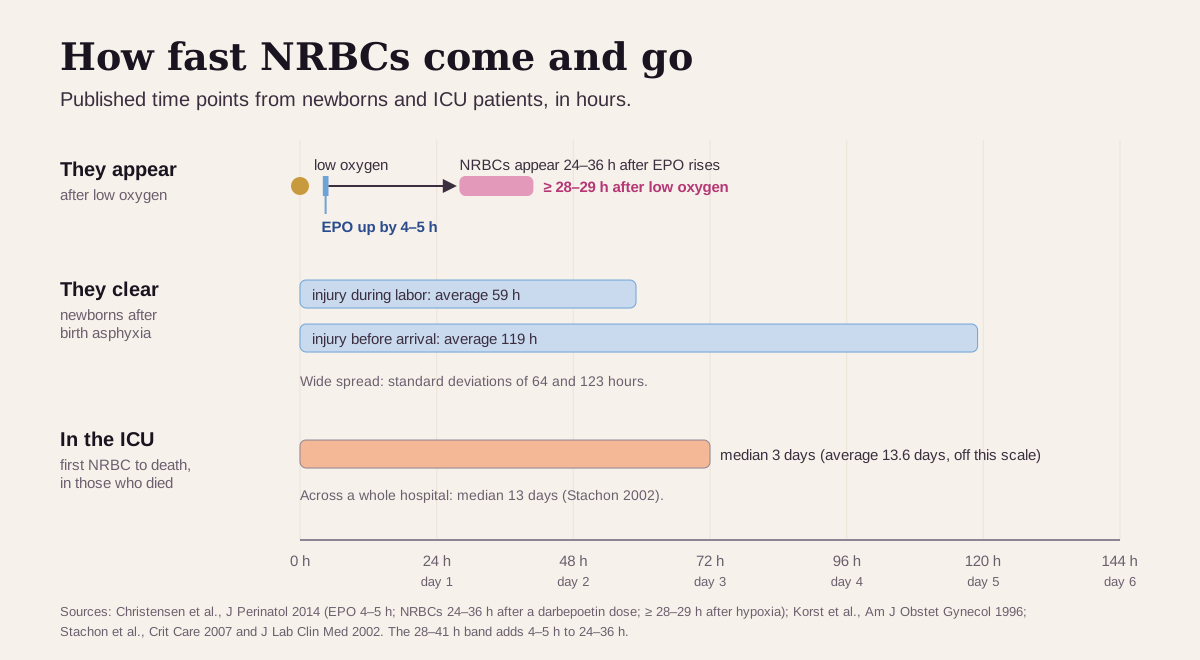
NRBCs trail the stress that causes them by about a day. After oxygen drops, the body takes about 4–5 hours to raise EPO. In newborns given an EPO-like drug, NRBCs first appeared in the blood 24–36 hours later. So an NRBC count raised at birth points to low oxygen that started at least 28–29 hours earlier.24
What that means in practice:
- They clear in days once the stress eases. In newborns after birth asphyxia, NRBCs cleared in an average of 59 hours when the injury came during labor and 119 hours when it began before the mother reached the hospital.3
- In the hospital they can come early. Among ICU patients who died, NRBCs first appeared a median of 3 days before death.1 Across a whole hospital, the median was 13 days.6
- Trends beat snapshots. In the medical ICU study, the outlook improved as the NRBC count fell. Patients still NRBC-positive on the day they left intensive care had 27.6% mortality, versus 8.6% for those who were NRBC-free that day.1
Going deeper: how NRBCs change your white count
Most analyzers count NRBCs as white cells unless they sort them out. With enough NRBCs, the white count reads falsely high, so labs correct it:89
Corrected WBC = measured WBC × 100 ÷ (100 + NRBC per 100 WBC)
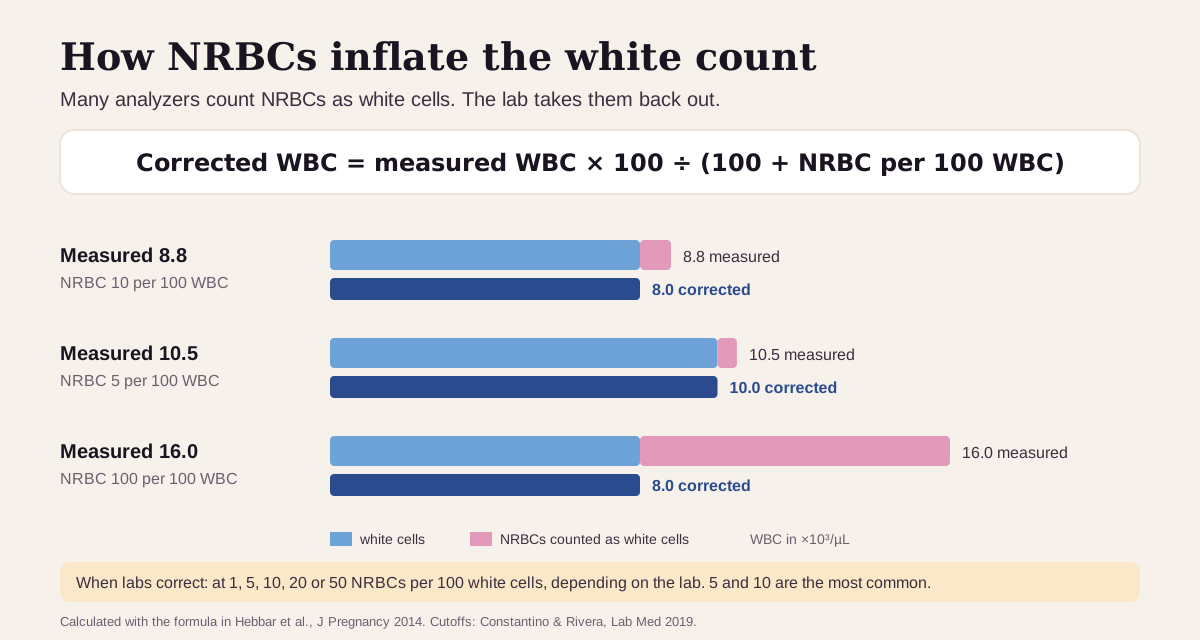
Labs choose different points at which to correct: 1, 5, 10, 20 or 50 NRBCs per 100 white cells, with 5 and 10 the most common.8 Newer analyzers count NRBCs as their own group, separate from the white cells. In a test of five top analyzers, three matched the microscope closely even at low counts.5 If your report shows both a WBC and a "corrected" WBC, the corrected one is your true white count.
Questions worth asking
- Is this my first NRBC result, and how high is it per 100 white cells and per µL?
- Was my white count corrected for the NRBCs?
- What do my hemoglobin, reticulocytes, platelets and immature granulocytes show next to it?
- Could low oxygen, an infection, bleeding or red-cell breakdown explain it?
- Should a specialist review a blood smear, or should I see a hematologist?
- When should we repeat the count, and what would a return to zero tell us?
FAQ
What is a normal NRBC count? Zero for adults. Healthy term newborns average about 3 per 100 white cells at birth, and they disappear during the first month.132
Is 1 NRBC per 100 white cells a problem? It's a small number, but it's above zero, so it deserves an explanation. In ICU survivors, even 1–100 per µL was linked to 1.77 times the odds of dying within 90 days of discharge.13 Outside the hospital, your clinician reads it next to the rest of your blood count.
Why do newborns have NRBCs? A newborn's marrow is making red cells fast, and NRBCs are normal in cord blood: 8.55 per 100 white cells on average in 1,112 term births. Higher counts can follow low oxygen before birth.1224
Do NRBCs affect my white blood cell count? Yes. Many analyzers count them as white cells, so labs report a corrected WBC: measured WBC × 100 ÷ (100 + NRBC per 100 WBC).89
This guide is for education. It can't diagnose you or replace care from a clinician who knows your history.
Footnotes
-
Stachon A, Segbers E, Holland-Letz T, Kempf R, Hering S, Krieg M. Nucleated red blood cells in the blood of medical intensive care patients indicate increased mortality risk: a prospective cohort study. Crit Care. 2007;11(3):R62. 383 medical ICU patients monitored daily: NRBC incidence, mortality by NRBC level (Figure 2), timing before death, and the smear and analyzer detection limits. PMC ↩ ↩2 ↩3 ↩4 ↩5 ↩6 ↩7 ↩8 ↩9 ↩10 ↩11 ↩12 ↩13 ↩14 ↩15 ↩16 ↩17 ↩18 ↩19 ↩20
-
Pikora K, Krętowska-Grunwald A, Krawczuk-Rybak M, Sawicka-Żukowska M. Diagnostic value and prognostic significance of nucleated red blood cells (NRBCs) in selected medical conditions. Cells. 2023;12(14):1817. Review: how red cells lose their nucleus, NRBCs in newborns, and the conditions linked to NRBCs in adults. PMC ↩ ↩2 ↩3 ↩4 ↩5 ↩6 ↩7 ↩8 ↩9 ↩10 ↩11 ↩12 ↩13
-
Korst LM, Phelan JP, Ahn MO, Martin GI. Nucleated red blood cells: an update on the marker for fetal asphyxia. Am J Obstet Gynecol. 1996;175(4 Pt 1):843–846. 83 term newborns without asphyxia averaged 3.4 per 100 white cells (range 0–12); clearance times after asphyxia. DOI ↩ ↩2 ↩3 ↩4 ↩5 ↩6 ↩7 ↩8 ↩9 ↩10 ↩11
-
Tabares Calvache E, Tabares Calvache AD, Faulhaber GAM. Systematic review about etiologic association to the leukoerythroblastic reaction. Int J Lab Hematol. 2020;42(5):495–500. Defines the leukoerythroblastic picture and ranks its causes. DOI ↩ ↩2 ↩3 ↩4 ↩5 ↩6 ↩7 ↩8
-
Da Rin G, Vidali M, Balboni F, et al. Performance evaluation of the automated nucleated red blood cell count of five commercial hematological analyzers. Int J Lab Hematol. 2017;39(6):663–670. Detection limits of 0.019–0.167 ×10⁹/L across five analyzers. DOI ↩ ↩2 ↩3 ↩4 ↩5 ↩6
-
Stachon A, Sondermann N, Imohl M, Krieg M. Nucleated red blood cells indicate high risk of in-hospital mortality. J Lab Clin Med. 2002;140(6):407–412. 4,173 patients at a university hospital: NRBCs in 7.5% overall and 20.0% in a surgical ICU. DOI ↩ ↩2 ↩3 ↩4 ↩5
-
National Library of Medicine. Sepsis. MedlinePlus. Sepsis warning signs. MedlinePlus ↩ ↩2 ↩3 ↩4
-
Constantino BT, Rivera GKQ. Cutoff value for correcting white blood cell count for nucleated red blood cells: what is it? Why is it important? Lab Med. 2019;50(4):e82–e90. Why NRBCs falsely raise the white count, and the correction cutoffs labs use. DOI ↩ ↩2 ↩3 ↩4 ↩5 ↩6
-
Hebbar S, Misha M, Rai L. Significance of maternal and cord blood nucleated red blood cell count in pregnancies complicated by preeclampsia. J Pregnancy. 2014;2014:496416. States the corrected-WBC formula used here. PMC ↩ ↩2 ↩3 ↩4
-
Stachon A, Bolulu O, Holland-Letz T, Krieg M. Association between nucleated red blood cells in blood and the levels of erythropoietin, interleukin 3, interleukin 6, and interleukin 12p70. Shock. 2005;24(1):34–39. 301 NRBC-positive and 250 NRBC-negative patients: the links to EPO, IL-3, IL-6 and age, no link to sex, and reticulocytes of 69 vs 60 per nL. DOI ↩ ↩2 ↩3 ↩4
-
Kuert S, Holland-Letz T, Friese J, Stachon A. Association of nucleated red blood cells in blood and arterial oxygen partial tension. Clin Chem Lab Med. 2011;49(2):257–263. 234 surgical ICU patients: NRBCs in 28.6%, and low oxygen preceding their appearance. DOI ↩ ↩2 ↩3 ↩4 ↩5
-
Hanlon-Lundberg KM (indexed in PubMed as Hanion-Lundberg), Kirby RS, Gandhi S, Broekhuizen FF. Nucleated red blood cells in cord blood of singleton term neonates. Am J Obstet Gynecol. 1997;176(6):1149–1154. 1,112 cord bloods: mean 8.55 per 100 white cells, range 0–89. DOI ↩ ↩2 ↩3
-
Purtle SW, Horkan CM, Moromizato T, Gibbons FK, Christopher KB. Nucleated red blood cells, critical illness survivors and postdischarge outcomes: a cohort study. Crit Care. 2017;21(1):154. 2,878 ICU survivors in Boston: 90-day mortality and adjusted odds by NRBC level. PMC ↩ ↩2 ↩3
-
Li L, Lan Y, Fan C. Peripheral blood nucleated red blood cells predict short-term mortality and clinical outcomes in critically ill adults: a systematic review and meta-analysis. Biomol Biomed. 2026 (online ahead of print). 20 cohort studies, 17,691 adults. DOI ↩
-
Danise P, Amendola G, Di Concilio R, et al. Nucleated red blood cells and soluble transferrin receptor in thalassemia syndromes: relationship with global and ineffective erythropoiesis. Clin Chem Lab Med. 2009;47(12):1539–1542. 152 people with thalassemia and 29 with hereditary spherocytosis. DOI ↩ ↩2 ↩3
-
Rani HS, Hui M, Manasa PL, et al. Bone marrow metastasis of solid tumors: a study of 174 cases over 2 decades from a single institution in India. Indian J Hematol Blood Transfus. 2022;38(1):8–14. Anemia in 41.4%, low platelets in 19.5%, leukoerythroblastic picture in 36.7%. PMC ↩ ↩2 ↩3 ↩4 ↩5 ↩6
-
National Library of Medicine. Reticulocyte count. MedlinePlus Medical Encyclopedia. Adult range 0.77–2.26%; high counts with hemolytic anemia and bleeding. MedlinePlus ↩ ↩2
-
National Library of Medicine. Hemoglobin. MedlinePlus Medical Encyclopedia. Normal ranges: newborns 14–24 g/dL, adult men 13.8–17.2, adult women 12.1–15.1. MedlinePlus ↩ ↩2
-
Bhansaly P, Mehta S, Sharma N, Gupta E, Mehta S, Gupta S. Evaluation of immature granulocyte count as the earliest biomarker for sepsis. Indian J Crit Care Med. 2022;26(2):216–223. 137 ICU patients: immature granulocytes rising and platelets falling around sepsis onset. PMC ↩ ↩2
-
Paterakis GS, Lykopoulou L, Papassotiriou J, et al. Flow-cytometric analysis of reticulocytes in normal cord blood. Acta Haematol. 1993;90(4):182–185. 35 term cord bloods: reticulocytes 3.11 ± 0.75%. DOI ↩ ↩2
-
Wiedmeier SE, Henry E, Sola-Visner MC, Christensen RD. Platelet reference ranges for neonates, defined using data from over 47,000 patients in a multihospital healthcare system. J Perinatol. 2009;29(2):130–136. Lower limit of 123,100/µL for term babies in the first 3 days. DOI ↩
-
Ianni B, McDaniel H, Savilo E, et al. Defining normal healthy term newborn automated hematologic reference intervals at 24 hours of life. Arch Pathol Lab Med. 2021;145(1):66–74. 120 healthy term newborns; immature granulocytes 0.6–6.1%. DOI ↩ ↩2
-
Weatherby D, Ferguson S. Blood Chemistry and CBC Analysis: Clinical Laboratory Testing from a Functional Perspective. Bear Mountain Publishing. ISBN 978-0976136712. The functional-medicine reference the Libby app uses for the optimal bands of hemoglobin, platelets, the white count and creatinine. The app's NRBC rows cite no optimal source. ↩
-
Christensen RD, Lambert DK, Richards DS. Estimating the nucleated red blood cell 'emergence time' in neonates. J Perinatol. 2014;34(2):116–119. EPO generation time of 4–5 hours and NRBC emergence 24–36 hours after a dose of darbepoetin. DOI ↩ ↩2 ↩3
Educational content, not medical advice. Libby is a personal record tool, not a medical service — it doesn't diagnose, treat, or prescribe. Reference ranges vary by lab and by person. Talk to a qualified healthcare professional about your results.
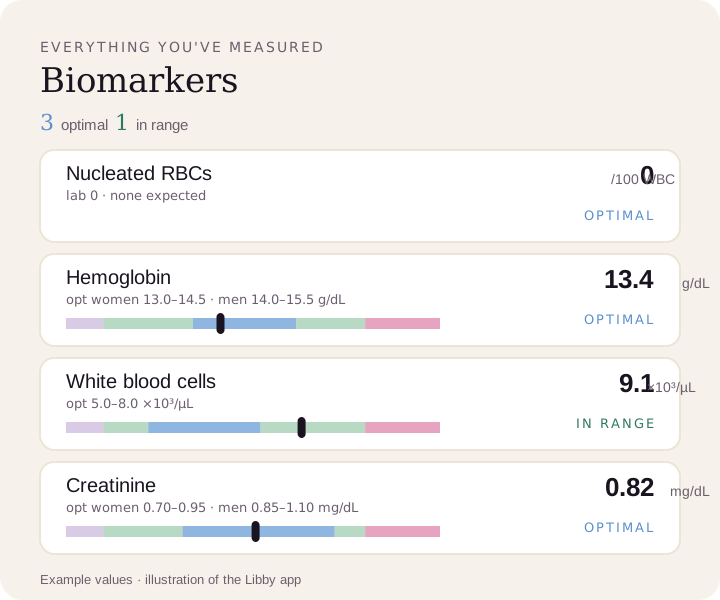
See every result against your lab's range.
Upload a lab PDF or a photo of your report. Libby flags any nucleated red cells, puts your other markers on a range bar, and tracks your trends over time.
View your NRBC count ›